
Int. J. of Engg. Sci. & Mgmt. (IJESM), Vol. 6, Issue 1: Jan-March: 2016, 106-111
106
INTERNATIONAL JOURNAL OF ENGINEERING SCIENCES
&
MANAGEMENT
A REVIEW ON MEAN SHIFT ALGORITHM BASED OBJECT TRACKING SYSTEM AND
ITS HARDWARE IMPLEMENTATION
Aarti Goswami
1, Rajesh Kumar Rai
2M.Tech (DC) NIRT, Bhopal, India
1Professor and Head, ECE Depatment, NIRT, Bhopal, India
2ABSTRACT
Various attempts have been made to implement human vision in real-time computer vision. In most cases, however, this capability has been found to be too complex to implement on a practical systems. In short, human vision capability looks like a simple system but in reality it is difficult to model. One of the difficulties is the computational complexity required to process large amounts of data in real-time, and consequently, the design of real-time object tracking using vision remains a challenging problem. However, in this paper, we propose and implement hardware architecture for real-time object tracking system. We have chosen Mean-Shift algorithm for implementation. We will implement firstly this algorithm on MATLAB and simulated in different environments to verify the performance. After approving its robustness we implemented the algorithm on hardware.
Keywords - object tracking; Mean-Shift Algorithm;FPGA
INTRODUCTION
Computer vision can be defined as a methodology that provides vision capabilities to a machine. Various attempts are being made in the computer vision industry to model human vision and to apply the same techniques to machine vision. In most of these cases researchers have had difficulty with the complexity of implementing such a capability on practical systems. These implementation problems are due to various constraints, including the lack of needed computational capability to process large amounts of data in a real-time, object motion, noise, complex background and the inability to model human vision exactly. Real-time object tracking remains a challenging problem in the computer vision industry and hence there is a huge interest on the market to make technical equipment “smart” and “self learning”[12].
Research Objective
The objectives of the current dissertation research are
1. Verification of tracking results by software implementation of Mean-Shift Algorithm on MATLAB.
2. To propose a novel hardware Architecture for Mean-Shift algorithm. The algorithm should be easy for hardware implementation.
To confirm experimentally soundness of the proposed hardware Architecture implemented through Hardware Description Language.
MEAN-SHIFT ALGORITHM
We assume in the sequel the support of two modules which should provide (a) detection and localization in the initial frame of the objects to track targets [5] and (b) periodic analysis of each object to account for possible updates of the target models due to significant changes in color.
Color Representation
Target Model :-Let
i* 1...i n
x
be the pixel
locations ofthe target model, centered at zero. We define a
Int. J. of Engg. Sci. & Mgmt. (IJESM), Vol. 6, Issue 1: Jan-March: 2016, 106-111
107
2
*
1
ˆ
u
n
i
[ (
i
)
]
i
q
C
k x
b x
u
…….(1)
Where
δ
is Kronecker delta function.
1
0
0
if
a
a
otherwise
…….(2)
The normalization constant C is derived by
imposing
the condition
1
ˆ
1
m u u
q
, from where
2 * 1
1
,
n i iC
k x
…….(3)
Science the summation of delta functions for u=1…m is equal to one.
Target Candidates: Let be the pixel
1... hi i n
x
locations of the target candidate, centered at y in the current frame. Using the same kernel profile k, but with radius h, the probability of the color u in the target candidate is given by
2
1
ˆ
h i[ ( )
]
n
y x
u y
h
h
i
i
p
C
k
b x
u
…….(4)
Where Ch is the normalization constant. The radius of the kernel profile determines the number of pixels (i.e., the scale) of the target candidate. By imposing
the
condition that
1ˆ
1
mu u
p
we obtain
2
1
1
,
h i
h
n
y x
h
i
C
k
…….(5)
Note that Ch does not depend on y, since the pixel location xi is organized in a regular lattice, y being one of the lattice nodes. Therefore, Ch can be precalculated for a given kernel and different values of h.[12]
Kernel
Flat Kernel
1
1
0
if
x
k x
otherwise
…….(6)
Gaussian Kernel
2
exp
k x
x
…….(7)
Epanechnikov Kernel
1
1
2 1
1
2
0
d
c
d
x
if
x
k x
otherwise
…….(8)
Int. J. of Engg. Sci. & Mgmt. (IJESM), Vol. 6, Issue 1: Jan-March: 2016, 106-111
108
LITERATURE REVIEW
Su Liu, Alexandros Papakonstantinou, Hongjun Wang1, Deming Chen [1] said Object tracking is an important task in computer vision applications. One of the crucial challenges is the realtime speed requirement. In this paper we implement an object tracking system in reconfigurable hardware using an efficient parallel architecture. In our implementation, we adopt a background subtraction based algorithm. The designed objecttracker exploits hardware parallelism to achieve high system speed. We also propose a dual object region search technique to further boost the performance of our system under complex tracking conditions. For our hardware implementation we use the Altera Stratix III EP3SL340H1152C2 FPGA device. We compare the proposed FPGA based implementation with the software implementation running on a 2.2 GHz processor. The observed speedup can reach more than 100X for complex video.
Zhi-Qiang Wen and Zi-Xing Cai [12] applied mean shift algorithm with Gaussian profile for tracking of objects. The imprecise proofs about convergence of mean
shift were firstly pointed out. Then a convergence theorem and its rigorous convergence proof were provided. Lastly tracking approach of objects based on mean shift was modified. The results of experiment showed the modified approach had good performance of object tracking applied to occlusion.
Int. J. of Engg. Sci. & Mgmt. (IJESM), Vol. 6, Issue 1: Jan-March: 2016, 106-111
109
Usman Ali, M. B. Malik and K. Munawar [5] presented an architecture based on soft RISC processor for kernel based mean shift algorithm in 2009. Design was based on Xilinx Micro blaze Soft processor core. Video decoder, Frame grabber, Video display unit and Video multiplexer modules were implemented in Xilinx FPGA tool (ISE). The complete system which included soft processor, multi-channel memory controller with DDR RAM interface and all other OPB peripherals were implemented in Xilinx EDK tool.
MATLAB Implementation:
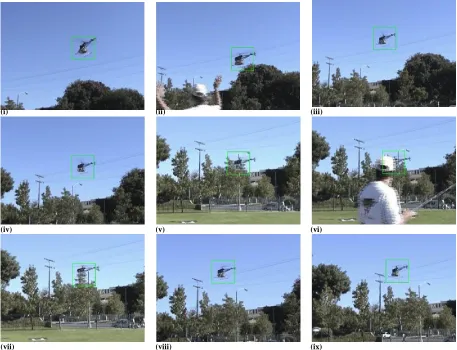
We have taken several different videos with different resolutions and different environmental condition. We have applied the algorithm and results are shown below. We have compared every video taking two bin sizes 16 and 8 and also calculated false detection rate and frame rate
Helicopter Sequence Resolution = 320*240 Number of bins = 16
(i) (ii) (iii)
(iv) (v) (vi)
(vii) (viii) (ix)
Int. J. of Engg. Sci. & Mgmt. (IJESM), Vol. 6, Issue 1: Jan-March: 2016, 106-111
110
HDL Implementation
Top Level Architecture for Object Tracking
The Object Tracking deals with tracking of objects which are of interest. The algorithm followed for implementation of tracking is Mean-shift. Mean-shift uses Histogram and Bhattacharyya coefficient for tracking the position of object in subsequent frames of videos by taking the fact into consideration that object will not displace much in continuous frames.
Host Interface New Center
h_x, h_y, centerx,
centery, bins 10 bits
Histogram Final
24 bits Center Center
and
Text File Histogram Rect_Box
Calculation
Frame Bhattacha- 10 bits Text File
ryya
19 bits Coefficient
Rect_crop_address 24 bits Frame Mean-Shift Controller Processing Unit
OT Controller Control Signal Data Signal
Object Tracking Unit
Figure 2 Mean-shift algorithms for Object Tracking [5] The above is the top level architecture which we have proposed for the hardware implementation of Mean-shift algorithm for Object Tracking. To provide a RGB image as an input to this architecture we have converted an image into a text file representing R,G and B values of each pixel in hexadecimal format[5]. Each pixel is read by histogram block as a frame. A frame is a 24-bit wide R,G,B values, 8-bits each, of a pixel representing intensity values of a pixel of a colored image. Host interfaces are inputs given by user in order to specify the object to be tracked in an image
Histogram Host Interface 10 bits h_x, h_y, centerx, centery Rect_crop Rect_crop_address 19 bits
13 bits Target Model
(q_u) Text File
Hist_bhatt 13 bits
Target Candidate 24 bits
(p_u)
21 bits coefficientBhattacharyya
Kernel (rho)
1 bit
Histogram
Figure 3 Histogram [5]
Sub modules of Histogram module are – Rect_crop, Kernel, Hist_bhatt. Rect_crop sub module is responsible for generating address of pixels of object of interest using (5.1).
As we have explained early that for processing of algorithm we do not require complete image, rather we just want only object of interest. So we need to crop our image and extract object of interest. For that we have designed an equation which calculates addresses of only those pixels related to crop image. [5]
Where x1,x2,y1 and y2 are corner pixel location of cropped image.When Rect_crop calculates address of the desired pixel at the same time kernel sub module calculates value of the kernel for the same pixel. For our implementation we have taken Flat Kernel (3.6). Flat Kernel is either „0‟ or „1‟ so only 1-bit is required. In Hist_bhatt sub module histogram for the desired object and Bhattacharyya Coefficient are calculated. Histogram is stored in histogram buffer. Size of the histogram buffer depends on the number of bins provided via host interface input. In our case we have taken it 8 bins, so the size of the histogram buffer would be bins*bins*bins=512 locations. When pixel intensity value and kernel value reaches to the Hist_bhatt sub module, address for the histogram buffer can be calculated by pixel intensity value. In order to calculate histogram kernel generated is added to the location addressed by Hsit_bhatt sub module in histogram buffer.
Center Calculation
Host Interface
h_x, h_y,
10 bits
centerx, centery
Center 10 bits
New
q_u
13 bits generation center
p_u 13 bits 10 bits Old center 21 bits 10 bits
Rho
Final
rho
Comparison center
Center Calculation
Figure 4 Center Calculation [5]
Int. J. of Engg. Sci. & Mgmt. (IJESM), Vol. 6, Issue 1: Jan-March: 2016, 106-111
111
Rho Comparison is the sub module in which Bhattacharyya coefficient calculated by Histogram module at old_center and new_center is compared. Comparison tells us which center is the correct center and it also tells us that shall we go for iteration loop or not. So from the Rho Comparison sub module, exact center is finalized which is stored as final_center and given to the Rect_box module to draw the rectangular box around tracked moving object. Then Rect_box module writes the image pixel values into a output text file
CONCULSION
The objective of this paper was to review the hardware design for real-time object tracking. Several algorithms for detection and tracking of moving objects have been proposed worldwide. Most of the researchers implemented software model of all available algorithms but only few of them attempted for their hardware model. Inspiring by wide range of application and excellent performance results presented by other researches we have chosen Mean-Shift algorithm for tracking. In first phase we implemented software model. We verified the robustness, capability of tracking object under partial occlusion, intensity variation and in random environment. In second phase we proposed hardware architecture for the design and implemented hardware model using HDL
REFERENCES
[1] Su Liu, Alexandros Papakonstantinou, Hongjun Wang1, Deming Chen 978-0-7695-4448-9/112014IEEE
[2]J. Aloimonos and A. Badyopadhyay. “Active Vision.” In IEEE intl Conf. on Computer Vision, pp. 35-54, 1987. [3] Comaniciu D, Comaniciu, Ramesh V, and Meer P, “Real-Time Tracking of Non-Rigid Objects using Mean Shift,” In Proc. Of the IEEE Conf. on Computer Vision and Pattern Recognition (CVPR), pp. 142-149, 2000.
[4] VEENMAN, C., REINDERS, M., AND BACKER, E. 2001. Resolving motion correspondence for densely moving points. IEEE Trans. Patt. Analy. Mach. Intell. 23, 1, 54–72.
[5] Ali U, Malik M and Munawar K, “FPGA/SOFT-processor based real time tracking system,” In Fifth Southern Conference on Programmable logic, pp 33,2009.
[6] COMANICIU, D., RAMESH, V., ANDMEER, P. 2003. Kernel-based object tracking. IEEE Trans. Patt. Analy. Mach. Intell. 25, 564–575.
[7] YILMAZ, A., LI, X., AND SHAH, M. 2004. Contour based object tracking with occlusion handling in video acquired using mobile cameras. IEEE Trans. Patt. Analy. Mach. Intell. 26, 11, 1531– 1536.
[8] BALLARD, D. AND BROWN, C. 1982. Computer Vision. Prentice-Hall.
[9] ZHU, S. AND YUILLE, A. 1996. Region competition: unifying snakes, region growing, and bayes/mdl for multiband image segmentation. IEEE Trans. Patt. Analy. Mach. Intell. 18, 9, 884– 900. [10] ELGAMMAL, A.,DURAISWAMI,
R.,HARWOOD, D., ANDDAVIS, L. 2002. Background and foreground modeling using nonparametric kernel density estimation for visual surveillance. Proceedings of IEEE 90, 7, 1151–1163. [11] Fukunaga K, and Hostetler LD, “The estimation of
the gradient of a density function, with application in pattern recognition,” IEEE Trans. Information Theory, vol. 21, pp.32-40,1975.
![Figure 2 Mean-shift algorithms for Object Tracking [5]](https://thumb-us.123doks.com/thumbv2/123dok_us/7830614.1666999/5.595.54.266.508.649/figure-mean-shift-algorithms-object-tracking.webp)
