ISSN 2230- 9373
Volume-V, Issue-1
January-March, 2016
PERFORMANCE OF DIFFERENT PAD MATERIALS IN
ADVANCED DESERT COOLERS:
A COMPARATIVE STUDY
Shashank Shekhar*, Santosh Suman*, Dr. H.S. Moharana**, D. Sethy***
*Pre-final year students, Dept. of Mech. Engg., GIFT, Bhubaneswar **Dean Research, GIFT,Bhubaneswar
***Asst. Professor, GIFT, Bhubaneswar
Abstract-Meeting demand for electric power during peak periods in the summer is a major concern for most utilities in the fast-moving world. From the demand points of view on the grid and cost to the consumer, it would be quite wise to install, energy-efficient evaporative coolers rather than conventional air conditioners. Evaporative cooling has a great many advantages over other cooling processes. Due to the non-pollution creating environment, it is one of the healthiest ways to cool ones workplace or living place because of the fact that it uses clean fresh air and replaces the air many times an hour. Due to recirculation of air, smells and allergens are expelled. Based on a totally natural process of air cooled by water, it won’t dry out the air, or irritate human skin, throat or eyes. Doors can be left open allowing one to enjoy the summer. Moreover, evaporative cooling is also an inexpensive cooling option which enhances the lifestyle of people. However, evaporative cooling requires abundant water and is only efficient when the relative humidity is low. Padding media play a major part in cooling efficiency. This paper investigates the performance of Desert Cooler using six different pads in terms of cooling efficiency, water consumption and air velocity for a sustainable and economic application. In real practice, we use wood wool, khus, coconut coir fiber, ceramic materials tubes, stainless steel, galvanized
metal sheets as pads in desert coolers and the paper focusses on the best of the pads used, quite suitable to the rural masses in operational and economic senses, on a wide range of comparisons. This investigation is sorted out to bring the performance indicator of the best suited pad out of different pads used globally.
Key Words: Evaporative cooling, wood wool, khus, coconut coir, ceramic materials, stainless steel, galvanized metal sheet pads
1. INTRODUCTION
Evaporative cooling uses less electricity nearly one seventh of the conventional consumption method, it is necessary that our environment would contribute to the greenhouse gas emission and control. The investigators have chosen six different types of material analyzed (pads) and same have been compared to obtain the best of the results.
material with respect to performance .Literature reveals the manufacturing of conventional desert coolers expecting a single entry for a modern desert cooler. The experiment results obtained so far after
analysis would suffice parametric condition for a modern desert cooler. A natural evaporative cooling is also called as perspiration, it secrets from body to cool itself. The heat transfer from the body depends on the evaporation rate of water. The rate of evaporation depends on the temperature humidity of the air. Hence sweat accumulates more on hot, humid days and the perspiration cannot evaporate.
Traditionally, evaporative cooler pads consist of wood wool termed as excelsior was used. To use a Coconut Coir fiber, in evaporative cooling pads, coconut coir pads are fabricated and tested on low cost desert coolers used. Laboratory scale experimental arrangement were made and tested. The coconut coir fiber pad was analyzed and compared with those of a commercial wood (wood wool) pad. Commercial development appears feasible for the co availability. The life of Coconut Coir Pad as compared to Wood pad is more. Similarly, ceramic material tubes, stainless steel, galvanized metal sheets are compared and tested.
2. MATERIALS AND METHODS
Evaporative cooling is a physical phenomenon in which evaporation of a liquid into surrounding air. The evaporation of liquid takes place by absorbing latent heat drawn from the air. To find water evaporated into air, the dry bulb and wet-bulb temperature is to be measured to determine the potential for evaporative cooling. The evaporative cooling effect is greater when the differences between the two temperatures are greater. When the both the temperatures are the same, net evaporation of water in air doesn’t occurs.
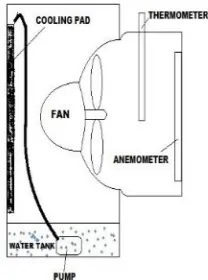
Experimental Desert cooler unit consists of a cubical box of sheet metal containing large vertical filter pads, an electric-motor-driven fan, a water pump, a water distribution system, and a water sump at the bottom. Woodwool, Khus, Coconut coir,
Ceramic materials, stainless steel used as pad materials
Two small coconut coir pads of different configurations and tested using a laboratory-scale experimental arrangement. Results show that the cooling efficiency of the manufactured coconut coir evaporative cooling pad was fairly good (about 50%) and close to that of the commercial paper pad (about 47%).
Fig. 1.Experimental Setup for desert cooler
In present work, performance analysis of desert cooler was evaluated using stainless steel wire mesh pad, coconut coir pad, khus pad, wood wool pad, ceramic material tubes, and Galvanised sheet pads and compared in terms of cooling efficiency, water consumption rate and air velocity.
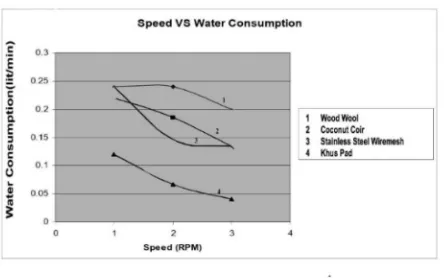
The experiment was conducted with varying speed of fan, and parametres like water consumptions, cooling efficiency, and air velocity. The measurement showed that the water consumption rate for stainless steel wire mesh pad is very low as compared to other pads (fig-2).
Fig.2. Speed Vs Water Consumption
The water pump lifts the water from the sump through the distribution system to the top of the pads from where it trickles down by gravity back to the water sump. The cooled air is then delivered either directly through a grille into a single room or into a duct distribution system. Outlet section contains DBT/WBT sensor for outlet air condition measurement. Hot wire type anemometer is placed at the center of the duct for air velocity measurement. Maximum cooling efficiency was found in wood wool and Khus pad materials.
Fig 3 shows a variation of fan speed vs. cooling efficiency of various pad materials. Maximum cooling efficiency was found in wood wool and Khus pad materials. Stainless steel wire materials pad shows poor cooling efficiency as compared to other pad materials but can be use where relative humidity was higher.
Fig.3. Speed Vs Cooling Efficiency
Fig.4. Fan speed Vs Air velocity
It reveals that resistance to air flow was higher at Khus pad as compared to wood wool and coconut coir pad. As a result wood wool pad and coconut coir pad shown higher air velocity which provides proper air distribution in room.
Ceramic used as pad material
beverage can. A separate compartment inside the can contain a desiccant and cooling liquid. Just before the consumption, the desiccant comes in contact with the cooling liquid inducing evaporation. It has been found that by not using pump electricity consumption reduces by 31%. It is not affected by atmospheric conditions. The water consumption reduces by an average of 55%. But water consumption increases with increase in atmospheric temperature where cooler is kept. The average cooling efficiency was found to be 72%.
Galvanized metal sheets used as pad material
Evaporative cooling systems using relatively expensive cellulosic paper pads are widely used in residential, commercial and agricultural buildings. However, the fast minerals and dust build up shorten the useful life of these pads. Water drips from the top distribution bath over the pads through small holes. Outside the air is cooled by evaporating water droplets and moisture retained at the surface of the wetted sheets in the zigzagged air pathways.
Fig.5. Galvanized metal sheets pads vertically
aligned
The components of the system are pad media, electrical fan, water reservoir, floater, water supply pipe, electrical pump and top distribution bath. Pad media and top water distribution bath configuration in the new design differ from other commercially evaporative cooling systems. Pad media is made of galvanized metal sheets (0.3 mm thickness). Sixty-three sheets as shown in Fig.5,
aligned vertically in series to give a sharp crisscross as air enters between the sheets.
Dry-bulb temperature and relative humidity of outside and conditioned air were measured using two temperature and humidity probes. The sensors were shielded to prevent direct radiation and water droplets from affecting the temperature and humidity readings. Water temperature in the reservoir was measured using temperature probe Sensors were connected to a datalogger.
Using the Outside dry-bulb temperature and relative humidity readings, dew point and wet-bulb temperature were calculated from the calculation module.
Clearly, it is shown that the outside dry-bulb air temperature during the trials repeated the same pattern with little variations from day to another.To determine if the pad depth has an effect on the cooling efficiency, analysis of variance (ANOVA) was taken as a tool.The first data set represents the cooling efficiency at the highest outside dry-bulb air temperature peak, while the second data set represents the cooling efficiency at the lowest outside dry-bulb air temperature.
Table1: Average of the parameters and
cooling efficiency recorded for different
pad depths
Pad depth (m) 0.45 0.30 0.15 Outside dry-bulb
temperature (C) 38 37.66 38.42 Outside wet-bulb
temperature (C) 17.01 17.37 17.33
Outside relative
humidity (%) 11.28 11.59 10.23 Conditioned dry-bulb
temperature (C) 19.95 23.46 27.28 Conditioned relative
humidity (%) 78.15 77.19 64.68 Reservoir water
temperature (C) 18.87 18.96 19.48 Cooling efficiency
The difference between treatment groups was clear that the pad depth has a significant effect on the cooling efficiency. In experiment, Averaged conditioned air temperature decreased from 22.95 to 20.77 0C and averaged cooling efficiency increased from 73 to 83%.
3. CONCLUSION
The ease of installation, consumption of power and maintenance estimates the evaporative cooling at a price nearly one-fourth of the air conditioners system. The constant and high volumetric flow rate of air reduces the temperature of air. It improves the condition of climate inside the room. Electricity consumption is reduced and water saving is also a concern.
From the comparative account, it has been observed that the vertically aligned galvanized metal sheets could withstand any environment in the country’s scenario and the cooling efficiency is nearly 83% above all the performance indicators of the various evaporative coolers.
In the new designed pads arrangement, it is easier to remove salt deposition and dust build up over the pads surfaces. Certainly, this will give longer useful life compared to the commercially available cellulosic pads.
4. REFERENCES
[1] Krishna Shrivastava, Dr. Dhiraj Deshmukh, M.K.Rawlani, “Experimental Analysis of coconut coir pad”, International Journal of Innovative Research in Science, volume 3, issue 1, January 2014, Pages 8346-8351
[2] Vivek W. Khond , “Experimental investigation of desert cooler performance using four different cooling pad materials”, Am. J. Sci. Ind. Res., 2011, 2(3): 418-421
[3] Mohammed A.Alodan, Abdulah A.Al-Faraj, “Design and Evaluation of Galvanized Metal Sheets as Evaporative cooling pads”, J.King Saud Univ,Vol.18,Agric.Sci(1),pp 9-18
[4] Amit Kumar Jain, “Thermal Performance Analysis of Pump less Earthen Pipe Evaporative Air
Cooler”, International Journal of Engineering Research and Applications, Vol. 2,Issue 2,Mar-Apr 2012,pp 032-040
[5] M.S.Sodha and A.Somwanshi, “Variation of Water Temperature along the Direction of Flow: Effect on Performance of an Evaporative Cooler”, Journal of Fundamentals of Renewable Energynand Applications, Vol.8(2012)
[6] Bhushan D. Chaudhari ,Tushar R. Sonawane, Shubham M. Patil , “A Review on Evaporative Cooling Technology”International Journal of Research in Advent Technology, Vol.3, No.2, February 2015