R
esearch
A
rticle
VALIDITY AND RELIABILITY OF THE ARABIC VERSION OF KOOS-PHYSICAL FUNCTION SHORT
FORM IN KNEE OSTEOARTHRITIC PATIENTS
1*
Ahmed A. Torad,
2Wadida H. Abd El Kader,
2Marwa S. Saleh,
3Mona M. Torad
1
Qalub Hospital, Ministry of Health, Egypt
2
Basic Science Department, Faculty of Physical Therapy, Cairo University, Egypt
3
Girls' College for Arts, Science and Education, Ain Shams University, Egypt
ARTICLE INFO ABSTRACT
Objective: To test the validity and reliability of arabic-language version of the knee injury and
osteoarthritis outcome score physical function short form to measure the physical function in knee osteoarthritic patients.
Method: Sixty nine patients with knee osteoarthritis (bilateral osteoarthritis considered 2 cases) were
recruited and 150 sheets (test and retest sheets) were filled out and three expert panels (each consists of ten experts) participated in this study, forward translation, development of preliminary initially translated version, backward translation, development of the pre-final version and testing of pre-final version using experts then testing of the final version on patients was done. Clarity index, expert proportion of clearance, index of content validity, expert proportion of relevance, descriptive statistics, missed item index, Cronbach’s alpha and Spearman’s rank correlation coefficient were used for statistical analysis.
Results: The study showed that scale index of clarity equals 100%, scale-level clarity index universal
agreement equals 100%, scale index of content validity equals 97.14%, scale-level content validity index universal agreement equals 71%, the scale items were filled by 99.4% in all sheets, the scale needed less than five minutes to answer in about 99% all sheets, Cronbach's alpha equals 0.848 (0.789, 0.896) and all Spearman’s correlations between test and retest results were statistically significant.
Conclusion: Arabic-language version of the knee injury and osteoarthritis outcome score physical
function short form is valid and reliable enough to measure the physical function in knee osteoarthritic patients.
INTRODUCTION
Osteoarthritis (OA) is a chronic degenerative and progressive condition affecting synovial joints, which mainly causes degeneration of hyaline cartilage; Although OA can affect any joint containing hyaline cartilage; Its effects take place most often in the weight bearing joints of lower extremities and the
most common large joints involved are knee joints (Osiri et al.,
2000). David et al. (1999) stated that knee OA can result in
functional difficulty, but this is variable. Patients with OA may describe such problems in walking a distance, climbing stairs, getting out of chairs activities of daily living (ADL), rising from the bed, rising from sitting, kneeling, put on socks, inflammation and effusion, loss of range of movement, muscle inhibition and atrophy, joint instability, deformities. Many English knee measures of knee function were developed such as International Knee Documentation Committee (IKDC) and
*Corresponding author: Ahmed A. Torad,
Basic Science Department, Faculty of Physical Therapy, Cairo
University, Egypt
.
Subjective Knee Evaluation Form, also Knee Injury and Osteoarthritis Outcome Score (KOOS), Knee Outcome Survey Activities of Daily Living Scale (KOS-ADL) were developed, and some researchers developed other scales like Lysholm Knee Scoring Scale and Oxford Knee Score (OKS), also some universities developed scales like Western Ontario and McMaster Universities Osteoarthritis Index (WOMAC), but. All the previous scales are long and assess the whole knee status and need long time to be completed. Also they are not specific on knee physical function (PF) because it is usually part of long questionnaires that make patient unfocused so his
answers may not get to his point directly(Collins et al., 2011).
The necessity for a brief short form of measure for knee PF was simplified and identified as part of an Osteoarthritis Research Society International and Outcome Measures in Clinical Trials beginning to develop criteria for therapy failure (OA Disease Modifying Drugs). Also it is needed for physical therapy to track patient status throughout treatment sessions. The knee injury and osteoarthritis outcome score physical function short form (KOOS-PS) which consists of a seven item Article History:
Received 28th May 2015
Received in revised form
30th June, 2015
Accepted 03rd July, 2015
Published online 31st August, 2015
International Journal of Recent Advances in Multidisciplinary Research Vol. 02, Issue 08, pp.0599-0604, August, 2015
Keywords:
measure of PF descended from the items of the function, daily living and function, sports and recreational activity subscales of the KOOS can be used where few items are needed and advantageous to limit scale filler burden and/or cost. For example, the short questionnaire is needed and necessary when two or more questionnaires are administered sequentially as in registries, also it is advantageous when filled by elderly population because they cannot withstand long questionnaires
(Perruccio et al., 2008). It is very important to have an Arabic
version of tools used for assessment of physical function of knee, in this study original version was translated into Arabic version but in order to use any new assessment tool in researches. It should be valid and reliable to minimize bias in the study (Kimberlin and Winterstein, 2008). So this study aimed to translate the English scale and test the validity and reliability of its Arabic version.
MATERIALS AND METHODS
Participants and design
This study was conducted on outpatient clinics of Al- Qasr Al Aini Hospital and Faculty of Physical Therapy, Cairo University to test and investigate the validity and reliability of Arabic version of the KOOS-PS in patients with knee joint osteoarthritic patients. This study followed studies that recommended guidelines for translating, adapting and
validating psychological instruments (Borsa et al., 2012)
(Sousa and Rojjanasrirat, 2011). Sixty nine patients with knee OA (bilateral OA considered 2 cases); referred by physician, able to read and write (not illiterate), didn’t have deformity, and no medications were administered. Also, three expert panels; each consists of ten experts (Experience not less than ten years or at least master degree and fluent in English and arabic) participated in this study, and each participant signed the consent form.
Procedures
The following steps were followed:
Forward translation (targeted translation): translation of the primary scale from English into Arabic:
Two translators participated in forward translation.
Scale in English was translated to Arabic to produce two
Arabic versions of the scale (Ar1 and Ar2).
Development of Arabic version which is initial and preliminary:
a) Both versions (Ar1 and Ar2) were compared and merged
by the researchers.
b) Dr. Omaima Katabi; professor of physical therapy, Faculty
of Physical Therapy Cairo University provided an assistance in resolving mystification and fuzziness of kneeling item
Blind back translation (blind revision translation or blind double revision translation) of the preliminary initial arabic version of the scale:
Two translators participated in backward translation.
The preliminary initial translated arabic version of the scale
was translated to English to produce two back translated English revision versions (En1 and En 2)
Comparison of the two back translated English versions of the scale (En 1 and En 2):
Researchers compared English back translation English revision versions of the scale En 1 with En 2, and also compared both En 1 and En 2 with the original English scale regarding instructions, items, responses format, word meanings, sentence composition, significance and relations, and they found that there were no significant differences between them, so the researchers consider that the preliminary initial translated Arabic version is the prefinal Arabic version of the scale.
Pilot study to test the prefinal Arabic version of the scale:
The first expert panel (ten experts) were asked to evaluate
each word (instructions, items and choices) of the tool for clarity using dichotomous scale (yes or no questions) and if no, provide suggestions to improve its clarity.
According to the suggestions of the first expert panel,
changes had been made to improve the clarity index to the minimum acceptable value (80%) so that it can be given to patient:
The most suggestions are concerned with mentioning the
position of knee during the physical activity, so figures that demonstrate the activity were added to the questionnaire.
Then the second expert panel reassessed the clarity.
The third expert panel (ten experts) were asked to rate and
evaluate all items of the scale for content equivalence (relevance) using scale of four grades: 1 means not relevant; 2 means unable to assess relevance; 3 means relevant but needs minor alteration and 4 means very relevant and succinct, then they were asked to give suggestions to improve its relevance, the interpretation of result was as follow: first and second grades were considered not relevant, while third and fourth grades were considered relevant).
After the prefinal version pass the clarity and relevance
test, it is called the final Arabic version of KOOS-PS.
Pilot study to test the final Arabic version of the scale was conducted on osteoarthritic patients as follow:
Patients fill the data collection sheet which was used to
collect demographic data (name, age, sex, weight, height, body mass index (BMI)), and KOOS-PS.
Patients with knee OA completed the sheet again after two days.
Statistical analysis
SPSS computer program (version 20) was used for data analysis:
Face validity was tested by clarity index and expert
Content validity was tested by index of content validity (CVI) and expert proportion of relevance.
Descriptive statistics of patients and sheets were made
using mean, median, standard deviation (SD), mode,
minimum (min) and maximum (max).
Feasibility index was calculated using missed item index
and time taken to fill the questionnaire.
Internal consistency reliability was measured using
Cronbach’s coefficient alpha.
Test retest reliability was measured using mean scores and
Spearman’s rank Correlation.
RESULTS
Item index of clarity was calculated and it was found that scale index of clarity equals 100% and scale level clarity index UA equals 100% as shown in Table 1. Expert proportion of clearance was calculated and represented in Table 2.
Table 1. Item index of clarity of the pre-final arabic version of the scale
Item Number of agreements Item index of clarity
Instructions 10 100%
(1) 10 100%
(2) 10 100%
(3) 10 100%
(4) 10 100%
(5) 10 100%
(6) 10 100%
(7) 10 100%
(a) 10 100%
(b) 10 100%
(c) 10 100%
(d) 10 100%
(e) 10 100%
Mean 10 100%
(a) first response word (None), (b) second response word (Mild), (c) third response word (Moderate), (d) fourth response word (Severe), (e) fifth response word (Extreme).
Table 2. Expert proportion of clearance of the pre-final arabic version of the scale
Expert number Expert ratings Proportion of clearance
1 13 100%
2 13 100%
3 13 100%
4 13 100%
5 13 100%
6 13 100%
7 13 100%
8 13 100%
9 13 100%
10 13 100%
Mean 13 100%
Index of content validity was calculated and it was found that scale index of content validity (S-CVI) equals 97.14% and scale index of content validity universal agreements (S-CVI/UA) equals 71% as shown in Table 3.
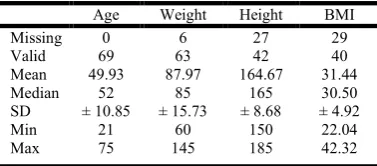
Also Expert proportion of relevance was calculated and represented in Table 4. Patients were of both genders (52 female and 17 male) and 46 of them had unilateral knee OA while 23 had bilateral knee OA also 42 patients made retest while 27 patient didn’t, descriptive statistics of patient general characteristics (age, eeight, height and BMI) were represented
in Table 5, descriptive statistics of sheets general characteristics were
Table 3. Item index of content validity of the pre-final arabic version of the scale
Item Number of raters that agree I-CVI
(1) 10 100%
(2) 10 100%
(3) 10 100%
(4) 9 90%
(5) 10 100%
(6) 9 90%
(7) 10 100%
Mean 9.71 97.14%
I-CVI: item index of content validity index
Table 4. Expert proportion of relevance of the pre-final arabic version of the scale
Expert number Number of agreements Proportion of
relevance
1 7 100%
2 7 100%
3 7 100%
4 7 100%
5 7 100%
6 7 100%
7 6 86%
8 7 100%
9 7 100%
10 6 86%
Mean 6.8 97.14%
Table 5. Descriptive statistics of patient general characteristics
Age Weight Height BMI
Missing 0 6 27 29
Valid 69 63 42 40
Mean 49.93 87.97 164.67 31.44
Median 52 85 165 30.50
SD ± 10.85 ± 15.73 ± 8.68 ± 4.92
Min 21 60 150 22.04
Max 75 145 185 42.32
BMI: Body Mass Index, SD: Standard Deviation, Min.: Minimum, Max.: Maximum
Table 6. Descriptive statistics of sheets general characteristics
Who Fill the Score
Affected Side
test retest date time
missed 0 60 0 0 43
valid 150 90 150 150 107
patient himself=
RT= Test= Min= Min=
136 50 92 18/2/2015 0.5
relevant= LT= Retest= Max= Max=
14 40 58 9/3/2015 15
total 150 150 150 150 150
Rt: right, LT: left, Min.: Minimum, Max.: Maximum
Table 7. Descriptive statistics of sheets results
Item 1st 2nd 3rd 4th 5th 6th 7th
Missed 0 4 1 2 1 0 0
Valid 150 146 149 148 149 150 150
None 14 24 4 14 7 5 1
Mild 19 19 16 9 10 8 4
Moderate 49 34 30 37 24 21 9
Sever 40 39 57 44 39 37 31
represented in Table 6 and descriptive statistics of sheets results were represented in Table 7, internal consistency calculations were made and it was found that Cronbach's alpha
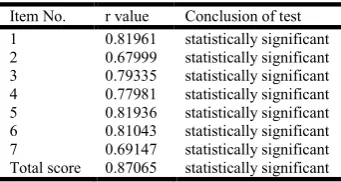
Table 8. Spearman’s correlations coefficients
Item No. r value Conclusion of test
1 0.81961 statistically significant
2 0.67999 statistically significant
3 0.79335 statistically significant
4 0.77981 statistically significant
5 0.81936 statistically significant
6 0.81043 statistically significant
7 0.69147 statistically significant
Total score 0.87065 statistically significant
equals 0.848 with lower bound 0.789 and upper bound 0.896 at 95% confidence interval., test result was 26.721±5.67 with minimum value of 11 and maximum value of 35 also retest result was 27±5.8513 with minimum value of 12 and maximum value of 35. Finally, Spearman’s correlation coefficients were calculated and represented in Table 8.
DISCUSSION
The present study was designed to test the validity and reliability of the arabic-language version of the KOOS-PS to measure the PF level in knee osteoarthritic patients. The arabic version of KOOS-PS is valid as scale index of clarity equals 100%, scale-level clarity index UA equals 100%, S-CVI equals 97.14% and S-CVI/UA equals 71%.The results of the current study came in agreement with a study that stated that to judge a scale for excellent content validity, it would be composed of items with I-CVI that meet the following criteria: I-CVI of 1.00 with three to five experts and a minimum I-CVI of .78 for 6 to 10 experts and it would have S-CVI/ Ave of .90 or higher. The recommended standards may necessitate two rounds of expert review if the initial assessment rejects the tool and suggests the need for substantial item improvements (Polit and Beck, 2006). Also this came in agreement with a study that stated that S-CVI of 0.90 or above is a value below it we cannot judge the tool to have content validity, and items that do not achieve that value are revised, re-written and re-evaluated
(Waltz et al., 2005).
The arabic version of KOOS-PS has a good internal consistency and good test retest reliability as Cronbach's alpha equals 0.848 with lower limit of 0.789 and upper limit of 0.896) and all Spearman’s correlation coefficients between test and retest results were statistically significant (item 1: 0.81961, item 2: 0.67999, item 3: 0.79335, item 4: 0.77981, item 5: 0.81936, item 6: 0.81043, item 7: 0.69147, total score: 0.87065), so according to statistics researchers α between 0.7 and 0.9 is referred as good internal consistency, also Spearman’s correlation coefficient between 0.7 and 0.9 (as in item 1,3,4,5 and 6) is referred as good test retest reliability and Spearman’s correlation coefficient between 0.6 and 0.7 (as in item 2 and 7) is referred as acceptable test retest reliability (George and Mallery, 2003). These results come in agreement with a study that conducted to test validity and reliability of the Portuguese language version of KOOS-PS, the Portuguese language version of KOOS-PS and medical outcomes Study-36 item Short-Form questionnaires. In that study data collection sheets were applied to 85 subjects complaining of knee OA, the study found Cronbach’s alpha coefficient equaled 0.89 and
Intraclass correlation coefficient (ICC) equal 0.85, concluding that the portuguese language version of KOOS-PS reliability was acceptable. Also the study concluded that subjects that face great resistance during walking obtaining higher KOOS-PS scale scores than those who can walk independently. So the Portuguese language version of KOOS-PS scale obtained a satisfactory psychometric characteristics because of high results of ICCs for the scale scores and the good stability of the Portuguese language version of KOOS-PS over time. So, The KOOS-PS seems to provide internally consistent and reproducible results for patient with knee OA (Gonçalves et al., 2010). Also these results come in agreement with other results obtained by a study designed to translate the english language version of PS into Turkish language version of KOOS-PS and to evaluate the psychometric properties of the Turkish language version of the KOOS-PS in patients complaining of knee OA, the translation from the English language to the Turkish language, synthesis, back-translation, revision and testing were performed, A total of eighty patients participated in the study, Internal consistency was evaluated and it was found to be good reliability as a Cronbach's alpha equaled 0.904 and an ICC equaled 0.839 ratificating that the Turkish KOOS-PS is a reliable tool to assess physical function of
patients complaining of knee OA (Gul et al., 2013).
The results of the present study also strengthened by a study conducted to test the reliability of intermittent and constant OA pain (ICOAP) score, KOOS-PS, the hip disability and osteoarthritis outcome score physical function short form (HOOS-PS), and the quality of life (QOL) subscales of HOOS and KOOS in patients complaining from knee or hip osteoarthritis, in that study, 195 patients (141 knee, 54 hip) from two different orthopedic outpatient clinics were included , they were diagnosed as knee or hip OA, they were asked to completed data collection sheet which includes ICOAP pain scale, KOOS-PS, HOOS-PS and QOL subscales of HOOS and KOOS at two different times with two weeks in-between. ICC was used to assess different aspects of reliability, and the results were as follows: ICOAP pain scale ICC equaled 0.63 with lower limit of 0.48 and upper limit of 0.74 in patients complaining of knee osteoarthritis and equaled 0.86 with lower limit of 0.73 and upper limit of 0.93 for patients complaining of hip osteoarthritis, KOOS-PS scale ICC equaled 0.66 with lower limit of 0.52 and upper limit of 0.77, HOOS-PS scale ICC equaled 0.82 with lower limit of 0.66 and upper limit of 0.91, KOOS-QOL scale ICC equaled 0.79 with lower limit of 0.69 and upper limit of 0.86, HOOS-QOL scale ICC equaled 0.67 with lower limit of 0.42 and upper limit of 0.83. This study analyzed the previous results and concluded that ICOAP, HOOS-PS and QOL subscales had high reliability in patients with hip OA. But reliability of ICOAP and KOOS-PS was
much lower in patients complaining of knee OA (Singh et al.,
2014).
HOOS-PS questionnaire and the osteoarthritis knee and hip quality of life questionnaire (OAKHQOL). The patients were asked to fill the collection sheet again and return by mail two weeks later. Factors like missing items percentage and the floor and ceiling effects were used to assess feasibility. ICCs were used to assess and evaluate test retest reliability. Eighty-seven patients with knee OA and fifty patients with hip OA were utilized in that study. The results came great as there is no missing items regarding the French language version of KOOS-PS and HOOS-PS scores. The ICC of KOOS-PS equaled 0.861 with lower limit of 0.763 and upper limit of 0.921 and The ICC of HOOS-PS equaled 0.859 with lower limit of 0.725 and upper limit of 0.929. So the author could conclude that the French language versions of KOOS-PS and HOOS-PS are reliable and valid, and they are very good questionnaires to be used for assessing functional disability in
patients complaining from knee and\or hip OA (Ornetti et al.,
2009).
When thinking about creating a new tool for assessment reliability and validity studies should be conducted for this tool first, and it is not easy. Also when translating an assessment tool from any language to another; reliability and validity studies should be conducted to ensure that the translated versions is suitable for the targeted population and also it is not an easy process as it seems; it needs patience and longtime. Validity and reliability of translated tools were made over two or three studies not one. The first study is designed to translate the tool to the targeted language then test the translated version for face and content validity then test the reliability, it was conducted on monolingual population. The second study was designed to test the full the psychometrics of the translated tool with bilingual participants. The third study is conducted to test the full psychometric properties of the translated tool on monolingual population, noting that the second study is not
necessary to be made (Borsa et al., 2012) (Sousa and
Rojjanasrirat, 2011). This study is considered to be the first study in the validity and reliability studies of the Arabic language version of KOOS-PS. The final version is considered the base for the next research that will be conducted to establish the full psychometric properties (construct and criterion validity) of arabic-language version of KOOS-PS.
Conclusion
The results obtained from the current study and the discussion that follows it can lead to drawing the following conclusions:
Arabic-Language version of KOOS-PS is valid enough to
measure the PF in knee osteoarthritic Arabian patients.
Arabic-Language version of KOOS-PS is reliable enough
to measure the PF in knee osteoarthritic Arabianpatients.
Recommendations
The results of this study indicated a need to consider the following recommendations:
Further studies should be conducted to establish the
preliminary psychometrics of the arabic-language version of KOOS-PS with bilingual participants.
Further studies should be conducted to establish the full
psychometric properties (construct and criterion validity) of
arabic-language version of KOOS-PS in a sample of the target population of interest.
Acknowledgments
The researchers wish to take this medium to thank the participants for making this study possible
REFERENCES
Borsa, J., Damásio, B. and Bandeira, D. 2012. Cross-cultural adaptation and validation of psychological instruments: Some considerations. Paidéia (Ribeirão Preto), 22(53):423-432.
Collins, N., Misra, D., Felson, D., Crossley, K. and Roos, E. 2011. Measures of knee function: International Knee Documentation Committee (IKDC) Subjective Knee Evaluation Form, Knee Injury and Osteoarthritis Outcome Score (KOOS), Knee Injury and Osteoarthritis Outcome Score Physical Function Short Form (KOOS-PS), Knee Outcome Survey Activities of Daily Living Scale (KOS-ADL), Lysholm Knee Scoring Scale, Oxford Knee Score (OKS), Western Ontario and McMaster Universities Osteoarthritis Index (WOMAC), Activity Rating Scale (ARS), and Tegner Activity Score (TAS). Arthritis Care Res, 63 (11):208-228.
David, W., Carol, T. and Loyd, S. 1999. Osteoarthritis assessment and treatment. Phys Ther, 78 (4): 983-994. George, D. and Mallery, P. 2003. SPSS for Windows step by
step: A simple guide and reference, 4th edition. Boston: Allyn and Bacon.
Gonçalves, R., Cabri, J., Pinheiro, J., Ferreira, P. and Gil, J. 2010. Reliability, validity and responsiveness of the Portuguese version of the Knee injury and Osteoarthritis Outcome Score--Physical Function Short-form (KOOS-PS). Osteoarthritis Cartilage, 18(3):372-376.
Gul, E., Yilmaz, H. and Bodur, H. 2013. Reliability and validity of the Turkish version of the knee injury and osteoarthritis outcome score-physical function short-form (KOOS-PS). J Back Musculoskeletal, 26(4):461-466. Kimberlin, C. and Winterstein, A. 2008. Validity and
reliability of measurement instruments used in research.
Am. J. Health Syst. Ph, 65(23):2276-2284.
Ornetti, P., Perruccio, A., Roos, E., Lohmander, L., Davis, A. and Maillefert, J. 2009. Psychometric properties of the French translation of the reduced KOOS and HOOS (KOOS-PS and HOOS-PS). Osteoarthritis Cartilage, 17(12): 1604-1608.
Osiri, M., Welch, V., Brosseau, L., Shea, B., McGowan, J. and Tugwell, P. 2009. Transcutaneous electrical nerve stimulation for knee osteoarthritis. Cochrane Database Sys Rev 2000; (4): CD002823. Update in Cohrane Database Sys Rev, (4).
Perruccio, A., Lohmander, L., Canizares, M., Tennant, A., Hawker, G. and Conaghan, P. 2008. The Development of a Short Measure of Physical Function for Knee OA -
KOOS-Physical Function Short-form (KOOS-PS) – An
OARSI/OMERACT Initiative. Osteoarthritis Cartilage, 16(5): 542-550.
Singh, J., Luo, R., Landon, G. and Suarez-Almazor, M. 2014. Reliability and clinically important improvement thresholds for osteoarthritis pain and function scales: a multicenter
study. J, Rheumatol., 41(3):509-515.
Sousa, V. and Rojjanasrirat, W. 2011, Translation, adaptation and validation of instruments or scales for use in cross-cultural health care research: a clear and user-friendly guideline. J Eval Clin Pract, 17(2):268-74.
Waltz, C., Strickland, O. and Lenz, E. 2005. Measurement in Nursing and Health Research, 3rd edition. New York: Springer Publishing Company.