(www.dvpublication.com) Volume 2, Issue 2, 2017
16
DIGITAL WATERMARKING USING CONTOURLET
TRANSFORM BASED OPTIMUM DETECTOR IN A NOISY
ENVIRONMENT
K. K. Kannan
Assistant Professor, Department of ECE, Indus College of Engineering, Coimbatore, Tamilnadu
Cite This Article: K. K. Kannan, “Digital Watermarking Using Contourlet Transform
Based Optimum Detector in a Noisy Environment”,International Journal of Advanced Trends in Engineering and Technology, Volume 2, Issue 2, Page Number 16-22, 2017.
Abstract:
This paper explains how to protect the Binary image from Attackers or Hackers using Improved Multiplicative Image Watermarking System. Here the water mark image is embedded into digital image, audio, video in the random manner using the Counterlet Transform. Here the watermark images appear as noise. No one can’t see this image. To see this image in receiver need specially designed Optimum Detector based Maximum likelihood Decision rule to extract these files. Since human visual system is less sensitive to the image edges, watermarking is applied in the contourlet domain, which represents image edges sparsely. In the presented scheme, watermark data is embedded in directional subband with the highest energy. By modeling the contourlet coefficients with General Gaussian Distribution (GGD), the distribution of watermarked noisy coefficients is analytically calculated. The tradeoff between the transparency and robustness of the watermark data is solved in a novel fashion. At the receiver, based on the Maximum Likelihood (ML) decision rule, an optimal detector by the aid of channel side information is proposed. In the next step, a blind extension of the suggested algorithm is presented using the patchwork idea. Experimental results confirm the superiority of the proposed method against common attacks, such as Additive White Gaussian Noise (AWGN), JPEG compression and rotation attacks, in comparison with the recently proposed techniques.
1. Introduction:
DIGITAL watermarking is progressively applied for several purposes such as broadcast monitoring, data authentication, data indexing, and secret communication systems. A digital watermark must have special features to guarantee desired functionalities. Perceptual transparency, data rate, and robustness against attacks are three major requirements of any watermarking system. There is a trade-off among these requirements which has been investigated from an information-theoretic perspective. However, depending on the application, the importance of these features varies. For example, for secret communication systems, the robustness against noise and data rate is the most important feature, while for data authentication; imperceptibility and robustness against different processing attacks are the most significant ones. The increase of the power of watermark causes more resistance against attacks. This point leads designers to choose the energy of the watermark to be dependent on the still image powers. In the attempt to match the characteristics of the water- mark to those of the image features, larger image information contents bear greater watermark. In other words, the power of the watermark is proportional to the corresponding image feature samples. The simplest way to implement this principle is by means of multiplicative watermarking. In order to employ the Human Visual System (HVS) properties, multiplicative water- marking is often used in the transform domain. The transforms usually selected for digital watermarking are Discrete Cosine Transform (DCT), Discrete Fourier Transform (DFT), and Discrete Wavelet Transform (DWT) , which concentrate the energy of the host signal in a fewer components. It has been proven that the kernel of DWT is well suited for representing one-dimensional discontinuities. However, when the dimension increases, wavelet fails to represent singularities. The limited capability of wavelet transform in capturing directional information in two dimensions, resulted in introducing many directional image representations in recent years which can capture the intrinsic geometrical structures in natural images such as smooth curves and contours Curvelet transform is defined to represent two dimensional discontinuities more efficiently, with less error in a fixed term approximation. However, since curvelet transform has been introduced in continuous domain, it does not have acceptable performance in critical discrete applications. As an improvement on the curvelet transform, Contourlet Transform (CT) is proposed using Pyramidal Directional Filter Bank (PDFB). The main advantage of contourlet transform over other directional different number of directions at each scale while achieving nearly critical sampling. Besides, it employs iterated filter banks, which makes it computationally efficient Different approaches have been used for implementing multiplicative watermarking schemes. In, a correlation detector has been used for this purpose. However, since correlation detection is suboptimal for multiplicative watermarking in a transform domain, several alternative optimum and suboptimum decoders have been proposed. In a robust optimum detector for the multiplicative rule in the DCT, DWT and DFT domains is proposed. The distribution of high frequency coefficients of DCT and DWT are assumed to be Generalized Gaussian (GG) while the magnitude of DFT coefficients are modeled by Weibull distribution
(www.dvpublication.com) Volume 2, Issue 2, 2017
17
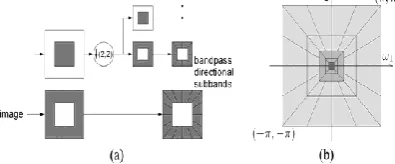
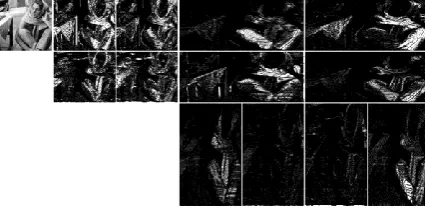
exactly. They have designed an optimum detector for multiplicative watermarks in the DFT domain of nonwhite signals. In, the locally optimum detector for Barni’s multiplicative watermarking scheme using HVS in the wavelet transform do- main has been proposed. Li et al., proposed an ML detector for multiplicative watermarking in the contourlet transform domain. They have assumed that the distribution of the received coefficients is GG, and hence their receiver is suboptimum for noise free environments. In this paper, in order to achieve higher robustness against AWGN and JPEG compression attacks, the multiplicative watermarking approach in the contourlet transform domain is used. We introduce a new multiplicative watermarking scheme to match the watermark message to the contourlet coefficients in an optimum way. The contourlet coefficients are multiplied by two special functions depending on the value of the watermark bits. These functions are optimized for the highest robustness against AWGN and JPEG attack. For data extraction, similar to, the ML detector has been used utilizing GGD property of the contourlet coefficients. To this aim, the density function of the noisy contour let coefficients. Combining the Laplacian pyramid and the directional filter bank into a double filter bank structure the contourlet transform is developed. Fig. 2(a) shows the decomposition used in the contourlet filter bank. Bandpass images from the LP are fed into a DFB to capture the directional information. By iterating this scheme on the coarse image, the image decomposes into directional subbands at multiple scales. This cascade structure helps the user to decompose different scales into different directions. An example of frequency partition of the contourlet transform is shown in Figure 2(a). This type of frequency partitioning leads to the sparsity of the contourlet coefficients, i.e., only the coefficients with both direction and location on the original image edges has significant values. This can be clearly seen in Fig.3, where the contourlet transform sub-bands of the Barbara image is multiplicative watermarking method is evaluated. We also extend the proposed method to a blind technique which does not need side information approximated with a suitable function. Under this estimation, the optimum threshold of the proposed of the receiver, the distribution of these coefficients is analytically computed. In order to decrease the complexity
2. Contour Let s:
For piecewise continuous 1-D signals, wavelets have been established as a right tool in generating efficient representation. However, natural images are not simply stacks of 1-D piece- wise smooth scan-lines, but they have many discontinuity points
Figure 2.1: ( a), (b) Laplacian pyramid one level of decomposition and reconstruction; (c), (d) directional filter bank frequency partitioning and the multichannel view of tree-structured directional filter bank
Figure 2.2: (a) Contourlet filter bank: Laplacian pyramid as the first stage and directional filter bank as the second stage. (b) Example of frequency partition by the contourlet transform.
3. Proposed Method:
A. Watermark Embedding: Imperceptibility of the watermarking algorithm is commonly achieved by
exploiting the weaknesses of the HVS. As demonstrated in HVS, the human eye is less sensitive to high entropy blocks instead of smooth ones as there are usually stronger edges in the high entropy blocks. For this purpose, we select blocks with the highest entropy in the whole image for the watermarking purpose. We then apply the contourlet transform to each selected block. Calculating the energy of the coefficients in each directional subband of the finest scale, we choose the directional subband with the highest energy for embedding purpose. This way, we hide the code in the most significant direction of each block.
(www.dvpublication.com) Volume 2, Issue 2, 2017
18
such as contourlets yields sparser coefficients, i.e., it represents the edges in a few samples. Therefore, in the proposed method, we insert the watermark in the edges of the most energetic contourlet sub band of high entropy blocks which are the right places to be visually acceptable to HVS.
Figure 3.1: Contourlet transform of the Barbara image. The image is decomposed into two pyramidal levels, which are then decomposed into four and eight directional subbands. Small coefficients are showed by black
while large coefficients are showed by white
We embed a single bit of “0” or “1” in each block by manipulating the coefficient in the most energetic directional subband based on the following strategy:
Where and are strength functions.
With the same inference that the most energetic directional subband relates to the dominant direction of the block, we can say that the large coefficients in that subband are relates to the strong edges in the block and we can embed more data in these coefficients. This verifies that the strength function must be an increasing function for. Although a linear function may be a straightforward choice in this case, we found that the rate of increasing should not be linear because we have much higher capacity in larger coefficients and with linear function we either may miss this capacity or may cause visible distortions in the image because of high changes in small coefficients. Thus, I need a nonlinear increasing function. Exponential function is a good choice which gives us a large change in larger coefficients and small changes in smaller coefficients.
Considering these facts, we suggest the strength functions to be even and monotonically exponential functions, i.e.,
a2: This parameter has an important role in the rising rate of strength function. Thus, the strength function reaches its final value after which is a good point for us as for many directional subbands the maximum amplitude of coefficients occurs near this value.
a1: For small coefficients we have, This is the minimum strength we use for embedding. We fixed this value to 1.3. As we see in our experiments that this minimum strength is endurable in most of the energetic sub bands and preserves the transparency.
b1, b2, b3: Our reasoning to define the parameter in is to make this function to show the behaviour of for large values. This way, we increase the host coefficients for “1” embedding and decrease them for “0” embedding.
B. Watermark Detection:
For detecting the watermark data in each block, I suggest a detection scheme based on an optimum detector. Fig. 7(b) shows the block diagram of the proposed detector. Suppose that represents the contourlet coefficients of the most energetic directional subband of a specific block. We assume these coefficients to be independently and identically distributed (i.i.d.). Besides, we approximate the distribution of the watermarked coefficients attacked by AWGN.
In order to have ML decision, we must have where the left term is the distribution of the coefficients in a specific block with coefficients for “1” embedding and the right term is the same distribution for “0” embedding.
4.Parameter Optimization:
(www.dvpublication.com) Volume 2, Issue 2, 2017
19
These functions can affect two factors in the watermarked image: visibility and robustness.
Figure 4.1: Block diagram of the proposed watermarking scheme: (a) embedding; (b) detecting.
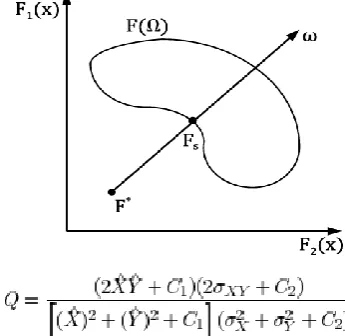
Since can be calculated from through (15), we only consider the effect of . First, larger values of can cause more distortions in the image due to the watermark. On the other hand, larger values of increase the robustness of the watermarked image against various attacks. Therefore, there is a trade-off between visibility and robustness. We utilize a multi-objective optimization technique to select an appropriate strength functions ensuring imperceptibility with acceptable robustness.
There is one degree of freedom, in defining the strength functions and . We thus seek for an appropriate value of satisfying the requirement of imperceptibility and robustness.
We model the effect of the strength function on the visibility using the image quality index suggested. In this quality assessment method, any image distortion is modeled as a combination of three factors considering the properties of the HVS: 1) loss of correlation, 2) Luminance distortion, and 3) contrast distortion. This image quality index outperforms traditional quality assessment methods such as MSE due to its conformity to HVS and subjective tests.
If we denote the original and the manipulated watermarked images with and, respectively, the quality index is defined as dynamic range of the pixel values (255 for 8-bit grayscale images), and are small constants. Since image signals are generally nonstationary and image quality is often spatially variant, it is reasonable to measure statistical features locally and then combine them together. Wang et al. [42] suggested to apply the quality measurement to non overlapping block segments of the image, calculate a local index for each block, and find the overall quality index for blocks by arithmetic averaging.
(www.dvpublication.com) Volume 2, Issue 2, 2017
20
similar DWT based approach for different block sizes to find the efficiency of implementation of contourlet. Experimental results revealed that as we have expected even for the small block size of 16*16 there is a notable difference between the performance of contourlet and wavelet transform.
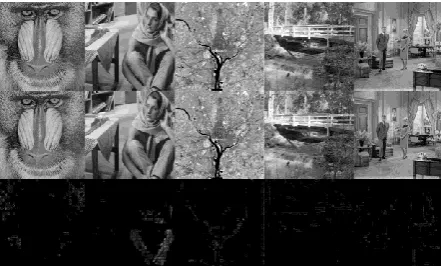
The five times scaled of the absolute difference between the watermarked and the original image are shown in Figure
Figure 4.3: Original, watermarked and difference images using the proposed method: Baboon, Barbara, Map, Bridge, and Couple. For each image, the top one is the original test image, the middle one is the watermarked image, and the bottom one is the five times scaled of the absolute difference between the watermarked and the
original image
5. Simulation Results:
We have performed several experiments to test the proposed algorithms and evaluate its performance against several attacks which are common in our application. For the contourlet transform as suggested in , we use the 9–7 biorthogonal filters with three levels of pyramidal decomposition for the multiscale decomposition stage and the ladder filters introduced.(referred to as PKVA filters) for the multidirectional decomposition stage. We partition the finest scale to eight directional subbands. The results are obtained by averaging over 20 runs with 20 different pseudorandom binary sequences as the watermarking signal.
For this study, we use five natural images (Baboon, Barbara, Map, Bridge, and Couple) of size 512*512. The original test images and their watermarked version using the proposed method with 16*16 block size and 128 bits message length as well as
In fact, wavelet as a separable 2-D multi resolution transform just follows the curves as horizontal-vertical lines and essentially cannot represent 2-D directional discontinuity which is common in as image edges. Thus, contourlet has advantage over the wavelet transform in our proposed method, in which the great performance is obtained where the transform coefficients are sparse.
For the proposed semi-blind approach, a typical side information bit budget needed for an image of size 512* 512 and assuming 16* 16 block size and 128-bit message length is as follows:
i) Block Positions: 1BIT/BLOCK = (512/16)2=1024 BITS (we send “1” if a block is among the high entropy
blocks and “0” otherwise);
ii) 4-Bit Words: for the shape parameter beta and 8 bit words for the ML parameter as mentioned already: 12.128=1536 bits
iii) a3: 8 Bits: Thus, the raw side information necessitates 2568 bits/image. The block positions, however, can be compressed to near 512 bits on the average using Arithmetic coding as a lossless coding. Other block parameters also can be reduced with lossy coding to near 1024 bits using Vector Quantization (VQ) with negligible loss in the performance. Thus, in total the side information is reduced to near 1.5 Kbits on the average per image.
5.1 Performance Under Attacks:
First test the performance of the proposed technique against several common watermarking attacks such as JPEG compression, AWGN, salt & pepper noise, rotation, and scaling attacks.
a) AWGN Attack: In the first experiment, investigate the effect of AWGN to the proposed watermarking the
BER of the proposed method for various images versus different noise power. The method has a great resistance even against heavy AWGN attack. This is because the receiver is optimized for the noisy environment.
b) JPEG Attack:In the second experiment, the proposed technique will test against JPEG compression with
different quality factor. The proposed method is highly robust against JPEG with different quality factor up to 10%.The proposed method is highly robust against salt & pepper noise attack even for high salt &pepper noise percentage up to 5%.
(www.dvpublication.com) Volume 2, Issue 2, 2017
21
estimation and a fine tuning step.
d) Testing the Performance for Various Images: Here, we test the performance of the proposed technique for
100 different test images selected from different categories of natural images. The average BER for AWGN attack is given in Fig. 13. As we can see, we have a good robustness for these test images and this shows the significance of other method and its generality for various test images.
5.2. Comparison with Other Watermarking Schemes:
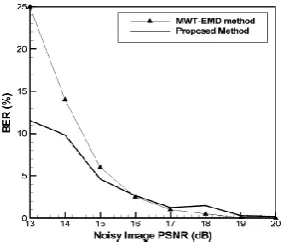
In this section, to compare our watermarking algorithm with other watermarking schemes, we use the same bit rate and PSNR as the bit rate and PSNR used in other techniques. The simulation results are shown in Tables IV and V and Figures. In Tables IV and V and Figure, we compare our watermarking scheme with the MWT-EMD method for JPEG compression, rotation, and AWGN attacks. In this experiment, we use the message length of 64 bits and PSNR (42 dB) for the watermarked image as used in with the Baboon image. We see that the robustness of our method against JPEG compression attack is slightly lower than MWT-EMD method.
Table 5.1: Comparison between our watermarking method and MWT-EMD method: BER (%) under JPEG compression attack for Baboon image. in this experiment the message length is 64 bits and PSNR of the
watermarked image is 42 dB
Table 5.2: Comparison between our watermarking method and MWT-EMD method: BER (%) under rottatiion attack for Baboon image. in this experiment the message length is 64 bits and PSNR of the watermarked image
is 42 dB
Figure 5.3: Comparison between our watermarking method and MWT-EMD method for different images: BER (%) under AWGN attack.
Experimental results over several images confirm the excellent resistance against common attacks in the semi-blind version. In the blind version the proposed method outperforms recently proposed techniques in AWGN and rotation attacks, while it has competitive results in JPEG attacks.
5.3 Extension to a Blind Technique:
Here, we will suggest a blind extension of the proposed watermarking technique. To make our system blind we should estimate two parameters of the GGD distribution function parameters: and at the receiver. For this purpose, we make a slight change in our embedding strategy.
6. Conclusion:
(www.dvpublication.com) Volume 2, Issue 2, 2017
22
and then the fine estimation is performed using the shape and ML parameter environment. Moreover, we see that, unlike the MWT-EMD method, our scheme is highly robust against rotation attack due to the synchronization technique we used in the detector to estimate the rotation angle. The comparison with the Ergodic Chaotic Parameter Modulation (ECPM) method is shown in Figure. In this experiment, we embed the watermark code with different message length in the host image and attack the watermarked image by AWGN with for different message lengths. As we can see in Figure, our method considerably outperforms the EPCM method.
7. References:
1. Barni, M. Bartolini, F. De Rosa, A. and Piva, A. (2003) “Optimum decoding and detection of multiplicative watermarks,” IEEE Trans. Signal Process., vol. 51, no. 4, pp. 1118–1123, April.
2. Burt, P.J. and Adelson, E.H. (1983) “The Laplacian pyramid as a compact image code,” IEEE Trans. Commun., vol. COM-31, no. 4, pp. 532–540, April.
3. Da Cunha, A.L. Zhou, J. and Do, M.N. (2006) “The nonsubsampled contourlet transform: Theory, design, and applications,” IEEE Trans. Image Process., vol. 15, no. 10, pp. 3089–3101, Oct. 2006. 4. Do, M.N. and Vetterli, M. (2005) “The contourlet transform: An efficient directional multiresolution
image representation,” IEEE Trans. Image Process., vol. 14, no. 12, pp. 2091–2106, December. 5. Jayalakshmi, M. Merchant, S.N. and Desai, U.B. (2006) “Digital watermarking in contourlet domain,”
in Proc. 18th Int. Conf. Pattern Recognition, Vol. 3, pp. 861–864.
6. Jayalakshmi, M. Merchant, S.N. and Desai, U.B. (2006) “Blind watermarking in contourlet domain with improved detection,” presented at the Int. Conf. Intelligent Information Hiding and Multimedia Signal Processing (IIH-MSP)
7. Kundur, D. and Hatzinakos, D. (2004) “Towards robust logo watermarking using multiresolution image fusion principles,” IEEE Trans. Image Process., vol. 6, no. 1, pp. 185–198, January.
8. Po, D.D.-Y. and Do, M.N. (2006) “Directional multiscale modeling of images using the contourlet transform,” IEEE Trans. Image Process., vol. 15, no. 6, pp. 1610–1620, June.
9. Simoncelli, E.P. Freeman, W.T. Adelson, E.H. and Heeger, D.J.(1992), “Shiftable multiscale transforms,” IEEE Trans. Inf. Theory, vol. 38, no. 2, pp. 587–607, February.