48 | P a g e
IMPACT OF GOODS AND SERVICES TAX ON BUILDING CONSTRUCTION
PROJECTS AT ISLAMPUR CITY.
Mr. Sagar B. Pawar PG Student RIT, Rajaramnagar Islampur, Maharashtra, India [email protected]
Mr. Amol S. Thorbole Assistant Professor
RIT, Rajaramnagar Islampur, Maharashtra, India
Abstract: Goods and services tax or GST as it is known is all set of game changer for Indian economy. In, India there are different indirect taxes apply on goods and services by central and state government. GST is intended to include all these taxes into one tax with ITC and charged on both goods and services. Thus excise duty, special additional duty, service tax, VAT are replaced and added into GST. For successful implementation of GST, it is necessary that the government at both central and state levels agree to merge all their taxes into SGST/CGST. In building construction projects GST is now applied mostly on materials. The materials having major role in building construction projects. In building construction projects required 60% to 70 % cost for materials. The material rates are changes due to new taxation system, therefor it changes cost of construction projects.
Keywords: GST for construction, CGST, SGST.
I. INTRODUCTION
The Goods and Services Tax has revolutionized the Indian taxation system. The GST Act was passed in the Lok Sabha on 29th March, 2017, and came into effect from 1st July,2017. India which replaced multiple cascading taxes levied by central and state governments. The GST is governed by GST council and its chairman is the finance minister of India. Under GST, goods and services are taxed rates 0%, 5%, 12%, 18%, 28%. Goods and services tax is single tax system on the supply of goods and services. The composite supply of works in building construction sector will fall under 18% GST rate with full input tax credit (ITC)[1]. The VAT payable varies across states ranging from 1-15% and is applicable on supply of goods[2]. The effective tax for an average construction in pre-GST era is typically in the range of 11-18%[2]. The difference is more pronounced for construction services which fall under the service tax exemption category. Under GST, sale of under construction real estate properties would be classified as a supply of services and would be liable for payment of GST. However, sale of completed real estate properties and land exempted there would be no changes in the stamp duty and
registration charges. The GST rate for construction of buildings intended for sale to buyer, where the value of land is included in the sale value. In case the land and construction values are identified through separate agreements the GST rate applicable is expected to be 18%[1]. The GST rates are higher than the current tax rate (VAT + service tax) in most states[5]. This will increase the net effective tax rate under GST. In the GST there are mentioning that the effective GST payable on purchase under construction residence or commercial properties from a builder to the buyer is 12% with full input tax credit system[6]. Input tax credit means at the time of paying taxon output, you can reduce the tax you have already paid on inputsand pay the balance amount. In this system supplier who construct building, flat, shop or independent floor etc. either through works contractor or on his own for the purpose consideration, will not be able to take any credit of taxes charged on input services used in the construction of such buildings, flats etc. due to specific restriction. For commercial purpose is taxable but benefit of input tax credit is not extended which is against the principle of taxation system. It is results into increased cost of constructions and higher rents of such commercial properties. The relation between properties and prices is known fact, in the VAT system the construction price is increase where the housing price of properties drop as construction cost. In the construction sector faced scenario similar to it in which introduction of GST influences the price of building input and thus affects the developers profit and eventually the profit value.
II. METHODOLOGY
At Islampur city is one of taluka place in the Sangli district of state Maharashtra. Being taluka place the city is spreading in all directions. Number of housing projects are being executed in all parts of city. Here attempt has been made to identify impact of GST on construction activity in Islampur city.
a) Data Collection
49 |
P a g e
used in many projects of building construction. Modern materials are like polymers, composites, AAC blocks etc. Various services are used in building construction projects in Islampur city.
TABLE NO 1: VAT and GST rates for building materials
Materials VAT Rates GST Rates
River sand 5% 5%
Coarse aggregates
5% 18%
Steel 19.5% 18%
Cement 12.5% 28%
AAC blocks 12.5% 18%
Tiles & Granites 18-28% 12.50%
RMC 13% 28%
Electric materials 14.5% 28%
Plumbing materials
13.5% 28%
Fabrication 12.5% 18%
Wooden doors 12.5% 28%
b) Case Study Details
Site name- Balaji Icon
Location- Near Shani Mandir, Kacheri Road, Islampur. Tal- Walwa, District- Sangli.
Plot area- 1128 Sq.M
Builtup area- 878 Sq.M Each floor Structure- G+4
No. of flats- 36 No. of shops- 36
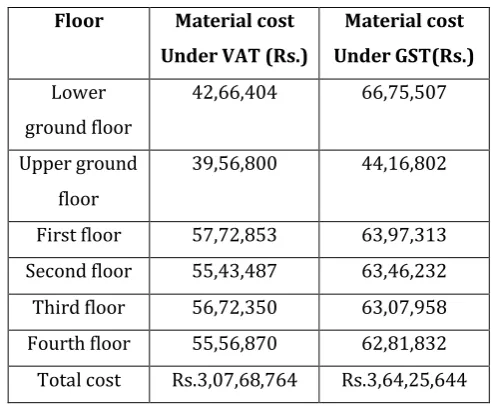
Material Cost under VAT and GST
In this project various types of materials are required, therefore total cost of project is floor wise measured under VAT and GST rates.
TABLE NO. 2: Material Cost under VAT and GST
Floor Material cost Under VAT (Rs.)
Material cost Under GST(Rs.)
Lower ground floor
42,66,404 66,75,507
Upper ground floor
39,56,800 44,16,802
First floor 57,72,853 63,97,313 Second floor 55,43,487 63,46,232 Third floor 56,72,350 63,07,958 Fourth floor 55,56,870 62,81,832
Total cost Rs.3,07,68,764 Rs.3,64,25,644
Cost Difference-
Cost Difference =
Material cost under GST – Material cost under VAT
Rs. 3,64,25,644 – Rs. 3,07,68,764 = Rs. 56,56,880 /-
Services cost for Project
Various construction services are used for this project, services are required 30% to 35 % cost of project. There are no GST applied on services.
TABLE NO. 3: Services Cost
Services Cost (Rs.)
Excavation 1,36,000
Centring 68,05,440
Brickwork & Plaster 53,87,640 Flooring & Dado 7,46,100
Granite work 2,33,820
Plumbing 2,68,350
Electrification 3,37,500 Wall putti 5,61,730 Supervisor 2,64,000 Architect 29,49,000 Structural Engg. 29,49,000
Total cost Rs.2,06,38,580
50 |
P a g e
Total Investment under VAT and GSTIn this project for total investment various costs are considered, i.e. material cost, service cost, waterproofing, lift installation, land cost etc.
TABLE NO. 4: Total Investment under VAT
Particulars Investment under VAT
Investment under GST
Material cost 3,07,68,764 3,64,25,644 Service cost 2,06,38,580 2,06,38,580 Waterproofing 3,69,000 3,69,000
Lift cost 3,50,000 3,50,000 Land cost 1,44,00,000 1,44,00,000 Lumpsum 1% 6,65,260 7,21,832
Total cost Rs. 6,71,91,604 Rs.7,37,40,520
Difference in total investment
Under GST – Under VAT
7,37,40,520 – 6,71,91,604 = 65,48,916
Difference in total investment = Rs. 65,48,916/-
Difference in total investment in percentage
Rs. 7,37,40,520 / Rs. 6,71,91,604 = 1.09
Due to implementation of GST investment cost is increased by 9 %.
Difference in investment per unit
Built up area = 56,683 Sq. feet
1] Investment under VAT = Rs. 6,71,91,604/-
Rate per sq. feet = 6,71,91,604 / 56,683 = 1,185
Investment under VAT per sq. feet = Rs.1185/-
2] Investment under GST =
Rate per sq. feet = 7,37,40,520 / 56,683 = 1301
Investment under GST per sq. feet = Rs.1301/-
Difference in investment per unit-
Investment under VAT per sq. feet – Investment under GST per sq. feet
1301 – 1185 = 116
Difference in investment per sq. feet = Rs. 116/-
Total sale amount under VAT
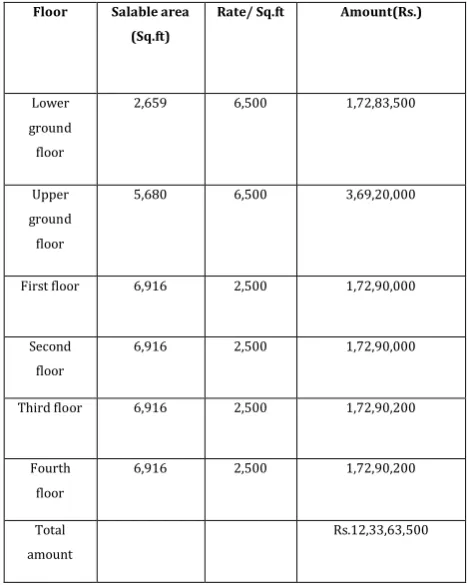
In this project lower and upper ground floor consisting commercial shops had Rs.6,500/- per sq. feet salable rate and the first, second, third and fourth floor consisting residential flats had Rs.2,500/- per sq. feet salable rate under VAT system.
TABLE NO. 5: TotalSale Amount under VAT
Floor Salable area (Sq.ft)
Rate/ Sq.ft Amount(Rs.)
Lower ground floor
2,659 6,500 1,72,83,500
Upper ground floor
5,680 6,500 3,69,20,000
First floor 6,916 2,500 1,72,90,000
Second floor
6,916 2,500 1,72,90,000
Third floor 6,916 2,500 1,72,90,200
Fourth floor
6,916 2,500 1,72,90,200
Total amount
Rs.12,33,63,500
Developers profit under GST
Total sale price = Rs.12,33,63,500/- Developers profit =
Rs. 12,33,63,500 – Rs. 6,71,91,604 = Rs. 56171896/-
Total sale amount under GST
51 |
P a g e
TABLE NO. 6: TotalSale Amount under GST
Floor Salable area (Sq.ft)
Rate/ Sq.ft
Amount(Rs.)
Lower ground floor
2,659 7,000 1,86,13,000
Upper ground
floor
5,680 7,000 3,97,60,000
First floor
6,916 2,700 1,86,73,200
Second floor
6,916 2,700 1,86,73,200
Third floor
6,916 2,700 1,86,73,200
Fourth floor
6,916 2,700 1,86,73,200
Total amount
Rs.13,30,65,800
Developers profit under GST
Total sale price = Rs.133065800 Developers profit =
Rs.133065800 – Rs.73740520 = Rs.59325280
Selling amount increase due to GST in percentage
Rs.13,30,65,800 / Rs. 12,33,63,500 = 1.07
Selling amount increase 7% due to GST.
GST returns for developers
GST is applied 12% on construction industry, the 12% of sale amount is levied on total salable amount. As per input tax credit system GST returns reduced, means already paid GST on materials purchase which substract from total GST amount.
TABLE NO. 6: GST Amount on Materials
Materials GST amount (Rs.)
Steel 6,82,817
RMC 11,66,508
Sand 19,250
Cement 1,75,812
Coarse aggregates 28,512
Binding wire 7,742
AAC blocks 7,70,117 Chemical bags 3,27,409 Flooring tiles 4,18,824
Granites 2,52,759
White cement 6,968
Fabrication work 1,96,653
Railing 1,42,443
Electric materials 5,48,485 Plumbing materials 4,67,208 Wall putti 1,15,488 Wooden &
Laminated doors
2,63,648
Slidings 37,79,32
Total cost Rs.59,68,575
As per ITC provision-
Total sale price = Rs.133065800 Developers profit =
Rs.133065800 – Rs.73740520 = Rs.59325280
GST on total sale = 12%
12/100 x 133065800 = Rs.15967896 Already paid GST on materials = Rs.5968575
Remaining GST for developers = Rs.15967896 – 5968575 = Rs.9999321
52 |
P a g e
III. CONCLUSION
1. Most of construction materials fall in 18% GST slab. Previously same was taxed for 11% including VAT and other taxes.
2. Implementation of GST to the construction materials leads to substantial increase in cost of construction. For the study are we found 11% increase in cost of construction after GST implementation. As a result of this the selling cost is increase 7 % and construction cost increase by 9 %.
IV. ACKNOWLEDGMENT
I take this opportunity to thank my project guide Prof. A. S. Thorbole, owner of Balaji developers, site engineer Mr. Pratik Devarde and C.A. Santosh Nalwade for this valuable guidance, patience and support for this paper. It was a great experience to work with them and there valuable suggestion made me to have deep interest and knowledge of this topic. I am grateful to thank them for my successful completion of paper. Thank one and all for their help directly or indirectly for the successful completion of this study.
V. REFERENCES
[1] Arpit Shailesh, Dr.Taruna, “A Study On Impact Of Goods And Services Tax On Indian Economy.” IJCMR, vol. 2, issue 10, pp 76-80, (2017).
[2] Girish Garg, “Basic Concepts And Features Of Goods And Services Tax In India.” IJSRM, vol. 2, pp 542-549, (2014).
[3] Dr. Harvindersingh Bhalla, Mr. Ambarbirsingh Bhalla M.S. Nancy Gupta,“Goods and Services Tax (GST) – Impact Challenges and Opportunities.” IJBMSR , vol. 25, pp 51-64, (2017).
[4] Hector Martin, Timothy M. Lewis, Derek Outridge, “Is Legislation A Barrier To Procurement Of Construction Goods And Services? Review Of Trinidad And Tobago’s Construction Industry.” ASCE, vol. 5, issue 3, pp 142-150, (2013).
[5] Dr. Mahesh U. Daru, “A Critical Appraisal Of GST In India” IJRIM, vol 6, issue 5, pp 109-114, (2016).
[6] Rozlin Zainal, Teoh Chai Teng, Sulzakimin Mohamed, “Construction Costs And Housing Prices: Impact Of Goods And Services Tax.” IJEFI, pp 16-20, (2015).
[7] Rozlin Zainal, Teoh Chai Teng, Yeo See Pin, “The Effects Of Goods And Services Tax On Construction Capital Costs And Housing Property Prices.” ISSC. pp349-354, (2016).