N A N O E X P R E S S
Open Access
AM-DMC-AMPS Multi-Functionalized
Magnetic Nanoparticles for Efficient
Purification of Complex Multiphase Water
System
Yuru Ge
†, Yushu Li
†, Baiyi Zu
*, Chaoyu Zhou and Xincun Dou
*Abstract
Complex multiphase waste system purification, as one of the major challenges in many industrial fields, urgently needs an efficient one-step purification method to remove several pollutants simultaneously and efficiently. Multi-functionalized magnetic nanoparticles, Fe3O4@SiO2-MPS-AM-DMC-AMPS, were facilely prepared via a one-pot in situ polymerization of three different functional monomers, AM, DMC, and AMPS, on a Fe3O4@SiO2-MPS core-shell structure. The multi-functionalized magnetic nanoparticles (MNPs) are proven to be a highly effective purification agent for oilfield wastewater, an ideal example of industrial complex multiphase waste system containing cations, anions, and organic pollutants. Excellent overall removal efficiencies for both cations, including K+, Ca2+, Na+, and Mg2+of 80.68 %, and anions, namely Cl−and SO4
2−, of 85.18 % along with oil of 97.4 % were shown. The high
removal efficiencies are attributed to the effective binding of the functional groups from the selected monomers with cations, anions, and oil emulsions.
Keywords:Fe3O4, Polymeric functionalization, Magnetic nanoparticles, Water purification, Oil water
Background
The rapid progress of nanoscience and nanotechnology has enabled researchers to engineer materials on the nanoscale and molecular level to a great extent [1]. Consequently, as part of the nanomaterial engineering, multi-functionalization of nanoparticles aiming at in-corporating several functionalities into one single nano-particle is of increasing interest and has been widely applied in a variety of scientific fields [2–8]. There are two major strategies for fabricating multi-functional nanoparticles: (1) individually attaching multiple func-tions to nanoparticles [9, 10] and (2) attaching multiple functions to nanoparticle with a single attachment point [11]. However, further applications of both strategies are hindered mainly by the tedious multistep synthesis and the
associated difficulties in analytical quality control of each synthetic step. The lack of efficient and well-controlled synthesis approaches to multi-functionalize nanoparticles has become a bottleneck limiting the applications of multi-functionalized nanoparticles (MFNPs) in various fields. Therefore, simpler, faster, more efficient, and well-controlled approaches for preparing MFNPs are in urgent need.
As the representative of base materials [10, 12, 13], Fe3O4 magnetic nanoparticles (MNPs) have attracted a significant amount of interest during the past few de-cades owning to their merits, such as good stability, facile synthesis, high surface area, low toxicity, good biocompatibility, and especially unique magnetic responsiv-ity [14]. The generally functionalized Fe3O4MNPs are com-posed of a magnetic core, an outer functionalized shell, and commonly a silica shell in between not only serving as a protection layer by isolating the magnetic core from the external environment to achieve a better stability but also providing a biocompatible and easily modified surface enabling the covalent modification and functionalization. * Correspondence:[email protected];[email protected]
†Equal contributors
Laboratory of Environmental Science and Technology, Xinjiang Technical Institute of Physics & Chemistry, Key Laboratory of Functional Materials and Devices for Special Environments, Chinese Academy of Sciences, Urumqi 830011, China
Although the functionalized Fe- or Co-based MNPs with single or multiple functionalities have already been applied in a variety of research fields [2, 15–23], there are still some areas in which Fe3O4MNPs with multiple functionalities are more desired but barely explored compared to those with single functionality. The purification of industrial com-plex multiphase system is one of such areas, which gener-ally contains multiple types of pollutants, such as cations, anions, and organic compounds. However, up to date, the study of functionalized Fe3O4 MNPs is limited to single-functionalization which can only remove one type of pollu-tant in the system, such as hydrocarbon oil [24, 25] and heavy metal ions [26]. Thus, multi-functionalized MNPs, which can adsorb and remove several pollutants simultan-eously from the complex multiphase system, represent a promising agent for simple one-step complex multiphase system purification.
Acrylamide (AM)-based polymer, which can adsorb small organic emulsion droplets and is commonly used as a chemical flocculant in sludge wastewater treatment [27], plays an important role in adsorbing organic contents pre-venting fouling. Meanwhile, the ammonium group con-tained in methylacryloxyethyltrimethyl ammonium chloride (DMC) can bind with anions and serve as an anion adsorb-ing agent in the purification procedure. Furthermore, 2-acrylamido-2-methylpropanesulfonic acid (AMPS) could be a good candidate to remove cations due to the fact that its functional groups, amide, sulfonic acid, and carbonyl, can bind with heavy metal ions [28]. Therefore, if these three different monomers with various functional groups could be grafted onto the surface of MNPs via a very simple one-pot in situ free radical polymerization to form a functional polymeric shell, the as-prepared multi-functionalized MNPs would be used as a purification agent for adsorption and re-moval of various pollutants in a complex system. Oilfield wastewater, generally containing a significant amount of hydrocarbon oil and high salinity (cations and anions), is an ideal example of a complex multiphase system to illustrate the above multi-functionalized MNPs design. Furthermore, the fouling issue, which is caused by organic content and might occur rapidly during the desalination procedure resulting in loss of desalination efficiency, could be avoided effectively by utilizing the multi-functionalized MNPs.
Herein, we present a facile preparation of multi-functionalized MNPs for purification of complex multiphase industrial wastewater via a one-pot in situ polymerization of AM, DMC, and AMPS on the surface of modified Fe3O4@SiO2. As proved in the case of oilfield waste-water treatment, the multi-functionalized MNPs can remove both cations and anions, including K+, Ca2+, Na+, Mg2+, Cl−, and SO42−, with an overall weight aver-age removal efficiency of 83 % and with an excellent oil-removal efficiency of 97.4 %. To the best of our know-ledge, this is the first trial on the multi-functionalized
MNPs for the application of complex multiphase waste-water purification.
Methods
Materials
Ferric chloride hexahydrate (FeCl3·6H2O), tetraethyl orthosilicate (TEOS), ethylene glycol (EG), ammonia (25 wt%), sodium acetate (NaAc) were purchased from Sinopharm. Acrylamide (AM), methylacrylox-yethyltrimethyl ammonium chloride (DMC, 80 wt%), γ-methylacryloxypropyltrimethoxysilane (MPS), and 2-acrylamido-2-methyl propane sulfonic acid (AMPS) were purchased from Aladdin. Polyethylene glycol (PEG, Mw = 2000) and ethanol were purchased from Tianjin Baishi Chemical Co., Ltd. Ammonium persulfate (APS) was purchased from Tianjin Hongyan Chemical Co., Ltd. Carbon tetrachloride (CCl4) was obtained from Tianjin Aoran Fine Chemical Co., Ltd. All of the chemi-cals purchased are in analytical grade and were used as re-ceived without further purification.
Synthesis of Monodispersed Magnetic Fe3O4
Nanoparticles
Monodispersed magnetic Fe3O4nanoparticles were syn-thesized according to the solvothermal method [29]. Typically, FeCl3·6H2O (2.7 g, 10 mmol) was dissolved in ethylene glycol (80 mL) to form a clear solution, followed by the addition of polyethylene glycol (3.0 g). The mixture was heated with vigorous stirring to 60 °C in an oil bath for 30 min before the addition of NaAc (7.2 g). The mixture was stirred vigorously at room temperature for another 30 min and then sealed in a Teflon-lined stainless-steel autoclave (100-mL capacity). The autoclave was heated to and maintained at 200 °C for 6 h and allowed to cool to room temperature. The black products were collected with the help of an exter-nal magnet, washed several times with ethanol and de-ionized water, and subsequently vacuum dried at 45 °C for 6 h.
Synthesis of Fe3O4@SiO2Core-Shell Nanoparticles
Synthesis of Fe3O4@SiO2-MPS Core-Shell Nanoparticles The surface modification of Fe3O4@SiO2core-shell nano-particles was carried out according to a reported proced-ure [30]. The preformed Fe3O4@SiO2nanoparticles were dispersed in ethanol (80 mL) contained in a three-necked round-bottom flask and sonicated for 5 min. After the addition of ethanol solution of MPS (2 mL/40 mL), the mixture was refluxed at 78 °C for 24 h with continuous mechanical stirring under a nitrogen atmosphere. The surface modified Fe3O4@SiO2 core-shell nanoparticles with reactive C=C bonds were collected with the help of an external magnet, washed with ethanol for several times, and then vacuum dried at 60 °C for 8 h for the next step.
Synthesis of Fe3O4@SiO2-MPS-AM-DMC-AMPS Core-Shell
Nanoparticles
The core-shell-structured Fe3O4@SiO2 -MPS-AM-DMC-AMPS nanoparticles were synthesized via a one-pot free radical polymerization. Vinyl-modified Fe3O4@SiO2 (0.3508 g) core-shell nanoparticles were dispersed in 50 mL deionized water in a round-bottom flask (100 mL) and sonicated to form a homogenous suspension. Excess amount of AM (3.1572 g), DMC (3.9465 g), and AMPS (1.0524 g) monomers were injected into the mixture, re-spectively, followed by nitrogen purging for 15 min. After the addition of APS (7.4 mg), the flask was sealed and heated with continuous stirring at 65 °C for 7 h in oil bath. Upon completion of the reaction, the product was har-vested and washed several times with deionized water and ethanol by magnetic separation.
Measurements and Characterization
The morphology of the samples was characterized by field-emission scanning electron microscope (FESEM, ZEISS SUPRA 55VP) and transmission electron micro-scope (JEM-2011 TEM, 200 kV). X-ray diffraction (XRD) patterns were recorded using a Bruker D8 Advance dif-fractometer with a copper target at 40 kV and 40 mA with 2θvalue ranging from 20° to 80°. Fourier transform infra-red (FT-IR) spectra were obtained with a Thermo Fisher Nicolet 6700 FT-IR spectrometer at room temperature using KBr pellets. Thermal analysis experiments were collected using a NETZSCH STA449F3TGA apparatus operated at a heating rate of 5 °C/min under nitrogen atmosphere. In order to evaluate desalination efficiency, each ion (Na+, K+, Mg2+, Ca2+, Cl−, SO42−) was quantified by inductively coupled plasma optical emission spectrometry
(ICP-OES, Agilent 735) and ion chromatography (IC, DIO-NEX ICS-5000) with TMS as an internal standard and CCl4 as eluent. Infrared photometer oil content analyzer was utilized to evaluate the oil-removal efficiency.
Oil-containing wastewater obtained from the 72# oil well of Karamay Oilfield was used to determine the desalination efficiency of the as-synthesized nanoparticles. The average value of concentration of contents in the oil-based waste-water sample used in this study was listed in Table 1. Typic-ally, 25 mg of the pre-grounded nanoparticles were soaked into 80 mL oil-based wastewater at room temperature, followed by sonication for several minutes. Then, with the help of an external magnet, the nanoparticles were easily isolated and the supernatant was collected. The supernatant was extracted with CCl4yielding the organic phase for oil content measurement, and the aqueous phase for ion content measurement to evaluate the desalination efficiency. The desalination efficiency can be calculated by the equation
Rð Þ ¼% Ci−Cf
Ci
100 %
where R(%) represents the ion removal efficiency, Ciis the initial ion content, and Cf is the final ion content after desalination. Besides, the removal capacity of the particles is also defined as the mass of ions or oil re-moved in milligrams/gram of particles.
Results and Discussion
The overall fabrication procedures for the Fe3O4@SiO2
-MPS-AM-DMC-AMPS core-shell nanoparticles are
[image:3.595.58.536.680.732.2]schematically illustrated in Scheme 1a. First, uniform Fe3O4nanoparticles were synthesized through a modified solvothermal reaction [29]. Second, the surface of the MNPs were coated with a thin layer of dense amorphous silica based on the hydrolysis of TEOS via the well-known Stober method [31]. The Fe3O4@SiO2core-shell nanopar-ticles were then modified with a silane coupling agent (MPS) to form active C=C bond on the surface for the next polymerization step. Finally, the second shell of poly-mer was coated on the surface of Fe3O4@SiO2-MPS parti-cles by a free radical polymerization of AM, DMC, and AMPS, resulting in uniform polymeric magnetic nanopar-ticles with core-shell structure. Due to the fact that the free radical polymerization processed randomly among the monomers, the chemical structure of the polymer
Table 1Average value of concentration of contents in oil-based wastewater samples used in this study
Ions (mg/L)
Total Cations Anions Oil (mg/L)
Ca2+ K+ Mg2+ Na+ Cl− SO4
2−
could be represented as (AM)m-(DMC)n-(AMPS)o. The polymeric shell itself is illustrated as the black circle, while some functional side chains are shown for better under-standing of the working mechanism.
The proposed complex multiphase wastewater treating mechanism of the polymeric magnetic nanoparticles was briefly illustrated in Scheme 1b. Different functional groups on the polymeric shell introduced by the three monomers were able to bind with cations, anions, and small organic emulsion droplets which are commonly found in complex multiphase wastewater. The removal of anions is realized by the ammonium chloride group in DMC via ion exchange, while the cations can be removed by not only the sulfonic acid group in AMPS via ion ex-change but also the amide group on AM and AMPS via weak binding. Furthermore, as a commonly used demul-sion agent, AM could also adsorb small organic emuldemul-sion droplet in the wastewater to prevent fouling, which is caused by organic content and might occur rapidly during the desalination procedure and results in loss of the desalination equipment efficiency. Therefore, the pro-posed polymeric magnetic nanoparticles can remove cations and anions efficiently in multiphase wastewater without fouling and easily be isolated from the system with magnetic field after purification.
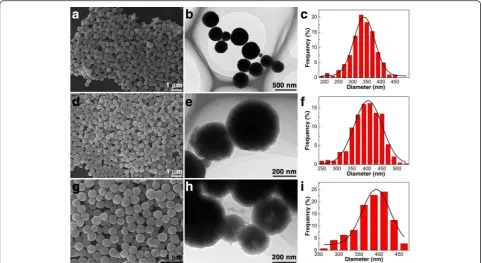
Typical SEM and TEM images of the as-synthesized nanoparticles at each step, namely Fe3O4, Fe3O4@SiO2, and Fe3O4@SiO2-MPS-AM-DMC-AMPS nanoparticles, along with the size distributions obtained from the SEM observation, are shown in Fig. 1. Uniform Fe3O4 nano-particles with an average diameter of 340 nm were
successfully prepared (Fig. 1a–c) After coating with a thin SiO2layer, the average diameter of Fe3O4@SiO2increased to around 404 nm (Fig. 1d–f), corresponding to a 60 nm thick SiO2 layer on the Fe3O4particles, which is able to protect the Fe3O4core and also provide the possibility for further functionalization. In the SEM and TEM images, even in the size distribution chart of Fe3O4@SiO2 -MPS-AM-DMC-AMPS nanoparticles (Fig. 1g–i), there is no obvious diameter increase observed. The reason for this could be addressed to that the polymeric shell formed in the present study was too thin to be observed in TEM re-sults. Due to the fact that only functional groups exposed on the surface of the polymeric shell are effective during the purification procedure, the limited thickness of the polymeric shell would not affect the purification proper-ties of the MNPs in a negative way. In fact, the thin poly-meric shell layer is preferred in this case. Other than the primary free radical polymerization, the three monomers in excess could also react with each other and consume the functional groups. If there is only a very thin layer of polymer formed on the surface of the MNPs, the overreac-tion between monomers could be prevented effectively.
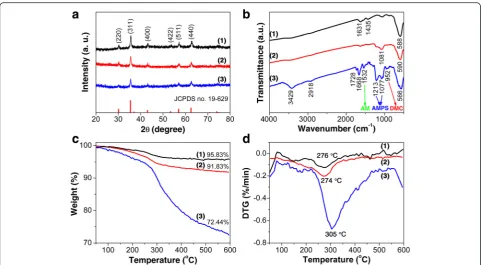
In order to investigate the crystal structures of the as-prepared materials, XRD experiments were conducted. As shown by curve 1 in Fig. 2a, the diffraction peaks for Fe3O4 nanoparticles located at 2θ values of 30.2°, 35.6°, 43.3°, 53.5°, 57.2°, and 62.8° are sharp and strong and could be well indexed to the (220), (311), (400), (422), (511), and (440) planes of face-centered cubic (fcc) phase magnetite (JCPDS no. 19-629), respectively, [32] confirming the successful synthesis of the magnetite nanoparticles
with good crystallinity. Besides, the broadening feature of the recorded peaks indicates that the size of the grains in Fe3O4 nanoparticles is in the nanometer scale. According to Scherrer’s relation:D= 0.9λ/βcosθ, where D is the average crystalline size,θ is the Bragg diffraction angle, and β is the full width at half max-imum, the average size of the Fe3O4 grains is calcu-lated to be 19 nm using the (311) peak for Fe3O4.
Similar diffraction peaks are also observed for
Fe3O4@SiO2 and Fe3O4@SiO2-MPS-AM-DMC-AMPS samples, as shown by curves 2 and 3 in Fig. 2a, sug-gesting that the Fe3O4nanoparticles are well retained in the magnetic composite nanoparticles [25]. Mean-while, the amorphous structure of silica can also be confirmed since no diffraction peaks corresponding to SiO2are observed.
Successful preparation of Fe3O4@SiO2 -MPS-AM-DMC-AMPS was also confirmed by FT-IR spectroscopy (Fig. 2b). For Fe3O4cores (curve 1 in Fig. 2b), the absorption band at around 590 cm−1is assigned to Fe–O stretching [33], while the bands observed at around 1631 and 1435 cm−1 correspond to the carboxylate group of sodium acetate, which acts as the stabilizer for Fe3O4nanoparticles during the preparation. The presence of sodium acetate repre-sents that the Fe3O4nanoparticles have excellent dispersi-bility in polar solvents, which is beneficial for the next SiO2coating and modification processes. For Fe3O4@SiO2 (curve 2 in Fig. 2b), the absorption band associated to
Si-O-Si vibrations appeared at 1081 cm−1 indicates the successful formation of silica shell on the magnetite surface. The C=C stretching band at 1644 cm−1 comes from MPS, which acts as the surface modify agent of Fe3O4@SiO2 particles. For Fe3O4@SiO2 -MPS-AM-DMC-AMPS (curve 3 in Fig. 2b), several new absorption bands appear as evidences of the formation of organic shell on Fe3O4@SiO2 nanoparticles. The absorption band at 3429 cm−1 is assigned to be the stretching vibrations for N–H bond in amide groups consisted in AM and AMPS moieties. The characteristic absorption bands for C=O in ester groups are found at 1728 cm−1. The band at around 1668 cm−1 is associated to the C–N bond in amide group, while the deformation band of– NH2in amide group is found at 1532 cm−1, demonstrat-ing the existence of AM moiety. The presence of DMC is confirmed by the characteristic absorption band for qua-ternary ammonium group at around 952 cm−1. Moreover, the asymmetric and symmetric bands of SO2in sulfonic acid group are at 1213 and 1077 cm−1, along with the band corresponding to the –OH bond in sulfonic acid at 2918 cm−1, indicating the appearance of AMPS moi-ety. However, The Si–O–Si band is covered by the sym-metric band of SO2in sulfonic acid group from AMPS at 1077 cm−1. And the Fe–O bond seems to be displaced about 20 to 566 cm−1 owing to the fact that the Fe–O band at about 590 cm−1is covered by the vibration band of C–C backbone with side chains in the organic shell,
[image:5.595.57.540.88.351.2]which also fall in the region around 570 cm−1. Moreover, the absence of C=C stretching band (1644 cm−1) indicates the completion of the reaction between MPS on the sur-face of the SiO2and the three monomers. Therefore, it can be concluded from the inferred spectral analysis that the organic shell was successfully synthesized by AM, DMC, and AMPS as raw materials.
To quantitatively determine the composite of the ob-tained Fe3O4@SiO2-MPS-AM-DMC-AMPS, thermogra-vimetric analysis (TGA) was conducted. Figure 2c, d shows the TGA and DTG curves of the obtained Fe3O4, Fe3O4@SiO2 and Fe3O4@SiO2-MPS-AM-DMC-AMPS, respectively. The weight loss of 4.17 wt% for Fe3O4 par-ticles, which existed in the temperature range of 246– 276 °C (curve 1 in Fig. 2d), could be attributed to the degradation of the stabilizer sodium acetate and the de-sorption of surface adsorbed water molecules (curve 1 in Fig. 2c). From the curve of Fe3O4@SiO2 (curve 2 in Fig. 2c), a weight loss of 8.17 wt% was observed at around 274 °C (curve 2 in Fig. 2d), which was believed to be related to the desorption of water molecules bonded to SiO2layer. Moreover, after being grafted with MPS-AM-DMC-AMPS, the weight loss of the composite particles was increased to 27.56 wt% at about 305 °C (curve 3 in Fig. 2c, d). These results clearly imply that AM-DMC-AMPS has been successfully grafted onto the surface of Fe3O4@SiO2-MPS.
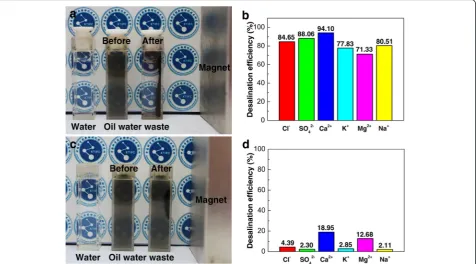
The purification property of the as-synthesized nanopar-ticles was evaluated by using the magnetic nanoparnanopar-ticles to treat the oilfield wastewater obtained from Karamay oil field as an example of complex multiphase wastewater, as shown in Fig. 3. The major ions contributing to the salinity of this oilfield wastewater sample are chloride (43.18 %), sodium (47.57 %), and sulfate (7.99 %), while calcium (0.80 %), potassium (0.27 %), and magnesium (0.18 %) are minor ions quantified by ion chromatography, as shown by Table 1. The oil content in this oilfield wastewater sample was measured to be 812.9 mg/L using inferred oil content analyzer.
The sludge oilfield wastewater became obviously much clearer after treatment associating to the removal of oil emulsions in the system while using Fe3O4@SiO2 -MPS-AM-DMC-AMPS nanoparticles to carry out the purifi-cation (Fig. 3a), which was further proven by the IR oil content analyzer results. After treated with the nanopar-ticles, the oil content of the sample dropped dramatically to 20.8 mg/L, indicating a great oil-removal capacity of 2534.7 mg/g of the nanoparticles. On the other hand, the ion analysis of the supernatant further confirms the excellent desalination efficiency of the as-synthesized Fe3O4@SiO2-MPS-AM-DMC-AMPS nanoparticles to remove both cations and anions remarkably (Fig. 3b). It is shown that the Fe3O4@SiO2-MPS-AM-DMC-AMPS nanoparticles can remove most of the major ions, 84.7 %
[image:6.595.57.540.86.351.2]of chloride, 80.5 % of sodium, and 88 % of sulfate, with a total weighted average desalination efficiency of 83 %. The overall removal capacities of the nanoparticles for cations and anions are 30073.9 and 33289.6 mg/g, res-pectively. Thus, the as-synthesized Fe3O4@SiO2 -MPS-AM-DMC-AMPS nanoparticles with oil-removal property show high desalination efficiency, providing a simple one-step purification method of complex multiphase wastewater system like oilfield wastewater. In con-trast, the sludge oilfield wastewater remained visibly unchanged after treatment while utilizing Fe3O4 nano-particles without surface modification as the purifica-tion agent (Fig. 3c). Furthermore, Fe3O4 nanoparticles shows a poor ion removal capacity with the best ion removal rate of 18.95 % for calcium (Fig. 3d). This re-sult provides a vivid demonstration that our multi-functionalization design of MNPs with AM, DMC, and AMPS works effectively for multiphase complex system purification.
As previously discussed, the capability of desalination was introduced to the magnetic nanoparticles by the functional polymeric shell synthesized via a one-pot free radical polymerization of three different monomers. Thus, the ratio of the three monomers is a significant factor affecting the desalination efficiency of the mag-netic nanoparticles. A series of Fe3O4@SiO2
-MPS-AM-DMC-AMPS nanoparticles were synthesized with differ-ent AM: DMC: AMPS monomer ratios and applied for the purification of the identical oilfield wastewater sam-ple to evaluate their desalination properties.
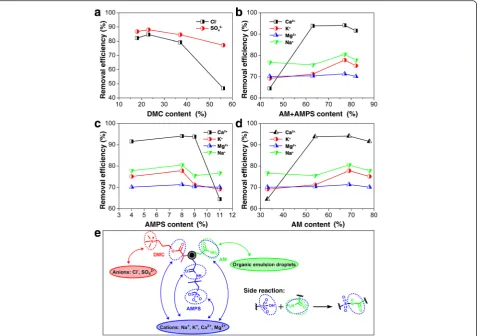
The removal efficiencies of anions, i.e., Cl− and SO42−, as a function of the DMC content are plotted in Fig. 4a. It is obvious that with the increase of DMC content, the removal efficiencies for both Cl− and SO42− anions in-crease first and then dein-crease. The removal efficiency dropped much more significantly for Cl−with increasing the content of DMC in the polymeric shell, which can be attributed to the introduction of chloride ions into the system by the amino chloride group on DMC. Be-sides, the removal efficiency of SO42− decreases slightly with further increase of DMC due to the fact that the active adsorbent sites for Cl− and SO42− anions got de-creased. Therefore, with the increase of the amount of DMC, there is a balance between the increase of the ad-sorbent sites for Cl− and SO42− anions and the increase of the introduced chloride anions. Meanwhile, both AM and AMPS have the amide groups which can bind with cations, i.e., Na+, K+, Mg2+and Ca2+. Therefore, the re-moval efficiencies of cations as a function of the AM + AMPS content are plotted in Fig. 4b. It is shown that with the increase of the AM + AMPS content, the re-moval efficiencies of all the four cations all increased
Fig. 3Purification performance of the nanoparticles towards oilfield wastewater. Photographs of deionized water, oilfield wastewater before and after treated withaFe3O4@SiO2-MPS-AM-DMC-AMPS andcFe3O4under external magnet field, respectively, and the corresponding desalination
[image:7.595.62.539.89.353.2]firstly and then kept stable, indicating the achievement of ion exchange equilibrium. With a further incensement of AMPS + AM content, the cations removal efficiencies started to drop. One possible explanation for this phenomenon is that with the increase of the amount of both AMPS and AM monomers, there are side reactions consuming functional groups, such as sulfonic acid and amino groups. When considering AMPS content only, the removal efficiency changing trend is different (Fig. 4c). With the increase of the amount of AMPS, the cation re-moval efficiencies increased slightly first and then dropped dramatically, which could also be attributed to the side re-actions during the polymerization process. Although both AM and AMPS have a binding effect with cations, AMPS with the sulfonic acid group acts as the main component for cation adsorption. Thus, the consumption of sulfonic acid group affects the cation removal efficiencies greatly. The changing trends of the removal efficiencies for the cat-ions with the increase of the content of AM are similar to those of AMPS + AM, as shown in Fig. 4d. To vividly explain the reason for the desalination performance, the
binding interaction between the functional groups on the polymeric shell with ions and organic emulsion droplets is further illustrated in Fig. 4e. One also can find that the side reaction during the polymerization would affect the ratio of the functional groups. Thus, it is demonstrated that the functional groups on the three monomers, namely DMC, AM, and AMPS, are able to bind with anions, organic droplets, and cations, respectively. Furthermore, the de-signed Fe3O4@SiO2-MPS-AM-DMC-AMPS nanoparticles with an optimized monomer ratio of AM: DMC: AMPS (3:3:1) is a suitable purification agent for complex multi-phase system.
Conclusions
In summary, to realize the purification of complex multi-phase industrial wastewater, a facile one-pot free radical polymerization of AM, DMC, and AMPS was designed to form a polymeric shell on the surface of MPS-functionalized Fe3O4@SiO2nanoparticles. To evaluate the overall removal efficiency, the as-synthesized Fe3O4@SiO2 -MPS-AM-DMC-AMPS nanoparticles were applied as the purification agent
Fig. 4Relationship between surface functionalities and the purification performance. Ions removal efficiencies as a function ofaDMC content,
[image:8.595.61.539.88.424.2]for oilfield wastewater, a great example of complex multi-phase system. Excellent removal efficiencies for cations (80.68 %) and anions (85.18 %) along with oil (97.4 %) were achieved with the AM: DMC: AMPS ratio of 3:3:1. The design concept illustrated here presents a facile multi-functionalization method of magnetic nanoparticles which can fulfill specific application demands.
Competing Interests
The authors declare that they have no competing interests.
Authors’Contributions
YG and YL contribute equally to this work. YG participated in the fabrication of the Fe3O4@SiO2-MPS-AM-DMC-AMPS nanoparticles and measured the
purification properties of the nanoparticles. YL analyzed the results and wrote the manuscript. CZ participated in the preparation of the Fe3O4@SiO2
-MPS-AM-DMC-AMPS nanoparticles with different monomer ratios. BZ and XD participated in the design of the study and coordination of the work. All authors contributed to interpretation of the results and drafting of the manuscript and they read and approved the final version.
Acknowledgements
We thank the financial supports from the Xinjiang Program of Cultivation of Young Innovative Technical Talents (2014731020) and the“Hundred Talents Program”of CAS.
Received: 24 February 2016 Accepted: 13 April 2016
References
1. Lindsay S (2009) Introduction to nanoscience. OUP, Oxford 2. Jin Y, Jia C, Huang SW, O'Donnell M, Gao X (2010) Multifunctional
nanoparticles as coupled contrast agents. Nat Commun 1(4):150 3. Sasso L, Suei S, Domigan L, Healy J, Nock V, Williams MA et al (2014) Versatile
multi-functionalization of protein nanofibrils for biosensor applications. Nanoscale 6(3):1629–1634
4. Shu D, Shu Y, Haque F, Abdelmawla S, Guo P (2011) Thermodynamically stable RNA three-way junction for constructing multifunctional nanoparticles for delivery of therapeutics. Nat Nanotechnol 6(10):658–667 5. Schladt TD, Shukoor MI, Schneider K, Tahir MN, Natalio F, Ament I et al
(2010) Au@ MnO nanoflowers: hybrid nanocomposites for selective dual functionalization and imaging. Angew Chem Int Ed 49(23):3976–3980 6. Groult H, Ruiz-Cabello J, Pellico J, Lechuga-Vieco AV, Bhavesh R, Zamai M et
al (2015) Parallel multifunctionalization of nanoparticles: a one-step modular approach for in vivo imaging. Bioconjug Chem 26(1):153–160
7. Sukhorukov GB, Rogach AL, Garstka M, Springer S, Parak WJ, Munoz-Javier A et al (2007) Multifunctionalized polymer microcapsules: novel tools for biological and pharmacological applications. Small 3(6):944–955
8. Torney F, Trewyn BG, Lin VS, Wang K (2007) Mesoporous silica nanoparticles deliver DNA and chemicals into plants. Nat Nanotechnol 2(5):295–300 9. Chen J, Chen S, Zhao X, Kuznetsova LV, Wong SS, Ojima I (2008) Functionalized
single-walled carbon nanotubes as rationally designed vehicles for tumor-targeted drug delivery. J Am Chem Soc 130(49):16778–16785
10. Pastorin G, Wu W, Wieckowski S, Briand JP, Kostarelos K, Prato M et al (2006) Double functionalization of carbon nanotubes for multimodal drug delivery. Chem Commun 11:1182–1184
11. Garanger E, Aikawa E, Reynolds F, Weissleder R, Josephson L (2008) Simplified syntheses of complex multifunctional nanomaterials. Chem Commun 39:4792–4794
12. Hosta-Rigau L, Olmedo I, Arbiol J, Cruz LJ, Kogan MJ, Albericio F (2010) Multifunctionalized gold nanoparticles with peptides targeted to Gastrin-releasing peptide receptor of a tumor cell line. Bioconjug Chem 21(6):1070–1078 13. Gao XH, Cui YY, Levenson RM, Chung LWK, Nie SM (2004) In vivo cancer
targeting and imaging with semiconductor quantum dots. Nat Biotechnol 22(8):969–976
14. Lu AH, Salabas EL, Schuth F (2007) Magnetic nanoparticles: synthesis, protection, functionalization, and application. Angew Chem Int Ed 46(8): 1222–1244
15. Georgelin T, Maurice V, Malezieux B, Siaugue J-M, Cabuil V (2009) Design of multifunctionalizedγ-Fe2O3@SiO2core-shell nanoparticles for enzymes
immobilization. J Nanopart Res 12(2):675–680
16. Cho NH, Cheong TC, Min JH, Wu JH, Lee SJ, Kim D et al (2011) A multifunctional core-shell nanoparticle for dendritic cell-based cancer immunotherapy. Nat Nanotechnol 6(10):675–682
17. Basuki JS, Duong HTT, Macmillan A, Whan R, Boyer C, Davis TP (2013) Polymer-grafted, nonfouling, magnetic nanoparticles designed to selectively store and release molecules via ionic interactions. Macromolecules 46(17):7043–7054 18. Kokate M, Garadkar K, Gole A (2013) One pot synthesis of magnetite-silica
nanocomposites: applications as tags, entrapment matrix and in water purification. J Mater Chem A 1(6):2022–2029
19. Zhang H, Zhang G, Bi X, Chen X (2013) Facile assembly of a hierarchical core@shell Fe3O4@CuMgAl-LDH (layered double hydroxide) magnetic
nanocatalyst for the hydroxylation of phenol. J Mater Chem A 1(19):5934–5942 20. Lin L-S, Cong Z-X, Cao J-B, Ke K-M, Peng Q-L, Gao J et al (2014)
Multifunctional Fe3O4@polydopamine core-shell nanocomposites for
intracellular mRNA detection and imaging-guided photothermal therapy. ACS Nano 8(4):3876–3883
21. Torad NL, Hu M, Ishihara S, Sukegawa H, Belik AA, Imura M et al (2014) Direct synthesis of MOF-derived nanoporous carbon with magnetic Co nanoparticles toward efficient water treatment. Small 10(10):2096–2107 22. Torad NL, Hu M, Imura M, Naito M, Yamauchi Y (2012) Large Cs adsorption
capability of nanostructured Prussian blue particles with high accessible surface areas. J Mater Chem 22(35):18261–18267
23. Ayad M, Salahuddin N, Fayed A, Bastakoti BP, Suzuki N, Yamauchi Y (2014) Chemical design of a smart chitosan-polypyrrole-magnetite nanocomposite toward efficient water treatment. Phys Chem Chem Phys 16(39):21812–21819 24. Liu Z, Yang H, Zhang H, Huang C, Li L (2012) Oil-field wastewater
purification by magnetic separation technique using a novel magnetic nanoparticle. Cryogenics 52(12):699–703
25. Li S, Li N, Yang S, Liu F, Zhou J (2014) The synthesis of a novel magnetic demulsifier and its application for the demulsification of oil-charged industrial wastewaters. J Mater Chem A 2(1):94–99
26. Shen Y, Tang J, Nie Z, Wang Y, Ren Y, Zuo L (2009) Preparation and application of magnetic Fe3O4nanoparticles for wastewater purification.
Sep Purif Technol 68(3):312–319
27. Zhu J, Zheng H, Jiang Z, Zhang Z, Liu L, Sun Y et al (2013) Synthesis and characterization of a dewatering reagent: cationic polyacrylamide (P (AM-DMC-DAC)) for activated sludge dewatering treatment. Desalin Water Treat 51(13-15):2791–2801
28. Wang H, Kang J, Liu H, Qu J (2009) Preparation of organically functionalized silica gel as adsorbent for copper ion adsorption. J Environ Sci 21(11):1473–1479 29. Deng H, Li X, Peng Q, Wang X, Chen J, Li Y (2005) Monodisperse magnetic
single-crystal ferrite microspheres. Angew Chem Int Ed 117(18):2842–2845 30. Pan M, Sun Y, Zheng J, Yang W (2013) Boronic acid-functionalized
core-shell-shell magnetic composite microspheres for the selective enrichment of glycoprotein. ACS Appl Mater Inter 5(17):8351–8358
31. Stöber W, Fink A, Bohn E (1968) Controlled growth of monodisperse silica spheres in the micron size range. J Colloid Interf Sci 26(1):62–69 32. Shao M, Ning F, Zhao J, Wei M, Evans DG, Duan X (2012) Preparation of
Fe3O4@SiO2@layered double hydroxide core-shell microspheres for
magnetic separation of proteins. J Am Chem Soc 134(2):1071–1077 33. Lei Z, Li Y, Wei X (2008) A facile two-step modifying process for
preparation of poly (SStNa)-grafted Fe3O4/SiO2particles. J Solid State Chem