Fast Mode Decision and Encryption Policy in
H.264/AVC Frame-skipping Transcoding
Xiaohong Zhang
School of Information Engineering /Jiangxi University of Science and Technology, Ganzhou, China Email:[email protected]
Baolin Qiu
School of Information Engineering /Jiangxi University of Science and Technology, Ganzhou, China Email:[email protected]
Abstract—H.264/AVC adopts Rate-Distortion Optimization (RDO) techniques to search all the prediction modes supported by standard in turn, then determine the optimal encoding mode which has the minimum rate-distortion cost. Frame-skipping transcoding among heterogeneous networks is a way to lower bitrate transcoding, which can solve incompatibility issues of video stream transmission. Aiming to varied motion problem of the video sequences, this paper introduces a set of adaptive threshold for inter mode decision, which can make a more correct code judgment of motion characteristics for the macroblock, also can obtain more reliable video quality; Combing the mode information of the skipping frame which can not be recovered, a simple and practicable encryption policy is introduced here, which avoids the shortcomings of traditional encryption algorithm complexity. Experimental results show that the encoding time of the new algorithm is almost the same with that of the referenced algorithm, the peak value SNR increases steadily, so novel scheme guarantees nice video quality; Encryption policy achieves the desired encryption effect and efficiency, and broadens the applications of the video security technology.
Index Terms— H.264/AVC; frame-skipping transcoding; adaptive threshold; inter mode decision; encryption
I.INTRODUCTION
With the rapid development of media technique, people pay growing attention and concern about the video quality and safety. As the newest video coding standard, comparing with H.263, H.264/AVC developed by both ITU-T VCEG and ISO/IEC MPEG standards committees displays a number of new ideas and new techniques, such as H.264/AVC divides operation processing of encoding
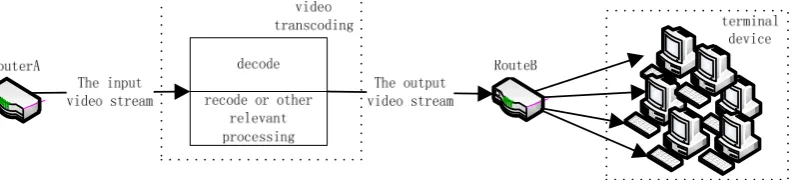
and network into two separate levels (layer): VCL (Video Coding Layer) and NAL (Network Abstraction Layer); flexible block transform in motion compensation; introducing 1/4 pixel precision motion compensation; loop de-blocking filtering technologies, and so on. H.264/AVC not only has tremendous progress and improvement in the video compression efficiency (under the same video quality, the compression ratio of H.264/AVC is twice as that of H.263), but also has been greatly improvement in the transmission, network compatibility [1]-[2]. Facing different network transmission limitations, original video stream is often required to decode, then undergo the second encoding or the other corresponding processing operations to meet vary requirements of terminal device, this process is defined as video transcoding. In H.264 standard, ME (Motion Estimate) and MC (Motion Compensation) are complicated and time-consuming [3]. The time they cost is more than 60% of the entire coding time[4]. It’s the main factor that impacts the implementation and application of H.264 [5]. Obviously, in video transcoding, using the mode traversal search strategy will decrease transcoding efficiency, so that the time complexity increases dramatically. Frame-skipping transcoding aims at solving the limitation of data transmission rate and bandwidth between heterogeneous networks, which is a kind of transcoding converting the higher quality compression code stream into lower code rate compression stream. Fig. 1 is a simplified schematic diagram of transcoding:
In order to avoid unnecessary mode search and compute in the frame-skipping transcoding process, as well as encrypts important frame, we can achieve accelerating encoding rate and access to safe video goals. In the field of skipping transcoding, many scholars and experts conduct a series of studies and improvement about relevant algorithms[6]-[8], for example, according to the macroblock motion features to avoid unnecessary mode search in order to accelerate transcoding speed[7]; selectively using the screened out mode to reduce the number of encode modes in order to accelerate transcoding efficiency [9]; combined the time-domain correlation of macroblock to reduce the number of prediction modes in order to accelerate transcoding speed [10] and so on. To ensure the security of video, a series of achievements have obtained, such as detecting and extracting the interesting regions, then integrate with H.264 encryption algorithms reasonably [11]; a selective encryption algorithm is proposed to protect video data which can performed in both types of CABAC and CAVLC [12] .
The key of frame-skipping transcoding is using the original macroblock coding information as reasonable as possible. Combined with encryption policy, it can not only speed up the second video encoding but also ensure the video quality and safety. Reference [7] introduces a pair of fixed threshold values to define and classify the movement of macroblock in the frame, and adopts the corresponding coding mode selection algorithm for the different motion characteristics of the macroblock. Therefore, the algorithm can eliminate some unnecessary mode search and computer, which plays a significant role on the enhancement for the execution efficiency of frame-skipping transcoding. However, the motion characteristics of video sequences are quite unstable in the real world. If we use the same fixed threshold criteria to measure and define the video feature when the motion characteristics of video sequence vary considerably large, it is not accurate. At the end, the inaccurate judgment of movement characteristics will result into the decrease of video quality. This paper introduces adaptive transcoding thresholds for fast mode selection and encryption policy. According to the current movement of macroblock, it is flexible to change the value of adaptive thresholds in the process of program execution which is used to define the motion characteristics of macroblock. Therefore, the judgment that what modes of macroblock need to be searched and calculated again is more accurate. Then, encrypting the key frame of video sequences with the encryption policy introduced here will get quality assured video sequences ultimately. Experimental results show that: on the premise that ensures the efficiency of frame-skipping transcoding, the algorithm introduced here achieves higher peak signal to noise ratio and better encryption effect, obtains better applicability.
II.H.264/AVC INTER-MODE DECISION
In the inter frame coding of H.264/AVC, it can store reconstructed image of the current coding frame in order to provide reference frame for the inter frame coding. The
coding unit of inter frame coding is 16×16 macroblock. Relevant regulations of H.264 show that there are seven segmentation methods for inter frame coding of macroblock. Macroblock size of 16×16 can be divided into 16×16, 16×8, 8×16 or 8×8, segmentation method of 8×8 will proceed subdivision into sub-macroblock. Every sub-macroblock will be divided into 8×8, 8×4, 4×8 and 4×4, then conducts motion estimation and rate-distortion cost calculation to determine the optimum encoding mode of the current macroblock, respectively. Table I gives the corresponding relationship between the inter coding mode and segmentation method in baseline profile of H.264. For example: horizontal size is 16, vertical size is 8, corresponding to the segmentation method is 16×8. “2 sizes/mode 2”, in the corresponding cell means that the macroblock is divided into two sub-macroblocks whose size is 16×8 and corresponding coding mode is mode 2.
Procedures for inter mode decision of macroblock in H.264/AVC standard are as follows:
Step 1:According to segmentation method of 16×16,16×8,8×16 in the macroblock level,conduct motion estimation and calculate the rate-distortion cost for the current macroblock to be encoded in turn;
Step 2: As to the 8×8 segmentation method followed, conduct motion estimation, calculate rate-distortion cost for the four sub-macroblock by the way of 8×8,8×4,4×8 and 4×4 in turn,then select the mode with the minimal value of rate-distortion cost as the best encoding mode of current 8×8 sub-blocks ;
Step 3: Add the minimum rate-distortion value of the four 8×8 sub-blocks calculated respectively in step 2 up,use the sum as rate-distortion cost of the current macroblock in 8×8 segmentation method;
Step 4: Calculate motion vector and rate-distortion value of the mode 0 (Direct mode) ;
Step 5: Calculation rate-distortion cost of mode 9 (I4MB, intra mode) and mode 10 (I16MB, intra mode) in turn;
Step 6: Select the mode with minimum rate-distortion cost from step 1,3,4,5 as the best inter encoding mode of the current macroblock.
The way that H.264 searches and calculates rate-distortion cost for all supported modes will result in a substantial increase in execution time and lead to the decline of coding efficiency. Therefore, the search
TABLE I.
CORRESPONDENCE TABLE OF SEGMENTATION METHOD AND CODING MODE
Vertical
Horizontal 16 8 4
16 1 size /mode 1 or I16MB
2 sizes
/mode 2 not have
8 2 sizes /mode 3 4 sizes
/mode 4 8 sizes/mode 5
4 not have 8 sizes
/mode 6
'
n D
P
'
n
uF '
n
F
' 1
−
n
F n F
n
D
+
+
−
+
XFigure 2. The CODEC framework of frame-skipping based on H.264.
strategy used in H.264 standard is inadvisable in the frame-skipping transcoding. Otherwise, it will limit the implementation of real-time.
III.MODE DECISION OF FRAME-SKIPPING TRANSCODING A. The Frame-Skipping Framework Based On
H.264/AVC
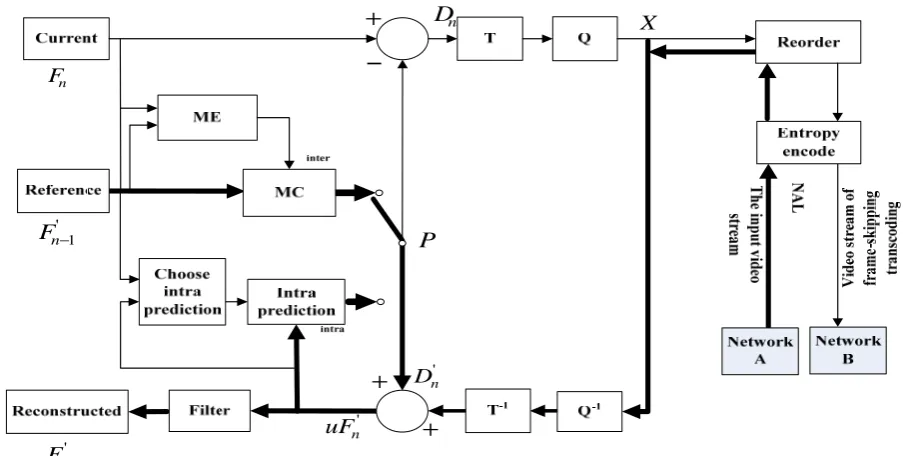
In the original compressed stream, there is much helpful macroblock information can be used in frame-skipping transcoding, such as mode information, the pixel residuals and motion vector information and so on. Appropriate using of such information will play a significant role in promoting the transcoding speed. Fig. 2 is map that shows the CODEC (enCOder/DECoder pair) framework of frame-skipping transcoding based on H.264
The figure contains two part processes of the encoder and the decoder, the thin line part shows process of encoder, the thick line part shows process of decoder.
B. Fast Mode Decision Of Frame-Skipping Transcoding
Introduce a set of variable thresholds to achieve real-time adaptive capacity of the motion feature for current video sequence so that the algorithm can distinguish the actual motion characteristics more precisely for macroblocks of different video sequences. Thus, achieve more appropriate and accurate classification of the current macroblock, which leads to the result of better video quality.
Generally, it’s scarcely possible that the adjacent video images make sudden change, so the adjacent image frames have a very strong correlation. During frame-skipping transcoding process, with this principle, the encoding mode of the current macroblock
] ][ [n k
curr_mode (n is the number of frame, k is the number of macroblock) makes reference to the mode of macroblock k in frame n(mode[n][k]) and the mode of the dominant macroblock k in frame n-1(mode[n-1][k]). Select the mode with smaller ratio-distortion cost as the inter encoding mode of current macroblock by calculating and comparing the cost. The macroblock of the skipped frame n-1 whose area covered by the current macroblock
is the largest among the four covered macroblock is defined as the dominant macroblock.
Equation (1) is proposed by reference [7], defines a variable that is used to measure and characterize motion characteristic of the current macroblock. The value of the variable is the sum of the two absolute values of original motion vector’s horizontal and vertical components.
| |MV | |MV
MMMB = [0]+ [1]. (1)
] 0 [
MV is the horizontal component of original motion vector, MV[1] is the vertical component of original
motion vector.
As MMMB reflects the motion characteristic of the
current macroblock, the variable also shows the degree of relevant for mode[n-1][k] and mode[n-1][k] in the two adjacent frames.
(1) When the value of MMMB is small, indicate that the
time-domain characteristics of current macroblock are relatively stable, the two adjacent frames have a strong correlation. Use mode[n][k] ( sub_mode[n][k] , sub-macroblock mode) as curr_mode[n][k]directly;
(2) When the value of MMMB is not small enough,
haven’t a strong correlation. The algorithm should computer RD cost of mode[n][k](sub_mode [n-1][k]) and mode[n-1][k] ( sub_mode[n-1][k] ) to determine
] ][ [n k curr_mode .
(3) When the motion of video sequences is too intense, means that the time-domain characteristics of current macroblock are quite unsteady, so algorithm needs to search all modes supported in H.264 to determine the best encoding mode of the current macroblock.
C. Fast Mode Decision With Adaptive Threshold
In order to obtain more guaranteed quality of video sequences, this paper introduces a simple and linear calculation method to calculate the changeable threshold. The threshold interval is defined as [low_value ,high_value ]. Combined with this set of threshold, the algorithm classifies the motion characteristic of current macroblock.
⎩ ⎨ ⎧
= =
b-k*ratio high_value
a-k*ratio
low_value . (2)
ratio in the equation is discrete, its value is natural number. Comparing PSNR Y (PSNR of Y component) values of the two adjacent frames, when a continuous decline in the value of PSNR Y occurs, then the value of
ratio is 1; when continuous decline in the value of PSNR Y occurs twice, then the value of ratiois 2 and the value of ratio on the other situation can be obtain in the same manner; if PSNR Y doesn’t decline, then the value of ratio is 0. k in the equation reflects the adaptation speed that the threshold adapts the movement of the current video sequence. Therefore, it will bring inaccurate reflection to the judgment of motion characteristic of macroblock when the value of k is assigned too large or too small. According to experimental statistics of video sequences, assign 5 to k. Introduce variable deta, its value is determined by the decreased PSNR Y value of the two adjacent frames. deta characterizes the intensity of movement. If the decreased PSNR Y value of the two adjacent frames is small, then deta=0; If the decreased
PSNR Y value of the two adjacent frames is large, then,
1 =
deta .
From (2) we know that the adaptive threshold value is determined ultimately by basis value (i.e. a and b) and the fine turning value(i.e. Minus k*ratio). Reasonable assigning of basis value can adapt the video motion feature faster, and the fine turning can make the threshold adapt the motion feature of video sequence more accurately. The more PSNR decreases, the worse the adaptability of threshold to the video, i.e., threshold is too large or too small. Combed with algorithm analysis, on the one hand, when the threshold value is too large, it will result in that most of the values of MMMB are smaller
than the threshold, so the current macroblock will continue to follow original mode to re-encode. While the original encoding mode is not necessarily the best encoding mode in frame-skipping transcoding, which will result in that the quality of video declines i.e. PSNR
drops. On the other hand, the coding efficiency will decline if the threshold is too small. Therefore, under the premise of guaranteed coding efficiency, in order to avoid mischoosing the inaccurate mode by mistake and obtain more accurate judgment of motion characteristics, the paper assigns smaller number to basis value appropriately. For the sake of faster and flexible adaptation of video movement, design two levels for basis value a and b.
If deta=0, then a=65 and b=85; If deta=1, then a=35 and b=50.
The initial values of a and b are determined by experimental statistics of a series of different video sequences with varied motion characteristics.
In the process of frame-skipping transcoding, compare
MB
MM reflected the motion characteristic with low_value and high_value. If MMMB≤low_value, means that motion characteristic of macroblock is stable; otherwise, it’s unstable, algorithm needs to calculate some rate-distortion values to finally determine
] ][ [n k
curr_mode .The following is specific algorithm steps:
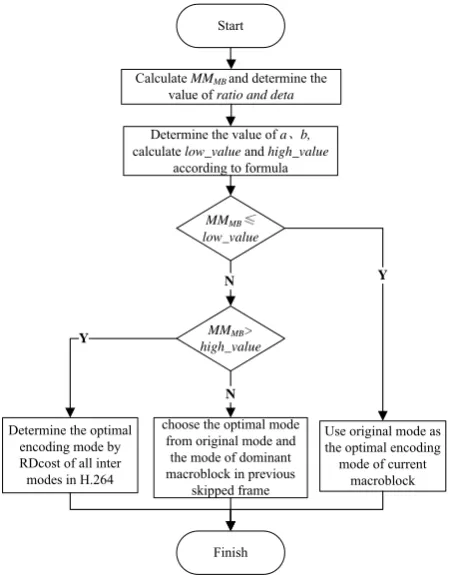
Step 1: Calculate the value of (1), and determine the value of ratio and deta by comparing the PSNR Y of adjacent frames;
Step 2: According to the change of PSNR, determine the value of a and b;
Step 3: Combined with ratio, a and b, work out the current value of low_value andhigh_value;
Step 4: Compare MMMB with low_value. If more than
half of macroblocks (sub-macroblocks) satisfy MMMB≤low_value, the motion characteristic of macroblock is slow and stable. Then, use
] ][ [n k
mode ( sub_mode[n][k]) as the optimal encoding mode of the current macroblock. Otherwise, go to Step 5;
Step 5: Compare MMMB with high_value . If more
than half of macroblocks (sub-macroblocks) satisfy high_value
MMMB> , the motion characteristics of
macroblock is violent movement. Determine the optimal encoding mode of the current macroblock by searching all inter mode supported in H.264. Otherwise, go to Step 6;
Step 6: Otherwise, satisfy high_value
MM
low_value≤ MB< . In this case, determine
the optimal encoding mode of the current macroblock by calculating RDcost of mode[n][k](sub_mode[n][k]) and
] ][ [n-1 k
mode ( sub_mode[n][k] ). Use the mode with smaller RDcost as the optimal mode of current macroblock;
The following flow chart shows the inter encoding mode decision of frame-skipping transcoding with adaptive threshold:
choose the optimal mode from original mode and
the mode of dominant macroblock in previous
skipped frame Start
Determine the value of a b,
calculate low_value andhigh_value
according to formula
Determine the optimal encoding mode by RDcost of all inter modes in H.264
MMMB
low_value
Use original mode as the optimal encoding mode of current
macroblock Y N
MMMB>
high_value
Y
N
Finish
Calculate MMMB and determine the
value of ratio and deta
Figure 3. The flow chart of inter encoding mode decision.
IV.ENCRYPTION POLICY OF FRAME-SKIPPING TRANSCODING IN H.264/AVC
Nowadays, with the rapid development of multimedia technology and popularization of network, multimedia information, people's life, and daily work are inextricably linked. Since video data of frame-skipping transcoding relates to many security issues like its own restrictions of network (such as network congestion, bandwidth limitations, etc.) and human factors (such as information theft, data corruption during network transmission, etc.), also relates to users' security requirements of video data [13]. Therefore, introduce secure encryption algorithms to protect frame-skipping transcoding data. And use the mode information of macroblock in skipped frame which comes from frame-skipping transcoding to process the encryption key.
A. Traditional Video Encryption
As to the research of video coding encryption algorithm, many achievements have been acquired now. The security of encryption algorithm is closely related to the encryption positions which even directly affect the efficiency and practicability of encryption algorithm. According to the designer’s consideration of the encryption algorithm, the selection of encryption position is flexible, such as some header information of NAL (Network Abstraction Layer) data packets, MVD (motion vector difference), some key syntax elements, DCT. Generally, the main encryption way is data scrambling or critical data extraction.
B. The Encryption Policy By Removing The First Frame Of Bit Stream
Inspired by the unrecoverable information of skipped frame in the process of frame-skipping transcoding, propose an encryption policy to destroy some vital information reasonably when conduct encoding, which results in that the decoder client without the authorization can not correctly decode the bit stream of video by the way of statistical analysis or other means. Therefore, the video data can achieve a high level of security.
In the inter-frame coding process of H.264 standard, the reference image of the current slice which has encoded before conducts motion compensation to obtain the prediction PRED (i.e. indicated by P in Fig. 3). The PRED is subtracted the current block, then get a residual or difference macroblock Dn. After transformation and
quantization of Dn, a set of quantized transform
coefficients X is obtained. Take these coefficients to re-order as well as entropy. Together with some side information (such as the prediction mode of macroblock, motion vector, etc) which is indispensable for decoding macroblock, achieve the compressed bit stream. Then, the bit stream will be passed to NAL to store or transmit to the receiver.
Combined with the brief statement of H.264 encoding process in the previous section, obviously, I frame is the foundation for the decoding of subsequent P-frame, so I frame is crucial. Although the video format is unbroken, residuals is undamaged, motion vector is correct, the decoder can not decode the original video sequence without PRED information. Therefore, this encryption algorithm that remove the whole compressed bitstream unit of I frame which is used as reference frame during encoding video is proposed and implemented. Undoubtedly, it is serious damage for the compressed bitstream of original video sequence. The whole encrypted compressed bitstream of P frames which is lack of the whole compressed bitstream unit of I frame are stored and transmit to the client-side. Therefore, the subsequent P frame can never be decoded correctly without supporting information of reference frame (i.e. I frame) if the compressed bitstream of video sequence is obtained by an unauthorized intruder. Then, the other frame which uses this subsequent P frame as reference frame can never continue to be decoded, which will trigger the chain reaction. The reaction leads to a result that the whole compressed bitstream of video can not be decoded, which guarantees high security but easy to do.
⊕
Figure 4. The process chart of encryption policy.
The encryption algorithm only needs to conduct some code integration for the encoder in JM of H.264 coding standard. The program has strong portability. In addition, it is simple and practicable, which makes it easy to promote practical applications; the encryption algorithm needn’t keep secret, the security of video bitstream only depends on the key; the brute force attack on the encryption algorithm is unrealistic, which makes the security of encryption compressed bitstream is relatively high.
C. The Key Processing
During frame-skipping transcoding, use the mode data of macroblock in skipped frame to encrypt coding mode of macroblock in the I frame which is used as the key to scrambling encryption. The encrypted mode
ption
mode_encry is calculated by (3):
mode_skip rand
best_mode ption
mode_encry = + + . (3)
In (3) best_mode is the optimal encoding mode of macroblock before encryption. rand is an artificially
generated random integer within limits which can be changed by man. mode_skip comes from the non-zero encoding mode of macroblock in the skipped frame.
It is arbitrary nature of rand and unrecoverable nature
of mode_skip that make the concealment and security of best_mode stronger, which produce one more security assurance. The operation of protection to the key only involves addition and subtraction, which will just cause a little computational overhead. Therefore, appropriate protection to the key isn’t making an unnecessary move. On the contrary, higher security of service for the user is obtained at a quite low computational cost. At first, free the operation of protection for the key after legitimate user receives all the encrypted bitstream. Then, with the key, the encrypted compressed bitstream can be decrypted correctly. The correct video sequence will be obtained at last.
V.EXPERIMENTAL RESULTS AND ANALYSIS
The experimental platform is the baseline profile of H.264 in JM8.6, the operating system is XP system, use PC with 2.09GHz dual-core intelprocessor and 1.99GB memory. In order to verify the effectiveness of the proposed algorithm, experiment uses five test sequences with different motion characteristics. The size of video
sequence is 176×144. The test sequences are akiyo_qcif.yuv, mobile_qcif.yuv, foreman_qcif.yuv , highway_qcif.yuv and carphone_qcif.yuv respectively. Each sequence contains 200 frames. The first frame is the I frame, the rest of frames are P frames.
A. Experimental Results
Experimental results are composed of three part data. The first part comes from frame-skipping transcoding with standard mode search strategy of H.264, the second part comes from frame-skipping transcoding with fast mode decision algorithm proposed in reference [7], the last part comes from frame-skipping transcoding with the fast mode decision used adaptive threshold which is proposed by this paper. The paper mainly compared PSNR Y and time of motion estimation ( Time ). The specific results are shown in Table 2
The encrypted video bitstream without any information of I frame can’t get reference frame. The illegal user can never decrypt the encrypted bitstream as well as seen the decrypted results without correct key. Use the right key to decrypt the encrypted bitstream and select one frame randomly (select unified the 55th frame) to be displayed in Fig. 5:
Standard mode search/Reference [7]/This paper
akiyo_qcif.yuv
carphone.yuv
foreman_qcif.yuv
highway_qcif.yuv
mobile_qcif.yuv
B Analysis Of Experimental Results
Data obtained from the above experiments indicated that:
(1) Synthesize the motion estimation time that the former 200 frames of the five test sequences. Although, standard mode search pattern obtained the higher peak signal to noise ratio, the total time spent on motion estimation increases, because the standard results in the increasing of complexity. The average time that algorithm proposed by this paper is 84.8654s less. The average time spent on motion estimation is reduced by about 35.25%;
(2) Compared with the reference [7], the PSNR of video sequence is improved steadily in this paper while the time of motion estimation are basically maintain the same time, which achieves more guaranteed quality of video service under the premise of good efficiency in process of video encoding;
(3) From the point of visual sense, image quality obtained by this paper are almost the same as that obtained by standard mode search pattern, and the other frames of the test sequences have similar experimental effects;
(4) The encrypted video bitstream encrypted by this paper can not be decrypted correctly without the decrypting key. The decrypted video sequences are completely correct when the correct key is obtained, which is related to the way of encryption directly.
So you can see that the fast mode decision and encryption policy proposed by this paper can achieve better effect of frame-skipping transcoding under the premise of guaranteed execution efficiency. Also, obtain more reliable video quality and more secure video sequence.
VI.CONCLUSIONS
The rational use of information of macroblock in original compressed bitstream can greatly promote the efficiency of frame-skipping transcoding. According to real-time movement of different video sequences, the adaptive threshold for frame-skipping transcoding proposed by this paper can use motion vector in the original compressed bitstream more accurately and reasonably. Experiments show that the algorithm proposed makes the video quality more reliable and more guaranteed under the premise of high efficiency of transcoding, as well as the encryption policy is simple and easy to do while it makes the video service keep a high security.
ACKNOWLEDGEMENTS
This work is jointly supported by the National Natural Science Foundation of China (No. 11062002, 61363076), Natural Science Foundation of Jiangxi Province (No. 20122BAB211019) and Scientific Research Key Plan Projects of Jiangxi Education Department (Nos. GJJ13435).
REFERENCES
[1] M. M. Jeong. “A new low-complexity integer distortion estimation method for H.264/AVC encoder,” IEEE Transactions on Circuits and Systems for Video Technology, vol. 20, no. 2, 2010, pp. 207-212.
[2] C. Chiang, W. Pan, and C. Hwang. “Fast H.264 encoding based on statistical learning,” IEEE Transactions on Circuits and Systems for Video Technology, vol. 21, no. 9,
2011, pp. 1304-1315.
[3] X. Su, P. Bai, Y. Wu, and Y. Feng. "An Improved Cross Diamond Motion Search Algorithm Based on H. 264,"
Journal of Computers, vol. 6, no. 12, 2011, pp. 2603-2606.
[4] Z. Shen, Z. Li, and T. Pan. “Motion estimation based on the partition and evaluation of the search area in H.264/AVC,” Journal of Image and Graphics, vol. 15, no.
2, 2010, pp. 242-246.
[5] G. Yuan, P. Liu, and K. Jia. "A Fast Motion Estimation Algorithm Based on Motion Vector Distribution Prediction," Journal of Software, vol. 8, no. 11, 2013, pp.
2863-2870.
[6] Z. Lv, K. Jia, and W. Siu. “Fast inter mode decision and motion estimation in H.264 frame-skipping transcending,”
Application Research of Computers, vol. 26, no. 12, 2009,
pp. 4814-4817.
[7] Q. Tang, and Panos Nasiopoulos. “Efficient motion re-estimation with rate-distortion optimization for MPEG-2 to H.264/AVC transcoding,” IEEE Transactions on Circuits and Systems for Video Technology,vol. 20, no. 2, 2010, pp.
262-274.
[8] T. Shanableh, E. Peixoto, and E. Izquierdo, "MPEG-2 to HEVC Video Transcoding With Content-Based Modeling," IEEE Transactions on Circuits and Systems for Video Technology, vol. 23, no.7, 2013, pp. 1191-1196. [9] X. Jin. “Low complexity H.264/AVC encoding and
transcoding,” Shanghai Jiao Tong University, 2011.
[10]Z. Lv, K. Jia, and W. Siu. “Fast inter coding in frame-skipping transcoding based on SVM,” Systems Engineering and Electronics, vol. 34, no. 6, 2012, pp.
1266-1271.
[11]J. Yu, Q. Liu, and Y. He. “H.264 video encryption algorithm based on region of interest,” CHINESE JOURNAL OF COMPUTERS, vol. 33, no. 5, 2010, pp.
945-953.
[12]Z. Shahid, C. Marc, and P. William. "Fast Protection of H. 264/AVC by Selective Encryption of CAVLC and CABAC for I and P frames," IEEE Transactions on Circuits and Systems for Video Technology, vol. 21, no. 5,
2011, pp. 565-576.
[13]T. Stutz, and A. Uhl. "A survey of h. 264 avc/svc encryption," IEEE Transactions on Circuits and Systems for Video Technology, vol. 22, no. 3, 2012, pp. 325-339.
Xiaohong Zhang, PH.D, professor, main
Baolin Qiu is currently a master student