Secure Data Aggregation in Wireless Network
using Key Based Approach
J.Kiruba Theporal M.Sangeetha
Department of Computer Science & Engineering Department of Computer Science & Engineering Christian College of Engineering & Technology Christian College of Engineering & Technology Oddanchatram, Dindigul, Tamilnadu-624619,India Oddanchatram, Dindigul, Tamilnadu-624619,India
M.Sasirekha R.Selva Muneeswari Deepika
Department of Computer Science & Engineering Department of Computer Science & Engineering Christian College of Engineering & Technology Christian College of Engineering & Technology Oddanchatram, Dindigul, Tamilnadu-624619,India Oddanchatram, Dindigul, Tamilnadu-624619,India
P.Tharcis Assistant Professor
Department of Computer Science & Engineering
Christian College of Engineering & Technology, Oddanchatram, Dindigul, Tamilnadu-624619,India
Abstract
Network security has become more important to personal computer users, organizations and the military. The internet is consider as a data network. Data Aggregation is a process of collecting information from surrounding area based on the query arrives from base station and respond or send data to the base station. Here data transmission is taking place using key value and report will be generated as key. In this paper we are going to demonstrate key based approach on the bases of public key cryptosystem. This approach which make data encryption using MD5 algorithm and key generation will be taken place using SHA-1 algorithm both are widely used in security related application. Such algorithms which aggregate data simultaneously and if attack is happened immediately it will send the report to base station. The main advantage of using this approach is to avoid blocking of nodes. The blocked node can be retrieved using screen capturing.
Keywords: Data aggregation, Encryption, Decryption, Intermediate node, message digest, secure hash algorithm
________________________________________________________________________________________________________
I. INTRODUCTION
The system process data aggregation and it is a process by which information is gathered and expressed in a summary form, for purposes such as statistical analysis. Data aggregation can be user-based personal data aggregation services offer the user a single point for collection of their personal information from other websites. The customer uses a single master personal identification number (PIN) to give them access to their various accounts. Performing this type of data aggregation will be sometimes referred to as “screen scraping.”
This aggregation process taken place using wireless technology which helps to send data form one node to another. Wireless technology is rapidly evolving and is playing an increasing role in the lives of people throughout the world. In addition ever-large number of people is relying on the technology directly or indirectly. wireless internet access makes mobile email access and web searching possible from phone and roaming mobile computers. Wireless internet services have been available for years but are now becoming easier to find and more affordable.
Here aggregation process is based on the public key cryptosystem which follow three steps (i) Encryption (ii) Key generation (iii) Decryption. A method of encryption (i.e. garbling a message so that unintended people can’t read it) in which for each person a pair of keys (digital codes) are included, one called the public key, which is disseminated widely, and one called the private key, which is known only to the intended recipient.
Data encryption will take to be place based on MD5 algorithm. MD5 is intended for use with digital signature applications, which require that large files must be compressed by a secure method before being encrypted with a secret key under a public key cryptosystem. The key generation can be take place in SHA-1 algorithm. SHA-1 is a cryptographic hash function. SHA-1 produces a 160 bit (20 byte) hash value known as a message digest.
II. RELATED WORKS
have three methods (i) The first IF method considered computes the trustworthiness of sensor nodes based on the distance of their readings to the current state of the estimated reputation and call these methods as dKVD – Reciporcal and dKVD- Affine[5]. (ii) The second IF method we consider is a correlation based ranking algorithm proposed by Zhou et al. in[6].we call this method Zhou. (iii) The third algorithm consider has been proposed by Laureti et al. in[10] and is an IF algorithm based on a weighted averaging technique.we call this method as Laureti.
E.Ayday,H.Lee and F.Fekry(2009) H.Liao,G.Cimini and M.Medothere(2012) B.-C.Chen,J.Guo,B.Tseng and J.Yang(2011) introduces an increasing amount of literature on IF algorithms for trust and reputation systems [2], [3], [9], [15]. The performance of IF algorithms in the presence of different types of faults and simple false data injection attacks has been studied, for example in [16] where it was applied to compressive sensing data in WSNs
Y.Zhou,T.Lei, and T.Zhou(2011) introduces Robust ranking algorithm by comparing with iterative refinement(IR) and mean score algorithm[10], results for both artificial and real data indicate that, the present algorithm shows a higher robustness against spammer attack.
P.Laureti,L.Moret,Y.-C Zhang and Y-K. YU(2006) introduce (iii) IF algorithm based on weighted averaging technique.The explosive growth of accessible information, expecially on the Internet,evaluation-based filtering has become a crucial task[6]. Various systems have been devised aiming to sort through large volumes of information and select what is likely to be more relevant. In this letter we analyse a new ranking method, where the reputation of information providers is determined self-consistently.
R.-H.Li,J.X.Yu,X.Huang and H.Cheng(2012) introduces robust reputation based ranking on Bipartite rating network and proposessix new reputation-based algorithms[8], where the users' reputation is determined by the aggregated diÆer-ence between the users' ratings and the corresponding objects' rankings.
S.Roy,M.Conti,S.Setia and S.Jajodia(2012) introduces Secure data aggregation in Wireless Sensor Network in that there is a large volume of published studies in the area of secure tiny aggregation in Wireless Sensor Network[7], [11], [12], [14].These studies focuses on detecting false aggregation operations by an adversary, i.e, on data aggregator nodes obtaining data from source nodes and producing wrong aggregated value.
III. PROPOSED WORK
The system propose a key based approach for preventing blocking of nodes and to identity the intermediate attack. In this report the information will be generated based on key value. This key will be encrypt and that will be send to the nearest node. Then the encrypted data value will be sent along with the same key value. To decrypt the key that will check whether the keys will be matched or not. (i) If it match then there will not be any attack.(ii) Otherwise the key will be hacked.
Two main security challenges in secure data aggregation are confidentiality and integrity of data. While traditionally encryption is used to provide end to end confidentiality in wireless sensor network(WSN),the aggregators in a secure data aggregation scenario need to decrypt the encrypted data to perform aggregation. This exposes the plain text at the aggregators, making the data vulnerable to attacks from an adversary. Similarly an aggregator can inject false data into the aggregate and make the base station accept false data. Thus, while data aggregation improves energy efficiency of a network, it complicates the existing security challenges.
The proposed system consists of source, destination and intermediate nodes. Source will send information in a compressed format. Then the encrypted data will generate a key as a report. That key will be send to the nearest node and also to the destination node. In the node that key will be encrypted and check whether two keys are same. If two keys are matched then there is no attack happened.
The attack happened means that particular node will send attacked message to the source. After that the message will be transformed using another intermediate node. That message will be send to the receipent.
The main aim of this proposed system there will not be any blocking of nodes. During attack a separate folder will be created and there some images will be stored. This images helps to know that where attack happens? and what changes they made on the key?. These change in the key will be captured and displayed in that folder. Then that key will be recovered and that node will be again used for transaction.
Encryption process will be undergone using MD5. This algorithm takes input message of arbitrary length and generates 128-bit long output hash. Hash value will be in a compressed manner. Message digest(fingerprint) algorithms are special functions which transform input of arbitrary length into output(so-called “fingerprint” or “message digest”) of constant length. Key generation will be performed using SHA-1. This SHA function are vulnerable to length-exception and partial-message collision attacks. MD5 and SHA-1 algorithms were widely used in security related applications, frequently used to check the integrity of files.
Resource
head. That means physically there is no difference between a head and a normal node because the Resource-head performs the same sensing job as the normal node.
Authentication Code Generation
To satisfy these properties, messages at the source are appended either a digital signature, a message authentication code (MAC), or an authentication code (also called tag).First, MAC and authentication codes ensure data integrity and data origin authentication, while digital signatures also provide no repudiation. Second, MACs, authentication codes, and digital signatures should be differentiated depending on what type of security they achieve: computational security or unconditional security. Here the authentication is generated based on the report as sent from the resource node.
Verifying Nodes (or) Intermediate Nodes
In particular, it is relevant in the context of fake information can transfer to the destination nodes, but also intermediate nodes, may a nodes. Using the disseminated and disclosed keys, the verifying nodes can validate the reports. In our scheme, each node can monitor its neighbors by overhearing their broadcast, which prevents the compromised nodes from changing the reports. Report verifying and key disclosure are repeatedly executed by each verifying node at every hop. Until the reports are dropped or delivered to the base station. They can also serve as verifying nodes for other resource node. The black dots represent the compromised nodes, which are located either in the Resource or intermediate node. A verifying node can receive the disclosed auth-keys, only after its upstream node overhears that it has already broadcast the reports. Receiving the disclosed keys, each verifying node verifies the reports, and informs its next-hop node to forward or drop the reports based on the verification result. If the reports are valid, it discloses the keys to its next-hop node after overhearing. The processes of verification, overhearing, and key disclosure are repeated by the verifying nodes at every hop until the reports are dropped or delivered to the recipient.
Transmission Attacks
The compromised nodes can send the false reports containing some forged or nonexistent events “occurring” in their resource. Moreover, given sufficient secret information, they may even impersonate some uncompromised nodes of other resource or intermediate node and report the forged events “occurring” within those nodes. These false reports not only cause false alarm at the Recipient, but also drain out the limited energy of intermediate nodes. Due to transmission failure of node completed data is loss.
Base Station
One type is called false report injection attacks, in which adversaries inject into networks the false data reports containing nonexistent events or faked readings from compromised nodes. These attacks not only cause false alarms at the Recipient. Resource(cluster head) node which get the data from other nodes and send the data to Recipient through Intermediate nodes. So the receiver can retrieve the complete original data by verifying the transmission at each node using homomorphic hash function.
Aggregation
The important aggregates considered by the research community include Count, and Sum. Note that it is straightforward to generalize these aggregates to predicate Count (e.g., number of sensors whose transferred data received in base station without any loss).Furthermore, Average can be computed from Count and Sum. A Sum algorithm can be also extended to compute Standard Deviation and Statistical Moment of any order.
IV. EXPERIMENTAL ANALYSIS OF KEY BASED APPROACH
Key based approach which will generate key as a report. This report will be produced based on two algorithms they are (i)MD5 and (ii)SHA-1.These algorithms were used for security related applications. The architecture diagram explained below will give a clear view.
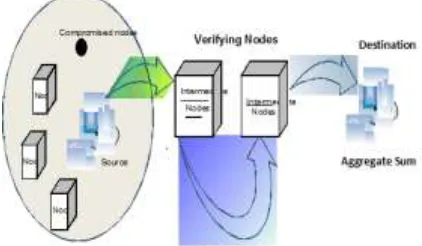
In the above fig 1 which shows data transmission from source to destination. Here several nodes will be present among that one node will be randomly selected as resource head. Using that resource head information will be proceed to verifying nodes. These verifying nodes which will verify the nodes in every hop. If there is no attack happened means then the information will be aggregated and send to the recipient. If attack happens means attacked message will be collected and stored in a separate folder compromised node. Using that we can able to understand what change they made on the node. With the help of this information we can avoid blocking of nodes.
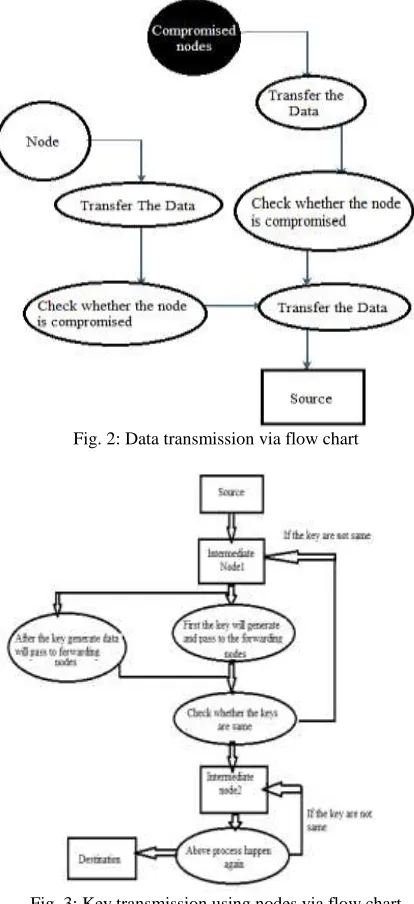
Fig. 2: Data transmission via flow chart
Fig. 3: Key transmission using nodes via flow chart
MD5
MD5 is intended for use with digital signature applications, which require that large files must be compressed by a secure method before being encrypted with a secret key under a public key cryptosystem.MD5 hash algorithm consists of five steps (i)Append Padding Bits (ii)Append Length (iii)Initialize MD Buffer (iv)Process Message in 16-Word Blocks (v)Output. This algorithm is also used in conjunction with other cryptographic methods in digital signature applications or in protocols like SSL and other.MD5 is widely used in security related application, frequently used to check the integrity of files.
SHA-1
SHA-1 forms part of several widely used security applications and protocols, including TLS and SSL,PGP,SSH,S/MIME and IPsec.
V. STIMULATED RESULTS
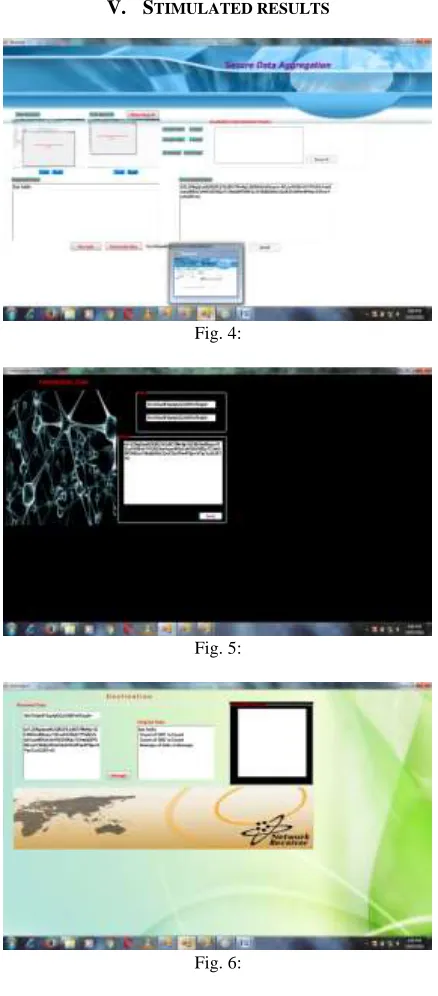
Fig. 4:
Fig. 5:
Fig. 6:
VI. CONCLUSION
The data transmission from source to recipient using intermediate nodes. The key based approach provides a way to avoid blocking of nodes. It helps to reuse that node. This approach solve problem immediately and avoid blocking of nodes. In future work, we will investigate whether our approach can protect against compromised aggregators. We also plan to implement our approach in a deployed sensor network.
REFERENCES
[1] M.Rezvani, A.Ignjatovic, E.Bertino and S.Jha, “Secure Data Aggregation Technique for Wireless Sensor Networks in the Presence of Collusion Attacks” IEEE Transaction on Dependable and Secure Computing, Vol. 12, NO. 1, JAN/FEB 2015
[2] E. Ayday, H. Lee, and F. Fekri, “An iterative algorithm for trust and reputation management,” Proc.IEEE Int. Conf. Symp. Inf. Theory, vol. 3, 2009, pp.
[3] B.-C. Chen, J. Guo, B. Tseng, and J. Yang, “User reputation in a comment rating environment,” in Proc. 17th ACM SIGKDD Int.Conf. Knowl. Discovery Data Mining, 2011, pp. 159–167.
[4] C. T. Chou, A. Ignatovic, and W. Hu, “Efficient computation of robust average of compressive sensing data in wireless sensor networks in the presence of
sensor faults,” IEEE Trans. Parallel Distrib.Syst., vol. 24, no. 8, pp. 1525–1534, Aug. 2013.
[5] C. de Kerchove and P. Van Dooren, “Iterative filtering in reputation systems,” SIAM J. Matrix Anal. Appl., vol. 31, no. 4, pp. 1812–1834, Mar. 2010.
[6] P. Laureti, L. Moret, Y.-C. Zhang, and Y.-K. Yu, “Information filtering via iterative refinement,” Europhys. Lett., vol. 75, pp. 1006–1012, Sep. 2006.
[7] Y.-K. Yu, Y.-C. Zhang, P. Laureti, and L. Moret, “Decoding information from noisy, redundant, and intentionally distorted sources,” Physica A: Statist.
Mech. Appl., vol. 371, pp. 732–744,Nov. 2006.
[8] R.-H. Li, J. X. Yu, X. Huang, and H. Cheng, “Robust reputation based ranking on bipartite rating networks,” in Proc. SIAM Int.Conf. Data Mining, 2012,
pp. 612–623.
[9] H. Liao, G. Cimini, and M. Medo, “Measuring quality, reputation and trust in online communities,” in Proc. 20th Int. Conf. Found. Intell. Syst., Aug. 2012,
pp. 405–414.
[10] Y. Zhou, T. Lei, and T. Zhou, “A robust ranking algorithm to spamming,” Europhys. Lett., vol. 94, p. 48002, 2011.
[11] S. Roy, M. Conti, S. Setia, and S. Jajodia, “Secure data aggregation in wireless sensor networks,” IEEE Trans. Inf. Forensics Security, vol. 7, no. 3, pp.
1040–1052, Jun. 2012.
[12] S. Ozdemir and H. C¸ am, “Integration of false data detection with data aggregation and confidential transmission in wireless sensor networks,” IEEE/ACM
Trans. Netw., vol. 18, no. 3, pp. 736–749, Jun. 2010.
[13] H. Chan, A. Perrig, and D. Song, “Secure hierarchical in-network aggregation in sensor networks,” in Proc. 13th ACM Conf. Comput.Commun. Security,
2006, pp. 278–287.
[14] Y. Yang, X. Wang, S. Zhu, and G. Cao, “SDAP: A secure hop-by-hop data aggregation protocol for sensor networks,” in Proc. 7th ACM Int. Symp. Mobile
Ad Hoc Netw. Comput., 2006, pp. 356–367.
[15] M. Rezvani, A. Ignjatovic, E. Bertino, and S. Jha, “Secure data aggregation technique for wireless sensor networks in the presence of collusion attacks,”
School Comput. Sci. and Eng., Univ. New South Wales, Kensington, NSW, Australia, Tech. Rep. UNSW-CSE-TR-201319, Jul. 2013.
[16] Y. Sun, H. Luo, and S. K. Das, “A trust-based framework for faulttolerant data aggregation in wireless multimedia sensor networks,” IEEE Trans.