Psycho-Diagnostic Subsystem of Computer Personalized
Learning Systems
Abstract: The computer personalized learning systems can play a key role in improving e-learning effectiveness. Those systems can adapt to the psychological characteristics of learners in e-learning. One of the key components of computer personalized learning systems is the psycho-diagnostic subsystem. The paper aimed at building psycho-diagnostic subsystem for measuring the learner cognitive properties and to manage the learning process.
Key words: Computer personalized learning systems, psycho-diagnostic subsystem, e-learning, learning style, cognitive style, intelligence level.
1.
Introduction
Nowadays e-learning is one of the most important educational activities and has proven its worth in multiple ways and domains [1]. Nevertheless, the e-learning systems do not offer a personalized learning process, which is more expensive and time-consuming to implement. E-learning is an excellent platform for one of the effective methods of computer-based learning which is Computer Personalized Learning Systems (CPLS) that provide a personalized e-learning process for each learner.
CPLS are systems with universal features, which can communicate with the learner, define the learner knowledge level and abilities, and change the learning method so it can be personalized [2].
The personalization of learning objective is to find the learner’s learning style, so the process of learning will be more effective as it will be faster as well as the learner will have a better understanding.
CPLS, as tutoring systems, reflect the effectiveness of personalization by distinguishing between hundreds of learners due to their abilities to identify the learner’s cognitive profile and their intelligence level. Tutoring systems can identify the complex parts of the educational material, and give them a higher attention while they give a lower attention to simple material.
CPLS can provide exceptional advantages for learning, such as:
• test and evaluate the learner underlying knowledge before the first lesson.
• repeat the lesson for the learner until he/she has the fundamental knowledge and only then it will move forward.
• motivate and encourage the learner to proceed further. • present the material to the learner in many different ways. • start the next lesson just where the previous one had ended.
It is clear that the machine abilities are greater than the human abilities [1].
Moteasem Abu-Dawas
*Irbid National University, Irbid, Jordan.
*Corresponding author. Tel.: (+962) 795991307; email: [email protected]
In the literature various types of tutoring systems classification are mentioned [2]-[11]. Most often they are classified according to their purpose in the learning process as tutors, learning environment with informed feedback, and coaching systems. We will consider the tutor one.
SCHOLAR [2] as a practical example of tutoring systems, its knowledge is represented in a semantic network. It had an effective dialogue between the system and the student. In the other hand the ability of the system to answer questions is limited.
WHY [2] as another practical example of tutoring systems, it does not teach a subject by direct explanation, but guides the learner by successive questions to formulate general principles on the basis of individual cases, to test the validity of its own assumptions, to discover differences, and finally to extract correct inferences from the facts it knows.
A comprehensive analysis of the existing tutoring systems [2]-[11] showed that those systems hold some characteristics of personalization. The learning strategies implemented in tutoring systems do not adapt to the existing knowledge and cognitive characteristics of the learner. Ideal CPLS must consider the learners learning style, cognitive style and profile.
2.
Cognitive Style and Learning
The cognitive characteristics of the learner can be divided as two intellectual characteristics [12]: • style
• productive
Intellectual abilities are considered in connection with the execution level, i.e. effectiveness of intellectual activity, and are defined in terms of accuracy and speed of information processing. Cognitive styles characterize individual differences in the characteristics of the construction of the mental image of a situation and the degree of formation of mechanisms of regulation of metacognitive intellectual activity [13]. Thus, cognitive style defines the presentation of educational material, and intellectual ability defines the pace and complexity. Cognitive style and intellectual abilities determine the cognitive profile of the learner.
The learning performance of a learner is influenced by an interaction between cognitive style, and • the educational material structure,
• its presentation mode, • its content type.
The learning material may be considered to have structure both in terms of its external format, and also its internal abstract form and content.
The structure can include the format structure layout: • title position
• heading presence • viewing size
The abstract structure and order of the information: • the decision process
• the addition of overviews and their position • large step versus small steps.
The material can be distinguished as the following types: • text
Forms of perceived information preferred by learner related to different dimensions of cognitive style [14] (between parentheses is the order of precedence of each form of presentation) are:
• Analytic-verbaliser: text (1), speech (2), diagram (2), picture (3) • analytic-imager: diagram (1), picture (2), text (2), speech (3) • wholist-verbaliser: speech (1), text (2), picture (2), diagram (3) • wholist-imager: picture (1), diagram (2), speech (2), text (3)
The learner classification is constructed according to the selected target attribute. The division of learners on cognitive styles defined preference presentation of educational material, the optimum feed rate and the level of complexity of the material.
To classify the learner to a particular type, it is necessary to build the learner cognitive profile. The tutoring systems must have the possibility of presenting the educational material that is suitable with the learner cognitive style.
To measure the productive characteristics, general intelligence tests, which aimed at measuring learning abilities, are used. The validation of these tests focused on the learning progress.
3.
Cognitive and Intelligence Tests
One of the most used computerized measures of cognitive styles is Cognitive Styles Analysis (CSA), developed by Richard Riding [15]. The CSA allows to determine the learner cognitive style by selecting the pole in which the scale wholist–analytic and verbaliser–imager the learner belongs to. This includes three subtests.
The first CSA subtest consists of 48 true or false statements to evaluate the verbal-imagery ratio. Half of the statements hold information belongs to the conceptual type, while the others describe the external view of items. In turn, half of statements of each category are true. It records the response time for each statement and calculates the ratio of the reaction time on the conceptual categories (T1) and statements in respect to the external view of items (T2). A low ratio (T1/T2 < 1) corresponds to the style of verbal and high ratio (T1/T2 > 1) for imager. This test takes about 12 minutes to complete and is done one at a time.
The second and third CSA subtests evaluate cognitive style wholist–analytic. The second CSA subtest consists of 20 pairs of complex geometrical figures that must be concluded whether those figures are different or the same. The third CSA subtest consists of 20 items that each item holds a simple geometrical figure, e.g. square or triangle, and a difficult geometrical figure, which must be concluded whether the simple geometrical figure belongs to the complex geometrical figure. It records the response time for each statement and calculates the ratio of the reaction time on the second CSA subtest (T3) and the third CSA subtest (T4). A low ratio (T3/T4 < 1) corresponds to the parameters of wholist and high ratio (T3/T4> 1) to analytic. Each subtest takes about 3 minutes to complete.
One of the most used Intelligence Quotient (IQ) test is the Wechsler Adult Intelligence Scale (WAIS), which designed to measure adults’ intelligence and cognitive ability [16]. Intellectual tests measure the learner ability of learning through their intelligence, and not their cognitive profile. This test will determine the learner’s intelligence level as low, medium, or high.
4.
Computing Learning Style
The learner’s learning style (LS) is a combination of learner’s cognitive style (CS) and intelligence level (IL). Cognitive styles are divided into four classes: analytic-verbaliser, analytic-imager, wholist-verbaliser, and wholist-imager. Learner’s levels are divided into three levels: low, medium, and high. The learner’s learning style can be obtained as LS = CS*IL.
is appropriate for learner’s cognitive style and intelligence level. Furthermore, the learner’s learning style will be one of the following:
• analytic-verbaliser with low intelligence • analytic-verbaliser with medium intelligence • analytic-verbaliser with high intelligence • analytic-imager with low intelligence • analytic-imager with medium intelligence • analytic-imager with high intelligence • wholist-verbaliser with low intelligence • wholist-verbaliser with medium intelligence • wholist-verbaliser with high intelligence • wholist-imager with low intelligence • wholist-imager with medium intelligence • wholist-imager with high intelligence
5.
The Proposed Model of Psycho-Diagnostic Subsystem
In terms of CPLS, it is necessary to ensure that the transmitted knowledge is managed, optimal learning efficiency is provided and information overload reduced. The tutoring system should consider the learner’s cognitive style and intelligence ability.
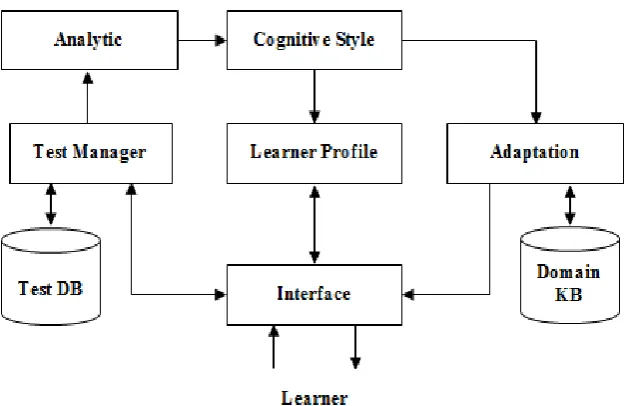
Fig. 1 shows the proposed model of Psycho-Diagnostic Subsystem which consists of six units: interface, learner profile, test manager, analytic, cognitive style, and adaptation.
Fig. 1. The proposed model.
The system interface organizes the dialogue communication with the learner. Its essential role is to exchange information between the learner and the system. The system gives the learner portions of knowledge, while on the other hand the learner answers the system questions, and then the system can analyze the learner cognitive profile.
The learner profile unit contains information about the learner (ID, password), the learner learning style, and the lesson where the learner had stopped.
his/her cognitive abilities. It uses the test database to define the learner cognitive style and intelligence level. This provides the ability to edit the tests and their scores without changing tutor software components. The results of the test will be sent to the analytic unit.
The analytic unit will receive the results of the learner test and will determine the best learning style for the learner. Then it will store this style in learner profile.
The cognitive style unit stores twelve variants of learning styles. Based on the received results from the analytic unit, it will determine and send the suitable learning style to the adaptation unit.
The adaptation unit will select the appropriate cognitive type learning scenario. It adapts the educational information to the learner cognitive profile.
The domain knowledge base contains knowledge on the subject, which is taught to the learner. It may be, for example, a variety of learning scenarios, each of which corresponds to the learner's cognitive type.
6.
The Psycho-Diagnostic Subsystem Implementation
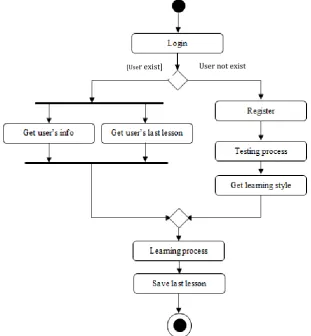
Fig. 2 shows the activity diagram of the system. The learner enters the login page, then the system will determine if the learner registered or not.
Fig. 2. The activity diagram of the proposed system.
If the learner login ID exists, then the system will retrieve the learner information (learner style and last lesson), and then based on the learner information, the process of learning will begin. The system will give the learner portions of knowledge and after finishing the lesson, the system will save the last lesson that the learner reached.
On the other hand if the learner login ID does not exist on the system, then the system will ask the learner to register to the system, after that the system will begin to test the learner, and based on the results, the system will determine and store the learner suitable learning style. After that the process of learning will begin, based on the information obtained from the above procedure. The system will save the last lesson that the learner had studied for the next entering.
7.
Conclusion
The aim of our research is to provide a model of psycho-diagnostic subsystem of CPLS. The psycho-diagnostic subsystem measures the learner characteristics and defines the learner learning style, so the system can adapt to the existing knowledge and cognitive characteristics of the learner. The proposed model integrates the e-learning and CPLS, to personalize the learning process on the basis of adaptation to the learner learning style. We hope that the proposed model will improve and increase the efficiency of e-learning by taking the advantages of CPLS.
References
[1] Frederick, B. (1996). Computers as Tutors: Solving the Crisis in Education. Retrieved from http://cybra.lodz.pl/Content/1081/issues/issue7/section4/index.html
[2] Wenger, E. (1987). Artificial Intelligence and Tutoring Systems: Computational and Cognitive Approaches
to the Communication of Knowledge. Los Altos, CA: Morgan Kaufmann Publishers.
[3] Sarrafzadeh, A., Alexander, S., Dadgostar, F., Fan, C., & Bigdeli, A. (2008). How do you know that I don’t understand? A look at the future of intelligent tutoring systems. Computers in Human Behavior, 24(4), 1342-1363.
[4] Aytürk, K., Rahim, O., Ali, K., & Aslan, G. (2009). ZOSMAT: Web-based intelligent tutoring system for teaching-learning process. Expert Systems with Applications: An International Journal, 36(2), 1229-1239.
[5] Anderson, J., et al. (1985). Intelligent tutoring systems. Science, 228, 456-462.
[6] Mark, M. A., & Greer, J. E. (1993). Evaluation methodologies for intelligent tutoring systems. Journal of
Artificial Intelligence and Education, 4(2/3), 129-153.
[7] Murray, T. (1999). Authoring intelligent tutoring systems: An analysis of the state of the art.
International Journal of Artificial Intelligence in Education, 10, 98-129.
[8] Corbett, A., Koedinger, K. R., & Anderson, J. R. (1997). Intelligent tutoring systems. Handbook of
Human-Computer Interaction. New York: Elsevier.
[9] Sleeman, D. H., & Brown, J. S. (1982). Intelligent Tutoring Systems. New York: Academic Press.
[10] Shute, V. J., & Psotka, J. (1996). Intelligent tutoring systems: Past, present and future. Handbook of
Research on Educational Communications and Technology. Scholastic Publications.
[11] Sharada N., Shashi M., & Madhavi, D. (2015). A comprehensive study on intelligent tutoring systems.
International Journal of Advanced Studies in Computers, Science and Engineering, 4(8), 1-7.
[12] Kholodnaya, M. A. (1992). Cognitive styles and intellectual abilities. Psychological Journal, 13(3), 84-93. [13] Kholodnaya, M. A. (1996). Psychological status of cognitive styles: Preference or "other abilities".
Psychological Journal, 17(1), 61-69.
[14] Riding, R., & Rayner, S. (1999). Cognitive styles and learning strategies. Understanding Style Differences
in Learning and Behavior. London: David Fulton Publishers.
[15] Riding, R. J., & Cheema, I. (1991). Cognitive styles—An overview and integration. Educational
Psychology, 11(3-4), 193–215.