S T U D Y P R O T O C O L
Open Access
The effect of an enriched environment on
activity levels in people with stroke in an
acute stroke unit: protocol for a before-after
pilot study
Ingrid C. M. Rosbergen
1,2*, Rohan S. Grimley
3, Kathryn S. Hayward
1,4, Katrina C. Walker
2, Donna Rowley
5,
Alana M. Campbell
2, Suzanne McGufficke
2, Samantha T. Robertson
2, Janelle Trinder
5, Heidi Janssen
6and Sandra G. Brauer
1Abstract
Background:Clinical practice guidelines advocate engaging stroke survivors in as much activity as possible early after stroke. One approach found to increase activity levels during inpatient rehabilitation incorporated an enriched environment (EE), whereby physical, cognitive, and social activity was enhanced. The effect of an EE in an acute stroke unit (ASU) has yet not been explored.
Methods/design:We will perform a prospective non-randomized before-after intervention study. The primary aim is to determine if an EE can increase physical, social, and cognitive activity levels of people with stroke in an ASU compared to usual care. Secondary aims are to determine if fewer secondary complications and improved functional outcomes occur within an EE. We will recruit 30 people with stroke to the usual care block and subsequently 30 to the EE block. Participants will be recruited within 24–72 h after onset of stroke, and each block is estimated to last for 12 weeks. In the usual care block current management and rehabilitation within an ASU will occur. In the EE block, the ASU environment will be adapted to promote greater physical, social, and cognitive activity. Three months after the EE block, another 30 participants will be recruited to determine sustainability of this intervention. The primary outcome is change in activity levels measured using behavioral mapping over 12 h (7.30 am to 7.30 pm) across two weekdays and one weekend day within the first 10 days of admission. Secondary outcomes include functional outcome measures, adverse and serious adverse events, stroke survivor, and clinical staff experience.
Discussion:There is a need for effective interventions that starts directly in the ASU. The EE is an innovative intervention that could increase activity levels in stroke survivors across all domains and promote early recovery of stroke survivors in the acute setting.
Trial registration:Australian New Zealand Clinical Trial Registry, ANZCTN12614000679684
Keywords:Stroke, Acute stroke unit, Enriched environment, Activity, Behavioral mapping, Complications
* Correspondence:[email protected] 1
Division of Physiotherapy, School of Health and Rehabilitation Sciences, University of Queensland, Brisbane, Australia
2Allied Health Services, Nambour General Hospital, Sunshine Coast Hospital
and Health Service, PO Box 547, Nambour 4560, Australia Full list of author information is available at the end of the article
Background
Stroke survivors who receive care in an acute stroke unit (ASU) are more likely to be alive and independent com-pared with general ward care [1]. Characteristics of the ASU considered to contribute to these outcomes include early mobility and multidisciplinary coordinated rehabili-tation [2] to prevent immobility-related complications [3] and commence functional recovery early after stroke. Strong evidence indicates that increased engagement in physical activities targeting mobility and arm-hand func-tion early after stroke result in improved funcfunc-tional out-comes [4]. Yet, despite awareness of the positive effects of increased physical activity, available evidence indicates that stroke survivors spend the majority of the day phys-ically inactive and alone early after stroke [5].
Social support has been recognized as an important determinant of health-related quality of life in stroke sur-vivors [6]. The relationship between various types of social support such as emotional, instrumental, or informational support and quality of life is inconsistent [6]. Some studies have found that high levels of social support are associated with larger improvements in functional status [7, 8]. It is argued that social support can offer encouragement, as-sistance, and increase compliance with treatments [7, 9] and assist in dealing with the consequences of stroke [6]. However, not all aspects of social support may be bene-ficial; instrumental support may lead to poorer health if someone becomes dependent on the provided assistance [10]. Limited evidence is available regarding cognitive activity after stroke. Cognitive activity such as listening to music during early recovery has been shown to enhance focused attention [11], lessen depressed mood [11], and improve visual attention in those with unilateral neglect [12]. Despite these possible benefits, little is known re-garding social and cognitive activity levels in stroke survi-vors early after stroke.
There is a need to identify interventions that can increase activity levels across physical, social, and cognitive domains and concurrently have a positive effect on outcomes early after stroke. One possible intervention is an enriched environment (EE). In animal research, an EE is defined as an organized stimulating environment to enhance sensory, motor, and cognitive activities [13]. A systematic review and meta-analysis in animal research of stroke has shown that an EE has a positive effect on physical re-covery, learning, and exploratory behavior, which includes reduced decline in memory and levels of anxiety [14]. A pilot study of EE in people with stroke was recently under-taken in the sub-acute inpatient rehabilitation setting [15]. This study showed promising results, with increased activ-ity levels demonstrated across these activactiv-ity domains [15]. An EE was achieved within this study by creating com-munal areas with stimulating equipment and individual enrichment through provision of personal equipment such
as music and hobby activities [15]. An EE can provide activities that are meaningful and tailored to each stroke survivor as a wide variety of activities can be included in an enriched clinical setting. In addition, novel advanced technology such as virtual reality, IPads, and active gam-ing technologies can be a valuable addition to provide stimulation to stroke survivors with a therapeutic effect [16–18]. Enrichment strategies with a more conventional character could involve music and art, as these activities have shown to reduce boredom and a positive effect on mood in stroke survivors [19, 20].
Taken together, it is plausible that the implementation of an EE immediately post-stroke within an ASU could positively influence activity levels across all domains and lead to fewer complications and improved functional out-comes. This pilot study aims to determine the effect of implementing an EE in an ASU on physical, social, and cognitive activity levels, adverse events, and functional outcomes. We hypothesize that stroke survivors who start their journey in an ASU with an embedded EE will be more active, experience fewer complications, and achieve greater functional outcomes compared to those who start their journey in an ASU without embedded EE.
Methods/design
The study involves a prospective non-randomized before and after design. We will recruit 30 people with stroke to usual care (block 1) and subsequently 30 to EE inter-vention (block 2). We will evaluate activity levels across all domains, secondary complications, and functional outcomes within both blocks. Following block 1, we will embed an EE in the same ASU during a 6-week period before commencement of block 2. To determine if em-bedding an EE within an ASU persists, activity levels will be re-evaluated 3 months post-Block 2 (EE) with an add-itional 30 stroke participants.
Participants and setting
All stroke survivors admitted to the hospital will be screened for eligibility with consecutive recruitment of eligible participants. Recruitment is estimated to occur over 12 weeks or until the target number is reached. Participants will be included if they are (1) admitted to the ASU within 24–72 h after onset of stroke (ischemic or hemorrhagic, first and/or recurrent stroke), (2) able to complete a transfer from bed to chair with assistance of two persons or less, (3) able to follow single stage commands, (4) requiring assistance for basic activities of daily living (ADLs), and (5) were able to walk independently premorbidly (functional ambulation category score≥4) and have a modified Rankin Score (mRS) of≤2 from self-report. Participants will be excluded if they have (1) a retrospective premorbid mRS of≥3, (2) a concurrent diagnosis of rapidly deteriorating disease, or (3) have an extensive psychiatric history. To allow for observational data collection, stroke survivors will also be excluded if discharge from the ASU is likely to occur within 2 days of admission. Informed con-sent will be obtained from participants or their substitute decision maker. Participants will be informed that the project aims to compare an alternative model of rehabi-litation with the traditional model of rehabirehabi-litation, but not informed regarding the specific intervention being investi-gated or group allocation.
Baseline measures
Baseline measures will include demographics; previous mRS and living arrangements; stroke details such as date, estimated time of onset, lesion location and type, Oxford Stroke Classification, and National Institute of Health Stroke Scale (NIHSS). Stroke severity will be classified according to NIHSS [21] on admission (day 1 if thrombo-lyzed): mild (<8), moderate (8–16), and severe (>16).
Intervention
In the 12-week usual care block, participants will receive usual stroke management within the ASU and rehabilita-tion will be delivered in one-on-one intervenrehabilita-tions by therapists to stroke participants. At this site, therapists have access to a common therapy room, discipline-specific allied health assistants for individual treatment sessions and equipment to increase practice. Staffing levels will be monitored across the study period to en-sure that they remain consistent across blocks.
After the usual care block, there will be a 6-week period in which the environment of the ASU will be adapted. Several communal areas will be created on the ward where participants have access to stimulating equipment. Self-directed exercise programs, iPads loaded with apps, iPods loaded with music, books, board games, puzzles, magazines, newspapers, and music will be available during and outside of therapy hours. During these 6 weeks, staff focus towards enabling activity will be reinforced through
interdisciplinary education sessions. At these sessions, the EE theoretical concept, EE intervention, and‘enablers and barriers’ of implementation of the intervention will be interactively discussed [22]. We will educate staff to en-courage participants to attend communal areas and to use stimulating equipment in communal areas and at the bedside. Allied health assistants will be trained from discipline-specific to “generic” allied health assistants for the EE intervention. By doing this, all assistants will be able to mobilize patients and assist all therapists. In addition to interdisciplinary education, we will appoint nurse champions to facilitate and encourage adherence to the intervention on a day-to-day basis.
In the 12-week EE block, communal areas will be used to enhance individual and group activities. A daily group session will focus on different aspects of stroke recovery such as education, emotional support, communication, and physical activities. On three weekdays, there will be an interactive breakfast, and every weekday, an interactive lunchtime will be organized. These interactive mealtimes are aimed to increase the frequency of mobilization, en-courage sitting upright for mealtimes, and stimulate social interaction. Staff present during mealtimes will facilitate independence in consuming meals and encourage nutri-tional intake in participants. Participants will be encour-aged to voluntarily attend mealtimes without coercion for any activity. As total staffing numbers will not change with the EE, any staff time in group/meal sessions will be diverted from previous 1:1 therapy time. Allied health assistants will play the main role in managing mealtimes.
Participants of the EE block will receive a brochure that outlines the importance of frequent activity early after stroke; advice about how families can be involved and the day structure of the ASU will be explained. To encourage family involvement, stimulating equipment and individualized activity cards will be placed at the participant’s bedside tailored to the stroke survivor’s goals. Family and staff will be advised to bring personal items and hobby activities for the participant and to encourage the participant to engage in these activities outside therapy hours and on weekends.
Fidelity of the intervention
During the EE intervention, we will monitor the occur-rence of mealtimes and group sessions, availability of resources, and provision of information brochures. Our main measure for a successful implementation is to deter-mine if participants in the EE intervention demonstrate significant higher activity levels as compared to usual care and that the EE is a safe intervention in the ASU.
Primary outcomes
activity is defined as the stroke survivor performing at least one physical, social, or cognitive activity or a combination of activities in these domains [23]. Total activity will be expressed as a percentage of the total number of observa-tions performed, as will activity within physical, social, and cognitive activity domains. The first 10 days after admission will be considered as the primary exposure profile.
The behavioral mapping protocol by Janssen et al. [23] has been adapted for this study and will be used for measuring activity. Protocol adaptation included incorp-orating typical activities and equipment utilized in the acute setting.
Participants will be observed for 1-min at 10-min in-tervals from 7.30 am till 7.30 pm on two weekdays and one weekend day for a maximum of three mapping days or until discharge from the ASU. For each observation, the main activity performed during 1-min will be re-corded for each category. In addition, we will report if the participant performed the observed activity inde-pendently, supervised, or with assistance. The partici-pant’s location, body position, and people present will also be documented. Participants can be engaged in 'no activity' and can perform activities across more than one domain concurrently.
During each observation, the observer will collect data for as many categories as able. When the observer is unable to view the participant due to activity precluding direct observation (e.g., participant is in the bathroom), an attempt will be made to retrospectively estimate activity from nearby staff or the participant. Intervals where a participant is unable to be observed (e.g., off the ward for investigations) or activity unable to be esti-mated will be classified as 'unobserved'. Unintentional non-observations will be classified as 'missing' data. Un-observed and missing data will not contribute to the total number of observations for a participant. The rea-son for and proportion of 'unobserved and missing observations' will be reported by group.
Staff performing behavioral mapping will have spe-cific training, followed by assessment compromising observation of four patients for 1 h, providing 24 obser-vations. Competency to record study data is defined as attaining≥90 % agreement with concurrent observations by the investigator. Behavioral mapping staff members will not receive any study details.
Secondary outcomes
Secondary measures to be collected include functional out-comes, adverse and serious adverse events, and mood. Functional outcomes will be assessed with the mRS, modi-fied Barthel index (MBI), 10-m walk test, and Mobility Scale for Acute Stroke patients (MSAS). Mood will be assessed with the Hospital Anxiety and Depression Scale (HADS), and nutritional status will be determined through
weight and the Subjective Global Assessment (SGA) to assess for malnutrition. Serious adverse events (SAE) are defined as an adverse event that led to death and/or led to serious deterioration in health of a patient, whereas adverse events (AE) are defined as any untoward or unfavorable medical occurrence in a patient. Complica-tions recorded include falls, pneumonia, pressure areas, cardiac problems, seizures, reduced Glasgow Coma Scale, stroke, transient ischemic attack, urinary tract infection, de-pression, constipation, malnutrition, delirium, and “other” including shoulder pain, deep venous thrombosis, and urin-ary retention [24, 25].
Data collection time points
An investigator will conduct the initial assessment on entry to the study. Blinded assessors will perform dis-charge assessments immediately prior to disdis-charge from the ASU or when a decision for palliative intent is made. Blinded assessors will also undertake follow-up phone calls at 3 months post-stroke to determine mRS, living arrangement, Health State Score [26], and if any SAEs have occurred after discharge. Three months after the EE block, another period of behavioral mapping will occur to determine whether activity levels have been sustained in the ASU. We aim to recruit 30 participants using the same eligibility criteria and complete behav-ioral mapping on a single, randomly chosen day from 7.30 am till 7.30 pm.
Participant and staff experience
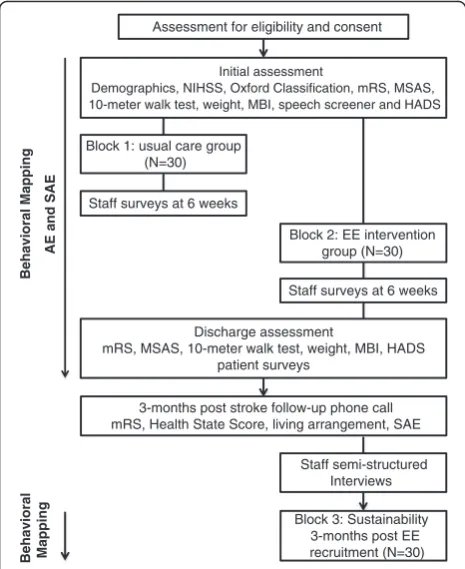
During both blocks, patient/carer and staff experiences will be explored through surveys. A short patient and carer survey will explore the patient/carer’s experience and whether they felt sufficient stimulation was offered to assist early rehabilitation and recovery during the acute stay. Staff surveys will be handed out to 25 nursing and therapy staff members of the unit. These surveys will explore their perceptions of innovation, patient care, team relationships, work satisfaction, and workload during each block. In addition, after block 2, up to ten semi-structured interviews with nursing and therapy staff will be conducted until saturation of data is reached. These interviews will focus on staff experience during the EE intervention period only. Questions will aim to explore perceived barriers in implementing an EE and what staff will need to be able to sustain the EE in the future. The-matic content analysis will be performed on all qualitative data. Figure 1 shows a flow chart of the pilot study.
Sample size
data from a recent study of the effect of an EE on activity levels conducted during inpatient stroke rehabilitation [15]. This study reported a mean increase in the proportion of observations with 'any activity' in the EE group of 13 % (SD 14) and the control (no EE) group of 2 % (SD 16.5), equivalent to an effect size of 0.719. We performed a one-sided, between-groups test as this past research has shown an enriched environment to increase activity levels in stroke survivors [15]. Based on a rounded effect size of 0.7, we calculated that we would need to recruit 26 partic-ipants per group to detect one standard deviation differ-ence between EE and non-EE groups for any activity with an alpha level of 0.05 and a power of 0.8. Allowing for a conservative dropout rate of 12 %, we will aim to recruit 30 participants per group.
Statistical analysis
Baseline characteristics of participants will be described using means and standard deviations for continuous vari-ables and counts and percentages for categorical varivari-ables. To address the primary outcome (change in activity levels for 'any activity'), we will compare the proportion of activ-ity between usual care and EE intervention group. We will assume that at each observation, the participant remains
engaged in that activity for the entire 10-min interval; this will allow us to calculate the proportion of time each group is engaged in any activity. Subsequently, we will explore for differences in each activity domain and subcat-egories within domains. Consistent with previous research in the field [15], unobserved and missing data will be excluded from the analysis for the primary outcome of change in activity level. Total number of observations per participant will be summed and used to calculate the proportion of observations each participant is observed to be engaged in any activity (and physical, social, and cogni-tive activity and other fields included in the data collection sheet). The difference in activity levels between groups will be determined using one-way ANCOVA with group as independent variable, activity levels as the dependent variable, and adjusting for covariates age (years), stroke severity (NIHSS), and premorbid function (mRS). To determine differences in secondary outcome measures be-tween groups, one-way repeated-measures ANCOVA will be performed for variables separately, adjusting for age (years), stroke severity (NIHSS), and premorbid function (mRS). We will adjust for the above covariates as these covariates impact on activity levels, functional outcomes, and mood in stroke survivors [27–29].
Discussion
Research has consistently shown that ASU care provides very limited opportunities for people with a stroke to be involved in physical activities and that patients are often alone. Increased activity levels after stroke are associated with better functional outcomes and reduced complica-tion rates. In addicomplica-tion, with the aging populacomplica-tion and the rising incidence in stroke, there is a strong need for the development of resource-efficient interventions that can improve patient and service outcomes without increas-ing staffincreas-ing cost. The EE is an innovative interdisciplin-ary model of care that could build the capacity of acute stroke teams to deliver efficient and effective care for people with stroke.
Acknowledgements
Study status: recruitment for this study took place from June 2014 through to July 2015.
Authors’contributions
All authors have made an intellectual contribution to this research trial. Principal investigator IR and co-investigators SB, RG, and KH were responsible for designing the study protocol, ethic application, funding applications, and writing and correcting the manuscript. SB and IR developed the statistical analysis plan. IR and KH adjusted the behavioral mapping documents and educated the behavioral mapping staff. IR and associate investigators KW, AC, DR, JT, SR, and SM were responsible for the recruitment of participants and data collection during the study. Associate investigator HJ wrote the original behavioral mapping protocol. All authors have contributed to the conceptual design, development, and implementation of the intervention. All authors have read and approved the final version of the manuscript.
Competing interests
The authors declare that they have no competing interests. Assessment for eligibility and consent
Initial assessment
Demographics, NIHSS, Oxford Classification, mRS, MSAS, 10-meter walk test, weight, MBI, speech screener and HADS
Discharge assessment
mRS, MSAS, 10-meter walk test, weight, MBI, HADS patient surveys
3-months post stroke follow-up phone call mRS, Health State Score, living arrangement, SAE Block 1: usual care group
(N=30)
Staff surveys at 6 weeks
Block 2: EE intervention group (N=30)
Staff surveys at 6 weeks
Block 3: Sustainability 3-months post EE recruitment (N=30) Staff semi-structured
Interviews
Behavioral Mapping
AE and SAE
Behavioral Mapping
Fig. 1Flowchart of study.NIHSSNational Institutes of Health Stroke Scale,mRSmodified Rankin Scale,MSAS Mobility Scale for Acute Stroke,MBI Modified Barthel Index,HADSHospital Anxiety and Depression Scale,EEenriched environment,AEadverse events,
Ethics approval and consent to participate
Ethical approval has been obtained from Human Research Ethics Committee, Metro North Hospital and Health Service, The Prince Charles Hospital (HREC/ 14/QPCH/21), and from the Medical Research Ethics Committee, The University of Queensland (MREC/2014000371). Informed consent will be obtained from participants or their substitute decision maker and from those participating in surveys and semi-structured interviews.
Study organization and funding
The trial is registered with the Australian New Zealand Clinical Trials Registry ANZCTN12614000679684. The study is supported by Wishlist Foundation, Sunshine Coast Hospital and Health Service (SCHHS) research grant, a Queensland Health Health Practitioner research grant, a SCHHS Scholarship, and by the Acute Stroke Unit and Allied Health Services, SCHHS.
Author details
1Division of Physiotherapy, School of Health and Rehabilitation Sciences,
University of Queensland, Brisbane, Australia.2Allied Health Services, Nambour General Hospital, Sunshine Coast Hospital and Health Service, PO Box 547, Nambour 4560, Australia.3Sunshine Coast Clinical School, The University of Queensland, Nambour, Australia.4Department of Physical
Therapy, University of British Columbia, Vancouver, BC, Canada.5Nursing and Midwifery, Sunshine Coast Hospital and Health Service, Nambour, Australia.
6
Hunter Medical Research Institute, Newcastle, Australia.
Received: 22 January 2016 Accepted: 20 July 2016
References
1. Stroke Unit Trialists’Collaboration. Organised inpatient (stroke unit) care for stroke. Cochrane Database Syst Rev. 2013;9:Cd000197.
2. Langhorne P, Pollock A. What are the components of effective stroke unit care? Age Ageing. 2002;31(5):365–71.
3. Govan L, Langhorne P, Weir CJ. Does the prevention of complications explain the survival benefit of organized inpatient (stroke unit) care?: further analysis of a systematic review. Stroke. 2007;38(9):2536–40.
4. Veerbeek JM, van Wegen E, van Peppen R, van der Wees PJ, Hendriks E, Rietberg M, et al. What is the evidence for physical therapy poststroke? A systematic review and meta-analysis. PLoS One. 2014;9(2):e87987. 5. West T, Bernhardt J. Physical activity in hospitalised stroke patients. Stroke
Res Treat. 2012;2012:813765.
6. Kruithof WJ, van Mierlo ML, Visser-Meily JM, van Heugten CM, Post MW. Associations between social support and stroke survivors’health-related quality of life—a systematic review. Patient Educ Couns. 2013;93(2):169–76. 7. Tsouna-Hadjis E, Vemmos KN, Zakopoulos N, Stamatelopoulos S. First-stroke
recovery process: the role of family social support. Arch Phys Med Rehabil. 2000;81(7):881–7.
8. Glass TA, Matchar DB, Belyea M, Feussner JR. Impact of social support on outcome in first stroke. Stroke. 1993;24(1):64–70.
9. Harris JE, Eng JJ, Miller WC, Dawson AS. The role of caregiver involvement in upper-limb treatment in individuals with subacute stroke. Phys Ther. 2010;90(9):1302–10.
10. Latham K, Clarke PJ, Pavela G. Social relationships, gender, and recovery from mobility limitation among older Americans. J Gerontol B Psychol Sci Soc Sci. 2015;70(5):769–81.
11. Sarkamo T, Ripolles P, Vepsalainen H, Autti T, Silvennoinen HM, Salli E, et al. Structural changes induced by daily music listening in the recovering brain after middle cerebral artery stroke: a voxel-based morphometry study. Front Hum Neurosci. 2014;8:245.
12. Tsai PL, Chen MC, Huang YT, Lin KC, Chen KL, Hsu YW. Listening to classical music ameliorates unilateral neglect after stroke. Am J Occup Ther. 2013; 67(3):328–35.
13. Nithianantharajah J, Hannan AJ. Enriched environments, experience-dependent plasticity and disorders of the nervous system. Nat Rev Neurosci. 2006;7(9):697–709.
14. Janssen H, Bernhardt J, Collier JM, Sena ES, McElduff P, Attia J, et al. An enriched environment improves sensorimotor function post-ischemic stroke. Neurorehabil Neural Repair. 2010;24(9):802–13.
15. Janssen H, Ada L, Bernhardt J, McElduff P, Pollack M, Nilsson M, et al. An enriched environment increases activity in stroke patients undergoing
rehabilitation in a mixed rehabilitation unit: a pilot non-randomized controlled trial. Disabil Rehabil. 2014;36(3):255–62.
16. Laver KE, George S, Thomas S, Deutsch JE, Crotty M. Virtual reality for stroke rehabilitation. Cochrane Database Syst Rev. 2011;9:Cd008349.
17. Des Roches CA, Balachandran I, Ascenso EM, Tripodis Y, Kiran S. Effectiveness of an impairment-based individualized rehabilitation program using an iPad-based software platform. Front Hum Neurosci. 2014;8:1015. 18. Bower KJ, Clark RA, McGinley JL, Martin CL, Miller KJ. Clinical feasibility of the
Nintendo Wii for balance training post-stroke: a phase II randomized controlled trial in an inpatient setting. Clin Rehabil. 2014;28(9):912–23. 19. Kim DS, Park YG, Choi JH, Im SH, Jung KJ, Cha YA, et al. Effects of music
therapy on mood in stroke patients. Yonsei Med J. 2011;52(6):977–81. 20. Baumann M, Peck S, Collins C, Eades G. The meaning and value of taking
part in a person-centred arts programme to hospital-based stroke patients: findings from a qualitative study. Disabil Rehabil. 2013;35(3):244–56. 21. Briggs DE, Felberg RA, Malkoff MD, Bratina P, Grotta JC. Should mild or
moderate stroke patients be admitted to an intensive care unit? Stroke. 2001;32(4):871–6.
22. Middleton S, McElduff P, Ward J, Grimshaw JM, Dale S, D'Este C, et al. Implementation of evidence-based treatment protocols to manage fever, hyperglycaemia, and swallowing dysfunction in acute stroke (QASC): a cluster randomised controlled trial. Lancet. 2011;378(9804):1699–706. 23. Janssen H, Ada L, Karayanidis F, Drysdale K, McElduff P, Pollack M, et al.
Translating the use of an enriched environment poststroke from bench to bedside: study design and protocol used to test the feasibility of environmental enrichment on stroke patients in rehabilitation. Int J Stroke. 2012;7(6):521–6.
24. Ostwald SK, Godwin KM, Ye F, Cron SG. Serious adverse events experienced by survivors of stroke in the first year following discharge from inpatient rehabilitation. Rehabil Nurs. 2013;38(5):254–63.
25. Goldfarb N. Adverse event terminology. J Clin Res Best Prac. 2012;8(7):1–7. 26. EuroQol group. EuroQol—a new facility for the measurement of
health-related quality of life. Health Policy. 1990;16(3):199–208.
27. Bernhardt J, Dewey H, Thrift A, Donnan G. Inactive and alone: physical activity within the first 14 days of acute stroke unit care. Stroke. 2004; 35(4):1005–9.
28. Kutlubaev MA, Hackett ML. Part II: predictors of depression after stroke and impact of depression on stroke outcome: an updated systematic review of observational studies. Int J Stroke. 2014;9(8):1026–36.
29. Veerbeek JM, Kwakkel G, van Wegen EE, Ket JC, Heymans MW. Early prediction of outcome of activities of daily living after stroke: a systematic review. Stroke. 2011;42(5):1482–8.
• We accept pre-submission inquiries
• Our selector tool helps you to find the most relevant journal • We provide round the clock customer support
• Convenient online submission • Thorough peer review
• Inclusion in PubMed and all major indexing services • Maximum visibility for your research
Submit your manuscript at www.biomedcentral.com/submit