Corresponding author, email:[email protected] (H. Jabbari). Tel.: +9844 33653791; Fax: +9844 34282484.
Asian Journal of Green Chemistry 1 (2017) 16-23
Contents lists available at Avicenna Publishing Corporation (APC)
Asian Journal of Green Chemistry
journal homepage: http://ajgreenchem.avicenna.pub/
Original Research
Article
Production of biodiesel
from jatropha curcas oil using solid
heterogeneous acid catalyst
Hadi Jabbari
a,*, Nader Noroozi Pesyan
ba Department of Management, Payam Noor University, Tehran, Iran
b Department of Organic chemistry, Faculty of chemistry, Urmia University, Urmia, 57159, Iran
A R T I C L E I NF O R MA T I O N A B S T R A C T
Received: 31 May 2017
Received in revised: 9 July 2017
Accepted: 10 July 2017
Available online: 11 July 2017
DOI: 10.22631/ajgc.2017.46511
Biodiesel produced by the transesterification of vegetable oils is a promising alternative fuel to diesel because of limited fossil fuel resources and environmental concerns. The use of heterogeneous catalysts greatly simplifies the technological process by facilitating the separation of the post-reaction mixture. The use of heterogeneous catalysts greatly simplifies the technological process by facilitating the separation of the post-reaction mixture. The purpose of the present work was to examine a heterogeneous catalyst, in particular, to produce methyl esters of jatropha curcas oil (JCO). In this study, the trans esterification of JCO with methanol was studied in a heterogeneous system, using Mg-Al hydrotalcites as solid base catalysts. The dependence of the conversion of JCO on the reactions variables such as the molar ratio of methanol/ oil, the amount of catalysts used, reaction temperatures and reaction times were performed. The conversion of 99% was achieved under the optimum reaction conditions.
KEYWORDS
Biodiesel
Transesterification
Solid base catalysts
Mg-Al hydrotalcites
Jatropha curcas oil
Production of biodiesel from jatropha curcas oil using ... 17
Introduction
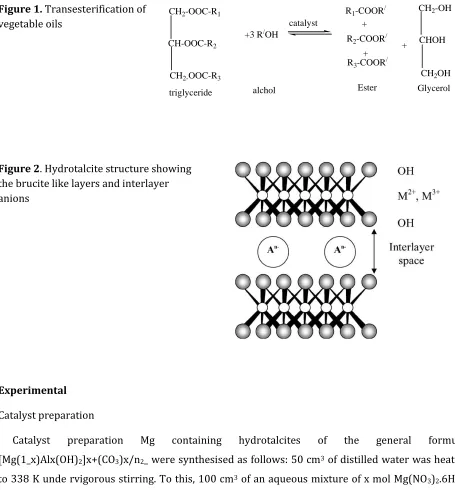
Biodiesel as an alternative fuel for diesel engines is becoming increasingly important due to diminishing petroleum reserves and the environmental consequences of exhaust gases from petroleum-fuelled engines. Biodiesel, which is made from renewable sources, consists of the simple alkyl esters of fatty acids. As a future prospective fuel, biodiesel has to compete economically with petroleum diesel fuels. One way of reducing the biodiesel production costs is to use the less expensive feedstock containing fatty acids such as inedible oils, animal fats, waste food oil and byproducts of the refining vegetables oils (Fig. 1) [1]. Biodiesel is a promising nontoxic and biodegradable renewable fuel comprised of mono-alkyl esters of long chain fatty acids, which are derived from vegetable oils or animal fats [2]. Biodiesel is oxygenated and essentially free of sulfur making it a cleaner burning fuel than petroleum diesel with reduced emissions of SOx, CO, unburnt hydrocarbons and particulate matter [3].
The acid-catalyzed process often uses sulfuric acid and hydrochloric acid as catalysts; however, the reaction time is very long (48-96 h), even at reflux of methanol, and a high molar ratio of methanol tooil is needed (30-150:1, by mole). Potassium hydroxide, sodium hydroxide, and their
carbonates, as well as potassium and sodium alkoxides, such as NaOCH3, are usually used as base
catalysts for this reaction. As the catalytic activity of a base is higher than that of an acid, and acid catalysts are more corrosive, the base-catalyzed process is preferred to the acid-catalyzed one, and is thus most often used commercially. Many different heterogeneous catalysts have been developed to catalyze the transesterification of vegetable oils to prepare fatty acid methyl esters. In recent years these materials have received considerable attention because they are used in a wide range of
application such as adsorbent for liquid ions [4] and gas molecules [5]. They also find use as
catalyst, precursors and other catalytic reactions [6]. Their most important applications are due to their permanent anion-exchange and adsorption capacity, the mobility of their interlayer anions and water molecules, their large surface areas and the stability and homogeneity of the materials formed by their thermal decomposition [7].
H. Jabbari & N. Noroozi Pesyan
18
higher catalytic activity than the decomposed Mg–Al hydrotalcite with Lewis base sites for the aldol condensation of benzaldehyde with acetone [13], aldol condensation of citral with ketones, selfaldolization of acetone, Michael addition reactions [14], and the transesterification of oleic acid methyl ester with glycerol.
It was reported that thermally activated Mg–Al hydrotalcites with various Mg–Al ratios were effective catalysts for transesterification of tributyrin with methanol, with increasing catalytic activity as the Mg content in the Mg–Al hydrotalcite increased [15].
Figure 1. Transesterification of
vegetable oils CH2-OOC-R1
CH-OOC-R2
CH2-OOC-R3
+3 R/OH
catalyst
R1-COOR/
+ R2-COOR/
+ R3-COOR/
Ester +
CH2-OH
CHOH
CH2OH
Glycerol triglyceride alchol
Figure 2. Hydrotalcite structure showing the brucite like layers and interlayer anions
Experimental
Catalyst preparation
Catalyst preparation Mg containing hydrotalcites of the general formula
[Mg(1_x)Alx(OH)2]x+(CO3)x/n2_ were synthesised as follows: 50 cm3 of distilled water was heated
Production of biodiesel from jatropha curcas oil using ... 19
and y mol Al(NO3)3.9H2O was added slowly over a period of 1 h along with 100 cm3 of an aqueous
solution of 0.2 mol (NH4)2CO3. The Mg:Al ratio was varied such that x + y = 0.15 mol and x:y = 1:1,
2:1, 3:1 and 4:1. The pH of the mixture was continuously monitored by a Jenway 3030 pH meter
and held at pH=7.6–8 by the drop wise addition of NH4OH (as 35% aqueous ammonia solution). The
resulting mixture was held at 338 K while stirred vigorously for 3 h and then filtered and washed with distilled water until the filtrate was as near pH=7 as possible. The precipitate was dried in an oven at 373–398 K for approximately 18 h. All materials were calcined at 723 K for 3 h and cooled
under a flowing stream of wet nitrogen (100 ml min-1, relative humidity 95%) before catalyst
testing.
General procedure for preparation of biodesel fuel from vegetable oils
In the transesterification of vegetable oils, a triglyceride reacts with an alcohol in the presence of a strong acid or base, producing a mixture of fatty acids alkyl esters and glycerol. The overall process is a sequence of three consecutive and reversible reactions, in which di and mono glycerides are formed as intermediates. The stoichiometric reaction requires 1 mol of a triglyceride and 3 mol of the alcohol. However, an excess of the alcohol is used to increase the yields of the alkyl esters and to allow its phase separation from the glycerol formed. Several aspects, including the type of catalyst (alkaline or acid), alcohol/vegetable oil molar ratio, temperature, purity of the reactants (mainly water content) and free fatty acid content have an influence on the course of the transesterification and will be discussed below, based on the type of catalyst used.
Transesterification reaction
JCO oil was obtained from a market. A 500 cm3 three-necked glass flask with a water-cooled
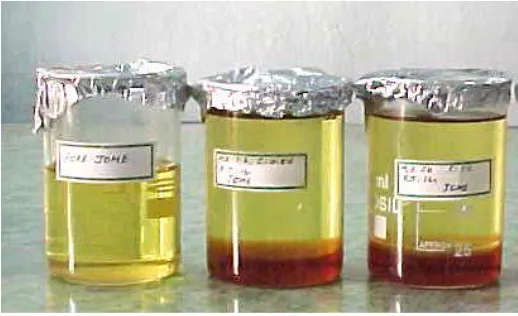
condenser was charged with 50g of JCO, methanol alcohol, and varied amounts of Mg-Al hydrotalcite catalysts. The mixture was refluxed at the required temperature for 3 h under stirring at 500 rpm. After the reaction, the solid catalyst was separated by filtration. The liquid was put into a separating funnel and was kept at ambient temperature for 24 h, after which 2 liquid phases appeared (Fig. 3). The upper layer was biodiesel and the lower layer was glycerol. The conversion of JCO was calculated from the quantity of total glycerol in the product.
Results and discussion
1H NMR spectrum of methyl esters in general should present a signal in δ 3.7 that is
characteristic of oxymethylic hydrogen referent to methylic esters and shouldn’t present signals
H. Jabbari & N. Noroozi Pesyan
20
NMR spectrum of Jatropha oil with 1H NMR spectrum of JOME sample, it can be verified that there is
a singlet in δ 3.64 that is characteristic of oxymethylic hydrogen, and this signal was attributed to esters (biodiesel), multiplet in δ 4.12-4.24 and δ 5.30-5.34 attributed to oxymethylic hydrogen that are characteristic of triglycerides from Jatropha oil (Fig. 4). From the NMR data it could be verified that Jatropha oil conversion into biodiesel was quite complete.
Figure 3. Jatropha biodiesel with glycerol samples
Effect of molar ratio of oil: Methanol and temperature on transesterification of JCO
The stoichiometric ratio for transesterification requires 3 moles of methanol for each mole of to 3 mol of fatty acid methyl ester and 1 mole of glycerol. Since the transesterification reaction is reversible reaction, excess methanol is required to drive the reaction towards product. As represented by Fig. 5, when methanol/oil molar ratio was increased, conversion was increased considerably. The maximum conversion was obtained when the methanol/oil ratio reach 15:1. There is evident that to elevate the conversion, an excessmethanol feed was effective only to a certain extent.
Effect of catalyst amount on the conversion
Production of biodiesel from jatropha curcas oil using ... 21
Figure 4. 1H NMR spectrum of Jatropha oil methyl esters (JOMEs)
Figure 5. Influence of
methanol/oil molar ratio on the conversion. Reaction condition: catalyst amount 3 wt.%, reaction time 3 hours, reaction
temperature 60 °C
C
o
n
v
ersi
o
n
(%
)
Methanol/oil molar ratio (mol/mol)
Figure 6. Influence of catalyst amount on the conversion. Reaction condition: methanol/oil molar ratio 15:1, reaction time 3 hours, reaction temperature 60 °C
C
o
n
v
er
si
o
n
H. Jabbari & N. Noroozi Pesyan
22
Reaction time
The influences of reaction time on JCO conversion are illustrated in Fig. 7. The reaction time was varied in the range 1-7 hours. As can be seen, the conversion was increased steadily in the first 3 hours and reached 99% conversion. The conversion thereafter remained nearly constant after 3 hours of reaction time.
Reaction Temperature
Transesterification can occur at different temperatures depending on the types of catalyst and alcohol used. The influenced of reaction temperature on conversion of JCO to boidiesel was investigated with four different temperature. From the result shown in Fig. 8, the conversion increased as the reaction temperature increased and give the highest conversion of 99% at 60 °C. However, when the temperature reaches to the boiling point of methanol, a lot of methanol’s bubbles were formed hence inhibit the mass transfer on the phase interface thus lower the conversion.
Figure7. Influence of reaction time on conversion. Reaction condition: molar ratio methanol/oil 15:1, catalyst amount 3 wt.%, reaction temperature 60 °C
C
o
n
v
er
si
o
n
(%
)
Production of biodiesel from jatropha curcas oil using ... 23
Conclusion
In this study the transesterification of JCO with methanol was studied in a heterogeneous system using Mg-Al hydrotalcites as solid base catalysts. Hydrotalcites were prepared by co-precipitation of magnesium and aluminum hydroxides from their nitrate solutions using an aqueous solution of sodium carbonate as the precipitating agent. The highest conversion 99% reached when the reaction was carried out at 60 °C with molar ratio of methanol/oil (15:1), reaction time 3 h and catalyst amount 3 wt%.
Acknowledgments
We are grateful to the research council of Urmia Payame Noor University for support of the present work.
References
[1]. MaF R., Hanna M.A. J. A Review Bioresour Technol, 1999, 70:1 [2]. Srivastava A., Prasad R. Renew Sustain Energy Rev., 2000, 4:111 [3] . Das J.D., Dash G.P., Parida K.M. Colloidal Interface Sci., 2002, 251:26
[4]. Yamamoto T., Kodama T., Hasegawa N., Tsuji M ., Tamaura T. Energy Conv., 1995, 36:637 [5]. Morato C., Alonso B., Coq F., Medina F., Cesteros Y., Sueiras J.E., Salagre P., Tichit D. Appl. Catal. A: Gen., 2001, 32:167
[6]. Wang J.W., Kalinichev A.G., Kirkpatrick R.J., Hou X.Q. Chem. Mater., 2001, 13:145
[7]. Veloso C.O., Perez C.N., Souza B.M., Lima E.C., Dias A.G., Monteiro J.L.F., Henriques C.A. Micro. Meso. Mater., 2008, 5:107
[8]. Climent M., Corma J.A., Iborra S., Epping K., Velty A. J. Catal., 2004, 225:316
[9]. Tichit D., Guida A., Chiche Auroux B.H., Bartalini D., Garrone E. J. Catal., 1995, 151:50 [10]. Corma S., Abd Hamid S., Iborra S., Velty A. J. Catal., 2005, 5:340
[11]. Dicosimo J.I., Díez J.V. J. Catal., 1998, 178:499
[12]. Rao K.K., Gravelle M.J., Figueras F. J. Catal., 1998, 173:115 [13]. Abello S., Pérez-Ramírez J. Chem. Commun., 2005, 14:53
[14]. Choudary B.M., Kantam M.L., Aranganathan S., Santhia P.L,. Figueras F., J. Mol. Catal. A: Chem., 2000, 159:411
[15]. Cantrell D.G., Gillie L.J., Lee A.F., Wilson K. Appl. Catal. A: Gen., 2005, 287:183
How to cite this manuscript: Hadi Jabbari, Nader Noroozi Pesyan. Production of biodieselfrom
jatropha curcas oil using solid heterogeneous acid catalyst. Asian Journal of Green Chemistry, 2017,