DETERMINANTS AFFECTING THE PERFORMANCES OF THE VIETNAMESE ENTERPRISES
IN THE FIELD OF ELECTRONICS AND ELECTRICAL
HOUSEHOLD APPLIANCES WHEN VIETNAM JOINS THE TPP
Tran Phi Hoang 1*, Nguyen Thi Van 2,Luong Thi Minh Huong 3,Ha Trong Quang 4 1*34Industrial University of Ho Chi Minh City, Vietnam
2Business School, Hunan University, China and Industrial University of Ho Chi Minh City, Vietnam
Keywords: Enterprise, performances, Vietnamese, electronics and TPP
Abstract
The study is to analyze the factors affecting the performances of Vietnamese enterprises in the field of electronics and electrical household appliances. The authors used qualitative and quantitative research methods that are combined to conduct with 201 consumers 30 observed variables. The study results showed that there are 5 factors impacting on sales performances as follows: Sales Skill, Tangibles, Customer services, Reliability and Service process with significance level 5 %. In addition, the research results processed from SPSS 20.0 software. The result was also a scientific evidence and important for researchers, and polic y makers who apply them for improving the performance for Vietnamese enterprises in the future. The researcher had obtained the main objectives of this study were to:
1. The researchers were to identify and test some factors affecting the performances of Vietnamese enterprises in the field of electronics and electrical household appliances.
2.
The researchers had recommendations to improve the performances of Vietnamese enterprises in the field of electronics and electrical household appliances.
Introduction
According to the committed route of Vietnam with many trade associations in the world, after January 1st, 2015, foreign retailers
will be allowed to set up 100% foreign investment in Vietnam, which means that the retail market will be completely open to foreign investors. According to the Vietnamese Ministry of Industry and Trade Vietnam, about 6-7% of foreign corporations invest in Vietnam's retail market with large-scale business and their revenue is equivalent compared with combining Vietnamese retail supermarket chains. AT Kearney Consultant Organization (USA) identified that with more than 90 million people and attractive growth rates, over 23%/year, Vietnam's retail market is becoming a "hotbed" for foreign corporate and retail business for investing and getting profits. Actually, currently, foreign investors are increasingly investing in Vietnam's retail market by the M & A (Mergers & Acquisitions- mergers and acquisitions) to increase market share. Typically, Berli Jucker Group acquisition (BJC) of Thailand bought the whole Metro Cash & Carry Vietnam system with a total value of up to 879 million USD.Large corporations such as Lotte (Korea) plans to develop another 60 supermarkets and trade centers in Vietnam by 2020; or Aeon Corporation (Japan) is expected growing more than 20 large shopping centers by 2020; Leading retailer of Thailand BJC also plans to expand its network of 300 B's Mart in 2015; Big C Group (France) with the system 20 supermarkets across Vietnam is planning to further expand its retail network and distribution... Remarkably, the the world's leading retailer Wal-Mart (US ) also said it would invest in developing supermarket chain in Vietnam to exploit the advantage of importers when Vietnam joins TPP. While many foreign corporations have come to Vietnam with the successful start, on the other hand, many Vietnames enterprises had to confront with many difficulties. In the strict competition race, electronics and electrical household appliances, only in the last 5 years, there were up to electronics and electrical household appliances distribution systems, which were strong in Vietnam collapsing. Besides, Topcare has closed all 6 sales points up to January, 23rd 2015. The above issue is closely related to the topic
“Determinants affecting the performances of the Vietnamese enterprises in the field of electronics and electrical household appliances when Vietnam joins the TPP” as a paper for researching in the developing of the Vietnamese enterprises in the future.
Literature review
also emphasized the element “shopping experience of customers". In relation to them, shopping experience for customers needs creating.
The direct or indirect retail businesses on the Internet today need creating personal interaction in order to attract more customers. The personal interaction is an active communication occuring directly among people in a specific store or in other words the interaction occurs among people, products and tangibles. Nowadays, many companies have invested in its customer research, observed specific customer, memorize how many times customer went to store many times, what they bought etc. Through what customers say, they know what customers are looking for and even know which is suitable for them. From the 90s of last century, internet has opened up opportunities for enterprises to take better care of customers. The collected data indicated the relationship between consumer and products of enterprise, we can change the shopping experience of each individual customer that is fit and attractive. Search history can be accessed and what related to the customer can be done in business web. All this data can help businesses improve the customer shopping information such as where they come from; what they have been searching and the whole list of things they bought in the past. Business can understand certain parts of the relationship between customers and their specific product. Business can also know how the customers visit their web: An ad on Google? While customers are looking for something, they go directly in the address bar on web browser or click on a link displayed in the email. If they are interest ed in the product or a certain commodity, business can use this data as a foundation to better understand customers, in which makes appropriate changes to their style and purpose. In short, businesses can use the database and create numerous changes to their advantages. Customers are considered as the center in modern days. Marketing Experts and professional sales everywhere have highly concentrated to make changes in which the customer is considered "God". Previously, customers have not been respected. Now everything is different, businesses have realized their mission is to understand their relationship with the customer to be able to take advantage of it, thereby implementing the right service strategy to each specific customer.
Thus, it is concludes that factors affecting sales performance for Vietnamese enterprises in the field of electronics and electrical household appliances focus on the following key factors: sales skills, tangibles, customer service, reliability and service process. Tangibles is the set of elements as tangible evidence of physical material, equipment, people and information materials, service personnel costume, support equipment for the provision of services [Cronin and Taylor, (1992, 1995)].
Reliability: the term refers to the ability to perform services on time and fix right the first time, the ability to ensure the services is performed as promised with certainty exactly. [Cronin and Taylor, (1992, 1995)]
Customer service: All interactions between a customer and a product provider at the time of before, during and after a purchase. Customer service is also often referred to when describing the culture of the organization. It concerns the priority an organization assigns to customer service relative to components such as product innovation, pricing and services. In this sense, an organization that values good customer service may spend more money in training employees than the average organization, or may proactively interview customers for feedback. [William T. et (2010)].
Sales skills are a set of skills and technical nature and the arts to help improve sales performance including listening skills, introduction skills, presentation skills, negotiation skills, objection handling skills, customer complaints, etc. Anyone can become a salesman but an excellent sales staff must focus on all skills. [Finn, T and Adam Khoo, (2007)].
Service process is a set of principle and systematic rules of an organization or enterprise in operation. The steps in the service process are knowledge as well as the culture of an organization versus another organization [Jukka, Laitamaki, and Raymond E. Kordupleski (2001)].
Methods of research
Qualitative and quantitative researches are mainly used to study. The research process has three stages. Stage 1, Based on theory and the related results mentioned the above, qualitative research method was used for group discussing and leading experts’ consultating to select the variables and observed variable groups. Stage 2, Based on the factors for improving Sales Performance for Vietnamese Enterprises in the field of electronics and electrical household appliances, a questionnaire is conducted to collect the opinions from 201 electronics and electrical household appliances customers in HCM City. The research model includes 5 scales, 30 observed variables (questionnaires), using 5-point Likert scale (Likert scale with a 5-point), Distance value = (Maximum - Minimum)/n = (5 - 1)/5 = 0.8: 1. Completely disagree; 2. Disagree; 3. No opinion/ Normal; 4. Agree; 5. Completely agree. Stage 3, after testing the reliability using Cronbach's alpha coefficient, Exploratory Factor Analysis - EFA was analyzed to shrink and summarize the data of the scale (Hoang Trong Chu and Nguyen Mong Ngoc, 2005 "Quantitative Research SPSS"). This method is based on extraction ratio factor (Eigenvalue), under which only those factors having ration (Eigenvalue) greater than 1 will be kept, those smaller than one will not show information better than origin variable because after standardizing, each original variance is 1.
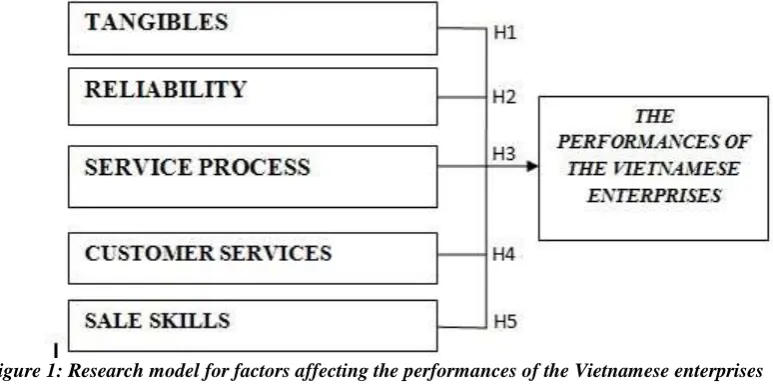
Figure 1: Research model for factors affecting the performances of the Vietnamese enterprises Hypothesis:
H1: 'Facilities' impacts on the performances of the Vietnamese enterprises. H2: 'Reliability' impacts on the performances of the Vietnamese enterprises. H3: 'Service process' impacts on the performances of the Vietnamese enterprises. H4: 'Customer services' impact on the performances of the Vietnamese enterprises. H5: 'Sale skills' impact on the performances of the Vietnamese enterprises.
Research results
Testing relability of the scale
Table 1: Cronbach’s Alpha for factors
Code Factors Hệ số Cronbach’s Alpha
Independent variables
TA Tangibles 0.809
RE Reliability 0.866
SP Service process 0.885
CS Customer services 0.887
SS Sale skills 0,891
Dependent variables GT the performances of the Vietnamese
enterprises 0.844
(Source: The researcher’s collecting data and SPSS)
Table 1 showed that the test results of scales are highly accuracy with Cronbach's alpha coefficient> 0.7 and the correlation coefficients of the total variables of measurement variable factors are standardized allowed (> 0, 3), the scale are accepted. The model with 30 observed variables is sastisfactory to EFA in the next step for the 5 groups as initial factors.
Exploratory factor analysis (EFA)
Kaiser-Meyer-Olkin Measure of Sampling Adequacy: 0878 (0.5 <KMO <1). Thus, that proves the variables entered in the analysis were significant factors and analytical models match the proposed hypothesis.
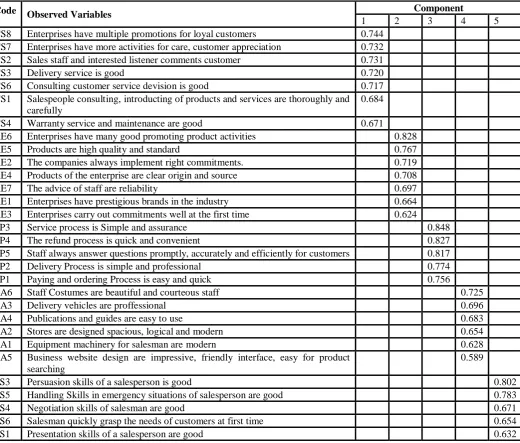
Results of EFA - Exploratory Factor Analysis in the above table shows the total variance extracted is greater than 50% (62.190%), this means that the deduction factors would explain 62.190% for model and the remaining 37.81% is explained by other factors. Extraction ratio factors (Eigenvalue) are greater than 1 should be retained.
Code Observed Variables Component
1 2 3 4 5
CS8 Enterprises have multiple promotions for loyal customers 0.744
CS7 Enterprises have more activities for care, customer appreciation 0.732
CS2 Sales staff and interested listener comments customer 0.731
CS3 Delivery service is good 0.720
CS6 Consulting customer service devision is good 0.717
CS1 Salespeople consulting, introducting of products and services are thoroughly and carefully
0.684
CS4 Warranty service and maintenance are good 0.671
RE6 Enterprises have many good promoting product activities 0.828
RE5 Products are high quality and standard 0.767
RE2 The companies always implement right commitments. 0.719
RE4 Products of the enterprise are clear origin and source 0.708
RE7 The advice of staff are reliability 0.697
RE1 Enterprises have prestigious brands in the industry 0.664
RE3 Enterprises carry out commitments well at the first time 0.624
SP3 Service process is Simple and assurance 0.848
SP4 The refund process is quick and convenient 0.827
SP5 Staff always answer questions promptly, accurately and efficiently for customers 0.817
SP2 Delivery Process is simple and professional 0.774
SP1 Paying and ordering Process is easy and quick 0.756
TA6 Staff Costumes are beautiful and courteous staff 0.725
TA3 Delivery vehicles are proffessional 0.696
TA4 Publications and guides are easy to use 0.683
TA2 Stores are designed spacious, logical and modern 0.654
TA1 Equipment machinery for salesman are modern 0.628
TA5 Business website design are impressive, friendly interface, easy for product searching
0.589
SS3 Persuasion skills of a salesperson is good 0.802
SS5 Handling Skills in emergency situations of salesperson are good 0.783
SS4 Negotiation skills of salesman are good 0.671
SS6 Salesman quickly grasp the needs of customers at first time 0.654
SS1 Presentation skills of a salesperson are good 0.632
(Source: The researcher’s collecting data and SPSS)
Table 2 showed that the model of EFA - Exploratory Factor Analysis is consistent with the data, calculated into 5 groups of factors and these results may be used for a multiple regression analysis.
Regression
analysis results
Regression analysis method is the study of the influence degree of one or more independent variables to one dependent variable to predict outcome variables based on the values of the variables which are known before explaining. To measure the performance of sales, analyzing multiple linear regressions is to test the hypotheses of models with 5-element group which is independent variables to measure the impact level of the group factors to sales performance for Vietnamese Enterprises in the field of electronics and electrical household appliances. The study results show that the influence degree of these factors reflected multiple regression coefficients. To compare the effects of the factors normalized regression coefficients are used for this coefficient does not depend on scale (Nguyen Dinh Tho - Nguyen Thi Mai Trang, 2009, 126 pages). Thus, using the regression equation was standardized to analyze the degree of influence of these factors on sales performance for Vietnamese Enterprises in the field of electronics and electrical household appliances.
R2 = 0.811 (verification F, sig. < 0.05) Shows that the compatibility of the model with independent variables and the dependent
2.236 < 4; Some observers n = 201, parameter k = 5, the level of significance of 0.01 (99%). Thus, customer satisfaction for business sales activities are due to 5 independent variables mentioned.
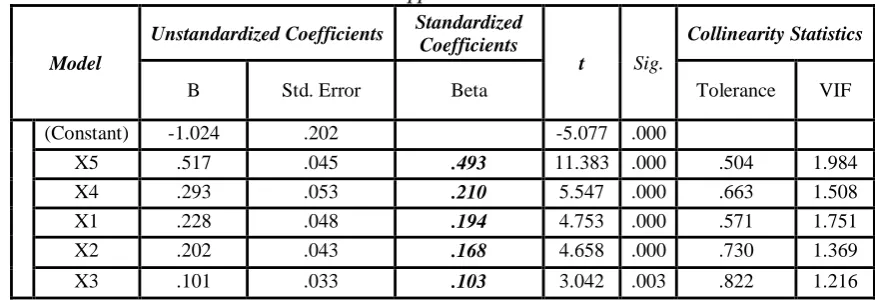
The test results have value and F = 172.148, Sig. = 0.000 < 0.05 shows the building model is consistent with the data set and the variables included in the model are related to the dependent variable. Generally, regression analysis with selected reliability is 99%, corresponding to the selected variables which are statistically significant at the p < 0.01; results also show that all variables are satisfying demand. Verification of conformity of the model shows the multicollinearitydoes not violate (VIF < 10).
Table 3: Factors affecting the performances of vietnamese enterprises in the field of electronics and electrical household appliances
Model
Unstandardized Coefficients Standardized
Coefficients
t Sig.
Collinearity Statistics
B Std. Error Beta Tolerance VIF
(Constant) -1.024 .202 -5.077 .000
X5 .517 .045 .493 11.383 .000 .504 1.984
X4 .293 .053 .210 5.547 .000 .663 1.508
X1 .228 .048 .194 4.753 .000 .571 1.751
X2 .202 .043 .168 4.658 .000 .730 1.369
X3 .101 .033 .103 3.042 .003 .822 1.216
(Source: The researcher’s collecting data and SPSS)
Table 3 showed that the factors affecting the performances of Vietnamese enterprises in the field of electronics and electrical household appliancesand the degree of priority the followings: (1) Sales skills: β = 0.493; (2) Tangibles: β = 0.210; (3) Customer services: β = 0.194; (4) Reliability: β = 0.168; and (5) Service Process: β = 0.103.
Conclusion and recommendation
Conclusion: This study shows that there are five factors that affect improving sales performance for Vietnamese enterprises in the field of electronics and electrical household appliances and the influence degree of each factor is different. According to the analysis, 5 correlation factors affect improving Sales Performance for Vietnamese enterprises in the field of electronics and electrical household appliances respectively: (1) sales skills, (2) Tangibles, (3) Customer Services, (4) Reliability and (5) Service Process. From this research result, enterprises have an important basis for considerating or planning their business strategy. Recommendation
Recommendation 1: "Sales Skills". The recruiting, training and maintaining policies need enhancing, especially good sales staff. Besides, business need to regularly enhance the training or improving knowledge, qualifications and skills for sales staff and customer service department because they often contact with customers. Sales skills are the most influential factors on the performance of sales which is decisive to the survival and development of enterprises.
Recommendation 2: "Tangibles": Perfecting and improving the quality of infrastructure facilities should be invested more such as offices, shops, showroom, stalls, toilets, and lounges for guests, machinery assisting sales staff towards modernization because they are regarded as the face of the company which impacts directly and indirectly to all the customers’ senses and psychology. Besides, businesses also need optimizing their presence on the Internet, improving interactive Website with customers or online sales because customers today tend to buy goods online, usually appreciate enterprises with high professional Web sites and interaction with customers.
Recommendation 3: "Customer Services": customer service and customer relationship management should be focussed professionally. Businesses need increasing the interaction with the customer in order to research customers in meeting the increasing their abundant demand. These companies need to take advantage of Internet and social networks to create opportunities to communicate and advertise to customers. Enterprises can use the database collected from customers to designa multitude of changes as establishing good relationships with consumers, building relationships between consumers and business products, helping businesses change the shopping experience for customers.
in business must become the business culture and philosophy and ensure all members of the organization to understand and perform it naturally and regularly.
Recommendation 5: "service process": In the digital age, the Internet and social networks are flourished, service processes need to improving and the process of selling is toward ease, convenience and safety for our customers. If sales process is good, it will positively impact customer satisfaction, helping maximize sales performance. Specifically, businesses should establish a systematic and consistent process of consultation, referrals, orders, billing, delivery, maintenance, warranty, refund that fit and simplify, eliminating the clumsy and unnecessary to facilitate and save time for customers.
References
1. Benn, A. (2001). Competitiveness in the retail industry. Special Issue on Competitiveness in retail sector. Journal of Retail Research
2. Crouch, G., & Ritchie, J. B. R. (1994). Retail competitiveness: exploring foundations for a long-term research program. In Proceedings of the Administrative Sciences Association of Canada annual conference.
3. Court, R. H. (1968). An application of demand theory to projecting New Zealand retail consumption. Journal of Retail Research 4. Dwyer, L., Forsyth, P., & Rao, P. (2000). The price competitiveness of retail industry. Journal of Retail Research.
5. Harteserre, A. (2002). Lessons in managerial retail competitiveness in the case of Thailand. Retail Management.
6. European Commission. (1994). Enhancing European competitiveness. 2nd report to the president of the commission. Competitiveness Advisory Group, European Commission, Luxembourg: OPEC.
7. Nguyen Huu Tho (2011). Methodology of scientific research in business. Labour Publishing House. 8. Pechlaner (2005). Competition and sustainable development. The Economic Review.
9. John Hann (2010). Solutions to enhance the competitiveness of enterprises in the integration. 10. Micheal Porter (2012). Micheal Porter's 5 forces. University of National Economy.
11. Hassan, S. (2000). Determinants of market competitiveness in an environmentally sustainable retail industry. Journal of Retail Research.
12. Mangion, M., Durbarry, R., & Sinclair, M. T. (2005). Retail competitiveness: price, quality and service. Retail Economics. 13. David Kok. (2011). Competitiveness in the retail industry: price and quality. The Journal of the American Statistical Association 14. Keaveney, Susan M. (1995). Customer Behavior in Industries: An Exploratory Study. Journal of Marketing.
15. Boulding, William, Richard Staelin, Ajay Kalra, and Valarie Zeithaml (1993). A Dynamic Process Model of Service Quality: From Expectations to Behavioral Intentions. Journal of Marketing Research.
16. Bernd Stauss, and Patricia Neuhaus (1997). The qualitative satisfaction model. International Journal of Service Industry Management.
17. Kurt Matzler (2002). The factor structure of Customer satisfaction. International Journal of Service Industry Management. 18. Eugene W. and Mary W. Sullivan (1993). The Antecedents and Consequences of Customer Satisfaction for Firms. Marketing
Science, 12 (Spring).
19. Finn, Adam and Ujwal Kayande (1997). Reliability Assessment and Optimization of Marketing Measurement. Journal of Marketing Research.