R E S E A R C H A R T I C L E
Open Access
Gender-differences in risk factors for suicidal
behaviour identified by perceived burdensomeness,
thwarted belongingness and acquired capability:
cross-sectional analysis from a longitudinal
cohort study
Tara Donker
1,2,3,4*, Philip J Batterham
5, Kimberly A Van Orden
6and Helen Christensen
1,2Abstract
Background:The Interpersonal-Psychological Theory of Suicidal Behavior (IPT) is supported by recent epidemiological data. Unique risk factors for the IPT constructs have been identified in community epidemiological studies. Gender differences in these risk factors may contribute substantially to our understanding of suicidal risk, and require further investigation. The present study explores gender differences in the predictors and correlates of perceived burdensomeness, thwarted belongingness and acquired capability for suicide.
Methods:Participants (547 males, 739 females) aged 32–38 from the PATH through Life study, an Australian population-based longitudinal cohort study (n=1,177) were assessed on perceived burdensomeness, thwarted belongingness and acquired capability for suicide using the Interpersonal Needs Questionnaire and Acquired Capability for Suicide Survey, and on a range of demographic, social support, psychological, mental health and physical health measures. Gender differences in the predictors of the IPT constructs were assessed using linear regression analyses.
Results:Higher perceived burdensomeness increased suicide ideation in both genders, while higher thwarted belongingness increased suicide ideation only in females. In females, thwarted belongingness was uniquely related to perceived burdensomeness, while greater physical health was significantly associated with greater thwarted belongingness in males but not in females. There were trends suggesting greater effects of being single and greater perceived burdensomeness for men, and stronger effects of less positive friendship support for women associated with greater thwarted belongingness.
Conclusions:Men and women differ in the pattern of psychological characteristics that predict suicide ideation, and in the factors predicting vulnerability. Suicide prevention strategies need to take account of gender
differences.
Keywords:Suicide, Gender, Risk factors, Interpersonal-Psychological Theory of Suicidal Behavior
* Correspondence:[email protected]
1
Black Dog Institute, Sydney, Australia
2School of Medicine, University of New South Wales, Sydney, Australia
Full list of author information is available at the end of the article
Background
One million deaths per year are estimated to occur as a re-sult of suicide (World Health Organization (WHO) 2002). If suicide is to be prevented, we need better models of its causes and pathways. One of the leading theoretical models of suicidal behaviour is the Interpersonal-Psychological Theory of Suicidal Behavior (IPT) (Joiner 2005), which provides a testable model of suicide, and is supported by evidence from clinical, community and experimental stud-ies (Christensen et al. 2013; Cukrowicz et al. 2011; Joiner et al. 2009; St Germain & Hooley 2013; Van Orden et al. 2008; You et al. 2011). The IPT proposes that the desire for suicide stems from two interpersonal characteristics: thwarted belongingness and perceived burdensomeness. Thwarted belongingness arises when the“need to belong” (to others) is unmet (Van Orden et al. 2010), while per-ceived burdensomeness refers to the belief that one is so inadequate that one`s existence is a burden on friends, family members and/or society (Van Orden et al. 2010). According to the IPT, the desire for suicide in combination with acquired capability, operationalized as a diminished fear of death and elevated physiological pain tolerance (Van Orden et al. 2010), leads to suicidal behaviour–near lethal attempts and death. Recent studies have indicated that the IPT model explained more variance in predicting suicidal behaviour than traditional mental health epidemio-logical models (Christensen et al. 2013); and that each of the IPT core constructs were uniquely correlated with psy-chological or mental health factors, such as anxiety, and psychoticism (Christensen et al. 2014). Men and women differ substantially in prevalence of suicidal behaviours. Men are more likely to die by suicide while women are more likely to attempt and survive (Bhugra 2006; Hawton & van Heeringen 2009). The pathways to suicide for males and females may be quite different, as has been recognised by many researchers (e.g., (Anestis et al. 2011; Ellis & Lamis 2007; Hawton 2000; Riley et al. 1998)). Previous re-search, whether directly or indirectly, has noted several gender differences in the prevalence of risk factors or cor-relates of suicide risk. However, gender differences in the risk factors for the IPT constructs may contribute substan-tially to our understanding of why particular characteristics produce increased risk of suicide for men and women and require systematic investigation. To date, the ways in which these gender differences are reflected in IPT models have not been clarified. Below we outline the evidence as to how risk factors and correlates may relate to the core IPT factors.
Perceived burdensomeness
Poorer mental and physical health, depression, and stressful life events, such as unemployment, have been found to be associated with perceived burdensomeness (Christensen et al. 2014). Unemployment increases the
risk for suicide in men but not in women (Qin et al. 2000) and may thus affect burdensomeness in males more than in females. Although mental illness increases the risk of suicide equally in both genders, higher preva-lence of mental illness may confer a greater proportion of the risk for suicide in women than men (Hawton 2000; Qin et al. 2000) and thus may affect burdensome-ness more in females than males. Previous research (Christensen et al. 2014) indicated that negative interac-tions from family and positive support from friends in-creased perceived burdensomeness, but this may be differentially affected by gender.
Thwarted belongingness
Van Orden (Van Orden et al. 2010) has suggested that women may be particularly sensitive to thwarted belong-ingness because of the importance of close ties and fam-ily for happiness. The significant higher rates of suicide attempts among female immigrants in Europe and other Western countries compared to non-Western countries, especially in young women moving from traditional to more individualistic societies suggests higher thwarted belongingness (Van Bergen et al. 2008; Burger et al. 2002; Bursztein Lipsicas et al. 2013; Miranda et al. 2013). Marriage in itself appears to be a protective factor for men, whereas in married women, being a parent of a young child was found to be a protective factor for sui-cide risk (Hawton 2000; Qin et al. 2000). For unmarried men, thwarted belongingness may therefore be higher.
Acquired capability
Several studies have indicated that men possess signifi-cantly higher levels of pain tolerance (Riley et al. 1998) and lower levels of fear of suicide (Ellis & Lamis 2007), which are measures of the two facets of acquired cap-ability. Previous findings also indicate a direct relation-ship between male gender and increased acquired capability (Van Orden et al. 2008; Christensen et al. 2999; Anestis et al. 2011). In addition, Anestis et al. (Anestis et al. 2011) found that distress tolerance inter-acted with sex to predict acquired capability, such that males with high distress tolerance had the highest levels of acquired capability.
marital status, number of recent stressful events, num-ber of lifetime traumas, positive and negative interac-tions from friends and family, ruminative style, mastery, personality traits, physical and mental health scores, self-reported presence of generalized anxiety and pres-ence of major depression. The risk factors included ei-ther have direct associations with the IPT constructs, or have associations with suicide ideation (e.g. rumination (Vilhjalmsson et al. 1998), Mastery (Blüml et al. 2013), personality traits (Martin et al. 2004) and life-time trau-mas (Merrill & Owens 1986).
Methods
Participants and procedure
The PATH Through Life Project is a population-based study examining the health and well- being of people who were initially 20–24, 40–44, and 60–64 years of age (Anstey et al. 2012). Each cohort is being followed up every four years over a total period of 20 years. Partici-pants were randomly sampled from the electoral rolls for the city of Canberra, Australia, and in the neighbour-ing town of Queanbeyan. Results presented here concern only the 20s cohort, with data from the fourth wave of interviews conducted in 2011–2012, when participants were aged 32–38 (the majority being 33–37). The ration-ale for including only this cohort cross-sectionally is be-cause the INQ items were only included for that cohort and only at the most recent assessment. At the first wave, interviews were completed with 2,404 in the 20– 24 year age-group, of which, 1242 (51.7%) were female and 1162 (48.3%) were male. The participation rate of those who were found to be in the appropriate age range was 58.6%. Follow-up interviews were completed by 1,191 (49.5%) participants (42.5% male, 57.5% female) at wave 4, 12 years after the initial interview, with a further 95 partial completions (53.5% total). The response rate was markedly lower than for previous interview waves (88.6% and 79.7% at Waves 2 and 3), due to reduced project funding that required the interviews be largely conducted online. At Wave 3, there were no significant differences in the rates of suicidal ideation (χ21 = 1.65, p = 0.199), suicidal behaviours (χ21 = 0.02, p = 0.881), presence of anxiety (χ21= 3.41, p = 0.065) or presence of depression (χ21= 1.56, p = 0.212) between those who did and did not complete Wave 4. Those who completed Wave 3 but not Wave 4 had significantly less education (14.0 vs 14.4 y; F1, 1964= 35.1, p < 0.001) and females had significantly higher rates of assessment completion (68% of F vs 58% of M;χ21= 22.2, p < 0.001). After exclusion on the basis of missing outcome data was made, the sample size for the regression analyses was n=1,177. Items used in the present analyses were based on a self-completed on-line survey. Approval for the research was obtained from The Australian National University’s Human Research
Ethics Committee (protocol #2010/542). All participants provided written informed consent to participate in the study.
Measures
experiences from 10 items, including combat experi-ence, life- threatening accident, natural disaster, witnes-sing injury or death, rape, sexual molestation, physical attack or assault, being threatened with a weapon/held captive/kidnapped, being tortured or a victim of terrorism, or other extremely stressful/upsetting event (Rosenman 2002). Social support was assessed using summed mea-sures of both negative and positive support from family and friends (Schuster et al. 1990). The items were “How often do friends make you feel cared for?”,“How often do friends express interest in how you are doing?”, “How often do family make you feel cared of?”and “How often do family express interest in how you are doing?” Re-sponses were given on a four-point scale ranging from
“often”to“never”. Three personality traits of neuroticism, extroversion and psychoticism were measured at the ini-tial interview, twelve years before the outcome data were assessed, using the Eysenck Personality Questionnaire-Revised (Eysenck et al. 1985). These traits tend to be highly stable (four-year reliability correlations of 0.56-0.74). Presence of major depressive episode was assessed using the nine-item Patient Health Questionnaire (PHQ-9 (Spitzer et al. 1999)) based on the algorithm identified by the authors of the scales, specifically, presence of anhedo-nia or feelings of depression (first two items of PHQ-9) and five or more of the nine PHQ-9 items being rated as
“more than half the days” or higher (or“several days” or higher for the suicidal ideation item). An example item is
“How often have you been bothered by little interest of pleasure in doing things?”. In a review of Wittkampf et al. (Wittkampf et al. 2007), a sensitivity of 0.77 (0.71–0.84) and a specificity of 0.94 (0.90–0.97) was found for the PHQ-9. Presence of Generalized Anxiety Disorder was assessed using the GAD-7 scale (Spitzer et al. 2006), which was also scored using the authors’ diagnostic algorithm (see (Spitzer et al. 1999)) based on ratings of “more than half the days” or “nearly every day” on the first item and at least three subsequent items. An example item is “how often have you been bothered by feeling nervous, anxious or on edge?”. Reliability and validity are excellent (Cronbach's α=0.92, AUC: 0.91). With a cut-off point of≥10, sensitivity is 0.89 and specificity is 0.82 among primary care participants (Eysenck et al. 1985). Both the PHQ-9 and the GAD-7 are based on past two weeks.
Analysis
Two exploratory factor analyses were conducted, the first with items from the shortened version of the INQ, and the second with the shortened items of the ACSS. Descriptive statistics for the sample were tabulated by gender. Differences in potential risk factors between fe-male and fe-male participants with and without suicidal be-haviour were assessed using F values from one- way
ANOVAs and chi-square statistics for continuous and categorical variables respectively. Next, logistic regres-sion analyses were used to test the predictions of the IPT model for suicidal ideation in males and females. The variables were centred to reduce multicollinearity. The independent variables for the model were the risk factors hypothesized by the IPT to predict ideation (per-ceived burdensomeness, thwarted belongingness and the interaction of these two constructs). The rates of suicidal ideation based on levels of perceived burdensomeness and thwarted belongingness were plotted using tertile splits of scores on these constructs. The logistic regression model for plans and attempts were not tested because prevalence was too low (n= 18, 1.4%). The hypothesized interaction between acquired capability and ideation could not be tested in the model for plan/attempts, as all partici-pants who reported a plan or attempt also experienced ideation. As thwarted belongingness and perceived bur-densomeness are distinct, but related constructs (Martin et al. 2004), we included the constructs as covariates in each of the models to assess risk factors for each of the constructs independent of the other constructs. Linear re-gression models were used to assess the association be-tween the potential risk factors and the three IPT constructs: perceived burdensomeness, thwarted belong-ingness and acquired capability for suicide in separate models for males and females. We tested whether the models for males explained more variance than the models for females using Chow tests (Chow 1960). To test the accuracy of the model for males compared to females, area under the ROC curve analysis (Hanley & McNeil 1982) were conducted. Finally, where possible differences were observed in the effects for males and females (i.e., one significant and the other non-significant, or both sig-nificant but of different magnitude), we examined a linear regression model that included the effects of gender, the risk factor and the interaction between gender and the risk factor. We then interpreted discrepant effects as indicating gender differences only when this interaction term was significant.
SPSS version 20 was used for all analyses. Because of the exploratory nature of the analyses, alpha was set at P<.01.
Results
Construct validity of the INQ and ACSS
44.5% of variance, with loadings >0.78 for the pain toler-ance items and >0.35 for the fear of death items.
Gender differences in the IPT risk factors
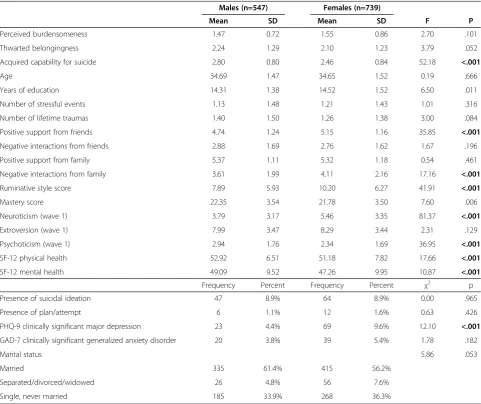
Only results of gender differences at P<.01 are reported. The community cohort of 32–38 year olds had a mean age of 34.7 and 58% of respondents were female. Sample characteristics are presented in Table 1 by gender. There were no gender differences in perceived burdensomeness or thwarted belongingness, but males reported signifi-cantly higher levels of acquired capability for suicide compared to females. Furthermore, compared to males, females experienced significantly higher levels of positive support from friends, higher levels of negative interac-tions from family, higher ruminative style, neuroticism and PHQ-9 depression. Males expressed higher levels of mastery, psychoticism, SF-12 physical and mental health.
There were no differences in suicidal ideation or plans/ attempts between males and females.
Table 2 and Figure 1 show data examining gender dif-ferences in the IPT. Each point of increase in perceived burdensomeness on the seven-point scale was associated with approximately a five-fold increase in the odds of ex-periencing thoughts of suicide for males, and a two-fold increase for females. A one-point increase in thwarted belongingness increased the odds of suicide ideation by 67% in females, while for males this increase was not significant. Based on area under the ROC curve, the model was not significantly more accurate for males compared to females (AUC male = 0.827, AUC female = 0.825, P= .97 (Spitzer et al. 1999)). Based on separate lin-ear regression analysis, The variance explained by the perceived burdensomeness model were similar for males and females (males: AdjustedR2= 0.53; females: adjusted
Table 1 Descriptive statistics by gender
Males (n=547) Females (n=739)
Mean SD Mean SD F P
Perceived burdensomeness 1.47 0.72 1.55 0.86 2.70 .101
Thwarted belongingness 2.24 1.29 2.10 1.23 3.79 .052
Acquired capability for suicide 2.80 0.80 2.46 0.84 52.18 <.001
Age 34.69 1.47 34.65 1.52 0.19 .666
Years of education 14.31 1.38 14.52 1.52 6.50 .011
Number of stressful events 1.13 1.48 1.21 1.43 1.01 .316
Number of lifetime traumas 1.40 1.50 1.26 1.38 3.00 .084
Positive support from friends 4.74 1.24 5.15 1.16 35.85 <.001
Negative interactions from friends 2.88 1.69 2.76 1.62 1.67 .196
Positive support from family 5.37 1.11 5.32 1.18 0.54 .461
Negative interactions from family 3.61 1.99 4.11 2.16 17.16 <.001
Ruminative style score 7.89 5.93 10.20 6.27 41.91 <.001
Mastery score 22.35 3.54 21.78 3.50 7.60 .006
Neuroticism (wave 1) 3.79 3.17 5.46 3.35 81.37 <.001
Extroversion (wave 1) 7.99 3.47 8.29 3.44 2.31 .129
Psychoticism (wave 1) 2.94 1.76 2.34 1.69 36.95 <.001
SF-12 physical health 52.92 6.51 51.18 7.82 17.66 <.001
SF-12 mental health 49.09 9.52 47.26 9.95 10.87 <.001
Frequency Percent Frequency Percent χ2 p
Presence of suicidal ideation 47 8.9% 64 8.9% 0.00 .965
Presence of plan/attempt 6 1.1% 12 1.6% 0.63 .426
PHQ-9 clinically significant major depression 23 4.4% 69 9.6% 12.10 <.001
GAD-7 clinically significant generalized anxiety disorder 20 3.8% 39 5.4% 1.78 .182
Marital status 5.86 .053
Married 335 61.4% 415 56.2%
Separated/divorced/widowed 26 4.8% 56 7.6%
Single, never married 185 33.9% 268 36.3%
R2= 0.53; F(24, 1118) = 0.81, P = .73). However, more variance was explained in the thwarted belongingness model for females and less variance was explained in the thwarted belongingness model for males (males: Adjusted R2= 0.53; females: adjusted R2= 0.58; F(24, 1118) = 1.95, P = .004). More variance was explained in the acquired capability model for males, while less vari-ance was explained in the acquired capability model for females (males: Adjusted R2= 0.17; females: adjusted R2= 0.12;F(24, 1118) = 2.12, P = .001).
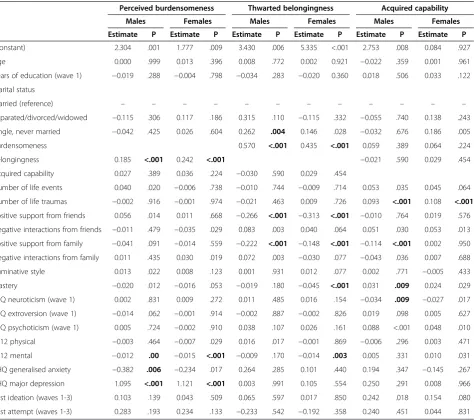
The results from multivariate linear regressions in gender differences for each of the three core constructs (perceived burdensomeness, thwarted belongingness and acquired capability for enacting suicide) are presented in Table 3.
Perceived burdensomeness
In the multivariate linear regression, the absence of Generalised Anxiety (GAD) predicted higher perceived burdensomeness only in males, although follow-up ana-lyses found no significant interaction effect between GAD and gender on perceived burdensomeness. However, a significant gender interaction effect was found for the
effect of thwarted belongingness (t = 3.70, P < 0.001) indi-cating a greater effect of thwarted belongingness on perceived burdensomeness for females than males. The model in Table 3 also shows significant effects of SF-12 mental health and PHQ-9 depression, although these were not significantly different by gender.
Thwarted belongingness
Males but not females experiencing higher levels of negative interactions from friends and family or being single/never married expressed higher levels of thwarted belongingness, whereas lower mastery levels and poorer mental health was associated with increased thwarted be-longingness in females but not males. However, follow-up linear regression models testing the interaction between gender and each risk factor separately found that none of these effects were significant at P< 0.01, although there were trends suggesting greater effects of being single (t =−2.27, P= 0.023) and greater perceived bur-densomeness (t = −2.39, P= 0.017) for men, and stron-ger effects of less positive friendship support for women (t = −2.33, P= 0.023). In addition, although SF-12 physical health was not significant at P < 0.01 for males or females, there was a significant gender inter-action indicative of stronger effects of greater physical health on greater thwarted belongingness among men than women (t =−3.41, P= 0.001).
Acquired capability
Less positive support from family, higher levels of mas-tery and psychoticism and lower levels of neuroticism were associated with higher levels of acquired capability in males but not in females. Only among females, signifi-cantly higher levels of acquired capability were seen
Table 2 Logistic regression models of suicidal ideation based on the Interpersonal-Psychological Theory of suicidal behaviour
Males (n = 520) Females (n = 713)
OR P OR P
Perceived burdensomeness 4.874 <.001 2.115 <.001
Thwarted belongingness 1.227 .301 1.674 <.001
Burden x belonging 0.731 .019 0.893 .212
Constant 0.063 <.001 0.064 <.001
among those who were single or never married. How-ever, follow-up linear regression models testing the interaction between gender and each risk factor separ-ately found that none of these interactions were signifi-cant. Life traumas were significantly associated with greater acquired capability for both men and women.
Discussion
The present study is, as far as we know, the first study testing the predictions of the IPT model for gender dif-ferences in a community-based cohort. Furthermore, no other study has directly identified gender differences in the predictors associated with the core IPT constructs of thwarted belongingness, perceived burdensomeness and acquired capability for suicide.
Partial support for the IPT model
There was partial support for the IPT model. Higher levels of perceived burdensomeness was associated with increased suicidal ideation in both genders, whereas thwarted belongingness was associated with increased suicidal ideation in women only. High levels of perceived burdensomeness increased risk for suicidal ideation, par-ticularly among males.
There was no gender difference in the variance ex-plained by the perceived burdensomeness model. More variance was explained for females than males for thwarted belongingness while more variance was ex-plained for males than females for the acquired capabil-ity model. However, especially for acquired capabilcapabil-ity, relatively little variance was explained by the model.
Table 3 Linear regression models examining gender differences in the predictors of the three Interpersonal-Psychological Theory constructs (n male = 491,nfemale = 676)
Perceived burdensomeness Thwarted belongingness Acquired capability
Males Females Males Females Males Females
Estimate P Estimate P Estimate P Estimate P Estimate P Estimate P
(Constant) 2.304 .001 1.777 .009 3.430 .006 5.335 <.001 2.753 .008 0.084 .927
Age 0.000 .999 0.013 .396 0.008 .772 0.002 0.921 −0.022 .359 0.001 .961
Years of education (wave 1) −0.019 .288 −0.004 .798 −0.034 .283 −0.020 0.360 0.018 .506 0.033 .122
Marital status
Married (reference) – – – – – – – – – – – –
Separated/divorced/widowed −0.115 .306 0.117 .186 0.315 .110 −0.115 .332 −0.055 .740 0.138 .243
Single, never married −0.042 .425 0.026 .604 0.262 .004 0.146 .028 −0.032 .676 0.186 .005
Burdensomeness 0.570 <.001 0.435 <.001 0.059 .389 0.064 .224
Belongingness 0.185 <.001 0.242 <.001 −0.021 .590 0.029 .454
Acquired capability 0.027 .389 0.036 .224 −0.030 .590 0.029 .454
Number of life events 0.040 .020 −0.006 .738 −0.010 .744 −0.009 .714 0.053 .035 0.045 .064
Number of life traumas −0.002 .916 −0.001 .974 −0.021 .463 0.009 .726 0.093 <.001 0.108 <.001
Positive support from friends 0.056 .014 0.011 .668 −0.266 <.001 −0.313 <.001 −0.010 .764 0.019 .576
Negative interactions from friends −0.011 .479 −0.035 .029 0.083 .003 0.040 .064 0.051 .030 0.053 .013
Positive support from family −0.041 .091 −0.014 .559 −0.222 <.001 −0.148 <.001 −0.114 <.001 0.002 .950
Negative interactions from family 0.011 .435 0.030 .019 0.072 .003 −0.030 .077 −0.043 .036 0.007 .688
Ruminative style 0.013 .022 0.008 .123 0.001 .931 0.012 .077 0.002 .771 −0.005 .433
Mastery −0.020 .012 −0.016 .053 −0.019 .180 −0.045 <.001 0.031 .009 0.024 .029
EPQ neuroticism (wave 1) 0.002 .831 0.009 .272 0.011 .485 0.016 .154 −0.034 .009 −0.027 .017
EPQ extroversion (wave 1) −0.014 .062 −0.001 .914 −0.002 .887 −0.002 .826 0.019 .098 0.005 .627
EPQ psychoticism (wave 1) 0.005 .724 −0.002 .910 0.038 .107 0.026 .161 0.088 <.001 0.048 .010
SF12 physical −0.003 .464 −0.007 .029 0.016 .017 −0.001 .869 −0.006 .296 0.003 .471
SF12 mental −0.012 .00 −0.015 <.001 −0.009 .170 −0.014 .003 0.005 .331 0.010 .031
PHQ generalised anxiety −0.382 .006 −0.234 .017 0.264 .285 0.101 .440 0.194 .347 −0.145 .267
PHQ major depression 1.095 <.001 1.121 <.001 0.003 .991 0.105 .554 0.250 .291 0.008 .966
Past ideation (waves 1-3) 0.103 .139 0.043 .509 0.065 .597 0.017 .850 0.242 .018 0.154 .080
Gender differences in predictors
Because of the exploratory nature of the analyses, we only discuss results of p-values of <.01 and results from follow-up analyses.
Perceived burdensomeness
Previous research found strong evidence for the inter-action of thwarted belongingness and perceived burden-someness increasing the risk of suicide ideation (Christensen et al. 2013; Joiner et al. 2009; Van Orden et al. 2008). Results from our study indicated a greater effect of thwarted belongingness on perceived burden-someness for females but not males. This is an import-ant finding as women who experience feelings that they do not belong may be at higher risk for experiencing in-creased feelings of burdensomeness, leading to greater risk for suicide ideation. Previous research has not ex-amined potential pathways whereby the theory`s inter-personal constructs may influence each other; this is a novel contribution of the current study.
Thwarted belongingness
The present study showed a trend that in single or un-married males but not females, thwarted belongingness was higher. This is in line with previous research (Hawton 2000; Qin et al. 2000), indicating that mar-riage in itself appears to be a protective factor for men. This study also found a trend that a higher level of per-ceived burdensomeness affected thwarted belonging-ness more in males than females.
Our results suggest that the etiological pathways in the IPT are likely more complex than originally proposed. In particular, the effects of belongingness and burdensome-ness do not appear to be independent, and depend on gender. For women, the model could include a causal link from belongingness to burdensomeness and for men, the model could include a causal link from burden-someness to belongingness. A frequently raised question regarding the theory is whether an individual can experi-ence a feeling of disconnection (e.g., thwarted belonging and at the same time experience connectedness- albeit negative in the form of burdensomeness). Our results are consistent with the theory`s proposal that one can experience both constructs simultaneously, while also generating a hypothesis that these constructs fuel each other, although in different directions for men and women. Future research examining the pathways among the construct of the IPT is needed, especially with regards to gender. For example, the theory is silent as to whether belongingness and burdensomeness might fluence acquired capability. However, given research in-dicating that social pain activates the same neural pathway as physical pain, it may very well be the case that all of the IPT construct are interrelated.
Furthermore, less positive friendship support affected thwarted belongingness more in females than males, and thus may confer a greater proportion of the risk for sui-cide in women than men. Interestingly, a greater phys-ical health affected thwarted belongingness more among men than women. An interaction effect with depression might be possible, but future research will be needed to test this.
Acquired capability
In the present study, no interaction effects of gender on acquired capability were found.
Limitations
The strengths of this study include a large community-based cohort and the inclusion of a large set of potential risk factors. However, this study also had several limita-tions. First, because of the independent samples, we were not able to test whether the models of perceived burdensomeness, thwarted belongingness and acquired capability significantly differed from each other for males or females. There also may have been subgroup differ-ences within each gender. Second, due to low suicide ideation and plans/attempts base rates of the sample, there may have been insufficient power to detect true gender differences in the IPT constructs. However, males had higher levels of acquired capability, consistent with previous research (Anestis et al. 2011). Third, we were not able to include risk factors which have previously been identified to differentiate between gender effects, such as distress tolerance (Anestis et al. 2011) or migra-tion (Bursztein Lipsicas et al. 2013), and other low prevalence risk factors, such as sexual abuse (Martin et al. 2004). Fourth, although some risk factors were measured longitudinally, the analysis used a cross-sectional design. Therefore it was not possible to deter-mine whether most risk factors were the cause rather than the consequence of suicidal behaviour. Further re-search using a longitudinal design (such as rere-search on the present cohort after the next follow-up in 2015) would provide stronger research evidence. Fifth, due to power limitations and difficulties of interpreting multiple interactions, we did not include all covariates in the models to test the interaction of gender with each risk factor. Finally, we did not have access to data on com-pleted suicides, and there are likely to be very few sui-cides even in a cohort of this size. Therefore, our conclusions on acquired capability may be limited to in-dividuals in the community with capability to engage in non-lethal suicidal behaviour.
Clinical implications
genders. In females, thwarted belongingness was uniquely related to perceived burdensomeness, while greater phys-ical health was significantly associated with greater thwarted belongingness in males but not females. This study contributes to a further understanding of the com-plex psychological and societal differences in women and men affecting the three IPT constructs for suicidal behav-iour. Identifying gender differences may enhance predict-ive value of risk factors for the IPT constructs of suicidal behaviour, and accordingly, allow for more precise identification of those being at risk of suicide. In addition, developing different suicide prevention strat-egies or interventions according to gender differences may enhance effectiveness and dissemination of those treatments. This study found that females may benefit more when screening and treatment is focused at in-creasing belongingness through targeting its associated risk factors (e.g., support from friends). Suicide preven-tion strategies focusing on decreased burdensomeness through targeting relationship status may reduce sui-cidal ideation for males in particular. Nevertheless, bur-densomeness had a large effect on suicidal ideation in both males and females, which indicates that non-gender-specific risk factors play an important role in precipitating suicidality. However, given the explanatory natures of our cross-sectional analysis, results need to be replicated in future research.
Further research
It is very likely that the risk factors associated with the three IPT constructs have complex interactions with many other clinical and sociodemographic variables. Examin-ation of these possible interactions is a challenge for future research. In addition, a very important area for further re-search involves the need to detect which of the numerous strategies to decrease levels of perceived burdensomeness, thwarted belongingness and acquired capability are most effective for males and females to meet their individual needs.
Conclusions
In sum, men and women may differ in the pattern of psychological characteristics that predict suicide idea-tion, and in the factors that predict vulnerability. Suicide prevention strategies need to take account of gender dif-ferences. For females, suicide prevention strategies that aim to increase support from friends may be more ef-fective. Interventions aiming to reduce suicidal ideation in males may be more effective when they focus on building skills to feel less burdened.
Abbreviations
ACSS:Acquired capability for suicide scale; ANOVA: Analysis of variance; AUC: Area under the ROC curve; GAD: Generalized anxiety; GAD-7: Generalized anxiety disorder; INQ: Interpersonal needs questionnaire; IPT:
Interpersonal-psychological theory of suicidal behavior; PHQ-9: Patient health questionnaire; ROC: Receiver operating characteristics; SF-12: Short-form health survey−12; SPSS: Statistical package for the social sciences.
Competing interests
The authors declare that they have no competing interests.
Authors’contribution
Author HC designed the study and wrote the protocol. Author TD managed the literature searches. Authors PJB undertook the statistical analysis, and author TD wrote the first draft of the manuscript. All authors contributed to and have approved the final manuscript.
Acknowledgements
We gratefully acknowledge the participants in this study, Patricia Jacomb, Karen Maxwell and PATH interviewers for their assistance. Funding for Waves 1 and 2 of the PATH study was provided by National Health and Medical Research Council (NHMRC) Program Grant 179805 (CIs Jorm, Christensen, Rodgers, Easteal and Anstey) and Unit Grant No. 973302. Wave 3 funding (CIs Anstey, Christensen, Mackinnon, Easteal, Butterworth) was provided by NHMRC Project grant No. 157125. HC is supported by NHMRC Fellowship 525411 PB is supported by NHMRC Early Career Fellowship 1035262.
Author details
1Black Dog Institute, Sydney, Australia.2School of Medicine, University of
New South Wales, Sydney, Australia.3Department of Clinical Psychology, VU University, Amsterdam, The Netherlands.4EMGO Institute for Health and Care
Research, VU University and VU University Medical Center, Amsterdam, The Netherlands.5Centre for Mental Health Research, Australian National
University, Canberra, Australia.6University of Rochester Medical Center, Rochester, USA.
Received: 14 February 2014 Accepted: 9 July 2014 Published: 12 August 2014
References
Anestis, MD, Bender, TW, Selby, EA, Ribeiro, JD, & Joiner, TE. (2011). Sex and Emotion in the Acquired Capability for Suicide.Arch Suicid Res, 15, 172–182. Anstey, KJ, Christensen, H, Butterworth, P, Easteal, S, Mackinnon, A, Jacomb, T,
Maxwell, K, Rodgers, B, Windsor, T, Cherbuin, N, & Jorm, AF. (2012). Cohort Profile: The PATH through life project.Int J Epidemiol, 41, 951–960. Bhugra, D. (2006). Suicide and gender: cultural factors.Harvard Health Pol Rev,
7, 166–80.
Blüml, V, Kapusta, ND, Doering, S, Brähler, E, Wagner, B, & Kersting, A. (2013). Personality factors and suicide risk in a representative sample of the German general population.PLoS ONE, 8(10), e76646.
Burger, I, van Hemert, AM, Schudel, WJ, & Middelkoop, BJ. (2002). Suicidal behavior in four ethnic groups in the Hague, 2002–2004.Crisis, 30, 63–67. Bursztein Lipsicas, C, Mäkinen, IH, Wasserman, D, Apter, A, Kerkhof, A, Michel, K,
Renberg, ES, van Heeringen, K, Värnik, A, & Schmidtke, A. (2013). Gender distribution of suicide attempts among immigrant groups in European countries—an international perspective.Eur J Pub Health, 23, 279–284. Butler, LD, & Nolen-Hoeksema, S. (1994). Gender differences in responses to
depressed mood in a college sample.Sex roles, 30, 331–346.
Chow, GC. (1960). Tests of equality between sets of coefficients in two linear regressions.Econometrica. J Econometr Soc, 28, 591–605.
Christensen, H, Batterham, PJ, Soubelet, A, & Mackinnon, AJ. (2013). A test of the Interpersonal Theory of Suicide in a large community-based cohort.J Affect Dis, 144, 225–234.
Christensen, H, Batterham, PJ, Mackinnon, AJ, Donker, T, & Soubelet, A. (2014). Predictors of the risk factors for suicide identified by the Interpersonal-Psychological Theory of Suicidal Behaviour.Psych Res.epub ahead of print. doi: 10.1016/j.psychres.2014.05.029.
Cukrowicz, KC, Cheavens, JS, Van Orden, KA, Ragain, RM, & Cook, RL. (2011). Perceived burdensomeness and suicide ideation in older adults.Psychol Aging, 26, 331–338.
Ellis, JB, & Lamis, DA. (2007). Adaptive characteristicsand suicidal behavior: A gender comparisonof young adults.Death Stud, 31, 845–854. Eysenck, SB, Eysenck, HJ, & Barrett, P. (1985). A revised version of the
Hanley, JA, & McNeil, BJ. (1982). The meaning and use of the area under a Receiver Operating Characteristic (ROC) curve.Radiol, 143, 29–36.
Hawton, K. (2000). Sex and suicide: Gender differences in suicidal behaviour.Brit J Psychiat, 177, 484–85.
Hawton, K, & van Heeringen, K. (2009). Suicide.Lancet, 373, 1372–1381. Joiner, TE, Jr. (2005).Why people die by suicide. Cambridge: Harvard University Press. Joiner, TE, Jr, Van Orden, KA, Witte, TK, Selby, EA, Ribeiro, JD, Lewis, R, & Rudd,
MD. (2009). Main predictions of the interpersonal-psychological theory of suicidal behavior: empirical tests in two samples of young adults.J Abnorm Psychol, 118, 634–646.
Lindelow, M, Hardy, R, & Rodgers, B. (1997). Development of a scale to measure symptoms of anxiety and depression in the general UK population: the psychiatric symptom frequency scale.J epidemiol Comm Health, 51, 549–557. Martin, G, Bergen, HA, Richardson, AS, Roeger, L, & Allison, S. (2004). Sexual abuse
and suicidality: gender differences in a large community sample ofadolescents.Child Abuse Neglect, 28, 491–503.
Merrill, J, & Owens, J. (1986). Ethnic differences in self-poisoning a comparison of Asian and white groups.Brit J Psych, 148, 708–712.
Miranda, R, Tsypes, A, Gallagher, M, & Rajappa, K. (2013). Rumination and hopelessness as mediators of the relation between perceived emotion dysregulation and suicidal ideation.Cognitive Therapy Research, 37(4), 786–795. Pearlin, LI, & Schooler, C. (1978). The structure of coping.J Health Soc Beh, 19, 2–21. Qin, P, Agerbo, E, Westergård-Nielsen, N, Eriksson, T, & Mortensen, PB. (2000). Gender
differences in risk factors for suicide in Denmark.Brit J Psych, 177, 546–50. Riley, JL, Robinson, ME, Wise, EA, Myers, CD, & Fillingim, RB. (1998). Sex differences in
the perception of noxious experimental stimuli: A meta-analysis.Pain, 74, 181–187. Rosenman, S. (2002). Trauma and posttraumatic stress disorder in Australia:
findings in the population sample of the Australian National Survey of Mental Health and Wellbeing.Aust New Zeal J Psychiat, 36, 515–520. Schuster, TL, Kessler, RC, & Aseltine, RH, Jr. (1990). Supportive interactions, negative
interactions, and depressed mood.Am J Commun Psych, 18, 423–438. Spitzer, RL, Kroenke, K, & Williams, JB. (1999). Validation and utility of a self-report
version of PRIME-MD: the PHQ primary care study. Primary Care Evaluation of Mental Disorders. Patient Health Questionnaire.J Am Med Ass, 282, 1737–1744. Spitzer, RL, Kroenke, K, Williams, JB, & Lowe, B. (2006). A brief measure for assessing
generalized anxiety disorder: the GAD-7.Arch Intern Med, 166, 1092–1097. St Germain, SA, & Hooley, JM. (2013). Aberrant pain perception in direct and
indirect non- suicidal self-injury: An empirical test of Joiner's interpersonal theory.Comprehen Psychiat, 28,pii, S0010-440X(13)00026-6.
Van Bergen, DD, Smit, JH, van Balkom, AJ, van Ameijden, E, & Saharso, S. (2008). Suicidal ideation in ethnic minority and majority adolescents in Utrecht, the Netherlands.Crisis, 29, 202–8.
Van Orden, KA, Witte, TK, Gordon, KH, Bender, TW, & Joiner, TE, Jr. (2008). Suicidal desire and the capability for suicide: tests of the interpersonal-psychological theory of suicidal behavior among adults.J Consult Clin Psychol, 76, 72–83. Van Orden, KA, Witte, TK, Cukrowicz, KC, Braithwaite, SR, Selby, EA, & Joiner, TE, Jr.
(2010). The interpersonal theory of suicide.Psychol Review, 117, 575–600. Van Orden, KA, Cukrowicz, KC, & Witte, TK. (2012). Joiner Jr TE: Thwarted belongingness
and perceived burdensomeness: construct validity and psychometric properties of the interpersonal needs queustionnaire.Psychol Assess, 24, 197–215.
Vilhjalmsson, R, Kristjansdottir, G, & Sveinbjarnardottir, E. (1998). Factors associated with suicide ideation in adults.Social Psychiatry Psychiatric Epidemiology, 33(3), 97–103.
Ware, J, Jr, Kosinski, M, & Keller, SD. (1996). A 12-Item Short-Form Health Survey: construction of scales and preliminary tests of reliability and validity.Med Care, 34, 220–233.
Wittkampf, K, Naeije, L, Schene, A, Van Huyser, J, & Weert, H. (2007). Diagnostic accuracy of the mood module of the Patient Helaht Questionnaire: a systematic review.Gen Hosp Psychiat, 29, 388–395.
World Health Organization (WHO). (2002).World report on violence and health: summary. Geneva: World Health Organization.
You, S, Van Orden, KA, & Kenneth, RC. (2011). Social Connectedness and Suicidal Thoughts and Behaviour.Psychol Addict Behav, 25, 180–184.
doi:10.1186/2050-7283-2-20
Cite this article as:Donkeret al.:Gender-differences in risk factors for suicidal behaviour identified by perceived burdensomeness,thwarted belongingness and acquired capability: cross-sectional analysis from a longitudinal cohort study.BMC Psychology20142:20.
Submit your next manuscript to BioMed Central and take full advantage of:
• Convenient online submission
• Thorough peer review
• No space constraints or color figure charges
• Immediate publication on acceptance
• Inclusion in PubMed, CAS, Scopus and Google Scholar
• Research which is freely available for redistribution