REVIEW
PEN AND PAPER BASED OBSERVATIONAL METHOD TO ASSESS POSTURAL
PROBLEMS: A REVIEW
1Sukadarin EH, 1Deros BM, 1Nawi NSM, 2Tamrin SBM, 3Bakar SA, 4Rambely AS
1Dept. of Mechanical & Materials Engineering, Faculty of Eng. and Built Environment, Universiti Kebangsaan Malaysia 2Department of Community Health, Faculty of Medicine and Health Sciences, Universiti Putra Malaysia
3School of Mechatronic Engineering, Universiti Malaysia Perlis
4Department of Mathematical Sciences, Faculty of Science and Technology, Universiti Kebangsaan Malaysia
ABSTRACT
Posture is one of the most important factor that need to be considered in any postural analysis. Awkward, extreme, and repetitive postures can increase the risk of musculoskeletal disorders (MSDs). As observational methods are more widely used than instrumentation-based methods to assess postural problems, this study reviews and assesses the scientific literature of observational methods and focused on pen and paper based specifically. In order to identify the published methods, a list of English or Malay articles dating as far back as 1990 was compiled from PubMed, Science Direct and Google Scholar. The keywords were ergo*, posture*, method*, observational*, postural problems*, pen and paper*, posture analysis*, indirect* and macro-ergo*. In addition, a secondary search was also performed using bibliography of retrieved articles so that additional papers for conducting review and evaluations can be collected. A total of 121 articles that assessed postural problems in working activities were found. However, after intensive screening process only 6 articles were selected to be further analyzed. Posture of upper arms/shoulder, lower arms/ elbow, wrist, neck, back/trunk and leg were highlighted in this study. The limitations and the strengths of the published pen and paper based observational method focusing on those postures were also discussed. The finding of this review will benefit researchers in the process of understanding unsafe posture in workplace. It could also provide to researcher on how to improve the current pen and paper based observational method for assessing postural problems.
Keywords: posture, observational method, pen and paper based.
INTRODUCTION
Safe working posture throughout daily working hours is an important factor to maintain health. However, in reality, to have such posture is almost impossible especially in physically demanding work task1. In agricultural work for example, postural problems are common. Tapping of rubber trees at a low level among
rubber tappers2, tapping rubber trees above
head level due to the condition of tree (old
tree)3, working with hands above shoulder height
among women farmers4. Other factors such as
squatting and kneeling4, operating vibration
tools4,5 work pace, twisting, repetitive or static posture also found significant to MSDs5. Because of that issues, many researchers had put an effort to study on ergonomics exposure measurement technique to assess strain in
muscle and joint among workers6,7.
Corlett et al.8 mentioned that human movement
is one of the most important factors that need to be considered in work load assessment. In doing acticities (job tasks) whole body is involved at most of the time. So, method to assess whole body posture are selected to be further
discussed9. Dynamic and whole body posture
assessment methods are then were filtered to pen and paper based observational method due to the reasons of the ability of those methods to handle posture data in real time, and the
avoidance of observer bias, as body movements can be recorded without the presence of an observer10.
Other important issues that need to be emphasized in each observational methods are the reliability and validity study. To have reliable and valid method is important so that the association between occupational risk factors
and health outcomes could be determined11.
However, studies found that the factor of reliability and validity in current published assessment techniques have not been much
tested during the development process12 -16. This
issue is vital. Failure to effectively test the reliability and validity of the assessment techniques will lead to the uncertainty on the gathered assessment results regarding to work
related musculoskeletal disorders13-16.Thus, the
aim of this study is to identify published pen and paper based observational methods for assessing working posture including its reliability and validity study.
METHODS
indirect* and macro-ergo*. In addition, a secondary search was also performed using bibliography of retrieved articles so that additional papers for conducting review and evaluations can be easily collected.
RESULTS AND DISCUSSION
A total of 121 articles that assessed postural problems in working activities were found. However after intensive screening process only 6 articles regarding dynamic and whole body the pen and paper based observational method to be further analyzed. Meanwhile, other methods that focused on upper limbs and manual handling activities for example, were excluded. The selected methods are WERA by Rahman et al.17,
QEC by David et al.18, REBA by Hignett and
McAtamney19, OWAS by Karhu et al.20, PATH by Buchholz et al.21 and PLIBEL by Kemmlert22. All the six methods are explained in the following paragraphs.
Workplace Ergonomic Risk Assessment (WERA)
Workplace Ergonomic Risk Assessment (WERA) is
a tool developed by Rahman et al.17. The WERA
assessment consists of six physical risk factors including posture, repetition, forceful, vibration, contact stress and task duration and its involve the five main body regions (shoulder, wrist, back, neck and leg). It has a scoring system and action levels which provide a guide to the level of risk and need for action to conduct more detailed assessments. WERA assessment provided a good indication of WMDs which might be reported as pain, ache or discomfort in the relevant body regions and its reliability is
moderate17. WERA assessment also has been
proved that easy and quick to use, applicable to workplace assessment for the wide range of job/task and valuable at work study.
Rapid entire body assessment (REBA)
Rapid Entire Body Assessment (REBA) by Hignett and McAtamney19 was developed on the basis of
RULA system20. Using REBA, observer have to
select the activity to be assessed10. Overall score
for all body parts (truck, legs, neck, shoulder, arms and wrist) are gained using REBA diagrams. Additional factors such as coupling also considered in the assessment. At the end of the
assessment, action levels are provided.
Application of REBA can be seen in the study of Janowitz et al.25and Jones & Kumar26.
Quick exposure check (QEC)
Quick Exposure Check (QEC) is a tool developed at the Robens Centre for Health Ergonomics in the United Kingdom and enhanced for several times27. The tool was tested in term of its
validity and reliability in the original tool development using simulated and workplace tasks28,9. Both intra-observer and inter-observer were found high in term of sensitivity and reliability10. Four main body areas (back, wrist/ arms, shoulder/hand, neck) can be assessed. Other factors such as psychosocial factors, movement (i.e. static/dynamic), frequency, subjective forces, weight handled, vibration and shift also included. In QEC, the assessment combines the observer’s assessment with the
worker’s answers30,27,31 indirectly participatory
ergonomics is involved28. At the end of the
assessment, QEC also has scoring system for all exposure levels.
PATH (Posture, Activity, Tools and Handling)
Posture, Activity, Tools and Handling (PATH), a
work sampling-based approach, was developed21.
The posture codes in the PATH method are based
on OWAS by Karhu et al.20, with other codes
included for describing worker activity, tool use, loads handled and grasp type. PATH method is found to be reasonably valid and reliable in a
preliminary study21. PATH assessment able to
characterize the proportion of time workers spend in awkward postures, handling loads, and performing manual materials handling and other activities within job tasks, as well as the frequency distribution of job tasks during non-routinized types of work32.
A Method Assigned for identification of ergonomics hazards (PLIBEL - Plan förIdentifiering av. Belastningsfaktorer)
PLIBEL is an observational checklist to identify ergonomics risk factor for MSDs. It was developed by Kemmlert22. The method consist of questions regarding posture, workplace and tool used. In PLIBEL the observer have to answer the checklist according body regions. Neck/shoulders and upper part of back, elbows/forearms and hands, feet/knees and hips, and low back and the concerned body region that include in the assessment method.
Ovako working posture assessment system (OWAS)
OWAS was developed in a steel company by
Karhu et al.20. OWAS observes weight of the load
handled (three categories) and postures of the back (four postures), upper arms / shoulders
(three postures), and lower extremities
(including the hip, knee and ankle), (seven postures. It is valid to perform OWAS either by
direct observation or video observation33.
Between OWAS and perceived postural problems
and discomfort are well associated34.OWAS is
widely used and well documented9and many case
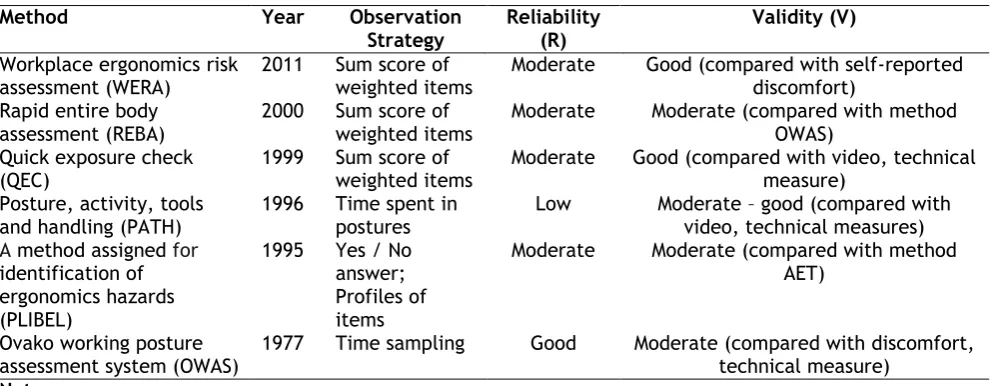
The result of reliability and validity study of the selected pen and paper based observational methods is presented in Table 1. Each method has different strategy in observing ergonomics risk factors associated with MSDs.
The pen and paper based observational methods and the covered body regions is presented in Table 2. Based on the literature reviews, only REBA covers all the body regions (upper arms/ shoulder, lower arms/ elbow, wrist, back/trunk and leg). Many study found that working with
lower arm / elbow above shoulder height is
associated with muscle fatigue / shoulder pain
37-40. Unfortunately the lower arm assessment was
not included in WERA and QEC method. For OWAS, the assessment of wrist is missing although flexion and extension activity in unsafe condition is harmful to the wrist area41- 43.
Table 1 - Reliability and validity of pen and paper based observational methods
Method Year Observation
Strategy Reliability (R) Validity (V) Workplace ergonomics risk
assessment (WERA)
2011 Sum score of
weighted items
Moderate Good (compared with self-reported
discomfort) Rapid entire body
assessment (REBA)
2000 Sum score of
weighted items
Moderate Moderate (compared with method
OWAS) Quick exposure check
(QEC) 1999 Sum score of weighted items Moderate Good (compared with video, technical measure)
Posture, activity, tools
and handling (PATH) 1996 Time spent in postures Low Moderate – good (compared with video, technical measures)
A method assigned for identification of ergonomics hazards (PLIBEL)
1995 Yes / No
answer; Profiles of items
Moderate Moderate (compared with method
AET)
Ovako working posture assessment system (OWAS)
1977 Time sampling Good Moderate (compared with discomfort,
technical measure) Notes:
(R) Inter –observer reliability
During the development process, how well does the method can achieve the same score for their assessment made by different observers?- (Good, Moderate, Low)
(V) Validity – During the development process, how well does method correspond with more valid method/s- (Good, Moderate, Low)
Table 2 - Pen and paper based observational method to assess posture and the body region
No Method
Body Region Upper
arms / Shoulder
Lower arms / Elbow
Wrist Neck Back / Trunk Leg
1 Workplace ergonomics risk assessment (WERA) ✔ O ✔ ✔ ✔ ✔
2 Rapid entire body assessment (REBA) ✔ ✔ ✔ ✔ ✔ ✔
3 Quick exposure check (QEC) ✔ O ✔ ✔ ✔ O
4 Posture, activity, tools and handling (PATH) ✔ O O ✔ ✔ ✔
5
Plan förIdentifiering av. Belastningsfaktorer; A method assigned for identification of
ergonomics hazards (PLIBEL) ✔ ✔ O ✔ ✔ ✔
CONCLUSION
In this study, 6 pen and paper based observational method to assess whole body posture were reviewed. Result showed that, current published methods still have limitation. Although the selected methods have been tested of their reliability and validity the limitation is obvious in term of missing in the assessment of lower arm region and wrist posture in the assessment. As conclusion, the findings of this review will benefit researchers in the process of understanding unsafe posture in workplace. It could also provide to researcher on how to improve the current pen and paper based observational method for assessing postural problems.
ACKNOWLEDGEMENTS
The authors wish to thank Universiti Malaysia Pahang (UMP), UniversitiKebangsaan Malaysia (UKM) and the Ministry of Higher Education of Malaysia (MOHE) for the support and facilities provided.
COMPETING INTERESTS
There is no conflict of interest.
REFERENCES
1. Gallagher S. Physical limitations and
musculoskeletal complaints associated with work in unusual or restricted
postures: A literature review. J. Safety
Res 2005;36(1): 51–61.
2. Meksawi S, Tangtrakulwanich B and
Chongsuvivatwong V. Musculoskeletal problems and ergonomic risk assessment in rubber tappers: A community-based study in southern Thailand. Int. J. Ind. Ergon. 2012; 42(1):129–135.
3. Shan CL, Adon MY, Rahman ABA, et al.
Prevalence of neck pain and associated factors with personal characteristics, physical workloads and psychosocial among male rubber workers in FELDA
settlement Malaysia. Glob. J. Health Sci
2011;4(1): 94–104.
4. Naidoo S, Kromhout H, London L, et al.
Musculoskeletal pain in women working in small-scale agriculture in South Africa.
Am. J. Ind. Med 2005;52(3): 202–209.
5. Hartman E, Vrielink HHEO, Metz JHM and
Huirne RBM. Exposure to physical risk factors in Dutch agriculture: Effect on sick leave due to musculoskeletal
disorders. Int. J. Ind. Ergon
2005;35(11):1031–1045.
6. Bridger RS. Some fundamental aspects of
posture related to ergonomics. Int. J.
Ind. Ergon 1991;8: 3–15.
7. Katila SK. Prevalance of posture related
musculoskeletal disorder in school children and the effect of postural exercises. Mangalore,2013.
8. Corlett EN, Madeley† *SJ and Manicica‡ I.
Posture Targeting: A Technique for
Recording Working Postures. Ergonomics
1979;22(3): 357–366.
9. Takala E-P, Pehkonen I, Forsman M, et
al. Systematic evaluation of
observational methods assessing
biomechanical exposures at work. Scand.
J. Work. Environ. Health 2010; 36(1):3– 24.
10. Li G and Buckle P. Current techniques for
assessing physical exposure to work-related musculoskeletal risks, with emphasis on posture-based methods.
Ergonomics 1999; 42(5): 674–695.
11. Dartt AL. Ergonomics Exposure
Assessment: A Study of Rater Reliability,
Method Reliability and Sampling
Strategy. Colorado State University,2010.
12. Burdorf A, Rossignol M, Fathallah FA, et
al. Challenges in assessing risk factors in epidemiologic studies on back disorders.
Am. J. Ind. Med 1997;32(2):142–152.
13. Burt S and Punnett L. Evaluation of
inter-rater reliability for posture observations
in a field study. Appl. Ergon 1999;30(2):
121–135.
14. David GC. Ergonomic methods for
assessing exposure to risk factors for work-related musculoskeletal disorders.
Occup. Med. 2005;55(3): 190–199.
15. Takala E -P, Pehkonen I, Forsman M, et
al. Systematic evaluation of
observational methods assessing
biomechanical exposures at work. Scand.
J. Work. Environ. Health2010;36(1): 3– 24.
16. Burdorf A. The role of assessment of
biomechanical exposure at the workplace in the prevention of musculoskeletal
disorders. Scand. J. Work. Environ.
Health 2010; 36(1):1–2.
17. Rahman MNA, Rani MRA and Rohani JM.
WERA : An Observational tool develop to
associated with WMDs. Journalof HumanErgology2011;40(1-2): 19 -36.
18. David G, Woods V, Li G and Buckle P. The
development of the Quick Exposure Check (QEC) for assessing exposure to
risk factors for work-related
musculoskeletal disorders. Appl. Ergon
2008;39(1): 57–69.
19. Hignett S and McAtamney L. Rapid entire
body assessment (REBA). Appl. Ergon
2000; 31(2):201–5.
20. Karhu O, Kansi P and Kuorinka I.
Correcting working postures in industry:
A practical method for analysis. Appl.
Ergon 1977;8(4): 199–201.
21. Buchholz B, Paquet V, Punnett L, Lee D,
Moir S and Punnet L. PATH: A work sampling-based approach to ergonomic job analysis for construction and other
non-repetitive work. Appl. Ergon
1996;27(3): 177–87.
22. Kemmlert K. A method assigned for the
identification of ergonomic hazards -
PLIBEL. Appl. Ergon 1995;26(3): 199–211.
23. Rahman MNA, Rani MRA, and Rohani JM.
A reliability and usability study of the Workplace Ergonomic Risk Assessment (
WERA ) tool. Malaysian J. Ergon.,Special
Issue: 2011; 5–6.
24. Mcatamney L and Corlett EN. RULA : a
survey method for the investigation of
work-related upper limb disorders. Appl.
Ergon. 1993; 24(2):91–99.
25. Janowitz IL, Gillen M, Ryan G, et al.
Measuring the physical demands of work
in hospital settings: design and
implementation of an ergonomics
assessment, Appl. Ergon. 2006;37(5):641–
58.
26.Jones T and Kumar S. (2007). Comparison of ergonomic risk assessments in a repetitive high-risk sawmill occupation: Saw-filer. Int. J. Ind. Ergon., 37(9–10): 744–753.
27. Simonsson P and Rwamamara R.
Ergonomic exposures from the usage of
conventional and self compacting
concrete. Proceeding 17th Annu. Conf.
Int. Gr. Lean Constr. 2011;pp. 313–322.
28. Li G and Buckle P. Current techniques for
assessing physical exposure to work-related musculoskeletal risks, with
emphasis on posture-based methods.
Ergonomics 1999; 42(5):674–695.
29. Motamedzade M, Ashuri MR,
Golmohammadi R and Mahjub H. Comparison of ergonomic risk assessment
outputs from rapid entire body
assessment and quick exposure check in
an engine oil company. J. Res. Health
Sci. 2011;11(1):26–32.
30. Bell A and Steele J. Risk of
musculoskeletal injury among cleaners
during vacuuming. Ergonomics
2012;55(2):237–247.
31. Paquet VL, Punnett L and Buchholz B.
Validity of fixed-interval observations for postural assessment in construction
work. Appl. Ergon. 2011;32(3): 215–224.
32. Ketan HS and Al-zuheri AK. Correcting
Working Postures in Water Pump Assembly Tasks using the OVAKO Work
Analysis System (OWAS). Al Khwarizmi
Eng. J. 2008;4(3):8–17.
33. Gangopadhyay S, Das B, Das T, Ghoshal G
and Ghosh T. An ergonomics study on
posture-related discomfort and
occupational-related disorders among
stonecutters of West Bengal, India. Int.
J. Occup. Saf. Ergon 2010;16(1):69–79.
34. Mattila M, Karwowski W and Vilkki M.
Analysis of working postures in
hammering tasks on building construction sites using the computerized OWAS
method. Appl. Ergon 2011;24(6): 405–
412.
35. Ismail AR, Yeo ML, Zulkifli R, Deros BM
and Makhtar NK. Assessment of Postural
Loading among the Assembly Operators :
A Case Study at Malaysian Automotive
Industry. Eur. J. Sci. Res 2009;30(2): 224–
235.
36. Quiñones-vientós S. Quantifying
Localized Muscle Fatigue of the Forearm during Simulations of High Pressure
Cleaning Lance Tasks. Virginia
Polytechnic Institute and State
University,2005.
37. Leclerc A, Chastang J-F, Niedgammer I,
Landre M-F and Roquelaure Y. Incidence of shoulder pain in repetitive work.
Occup Env. Med 2004;102:39–45.
38. Punnett L, Fine JL, Keyserling WM, et al.
Shoulder disorders and postural stress in
Work. Environ. Health 2000;26(4): 283– 291.
39. Buckle P and Devereux J. Work-related
neck and upper limb musculoskeletal disorders. Guilford, Surrey, U.K.,2000.
40. Sluiter JK, Rest KM and Frings-Dresen
MHW. Criteria document for evaluating the work-relatedness of upper-extremity
musculoskeletal disorders. Scand. J.
Work. Environ. Health 2001;27(suppl. 1):1–102.
41. Dennerlein JT and Johnson PW. Different
computer tasks affect the exposure of the upper extremity to biomechanical
risk factors. Ergonomics 2006;49(1): 45–
61.
42. Mogk JPM and Keir PJ. The effects of
posture on forearm muscle loading
during gripping. Ergonomics