Dissenting Voices
Volume 8 | Issue 1
8-9-2019
Dissenting Voices Volume 8 Issue 1 (Spring 2019)
Complete Issue
Women and Gender Studies Senior Seminar at The College at Brockport
This All Voices is brought to you for free and open access by the Women and Gender Studies at Digital Commons @Brockport. It has been accepted for inclusion in Dissenting Voices by an authorized editor of Digital Commons @Brockport. For more information, please contact
[email protected], [email protected]. Repository Citation
Women and Gender Studies Senior Seminar at The College at Brockport (2019) "Dissenting Voices Volume 8 Issue 1 (Spring 2019) Complete Issue,"Dissenting Voices: Vol. 8 : Iss. 1 , Article 1.
Our Voices
Our voices provide a sense of individualization for the ‘othered’ women who write their ways out of their binds. We speak for all beings, human and non-human, whose voices are muffled under a mask of systemic oppression. This is our call to arms for feminists to reach their full potential by challenging not only patriarchy but capitalism as well. Our dissenting voices want every little girl to know that she is just as worthy of ruling the world as the boy sitting next to her. Our work is a shout, not a whisper; we will not stand anymore for suppressed voices within our society. We showcase how women deserve recognition and equity to be able to care for and embrace our bodies. We are not dependent on our reproductive value. Our rights are not disputable, and our voices are immutable. Our radical thoughts differ from those before us. We are the new wave. We will dismantle patriarchy and pigs will fly.
Mackenzie April, WMS, ENG ‘19 Jenna Bygall, WMS, PLS, INS ‘19
Jasmine Kamal- Mohamed, WMS , ENG ‘19 Christina Karapinar, WMS ’19
Allie Knapp, WMS, PLS ‘19 Kelsie Kupiec, WMS, HLS ‘19
Angelica Whitehorne, WMS, ENG, INS ‘19 Kayla Sorenson, WMS ’19
Dissenting Voices Cover Art
Note from the Editor
I am thrilled to introduce volume eight of Dissenting Voices, a student engineered e-Journal collaboratively designed, authored, and published by undergraduate Women and Gender Studies majors as an extension of their Women and Gender Studies Senior Seminar at The College at Brockport.
Dissenting Voices grows out of a course learning structure where Women and Gender Studies students reflect upon their undergraduate experience in the discipline, and through engagement, activism, and synthesis of acquired knowledge, establish a theoretical foundation to inform future feminist practices. Course readings comprise students’ discipline-specific interests, enabling an intellectual forum in which students dialogue on a women and gender focused topic. This work culminates in a meaningful capstone project grounded in contemporary and emerging feminist scholarship.
Dissenting Voices volume eight showcases eight authors who tackle a wide range of topics salient to Women and Gender Studies. In “Opening Voices”, two essays introduce the volume, both exposing the pervasiveness of sex and gender oppressions. Essay one blends fiction with theory in a complex reading of reproductive justice. Essay two examines ways gender bias operates in electoral politics. “More Voices” centers the volume where four authors scrutinize sexism across religion, feminist epistemologies, popular culture, and animal rights. Essays in this section include a timely look at ways dominance of western feminism obscures the contribution of Egyptian female scholars, an analysis of ways Hollywood feminisms complicates women’s rights, research interwoven with fiction on the intersections of Ecofeminism and veganism, and an ethnography on questions of sexual equality growing up Jehovah Witness. In “Closing Voices”, two essays bookend the volume. Authors in this section capture women’s vulnerability as survivors, the first to illness as treated under male medical models, and the second to gender-based violence as realized in the context of family and war-time abuse.
gender equality causes forward. The photo essay at the end of the volume evidences some of this resolve as students enacted many of their topics across the semester. Adding to this, the journal cover portrays an artistic rendition of each author holding a sign that communicates their feminist activism. Their words rise up from their signs to frame the sun. Pause and watch closely for their cues. And listen carefully to their voices. If walking near or around this progressively-minded group, you might hear the adage, “When Pigs Fly,” the “when” in reference to what is seemingly impossible. For the authors here, that impossibility is no longer impossible. Because pigs are flying, offering us hope in the face of despair and belief that we can amend even the most broken systems of inequality. Bridging theory with praxis, Dissenting Voices preserves the authenticity of student voice, sanctioning a wide range of ability and talent that students’ senior seminar coursework engenders.
In my early role as Brockport’s Women and Gender Studies Director and faculty developing a new Women and Gender Studies senior capstone course, I had what seemed a pipedream in conceptualizing a student journal. Semesters of dynamic student activism and thought inspired me to imagine a women and gender studies publication that would bring to light undergraduate creative agency realized on the cusp of feminist knowledge. Dissenting Voices, as named and populated by its 2012 student founders, and pioneered onward by this 2019 class, is this dream forward.
Barbara LeSavoy, PhD
Dissenting Voices
Volume 8, Issue 1 Spring 2019 ISSN 2376-1997Opening Voices
The Abortion Fight: Neither Worn nor Won. . . Angelica Whitehorne 1 Treatment of Female Politicians and Impact on Voter Perception in the U.S.
Jenna Bygall 13
More Voices
Why are there No Great, Female, and Egyptian Scholars? . . . Jasmine Mohamed 27 The Pretty Pink Box . . .
Allie Knapp 39
Readying the Rape Rack: Feminism and the Exploitation of Non-Human Reproductive Systems . . .
Mackenzie April 51 Growing up a Witness . . .
Kayla Sorenson 65
Closing Voices
Missing from Research: Exposing the Deficit in Research and
Knowledge of Endometriosis and Women’s Health . . .
Keslie Kupiec 79
Dissenting Voices Editorial Board
Executive EditorBarbara LeSavoy, PhD, The College at Brockport
Managing Editor
Pat Maxwell, MLS, The College at Brockport
Copy Editor
Kilauren Guthrie, The College at Brockport
Editorial Board
ANGELICA WHITEHORNE The College at Brockport State University of New York
The Abortion Fight:
Neither Worn nor Won
I. Bleed
Yesterday, she had thirty-nine dollars and eleven cents in her bank account, babysitting blood money she calls it. Forty bucks to watch an infant scream on a Saturday night. Today, she takes a slow, tired trudge from her high school to the corner store nearest to her house. Its open sign stays lit from dawn to dawn. This and the poorly painted board introducing ‘Al’s Market’ has become reliable to her. On all major holidays, and even after the petty robbery left the front window boarded up, she could count on Al’s being open. In her youth, she would come here to steal candy cigarettes, pretending to smoke them with her friends before crunching them to powder between her molars.
She walks straight toward the back corner, grabs the three dollar off-brand maxi pads from the white, secluded shelf. She checks out with her arms folded across her breasts, tapping her foot disinterestedly as the skinny-faced man rings her out. They do know each other, but only in the way you know your local drugstore cashier; and so his smile to her is strained. The shade of her feminine hygiene is looming over them and he looks everywhere but into her eyes.
The pads come to three dollars and twenty-seven cents. The tax is almost the tipping point for her, but she pays anyway.
The young man shoots a “Have a nice day,” while counting her dollars with determination.
When she arrives home, she goes to her room and opens the package, unwraps one of the 24 neatly arranged, yellow plastic squares. She strips the wrapper slowly and theatrically loud as if the sound of the peeling could be a reminder to her body. It is 11 days past due. She sticks one pad under her pillowcase for good luck.
She unwraps two more sanitary pads, places a bony knee on each, using them as a cushion to pray to whatever celestial object is willing to listen. ‘Please, please, please,’ is her holy, whispered mantra. She uses another as a tissue, to wipe the tears of a weary fornicator. She thinks about how tears of a weary fornicator could be a comedic expression in a different circumstance. Right now, nothing seems particularly funny. Her mother is not yet home from work, so she spends her time trying to bargain with the possible embryo. She acts as if she has an extremist’s understanding of prenatal development; as if she believes the fetus has the cognitive function to interpret or to reason, to understand its existence at this moment would be a formidable one. Her fear makes her irrational, and so she pleads for the fetus to come back later or
stay dormant or just evaporate like it is water and her uterus is a hot summer day.
All of this is directed at the long, dirty mirror that is propped against her bedroom wall. Ironically, her reflection is sitting in a child’s pose, body hunching over bended knees. She has always had the face of a child herself, one that seems stuck in a soft pallid of innocence despite her growing experience. Although she is only sixteen, it has already been years since she has painted her face and scrunched it up in an elaborate fashion of stoicism, beautifully detached and mature. Today, though, her eyes look desperate, almost comically wide, expressing a youthful disbelief of the universe’s betrayals. She has also always been short. She has always had to look up and over things, the way children strain to see over a candy counter. The aisles and aisles of musty thrift store jeans always flooding over her stout legs, so that she has to roll them, three or four times, up to her ankle.
sticking out to her now rests in the bottom corner. It reads: ‘Find joy in the journey.’ The idyllic, pink calligraphy seems to mock her from a more optimistic time. The mirror also has smudges where her makeup has hit against it. There are dust spots acquired from all the forgotten cleanings and sporadic fingerprints, from where she has leaned against it, touched parts of her reflection in discovery.
The stickers and prints and smudges distort her appearance and she squints to make herself out. She combs the bangs out of her face with little hope for making them stay where she wills them to. She thinks about the algebra test she has on Monday, the boy she passes in the hall, who in some way might be growing in her now, about the robotic baby she failed in her Family and Consumer class, the way its mechanical wails tapered out after falling harshly from her backpack. She puts her forehead to the ground and cringes with the vision of holding a wailing child for eighteen years, longer than she’s even been alive herself.
Her mother cooks like it is a nasty chore. Slamming pots and violently scrubbing dishes along the way. Sweating so angrily that sometimes her perfume seeps into the food, pasta with sauce and mushrooms and a hint of
musky, imitation Dior. She sits at the table in silence while her mother cooks. One of the table legs are loose so that the entire thing leans oblong. She has thirty-five dollars and eighty-four cents in her bank account. Thirty-five dollars can buy you one large package of diapers, two weeks’ worth of baby food, or one-tenth of an abortion. She rocks the table leg back and forth to a slow rhythm of ‘how, how, how?’
Her mother notices the repetition of the table clanking against the cheap linoleum. “Are you anxious?” she scrutinizes, “Why are you anxious?” The skillet is still in her hand when she comes closer to examine her daughter, “Are you sick?”
“There are many tests tomorrow Momma,” is all she can reply, forcing her gaze to her mother’s, almost seeing the skillet walk into her face if her mother knew the truth.
“Study hard, my girl.” Her mother nods her head, sharp and approving, turning back to wrestle their dinner; the daughter bites down so hard on the skin surrounding her fingernail, the nailbed runs red, hyper aware that it is not the right kind of bleeding.
news she was feeding to him on the school’s benches. She felt then, looking over at the catastrophist expression on his face that she, herself could have been his mother; he had seemed that young, that distraught. ‘Don’t worry,’ she cajoled, ‘I will bleed.’ And the boy visibly relaxed, placing the heavy weight of his forehead on her shoulder.
But she has not bled. She has not bled for so, so many days and now she is gagging over the toilet. She is hoping the fetus could ride up on her vomit like a wave, crash down into the bowl and off to sea, but nothing comes. She begins to yell, a chanting protest of “get out, get out, get out!” It echoes around the rim and out into the hallway. Her mother opens the door. Slowly then fast enough that the door gives a quick shriek itself. She wraps her arms around her screaming daughter, who heaves into the basin and finally there is release.
II. The Story
This story was created the second week my period was late; it was a work of panic really, an expression of the fear and entrapment I felt with the prospect of losing control of my body. At that point, I was twenty years old, working on my undergraduate degree and below the poverty line. I was also sexually active with shoddy contraceptive practices, a
cruel culmination of my religious upbringing, my vague high school health curriculum, and my convoluted ‘all-natural’ philosophy. Perhaps my pregnancy scare could be attributed to the lack of agency and decisiveness I was taught to hold over my body. In accordance with the all too common narrative: society was too shy to educate me sexually, but not too shy to shame the young people like myself, who deal with the repercussions of that poor education.
At this turbulent time, like my narrator, I had little more than $39.81 in my account. I was alone. I twisted a pregnancy test around my fingers, clutched the pointed end into my palm, and stuffed it in the back of my underwear drawer. I remember googling the closest Planned Parenthood, in egotistical disbelief: I was driven, I was school-oriented, I was usually so smart about things; how could I have been so stupid about this?
the lens” (p.57). I want my character’s description to be loose, to be subjective to the reader and therefore open to interpretation. Her race or ethnicity is vague. Her state, country, province unknown. All we know is that she is young, unprepared, and ill equipped for new life. Her purpose is to allow readers to embody a kind of ‘pregnancy panic’ that is often overlooked in the politics of reproductive rights. In an issue revolving around the biological anatomy of the person, their own feelings, needs, and experiences are often not weighed in the arguments. I hope, through my character, readers can reconnect to the humanity of fear and bridge a better understanding that abortion is not a gleeful murder but a necessity for survival and medical agency.
III.Identity Politics of Reproductive Care
Personally, I was lucky. I was not pregnant. I bled a few days later and it was a celebration as much as it was an awakening. I told my mother I was going on birth control. I made an appointment with the gynecologist, and I got the pill fully covered by my insurance. But I recognize my personal story is one of privilege, a privilege that may not be afforded to my character. I am a cisgender, white woman. I have the
means to health care, the transportation to receive that health care. If I had been pregnant, I lived in a state where abortion is not restricted, covered for people of my income status, and 20 minutes away.
Reproductive rights also are racially discriminatory. Many pro-life clinics attack Black and Hispanic people for getting abortions, saying they are allowing abortion clinics to commit a kind of genocide on what would be colored children. However, these organizations leave out the fact that women of color receive abortions two to three times more than white women do (Mansbach & Von Hagel, 2018, para. 4). Partly because of the other health injustices racial minorities face, their rates of unplanned pregnancy is higher. We still live in a time where many racial and ethnic groups live in poverty-dense areas. This means they have less access to affordable contraception and sex health centers.
Due to socio-economic conditions and the lack of resources, it makes sense that more Black and Hispanic people would rely on abortions because they cannot support a child financially (Mansbach & Von Hagel, 2018). The fact that Black and Hispanic people rely more on abortions is an injustice in itself. All areas of lower socio-economic populations are at a higher risk for unplanned pregnancy because of the lack of resources and sex education available to them. It is not that poor people are deciding to have more abortions; insufficient education leads to
“problem pregnancies,” forcing those faced with poverty to seek out abortion more frequently (Furedi, 2016, p. 58). With these racist and classist issues, Black and Hispanic people face another layer of discrimination, both in their scarce health care and the racial guilt pro-life organizations place on them in an attempt to dissuade individuals from abortion (Mansbach & Von Hagel, 2018).
I creatively chose to leave the main character of my story vague to encompass a large breadth of experience. However, it is a reality that the layers of barriers between people and the health care they need are sexist, racist, and classist. The privileges that some identities have over others makes reproductive rights wholly unequitable in our society. In order to dissolve these barriers and ensure reproductive rights to everyone, it is necessary to offer care without restrictions based on cultural or economic factors.
IV. The Financial Straits
situation, many find themselves without the resources to terminate a pregnancy safely. “After Roe, privacy, liberty, equality— and reproductive rights— the goals of second wave feminism, remained conditional, dependent upon someone’s access to money and other resources" (Ross & Solinger, 2017, p. 122). There is a stark difference between writing a legal right to abortion and making that right an actuality. People in poverty do not have the means to proper reproductive care. The Roe v. Wade legislation is not enough to ensure safe abortions for everyone. There are also the variables of health care and transporting yourself to an abortion clinic, which can be spread out for hundreds of miles in the rural parts of the U.S., even bypassing into other states (Guttmacher Institute, 2014).
While Roe legislation allowed people of a higher class to obtain abortions in private, those of lower classes could not afford such a transaction. This is a reality ignored by many of the privileged feminists who saw the legislation as pure liberation, forgetting that until “abortion achieved the status of rights for all” (Ross & Solinger, 2017, p. 122), less privileged people would be coerced into unwanted pregnancies.
Those who cannot afford to get an abortion also cannot afford to have a
baby. Adoption is cited as the main remedy for those who cannot financially or emotionally take care of a child. Persuading someone with unwanted pregnancies to simply give up their child after it is born takes away agency as well as glazes over the economic constraints
of gestation. An “… estimate from the
International Federation of Health Plans put the average amount insurers paid for a vaginal birth in the US at $10,808 in 2015” (Glenza, 2018, para. 6). This excludes the additional costs for transportation, proper nutrition, and does not begin to estimate the costs for those who are not covered by insurance or are not legal residents of the United States.
V. Desire and Power
I spoke once to a young woman who was pro-life. She claimed that as soon as you engage in sex you are making a conscious choice to potentially have a child. But this is false. There are people in abusive situations, who have become impregnated through assault, who would now have to suffer through a traumatic delivery. All of this information I shared with blunt urgency, but there is one piece I left out, that didn’t come to me until later, but which might be the most
overlooked pro-choice argument:
feminine desire.
The statistical arguments show factual evidence that humans are financially and emotionally burdened by an unexpected pregnancy. But why do we need this research to justify abortions? Why is it so taboo to say that a person could be allowed to want pleasure without wanting to commit to a lifetime of care to another human being? It is sexist to think of pregnancy as a kind of penance for being sexually active and to expect tremendous sacrifice from the pregnant individual because of their sexual decisions (Lowe, 2016). However, this is the mentality when reproductive health
barriers are constructed. Abortion
restrictions are another way to regulate subjugated bodies, another way to
separate us from our desires and coax us into a reluctant, passive sexuality identity.
Like many things in our society, ignoring the realities of why someone may choose to terminate pregnancies is a privilege. As Michelle Goldberg (2009) states: “What’s at stake are not lifestyles but lives” (p. 223). When people correlate pregnancy as a punishment for unprotected sex, they are demonizing a lifestyle in which desire is a natural component. While this is unjust in itself, they are also ignoring the risks to livelihood that pregnancy causes, both
medically, economically, and
psychologically. I see abortion as a right regardless of circumstance; taking away someone's autonomy to their body is stripping them of their power and there has already been too long a history of doing so. If we are ever to achieve parity, we must first be given full access to our own body. Forcing anyone into parenthood is an entrapment of their spirit, a violation of their independence, a step backwards for the equity of our humanity.
VI. The Reality and a Call to Arms
privileged government. You may think that abortion rights are a topic worn and won by the feminists of the past, of the 60s and 70s. However, just last year, our newest supreme court judge, Kavanaugh
“infamously ruled against an
undocumented teenager in a detention facility who had petitioned for the right to access an abortion” (Arnold, 2018,
para.4). The government is choosing to
create legislation that prevents its citizens from accessing the health care they deserve, creating barriers that target the vulnerable and keep them so. There are five U.S. states, (Missouri, Wyoming, North Dakota, South Dakota, and Mississippi) who only have one Planned Parenthood within their borders (Guttmacher Institute, 2014, 2018). This means those looking to get an abortion have to travel increasingly far distances to do so, elevating the already stressful and expensive procedure and making it outright impossible for some.
Those in positions of power are still policing what we do with our bodies,
despite what is considered
constitutional. We do not have the luxury to forget that Kavanaugh would be the deciding vote during a Roe v. Wade overturn, or that abortion is not readily available for every person who needs it. We must realize the rights fought for in the past are once again at
stake and that honestly, they have never been fully secured.
VII. Conclusion
In conclusion, I have chosen to keep my narrator nameless because I want her to represent all of the people, young or old, who have become passive in their own bodies and all of those who are inflicted with reproductive expectations they cannot or do not want to carry. It seems to be the fate of all people with uteruses in our society to find barriers to their reproductive health, despite the fact that we all deserve bodily autonomy.
But what does happen next for our narrator who is devastated by and unprepared for the possibility of pregnancy?
Perhaps she will keep the child, raise the child, swallow her dread of motherhood and assume the role that is expected of her as an impregnated young woman. Of course, it will alter her education, her life path; the commitment is large but also rewarding as she holds her child to her chest, watches them grow with the seasons.
She could also have the child and then put them up for adoption. Give the miracle of life to a family who is looking for it, prepared for it. A couple who cannot or chooses not to have a traditional birth, a same-sex couple, a single parent wishing to begin their own family. She would cry as she holds the
swaddled child close, and then passes them to their new family, knowing they can give the child opportunities out of her own reach.
However, with each of these two choices there is something lost: our narrator’s health and happiness. In those nine months carrying new life she is carted back and forth to the hospital, missing class to care for the fetus. She has to quit her job, putting more economic strain on her mother. She starts to fall behind, she fails her algebra class, she misses her junior prom, quits her honor society. She is too tired, too consumed in gestation to live out an entire year of her fleeting youth. And if she keeps the child, college is distanced or doubly as difficult to work through. The reality is she could very well crumble under the weight of a disadvantaged motherhood.
However, what if we gave her a legitimate, destigmatized third choice? Not the shoddy and shamed structures of abortions we have today, but a safe, thorough, and accessible option. She could walk into one of the plentiful
clinics, probably past pro-life
her hormones fluctuate, while studying for her end of year exams. She wouldn’t have to miss prom or run out of study hall to throw up in the bathroom stall. She wouldn’t have to change the entirety of her life trajectory, modify her dreams, or fall in the cycle of poverty to support a child she did not wish to bear. Instead of punishing young people, specifically those with uteruses, for acting on natural human desire, instead of forcing pregnancy on oftentimes marginalized bodies, we could set up a competent health care structure that allows people to make autonomous decisions and gives them access to the health care that correlates with their needs.
In an ideal world, it would not matter what my character chooses, whether she chooses to carry the fetus to term and become a mother, whether she chooses adoption, or whether she acts soon enough to have a legal abortion. In an ideal world, she would get the right of
choice and the government would support her decision as well as offer proper care. But this is not an ideal world, and reproductive health is not as free as our legislators would have us believe. This paper has shown that the barriers between people and their reproductive care are racist, sexist, and classist, and that although we have Roe v. Wade, we are a long way from progressive and available reproductive care.
I hope with stories like the one I have shared, we can learn to think deeper than the easier arguments, confronting our ingrained societal pressures and recognizing the perspectives of varying privileges. Until we can create the idea that reproductive health is a necessary right, we will continue to be subjugated by the different needs of our bodies and continue to be at the mercy of the systems and legislation that restricts our care.
References
ARNOLD,A. (2018, July). Brett Kavanaugh poses a serious threat to reproductive rights.
The Cut. Retrieved from https://www.thecut.com/2018/07/brett-kavanaugh-supreme-court-abortion.html
GLENZA,J. (2018, January 16). Why does it cost $32,093 just to give birth in America?
The Guardian. Retrieved from
https://www.theguardian.com/us-news/2018/jan/16/why-does-it-cost-32093-just-to-give-birth-in-america
GOLDBERG,M. (2009). The means of production: Sex, power, and the future of the world. New
York, NY: Penguin Press.
GOODMAN,J.M. (2018). Laboring until labor: The prevalence correlates of antenatal
maternity leave in the United States. Maternal and Child Health Journal, 22(2), 184-194. doi: https://doi.org/10.1007/s10995-017-2390-0
GUTTMACHER INSTITUTE. (2014). Abortion clinics [Map of abortion clinics in each
state, 2014]. Retrieved from
https://data.guttmacher.org/states/table?state=US&topics=58&dataset=data
GUTTMACHER INSTITUTE. (2018). State facts about abortion: New York. Retrieved
from
https://www.guttmacher.org/fact-sheet/state-facts-about-abortion-new-york
JERKINS,M. (2016). Who gets to take part in the menstruation conversation? Retrieved
from
https://www.buzzfeed.com/morganthescribe/menstruation-and-gender-inclusivity
LOWE,P. (2016). Reproductive health and maternal sacrifice. London, UK: Palgrave
Macmillian.
MANSBACH,D. & Von Hagel, A. (2018). The abortion barriers and needs of black
women.Retrieved from
https://scholars.org/brief/abortion-barriers-and-needs-black-women
ROSS,L.J.&SOLINGER,R. (2017). Reproductive justice: An introduction. Oakland, CA:
University of California Press.
WEDDINGTON,S. (2013). A question of choice. New York, NY: The Feminist Press at
JENNA BYGALL The College at Brockport State University of New York
Treatment of Female Politicians and
Impact on Voter Perception in the
U.S.
“If your dreams do not scare you, they are not big enough.”
(Ellen Johnson Sirleaf, This Child Will Be Great: Memoir of a Remarkable Life by Africa's First Woman President, 2009)
This essay explores the treatment of female politicians in the United States government and the impact of negative treatment on potential candidates as well as voters’ perception of said candidates. Readers may obtain a better understanding of the stereotypes, double standards, and biases that are projected upon female politicians in the U.S. This work is based on a literature review of peer-reviewed journal entries, research-based books, and credible news sources.
Trouble at Home
In a study of 193 nations, the United States currently ranks 75th on the list for percentage
the Woman in 1992 and the historic midterms we recently experienced, women still only control just short of 25 percent of congressional seats (Catalyst, 2019, Percentage of Women in the 116th United States Congress). I believe that the public mistreatment of female candidates and politicians discourages women from running for office and entering politics.
Imagine you’re a stay-at-home mom with two kids, contemplating re-entering the work force. You finally get an interview for that perfect job you’ve been hoping for, and when you sit down for the interview, you find that they’re asking quite a lot of personal questions.
How many kids do you have?
Who will take care of them if you start working?
Are you planning on having more kids? According to Susan Heathfield (2018), questions like this are illegal to ask in job interviews. But do you think that stops interviewers across the country from asking them? Or asking less-direct versions of them? Meanwhile, the single man they interviewed before you was asked about his ambition and previous experience.
Imagine this scenario, but on the largest stage possible: a presidential election. This is what we, as a nation, witnessed in the 2016 presidential
election. When Hillary Clinton announced she was going to be a grandma, the ground shook, and critics everywhere wondered, how can she be a grandma and a president?! No one ever asked Mitt Romney during his previous run if his eighteen grandchildren would be a distraction. Despite the upward trend in women’s representation in our government, female politicians still face significant obstacles in the form of stereotypes, double standards, and biased media coverage. The unfair treatment of women in U.S. politics negatively affects the perception of female candidates, as well as the willingness of women to run for office in the first place.
suggest there is a systematic bias against women in government in the United States, and I conclude by pointing out that despite it all, the best is certainly yet to come. This is observable through the silver linings of the 2016 elections, the 2018 midterms, and the emerging field of presidential candidates for the 2020 election.
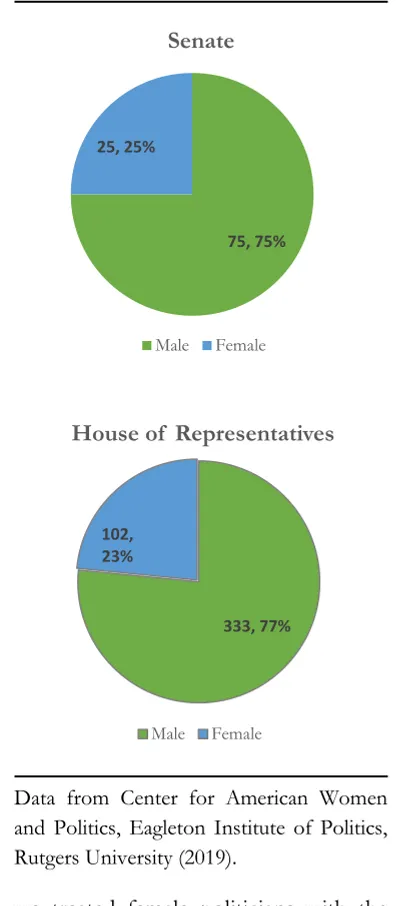
As a result of the previously mentioned 2018 midterms, there are currently 25 women in the Senate and 102 women in the House of Representatives, out of the 100 and 435 total seats, respectively. This adds up to 25 percent in the Senate, and 23.4 percent in the House (Catalyst, 2019, Percentage of Women in the 116th United States Congress). The numbers are crucial, because as one of the most developed nations in the world, there is no reason for us to be so lacking in basic gender equality in our government. Our population is more than one-half female, yet our government hasn’t even gotten close to touching that. Why not? The charts in Figure 1 show (in blue) the portion of our government that is female. I believe it is of the utmost importance to get to the bottom of why
our government looks like this when our population looks far more balanced. It is not representative, and it is not equal. If
Figure 1
Percentage by Gender in U.S. Government
Data from Center for American Women and Politics, Eagleton Institute of Politics, Rutgers University (2019).
we treated female politicians with the same respect and neutrality as we treat men, politics would be a more equal and proactive entity.
333, 77% 102,
23%
House of Representatives
Male Female 75, 75% 25, 25%
Senate
There are a few main factors to
consider when discussing the
mistreatment of female politicians: lack of encouragement, stereotypes, and double standards and media coverage. What exactly is it that is inhibiting women from running and/or wanting to be politically involved? Every time a woman is ignored, spoken over, criticized for her physical appearance, or sexualized – with no consequences for whomever treated her that way – we set a precedent as to how we treat women who aspire to enter politics in the United States.
EncourageMENt
Susan J. Carroll and Kira Sanbonmatsu (2013), in their research-based More Women Can Run: Gender and Pathways to the State Legislatures, explore the implications of gender on the pathway to state legislatures and other political offices. Much of their research focused on the relevancy of encouragement to male vs. female campaigns and candidacies. Because of our historically patriarchal government, one can imagine there might be disparities between the ease of a man’s decision to run, and the complexity of a woman’s. Carroll and Sanbonmatsu (2013) focus on the fact that “Politics traditionally has been and is still a masculinized domain. In turn,
women more often seek support and encouragement before they enter what is far from gender-neutral territory” (p. 61). The authors quote 2001 research from Moncrief, Squire, and Jewell, concluding that men, more than women, were far more likely to be what they called “self-starters,” or people who decide solely by themselves to run for legislature. Women, however, were more likely to decide to run after a suggestion from someone else, and were also more likely to report deciding to run due to a mix of encouragement and personal desire (Carroll & Sanbonmatsu, 2013). But, what are the reasons for the
hesitancy to run without
encouragement? Carroll and
Sanbonmatsu (2013) cite our
government as a reason, explaining:
Because of the masculine nature of mainstream politics and women’s history of marginalization in the electoral arena, one might well expect women to be less likely than men to view elective office holding as an appropriate career choice or even a realistic aspiration (p. 48).
women are deciding whether or not to run. Later in the book Carroll and Sanbonmatsu (2013) mention that throughout our nation’s history, “women have been excluded from and marginalized in the realm of electoral politics,” and that female politicians today “are sometimes met with skepticism on the part of voters, the media, and political parties, creating higher hurdles for women to surmount” (p. 124). This becomes relevant here because we can understand that the mistreatment and the hurdles create the hesitancy to run that we observe in American women. This hesitancy creates the need for encouragement and external support.
Aside from hesitancy to run due to the potential hurdles and mistreatment, there is one other crucial element that results in a need for encouragement: qualifications. Carroll and Sanbonmatsu (2013) quote Lawless and Fox (2005) in saying that “women potential candidates are less likely than men to view themselves as qualified for holding public office” (p. 48). There is an observable disparity between male and female feelings of adequacy. Carroll and Sanbonmatsu (2013) also point out that female candidates for office are frequently more experienced than male candidates, which raises the question of
woman in the United States, lost the presidency to what I would call an extraordinarily underqualified man. Regardless of the circumstances, across the board Carroll and Sanbonmatsu (2013) conclude that female legislators “are more likely to have received encouragement from parties and organizations” (p. 125). Whether their own personal desire to enact change played a part or not, they likely needed the extra push because they know just how female politicians are treated in the United States.
SterHEotypes
“Politics is a highly masculinized space, and women are still viewed as intruders whose presence disrupts the traditional order” (Carroll & Sanbonmatsu, 2013, p. 47). As intruders, women are faced with stereotyping and character defamation on a daily basis when running for office or trying to enter the political realm. Carroll and Sanbonmatsu (2013) point out that past social-psychological research has found “that men are viewed as more agentic (e.g., assertive, ambitious, confident, and competitive), while women are viewed as more communal (e.g., nurturant, sensitive to the needs of others, helpful, and supportive)” (p. 45). These views perpetuate the stereotypes that hold
female politicians back in the United States. They are seen as weak, emotional, and soft, while men are the strong and ambitious leaders that we believe are capable of leading. In her book, When Does Gender Matter?: Women Candidates and Gender Stereotypes in American Elections, Kathleen Dolan (2014) uses her background in research to examine the impact of gender stereotypes in U.S. elections. Dolan (2014) introduces prime examples of gender stereotyping very early on in her book:
In 2010, Kelly Ayotte, the attorney general of New Hampshire and a candidate for an open U.S. Senate seat, had to respond to concerns that being elected to the Senate would leave her with little time to be a good mother to her two young children. In running for governor of her state that same year, Oklahoma Lt. Governor Jari Askins was asked whether, as a single, childless woman, she had enough life experience to understand the concerns of the average Oklahoma family (p. 2).
emotional candidates who do not “possess the reason or dispassion to adequately provide political leadership” (Dolan, 2014, p.61). Stereotypes surrounding familial obligations and emotionality are frequently observed stereotypes, with physical appearance also making headlines once in a while. More substantively, Dolan (2014) points out the issue-based stereotypes that are often placed upon women, referring to the assumption that they are “more interested in, and more effective in dealing with, issues such as child care, poverty, education, health care, women’s issues, and the environment” (p. 20), while men are accredited strength in economics, military, and agriculture, to name a few. Women across the country watch female candidates suffer sexist stereotyping and criticism every day. Would you feel confident in running for office after observing all of that?
Alongside the stereotypical biases placed upon female candidates, because they are women, they are frequently sexualized. Caroline Heldman and Lisa Wade (2011) published an article about the sexual objectification of female candidates in the United States, analyzed through the lens of Sarah Palin’s experience running for Vice President. They reference research from Heflick and Goldenberg (2011) that links the
sexualization of female candidates to negative perceptions of said candidates, and importantly, that, focus on “Palin’s appearance ‘led people to perceive Palin as less competent, warm and moral’” (Heflick & Goldenberg, 2010, p. 156, as cited in Heldman & Wade, 2011). Public sexualization of female candidates is never well-meaning, and it happens far too frequently for us to allow it to continue. Heldman and Wade (2011) reference the sexualization of Hillary Clinton, at times focused on the way her laugh sounds or on her cleavage, while 14 percent of the media coverage of Sarah Palin throughout her election focused on her physical appearance, from “VPILF” (Vice President I’d like to fuck), to Caribou Barbie. They conclude that the stagnation in women’s representation in Congress directly correlates with the modernization of the internet and access to the media’s sexual objectification of female candidates (Heldman & Wade, 2011). The bias is further exemplified in Kelly Dittmar’s (2016) article for the American Political Science Association, where she quotes the rapper T.I.:
I sure would hate to just set off a nuke. [Other world leaders won’t be able to negotiate] foreign policy; the world ain’t ready yet. I think you might be able to [get] the Loch Ness Monster elected before you could [get a woman elected] (p. 808).
This is a sentiment used frequently by misogynists that do not want to see women in office. Jeb Lund tried to discredit Hillary Clinton’s campaign progress by calling her shrill and whiny, and that she was frequently angry or nagging. Donald Trump ridiculed Carly Fiorina, saying that her voice caused people to develop headaches (Dittmar, 2016, p. 808). No matter what your policy stances are, what you look like, how old or young you are, if you are a woman in politics, misogyny comes with the territory in the United States, but it doesn’t have to be this way. Despite the fact that Dittmar references research proving media attention to women’s appearance has a negative impact on voter perceptions of their leadership qualifications, Carly Fiorina had this to say:
The point is, whether a man thinks you’re homely or a man thinks you’re beautiful, it’s not a topic of conversation when a woman is trying to do a job – whether it’s president of the United States or secretary or anything else (McAfee & Westfall, 2015, para. 2).
That just about covers it.
Double Standards and Media CovHERage
another area in which there is a double standard. When working under the assumption that women need more experience than men to enter the
political sphere, Carroll and
Sanbonmatsu (2013) posit that,
An alternative explanation for the finding that women have more political experience is that there may be a double standard in which more is expected of women candidates. Women may need more experience than men in order to be viewed as equally qualified (p. 36).
They quote female legislators they spoke to as part of their research. These legislators frequently saw the experience disparity between genders. One legislator told Carroll and Sanbonmatsu (2013), “When women come on the scene, they have to prove themselves whereas men are given the presumption of competence until they disprove it” (p. 36). The authors quote three women who each echoed the sentiment that women have to work harder than an inexperienced man to be as respected as he is, solely because of our gender (Carroll & Sanbonmatsu, 2013). Women have to cater to the patriarchal system that our government is currently functioning under. From the way we express (or choose not to express) our emotion, to the lengths we will go to in order to convince ourselves and others
Women on the Run: Gender, Media, and Political Campaigns in a Polarized Era,
explain the double standards:
“compared to male candidates, female candidates are treated differently – and often worse – in the press and by the public,” (p. 16). These portrayals of female candidates not only align with, but also actively reinforce the public perception of female politicians by voters. The negative perception of female politicians by voters is an apparently everlasting relic of the patriarchy that our society has been formed and conditioned under. Further, Hayes and Lawless (2016) point out that women have to present themselves more strategically to the world. Due to the relatively equal competitiveness and resource supply of male and female candidates, “there are few reasons for journalists to treat equally qualified male and female candidates differently,” (p. 20) yet, they continue to do just that.
Through statistical analysis and simple observation, it is clear to see that the norm favors male candidates, and that women are held to a far different standard from their appearance to their experience. When it comes down to it, Hayes and Lawless (2016) remind us yet again that women are consistently more likely to be described using traditionally feminine traits like compassion and
loyalty while masculine traits like leadership and competence are attributed to the men. This sexist coverage creates challenges for female candidates. Hayes and Lawless (2016) say that because women receive higher amounts of trait coverage and lower amounts of issue coverage when compared to men, voters are less likely to see said women as effective politicians. It is difficult to comprehend the effect that media coverage has on voter perceptions of female politicians, but with today’s media and news coverage being so controversial and polarized, it is surely no small impact. Experience, emotion, presentation. Three of many realms in which society has wholly different expectations for men and women in politics. Three realms in which women truly prove not only sufficient, but also exceptional, time after time, regardless of the ways in which they are portrayed.
Patriarch-SHE and the Future
Given the current climate, however, we are still frequently met with “but things are so much better than they used to be!” Sure, but the perpetuation of this idea is a part of the problem. Cynthia Enloe’s (2017), The Big Push: Exposing and Challenging the Persistence of Patriarchy, is self-explanatory and nothing but on-the-money for our current situation. She tells us:
Patriarchy is as current as Brexit, Donald Trump, and nationalist political parties. It is as au courant as Twitter, hedge funds, and weaponized drones. Patriarchy is not old-fashioned; it is as hip as football millionaires and Silicon Valley start-ups. The fact that patriarchy is a term so many people shy away from using is one of the things that enables it to survive (Enloe, 2017, p. 15).
This country was founded by men. Granted, many of them had a brilliant woman working behind the scenes (I’m looking at you, Abigail Adams), but it nonetheless was founded on their principles, and thus, the United States Government and its patriarchal foundations were born. We are nearing 250 years into nationhood, and Enloe (2017) could not have said it better. Patriarchy is as modern as Twitter and has evolved with society. Enloe (2017) echoes reminders of double standards in her text, saying, “Patriarchy’s fans in the
political sphere, meanwhile, have not been able to prevent more women from running…but they have held them to standards of parenting and appearance that no male candidate has had to meet” (p. 162). She also emphasizes the fact that patriarchal values admire those masculine leadership characteristics in men, with the same admiration for women who “devote themselves first and foremost to mothering,” (p. 18). Pretty reminiscent of the gendered media coverage of politicians, no? My central point for this long descent into the patriarchy is this: patriarchy is the material from which the fateful glass ceiling is made.
Given this, we nevertheless have to remain optimistic about the future. If nothing else, draw your optimism from the November 2018 midterms. Kayla Epstein and Eugene Scott (2018) write for The Washington Post that the 2018 midterms “ushered in one of the most diverse groups of politicians in American history, bringing in a new wave of governors, senators and representatives who will break decades- or even centuries-long barriers” (para.1). Among the victors:
Ayanna Pressley: Massachusetts’ first black Congresswoman (para 5);
Marsha Blackburn: Tennessee’s first female Senator (para 6);
Jahana Hayes: Connecticut’s first black Congresswoman(para 8);
Deb Haaland & Sharice Davids: the first Native American
Congresswomen (para 9);
Rashida Tlaib & Ilhan Omar: the first Muslim Congresswomen(para 11);
And lastly, a personal favorite of mine:
Alexandria Ocasio-Cortez: the youngest woman ever elected to Congress (para. 12).
I choose to be hopeful. If we ensure that no one remains complacent and we keep putting the work in, I am not sure anyone can hold women back in this government moving forward. Once midterms were over, society immediately began looking towards November 2020. The field is not lacking in women. Kirsten Gillibrand, Liz Warren, Kamala Harris, and additional women have already thrown their hats into the ring, running for the biggest office in the country. I am thrilled to see how the campaigns will develop through the primaries and beyond. Cynthia Enloe (2017) said it best, “Where patriarchal ideas and relationships flourish, there is
the possibility that they can shrivel. For such shrivelings to occur, however, we need to view each of these places with fresh feminist eyes” (p. 76). That is precisely what I intend to do.
Love, ME.
May 18, Year 2033 Dear Me,
Work went well today. That bill I’ve been working for since last year finally passed into law. Things are finally starting to slow down since the last election; the whole city has been crazy. If you’re reading this in 2019, then I know you know what a crazy election looks like already. But I have to make an important distinction here. I mean crazy in a good way, not crazy in a 2016-election way. It was even better than 2028, and no one thought that was possible.
and the city is waiting for you to come make your mark.
The year 2019 left you with a Congress that was just shy of 25 percent women. Well, you’re 35 years old now, and Congress is now 44 percent women. We haven’t quite doubled it, but damn are we close. Close enough to be proud. Not close enough to be complacent. The ERA finally passed in 2026, and because I know you’re wondering, Roe v. Wade is alive and well, and Planned Parenthood is still fully funded across the country. Comprehensive parental leave laws are federal now, our previously dismal maternal mortality rates have improved, and women have continued to fight for what we need and resist those who want to speak over us. Change has been made. And you might be surprised to hear, you’ve been there in the thick of it all. The work has been hard, and at times disheartening, but you have climbed the ranks like you wanted to, not necessarily exactly how you wanted to. Where you are now is because of everywhere you’ve been along the way.
Inching closer to parity in government, stepping more aggressively into the realm of politics, and proving our knowledge and skill over and over again in those “masculine” areas like military, foreign policy, and national security; these are the things that have created a more equitable air in politics. The glass ceiling has been shattered, and you’re reaching for the next level. You’ve spent all four years of your undergraduate education wondering if it will all be worth it in the end, and if change will ever truly be effected. You’re wondering when you’ll see a woman sitting at the desk in the Oval Office. It is closer than you think, and it is so, so worth it. Take it from me… because you know what never gets old? Despite all the steps backwards and disheartening vetoes? Despite all the doubters, all the stereotypes, and all the good, long, cries along the way?
The joy in your heart when someone calls you “Senator Bygall.”
Love, Me
References
CARROLL,S.,&SANBONMATSU,K. (2013). More women can run: Gender pathways to the state
legislatures. New York, NY: Oxford University Press.
CATALYST. (2019, February 01). Quick take: Women in government. Retrieved from https://www.catalyst.org/research/women-in-government/
CENTER FOR AMERICAN WOMEN AND POLITICS,EAGLETON INSTITUTE OF POLITICS,
RUTGERS UNIVERSITY.(2019). Women in the U.S. Congress 2019. Retrieved
DOLAN,K.(2014). When does gender matter? Women candidates & gender stereotypes in
American elections. New York, NY: Oxford University Press.
DITTMAR,K. (2016). Watching election 2016 with a gender lens. PS: Political Science &
Politics, 49(4), 807-812. doi: https://doi.org/10.1017/S1049096516001554 DUNAWAY,J.,LAWRENCE,R.,ROSE,M.,&WEBER,C. (2013). Traits versus issues: How
female candidates shape coverage of senate and gubernatorial races. Political Research Quarterly66(3), 715-726. doi:
https://doi.org/10.1177/1065912913491464
EGGERS,A.,VIVYAN,N.,&WAGNER,M.(2017). Corruption, accountability, and
gender: Do female politicians face higher standards in public life? The Journal of Politics,80(1), 321-326. doi: https://doi.org/10.1086/694649
ENLOE,C. (2017). The big push: Exposing and challenging the persistence of patriarchy. Oakland,
CA: University of California Press.
EPSTEIN,K.,&SCOTT,E.(2018, Nov. 7). The historic firsts of the 2018 midterms. The
Washington Post. Retrieved from
https://www.washingtonpost.com/politics/2018/11/07/historic-firsts-midterms
HAYES,D.,&LAWLESS,J.L.(2016). Women on the run: Gender, media, and political campaigns
in a polarized era. New York, NY: Cambridge University Press.
HEATHFIELD,S. (2018). Are your job interview questions illegal? What you need to
know… Questions you should and shouldn't ask in a job interview. The Balance Careers. Retrieved from https://www.thebalancecareers.com/job-interview-questions-that-are-illegal-1918488
HELDMAN,C.,&WADE,L.(2011). Sexualizing Sarah Palin: The social and political
context of the sexual objectification of female candidates. Sex Roles, 65(3-4), 156-164. doi: http://dx.doi.org/10.1007/s11199-011-9984-6
MCAFEE,T.,&WESTFALL,S.S.(2015, September 23).Carly Fiorina tells PEOPLE
what she really thinks of Donald Trump – and when it’s not okay to tell a
woman she’s beautiful. Retrieved from
https://people.com/celebrity/carly-fiorina-responds-to-donald-trump-saying-she-has-a-beautiful-face/
SIRLEAF,E.J. (2009). This child will be great: Memoir of a remarkable life by Africa's first woman
JASMINE MOHAMED The College at Brockport State University of New York
Why are there No Great, Female,
and Egyptian Scholars?
“TO ALL EGYPTIANS”
(Mona Prince, Revolution is My Name, 2012)
This essay is a study on the topics that Egyptian women shine their lights on. I write this because I identify as an Egyptian woman, and I never hear these women’s names during my scholarship. I hope readers receive a sense of individualism for the “othered” women who write their ways out of their binds. My topic is crucial because Egyptian women are bound to either sexism in their own culture and racism in others, which begs my theory of a third space.
I believe it was second grade when I first noticed. I mentioned to one of my classmates that I don’t see my dad’s side of the family that much because they live in Egypt, so it’s quite difficult to manage regular visits.
“That’s impossible.” I believe her name was Sarah, but I can’t really remember. “If your family was from Egypt, then they’d all be dead.”
That was a new one.
and bravado, that half of your entire family, whom you’ve seen, hugged, and loved, never existed. What the hell was she thinking?
“They’re not dead.” I was baffled. “They’d have to be.” She wasn’t quitting on this conspiracy theory. “If your family is Egyptian, then that means they’re mummies now.” There it was. I understood at that point what she had meant. Of course, a young child in rural Connecticut in 2005 isn’t likely to have seen a lot of Egyptian or Arab people with the exception of child-friendly cartoons of Pharos or mummies.
DreamWorks’s The Price of Egypt or
Stephen Sommers’ The Mummy could
very likely be her only exposure to people from the Middle East. To her, to Sarah, Egypt existed exclusively in history and was a faint memory that frequents her media when plot devices call for it. I insisted that she was wrong, which invited the most powerful words uttered by elementary students to this very day: “Prove it.” I couldn’t blame her, but, as is the way of young children, I simply had to prove her wrong… in front of the whole class, naturally. The next day, I brought with me a scrapbook of my latest trip to Egypt and asked my teacher if I could show it to the class. Mr. Rogers –believe it or not, that was his name- agreed, and thus began my
impromptu show and tell. That wasn’t the last time he allowed me to present my heritage to the class: about halfway through that school year, I moved to Egypt with my family with no immediate plans of returning to the United States, and he hosted an Egypt-themed going away party for me. Of course, it was Ancient Egypt, but I never thought much of that.
I never really got away from that mindset, though: Egypt is camels and ancient deserts. After moving there for a few years, I returned to the States as “The New Kid from Egypt”. The novelty of my tan skin and bilingual tongue didn’t last very long in my new, rural school in Northern New York, but the questions sure did.
“You’re from Egypt? Did you go to school on a camel?”
“You’re from Egypt? Did you live in a pyramid?”
“You’re from Egypt? Is your dad a taxi driver?”
I can’t get too frustrated with middle school students, but it follows me until this day.
“How do you say ‘fuck’ in Egyptian?” “Your English is really good.”
“Aren’t men allowed to hit their wives in Islam?”
to me. Clearly, there’s a much larger issue at hand: my classmates did not know about Egypt. No one knew about the brilliance –or, more importantly, the normalcy- that exists beyond the Pyramids and the Pharos and the Sphinx. It exists beyond the politics of war and oil. Just like any other country, just like the United States, there’s complexity.
Driving Theorists
When entering Middle Eastern discourse, the scholar whose name I hear almost exclusively is that of Edward Said, a Palestinian American scholar who dedicated the vast majority of his scholarship to studying colonialist relationships between the East and West. Rarely ever hearing any other names merits the question: where are the great, Middle Eastern scholars in the world, and are any of them women? Borrowing language from Linda Nochlin’s (1971) essay titled, “Why Have There Been No Great Female Artists,” my research moves beyond the initial inquiry in order to address why there hasn’t been any attention paid to great, female, Egyptian scholars. Thus, contrary to common, Western perceptions of Arab women, there is a large community of Arab female scholars who own their authority to
discuss topics such as politics, gender, sexuality, identity, and, as plenty of readers are surely expecting, the veil. Specifically, I analyze Egyptian female scholars and their writing in order to examine how women who experience it first-hand observe subjects such as the aforementioned veil.
The backbone of my argument stems from three major sources: Mona
Eltahawy’s (2015) Headscarves and
Hymens: Why the Middle East Needs a Sexual Revolution, Leila Ahmed’s (1992) Women and Gender in Islam, and Chandra
Mohanty’s (2003) Feminism without
Borders. Using media research, these scholars help frame my question while auxiliary essays provide evidence for the answer. A centralized focus of the marginalized identities of the scholars who write these works assists in proving my theory that a ‘third space’ is the missing piece for which Eltahawy (2015), Ahmed (1992), and Mohanty (2003) are searching. Ultimately, my research takes the shape of a literary review providing evidence for my theory, based on the experiences that these women share and elaborate. I conduct an analysis showing patriarchal foundation is the root of why there are no great, female, Egyptian scholars dominating feminist discourse in the West. Thus, my methods present themselves as such.
Mona Eltahawy’s book, published in 2015, is the most recent source I have. She writes on the concept of the veil in Egypt through historical findings, literary reviews, and personal experience. She establishes the idea that
While I am acutely aware of Islamophobes and xenophobic political right-wingers who are all too glad to hear about how badly Muslim men treat their women, I’m also acutely aware that there’s a right wing among Muslim men that does propagate misogyny. We must confront both, not ally ourselves with one in order to fight the other (Eltahawy, 2015, p. 30).
Clearly, Eltahawy (2015) confronts one of the greatest reasons that Egyptian scholars are unheard of in the West, and it’s because of the “Islamophobes and xenophobic political right-wingers” (p. 30) as well as the Muslim men in Arab cultures who develop their own conservative right wing within the Egyptian political climate. Throughout her work, Eltahawy, references bold Egyptian women across centuries of Egyptian history who have made great strides in Egypt’s feminism. She overtly explores the two hindrances that Arab women face, supporting my question as to why Western perceptions are so valued and how that exact value assists in adhering Egyptian women to their space in the domestic sphere.
Discourses,” and “New Discourses” (Ahmed, 1992). What Ahmed (1992) does with Women and Gender in Islam is provide historical context for a lively, 21st century debate that prevails today
and follows a strict timeline while doing so. For my research, I’m primarily interested in the final chapters of Ahmed’s (1992) book that fall under the final section titled, “New Discourses,” specifically, the chapter, “The Discourse of the Veil”. This chapter touches on one of the most popular subjects concerning women in the Middle East. Ahmed’s (1992) chapter, following her contextual style of format, offers a
historical background for the
conversation that surrounds a woman wearing the veil in either a Muslim or non-Muslim country. Ahmed (1992) asserts that “… it is Western discourse that in the first place determined the new meanings of the veil and gave rise to its emergence as a symbol of resistance” (Ahmed, 1992 p. 164). This line, as well as her chapter, greatly exposes the gaping disconnect between Western perceptions of Middle Eastern, Arab, Muslim women and the reality that the women in these regions experience daily. Moreover, Ahmed’s (1992) book serves as the history against which the rest of my research rests. Ahmed looks at the beginnings of Arab and Middle Eastern
women losing their voice in their region, which ultimately bled westward to form inaccurate ideas.
The third piece that contributes to my research question is Chandra Mohanty’s
2003 research work, Feminism without
Borders. Within it, she discusses the issue of “colonization” of non-Western topics by Western feminists and the harm that derives from it. Mohanty (2003) predominantly argues that Western feminism asserts and solidifies ideas that Middle Eastern women who veil or become housewives are slaves to their oppressive patriarchy. While Egypt, the Middle East, and a heavy handful of Western countries do, indeed, suffer from a male-dominated society, Mohanty (2003) counters that writing off women in non-Western regions as oppressed and silent actually perpetuates that oppression and silence in the Western sphere. Rather than attempt to learn about the lifestyle of a woman in a Middle Eastern or Arab country as she lives it every day, Western feminism robs itself of a new perspective that will unite and globalize feminism. Mohanty (2003) titles her work based on a single ideal:
that feminist discourse and
final element of foundation for my question and argument.
“Prove It”
The remainder of my sources provide the evidence that answers my question as to why the West does not see and recognize great, female, Egyptian scholars. A curation of five additional sources, in short, exhibit that there not only is an abundance of Egyptian female scholars, but that they discuss topics far beyond the veil. Through their experiences, each woman showcases her work while simultaneously aiding in my discovery as to why they don’t own any wildly public authority over the topics they discuss, such as Egyptian politics or mother/daughter relationships. An anthology titled, Women Writing Africa: The Northern Region (2009) and a text
titled, The Nawal El Saadawi Reader
(1997), offers a collection that shines a small light on Egyptian women and their scholarship.
The Nawal El Saadawi Reader (1997) is the perfect example of one of my major arguments: Arab women do not just write about the veil, and the veil is not the most burning topic in the Middle East. Nawal El Saadawi (1997), a medical doctor and non-fiction writer, makes it her personal mission to make globally public the everyday discourse