Original Research Article
The effect of female genital mutilation on couple sexual function
Talal A. Abdel Raheem
1, Samar M. R. Eltahalawi
1, Nesreen M. Abo Raia
1,
Asmaa Younis Elsary
2*, Kariman Mahmoud Ibrahem
1INTRODUCTION
Female Genital Mutilation (FGM) is one of those traditional practices whose origin can be traced to antiquity. It is practiced worldwide, but common in Africa, Asia, and the Middle East.1
According to the UNICEF reports, in 2016 the UNICEF estimated that 200 million women in 30 countries, 27 African countries, and 3 Asian countries as Iraqi Kurdistan, Indonesia and Yemen are suffering from Female circumcision.2 Female circumcision is also widespread in Egypt; 92% of ever-married women aged 15-49 have been circumcised. Urban women show less
prevalence than rural women (86% versus 95%, respectively). The practice is much less common in the three Frontier Governorates (70%). More than half of the women were circumcised between seven and ten years old, and virtually all of the women were circumcised before the age of 15.3
Female Genital Mutilation (FGM) is defined as the removal of some or all of the external female genitalia seeking to control and decrease women's sexuality, thoughts about modesty, purity, and beauty. It is usually carried out by women who see it as a source of honor and fear of social exclusion if not done.4
ABSTRACT
Background: Female genital mutilation (FGM) is a procedure that had physical, social, psychological, and sexual complications.The study aimed to assess effect of FGM on couple sexual function.
Methods: case control nested from cross-sectional study in Fayoum governorate; it was conducted during a period of five months (March 2016 to July 2016).
Results: The prevalence of FGM was 432(83.4%). The risk of exposure to mutilation was about four folds higher among women inhabitant rural areas, and about nine folds higher among low educated women, and around six folds higher if parents were low educated. Around one-third of women in the study 157 (30.3%) suffered psychological problems and 142 (27.4%) of them suffered marital and social problems related to FGM practice. Mutilated women had five folds decrease in desire: four folds decrease in sexual satisfaction and five folds increase in sexual dysfunction on contrary 57% to 59% decrease in arousal and orgasm. As regards to husband sexual satisfaction, it decreases by around three folds if their wives were mutilated. There is statistically a significant increase in couple sexual dysfunction among complicated mutilation.
Conclusions: FGM is still practiced in Egypt and it resulted in many physical, psychological, and social complications; also it had a negative impact on the couple's sexual life.
Keywords: Female circumcision, Sexual dysfunction, Psychology, Mutilation
1
Department of Dermatological and Venereology, 2Department of Public Health, Faculty of Medicine, Fayoum University, Egypt
Received: 31 December 2017
Accepted: 02 February 2018
*Correspondence:
Dr. Asmaa Younis Elsary, E-mail: [email protected]
Copyright: © the author(s), publisher and licensee Medip Academy. This is an open-access article distributed under the terms of the Creative Commons Attribution Non-Commercial License, which permits unrestricted non-commercial use, distribution, and reproduction in any medium, provided the original work is properly cited.
The WHO/ UNICEF/ UNFPA Joint Statement classified female genital mutilation into four types: Type I is defined as clitoridectomy. Type II is defined as partial or total removal of the clitoris and the labia minora. Type III is often referred to as infibulations; this is the narrowing of the vaginal opening. Type IV is defined as all other harmful procedures for non-medical purposes, e.g. pricking, incising, scraping, and cauterization.5
The procedures are generally performed by a traditional circumciser in the girls' homes, with or without anesthesia.4 The practice takes place under unhygienic conditions. Mixtures of local herbs, earth, cow dung, ash, or butter are used to treat the wound.6 It is often performed by a traditional practitioner who has little knowledge on how to manage adverse events.7
FGM has no health benefits; on the contrary, the
procedure had a great risk of complications.
Complications could be divided into first: short-term complication in the form of pain, bleeding, and wound infection, septicemia, gangrene and tetanus; second: long-term complications in the form of psychological complications, such as depression, anxiety, and post-traumatic stress disorder; gynecological complications as infection (HIV and HBV), urinary symptoms, menstrual difficulties, and genital scars; obstetric complications as prolonged labor, postpartum hemorrhage, and Caesarean section, low birth weight, stillbirth and early neonatal death.8 FGM also had a negative impact on female sexual function.9
The UN convention on the elimination of all forms of discrimination against women (CEDAW) and the UN convention on the rights of the child (CRC) further called for an end to the practice, as had a variety of other UN human rights treaty bodies. The rights of girls and women require that they take action to ensure that girls and women can live free from harmful practices, such as FGM.10 Females’ genital mutilation violates human rights.11 The protection of human rights is the responsibility of governments; the health-care providers play a critical role in the eradication of FGM and consideration of girls' and women's human rights.12
In this context, the current study aimed to assess the effect of female genital mutilation (FGM) on couples' sexual function.
METHODS
This was a case control nested from a cross-sectional community-based survey; it was conducted on two stages: first, a community-based cross sectional study to assess the prevalence of female genital mutilation (FGM) in Fayoum governorate; the second stage was case control to compare between mutilated and non-mutilated women to assess associated risk factors and the effect of female sexual mutilation on sexual function of both women and their husbands.
Fayoum is one of 29 governorates of Egypt located in the
north of Upper Egypt governorates. Fayoum
governorate’s total population is 2,511,027 according to the Egyptian census conducted in 2006.
The sample was a cluster random sample to be representative for 6 districts of Fayoum governorate (Tamiya, Sinnuris, Fayoum, Etsa, Abshoay, and Youssef Sediek) districts. The number of females in reproductive age (15-49 years old) in Fayoum governorate was 634,627 with a 25.27% of the total population. A sample almost equal to the percent of the females in reproductive age in each district was taken from each district.13 In each district two primary healthcare centers and maternal child healthcare centers were selected: women who came to health care centers for antenatal care, family planning services and children vaccinations or outpatients' clinics were included in the study as well.
A sample of 600 was calculated using a special formula according to (EPI info 2000) based on the lowest reported prevalence of FGM among females in Egypt; about 92.0% (at confidence interval of 95% and precision of 2%), with consideration of cluster sampling method with 10% increase to overcome non-response and missing data.
Data entry and statistical analysis
Data were entered and an analysis using SPSS software version 18 under Windows 7 was done. Mean and S.D. were calculated for quantitative variables in the form of simple descriptive analysis. Categorical data were analyzed by computing percentages, and differences were statistically tested by Chi-square tests for comparisons between groups of qualitative data and student t-Test to compare groups of quantitative data; a p-value of <0.05 was considered statistically significant.
Ethical considerations
This study was reviewed and approved by the Faculty of Medicine Research Ethical Committee. Verbal consent was obtained. Each participant had the right not to participate or withdraw at any time.
RESULTS
The current study was conducted on 518 women in reproductive age (15-49 years old), with mean age (34.2±9.6) years old. 271 (52.3%) were inhabitant rural areas and 247 (47.7%) in urban areas. 140 (27.1%) received less than secondary level, and 378(72.9%) received a high educational level (secondary and university). As regards to parents educational level, 352 (67.9%) of study population's mother and 318 (61.4%) of their fathers had low educational level. As for marital criteria, the mean age of marriage was (21.1± 4.1) years with mean duration of (13.1±9.2) years, and mean of (3±1) children.
The prevalence of FGM was 432(83.4%). The practice took place at mean of age (12±2.3) years old, the majority of it occurred at home 354 (81.9%) versus 67 (15.6%) at private clinics, and 11(2.5%) at the hospital. FGM was practiced by birth attendance 331 (76.6%) versus 88 (20.4%) done by physicians, and 13 (3%) done by nurses.
The main cause of FGM was to follow the culture and traditions 326 (75.5%), then 43 (10%) to decrease sexual desire, and around 7% for each cosmetic, religion, and combined causes. Among mutilated women 301 (69.7%) had first-degree of FGM, and 11 (30.3%) had second degree; as regards to FGM complications, 246 (56.9%) had history of pain followed by 27 (6.3%) who had history of bleeding, then 10 (2.3%) for infection, and 12 (2.8%) had multiple complications, versus 137 (31.7%) who had no history of complication
As regards to sexual function, the mean sexual intercourse per month was (3±2) times per month, with 202 (38.9%) of study group had no desire, 236 (45.6%) had no arousal, 246 (47.5%) had good lubrication, 180 (34.7%) of them had no orgasm, 326 (62.9%) had dyspareunia, 332 (64.1%) had no sexual satisfaction, and 336 (64.9%) had sexual dysfunction. As regards to husband sexual dysfunction criteria, 126 (24.3%) had
impotence, 162 (31.3%) had premature ejaculation, and 200 (38.6%) feel no satisfaction in their sexual life.
Around one-third of women in the study 157 (30.3%) suffered psychological problems and 142 (27.4%) of them suffered marital and social problems related to FGM practice. 341 (65.8%) of women intended to do FGM to their daughters and 18 (3.5%) will do it after physician consultation. In contrast, 159 (30.7%) refused to do it for their daughters as there was no need to do this practice because of its negative psychological effect on their daughters.
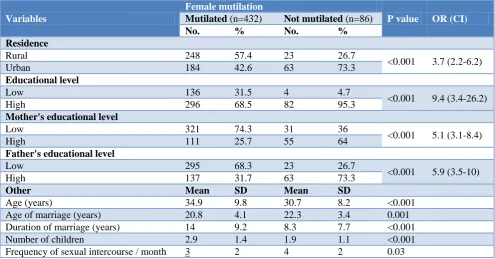
There was a statistically significant high prevalence of mutilation with p<0.001 among woman inhabitant rural area 248 (57.4%), low educated women 136 (31.5%), low educated mothers 321 (74.3%) and fathers 295 (68.3%).
The risk of exposure to mutilation was about four folds higher among women inhabitant rural areas, and about nine folds higher among low educated women, and around six folds higher if parents were low educated. Table 1.
There was a statistically significant high prevalence of mutilation with p-value <0.001, 0.001, <0.001, <0.001, and 0.03 respectively among women were older in age, younger at the time of marriage, have a longer duration of the marriage, deliver less number of children, and with a lower frequency of sexual intercourse Table 1.
There were statistically a significant increase in sexual dysfunction domains among mutilated women with low percentage of desire, arousal, orgasm, and sexual satisfaction domains, and high percentage of female sexual dysfunction were reported among mutilated women. As regards husbands sexual dysfunction, it was reported that mutilated women show a low level of their husband satisfaction (p≤0.001, 0.01, 0.01, <0.001, <0.001 and <0.001 respectively).
Mutilated women had five folds decrease in desire: four folds decrease in sexual satisfaction and five folds increase in sexual dysfunction on contrary 57% to 59% decrease in arousal and orgasm. As regards to husband sexual satisfaction, it decreases by around three folds if their wives were mutilated.
On the contrary, there was no statistically significant difference with p<0.05 in women lubrication, or dyspareunia; for husbands there was no statistically significant difference in impotence or premature ejaculation Table 2.
low level of husband satisfaction were reported among complicated mutilation (p=0.004, 0.001, 0.01, 0.001,
<0.001, 0.006, 0.015and 0.001 respectively).
Table 1: Comparisons of demographic characters in mutilated and not mutilated women.
Variables
Female mutilation
P value OR (CI)
Mutilated (n=432) Not mutilated (n=86)
No. % No. %
Residence
Rural 248 57.4 23 26.7
<0.001 3.7 (2.2-6.2)
Urban 184 42.6 63 73.3
Educational level
Low 136 31.5 4 4.7
<0.001 9.4 (3.4-26.2)
High 296 68.5 82 95.3
Mother's educational level
Low 321 74.3 31 36
<0.001 5.1 (3.1-8.4)
High 111 25.7 55 64
Father's educational level
Low 295 68.3 23 26.7
<0.001 5.9 (3.5-10)
High 137 31.7 63 73.3
Other Mean SD Mean SD
Age (years) 34.9 9.8 30.7 8.2 <0.001
Age of marriage (years) 20.8 4.1 22.3 3.4 0.001
Duration of marriage (years) 14 9.2 8.3 7.7 <0.001
Number of children 2.9 1.4 1.9 1.1 <0.001
Frequency of sexual intercourse / month 3 2 4 2 0.03
Table 2: Association between FGM and sexual dysfunction domains.
Variables
Female mutilation
P value OR (CI)
Mutilated (n=432) Not mutilated (n=86)
No. % No. %
Female sexual dysfunction
Desire 141 32.6 61 70.9 <0.001 5.03 (3.1-8.3)
Arousal 186 43.1 50 58.1 0.01 0.57(0.35-0.90)
Lubrication 201 46.5 45 52.3 0.34 0.80(0.50-1.3)
Orgasm 141 32.6 39 45.3 0.01 0.59(0.36-0.96)
Dyspareunia 277 64.1 49 57 0.22 0.74(0.46-1.2)
No Satisfaction 301 69.7 31 36 <0.001 4.1(2.5-6.6)
FSFI (dysfunction) 300 69.4 36 41.9 <0.001 4.9(2.1-5.6)
Husband sexual dysfunction
Impotence 109 25.2 17 19.8 0.33 0.7(0.41-1.3)
Premature ejaculation 143 33.1 19 22.1 0.056 0.57(0.33-1)
No Satisfaction 183 42.4 17 19.7 <0.001 2.9(1.7-5.2)
Table 3: Association between FGM complication and sexual dysfunction domains among mutilated women.
Variables
Mutilation complication
P value OR (CI)
No (n=137) Yes (n=295)
No. % No. %
Female sexual dysfunction
Desire 103 75.2 181 61.3 0.004 0.52 (0.34-0.80)
Arousal 102 74.5 172 58.3 0.001 0.47 (0.31-0.72)
Lubrication 73 53.3 174 59% 0.29 1.3 (0.83-1.9)
Orgasm 77 56.2 127 43.1 0.01 1.7 (1.1-2.6)
Dyspareunia 61 44.5 134 45.4 0.91 1.03 (0.69-1.6)
No Satisfaction 72 52.6 205 69.5 0.001 2.1 (1.4-3.1)
Variables
Mutilation complication
P value OR (CI)
No (n=137) Yes (n=295)
No. % No. %
Husband sexual dysfunction
Impotence 23 16.8 86 29.2 0.006 2 (1.2-3.4)
Premature ejaculation 34 24.8 109 36.9 0.015 1.8 (1.1-2.8)
No Satisfaction 45 32.8 138 46.8 0.005 0.56 (0.36-0.85)
Women with complicated mutilation had 52% decreases in desire, 47% decrease in arousal level, around two folds decrease in orgasm, and sexual satisfaction, and three folds increase in sexual dysfunction. As regards to husband sexual dysfunction, it increased by around two folds in impotence, premature ejaculation, and 56% decrease in sexual satisfaction if their wives were mutilated. On the contrary, there was no statistically significant difference with p<0.05 in lubrication, and dyspareunia Table 3.
Figure 1: Association between FGM and each of psychological and marital problems.
Figure 2: Association between FGM complication and each of psychological and marital problems.
There was a statistically significant association between mutilation and presence of psychological and marital social problems with p<0.001 Figure 1.
Also, there was a statistically significant high prevalence of psychological and marital social problems with p
value=0.03, and 0.005 respectively among complicated mutilation Figure 2.
DISCUSSION
FGM is considered as a violation of the human rights of women and girls. Egypt is the fourth country in the high prevalence after Somalia, Guinea, and Djibouti.14
A current study demonstrated that the prevalence of FGM was 83.4%, comparable with other studies the prevalence in Iranian was 55.7%; in Ethiopia the study was 78.5%; in the Somali region prevalence of 97% was reported; in Malaysia it was 62%; some other studies were conducted in other countries like Mauritania 77%, Sierra Leone 81.2%, and Gambia 75.6%, which had almost similar findings.15-21
Results of the current study illustrated that mutilation was highly prevalent among women who were older in age, younger at the time of marriage, had a longer duration of the marriage, inhabitant rural area, and with low educational level for themselves and their parents, with a mean age of FGM (12±2.3) years old. These results were similar to results of Bogale et al, Ibrahim et al and Ibrahim et al Egyptian studies which illustrated that circumcised women were younger at the time of marriage and were mostly from rural areas.16,22,23 Also, they were found to have a lower level of education with a mean age of FGM at (7.89±4.56), (10.5±1.3), and (9.7±2.1) years old respectively.
The Sudan study also reported that low socioeconomic status and low education levels of parents were statistically significant with practicing FGM.24
This was in agreement with who have suggested that rural women are more likely to be mutilated than an urban one. That could be explained by cultural believes and low educational level were more prevalent in rural areas. Results of Ethiopia study disagreed with ours in being more prevalent in urban areas more than rural areas.17,25
Suggested that there was a strong negative association between the female’s parents’ education and the practice of FGM.26 Parents with low education are the most likely to have circumcised their daughters. Establishing a relationship between a woman’s FGM status and her educational level can often be misleading, as FGM usually takes place before education is completed.
0% 10% 20% 30% 40%
Psychological problems Marital problems 34.5%
30.6%
9.3% 11.6%
Mutilated Not-Mutilated
0% 10% 20% 30% 40%
Psychological problems Marital problems 27%
21.2% 38%
34.9%
Our results illustrated that the main cause of FGM was to follow culture and traditions 75.5%, and 10% to decrease sexual desire, In contrast, report the main causes were to get married 78.7%, and to get social acceptance, 74.8%.16
The most prevalent type of FGM was type I (69.7%); these results are comparable to studies that conducted in Ethiopia; 78.6% but 68% in Sierra Leone had type II.16,20
The current study was in line with a study conducted in Sudan; it reported that the majority of FGM occurred at home and practiced by birth attendant.24 The findings bear similarities to the results of Ethiopia study that FGM complications included pain, bleeding, and infection.17
The current study reported that mutilation had adverse effect on female sexual function as desire, arousal, orgasm, and sexual satisfaction; it also clarified the high percentage of sexual dysfunction among mutilated women that is in agreement with results of a study conducted in Gambia, review study, African countries Knipscheer et al, Egypt, Alexandria, Ibrahim et al, El Defrawi et al and Ibrahim et al illustrated the negative impact of mutilation on couples sexual function, psychological condition, and social life.20,23,27-32
CONCLUSION
FGM is still practiced in Egypt and it resulted in many physical, psychological, and social complications; also it had a negative impact on the couple's sexual life.
Recommendations
More national and international efforts should be directed to eradicate that practice. That could be achieved through a law for criminalizing such practice in addition to raising awareness of the complication of that practice by launching a health education campaign.
Funding: No funding sources Conflict of interest: None declared
Ethical approval: The study was approved by the Institutional Ethics Committee
REFERENCES
1. Shah G, Susan L, Furcroy J. Female circumcision: history, medical and psychological complications, and initiatives to eradicate this practice. Canadian J Urol. 2009;16(2):4576-9.
2. UNICEF report "Female Genital Mutilation/Cutting: A Global Concern", New York: United Nations Children's Fund, February 2016.
3. Egypt Demographic and Health Survey, 2014.
4. UNICEF report Female Genital Mutilation/Cutting: A statistical overview and exploration of the dynamics of change, 2013.
5. WHO, Guidelines on the Management of Health Complications from Female Genital Mutilation. 2014.
6. Nwaokoro JC, Ede AO, Dozie IJ, Onwuliri CD, Nwaokoro AA, Ebiriekwe SC. Attitude and Perception on the Impact of Female Genital Mutilation on Health and Sex Drive among Married Women in Ebenebe, Awka North L.G.A., Anambra State. Austin J Public Health Epidemiol. 2016;3:4. 7. Berg RC, Underland V, Odgaard-Jensen J, Fretheim
A, Vist GE. Effects of female genital cutting on physical health outcomes: a systematic review and meta-analysis. BMJ Open. 2014;4(11):e006316.
8. Reisel D, Creighton SM. Long term health
consequences of Female Genital Mutilation (FGM). Maturitas 2015;80(2015):48–51.
9. Farnam MHBA, Abotalebi P, Biglu S, Ghavami M.
Effect of female genital mutilation/cutting on sexual functions. Sexual and reproductive health care. 2016.
10. Joint General Recommendation/General Comment No. 31 of the Committee on the Elimination of Discrimination against Women and No. 18 of the Committee on the Rights of the Child on harmful practices. New York (NY): United Nations; 2014. CEDAW/C/GC/31/CRC/C/GC/18;
11. Adam T, Bathija H, Bishai D, Bonnenfant Y-T, Darwish M, and Huntington D, Johansen E: Estimating the obstetric costs of female genital mutilation in six African countries. Bull World Health Organ. 2010;88:281-8.
12. Fried ST, Banerjee J, Kowalchuk J, Chiliza J. Gender equality and human rights approaches to female genital mutilation: interventions and impact. 2015.
13. CAPMAS, demographic and Vital Statistics
(Statistics of morbidities) estimation for the year 2013- Egypt. 2013.
14. UNICEF report, what is female genital mutilation and where does it happen February 2014.
15. Pashaei T, Rahimi A, Ardalan A, Felah A, Majlessi F. Related Factors of Female Genital Mutilation (FGM) in Ravansar (Iran). Woman's Health Care J. 2012;1:2.
16. Bogale D, Markos D, Kaso M. Prevalence of female genital mutilation and its effect on women’s health in Bale zone, Ethiopia: a cross-sectional study. BMC Public Health, 2014;14:1076.
17. Yirga WS, Kassa NA, Gebremichael MW, Aro AR.
Female genital mutilation: prevalence, perceptions and effect on women’s health in Kersa district of Ethiopia. 2012, Int J Women's Health. 2012;4:45– 54.
18. Dahlui M, Wong YL, Choo WY. Female
circumcision (FC) in Malaysia: Medicalization of a religious practice. Int J Behav Med. 2012;19(Suppl 1):S7.
protection of child rights and health. PLoS One. 2013;8(4):e60594.
20. Bjälkander O, Grant DS, Berggren V, Bathija H, Almroth L. Female genital mutilation in Sierra Leone: forms, reliability of reported status, and accuracy of related demographic and health survey questions. Hindawi Publ Corp: Obstet Gynecol Int. 2013;1-14.
21. Kaplan A, Forbes M, Bonhoure I, Utzet M, Martín
M, Manneh M, et al. Female genital
mutilation/cutting in The Gambia: long-term health consequences and complications during delivery and for the newborn. Int J Women’s Health. 2013;5:323-31.
22. Zakia Mahdy Ibrahim, Magdy R. Ahmed and
Rashad M. Mostafa Psychosexual impact of female genital mutilation/cutting among Egyptian women. J Human Androl. 2012;2:36–41.
23. Ibrahim M, Mahmoud H. Effect of female genital mutilation on female sexual function, Alexandria, Egypt, Alexandria J Med. 2016;52:55–9.
24. Satti A, Elmusharaf S, Bedri H, Idris T, Hashim MK, Gaafar I. Prevalence and determinants of the practice of genital mutilation of girls in Khartoum, Sudan. J Annals Trop Pediatr International Child Health. 2013;303-10
25. Arafa E, Abdelghany A, Madkour N, Nossair W, Mohamed E. Survey Study of Acute and Long Term Effects of Female Genital Mutilation among Women in Sharkia Governorate. Open J Obstetr Gynecol. 2014;4:874-80.
26. Tag-Eldin M, Gadallah M, Al-Tayeb M, Abdel-Aty
M, Mansour E, Sallem M. Prevalence of female
genital cutting among Egyptian girls. Bulletin of the World Health Organization. 2008;86(4)269-74.
27. Mulongo P, Hollins Martin C, McAndrew S.
Psychological impact of Female Genital
Mutilation/Cutting (FGM/C) on girls/women’s mental health: a narrative literature review. J Reproductive Infant Psychol. (2014);32(5):469-85.
28. Knipscheer J, Vloeberghs E, Kwaak AVD,
Muijsenbergh MVD. Mental health problems associated with female genital mutilation, 2015. B Journal of Psychological Bulletin. 2015;39(6):273– 7.
29. El Defrawi MH, Lotfy G, Dandash KF, Refaat AH,
Eyada M. Female genital mutilation and its psychosexual impact. J Sex Marital Therap. 2001;27(5):465–73.
30. Ibrahim Z, Ahmed M, Mostafa R. Psychosexual impact of female genital mutilation/cutting among Egyptian women. Human Andrology. 2012;2:36– 41.
31. Stop FGM Middle East campaign. New Study from
Iran: Female Genital Mutilation Impedes Men’s Well-Being, 2015.
32. Elnashar A, Abdelhady R. The impact of female genital cutting on health of newly married women. Int J Gynecol Obstetr. 2007;97:238–44.