http://www.ijcmph.com pISSN 2394-6032 | eISSN 2394-6040
Original Research Article
A cross sectional study of prevalence of internet addiction and its
association with mental health among college going
students in Nagpur city
Prashant Bagdey
1, Hemant Adikane
2*, Uday Narlawar
1, Dadasaheb Dhage
3,
Kishor Surwase
4, Alka Kaware
2INTRODUCTION
The Internet has become an integral part of life.1 Moreover, Internet has the touch in each and every aspect of human life. There is an emerging public health concern over the increase in Internet usage, particularly among college going students.2 Today, 1.2 billion adolescents
stand at the crossroads between childhood and the adult world. Around 243 million of them live in India.3 India is the third largest country in the world next to china and United States in respect of the number of internet users.4 GSMA 2017 report tells that from 2016 to 2020, subscriber penetration will be increased from 51 % to 65
ABSTRACT
Background: The Internet has become an integral part of life. India is the third largest country in the world next to china and United States in respect of the number of internet users. Adolescents usually have poorer self- control, worse self-regulation, and poorer cognition as compared to adults and are considered the most vulnerable group to the temptations of the internet. Objective of the study was to understand the patterns, preferred use of internet, prevalence Internet addiction and its effect on their mental health status among college students in Nagpur.
Methods: This cross-sectional study was carried out in different colleges across in the Nagpur corporation during the period Dec 2016 to May 2017. Pre-validated, pre-tested, structured questionnaire was developed. Young’s 20-item scale for Internet addiction (YIAT) was applied to qualify for the prevalence of Internet addiction. The 12-item General Health Questionnaire has excellent psychometric properties as a screening instrument for psychiatric disorders in nonclinical settings.
Results: This study of college students aged 17-25 years with marginally high male representation (51.92%), identified 30.69%, 26.60% and 0.26% students with mild, moderate and severe Internet addiction respectively. Those who are having internet addiction are two times at a risk of having poor mental health (OR = 2.28, p = 0.01).
Conclusions: Disproportionate Internet use is an evolving issue among college going students as our study have highlighted that excessive use of the Internet undesirably affects one’s physical and mental health and social well-being.
Keywords: Internet addiction, Young IAT-20, GHQ-12, Mental health, Adolescents
Department of Community Medicine, 1Government Medical College, Nagpur, 2Government Medical College, Gondia, Maharashtra, India
3
Taluka Health officer, Umerkhed, Yawatmal, Maharashtra, India
4
Medical officer, Civil Hospital, Parbhani, Maharashtra, India
Received: 18 February 2018
Accepted: 09 March 2018
*Correspondence:
Dr. Hemant Adikane,
E-mail: [email protected]
Copyright: © the author(s), publisher and licensee Medip Academy. This is an open-access article distributed under the terms of the Creative Commons Attribution Non-Commercial License, which permits unrestricted non-commercial use, distribution, and reproduction in any medium, provided the original work is properly cited.
% and smartphone adoption will increased from 28% to 49%.5
The technological development has brought in high speed mobile broadband internet connectivity, wi-fi, and smart phone applications that has transformed the pattern of internet access of youth, from just “logging in” for a particular duration of time in front of a desktop computer to an era of being online anytime .Indeed, such development has made people life easier in terms of communication, business, banking, education, research, health seeking, shopping and entertainment. Now it is hard for most of us to imagine a world without instant and continuous access to internet.6
In 1995, a clinical psychology student Ms Kimberly Young, then in Rochester, USA, got interested in the psychological factors behind computer use and independently conceived of “addictive use of the Internet” as a pathological condition.7
In tandem with the splurge in access to the Internet globally, with the rise of new-generation gadgets, the risk of “internet addiction” is emerging as a significant behavioural addiction pandemic to be tackled worldwide.8
As Internet use has proliferated, so too have reports of internet addiction / problematic internet use. In the rapidly burgeoning literature in this area, different terms are used to refer to seriously dysfunctional patterns of excessive Internet use.9 It has been recommended to include internet addiction (IA) in Diagnostic and Statistical Manual of Mental Disorders, fifth edition (DSM 5).10
Adolescents usually have poorer control, worse self-regulation, and poorer cognition as compared to adults and are considered the most vulnerable group to the temptations of the internet.11
Internet use can become overuse and addiction when it starts to take away from the time one normally spend on socializing with friends or family, relaxing, or doing a hobby. Of course, it’s not that extreme for everyone.12
Researchers have also shown that younger population and especially college students are more vulnerable because of their psychosocial and environmental characteristics.13
Though there are innumerable studies globally depicting a worldwide scenario of the behavioural addiction phenomena, a lot of these studies have utilized inconsistent criteria to rate the levels of addiction, applied recruiting methods that may have caused serious sampling bias, and examined data using primarily exploratory rather than confirmatory data analysis techniques to investigate the degree of association rather than a causal relationship among variables.14 The absence of large-scale epidemiological studies and huge disparities in the use of diagnostic criteria have resulted in difficulties in establishing the prevalence of Internet addiction. This paper attempts to understand the patterns,
preferred use of internet, prevalence Internet addiction and its effect on their mental health status among college students in Nagpur. Unfortunately, there is no similar published study from the central city of India. With this back- ground, we undertook the present study to take a close look on this issue.
METHODS
Methodology is discussed under following headings
Study design
A cross sectional study design is used in present study to identify prevalence of internet addiction among college going students in colleges of across different streams (arts, science, and computer science) in the city of Nagpur during the period Dec 2016 to May 2017.
Study population
College going students in Nagpur city, who are of adolescent age group and young adults age group were included in our study.
Study setting
Various colleges in Nagpur city were contacted prior start of the study. Out of them one junior college, two senior college is selected randomly for selecting study subjects.
Sampling procedure/technique
A multistage cluster random sampling design was applied to target recruitment procedure. Nagpur has eight zones under Nagpur Mahanagar Palika. Senior secondary, undergraduate, masters, and postgraduate colleges in the selected zones were randomly selected and then contacted for permission to conduct the survey. The survey was made with students of all the colleges where permission was granted. Out of the 08 colleges that were contacted, 03 colleges gave immediate permission to conduct the survey.
Sample size
The required sample size for our study is calculated from study conducted by Krishnamurthy et al, on College Students in Bengaluru in 2015, and found total prevalence of 43 % of total internet addiction, allowing a relative error of 10% and for a confidence interval of 95%, using the Epi Info ver 7.1.2 software, the estimated minimum sample size was 376. Total 400 students were surveyed in campus.8
not Internet users, and 9 submitted forms that were incomplete. Hence total, 384 students were included in final analysis.
Measurement tools
The questionnaires were anonymous and self-administered.
The questionnaire contained four parts:
1. Sociodemographic information,
2. Details regarding patterns of internet use,
3. Young’s Internet Addiction Test (YIAT), and
4. General Health Questionnaire 12 items.
Young’s 20-item scale for Internet addiction was utilised for qualification of the prevalence of Internet addiction. It is a 20-item questionnaire gauged on the five-point Likert Scale (score 1 to 5). After all the questions have been responded, numbers for each response are added to obtain a final score. The higher the score range, the greater the level of addiction; normal range: 0-30 points, mild: 31-49 points, moderate: 50-79 points, and severe: 80-100 points.15 The outstanding psychometric properties of the questionnaire are well-documented in the previous studies.16 Young’s IAT, developed for screening and measuring levels of Internet addiction, and has been the most widely used and well-tested for its psychometric properties.17 The items of the YIAT, each rated from 1 (rarely) to 5 (always), include compulsive behaviour related to use of the Internet, the occupational or academic difficulties, lack of competence at home, problems in interpersonal relations, and emotional problems. The underlying principles for choosing Young’s diagnostic questionnaire for the study was that it is the first global psychometric measure and hence has been extensively and frequently used across many studies globally, is self-completed, has been validated on adult and adolescent populations, and has good internal consistency reliability as well as concurrent validity. In a recent meta-analysis study drawing from a large sample of studies conducted to determine the overall value for the reliability YIAT20, the mean differences showed that it is more reliable in college students and probably in Asia. The overall Cronbach’s computed from the studies was 0.889 [95% confidence interval (CI) 0.884-0.895]. The standard deviation of the alpha was low, at 0.049.18
GHQ is a screening tool used to assess the overall psychological well-being of students which is defined as a state of being in which a student is balanced both emotionally and intellectually. GHQ was developed by Goldberg and has been widely used in various studies as a screening tool to determine whether an individual is at risk of developing a psychiatric disorder. It is extensively used by researchers and found to be reliable and well validated.19 GHQ 12 stress scale was used in this study.
GHQ – 12 scale score >18 is considered stressful mental state.
Hypothesis
Our hypothesis is that those who are having internet addiction are at a risk of having poor mental health.
Data collection
All questionnaires were distributed to the participants in campus settings at a predetermined time and were collected onsite after 30 min.
Ethical consideration
College approval and written informed consent were obtained for all students who participated. The study was approved by Institutional Ethics Committee, Govt. Medical College, Nagpur. A pilot study was done on 40 students; subsequent suggestions were incorporated before the start of the study.
Data analysis
The Stata Ver 13.1 was used for statistical analysis of the data collected. Sociodemographic variables and patterns of Internet use have been represented by frequency tables. The prevalence of Internet addiction was described in terms of percentage. Descriptive statistics has been used to examine the association of factors of the questionnaire with Internet addiction. The frequency and odds ratio with CI has been reported for all variables where the p values (<0.05) was significant.
RESULTS
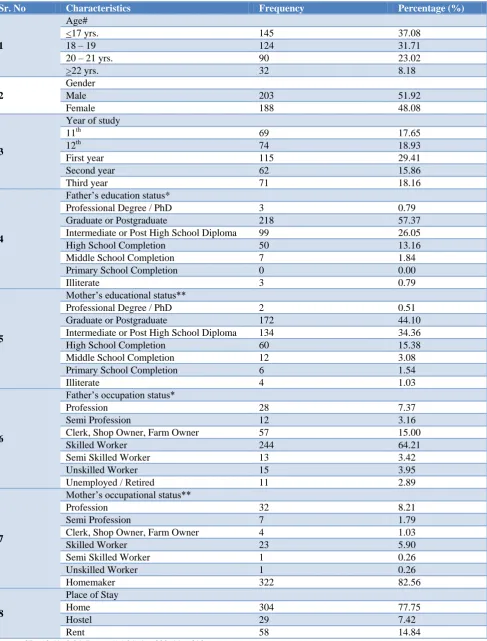
Socio demographic characteristic of the students and pattern of Internet use are depicted in Tables 1 and 2. Majority were adolescents (68.79%). The patterns of Internet use are extremely varied, with the majority of students having been using computers for more than 4 years 274 (70.08%), using computers for less than 2 hours per day 252 (64.96%), using Internet for less than 4 years 249 (63.68%), using Internet for less than 2 h a day 237 (60.61%), using smartphone since last 4 years 313 (80.05%), daily use of smartphone upto 4 hrs 248 (63.43%), spending less than Rs. 200 per month for Internet usage 292 (74.68%), the mobile phone being the most preferred gadget for Internet use 281 (71.87%), logging off at end of work 171 (43.73%), mobile internet most common mode of internet access 260 (66.50%), accessing internet at residence 287 (73.40%) and being under parental supervision 253 (64.71%).
Table 1: Socio-demographic characteristics of study participants (n=391).
Sr. No Characteristics Frequency Percentage (%)
1
Age#
<17 yrs. 145 37.08
18 – 19 124 31.71
20 – 21 yrs. 90 23.02
>22 yrs. 32 8.18
2
Gender
Male 203 51.92
Female 188 48.08
3
Year of study
11th 69 17.65
12th 74 18.93
First year 115 29.41
Second year 62 15.86
Third year 71 18.16
4
Father’s education status*
Professional Degree / PhD 3 0.79
Graduate or Postgraduate 218 57.37
Intermediate or Post High School Diploma 99 26.05
High School Completion 50 13.16
Middle School Completion 7 1.84
Primary School Completion 0 0.00
Illiterate 3 0.79
5
Mother’s educational status**
Professional Degree / PhD 2 0.51
Graduate or Postgraduate 172 44.10
Intermediate or Post High School Diploma 134 34.36
High School Completion 60 15.38
Middle School Completion 12 3.08
Primary School Completion 6 1.54
Illiterate 4 1.03
6
Father’s occupation status*
Profession 28 7.37
Semi Profession 12 3.16
Clerk, Shop Owner, Farm Owner 57 15.00
Skilled Worker 244 64.21
Semi Skilled Worker 13 3.42
Unskilled Worker 15 3.95
Unemployed / Retired 11 2.89
7
Mother’s occupational status**
Profession 32 8.21
Semi Profession 7 1.79
Clerk, Shop Owner, Farm Owner 4 1.03
Skilled Worker 23 5.90
Semi Skilled Worker 1 0.26
Unskilled Worker 1 0.26
Homemaker 322 82.56
8
Place of Stay
Home 304 77.75
Hostel 29 7.42
Rent 58 14.84
Table 2: Pattern of internet use.
Characteristics No. of study subjects n=391 Percentage (%)
Years of computer use (in years)
1-4 117 29.92
5-8 167 42.71
>8 107 27.37
Daily computer use (in hours)
0-2 252 64.96
2-4 113 28.90
4-6 19 4.86
>6 5 1.28
Years of internet use (in years)
1-4 249 63.68
5-8 119 30.43
>8 23 5.88
Daily internet use (in hours)
0-2 237 60.61
2-4 94 24.04
4-6 43 11.00
>6 17 4.35
Years of smartphone use (in years)
1-4 313 80.05
5-8 75 19.18
>8 3 0.77
Smartphone use per day (in hours)
0-2 115 29.41
2-4 133 34.02
4-6 85 21.74
>6 58 14.83
Expenditure on Internet per month (in Rs.)
<200 292 74.68
200-400 52 13.30
400-600 24 6.14
>600 23 5.88
Most commonly used gadget for accessing Internet
Mobile phone 281 71.87
Desktop 47 12.02
Laptop 55 14.07
Tablet 8 2.05
Login status
Log in and off occasionally 166 42.46
At end of work log off 171 43.73
permanently online 54 13.81
Most common mode of internet access
Mobile Internet 260 66.50
Wi-Fi 60 15.35
Broadband 30 7.67
Data card 41 10.49
Most common location of internet access
Residence 287 73.40
Classroom 15 3.84
Cybercafé 29 7.42
Hostel 9 2.30
Computer lab 14 3.58
Library 3 0.77
Other public places 34 8.70
Characteristics No. of study subjects n=391 Percentage (%)
Parents know about my internet activities
Never 20 5.12
Rarely 27 6.91
Sometime 91 23.27
Most of the times 99 25.32
Always 154 39.39
Table 3: Preferred use of internet.
Use of internet for n=391 Percentage (%)
Chatting 297 75.96
Using internet for coursework 254 64.96
General websites 233 59.59
Shopping 217 55.50
E – mail 196 50.12
Games 160 40.92
Online friendships 153 39.13
Pornography 138 35.29
Online relationships 31 7.92
Table 4: Outcome of internet addiction.
Variable n Normal Mild Moderate Chi p OR CI
Time spent <4 hrs. 391 126 71 40 29.08 0.000 3.24 2.08-5.03
>4 hrs. 40 49 105
Amount spent <200 Rs 391 128 91 73 4.95 0.02 1.68 1.10-2.65
>200 Rs 38 29 32
Table 5: Prevalence of internet addiction.
Prevalence YIAT criteria Frequency (n) Prevalence
Normal users Score 0 – 30 166 42.46
Mild Score 31-49 120 30.69
Moderate Score 50-79 104 26.60
Severe > 80 1 0.26
Total 391 100.00
Table 6: Association between internet addiction and GHQ12 score.
Internet addiction
GHQ score
Chi Square OR (95% CI) P value
Normal (%) High (%)
Normal 133 (38.01%) 33 (21.21%)
8.64 2.03 (1.26-3.26) 0.001
Addicted 150 (61.99%) 75 (78.79%)
Total 283 108
With 1 (0.26%) prevalence of severe internet addiction, moderate levels of addiction 104 (26.60%) seem to be at par with what has been reported elsewhere in the literature in the same population. Mild Internet addiction 120 (30.69%) though is marginally on the higher end. The findings have been reported in Table 5. Table 6 shows association between internet addiction and GHQ-12 score. OR of 2.03 (1.26-3.26) suggests internet addiction causes higher level of stress.
DISCUSSION
Present study was undertaken among college going students to recognize whether there is a morbid use of the Internet. We have found, mild internet addiction among 30.69 % of study subjects, moderate addiction among 26.60% and severe among 0.26%.
withdrawal symptoms, tolerance, unsuccessful attempts to control internet use, and continued excessive internet use despite the negative consequences. There is also evidences of loss of interest in previous hobbies, entertainment as a result of, and with the exception of, internet use.10 In the current study, a Cronbach’s alpha of 0.90, suggested good internal consistency of the overall questionnaire.
The age distribution of college students in our study is similar to the study conducted by Bagdey et al <16 yrs = 34.41%, 17-18 yrs=41.74%, >19 yrs= 28.90%.20 Also Surwase et al conducted study on college going students had age distribution 17 – 18 yrs. = 19.86%, 19 – 20 yrs. = 60.63, > 20 yrs. = 19.51%.21 The gender distribution in our study is nearly equal, males were 51.92% and females were 48.08%. Krishnamurthy et al conducted study on college going students and found slightly higher proportion of males (56%) as compared to females (44%).8 Also study conducted by Prabhakaran et al, males = 56.8%, females = 43.2%.10
The pattern of internet use in our study was diverse and Krishnamurthy et al, Surwase et al, Bagdey et al had similar pattern of internet use.8,20,22 Chatting 297 (75.96%) was most preferred use of internet in our study The preferred use of internet was similar to the study
conducted by Bagdey et al (66.51%) while
Krishnamurthy et al found chatting use in 60.39%.8,20
Students with Internet addiction had thrice the odds of spending more than 28 h per week on the Internet (OR=3.24) and spending more than Rs. 200 per month (OR=1.68) as compared to their non-addict counterparts. Even though time is not a direct function in detecting internet addiction, Krishnamurthy et al suggested that those classified as dependent online users were generally disproportionate online usage, spending anywhere from 40 to 80 hours per week, with sessions that could last up to 20 hours.8
The prevalence of internet addiction in our study is mild internet addiction among 30.69 % of study subjects, moderate addiction among 26.60% and severe among 0.26%. Surwase et al studied in Nanded, Maharashtra reported mild prevalence 31.36% which is similar to our study while moderate 34.49% which was higher than our results.21 While Chaudhari et al found mild prevalence of 51.42%, and moderate prevalence 7.45%.13 Our hypothesis is significant that those who are having internet addiction are two times at a risk of having poor mental health (OR=2.28, p=0.01). There are very few studies conducted on assessing ill effects of internet addiction on mental health. Alpaslan et al conducted study on Turkish medical students and found internet addiction was significantly associated with loneliness, alexithymia and probability of suicide (p<0.001).22 Similarly Soumya also found significant relation (Chi square=4.649 and p=0.031).1
CONCLUSION
Disproportionate Internet use is an evolving issue among college going students as our study have highlighted that excessive use of the Internet undesirably affects one’s physical and mental health and social well-being. Our observations suggest that internet addiction is a prevalent public health issue, which is having multiple risk factors and varied patterns of Internet use. Also the Internet is becoming an inclusive component of an individual’s personal and social life.
Weakness
There are several limitations involved in this study which must be addressed to provide direction for future research. First, the analysis reported here should be regarded as exploratory. Secondly, the sample size of our study is relatively small compared to the estimated 616 million current mobile services users.23
Our data collection was based on self-reporting of symptoms by the students, and we did not conduct any interview with students to confirm the clinical diagnosis of internet addiction. In addition, the well-matched control group was not taken which weakens the comparative results. Therefore, generalizability of results must be interpreted with caution and continued research should include larger sample sizes to draw more accurate conclusions.
Along with the non-consideration of design effect in the calculation of sample size, the other two relatively key drawbacks were recall bias and social desirability bias. As, subjects being inquired about details of past exposure to/use of internet. As the study participants may have answered in such a way as to portray themselves in a good light hence social desirability bias could be present.
Strengths
Recommendations
India is a developing country that is embracing technological growth at a pace faster than ever. The role of young generation is crucial in building the nation. The need of the hour is to create awareness among them, plan public health policies with regard to this behavioural addiction, and conduct further research to support the same. Future studies may be directed toward the effect of the Internet on human behaviour, its association with psychological distress and ultimately quality of life.
ACKNOWLEDGEMENTS
We sincerely thank all the students who participated in the study for their cooperation. We also extend our thanks to all staff members from the selected colleges for their support.
Funding: No funding sources Conflict of interest: None declared
Ethical approval: The study was approved by the Institutional Ethics Committee
REFERENCES
1. Prakash S. Internet Addiction among Junior Doctors : A Cross- sectional Study. Indian J Psychol Med. 2017;39(4):422–5.
2. Dhok RS, Kadarkar KS, Doibale MK. Exploring levels of Internet addiction among medical interns : a cross-sectional study. Int J Med Sci Public Heal. 2016;5(11):1–5.
3. Adolescence - An Age of Opportunity. UNICEF. 2015: 1-12.
4. GSMA. The Mobile Economy: India. 2015: 1-56. 5. GSMA. The Mobile Economy. 2017: 1-54.
6. Paul AV, Ganapthi C, Duraimurugan M, Abirami V, Reji E. Internet Addiction And Associated Factors: A Study Among College Students In South India. Innov J Med Heal Sci. 2015;5(3):121–5.
7. Dalal PK, Basu D. Twenty years of Internet addiction. Quo Vadis ? Indian J Psychiatry. 2016;58(1):6–11.
8. Krishnamurthy S, Chetlapalli SK. Internet addiction: Prevalence and risk factors: A cross-sectional study among college students in Bengaluru, the Silicon Valley of India. Indian J Public Health. 2015;59(2):115–21.
9. Li W, O’Brien JE, Snyder SM, Howard MO. Characteristics of Internet Addiction/Pathological Internet Use in U.S. University Students: A Qualitative-Method Investigation. PLoS One. 2015;10(2):e0117372.
10. Prabhakaran MCA, Patel VR, Ganjiwale DJ, Nimbalkar MS. Factors associated with internet addiction among school ‑ going adolescents in Vadodara. J Fam Med Prim Care. 2017;5(4):765–9.
11. Sharma P, Bharti A, De Sousa AV, Shah N. Internet addiction and its association with psychopathology : a study in school children from Mumbai, India. Natl J Community Med. 2016;7(1):2–5.
12. O’Reilly M. Internet addiction: A new disorder
enters the medical lexicon. CMAJ.
1996;154(12):1882–3.
13. Chaudhari B, Menon P, Saldanha D, Tewari A, Bhattacharya L. Internet addiction and its determinants among medical students. Ind Psychiatry J. 2015;24(2):158–62.
14. Spada MM. Addictive Behaviors An overview of problematic Internet use. Addict Behav. Elsevier Ltd; 2014;39(1):3–6.
15. Young KS. Internet Addiction : Symptoms, Evaluation, And Treatment. Innov Clin Pract. 1999;17:1–17.
16. Ngai SS. Exploring the Validity of the Internet Addiction Test for Students in Grades 5 – 9 in Hong Kong Exploring the Validity of the Internet Addiction Test for Students in Grades 5-9 in Hong Kong. Int J Adolesc Youth. 2007;13(1):221–37. 17. Widyanto L, Murran MMC. The Psychometric
Properties of the Internet Addiction Test. Cyber Psychology Behav. 2004;7(4):443–50.
18. Frangos CC. A Meta-analysis of the Reliabilty of Young’s Internet Addiction Test. Proc World Congr Eng 2012. 2012;I(1):8–11.
19. Shashikala KT, Mayadevi DK SN. Using the 12-item General Health Questionnaire ( GHQ-12 ) to Assess the Psychological Health of Indian Medical college Students. Int J Basic Med Sci. 2015;5(6):121–5.
20. Bagdey P, Gawande A, Narlawar U, Adikane HB, Barwal RK. Pattern of internet use among college going adolescent students in Nagpur city : A cross sectional study. Int J Med Sci Public Heal. 2017;6(5):901–6.
21. Surwase K, Adikane H, Bagdey P, Narlawar U. A Cross Sectional Study on the Prevalence of Internet Addiction and Its Association with Mental Health Among College Going Students in Nanded City. Sch J Appl Med Sci. 2017;5(2):385–90.
22. Alpaslan AH, Avci K, Soylu N, Guzel HI. The Association between Problematic Internet Use, Suicide Probability, Alexithymia and Loneliness among Turkish Medical Students. J Psychiatry. 2015;18(1):1–8.
23. GSMA. The Mobile Economy. 2016: 1-36.