Dickie, Rachel and Rasmussen, Susan and Cain, Rachel and Williams,
Lynn and Mackay, William (2017) The effects of perceived social norms
on handwashing behaviour in students. Psychology, Health and
Medicine. ISSN 1354-8506 ,
http://dx.doi.org/10.1080/13548506.2017.1338736
This version is available at
https://strathprints.strath.ac.uk/60951/
Strathprints is designed to allow users to access the research output of the University of Strathclyde. Unless otherwise explicitly stated on the manuscript, Copyright © and Moral Rights for the papers on this site are retained by the individual authors and/or other copyright owners. Please check the manuscript for details of any other licences that may have been applied. You may not engage in further distribution of the material for any profitmaking activities or any commercial gain. You may freely distribute both the url (https://strathprints.strath.ac.uk/) and the content of this paper for research or private study, educational, or not-for-profit purposes without prior permission or charge.
Any correspondence concerning this service should be sent to the Strathprints administrator: [email protected]
The Strathprints institutional repository (https://strathprints.strath.ac.uk) is a digital archive of University of Strathclyde research outputs. It has been developed to disseminate open access research outputs, expose data about those outputs, and enable the
The effects of perceived social norms on handwashing behaviour in students
Rachel Dickie
1, Susan Rasmussen
1, Rachel Cain
1, Lynn Williams
1, & William MacKay
2 1School of Psychological Sciences and Health, University of Strathclyde, Graham Hills
Building, 40 George Street, Glasgow G1 1QE
2
Institute of Healthcare Policy and Practice, School of Health, Nursing and Midwifery,
University of the West of Scotland and University Hospital Crosshouse, UK
Corresponding author: Susan Rasmussen
School of Psychological Sciences and Health,
University of Strathclyde, Graham Hills Building, 40 George Street, Glasgow G1 1QE, email:
, telephone: 0141 548 2575
Keywords: social norms theory, handwashing, students, health behaviour
Abstract
University students may be at increased risk of infection because of living and working in
close proximity to one another. Hand washing is widely considered the most effective
method of preventing the spread of infectious illness. Exploring the determinants of hand
washing is vital to the development of interventions to increase this behaviour. A survey
based on Social Norms Theory assessed hand washing frequency and perceptions of peer
hand washing in 255 students at a Scottish University. Participants reported their own hand
washing frequency and rate, and how often they thought their peers washed their hands in
particular circumstances, to determine whether misperceptions around hand washing exist
in a UK student population, and whether these influence the behaviour of individuals.
Gender was found to be a significant determinant of hand washing frequency as females
reported washing their hands significantly more often than males. Participants also
believed they washed their hands significantly more frequently than their peers. Perceived
This effect was seen in overall hand washing and in food, waste and illness-related hand
washing. These results suggest perceived social norms around hand washing have a
consistent and robust association with individual behaviour. An intervention based on
Social Norms Theory may, therefore, be effective in increasing hand washing in a student
population, reducing infection spread and illness rates within this group. Future research
might test the effectiveness of a social norms intervention in other settings which carry an
increased risk of infection spread, for example schools, hospitals and care homes.
Handwashing is the most successful way of preventing the spread of infectious illnesses. An
increased risk of infection spread is apparent among populations who live and work in close
proximity to one another, such as University students
(White et al., 2003). Effective
handwashing could reduce the spread of infection and decrease illness rates within this
population by breaking the chain of infection; however, research has shown that
handwashing rates tend to be relatively low among students (Ergin et al., 2011; Thumma et
al., 2009).
Social factors may be important drivers of health behaviour engagement, and several
theoretical approaches, e.g. social norms theory (SNT; Berkowitz & Perkins, 1987), the
theory of reasoned action (Ajzen & Fishbein, 1980), focus theory (Cialdini, Reno & Kallgren,
1990), and the theory of normative social behaviour (Rimal & Real, 2005), consider the role
of social norms. SNT examines the beliefs individuals hold about how frequently their peers
engage in particular behaviours, and the effect these have on their own behaviour.
Berkowitz (2005) reviewed the social norms literature and found that people typically
and underestimate healthy
behaviours. This may help to rationalise unhealthy behaviour, as individuals perceive this as
common amongst their peer group, and inhibit healthy practices (e.g., handwashing).
While the majority of SNT research has concentrated on alcohol consumption (e.g., Perkins,
2007), handwashing in students has recently been the focus of a small number of studies
(e.g., Lapinski, Maloney, Braz and Shulman, 2013; Miko et al., 2013). Mackert, Liang and
Champlin (2013) found that students reported that they washed their hands after using the
bathroom 88% of the time but estimated that their peers only washed theirs 58.6% of the
time. Importantly, this study also found that perceptions of peer handwashing were
significant predi
washing behaviour. However, little research
has considered handwashing across different situations where handwashing is important.
The present study aims to address this gap by investigating the perceptions university
iour across contexts, and whether these
beliefs are associated with
. As SNT research consistently highlights
gender differences (e.g., Borchgrevink, 2013; Ergin et al., 2011), it is hypothesised that rates
of self-reported handwashing will be higher in females than in males. Also in line with
previous research (Miko et al., 2013; Lapinski et al., 2013),
it is expected that students will
believe their own hand hygiene is better than that of their peers, indicating that
misperceptions exist around this behaviour.
Method
Participants
255 students aged 17-55 years (M = 23.93 years; SD= 7.16) at a Scottish University (184
females), completed an online questionnaire.
Materials and Procedure
Ethical approval was obtained from the local ethics committee. A SNT based questionnaire
was compiled which contained 39 questions adapted from other questionnaires (Scott and
Vanick, 2007; Miko et al., 2013)
and the Centres for Disease Control and Prevention (2015)
handwashing guidelines. The first question assessed group identification (see below) and
the remaining 38 questions formed two sub-scales (19 questions each). The first sub-scale
hand
often do you wash your
hands before eating
).
Participants responded using a 5 point Likert scale (0-4)
T
to give a
handwashing score. The second sub-scale asked participants to rate how often they think
their peers washed their hands in these situations. The mean of these scores was calculated
to provide a perceived peer handwashing score, representing
norms. These sub-scales were found to be highly reliable (
own behaviour: = .90;
perceived peer behaviour: = .89).
Group Identification
To ensure an appropriate peer group was identified for each participant
(Mahalik et al.,
2007) participants were asked to rate to what extent they agreed or disagreed with the
a
to this question, the social norms questions they were
asked concerned the behaviour of other Universit
I
, they were asked about the behaviour of their friends. An
independent samples t-test revealed no significant difference between perceptions of peer
handwashing frequency reported by participants who answered social norms questions
regarding other students (M= 2.23, SD=.55) or their friends (M= 2.29, SD=.51) (t (253) =
-.732, p= .465); therefore, these measures were combined and will be refer
handwashing scores.
Statistical Analysis
A Shapiro-Wilk test found that participants own handwashing scores were not normally
distributed; therefore non parametric statistics were used. A Wilcoxon Signed Ranks test
was used to determine whether participants rated their own handwashing frequency as
T
behaviours are related, a series of correlation analyses were conducted. Composite
handwashing, and questions concerning peer behaviour in these situations made up the
corresponding social norms scales. The internal reliability of these composite scales were:
own behaviour: food ( = .77), waste ( =.61), illness ( =.82). Perceived peer
behaviour: food ( = .75), waste ( =.72), illness ( =.80).
Results
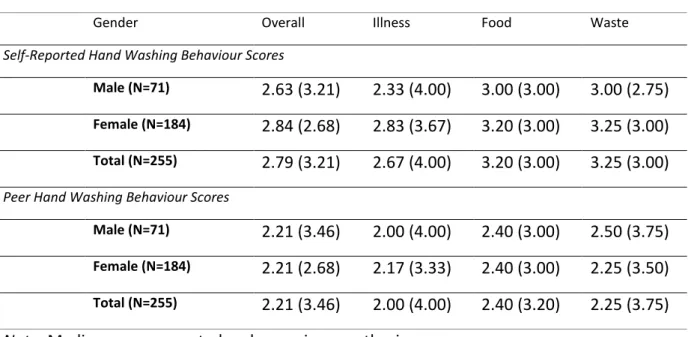
As shown in Table 1, a Mann Whitney U test revealed that females (Mdn = 2.84, r = 2.68)
had significantly higher handwashing frequency scores than males (Mdn = 2.63, r = 3.21) (U
= 5462.50, p = .043). However, no gender differences were observed in perceived social
norms and age was not significantly correlated with handwashing (or perceptions of peer
handwashing).
A Wilcoxon Signed Ranks test revealed that participants rated their own handwashing
(Mdn= 2.79, r = 3.21) as significantly more frequent than that of their peers (Mdn = 2.21, r =
3.46), (Z = -11.12, p <.001). This result was then broken down to analyse handwashing
behaviour around food, waste, and illness. Self-reported handwashing was significantly
higher than estimated peer handwashing across all three contexts: food (Z= -10.980, p
<.001), waste (Z= -11.030, p <.001) and illness (Z= -8.759, p <.001).
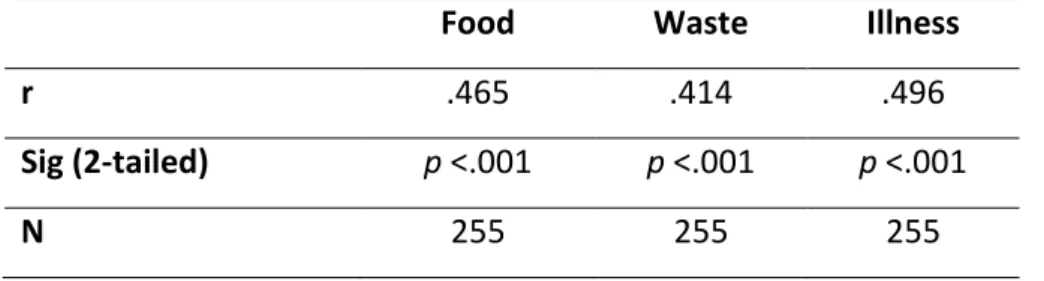
As shown in Table 2, stu
-reported handwashing was significantly correlated with
their perceptions of the handwashing frequency of their peers when in contact with food: (r
(255)= .47 , p <.001), waste: (r (255)= .41, p <.001), and illness: (r (255)= .50 , p <.001). In all
cases, more frequent self-reported handwashing was related to a higher perception of peer
handwashing.
[Insert Table 2]
Discussion
We found that participants believed they washed their hands more frequently than their
peers. Overall handwashing was associated with perceived social norms, and perceptions of
peer handwashing around food, waste and illness were significantly associated with
participants own handwashing in these contexts. The finding that females reported better
hand hygiene than males is consistent with survey findings with students (Thumma et al.,
2009; Ergin et al., 2011) and the general population (Rubin et al., 2009). Also consistent with
previous research (Lapinski et al., 2013; Miko et al., 2013)
was the finding that participants
believed their own handwashing was more frequent than that of their peers; however, it is
possible that self-reported handwashing may be exaggerated due to the social desirability of
this behaviour (Surgeoner et al., 2009).
We found that perceptions of peer handwashing frequency were associated with
. This has also been reported in a US student population
(Mackert et al., 2013) and perceived social norms were found to predict a number of health
behaviours in a non-student male sample
(Mahalik et al., 2007). The present study extends
previous research by showing that handwashing around food, waste and illness were all
significantly predicted by perceptions of peer handwashing frequencies in these contexts.
This provides evidence that SNT is a valuable theoretical standpoint from which to
investigate and influence this behaviour across contexts.
This was a cross-sectional study meaning that we cannot infer causality regarding the
relationship between social norms and handwashing behaviour. There are both strengths
and limitations associated with the questionnaire. Questions were adapted from published
social norms research and official guidelines regarding handwashing, and behaviour was
assessed across a range of contexts to obtain a comprehensive picture. However, the
questionnaire was not tested for reliability or validity before use (although we found the
internal consistency of the measures to be good in the current sample).
References
Berkowitz, A.D. (2005) Changing the Culture of College Drinking: A Socially Situated
Prevention Campaign. NJ: Hampton Press.
Berkowitz, A.D. and Perkins, H.W. (1987) Current Issues in Effective Alcohol Education
Programming. In J. Sherwood (Ed.), Alcohol Policies and Practices on College and University
Campuses (pp.69-85). Columbus, OH: National Association of Student Personnel
Administrators Monograph Series.
Borchgrevink, C.P., Cha, J. and Kim, S. (2013) Hand washing practices in a college town
environment. Journal of Environmental Health, 75, 18-24.
Cialdini, R.B., Reno, R.R., & Kallgren, C.A. (1990). A focus theory of normative conduct:
Recycling the concept of norms to reduce littering in public places. Journal of Personality
and Social Psychology, 58, 1015-1026.
Ergin, A., Bostanci, M. Onal, O., Bozkurt, A.I. and Ergin, N. (2011) Evaluation of students'
social hand washing knowledge, practices, and skills in a university setting. Central European
Journal of Public Health, 19, 222-226.
Lapinski, M.K., Maloney, E.K., Braz, M. and Shulman, H.C. (2013). Testing the Effects of Social
Norms and Behavioural Privacy on Hand Washing: A Field Experiment. Human
Communication Research, 39, 21-46.
Mackert, M., Liang, M.C. and Champlin, S. (2013).
T
“
P
E
Mahalik, J.R., Burns, S.M. and Syzdek, M. (2007). Masculinity and perceived normative
Social Science and Medicine, 64,
2201-2209.
Miko, B.A., Cohen, B., Conway, L., Gilman, A., Seward, S.L. and Larson, E. (2013).
Determinants of Personal and Household Hygiene Among College Students in NYC, 2011.
American Journal of Infection Control, 40, 940-945.
Perkins, H.W. (2007). Misperceptions of peer drinking norms in Canada: another look at the
"reign of error" and its consequences among college students. Addictive Behaviour, 32,
2645-2656.
Rubin, G.J., Amlot, R., Page, L. and Wessely, S. (2009). Public perceptions, anxiety, and
behaviour change in relation to the swine flu outbreak: cross sectional telephone survey.
British Medical Journal, 339, 1-8.
Scott, E. and Vanick, K. (2007). A survey of hand hygiene practices on a residential college
campus. American Journal of Infection Control, 35, 694-696.
Surgeoner, B.V., Chapman, B.J. and Powell, D.A. (2009). University students' hand hygiene
practice during a gastrointestinal outbreak in residence: what they say they do and what
they actually do. Journal of Environmental Health, 72, 24-28.
Thumma, J., Aiello, A.E., and Foxman, B. (2009). The association between handwashing
practices and illness symptoms among college students living in a university dormitory.
American Journal of Infection Control, 37, 1-3.
When and How to Wash your Hands. (2015, July 22). Retrieved from
http://www.cdc.gov/handwashing/when-how-handwashing.html
White, C., Kolble, R., Carlson, R., Lipson, N., Dolan, M., Ali, Y. and Cline, M. (2003). The
Effects of Hand Hygiene on Illness Rates Among Students in University Residence Halls.
American Journal of Infection Control, 31, 364-370.
Table 1:
Self-Reported Hand Washing Frequency and Perceived Peer Behaviour Scores in the
Contexts of Food, Waste and Illness
Gender Overall Illness Food Waste
Self-Reported Hand Washing Behaviour Scores
Male (N=71)
2.63 (3.21)
2.33 (4.00)
3.00 (3.00)
3.00 (2.75)
Female (N=184)
2.84 (2.68)
2.83 (3.67)
3.20 (3.00)
3.25 (3.00)
Total (N=255)
2.79 (3.21)
2.67 (4.00)
3.20 (3.00)
3.25 (3.00)
Peer Hand Washing Behaviour Scores
Male (N=71)
2.21 (3.46)
2.00 (4.00)
2.40 (3.00)
2.50 (3.75)
Female (N=184)
2.21 (2.68)
2.17 (3.33)
2.40 (3.00)
2.25 (3.50)
Total (N=255)
2.21 (3.46)
2.00 (4.00)
2.40 (3.20)
2.25 (3.75)
Table 2
C
“
“
-Reported Hand Washing Behaviour and
Perceived Frequency of Peer Hand Washing Across Three Contexts
Food
Waste
Illness
r
.465
.414
.496
Sig (2-tailed)
p <.001
p <.001
p <.001