Original Research Article
Prevalence and factors influencing anaemia among urban adolescent
females, a cross sectional study
J. S. Poyyamozhi
1, Rajan Rushender
2*, G. Murali Mohan Reddy
3INTRODUCTION
Adolescence age group bridging childhood and adult life, marks the transition in social role with increasing potential to shape the country’s economic prospects and bring about change within the community. Adolescents to include persons aged 10-19 years.1
There are about 1.8 billion adolescents globally today and 90% of the adolescent population is reported to be living in developing nations.2 Even though adolescent age group is considered as relatively healthy period, increasing
number of studies are proving that it is a great misconception. The adolescents are at risk of many diseases and nutritional disorders, especially anemia is a major adolescent morbidity.3
The prevalence of anemia is reported to be ranging between 30% to as high as 68.8% as reported by various community based studies across India.4-9 This burden is comparatively similar and in some cases higher than prevalence reported from other developing countries.10-14 The prevalence depends on the socio demographic
ABSTRACT
Background: Despite many organized efforts by the government, adolescent anemia remains to be a major public health problem in India. The prevalence of anemia and factors influencing it in urban adolescent females is a relatively less studied aspect. Hence the current study is conducted with an objective of assessing the prevalence and factors influencing anemia among adolescent school girls living in an urban locality.
Methods: The current study was a community-based cross sectional study conducted in the selected schools and colleges of Permabalur town, south India, in the field practice area of Dhanalakshmi Srinivasan Medical College and Hospital between June to December 2017. Total 373 adolescent girls selected by multistage simple random sampling were included in the study. The hemoglobin was assessed by cyanmethemoglobin method.
Results: The prevalence of anaemia among urban adolescent girls was 41.1% (95% CI 0.36-0.46). The proportion of mild and moderate anaemia was 37% and 4.10% respectively and none had severe anaemia. Compared to upper middle class, the odds of anemia were 14.16 times more in the lower class (95% CI 4.54-44.12, p<0.001). Compared to scanty/normal bleeding, the odds of anemia were 2.943 (95% CI 1.4-3.87 p<0.05) more in girls with heavy bleeding. Age, upper lower or lower middle socio-economic strata, religion, type of family and menstrual irregularity did not have any statistically significant association with anemia.
Conclusions: Anemia is highly prevalent among adolescent girls and there is a need to intensify efforts all levels to reduce the prevalence of anemia.
Keywords: Anemia, Adolescent girls, Urban
Department of Community Medicine, 1Dhanalakshmi Srinivasan Medical College, Sirivachur, Perambalur, 2SRM Medical College, Kattankulathur, Kanchipuram, 3Chettinad Hospital and Research Institute, Tamil Nadu, India
Received: 15 January 2018
Accepted: 10 February 2018
*Correspondence:
Dr. Rajan Rushender, E-mail: [email protected]
Copyright: © the author(s), publisher and licensee Medip Academy. This is an open-access article distributed under the terms of the Creative Commons Attribution Non-Commercial License, which permits unrestricted non-commercial use, distribution, and reproduction in any medium, provided the original work is properly cited.
conditions, food intake patterns, cultural beliefs and is quite heterogeneous across the country.15,16
In spite of the number of interventions undertaken to combat anemia, its prevalence continues to be high in the adolescent population. In the light of the rapid sociodemographic transition in the country, many of the adolescents are living in urban areas. Even though there were many studies conducted in India on prevalence of anemia in adolescent age group, studies focusing on urban adolescent females are very few. Considering the fact that majority of the urban adolescents are enrolled for their education in the private sector, they are quite often left of the government run prevention and control programmes.6
There were very few community based studies, which have attempted to analyze the factors influencing anemia in this age group. The findings of these studies parents’s education, standard of living, religion, age at menarche, urban or rural location, social class, BMI are the strong determinants of anemia. So studies determining the influencing factors of adolescent anemia in different socio demographic settings the country are need of the hour to design more effective interventions.
Considering the above scenario, understanding the burden and factors influencing anemia in this population group is vital in drawing the attention of clinicians and policy makers to this important public health problem.
Hence the current study was conducted with an objective of assessing the prevalence of anemia among urban adolescent school going girls and the factors influencing anemia among study population.
METHODS
Study design
The study was a cross sectional study, conducted among selected schools/colleges of Permabalur town, located in south Tamil Nadu.
Study population
Adolescent females between 16-19 years of age, who were studying in selected schools/colleges were included in the study
Study period
The data collection for the study was conducted between June 2017 to December 2017.
Sample size
Considering the prevalence of anemia to be detected as 30%, with an absolute precision of 5%, and95% level of
confidence. The following formula was used to calculate the sample size.
Where N= required sample size
Z= Z statistic for the level of confidence (95%)- 1.96
P= prevalence (0.3)
d= level of precision (0.05)
Using the above calculation, the sample size required for the study would be 323 subjects. To account for non-participation, it was decided to include 360 subjects into the study at the time of planning. The final analysis has included 370 adolescent girls.
Selection of study subjects
A list of colleges in the field area was acquired from the department of secondary education, Tamil Nadu government. Three colleges were randomly selected from the list of the colleges. Necessary administrative
approvals were sought from the concerned
authorities.120 adolescent girls from each of the three colleges were selected randomly from each college, after acquiring the list of students from the college.
Study tools
A structured questionnaire to capture relevant socio demographic, food intake related and other factors was prepared. The questionnaire was validated by distributing it to five experts in the field. Pretesting of the questionnaire was done on 20 subjects, to assess the feasibility of administering the questionnaire and to further validate the tool.
Ethical consideration
Ethical approval of Institute’s Human Ethics committee, was obtained for the study. Ascent of the selected participants and informed written consent from the parents or guardian was obtained, after thoroughly explaining the purpose of the study, risks and benefits involved. Appropriate health education was provided to the participants at the end of the study, and where necessary patients were advised to undergo further evaluation and proper medical management.
Study procedure
samples were placed in one cassette. And approximately 60 samples were processed in one hour. The value of hemoglobin in the blood sample is given in g/dl.
Statistical analysis
Serum hemoglobin level was the primary outcome. Sociodemographic parameters, food intake pattern, menstrual parameters, anthropometry of the participants etc were considered as explanatory variables. Descriptive analysis of the parameters was done by using frequencies and percentages for categorical variables and means and standard deviations for quantitative variables. The association between the explanatory and outcome variables was assessed by univariate logistic regression analysis. Odds ratios and 95% CI and their p values were presented. The final model of factors influencing anemia was developed by variables with statistically significant association in univariate analysis into multivariate logistic regression analysis. IBM SPSS version 21 was used for statistical analysis.
RESULTS
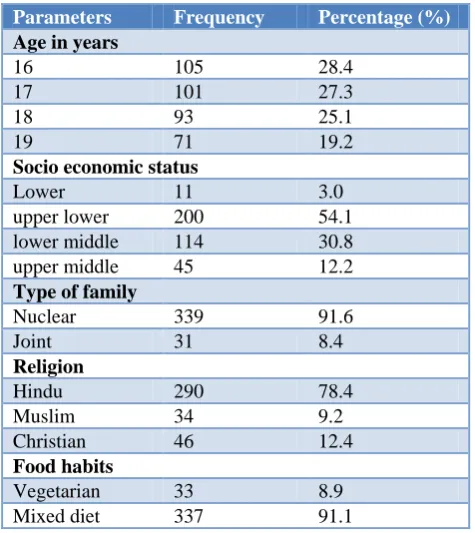
Among the study population, 105 (28.4%) participants were aged 16 years, 101 (27.3%) were aged 17 years, 93 (25.01%) were aged 18 years, and 71 (19.2%) were aged 19 years. Among the study population, 11 (3.00%) participants were in lower class, 200 (54.1%) were in upper lower class, 114 (30.8%) were in lower middle class, and 45 (12.2%) were in upper middle class.
Table 1: Socio demographic parameters of study population (N=370).
Parameters Frequency Percentage (%)
Age in years
16 105 28.4
17 101 27.3
18 93 25.1
19 71 19.2
Socio economic status
Lower 11 3.0
upper lower 200 54.1
lower middle 114 30.8
upper middle 45 12.2
Type of family
Nuclear 339 91.6
Joint 31 8.4
Religion
Hindu 290 78.4
Muslim 34 9.2
Christian 46 12.4
Food habits
Vegetarian 33 8.9
Mixed diet 337 91.1
Among the study population, 339 (91.6%) were living in nuclear family and 31 (8.4%) were living in joint family. Among the study population, 290 (78.4%) were Hindu, 34 (9.2%) were Muslim, 46 (12.4%) were Christian. Among the study population, 33 (8.9%) were vegetarian and 337 (91.1%) were mixed diet (Table 1).
Table 2: Menstrual history of study population.
Parameter Frequency Percentage (%)
Age at menarche
11.00 31 8.4
12.00 66 17.8
13.00 137 37.0
14.00 87 23.5
15.00 49 13.2
Menstrual pattern
Regular 296 80.0
Irregular 74 20.0
Severity of bleeding
Scanty 53 14.3
Moderate 242 65.4
Heavy 75 20.3
Among the study population, 31 (8.4%) women were age at menarche in 11 years. 66 (17.8%) women were in 12 years, 137 (37%) women were in 13 years, 87 (23.5%) women were in 14 years, and 49 (13.2%) women were in 15 years. Among the study population, 296 (80%) women had regular menstrual, and 74 (20%) women had irregular menstrual. Among the study population, 53 (14.3%) had scanty, 242 (65.4%) had moderate bleeding, and 75 (20.3%) had heavy bleeding (Table 2).
Among the study population, 152 (41.1%) had anemia. (95% CI 0.36-0.46). The majority of the, 137 (37%) people had mild (9-12) anemia, and 15 (4.10%) had moderate (95% CI 0.024-0.065) anemia and none of the girls had severe anemia (Table 3).
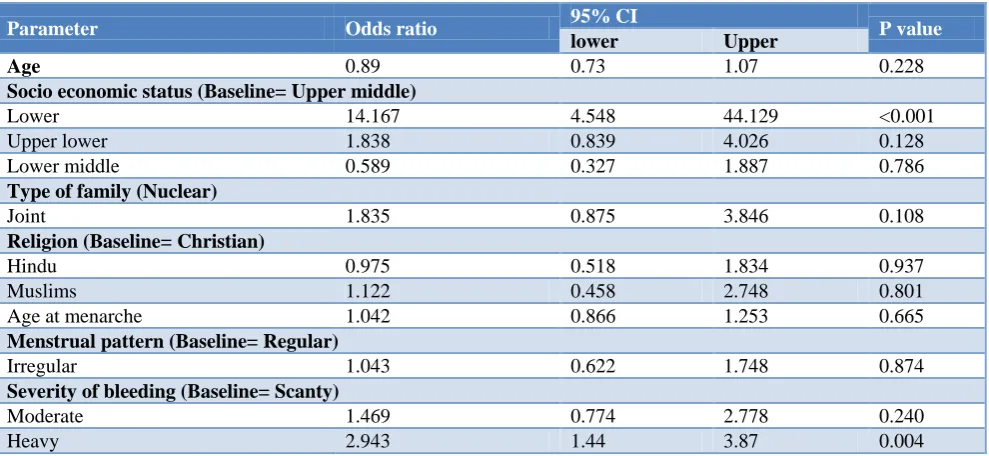
menstrual cycle (95% CI 0.622-1.748), the association was statistically not significant (p>0.05). Compare to scanty, the odds of anemia in moderate bleeding group was 1.44 times more (p>0.05). Compare to scanty, the
odds of anemia was 2.943 times more in heavy, the association was statistically significant (95% CI 1.44-3.87, p<0.05) (Table 4).
Table 3: prevalence of anemia in study population.
Parameters Frequency Percentage 95% CI of proportion
Lower Upper
Anemia 152 41.1% 0.36 0.46
Severity of anemia
Mild (9-12) 137 37.0% 0.322 0.421
Moderate (6-9) 15 4.10% 0.024 0.065
Severe (<6) 0 0.00 0.00 0.00
Table 4: Univariate logistic regression analysis of factors influencing anemia in study population.
Parameter Odds ratio 95% CI P value
lower Upper
Age 0.89 0.73 1.07 0.228
Socio economic status (Baseline= Upper middle)
Lower 14.167 4.548 44.129 <0.001
Upper lower 1.838 0.839 4.026 0.128
Lower middle 0.589 0.327 1.887 0.786
Type of family (Nuclear)
Joint 1.835 0.875 3.846 0.108
Religion (Baseline= Christian)
Hindu 0.975 0.518 1.834 0.937
Muslims 1.122 0.458 2.748 0.801
Age at menarche 1.042 0.866 1.253 0.665
Menstrual pattern (Baseline= Regular)
Irregular 1.043 0.622 1.748 0.874
Severity of bleeding (Baseline= Scanty)
Moderate 1.469 0.774 2.778 0.240
Heavy 2.943 1.44 3.87 0.004
DISCUSSION
The current study was conducted with an objective of assessing the prevalence of anemia among a group of urban adolescent girls and found that majority of the participants belonged to lower or lower middle socio-economic strata and were hailing from nuclear families. Majority of the study population were Hindus and were consumers of mixed diet. The age of menarche was ranging from 11 to 15 years and 20% had irregular menstruation, moderate and heavy bleeding was found in 65.4% and 20.3% of the study population.
The prevalence of anemia was 41.1%; 95% CI 0.36-0.46) among the study population. The proportion of mild and moderate anaemia was 37% and 4.10% respectively in study population. None of the study subjects had severe anaemia. Assefa et al have reported a prevalence of 37.6% in their study of adolescent girls, which was slightly lesser than current study.10 Out of which, 18.1% and 19.6% had mild and moderate anaemia respectively, but in the current study major proportion of anemia was
mild. In study by Chaudhary et al 4 35.1% of the adolescent girls had anemia. Desalegn et al have reported 43.7% of adolescent girls to anemic and the major contributor was iron deficiency anemia in 37.4% patients.17
The factors, which have shown statistically significant association with anemia were lower socio-economic class and heavy menstrual bleeding. Compared to upper middle class, the odds of anemia were 14.167 times more in lower class (95% CI 4.548-44.129), the association was statistically significant (p<0.05). Compare to scanty, the odds of anemia were 2.943 times more in heavy, the association was statistically significant (p<0.05). Age, belonging to upper lower or lower middle socio-economic strata, religion, type of family and menstrual irregularity did not have any statistically significant association with anemia in the study. In study by Assefa et al the factors, which were associated with presence of anaemia were low family income, poor maternal education, and vegetarian diet.10 Chaudhary et al have reported socio-economic status and literacy status of parents.5 As the key factors associated with anemia. In study by Desalegn et al the key predictors of anemia among adolescent girls were non consumption of protein and high calories foods, lower socio economic status and presence of intestinal worms.17 Panigrahi et al has reported lower socioeconomic status, excessive menstrual bleeding and poor intake of green leafy vegetables and pulses as independent risk factors for anemia.7 Shah, et al have reported contradictory findings, and concluded menarcheal status, socio-demographic factors like parental education or occupation have no association with anemia among adolescent girls and concluded that anemia among adolescent girls affects the entire spectrum of adolescent girls.8
Many authors like Ghosh et al have recommended further intensified efforts not only by the government through appropriate policy interventions, but also intensified action by all stake holders, including, parents, teachers, health care providers at different levels.6 Considering the contribution, the negative influence anemia on adolescent girl’s health, academic performance, quality of life and future risk of morbidity during pregnancy and child birth, it should be dealt with utmost priority.
CONCLUSION
The prevalence of anaemia is high among urban adolescent girls, majority of which is mild anaemia. The key factors associated with anemia were lower socio economic status and heavy menstrual bleeding. The factors, which did not have any statistical significant association with anemia were age, upper lower or lower middle socio economic strata, religion, type of family and menstrual irregularity.
Considering the high prevalence of anaemia among adolescent girls across different socio economic strata, appropriate behavioural change communication (BCC) interventions at personal and family level needs to be intensified. Periodic evaluation of the impact of various policy interventions by the government is needed to make them more effective.
Funding: No funding sources Conflict of interest: None declared
Ethical approval: The study was approved by the Institutional Ethics Committee
REFERENCES
1. UNFPA. Adolescent and Youth Demographics:A brief overview Available at: http://www.
unfpa.org/resources/adolescent-and-youth-demographicsa-brief-overview. Accessed on 23 November 2017.
2. UNFPA. The Power of 1.8 Billion: Adolescents, Youth and the Transformation of the Future 2014 Available at: http://eeca.unfpa.org/en/publications/ state-world-population-2014-report. Accessed on 23 November 2017.
3. WHO. The global prevalence of anaemia in 2011. Geneva; 2015.
4. Agarwal KN, Agarwal DK, Sharma A, Sharma K, Prasad K, Kalita MC, et al. Prevalence of anaemia in pregnant & lactating women in India. Indian J Med Res. 2006;124(2):173-84.
5. Chaudhary SM, Dhage VR. A study of anemia among adolescent females in the urban area of nagpur. Indian J Community Med. 2008;33(4):243-5.
6. Ghosh R, Bharati P. Haemoglobin status of adult women of two ethnic groups living in a peri-urban area of Kolkata city, India: a micro-level study. Asia Pac J Clin Nutr. 2003;12(4):451-9.
7. Panigrahi A, Sahoo PB. Nutritional anemia and its epidemiological correlates among women of reproductive age in an urban slum of Bhubaneswar, Orissa. Indian J Public Health. 2011;55(4):317-20. 8. Shah BK, Gupta P. Anemia in adolescent girls: a
preliminary report from semi-urban Nepal. Indian Pediatr. 2002;39(12):1126-30.
9. Verma M, Chhatwal J, Kaur G. Prevalence of anemia among urban school children of Punjab. Indian Pediatr. 1998;35(12):1181-6.
10. Assefa S, Mossie A, Hamza L. Prevalence and severity of anemia among school children in Jimma Town, Southwest Ethiopia. BMC Hematol. 2014;14(1):3.
11. Ortega P, Leal J, Amaya D, Chavez C. [Nutritional evaluation, micronutrient deficiencies and anemia among female adolescents in an urban and a rural zone from Zulia state, Venezuela]. Invest Clin. 2010;51(1):37-52.
12. Tesfaye M, Yemane T, Adisu W, Asres Y, Gedefaw L. Anemia and iron deficiency among school adolescents: burden, severity, and determinant factors in southwest Ethiopia. Adolesc Health Med Ther. 2015;6:189-96.
14. Ulukanligil M, Seyrek A. Anthropometric status, anaemia and intestinal helminthic infections in shantytown and apartment schoolchildren in the Sanliurfa province of Turkey. Eur J Clin Nutr. 2004;58(7):1056-61.
15. Bharati P, Shome S, Chakrabarty S, Bharati S, Pal M. Burden of anemia and its socioeconomic determinants among adolescent girls in India. Food Nutr Bull. 2009;30(3):217-26.
16. Thomas D, Chandra J, Sharma S, Jain A, Pemde HK. Determinants of Nutritional Anemia in Adolescents. Indian Pediatr. 2015;52(10):867-9.
17. Desalegn A, Mossie A, Gedefaw L. Nutritional iron deficiency anemia: magnitude and its predictors among school age children, southwest Ethiopia: a community based cross-sectional study. PLoS One. 2014;9(12):e114059.