Original Research Article
Study to estimate the prevalence of risk factors of chronic disease
among a fishing community in Tamil Nadu
P. Seenivasan, K. Caroline Priya*, Raghul Siddharth, S. Devanand, A. Siva Surya, G. Sarath,
M. Kavin Chander, K. Sivasharan, H. Raj Kumar
INTRODUCTION
Fishing one of the world’s oldest occupations is probably one of the more dangerous has been noted as an occupation with a high risk of occupational hazards. They work in non-industrial settings, their work is non-routine or in very long cycles, and is dictated by factors such as weather, crew and boat sizes, and fishery policies.1 Studies have shown that fishermen have a higher
mortality from cardiovascular disease, cancer and accident.2 Chronic diseases include many conditions such as cardiovascular diseases, mainly heart disease and stroke; cancer; chronic respiratory diseases; diabetes; others. Cardiovascular diseases account for 30% of deaths, majority of cardiovascular disease (CVD) is caused by external risk factors that can be controlled, treated or modified, such as the diet, tobacco, alcohol and lack of physical activity.3 About half of the world’s
ABSTRACT
Background: Studies have shown that fishermen have a higher mortality from cardiovascular disease, cancer and accident. Despite existing knowledge regarding the high morbidity and mortality rates associated with fishing, there has been little research on the effect of working conditions on the health of fishermen, especially in the developing world. To estimate the prevalence of risk factors of chronic disease among the fishing community in Pulicat village and to find the association among various risk factors.
Methods: This cross-sectional study was carried out from March 2016 to September 2016, among the residents of Pulicat village, a fishing community to the north of Chennai. The core items in of the WHO steps instrument were used, the questionnaire also included data on demographics and socio-economic variables.
Results: Fruit consumption was low among the study population only 15.11% and 12.44% consumed fruits and vegetables daily, 25% of the population were involved in vigorous activity daily, 4.44% of the population was smokers, 18.67% of them consumed alcohol, 31.11% of them were hypertensive, 12.81% were diabetic. BMI calculations showed that 37.33% were above the normal range and 52.44% had waist circumference above the normal range.
Conclusions: Health promotion and education initiatives should be conducted in the fishing community to increase the awareness of the risk for developing chronic diseases which may permanently incapacitate them and force them to quit their profession. They should be encouraged to avoid alcohol, smoke less, eat more fruits and vegetables especially at sea, increase physical activity, and monitor regularly their weight, abdominal circumference and blood pressure.
Keywords: Fishing community, Chronic diseases, Risk factors, Prevalence
Department ofCommunity Medicine, Stanley Medical College, Chennai, Tamil Nadu, India
Received: 27 December 2017 Revised: 26 February 2018 Accepted: 28 February 2018
*Correspondence: Dr. K. Caroline Priya,
E-mail: [email protected]
Copyright: © the author(s), publisher and licensee Medip Academy. This is an open-access article distributed under the terms of the Creative Commons Attribution Non-Commercial License, which permits unrestricted non-commercial use, distribution, and reproduction in any medium, provided the original work is properly cited.
seafood is caught or otherwise collected by small-scale fishermen operating a variety of fishing craft.4 Despite existing knowledge regarding the high morbidity and mortality rates associated with fishing, there has been little research on the effect of working conditions on the health of fishermen, especially in the developing world.5 Added to this fisherman do not have any social security cover.6 The traditional fisher folk are all those men and women who earn a livelihood by involving in harvesting, handling, processing and marketing of fish and fish products. Therefore, traditional fisher folk include, artisan fishermen, working on non-mechanised and motorised crafts in coastal waters, fishermen working on mechanised boats in coastal waters, workers at fish landing centres involved in unloading, sorting and icing, workers involved in traditional methods of fish curing and drying, workers involved in prawn peeling sheds, workers in fish processing firms, workers involved in marketing of fish inside the state, they include men and women.7
Thus, it is very important to prevent the development of the chronic diseases allowing fisherfolk to live in good health as many years as all other professions. By obtaining information on the prevalence of the main preventable risk factors for the chronic non-infectious diseases it will be possible to strengthen preventive strategies and to point out areas for further research and health promotion. In light of the above reasons it was proposed to conduct a study to assess the prevalence of risk factors among the fishing community in Pulicat village in Tamil Nadu.
Objective
To estimate the prevalence of risk factors of chronic disease among the fishing community in Pulicat village and to find the association among various risk factors.
METHODS
This Cross-sectional study was carried out from March 2016 to September 2016, among the residents of Pulicat village, a fishing community to the north of Chennai. A sample size of 303 was arrived at taking into account the prevalence of overweight 25.8%i, and relative precision of 5.16% (Zα=1.96, p=25.8%, d=20% of p, q=(1-p) =74.2%). The participants were selected by Systematic sampling method. The core items in of the WHO Steps Instrument were used with modification after extensive content-setting interviews with the community, the questionnaire also included data on demographics and socio-economic variables. After obtaining Institute Ethics Committee approval and informed consent from the participants face-to-face interviews were performed and physical measurements were taken. The questionnaire data was entered into Excel spread sheet and analysed using the Epi Info 7. Chi-square analysis for trend was performed to find out association among the risk factors for diseases.
Operational definitions
Smoking
Current smoker: Smoked at least one cigarette during the last 30 days.8
Alcohol
Current drinkers: Those who consumed at least one alcoholic beverage in the past 30 days.
BMI classification: Subjects were classified using WHO classification. 9
Hypertension: Defined as systolic blood pressure (SBP) of ≥140 mmHg or diastolic blood pressure (DBP) ≥90 mmHg as per WHO criteria or history of previously known disease and pre-hypertension was defined as SBP 120-139 mmHg or DBP 80-89 mmHg.10
Type 2 diabetes mellitus: Diagnosed either by history of previously known disease or casual plasma glucose concentration ≥200 mg/dl (11.1mmol/l).11
Hypercholesterolemia: Defined as total cholesterol level ≥200 mg% according to USA - adult treatment panel (ATP) III guidelines.12
RESULTS
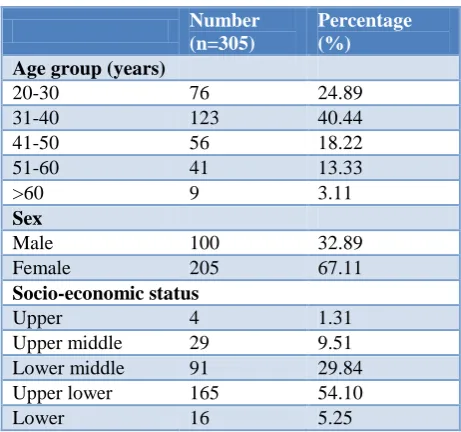
The study was conducted in Pulicat village. Pulicat (Pazhaverkadu) is a historic seashore town in Thiruvallur district, of Tamil Nadu state, South India. It is about 60 kilometres north of Chennai. The demographic distribution of the study population is given in Table 1.
Table 1: Socio-demographic details of the study population.
Number (n=305)
Percentage (%)
Age group (years)
20-30 76 24.89
31-40 123 40.44
41-50 56 18.22
51-60 41 13.33
>60 9 3.11
Sex
Male 100 32.89
Female 205 67.11
Socio-economic status
Upper 4 1.31
Upper middle 29 9.51
Lower middle 91 29.84
Upper lower 165 54.10
Lower 16 5.25
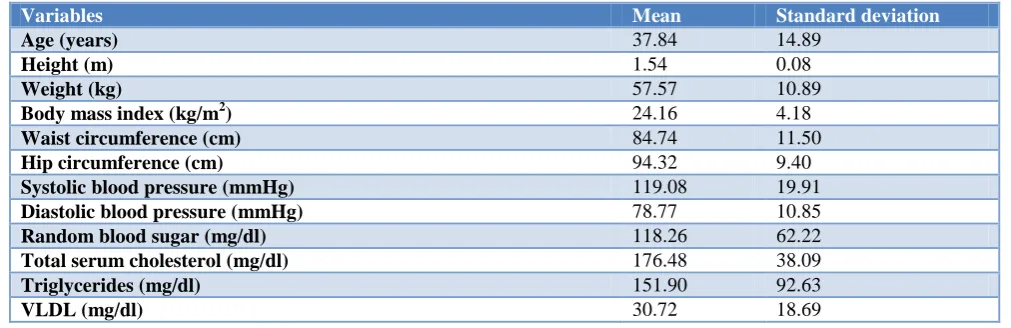
Table 2: Mean and standard deviation for various cardiovascular disease risk factors in the study population.
Variables Mean Standard deviation
Age (years) 37.84 14.89
Height (m) 1.54 0.08
Weight (kg) 57.57 10.89
Body mass index (kg/m2) 24.16 4.18
Waist circumference (cm) 84.74 11.50
Hip circumference (cm) 94.32 9.40
Systolic blood pressure (mmHg) 119.08 19.91
Diastolic blood pressure (mmHg) 78.77 10.85
Random blood sugar (mg/dl) 118.26 62.22
Total serum cholesterol (mg/dl) 176.48 38.09
Triglycerides (mg/dl) 151.90 92.63
VLDL (mg/dl) 30.72 18.69
Table 3: Consumption of fruits, vegetables, meat and fish among the study population.
No. of days per week
Consumption of
Fruit (%) Vegetables (%) Meat (%) Fish (%)
0 20 6.67 8 2.67 1 0.44 0 0
1 43 14.22 33 10.67 19 6.22 20 6.67
2 102 33.33 106 34.67 34 11.11 37 12.00
3 60 19.56 61 20.00 35 11.56 45 14.67
4 20 6.67 46 15.11 68 22.22 72 23.56
5 9 3.11 9 3.11 42 13.78 42 13.78
6 4 1.33 4 1.33 8 2.67 12 4.00
7 46 15.11 38 12.44 98 32.00 77 25.33
Table 4: Prevalence of cardiovascular disease risk factors in the study population.
Variables Number (n=305) Percentage (%)
Physical activity
Work involve vigorous activity 79 25.78
Work involve moderate activity 70 23.11
Bicycle use for at least 10 min per day 169 55.56
Smoking 14 4.44
Alcohol consumption 57 18.67
Obesity
Waist circumference (cm) >90 for men and >80 for women 160 52.44
Waist hip ratio >0.9 for men and >0.85 for women 203 66.67
Hypercholesterolemia >200 mg/dl 73 24.00
Body mass index ≥25 (kg/m2) 114 37.33
Blood pressure
Pre-hypertension 114 47.11
Hypertension self- reported 46 15.11
Hypertension newly detected 49 16
Blood glucose
Normal 247 80.88
Impaired glucose 19 6.22
Self-reported diabetes 34 11.11
Newly detected diabetes 5 1.7
The mean values, corresponding standard deviations for various measurable cardiovascular risk factors are presented in Table 2. It is inferred that the body mass
(VLDL) mean values are in in optimal range, but, triglycerides (TGL) values are high normal range.
Dietary habits
Fruit consumption was low among the study population only 15.11% and 12.44% consumed fruits and vegetables daily and 6% did not eat fruits at all. 25% ate fish or meat daily.
The distribution of various cardiovascular disease risk factors in the study population is given in Table 4.
Physical activity: 25% of the population work involves vigorous activity and 23% work involves moderate activity, 55.56% use bicycle for at least 10 min per day.
Behavioural risk factors like smoking were present in 4.44% of the population, 18.67% of them consumed alcohol. 15.11% were known hypertensive of these only 27(8.8%) had controlled blood pressure. 11.11% were known diabetics and 20 of them had RBS <140mg/dl.
In this study 30.67% had normal blood pressure, pre-hypertension was present in 47.11% and pre-hypertension was present in 31.11% of the subjects. Among the hypertensives 16% were newly detected.
Impaired glucose was present in 6.22% and Diabetes Mellitus was present in 12.81% subjects respectively. Among the diabetics, 1.7% were newly detected.
Taking into account the various measures of obesity, waist/hip ratio was the highest with 66.6% having abnormal values. Waist circumference alone when measured showed 52.44% were above normal. BMI calculations showed that 37.33% were above the normal range. 24% had abnormal total cholesterol values.
Age specific distribution of various risk factors is given in Figure 1. There was increase in prevalence of hypertension, diabetes, hypercholesterolemia with increasing age. Analysis for linear trend was significant for DM, TC and HT (p <0.0001).
Figure 1: Percentage distribution of risk factors across age groups.
Distribution of various risk factors across BMI categories is given in Figure 2. There was increase in prevalence of hypertension, diabetes, hypercholesterolemia with increasing BMI. Chi-square for linear trend was significant for HT and TC (p<0.5).
Figure 2: Percentage distribution of risk factors across BMI categories.
DISCUSSION
Traditionally, risk factors for CVDs have been categorized as behavioural, anthropometric and biochemical. Many studies conducted on the prevalence of CVD risk factors have indicated an increasing trend. 13-15
Pougnet et al in their study reviewed eighteen articles from Medline® database and the Medicina Maritima journal which included 57,473 European sailors and 327 non-European sailors, to evaluate the prevalence of risk factors for cardiovascular disease among sailors and their evolution over time.16 They found that the prevalence of smoking varied between 37.3 and 72.3%; overweight prevalence was between 27.9 and 66.5%; hypertension was between 8.2 and 49.7%; hypercholesterolaemia varied between 25.1 and 42% of the populations studied and that 3.3 to 9.3% of the populations studied suffered from diabetes. Two studies showed a 10-year cardiovascular risk comparable to that of the general population.
Shah et al compiled the profile of behavioural, anthropometric and biochemical risk factors as available from literature based on studies done in Indian. Their review showed that show that urban populations had higher prevalence of CVD risk factors as compared to rural populations and slum/ peri-urban areas lay somewhere in between but more inclined towards urban trends. Alcohol as a risk factor was reported by very few studies. Fruit and vegetable consumption of at least 5 servings per day was very low. Subjects studied in the industrial settings were more physically active than those in the general populations. Overweight, obesity and central obesity were more in the urban than in rural populations. The prevalence of obesity was higher among women than in men. Most studies reported that
0.00% 10.00% 20.00% 30.00% 40.00% 50.00% 60.00%
20-30yrs 31-40yrs 41-50yrs >50yrs
DM
TC >200mg/dl HT
0.00% 5.00% 10.00% 15.00% 20.00% 25.00% 30.00% 35.00% 40.00%
<18.5 18.5-24.9 >25
DM
hypertension was prevalent in more than 20 per cent subjects. Prevalence of diabetes and hyperlipidaemia also followed similar patterns. The data from these studies lacked comparability due to methodological variations.17 In this study done among a fishing community it was found that 4.44% were smokers, 18.67% consumed alcohol. Though the prevalence of smoking and alcohol is low when compared to other studies this may be attributed to self-reporting and that more than half the population studied was female. Only 15.11% and 12.44% consumed fruits and vegetables daily which is very low considering the recommended consumption of at least 5 servings of fruits and vegetables per day. 25% of the population work involves vigorous activity and 23% work involves moderate activity. 31.11% had hypertension, 12.81% had diabetes, waist circumference was above recommended values in 52.44%, waist-hip ratio was also increased in 66.67%, 37.33% were overweight or obese, 24% had abnormal serum cholesterol. There is increasing prevalence of risk factors across age and BMI categories. Studies have shown that obesity has many negative effects on health, being associated with cardiovascular diseases, hypertension and dyslipidemia.18-20
CONCLUSION
The burden of CVD and its risk factors in India has been showing rising trends and calls for a sound public health approach to stem the emerging epidemic. An essential prerequisite to put in place an intervention programme is a robust surveillance mechanism in order to monitor, evaluate and provide a guideline for such programmes. It has been demonstrated that it is feasible to establish surveillance for CVD risk factors at community levels. This has been scaled up to the national level, and is now included in the National Programme for prevention and control of diabetes, cardiovascular diseases and stroke. These programmes could be modified to be tailor-made for the requirement of specific communities. Health promotion and education initiatives should be conducted in the fishing community to increase the awareness of the risk for developing chronic diseases which may permanently incapacitate them and force them to quit their profession. They should be encouraged to smoke less, avoid alcohol, eat more fruits and vegetables especially at sea, increase physical activity, and monitor regularly their weight, abdominal circumference and blood pressure.
ACKNOWLEDGEMENTS
This study project was funded by State NCD Cell of Tamil Nadu.
Funding: funded by State NCD Cell of Tamil Nadu Conflict of interest: None declared
Ethical approval: The study was approved by the Institutional Ethics Committee
REFERENCES
1. El-Saadawy ME, Soliman NE, El-Tayeb IMM, Hammouda MA. Some occupational health hazards among fishermen in Alexandria city Gaziantep Med J. 2014;20(1):71-8.
2. Frantzeskou E, Jensen O, Linos A. Prevalence of Health Risk Factors among Fishermen – A Review. Occup Med Health. 2014;2:157.
3. Mendis, Shanthi, Pekka Puska, Bo Norrving Global Atlas on Cardiovascular Disease Prevention and Control. World Health Organization, 2011.
4. Ben-Yami M. Risks and dangers in small-scale fisheries: an overview. International Labour Organization, 2000. Available at: http://www.ilo. org. Accessed on 12 January 2017.
5. Matheson C, Morrison S, Murphy E, Lawrie L, Ritchie L, Bond C. The health of fishermen in the catching sector of the fishing industry: a gap analysis. Occup Med (Lond). 2001;51:305-11. 6. Percin F, Akyol O, Davas A, Saygi H. Occupational
health of Turkish Aegean small-scale fishermen. Occup Med (Lond). 2012;62(2):148-51.
7. Dhanuraj D Traditional Fishermen Folk In Kerala & Their Livelihood Issues CCS research internship papers. 2004.
8. WHO report on the global tobacco epidemic, 2008. 9. World Health Organization. Obesity- Preventing
and managing the global epidemic. WHO technical report series 894. Geneva: WHO; 1999.
10. James PA, Oparil S, Carter BL, Cushman WC, Dennison-Himmelfarb C, Handler J, et al. Evidence-Based Guideline for the Management of High Blood Pressure in Adults: Report From the Panel Members Appointed to the Eighth Joint National Committee (JNC 8). JAMA. 2014;311(5):507-20.
11. American Diabetes Association Diagnosis and classification of diabetes mellitus. Diabetes Care. 2004;27:5-10.
12. Executive Summary of the Third Report of the National Cholesterol Education Program (NCEP) Expert Panel on Detection, Evaluation, and Treatment of High Blood Cholesterol in Adults (Adult Treatment Panel III). JAMA. 2001;285:2486-97.
13. Chadha SL, Gopinath N, Shekhawat S. Urban–rural differences in the prevalence of coronary heart disease and its risk factors in Delhi. Bull World Health Organ. 1997;75:31–8.
14. Ramachandran A, Snehalatha C, Latha E, Satyavani K, Vijay V. Clustering of cardiovascular risk factors in urban Asian Indians. Diabetes Care. 1998;21:967–71.
15. Chand MG, Rao RS. Appraisal of Cardio Vascular Disease Risk Factors in a Costal Environment Fishermen’s Urban Slum of Visakhapatnam. J Hum Ecol. 2007;21(1):53-8.
factors in seamen and fishermen: review of literature, Int Marit Health. 2013;64(3):107–13. 17. Shah B, Mathur P. Surveillance of cardiovascular
disease risk factors in India: The need & scope Indian J Med Res. 2010;132:634-42.
18. Gunnell DJ, Frankel SJ, Nanchalal K, Peters TJ, Dauey SG. Childhood obesity and adult cardiovascular mortality: A fallow up study based on the Boydorr cohort study. Am J Clin Nutr. 1998;67:1111-8.
19. Chapman BA, Wilson IR, Frampton CM. Prevalence of Gallbladder disease in diabetic mellitus. Dig Dis Sci. 1996;41:2222-8.
20. Howard BV, Pan XR, Harper I, Kuusi T, Taskinen MR. Lack of sex differences in highdensity lipoproteins in Pima Indians: Studies of obesity, Lipase activities and steroid hormones. Arteriosclerosis. 1987;7:292-300.
Cite this article as: Seenivasan P, Priya KC, Siddharth R, Devanand S, Surya AS, Sarath G, et al. Study to estimate the prevalence of risk factors of chronic disease among a fishing community in Tamil Nadu. Int J Community Med Public Health