www.ijaera.org 2016, IJA-ERA - All Rights Reserved 238
Enhanced Vehicular Security through Brain
Wave Analysis
Hardavinder Singh Kairon1 & Dr. Rohit Bajaj2
Research Scholar, Department of CSE, Chandigarh Engineering College, Mohali, India
Associate Professor, Department of CSE, Chandigarh University, Mohali, India
Abstract-Cars operate through indistinguishable journeys yet being the most common part of life. If anything luxurious is possessed by someone then there are chances of it liking by the others which gives birth to theft. Numerous countries of the world show enormous amount of money and time spent in the Anti-theft systems yet those are not up to the point. The newly employed research exhibits brain waves and DNA matching as the new era concept that monitors the activity in short spans of time thereby providing continuous security. Brain waves are operated using maintaining a record database alongside comparison to live activities of brain waves capturing there by enhancing the security.
Keywords: EEG (Electroencephalograph); Embedded Sensors; Fuel motor; Vehicle Security.
I. INTRODUCTION
The manner that represents our driving in today’s lifestyle goes to the point of no return sometimes. Modern vehicular systems are itself a far more approach than varies with the automobile industry that comprises of special production vehicles. Anti theft is considered far more advanced automobile protection that prior to the security that a manufacturer can provide an owner with. There remains a need for the upgrade till the keyless security got breached resulting in many major information losses, which now have become a simple habit for the attackers to go on find a luxury vehicle break in and get away with that.To answer these problems, this paper discusses a far more advanced approach of enhancing the security with the advancement of brain wave capturing methodology. Here that technology is brain waves guided anti-theft system, an approach that monitors the incident brain waves of the driving of the vehicle through the sensor sheet embedded in the driver seat of the vehicle. The output from these sensors is then passed onto the embedded touch panel which operates in the background to monitor and compare those brain wave results within the database that is the information pool for the working of whole system that fetches and write onto the same database for different brain waves results.
The system interpretation starts up with the driver seat embedded sensors that remains Idle till the System monitoring is turned ON within the USER panel management that works on the passwords likely being the Family pass and the user pass it. The privilege is provided within that account to modify the System Monitoring.
www.ijaera.org 2016, IJA-ERA - All Rights Reserved 239 and what the categorization is. Shows the different phases who the communication in the brain takes place and at what time which signal activates which type of brain waves.
A. Brain Waves Categorization
Brain as it is, acts as a very vital part of any individual as the brain transfers signals through brain waves, working as a super-computer itself which mainly works by processing multi-tasks. The brain waves produced signal is a unique wave that even differs in just a blink of the eye. So, the difference between the brain waves of the two individuals is quite a big scenario. The processing of the activities a human goes through are all part of the brain functionality. These activities are triggered through the signals that are found in human brain. For every individual the frequency of those brain waves remains the same but they differ from individual to individual. This difference is shown by the manipulation of different types of brain waves that discusses a human either possessing a larger number of any type of Brain waves or their other type in another individual. There are transitions in the wave patterns depending upon the things we do and emotions everyone possess. For stress, work, sleep and many more activities the patterns may vary infrequency. The electroencephalograph measures up to different types of the brain waves i.e. alpha, beta, gamma, delta and theta.
Gamma Waves: These waves range in the frequency of 40Hz to 100Hz. These waves correspond to the cognitive behavior and tasks that require more processing like that of learning, processing the information and memory itself. The way we percept our environment and adapt is up to Gamma waves but the people with disabilities possess much lower gamma waves activity.
Beta Waves: The beta waves range in the frequency of 12Hz to 40Hz. These waves correspond to logical thinking or in conscious thoughts these are very fast ones that correspond to tasks such as socialization, writing, critical thinking etc.
Alpha Waves: The alpha waves range is much moderate that varies from 8Hz to 12Hz. In simple words these waves are the bridge between the beta and theta waves i.e. subconscious mind and conscious thinking.
Theta Waves: These are the second slowest brain waves after the delta waves. These are exhibited either during daydreaming or sleeping. These waves correspond to the thoughts that humans comprise while in their sleep either leading to depression or high relaxation.
www.ijaera.org 2016, IJA-ERA - All Rights Reserved 240
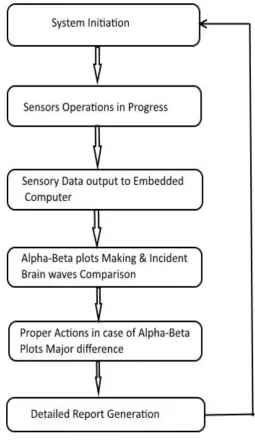
B. Flowchart of the System
Figure 1: Flowchart
II. EXISTING SYSTEM
The existing research includes the straight-forward research by Mashballe (professor) at Japan’s TottoriUniversity whose colleagues proposed a system prototype which monitors brain waves with EEG and targets the vehicle engine to shut it down in case of thefts. The engine wires can be tampered as the connections goes from the outside of the vehicle to the inside of the vehicle. In this paper, the research has been more improved with the shut down triggers located at the fuel motor of the vehicle that hampers the tampering techniques as for a theft it is rather impossible to reach the fuel motor with bare hands and moreover the proper location is not known.
www.ijaera.org 2016, IJA-ERA - All Rights Reserved 241 sensors are embedded on the driver’s seat to allow uninterrupted brain-wave monitoring while the vehicle is idle or in motion.
III. RELATED WORK
Mashable et al. [20] and his colleagues in the graduate school of engineering at Japan's Tottori University proposed a prototype that operates by recording the brain waves of a person on Database so as to provide anti-theft measures. That prototype designed whenever finds a person driving the car does not matches the one on the file the vehicle is shut. This proposal make it even worse for the thieves that rely themselves on various tools to go through the automobiles. But this prototyped has yet to establish in situations where the vehicle is to driven by an unauthorized person thereby overriding or bypassing the system build.
Ford [8] unveiled a driver seat with the inbuilt sensors to detect the heart attack situations as most times the cause of the accident is the heart attack in senior citizens. According to ford, the seat has been embedded with 6 sensors that detects heart rates, and in case of heart attack the steering and the braking systems too are activated to provide the safety from the accidents.
Infiniti [15] proposed another authentication prototype that identifies drivers based on the brain waves being recorded on file. If the waves doesn’t match then the vehicle disables itself. The research is ongoing at japan’s tottori university that uses EEG to capture brain waves.
Jaguar [7], a brand name in automotive industry, is currently working on 'Mind Sense' project that uses brain waves to detect concentration of the driver. Their main concern bring the measurement of driver concentration, Fatigue and stress. Jaguar's land-rover Mind Sense technology is based on driver's concentration being sleepy or drunk. They are currently working on the technology to wake up driver either through the steering wheel vibration or through any kind to sound technology.
M.Sivagnanam [10] presented forward the development of a brain driven car, which would be of great help to the physically disabled people. Since these cars will rely only on what the individual is thinking they will hence not require any physical movement on the part of the individual.
Isao Nakanishi et al. [12] used a simulated driving environment to test the brain waves authentication using the Ps3 console with results on the Gran Turismo 5 Prologue Video Game.
Kennet Fladby [19] in his publication "Brain waves based authentication", suggested that the brain waves can be used as a password just as simple an individual thinking of any password in his mind.
Montaser N. Ramadan et al. [11] proposed an efficient automotive security system that is implemented for anti-theft using an embedded system occupied with a Global Positioning System (GPS) and a Global System of Mobile (GSM). The client interacts through this system with vehicles and determines their current locations and status using Google Earth. The user can track the position of targeted vehicles on Google Earth.
Ming zhang Luo et al. [13] proposed a cost-effective mobile development platform, MTK that support the functions of recording video and sending multimedia message. They proposed an anti-theft monitoring alarm system based on MTK. The design based on a high performance MTK chip of MT6226.The sensors and the alarm device attached to MT6226 through the interface of GPIO. Once one of the sensors detect abnormal signal, MT6226 call the thread of recording video, driving the alarm device.
IV. PROPOSED SYSTEM
www.ijaera.org 2016, IJA-ERA - All Rights Reserved 242 problem in the existing researches remains of bypassing i.e. the theft can still be carried out by tampering up the physical connectivity of wires. To make it more Flawless, the research here adds up certain manipulations that takes up the security to a whole new level minimizing the existing techniques flaws.
The research by Mashable, Isao Nakanishi and his colleagues at the Tottori University gave birth to a new invention in the field of the Anti-theft known Brain waves anti-theft. In this article, a technique is devised to enhance that technique that makes it more users friendly. This criteria embeds every function to work through the Computer embedded in cars. The functionality takes up the fuel pump and instead of wearing EEG electrodes to the scalp the sensors are embedded in driver seat itself. The software part does the alpha-beta plotting thereby performing continued monitoring of the brain waves alongside keeping the side motive of trapping the thief itself that includes the door mechanism sensors. All these mechanisms are connected to the embedded computer with the pre-installed brain waves measuring software that takes the sensory data and operates on it.
BW Monitoring Panel
It discusses a special panel provided alongside the Software embedded technology to provide the owner with the functionality of switching the system to either ON or OFF modes in case they find the security disturbing as it is a very sensitive security protocol that doesn’t even allow the owner in case of mismatches.
The BW Monitoring panel is provided at very beginning phase of system panel. It emphasis onto controlling the monitoring phase but it further requires the provided family code and the particular user accounts. This combines up a two-step authentication and a periodic monitoring at the main phase of the System working.
V. RESULT AND DISCUSSION
The equations for the purpose of measuring the brain waves of the driver for a particular vehicle can be depicted using the Hilbert Transform derived by studying of brain waves by Hilbert himself. Its transform evaluates the real and imaginary parts. To measure the brain waves using MATLAB, the equation needs to be modified so that it supports Hilbert’s Transform.Chuck Anderson and Zach’s EEG signals provide the equations that can be derived as follows:
Suppose the function f(t) consists of several sine waves that are added together, we get:
f(t) = a1 sin(1⋅2πt) + a2 sin(2⋅2πt)+………+ ansin(n⋅2πt)
Suppose we know f(t) over some interval, say [0,1], and we want to find aj. Before we use this function,
we need to calculate the value of a certain integral. For integers h and k, with h≠k,
= ∫ sin(h .2πt ) sin (k. 2πt)dt01 [Trigonometric identity (substitution)]
We get, =∫ 1
2[cos((ℎ − 𝑘) . 2𝜋𝑡) − cos(ℎ + 𝑘) . 2𝜋𝑡]𝑑𝑡 1
0 [Integral of cosine is sine]
Evaluate from 0 to 1
=2(h−k)2πt1 sin(ℎ − 𝑘). 2𝜋𝑡 −2(ℎ+𝑘)2𝜋1 sin(ℎ + 𝑘) . 2𝜋𝑡⃒ 𝑡 = 0 to 1
=0
If instead h=k,
∫ sin (h .2πt)1 2
0 dt= ∫
1
2(1 − cos (2ℎ .2𝜋𝑡))𝑑𝑡 1
www.ijaera.org 2016, IJA-ERA - All Rights Reserved 243 = 𝑥2−2ℎ.2𝜋1 sin(2ℎ. 2𝜋)⃒ 𝑡 = 0 𝑡𝑜 1
= ½
Now we wish to find the coefficients of f(t). If we multiply f(t) by sin(j⋅2πt) and integrate, we get:
∫ 𝑓(𝑡)sin (𝑗. 2𝜋𝑡)𝑑𝑡 1
0
= ∫ (𝑎1. 𝑠𝑖𝑛(1 ⋅ 2𝜋𝑡)𝑠𝑖𝑛(𝑗 ⋅ 2𝜋𝑡) + ⋯ + 𝑎𝑗𝑠𝑖𝑛(𝑗 ⋅ 2𝜋𝑡)𝑠𝑖𝑛(𝑗 ⋅ 2𝜋𝑡) +01
⋯ + 𝑎𝑛. 𝑠𝑖𝑛(𝑛2𝜋𝑡)𝑠𝑖𝑛(𝑗 ⋅ 2𝜋𝑡))𝑑𝑡
(𝑡ℎ𝑒 𝑖𝑛𝑡𝑒𝑔𝑟𝑎𝑙 𝑜𝑓 𝑎 𝑠𝑢𝑚 𝑖𝑠 𝑡ℎ𝑒 𝑠𝑢𝑚 𝑜𝑓 𝑖𝑛𝑡𝑒𝑔𝑟𝑎𝑙𝑠) = 0+⋯+aj/2+⋯+0
(all integrals are zero except for the jth integral by the above equations)
= aj/2
Then equating the first and last lines, we have a formula for recovering aj:
aj=2 . ∫ 𝑓(𝑡)𝑠𝑖𝑛(𝑗 ⋅ 2𝜋𝑡)𝑑𝑡01
This derivation is valid for as large of n as we want. The most general application is infinite series of sine waves.
Additionally, we can do the same thing with sums of cosines.
If f=b1 cos(1⋅2πt)+b2 cos(2⋅2πt)+⋯ , then we can recover the coefficients in the same way:
bj=2. ∫ 𝑓(𝑡)𝑐𝑜𝑠(𝑗 ⋅ 2𝜋𝑡)𝑑𝑡01
And if we have a function that is a mix of the two, such as
f=sin(2πt)+sin(2⋅2πt)+⋯+cos(2πt)+cos(2⋅2πt)+⋯
Finally, by processing the above equation more times, we get: y=sin (6*2πt) + sin (2πt) + 2*sin(exp(t/1.5));
Applying Hilbert’s Transform
We get the analytic behavior of brainwaves
hilbert(y);
y=sin(6*2*pi*t)+sin(freqa*2*pi*t)+2*sin(exp(t/1.5));
hilbert(y);
Where ‘freqa’ represents the brainwave frequency of the rider.
s=sin(6*2*pi*t)+sin(freqb(index)*2*pi*t)+2*sin(exp(t/1.5));
hilbert(s);
www.ijaera.org 2016, IJA-ERA - All Rights Reserved 244 Fig.2 Different Brain Waves Plots (L.H.S) & Their Difference (R.H.S)
VI. OBJECTIVES OF BATS
1. To ensure capability against certain wear and tear.
2. To provide security against unmatched criteria’s.
3. To enable total security rather than a module or two.
4. To provide efficient and Time responsive working in certain cases.
5. To ensure the accuracy of software that depends on the sensory working.
6. To highlight new paths in the future techs of the underlying area.
VII. CONCLUSION
The functionality talks about the Sensor based approach that can be enhanced to take up the full control of the vehicle; moreover the system itself can be made portable allowing the owner to carry on with the key chains that include the software key functions. The system itself can be provided within a software package comprising different functionalities added to the user control.
ACKNOWLEDGMENT
We would like to place on record our deep sense of gratitude to Associate Professor Dr. Rohit Bajaj for his valuable suggestions to improve the review. I am also thankful to Dr. Jagpreet Sidhu, who motivated us throughout the process and made the resources available at the right time.
Conflict of Interest: The Authors declare that they have no conflict of interest.
Ethical Statement: The Authors declare that they have followed ethical responsibilities.
REFERENCES
[1] S Marcel and J R Millan. Pearson Authentication Using Brainwaves (EEG) and Maximum A Posteriori Model Adaption. (2007) IEEE Trans. on Pattern Analysis and Machine Intelligence, 29(pp.743–748).IEEE [2] I Nakanishi, S Baba, and C Miyamoto. (2009) EEG Based Biometric Authentication Using New Spectral Features. In Proc. of IEEE International Symposium on Intelligent Signal Processing and Communication Systems, pages 651–654.IEEE
www.ijaera.org 2016, IJA-ERA - All Rights Reserved 245 [4] M Poulos, M Rangoussi, V Chissikopoulus, and A Evangelou.(1999) Parametric Person Identification
from the EEG Using Computational Geometry.In Proc. of the 6th IEEE International Conference on Electronics, Circuits and Systems, (pp 1005–1008).IEEE
[5] Lv, X., & Wang, Z. J. (2009). ”Hashing the mAR coefficients from EEG data for person authentication.” Acoustics, Speech and Signal Processing, 2009.ICASSP 2009. IEEE International Conference on, (pp. 1445-1448).IEEE
[6] Sutter (1992) “The brain response interface communication through visually-induced electrical brain responses” E.E., Journal of Microcomputer Applications, (pp: 31-45).
[7] JAGUAR (2014) 'Mind Sense' project for detecting concentration of the driver.
[8] Ford motorsport (2014) “Heart-rate monitor driver seat”, report published in ‘Financial times‘, 2014. [9] G Kwang, R H C Yap, T Sim, and R Ramnath (2009.), Usability Study of Continuous Biometrics
Authentication, Lecture Notes in Computer Science. Springer- Verlag, Berlin, Germany, Vol No.5558. [10] M. Sivagnanam(2010)"Brain Controlled Car For Disabled Using Artificial Intelligence".
[11] Montaser N. Ramadan, Mohammad A. Khedher, Senior Member, IACSIT and Sharaf A. Al-Kheder.(2002)"Intelligent Anti-Theft and Tracking System for Automobiles",
[12] Isao Nakanishi, Koutaro Ozaki and ShigangLi(2014)"Evaluation of the Brain Wave as Biometrics in a Simulated Driving Environment".
[13] Mingzhang Luo, Junmin Wang, Mingyun Zhang, Hongli Wang(2012),"The Research and Implementation of Anti-theft Monitoring Alarm System Based on MTK",
[14] Ajay B. Gadicha, Vijay. B. Gadicha, A.S.Alvi (2012), "Brain Controlled Car for Disabled Using Artificial Intelligence"
[15] Infiniti (2015) “Driver Authentication prototype”.
[16] Palaniappan, R. (2008). “Two-stage biometric authentication method using thought activity brain waves.” International Journal of Neural Systems, Vol. No.18 (01), (pp. 59-66).
[17] R B Paranjape, J Mahovsky, L Benedicent, and Z Koles (2001), “The Electroencephalogram as a Biometric”. In Proc. of 2001 Canadian Conference on Electrical and Computer Engineering, volume 2, (pp.1363–1366).
[18] R Palaniappan.(2005)“Identifying Individuality Using Mental Task Based Brain Computer Interface”, in Proc. of the 3rd International Conference on Intelligent Sensing and Information Processing, (pp.239–242). [19] Kennet Fladby, (2008)."Brain waves based authentication",
[20] Tottori et al. (2013), “Using brain waves as a transparent biometrics for on-demand driver authentication” Int. J. Biometrics, 5, 288-305.