Original Research Article
Medical students and the National Medical Commission bill:
negativity and misinformation combine
Liaquat R. Johnson
1*, Junaida Sulfy
2, Lishana Shajahan
2, Manirsha P. Vayalil
2,
Ananthan A. S. Mangalathumannil
2, Masoodha M. Palli Thodi
2INTRODUCTION
The National Medical Commission bill (NMC bill) was drafted in response to numerous concerns regarding the status of medical education and health care in India.1-15 It seeks to improve the standards of medical training, as well as address inequities in availability of trained healthcare professionals within the country.16,17 Despite its reformist intentions, the NMC bill has been the subject of several protests by medical students and doctors across
the country, with the Indian Medical Association (IMA) leading the offensive.18-24
Despite the outrage, medical students seemed unfamiliar with actual content of the NMC bill. Therefore, we wanted to determine 1. The knowledge of, and attitude towards the NMC bill; 2. The factors influencing knowledge and attitude of medical students regarding the NMC bill.
ABSTRACT
Background: The National Medical Commission bill (NMC bill) was drafted in response to concerns regarding medical education and healthcare in India. It seeks to reform medical education in India. However, a storm of protests by medical students and doctors erupted after it was tabled in parliament. This study was conducted to determine medical students‟ knowledge of, and attitude towards the NMC bill.
Methods: This cross-sectional study was conducted among medical students in a private medical college in south India. A tool based on each section of the NMC bill was developed to assess knowledge. Attitude was assessed using a 5-point Likert scale. Separate knowledge and attitude scores were computed. Statistical analyses were performed using EZR (version 1.36). Descriptive statistics, Chi-square test, logistic regression analyses were performed. Results: Only 74 (31.49%) had adequate knowledge of the NMC bill. The major source of information regarding the NMC Bill was social media (191; 81.28%), followed by newspapers (107; 45.53%). Those who were aware of the amendments to the bill; and who received information about the bill from newspapers were significantly more likely to have adequate knowledge. Participation in IMA protest rally was significantly associated with negative attitude; belonging to main (regular) batch was significantly associated with positive attitude towards the bill. Superior knowledge was not associated with positive attitude towards the bill.
Conclusions: Medical students lack knowledge about the NMC bill, but have strong negative attitude towards it. Negative attitude is significantly associated with participation in IMA protest rally against NMC bill.
Keywords: Medical students, National medical commission bill, Protest, Knowledge, Attitude
1
Department of Community Medicine, Azeezia Institute of Medical Sciences and Research, Kollam, Kerala, India
2
Azeezia Institute of Medical Sciences and Research, Kollam, Kerala, India
Received: 17 September 2018 Accepted: 05 October 2018
*Correspondence: Dr. Liaquat R. Johnson, E-mail: [email protected]
Copyright: © the author(s), publisher and licensee Medip Academy. This is an open-access article distributed under the terms of the Creative Commons Attribution Non-Commercial License, which permits unrestricted non-commercial use, distribution, and reproduction in any medium, provided the original work is properly cited.
METHODS
This cross-sectional study was conducted among 235 consenting medical students and interns of a private medical college in Kerala from April 2018 to May 2018, after obtaining permission from the Head of the department. The study was conducted using an anonymous, semi-structured questionnaire based on the NMC bill that included basic socio-demographic variables, and included questions from each section of the Bill as introduced in parliament, and the amendments introduced later.16,25 In addition, respondents were asked if they were members of the Indian Medical Association Medical Student Network (IMA-MSN); and if they had participated in a protest rally organised by Indian Medical Association (IMA).20
Sample size calculation was performed using the formula n=4pq/l2 where p: prevalence; q: (100-p); and l: 20% of p. We hypothesized that only 30% of respondents would have adequate knowledge regarding the NMC bill.This yielded a sample size of 233, which was rounded up to 235. We employed stratified random sampling (with each year of study taken as a stratum), and systematic random sampling within each stratum. First MBBS students were excluded from the study as they were undergoing internal examination at the time.
Data were entered in Microsoft Office Excel 2013, and analysed using EZR (version 1.37).26-28 In addition to
descriptive statistics, independent samples t- test, chi-square test and logistic regression analyses were performed. Statistical significance was set at the 5% level.
RESULTS
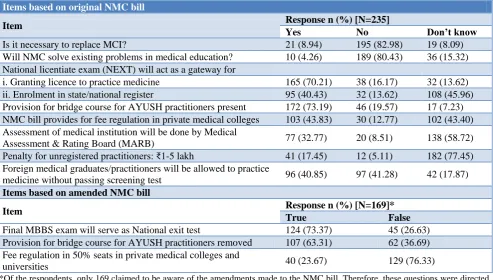
Of the respondents, 85 (36.2%) were male, while 150 (63.8%) were female. Main batch students (156; 66.4%) outnumbered those from supplementary batches (76; 33.6%). Almost equal proportion of respondents had secured admission through merit (118; 50.2%) and management (117; 49.8%) quota. There were 51 (21.7%); 46 (19.6%); 69 (29.4%); and 69 (29.4%) respondents from II MBBS, Final MBBS part 1, Final MBBS part 2, and internship respectively. Although 188 (80%) of respondents were not members of IMA-MSN, 122 (51.9%) had participated in the protest rally organised by IMA. Responses to items in questionnaire are presented in Table 1.
Respondents were asked why/ why not it was necessary to replace MCI, depending upon their response to the main question. Of the 21 who stated that it was necessary to replace MCI, 19 (90.47%) claimed that MCI had failed to improve standards and quality of medical education. In contrast, 187 (95.9%) of those who stated that it was not necessary to replace MCI, claimed that there is no problem with the functioning of MCI.
Table 1: Responses to knowledge questions based on original and amended NMC bill.
Items based on original NMC bill
Item Response n (%) [N=235]
Yes No Don’t know
Is it necessary to replace MCI? 21 (8.94) 195 (82.98) 19 (8.09)
Will NMC solve existing problems in medical education? 10 (4.26) 189 (80.43) 36 (15.32)
National licentiate exam (NEXT) will act as a gateway for
i. Granting licence to practice medicine 165 (70.21) 38 (16.17) 32 (13.62)
ii. Enrolment in state/national register 95 (40.43) 32 (13.62) 108 (45.96)
Provision for bridge course for AYUSH practitioners present 172 (73.19) 46 (19.57) 17 (7.23)
NMC bill provides for fee regulation in private medical colleges 103 (43.83) 30 (12.77) 102 (43.40)
Assessment of medical institution will be done by Medical
Assessment & Rating Board (MARB) 77 (32.77) 20 (8.51) 138 (58.72)
Penalty for unregistered practitioners: ₹1-5 lakh 41 (17.45) 12 (5.11) 182 (77.45)
Foreign medical graduates/practitioners will be allowed to practice
medicine without passing screening test 96 (40.85) 97 (41.28) 42 (17.87)
Items based on amended NMC bill
Item Response n (%) [N=169]*
True False
Final MBBS exam will serve as National exit test 124 (73.37) 45 (26.63)
Provision for bridge course for AYUSH practitioners removed 107 (63.31) 62 (36.69)
Fee regulation in 50% seats in private medical colleges and
universities 40 (23.67) 129 (76.33)
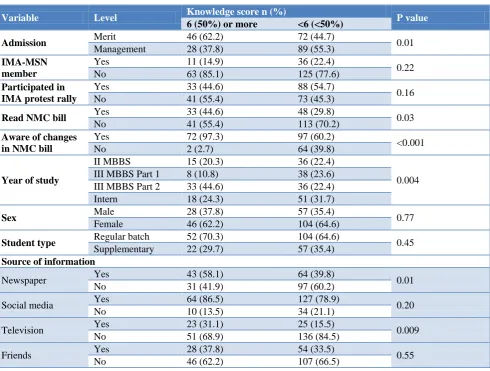
Table 2: Chi-square test results of knowledge with selected factors.
Variable Level Knowledge score n (%) P value
6 (50%) or more <6 (<50%)
Admission Merit 46 (62.2) 72 (44.7) 0.01
Management 28 (37.8) 89 (55.3)
IMA-MSN member
Yes 11 (14.9) 36 (22.4)
0.22
No 63 (85.1) 125 (77.6)
Participated in IMA protest rally
Yes 33 (44.6) 88 (54.7)
0.16
No 41 (55.4) 73 (45.3)
Read NMC bill Yes 33 (44.6) 48 (29.8) 0.03
No 41 (55.4) 113 (70.2)
Aware of changes in NMC bill
Yes 72 (97.3) 97 (60.2)
<0.001
No 2 (2.7) 64 (39.8)
Year of study
II MBBS 15 (20.3) 36 (22.4)
0.004
III MBBS Part 1 8 (10.8) 38 (23.6)
III MBBS Part 2 33 (44.6) 36 (22.4)
Intern 18 (24.3) 51 (31.7)
Sex Male 28 (37.8) 57 (35.4) 0.77
Female 46 (62.2) 104 (64.6)
Student type Regular batch 52 (70.3) 104 (64.6) 0.45
Supplementary 22 (29.7) 57 (35.4)
Source of information
Newspaper Yes 43 (58.1) 64 (39.8) 0.01
No 31 (41.9) 97 (60.2)
Social media Yes 64 (86.5) 127 (78.9) 0.20
No 10 (13.5) 34 (21.1)
Television Yes 23 (31.1) 25 (15.5) 0.009
No 51 (68.9) 136 (84.5)
Friends Yes 28 (37.8) 54 (33.5) 0.55
No 46 (62.2) 107 (66.5)
Table 3: Responses to attitude questions regarding the NMC bill.
Item
Response n (%)
Strongly
disagree Disagree Neutral Agree
Strongly agree NMC favours private medical colleges 12 (5.11) 42 (17.87) 94 (40) 58 (24.68) 29 (12.34) NMC will provide high quality, high standard
in medical education 73 (31.06) 86 (36.60) 52 (22.13) 24 (10.21) 0 (0) Exit exam will ensure minimum standard in
all medical graduates regardless of institution 59 (25.21) 74 (31.62) 60 (25.64) 24 (10.26) 17 (7.26) Provision of bridge course for AYUSH will
fill gaps in availability of trained healthcare personnel in rural areas
132 (56.17) 63 (26.81) 28 (11.91) 9 (3.83) 3 (1.28)
Licentiate exam would serve as screening test for doctors with foreign medical
qualifications
31 (13.19) 48 (20.43) 70 (29.79) 66 (28.09) 20 (8.51)
Those who responded in the affirmative to the question whether NMC provides for fee regulation in private medical colleges were asked the extent of such regulation. Of the 103 who agreed that there was provision for fee regulation, 29 (27.36%) stated that fee regulation extended to 60% of seats; 6 (5.66%) stated that it was unregulated; while 71 (66.98%) didn‟t know the exact details.
Of the 235 respondents, 169 (71.91%) claimed that they were aware of amendments made to the NMC bill. These respondents were asked three additional questions regarding the amendments. A knowledge score was computed based on the responses to the twelve knowledge questions, with each correct response awarded one point, and incorrect responses scored zero. A score of 6/12 (50%) was considered adequate knowledge, and was
achieved by 74 (31.49%) of respondents. The average knowledge score (Mean (SD)) was 4.64 (2.0), with a median of 4. Knowledge score was transformed into a binary variable with a score of 6 (50%) taken as the threshold. Only 74 (31.49%) had an adequate knowledge score of 6 (50%) or more. The results of bivariate analyses with the binary knowledge score as the dependent variable are presented in Table 2.
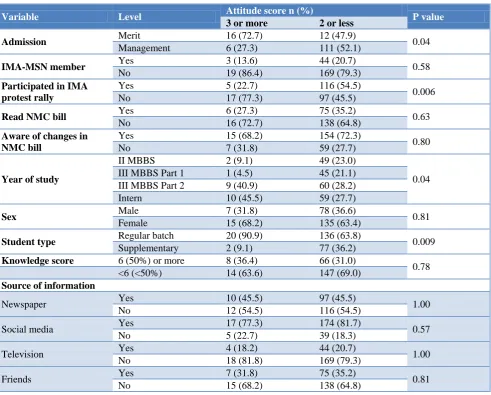
Table 4: Chi-square test results of attitude towards NMC bill with selected factors.
Variable Level Attitude score n (%) P value
3 or more 2 or less
Admission Merit 16 (72.7) 12 (47.9) 0.04
Management 6 (27.3) 111 (52.1)
IMA-MSN member Yes 3 (13.6) 44 (20.7) 0.58
No 19 (86.4) 169 (79.3)
Participated in IMA protest rally
Yes 5 (22.7) 116 (54.5)
0.006
No 17 (77.3) 97 (45.5)
Read NMC bill Yes 6 (27.3) 75 (35.2) 0.63
No 16 (72.7) 138 (64.8)
Aware of changes in NMC bill
Yes 15 (68.2) 154 (72.3)
0.80
No 7 (31.8) 59 (27.7)
Year of study
II MBBS 2 (9.1) 49 (23.0)
0.04
III MBBS Part 1 1 (4.5) 45 (21.1)
III MBBS Part 2 9 (40.9) 60 (28.2)
Intern 10 (45.5) 59 (27.7)
Sex Male 7 (31.8) 78 (36.6) 0.81
Female 15 (68.2) 135 (63.4)
Student type Regular batch 20 (90.9) 136 (63.8) 0.009
Supplementary 2 (9.1) 77 (36.2)
Knowledge score 6 (50%) or more 8 (36.4) 66 (31.0)
0.78
<6 (<50%) 14 (63.6) 147 (69.0)
Source of information
Newspaper Yes 10 (45.5) 97 (45.5) 1.00
No 12 (54.5) 116 (54.5)
Social media Yes 17 (77.3) 174 (81.7) 0.57
No 5 (22.7) 39 (18.3)
Television Yes 4 (18.2) 44 (20.7) 1.00
No 18 (81.8) 169 (79.3)
Friends Yes 7 (31.8) 75 (35.2) 0.81
No 15 (68.2) 138 (64.8)
Multiple logistic regression analysis was performed using the statistically significant factors identified from bivariate analyses as independent variables, and the transformed knowledge score as binary dependent variable. Those who were aware of new changes in the NMC bill (OR: 25.9, 95% CI: 5.9-112.0, p<0.0001); and received information about NMC bill from newspapers (OR: 1.9, 95% CI: 1.01-3.61, p=0.046) were significantly likely to have adequate knowledge about the same.
Since a substantial proportion of respondents were unaware of the new changes, we analysed knowledge by computing a knowledge score that was limited to items from the original NMC bill as well. Keeping a score of 5
A 5-point Likert scale was used to assess attitudes towards NMC bill, with scale items ranging from strongly disagree through strongly agree. Responses to attitude questions are presented in Table 3. The responses to attitude questions were transformed to an attitude score, wherein responses in support of the NMC bill were scored higher. For instance, the item stating that NMC bill favours private medical colleges was scored as: any disagree (1); others (0). The scores for individual items were added to create a composite attitude score having minimum value of zero, and maximum value of five. The score was further transformed to create a binary variable, taking three as the threshold. Only 22 (9.36%) of the respondents had a favourable attitude (attitude score of 3 or more) towards the NMC bill. Results of bivariate analyses with the binary attitude score as dependent variable are presented in Table 4.
Multiple logistic regression with the transformed binary attitude score as dependent variable, and statistically significant variables from bivariate analyses as independent variables was performed. Those who participated in the IMA protest rally (OR: 0.28, 95% CI: 0.09-0.79, p=0.017) were significantly likely to have a negative attitude towards the NMC bill. However, respondents belonging to main (regular) batches (OR: 4.83, 95% CI: 1.09-21.50, p=0.038) were significantly likely to have a favourable attitude towards the bill.
DISCUSSION
In this study, only 21(8.94%) of respondents felt that it was necessary to replace the MCI, while 195(82.98%) did not believe it was necessary to do so. This sentiment is more likely a reflection of their unfamiliarity with the concerns and controversies involving the MCI, than a studied opinion.12 Within the medical education and healthcare paradigms, medical students constitute beneficiaries of the system. They do not have to engage with the MCI while in that capacity. The administrative and policy issues stemming from decisions of the MCI mostly impact teaching faculty and administrators of medical institutions. Therefore, medical students are largely insulated from the MCI and its actions. Similarly, medical students are not concerned with policy matters at the national and state level, and are not obliged to be familiar with the condition of medical education in the national or international context.
Our findings are consistent with the initial assumption regarding medical students‟ knowledge of the NMC Bill- adequate knowledge was 31.49%, while our estimate was that the same would be 30%. Surprisingly, members of IMA Medical Students Network (IMA-MSN) and those who participated in the protest rally, both had low awareness of NMC bill (14.9% and 44.6% respectively). Since the IMA-MSN was instrumental in organising students‟ protest rallies, we expected members to have superior knowledge about the NMC Bill than others. Similarly, we assumed that those who participated in the
protest rally were doing so after fully understanding the Bill.
Considering that the bill will potentially transform medical education in India, medical students are expected to be familiar with all provisions of the bill. Their ignorance is both baffling and disturbing, since medical students were the most visible stakeholders protesting provisions of the bill.20 In this context, it is interesting to note that only 34.47% of the respondents had read any part of the actual bill document, with a mere 8.75% having read the bill in its entirety. With 81.28% of respondents obtaining information about the bill from social media, it seems to be responsible for their misinformation (those who sourced their information from newspapers and television were significantly likely to have adequate knowledge about the bill on bivariate analyses). This may be explained by the need for newspapers and television channels to present verified facts, while social media networks are devoid of any such requirement. The ease of propagation of social media
messages facilitates widespread dissemination of
misinformation, and can easily drown the limited fact based reports on any topic.29 Moreover, such (fake) messages tend to be transmitted with significantly higher frequency compared to legitimate messages, and gain credibility over time.30-32 Nevertheless, one expects that medical students would be less susceptible to such „misinformation networks‟, given the unrestricted access to the bill document online, as well as motivation to know the facts.33 That such fact-checking was not performed in a matter that directly affects them, exposes their vulnerability to fake medical news pertaining to more mundane aspects of medical practice.
Unsurprisingly, the general attitude towards the NMC Bill was negative. However, the negativity was influenced by whether the respondent had participated in the IMA protest rally or not. Those who participated in the rally were significantly more likely to have a negative attitude towards the bill. We expected those who had good knowledge about the bill to have generally positive attitudes towards the same. However, only 8(10.8%) of those who had adequate knowledge about the bill also had a positive attitude towards it. Perhaps this is on account of the unrelenting negative coverage/ messages that followed the tabling of the bill in parliament. Since there were few countervailing voices, the dominant (negative) messages gained credence and acceptance.34-36 Later, although the government issued clarifications, it was insufficient to persuade those who had already decided that the dominant narrative was true.37,38 This is consistent with past events wherein factual clarifications by key authorities failed to change popular opinion regarding the veracity of fake news.39
anything else. It is quite natural for academically weaker students to experience greater anxiety about the bill, given its intention to improve standards. This makes them more likely to accept misinformation, and is probably independent of awareness regarding the bill.40
To our knowledge, this is the first study to investigate the knowledge and attitude of medical students towards the NMC bill. Therefore, the study is limited by the absence of a validated tool, and other studies for comparison. However, the content validity of the tool might partially compensate for the absence of a validated tool with known psychometric properties.
CONCLUSION
Medical students are lacking in adequate knowledge of the NMC bill, yet have significantly negative attitudes towards the same. Knowledge of NMC bill is significantly influenced by awareness of the recent changes; and receiving information about the bill from newspapers. Negative attitude towards the bill is significantly associated with participation in IMA protest rally; while positive attitude is associated with belonging to regular (main) batches.
We recommend that similar studies be conducted in other medical colleges to determine if our findings are indicative of a general pattern, or a local phenomenon.
ACKNOWLEDGEMENTS
The authors wish to thank the students who participated in this study.
Funding: No funding sources Conflict of interest: None declared
Ethical approval: The study was approved by the Institutional Ethics Committee
REFERENCES
1. Kothari R. Medical education in India: A need to think differently. Natl Med J India. 2012;25(2):99– 100.
2. Anjali S, Sanjay Z, Bipin B. India‟s foreign medical
graduates: an opportunity to correct India‟s physician shortage. Educ Heal. 2016;29(1):42. 3. Talwar K, Grover A, Thakur J. Role of Medical
Education in Preventing and Control of
Noncommunicable Diseases in India? Indian J Community Med. 2011;36(5):63.
4. Jayakrishnan T, Honhar M, Jolly GP, Abraham J, Jayakrishnan T. Medical Education in India: Time to make some changes. Natl Med J India. 2012;25(3):164–7.
5. Dasgupta S. Reforms in medical education:
Optimizing quantity and quality. Indian J Public Health. 2014;58(1):1.
6. Das J, Holla A, Das V, Mohanan M, Tabak D, Chan
B. In Urban And Rural India, A Standardized Patient Study Showed Low Levels Of Provider Training And Huge Quality Gaps. Health Aff. 2012;31(12):2774–84.
7. Deo MG. Doctor population ratio for India - the reality. Indian J Med Res. 2013;137(4):632–5.
8. NITI aayog. A Preliminary Report of the Committee
on the Reform of the Indian Medical Council Act, 1956. 2016.
9. Ananthakrishnan N. Medical Education in India: Is it still possible to reverse the downhill trend? Natl Med J India. 2010;23(3):156–60.
10. Sood R, Adkoli BV. Medical Education in India- Problems and Prospects. Journal, Indian Acad Clin Med. 2000;1(3):210–2.
11. Diwan V, Minj C, Chhari N, De Costa A. Indian medical students in public and private sector medical schools: are motivations and career aspirations different? -- studies from Madhya Pradesh, India. BMC Med Educ. 2013;13(1):127.
12. Ananthakrishnan N, Shanthi AK. Attempts at
regulation of medical education by the MCI: issues of unethical and dubious practices for compliance by medical colleges and some possible solutions. Indian J Med Ethics. 2012;(1):1–8.
13. Deswal B, Singhal V. Problems of medical
education in India. Int J Community Med Public Heal. 2016;3(7):1905–9.
14. Rao M, Rao KD, Kumar AS, Chatterjee M,
Sundararaman T. Human resources for health in India. Lancet. 2011;377(9765):587–98.
15. Majumdar MAA, D‟Souza U, Rahman S. Trends in
medical education : challenges and directions for need-based reforms of medical training in south-east asia. Indian J Med Sci. 2004;58(9):369–80.
16. Ministry of Health and Family Welfare G of I. The
national medical commission bill, 2017. Lok Sabha; 2017.
17. Rao N. Bill Summary: The National Medical
Commission Bill, 2017. New Delhi; 2018.
18. Tribune News Service. IMA members hold protest over NMC Bill. The Tribune. 2018. Available at: https://www.tribuneindia.com/news/amritsar/ima-members-hold-protest-over-nmc-bill/628412.html. Accessed on 3 July 2018.
19. PTI. IMA opposes draft National Medical
Commission Bill, says it will „ cripple ‟ profession.
The Indian Express. 2017. Available at:
https://indianexpress.com/article/india/ima-opposes- draft-national-medical-commission-bill-says-it-will-cripple-profession-4986500/ Accessed on 3 July 2018.
20. Anand A. IMA calls 3 Lakh medical students for Indefinite Strike against NMC Bill. careers360.com. 2018. Available at: https://news.careers360.com/ ima-calls-3-lakh-medical-students-indefinite-strike-against-nmc-bill. Accessed on 3 July 2018.
21. Ray K. IMA steps up fight against not-in-sync NMC
https://www.deccanherald.com/national/ima-steps-fight-against-not-684386.html
22. ANI. IMA‟s battle against National Medical
Council Bill. ANI News. 2018; Available at: https://www.aninews.in/news/health/imas-battle-against-national-medical-council-bill2018 03101522550002/. Accessed on 3 July 2018. 23. Statesman News Service. IMA meet on Sunday to
spread public awareness on NMC Bill „ risks.‟ The Statesman. 2018. Available at: https://www. thestatesman.com/cities/ima-meet-on-saunday-to- spread-public-awareness-on-nmc-bill-risks-1502607778.html Accessed on 25 March 2018.
24. Yasmeen A. Medical body opposes NMC Bill. The
Hindu. 2018. Available at: https://www.thehindu. com/news/national/medical-body-opposes-nmc- bill/article22597929.ece Accessed on 31 January 2018.
25. Press Information Bureau G of I. Cabinet approves certain official amendments to the National Medical Commission (NMC) Bill. New Delhi; 2018: 1–2. 26. Kanda Y. Investigation of the freely available
easy-to-use software „EZR‟ for medical statistics. Bone Marrow Transplant. 2013;48(3):452–8.
27. Johnson LR, Karunakaran UD. How to Choose the Appropriate Statistical Test Using the Free Program “Statistics Open For All” (SOFA). Ann Community Heal. 2014;2(2):54–62.
28. Johnson LR, Karunakaran UD. How to Perform
Data Analysis Using the Free Software EZR. Part 1 : Single Continuous Dependent Variable. Ann Community Heal. 2014;3(2):22–5.
29. Lazer DMJ, Baum MA, Benkler Y, Berinsky AJ,
Greenhill KM, Menczer F, et al. The science of fake news. Science. 2018;359(6380):1094–6.
30. Shin J, Jian L, Driscoll K, Bar F. The diffusion of misinformation on social media: Temporal pattern, message, and source. Comput Human Behav. 2018;83:278–87.
31. Bessi A. On the statistical properties of viral misinformation in online social media. Phys A Stat Mech its Appl. 2017;469:459–70.
32. Figueira Á, Oliveira L. The current state of fake news: challenges and opportunities. Procedia Comput Sci. 2017;121:817–25.
33. Marcon AR, Murdoch B, Caulfield T. Fake news
portrayals of stem cells and stem cell research. Regen Med. 2017;12(7):765–75.
34. Jagannathan. Why The Doctors Fulminating Against
NMC Bill Are Wrong And Merely Protecting Their
Turf. Swarajya. 2018. Available at:
https://swarajyamag.com/ideas/why-the-doctors- fulminating-against-nmc-bill-are-wrong-and-merely-protecting-their-turf Accessed on 3 January 2018.
35. Johnson LR. Understanding the National Medical
Commission Bill 2017 (India) Part 1: Bridge Course. 2018. Available at: https://community medicine4asses.com/2018/01/05/understanding-the- national-medical-commission-bill-2017-india-part-1-bridge-course/. Accessed on 3 July 2018.
36. Johnson LR. Understanding the National Medical
Commission Bill 2017 Part 2: National Licentiate Examination (aka ‟NEXT‟). 2018. Available at: https://communitymedicine4asses.com/2018/01/14/ understanding-the-national-medical-commission- bill-2017-part-2-national-licentiate-examination-aka-next/ Accessed on 3 July 2018.
37. Ministry of Health and Family Welfare G of I. FAQs on NMC Bill. New Delhi: Ministry of Health and Family Welfare, Government of India; 2017: 1– 8.
38. Horne BD, Adali S. This Just In: Fake News Packs a
Lot in Title, Uses Simpler, Repetitive Content in Text Body, More Similar to Satire than Real News. arXiv. 2017.
39. Spinney L. How Facebook, fake news and friends are warping your memory. Nature. 2017 Mar
7;543(7644):168–70. Available at:
http://www.nature.com/doifinder/10.1038/543168a
40. De keersmaecker J, Roets A. „Fake news‟: Incorrect,
but hard to correct. The role of cognitive ability on the impact of false information on social impressions. Intelligence. 2017;65(9):107–10.
Cite this article as: Johnson LR, Sulfy J, Shajahan L, Vayalil MP, Mangalathumannil AAS, Thodi MMP. Medical students and the National Medical