Available online:
http://edupediapublications.org/journals/index.php/IJR/
P a g e | 580A New Collaborative Approach for Consignment Balancing in
Wireless Sensor Networks via Mu-Mimo
1 J. Ravali, 2 A. Geetha Vani1M.Tech Dept of CSE, PVKK College, Affiliated to JNTUA, AP, India .
2Associate Professor, Dept of CSE, PVKK College, Affiliated to JNTUA, AP, India
Abstract— A three-layer framewo rk is proposed for mobile data collection in wireless sensor networks, wh ich includes the sensor layer, cluster head layer, and mobile collector (called Sensor) layer. The framework employs distributed load balanced clustering and dual data uploading, which is referred to as LBC-DDU. The objective is to achieve good scalability, long network lifetime and low data collection latency. At the sensor layer, a distributed load balanced clustering (LBC) algorithm is proposed for sensors to self-organize themselves into clusters. In contrast to existing clustering methods, our scheme generates mu ltiple cluster heads in each cluster to balance the work load and facilitate dual data uploading. At the cluster head layer, the inter-cluster transmission range is carefully chosen to guarantee the connectivity among the clusters. Multiple cluster heads within a cluster cooperate with each other to perform energy-saving inter- cluster communications. Through inter-cluster transmissions, cluster head information is forwarded to Sensor for its moving trajectory planning. At the mobile collector layer, Sensor is equipped with two antennas, which enables two cluster heads to simu ltaneously upload data to Sensor in each time by utilizing mu lti-user multiple-input and multip le-output (MU-MIMO) technique.
Key Words: Load balanced clustering algorithm, Data collection, Mobility, Dual antenna.
I. INTRODUCTION
Proliferation of the implementation for low-cost,low-power, mu ltifunctional sensors has made wireless sensor networks, a major data collection model for extracting local measures of benefit. sensors are generally densely deployed and randomly scattered over a sensing field and left unattended after beingdeployed, which makes it difficult to recharge or replace their batteries. After sensorsform in to autonomous organizations, those sensors near the data sink typically
deplete their batteries much faster than others due to more relaying traffic. When sensorsaround the data sink exhaust their energy, network connectivity and coverage may not be guaranteed. as sensing data in some applications are time-sensitive, data collection may be required to be performed within a specified time frame. Therefore, an efficient, large-scale data collection scheme should aim at good scalability, long network lifetime and low data latency. Several approaches have been proposed for efficient data collection in the literature. The first category is the enhanced relay routing in wh ich data are relayed among sensors. Besides relaying, some other factors, such as load balance, schedule pattern and data redundancy, are also considered. The second category organizes sensors into clusters and allows cluster heads to take the responsibility for forward ing data to the data sink Clustering is particu larly useful for applications with scalab ility requirement and is very effective in local data aggregation since it can reduce the collisions and balance load among sensors.
Available online:
http://edupediapublications.org/journals/index.php/IJR/
P a g e | 581dual data uploading between multiple cluster heads and the mobile co llector. Second, multiple cluster heads within a cluster can collaborate with each other to perform energy efficient inter-cluster transmissions. a mobilecollector with two antennas (called SenCar in this paper) to allow concurrent uploading from two cluster heads by using MU-MIMO co mmunication. The Sen Car collects data from the cluster heads by visiting each cluster. It chooses the stop locations inside each cluster and determines the sequence to visit them, such that data collection can be done in minimum time.
2. SENCAR LAYER
The sensor layer is the bottom and basic layer. For generality, we do not make any assumptions on sensor distribution or node capability, such as location-awareness. Each sensor is assumed to be able to commun icate only with its neighbours, i.e., the nodes within its transmission range. During in itialization, sensors are self-organized into clusters. Each sensor decides to be either a cluster head or a cluster member in a distributed manner. Sensors with higher residual energy would beco me cluster heads and each cluster has at most Mb cluster heads, where M is a system parameter. For convenience, the multiple cluster heads within a cluster are called a cluster head group (CHG), with each cluster head being the peer of others. The algorithm constructs clusters such that each sensor in a cluster is one hop away fro m at least one cluster head. The FT designed to static WSNs, and there is no predefined topology to transfer the data from the sensor nodes to sink. Here, all the sensor nodes directly commun icate with the sink or simp ly forwards the data packets to the one-hop neighbour nodes and finally reach to the sink. The existing methods have limitation such as delay, node failu re, data redundancy and large amount of energy utilization, since it is using flooding, gossiping, direct co mmun ication, etc., to co mmun icate between the nodes. It is the main drawback of this topology and not recommended to mobile WSNs. Upon the arrival of SenCar, each CHG uploads buffered data via MU-M IMO communications and synchronizes its local clocks with the global clock on Sen Car via acknowledgement messages. Finally, periodical re-clustering is perfo rmed to rotate cluster heads among sensors with higher residual energy to avoid draining energy fro m cluster heads. Fig 2 describes the SenCar layer with LBC-DDU.
The cluster head layer consists of all the cluster heads. As a fore mentioned, inter-cluster forward ing is only used to send the CHG information of each cluster to SenCar, wh ich contains an identification list of mu ltiple cluster heads in a CHG. Such information must be sent before SenCar departs
for its data collection tour. Upon receiving this information, SenCar utilizes it to determine where to stop within each cluster to collect data fro m its CHG. To collect data as fast as possible, SenCar should stop at positions inside a cluster that can achieve maximu m capacity[7][8]. In theory, since SenCar is mobile, it has the freedom to choose any preferred position.
However, this is infeasible in practice, because it is very hard to estimate channel conditions for all possible positions. Thus, we only consider a finite set of locations. To mitigate the impact fro m dynamic channel conditions, SenCar measures channel state information before each data collection tour to select candidate locations for data collection. We call these possible locations SenCar can stop
to perform synchronized data collections polling points. In fact, SenCar does not have to visit all the polling points. Instead, it calcu lates some polling points wh ich are accessible and we call them selected polling points. In addition, we need to determine the sequence for Sen Car to visit these selected polling points such that data collection latency is minimized. Since Sen Car has pre-knowledge about the locations of polling points, it can find a good trajectory by seeking the shortes t route that visits each selected polling point exactly once and then returns to the data sink.
2.1 MU-MIMO
MU-MIM O can greatly speed up data collection time and reduce the overall latency. Another application scenario emerges in disaster rescue. For example, to co mbat forest fire, sensor nodes are usually deployed densely to monitor the situation. These applications usually involve hundreds of readings in a short period (a large amount of data) and are risky for hu man being to manually co llect sensed data. A mobile co llector equipped with mu ltiple antennas overcomes these difficulties by reducing data collection latency and reaching hazard regions not accessible by human being[1][2][10]. Although employing mobility may elongate the moving time, data collection time would become dominant or at least comparable to moving time for many h igh-rate o r densely deployed sensing applications. In addition, using the mobile data collector can successfully obtain data even fro m d isconnected regions and guarantee that all of the generated data are collected.
3. LOAD BALANCED CLUSTERING
Available online:
http://edupediapublications.org/journals/index.php/IJR/
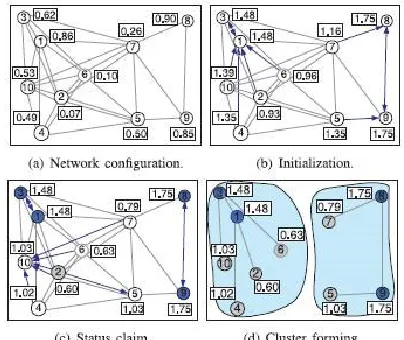
P a g e | 582energy of each sensor as the initial clustering priority. Assume that a set of sensors, denoted by S ={ fs1; s2;…. ; sn}, are homogeneous and each of them independently makes the decision on its status based on local information. After running the LBC algorithm, each cluster will have at most M (>1) cluster heads, which means that the size of CHG of each cluster is no more than M. Each sensor is covered by at least one cluster head inside a cluster. The LBC algorith m is co mprised of four phases: (1) Initialization; (2) Status claim; (3) Cluster fo rming and (4) Cluster head synchronization.
3.1 Initialization phase
Fig 1 LBC Algorithm M=2
It implies that once si successfully claims to be a cluster head, its up-to-date candidate peers would also automatically beco me the cluster heads, and all of them form the CHG of their cluster. si sets its priority by summing up its in itial priority with those of its candidate peers. In this way, a sensor can choose its favorable peers along with its status decision. Fig. 1b depicts the initialization phase of the example, where M is set to 2, which means that each sensor would p ick one neighbor with the highest initial priority as its candidate peer.
3.2 Status claim
In the second phase, each sensor determines its status by iteratively updating its local information, refraining fro m promptly claiming to be a cluster head. Whether a sensor can finally beco me a cluster head primarily depends on its priority. Specifically, we partition the priority into three
zones by two thresholds, th and tm (th > tm) , which enable a sensor to declare itself to be a cluster head or member, respectively, before reaching its maximu m number of iterations. During the iterations, in some cases, if the priority of a sensor is greater than th or less than tm compared with its neighbours, it can immed iately decide its final status and quit fro m the iteration. We call this process self-driven status transition. Also, si will announce In the initialization phase, each sensor acquaints itself with all the neighbours in its pro ximity. If a sensor is an isolated node (i.e., no neighbour exists), it claims itself to be a cluster head and the cluster only contains itself. Otherwise, a sensor, say, si, first sets its status as “tentative” and its initial priority by the percentage of residual energy. Neighbours with the highest initial priorities, which are temporarily
treated as its candidate peers. We denote the set of all the candidate peers of a sensor by A.
its current candidate peers to be cluster heads by broadcasting a packet including an ID list, which is referred to as the peer-driven status transition.
3.3 Cluster forming
The third phase is cluster forming that decides wh ich cluster head a sensor should be associated with. The criteria can be described as follo ws: for a sensor with tentative status or being a cluster member, it would randomly affiliate itself with a cluster head among its candidate peers for load balance purpose. In the rare case that there is no cluster head among the candidate peers of a sensor with tentative status, the sensor would claim itself and its current candidate peers as the cluster heads. Cluster members that receive this message switch to the initialization phase to perform a new round of clustering.
3.4 Synchronization among cluster heads
Available online:
http://edupediapublications.org/journals/index.php/IJR/
P a g e | 583gathering applications, message overhead is certainly manageable within a cluster[2][14].
4 Cluster Head Layer-Connectivity Among CHGs
Multiple cluster heads in a CHG coordinate among cluster members and collaborate to co mmun icate with other CHGs. Hence, the inter-cluster commun ication in LBC-DDUs essentially the communication among CHGs. By employing the mob ile collector, cluster heads in a CHG need not to forward data packets fro m other clusters. Instead, the inter-cluster transmissions are only used to fo rward the information of each CHG to SenCar.
The inter-cluster organization is determined by the relationship between the inter-cluster transmission range Rt and the sensor transmission range Rs. Clearly, Rt is much larger than Rs. It imp lies that in a traditional single-head cluster, each cluster head must greatly enhance its output power to reach other cluster heads.
However, in LBC-DDU the mu ltiple cluster heads of a CHG can mitigate this rigid demand since they can cooperate for inter-cluster transmission and relax the requirement on the individual output power.
Cluster heads in a CHG as multiple antennas both in the transmitting and receiv ing sides such that an equivalent MIMO system can be constructed[6][7][8]. The self-driven cluster head in a CHG can either coordinate the local information sharing at the transmitting side or act as the destination for the cooperative reception at the receiving side. Each collaborative cluster head as the transmitter encodes the transmission sequence according to a specified space-time block code (STBC) to achieve spatial d iversity. Co mpared to the single-input single-output system, that a MIMO system with spatial diversity leads to higher reliability g iven the same power budget. An alternative view is that for the same receive sensitivity; MIMO systems require less transmission energy than SISO systems for the same trans mission distance. Therefore, given two connected clusters, compared with the single-head structure, in wh ich the inter-cluster transmission is equivalent to a SISO system, the multi-head structure in LBC-DDU can save energy for inter-cluster communication.
4.1 MU-MIMO Uploading
We jointly consider the selections of the schedule pattern and selected polling points for the corresponding scheduling pairs, aiming at achieving the maximu m su m of MIMO uplink capacity in a cluster. We assume that SenCar utilizes the minimu m mean square error receiver with successive interference cancellation (MMSE-SIC) as the receiving
structure for each MIMO data uploading. Based on this receiver, the capacity of a 2 _ 2 M IMO uplink between a scheduling pair ða; bÞ where ha and hb are two 2 _ 1 channel vectors between cluster heads a and b and SenCar at ~, respectively, Pt is the output power of a sensor for transmission range Rs, and N0 is the variance of the back-ground Gaussian noise. The MMSE -SIC receiver first decodes the information fro m a, treating the signals of b as the interference. Then, it cancels the signal part of a fro m the received signals. The remain ing signal part of b only has to contend with the background Gaussian noise. Once the selected polling points for each cluster are chosen, SenCar can finally determine its trajectory. The moving time on the trajectory can be reduced by a proper vis iting sequence of selected polling points. Since SenCar departs fro m the data sink and also needs to return the collected data to it, the trajectory of Sen Car is a route that visits each selected polling point once. This is the well-known travelling salesman problem (TSP). Since Sen Car has the knowledge about the locations of polling points, it can utilize an approximate or heuristic algorith m for the TSP problem to find the shortest moving trajectory among selected polling points, e.g., the nearest neighbor algorithm[10][11]
5. CONCLUS ION
Available online:
http://edupediapublications.org/journals/index.php/IJR/
P a g e | 584MIMO-based transmission scheduling algorithms should be studied in future.
REFERENCES
[1] B. Krishnamachari, Networking Wireless Sensors. Cambridge, U.K.: Cambridge Univ. Press, Dec. 2005.
[2] R. Shorey, A. Ananda, M. C. Chan, and W. T. Ooi, Mobile, Wireless, Sensor Networks. Piscataway, NJ, USA: IEEE Press, Mar. 2006.
[3] W. C. Cheng, C. Chou, L. Go lubchik, S. Khu ller, and Y. C. Wan, “A coordinated data collection approach: Design, evaluation, and comparison,” IEEE J. Sel. Areas Commun., vol. 22, no. 10, pp. 2004– 2018, Dec. 2004
[4] K. Xu, H. Hassanein, G. Takahara, and Q. Wang,
“Relay node deployment strategies in heterogeneous wireless sensor networks,” IEEE Trans. Mobile Comput., vol. 9, no. 2, pp. 145–159, Feb. 2010.
[5] E. Lee, S. Park, F. Yu, and S.-H. Kim, “Data gathering
mechanism with local sink in geographic routing for wireless sensor networks,” IEEE Trans. Consum.
Electron., vol. 56, no. 3, pp. 1433– 1441, Aug. 2010.
[6] Y. Wu, Z. Mao, S. Fahmy, and N. Shroff, “Constructing maximum- lifetime data-gathering forests in sensor
networks,” IEEE/ ACM Trans. Netw., vol. 18, Wan, “A
coordinated data collection approach: Design, evaluation, and comparison,” IEEE J. Sel. Areas Co mmun., vol. 22, no. 10, pp. 2004– 2018, Dec. 2004.
[7] X. Tang and J. Xu, “Adaptive data collection strategies for lifetime- constrained wireless sensor networks,” IEEE Trans. Parallel Distrib. Syst., vol. 19, no. 6, pp. 721– 7314, Jun. 2008.