Original Research Article
A study on assessment of knowledge, attitude and practice on
handwashing among nursing students of Sree Venkateswara College
of Nursing, Chittoor, Andhra Pradesh
Sudhakara Reddy Muthyala
1*, Venkateswarlu Vankayalapati
2INTRODUCTION
Hand hygiene is a general term referring to any action of hand cleansing. Handwashing (HW) is the act of cleaning one's hands for the purpose of removing soil, dirt & microorganisms. Handrubbing is treatment of hands with waterless an antiseptic (alcohol-based formulation). Handwashing at all critical times refer to: “before: cooking, serving, and eating after: defecation, finding any soil on the palms, touching a lacerated wound/ blood product, relieving from duty and before and after: touching a patient”. Hand hygiene is recognized as the leading measure to prevent cross-transmission of
microorganisms and to reduce the incidence of Healthcare Associated Infections (HCAI).1 HCAI complicate 7‑10% of hospital admissions.2 Though Hand
hygiene (HH) is an important measure to prevent HCAI but despite relative simplicity of Hand Hygiene procedures and recommendations; compliance with handwashing is still poor.3 The high prevalence of these infections, as high as 19%, in developing countries poses a challenge to healthcare providers.4
The World Health Organization (WHO) has issued guidelines for procedural handwashing in order to reduce the prevalence of hospital associated infections but lack
ABSTRACT
Background: Handwashing is the act of cleaning one's hands for the purpose of removing soil, dirt & microorganisms. Through review of literature it is understood that the most nosocomial infections are thought to be transmitted by the hands of healthcare workers, handwashing is considered the single most important intervention to prevent nosocomial infections. This study was conducted to assess the knowledge, attitude and practices (KAP) on handwashing among the nursing students and to identify the areas of gap in their KAP along with the provisions for handwash.
Methods: A descriptive, cross-sectional study was conducted among 192 nursing students at S.V. College of Nursing,
Chittoor during October 2018 using pre-validated self-reported questionnaire. Statistical analysis was done with SPSS 20.0 software and Chi-Square test was used with “P” value<0.05 taken as statistically significant.
Results: Among all respondents 85% were aware about washing their hands during all common critical times, but practicing was observed in 08% only. 50% felt that alcohol based handrub is effective than handwashing with soap and water, but facilitated 10% only. While the final year students all (100%) were well aware about all critical times of handwashing, whereas 1st and 2nd years 71% and 3rd year students 87% were aware (p=0.002).
Conclusions: There is a need of orientation and arrangements for proper handwashing to be improved.
Keywords: Handwashing, Healthcare workers, Critical times, Unhygienic hands, Transmitted, Wash
1
Research Scholar, 2Associate Professor and Chairman-P.B.O.S., Department of Sociology and Social Work, Acharya Nagarjuna University, Guntur, Andhra Pradesh, India
Received: 29 May 2019
Revised: 18 July 2019
Accepted: 19 July 2019
*Correspondence:
Sudhakara Reddy Muthyala, E-mail: [email protected]
Copyright: © the author(s), publisher and licensee Medip Academy. This is an open-access article distributed under
the terms of the Creative Commons Attribution Non-Commercial License, which permits unrestricted non-commercial use, distribution, and reproduction in any medium, provided the original work is properly cited.
of knowledge amongst healthcare workers is associated with poor compliance. An alarming revelation was that compliance was found to be worst before high risk procedures.5 According to UNICEF, turning HW with soap before eating and after using the toilet into an ingrained habit can save more lives than any single vaccine or medical intervention, cutting deaths from diarrhoea by almost half and deaths from acute respiratory infections by one-quarter.6 Hands are the most exposed part of the body to germs. Touching with hands the eyes, mouth, nose, food or faeces transfers the germs into the body resulting mainly diarrhoea and Acute Respiratory Infections (ARI).7 When the undergraduate students’ genetic material was sequenced, results revealed 332,000 genetically distinct bacteria belonging to 4,742 different species on their hands.8
Doctors and nurses constitute the largest percentage of the healthcare workers (HCW). Nurses are the “nucleus of the healthcare system.”6 Because they spend more time with patients than any other HCWs, their compliance with HW guidelines seems to be more vital in preventing the disease transmission among patients.9 As the most nosocomial infections are thought to be transmitted by the hands of healthcare workers, HW is considered the single most important intervention to prevent nosocomial infections.10 Hospital acquired infection poses a very real and serious threat to all who are admitted to hospital. Pathogens are readily transmitted on healthcare workers’ hands, and HH substantially reduces this transmission. Evidence‐based guidelines for healthcare workers’ HH practices exist, but compliance with these is internationally low.11
Handwashing is widely accepted as being key to the prevention of hospital-acquired infection but the frequency of handwashing by healthcare workers has been found to be low.12 HW practices are persistently suboptimal among healthcare professionals and are also stubbornly resistant to change.13 “Clean care is safer care” as a prime agenda of the global initiative of WHO on patient safety programmes, it is time for developing countries to formulate the much-needed policies for implementation of basic infection prevention practices in healthcare set-ups.14 Generally, 20 seconds is the ideal time for proper HW.15 The CDC, USA has found that HW as the single most important means of preventing the spread of infection.16 HW with soap is estimated globally to reduce incidents of diarrhoea by 30% and ARI by 21% in <5 children.17 Proper HW could save more lives than any single vaccine or medical intervention. We can prevent deaths almost 50% from diarrhoea and 25% from ARI.18 A study in Nepal identified that can be reduced 41% of neonatal deaths through proper HW by both birth attendant and mother.19 Majority of medical and nursing students had good knowledge and attitudes towards hand hygiene and also majority follows the proper hand hygiene practicing procedures. But there is a lack of knowledge and practice regarding all the six steps of
HW.20 A study in India: Povidone-iodine scrub significantly reduced the number of colony-forming units of bacteria after application on bare hands. 21
Rationale for selection of the nursing students as respondents
Through structural review of research, it is understood that hands are the most exposed parts of the body to germs. As the most nosocomial infections are thought to be transmitted by the hands of healthcare workers, HW is considered the single most important intervention to prevent nosocomial infections. So, if the nursing students will be sensitized, they can prevent infections among themselves, their families and nosocomial infections at hospital level also. In addition, if the nursing students will sensitize the community, the cross transmission of infection can be prevented at mass level also. Handwashing practices are persistently suboptimal among healthcare professionals and are also stubbornly resistant to change. In this regard we have conducted this study to assess the knowledge, attitude and practices (KAP) on HW among the nursing students, to identify the areas of gap in their KAP along with the provisions for HW, to analyse the HW practice among respondents during critical times, to understand the implications of improper HW practice among respondents and to observe the wash facilities available at work place for HW.
METHODS
A descriptive cross-sectional study was conducted on 192 nursing students belonging to all the study year of S.V. College of Nursing, Chittoor during October 2018. Before conduction of study, prior permission was taken from the head of the institution. Importance of the study was explained to the study participants and an informed consent was taken from all the study participants before data collection. The data was collected using pre-validated self-reported questionnaire designed by WHO and revised in August 2009; same has been customized as per the needs of research. Socio-demographic information; knowledge, attitude and practice regarding handwashing among nursing students were collected in the questionnaire. Nursing students who were absent on the day of data collection were excluded from the study.
Sample size
192 nursing students.
Sampling method
Convenience sampling method.
Study setting
Data and statistical analysis
Data collected was entered into Microsoft Office Excel 2010 and statistical analysis was done using SPSS 20.0 software and Chi-Square test was used to know the level of significance with p<0.05 considered as statistically significant.
RESULTS
Of the 192 questionnaires distributed, all the questionnaires were adequately filled and returned. This gave a response rate of 100%, of which 97% (n=187) are
B.Sc. Nursing and 3% (n=05) were General Nursing Mid-Wifery students. Of which one-third (34%, n=63) belong to second year only. All the respondents were females and of which 53% (n=101) were more than 20 years aged and the rest of below 20 years. Among all respondents more than two thirds (64%, n=123) are Hindus following 31% (n=60) Christians. About half of the respondents (49%, n=94) belonged to scheduled castes following 30% (n=57) backward classes. About two-thirds (59%, n=114) were economically above poverty line. 70% (n=135) have rural background. Among all respondents 96% (n=184) were residing in the college hostel.
Table 1:Knowledge of handwashing performance during critical times.
Current year of
study 1 critical time
2-3 critical times
4-6 critical times
7-9 critical times
All critical times
Not
known Total
1st year N 6 2 0 1 44 3 56
% 10.7 3.6 0 1.8 78.6 5.4 100
2nd year N 2 1 1 0 54 7 65
% 3.1 1.5 1.5 0 83.1 10.8 100
3rd year N 2 0 0 1 25 2 30
% 6.7 0 0 3.3 83.3 6.7 100
4th year N 1 0 0 0 40 0 41
% 2.4 0 0 0 97.6 0 100
Total N 11 3 1 2 163 12 192
% 5.7 1.6 0.5% 1 84.9 6.3 100
Chi-Square test: Pearson Chi-Square value=17.311; degree of freedom=15; p=0.301.
The Table 1 shows that among all students 85% (n=163) were well aware about handwashing during at all critical times such as before cooking, serving, and eating and after defaecation, finding any soil on the palms, touching a lacerated wound/ blood product, relieving from duty and before and after touching a patient. Further 6%
(n=12) of respondents were unaware of critical times of handwashing. Among all respondents’ knowledge regarding the handwashing at all critical times was poor among first year students (79%, n=44). But it was gradually increased from 1st year to 4th year (98%, n=40). The result was not statistically significant as Chi-Square test with p value 0.301.
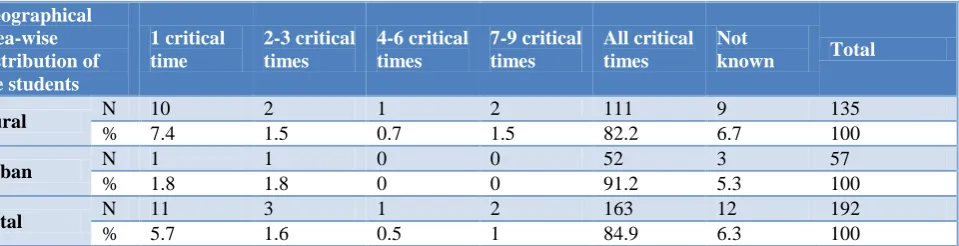
Table 2: Geographical area-wise comparison of knowledge towards handwashing at critical times.
Geographical area-wise distribution of the students
1 critical time
2-3 critical times
4-6 critical times
7-9 critical times
All critical times
Not
known Total
Rural N 10 2 1 2 111 9 135
% 7.4 1.5 0.7 1.5 82.2 6.7 100
Urban N 1 1 0 0 52 3 57
% 1.8 1.8 0 0 91.2 5.3 100
Total N 11 3 1 2 163 12 192
% 5.7 1.6 0.5 1 84.9 6.3 100
Chi-Square test: Pearson Chi-Square value=4.03; degree of freedom=5; p=0.545.
The Table 2 reveals that among all urban background students 91% (n=52) are well aware regarding HW at all
Among of all respondents, other caste (OC) students were more knowledgeable (92%, n=33) than scheduled castes (SCs, 82%, n=77) and scheduled tribes (STs, 60%, n=03) regarding HW during at all critical times. But OCs were
poorer than SCs and STs towards positive attitude (OCs=78%, SCs=79%, STs=100%) and practices (OCs=31%, SCs=33%, STs=40%) of HW during at all critical times.
Table 3: Knowledge regarding harmful germs transmitted through unhygienic hands.
Year of study Virus Bacteria Virus and
bacteria Fungus Helminths Above all Total
1st year N 5 17 0 3 7 24 56
% 8.9 30.4 0 5.4 12.5 42.9 100
2nd year N 9 13 1 2 19 21 65
% 13.8 20 1.5 3.1 29.2 32.3 100
3rd year N 1 9 1 0 6 13 30
% 3.3 30 3.3 0.0 20 43.3 100
4th year N 3 9 2 2 2 23 41
% 7.3 22 4.9 4.9 4.9 56.1 100
Total N 18 48 4 7 34 81 192
% 9.4 25 2.1 3.6 17.7 42.2 100
Chi-Square test: Pearson Chi-Square value=22.321; degree of freedom=15; p=0.100.
Table 4: Knowledge regarding diseases transmitted through unhygienic hands.
Year of study 01 disease 2-3 diseases 4-6 diseases All Not known Total
1st year N 25 1 2 14 14 56
% 44.6 1.8 3.6 25 25 100
2nd year N 20 4 1 38 2 65
% 30.8 6.2 1.5 58.5 3.1 100
3rd year N 10 3 0 15 2 30
% 33.3 10 0 50 6.7 100
4th year N 12 0 1 28 0 41
% 29.3 0 2.4 68.3 0 100
Total N 67 8 4 95 18 192
% 34.9 4.2 2.1 49.5 9.4 100
Chi-Square test: Pearson Chi-Square value = 41.297; degree of freedom=12; p=0.000.
Table 5: Knowledge regarding avoidable things to dis-associate the harmful germs on hands.
Avoidable things Frequency %
Wearing jewellery 8 4.2
Damaged skin 38 19.8
Artificial fingers 5 2.6
All the above 90 46.9
Not known 51 26.6
Total 192 100.0
The Table 3 reveals that among all respondents 42% (n=81) only well aware about common harmful four types of germs such as virus, bacteria, fungus and helminths transmitted through unhygienic hands and percentage of students has been increased from 1st year (43%, n=24) to 4th year (56%, n=23) except 2nd year (32%, n=21). Whereas the rest of mentioned about one or two harmful germs only. The result was not statistically significant as Chi-Square test with p value 0.100.
The Table 4 shows that 50% (n=95) of all respondents only aware about all common diseases such as diarrhoea,
Among all respondents 70% (n=134) only elicited that the healthcare worker could transmit the harmful germs from one to another, 17% (n=33) did not agree and 13% (n=25) were unaware. 99% (n=190) of the respondents informed that they wore the hand gloves while attending to the medical/surgical/lab services. 81% (n=155) of all respondents mentioned that the hands should be washed with soap after removal of hand gloves, 4% (n=7) did not agreed and 16% (n=33) were unaware. Among all respondents 62% (n=118) believed that the running water
supplied at healthcare services is hygienic, 17% (n=33) did not agreed and 21% (n=41) were unaware.
The Table 5 reveals that 47% (n=90) of respondents only aware about all common avoidable things such as wearing jewellery, damaged skin and artificial fingers which probes the lodging of the harmful germs on palms and the rest of respondents mentioned one or two said avoidable things. Further more than one fourth respondents were unaware of said avoidable things.
Table 6: Response of the respondents regarding essentiality of HW at all critical times.
Year of study Essential Not essential Not known Total
1st year N 40 8 8 56
% 71.4 14.3 14.3 100
2nd year N 46 11 8 65
% 70.8 16.9 12.3 100
3rd year N 26 0 4 30
% 86.7 0 13.3 100
4th year N 41 0 0 41
% 100 0 0.0 100
Total N 153 19 20 192
% 79.7 9.9 10.4 100
Chi-Square test: Pearson Chi-Square value=20.338; Degree of freedom=6; P=0.002.
Table 7: Perception of the respondents towards effectiveness of alcohol based handrub over HW with soap and water.
Effectiveness of handrub with alcohol Frequency %
Effective 95 50
Not effective 66 34
Not known 31 16
Total 192 100.0
Table 8: Geographical area-wise comparison of attitude towards HW at all critical times.
Geographical area-wise
distribution of respondents Essential Not essential Often Total
Rural background N 103 17 15 135
% 76.3 12.6 11.1 100
Urban background N 50 2 5 57
% 87.7 3.5 8.8 100
Total N 153 19 20 192
% 79.7 9.9 10.4 100
Chi-Square test: Pearson Chi-Square value=4.209; degree of freedom=2; p=0.122.
The Table 6 reveals that among all respondents 80% (n=153) mentioned that HW is essential at all critical times. But the final year students all (100%) were well aware about all critical times of handwashing, whereas 1st and 2nd years 71% and 3rd year 87% only. The result was statistically significant as Chi-Square test with p value 0.002.
The Table 7 details that half of the respondents (50%, n=95) felt that alcohol based handrub is effective than
HW with soap and water following 34% (n=66) not accepted and 16% (n=31) aware.
Table 9: Practice of HW during critical times.
Year of study
At all critical times
Often Total
1st year N 21 35 56
% 37.5 62.5 100
2nd year N 17 48 65
% 26.2 73.8 100
3rd year N 8 22 30
% 26.7 73.3 100
4th year N 10 31 41
% 24.4 75.6 100
Total N 56 136 192
% 29.2 70.8 100.0
Chi-Square test: Pearson Chi-Square value=2.711; degree of freedom=3; p=0.438.
The Table 9 details that among all respondents the practice of HW at all critical times was 29% (n=56) only and the rest of maintain often. Highest percentage of first year students are followed this activity (38%, n=21) over the rest of all students. The activity was the lowest among fourth year students (24%, n=10). The result was not statistically significant as Chi-Square test p value 0.438.
The HW practice was almost same among all respondents of rural and urban backgrounded. Among all respondents 5% (n=09) were unaware of steps to be followed while HW. 12% (n=25) of respondents only were practicing HW for 20 seconds as suggested by the UNICEF (during other than surgery/clinical/lab assistance), whereas 82% (n=156) were washing their hands for less than 20 seconds during critical times. Further 6% (n=11) were unaware of time to be allowed for HW. During surgery/clinical/lab assistance 62% were washing their hands for less than two minutes (minimal time), whereas 8% (n=16) only following minimal time. 89% (n=170) mentioned that the infectious agents will be transmitted through long nails also, but 6% (n=11) were disagreed and the same number were unaware. Among hand gloves wearers, 63% (n=120) believed that wearing of hand gloves could protect 100% from harmful germs, 23% (n=44) not agreed and the remaining were unaware.
Table 10: Availability of facilities for the respondents towards HW.
Facilities for HW Frequency %
Only water 37 19
Normal soap 90 47
Medicated soap 45 24
Alcohol based hand rub 20 10
Total 192 100
The Table 10 reveals that among all respondents 47% (n=90) provided normal soap and 19% (n=37) provided only water without any soap or hand rub. Further about
one-third of the respondents (34%, n=65) only provided medicated soap/alcohol based handrub towards HW.
All the respondents unanimously mentioned that no poster and visible, simple and clear instructions regarding HW were not displayed in the hospital premises. Further unanimously all respondents elicited that no one was receiving feedback from them regarding HW. The urban backgrounded students were more prevalent (60%) to all common diseases such as water and air borne diseases and contagious diseases over rural backgrounded (50%).
Table 11: Frequency of disease sufferers by a chance of transmitted through unhygienic hands.
Suffered with Frequency %
Water borne diseases 19 10
Air borne diseases 25 13
Water & air borne
diseases 44 23
Contagious diseases 2 1
All above 102 53
Total 192 100
The Table 11 shows that more than half (53%, n=102) of the respondents suffered with all common diseases transmitted by a chance through unhygienic hands such as water borne, air borne and contagious diseases following rest of suffered with any one or two said diseases.
Prevalence of all common diseases such as water and air borne diseases and contagious diseases has been increased gradually from 1st year to 4th year (46%, 51%, 53% and 66% respectively). Among all respondents the prevalence of all common diseases such as water and air borne diseases and contagious diseases were higher among OCs (57%) than SCs (50%) and STs (40%). Among all respondents 66% (n=126) were already trained on handwashing practice. But among all still 92% (n=177) demanded for further orientation on handwashing practice. Of which 96% were rural backgrounded and 84% were urban backgrounded (p=0.007). Every student whole heartedly expressed that they would conduct sessions on handwashing in the community in future to prevent cross transmission of harmful germs.
DISCUSSION
The study found that there is a difference of knowledge towards the HH among 1st year students to 4th year, wherein it was poor among first year students and gradually increased from 1st year to 4th year. But it was not statistically significant (p=0.301). The gap could be due to the fact that the nursing students are taught on hand hygiene during the early part of their curriculum. 80% opined that HW is essential at all critical times, while the final year students all (100%) were well aware about all critical times of HW, whereas 1st and 2nd years 71% and 3rd year 87%. The result was statistically significant with p value 0.002. But the practice is poor among the 4th year while highest among 1st year students.
Half of the respondents only opined that the alcohol based handrub was effective than handwashing with soap and water. This is also proved in a study conducted amongst Residents and Nursing Staff in a Tertiary Healthcare Setting of Bhopal City, India.24 The urban backgrounded students were having good knowledge and positive attitude towards handwashing at all critical times over rural backgrounded. It was not statistically significant as p=0.545. But there is no significant difference in HW practices among both categories. Among all respondents 95% were aware of steps to be followed while HW. But one among eight respondents was only practicing HW for 20 seconds (ideal time) during other than surgery/clinical/lab assistance as suggested by the UNICEF. Whereas about two-fifth of respondents only were washing their hands for two minutes (minimal time) during surgery/clinical/lab assistance. This finding is as similar as mentioned in the WHO guidelines on hand hygiene.5
One third of the respondents only were provided either medicated soap or alcohol based handrub towards handwashing. The remaining had not been provided. This has seen in a previous study conducted among Nursing and Medical Students in a Tertiary Care Hospital in Puducherry, India and other studies also.23 All respondents had been suffered with any one or two of the common communicable diseases transmitted through unhygienic hands, but half of all respondents suffered with all common communicable diseases, which has been increased gradually from 1st year (25%) to 4th year (68%) except 3rd year. The result is statistically significant with p value 0.000. This may be because of poor handwashing practice among 4th year students comparatively 1st year. The urban backgrounded students are more prevalent to all said common diseases over rural backgrounded. The disease prevalence is more among OCs over SCs and STs.
Among all respondents, OC students were more knowledgeable than SCs and STs regarding HW, while OCs were poorer than SCs and STs towards positive attitude and practices of handwashing during at all critical times. Regarding the transmission of all common harmful germs such as virus, bacteria, fungus and helminths through unhygienic hands, less than half of the respondents (42%) only aware and percentage of students
has been increased from 1st year (43%) to 4th year (56%) except 2nd year (32%) with p value 0.100 which was not statistically significant.
About one-third of the respondents did not elicit that the healthcare worker could inter transmit the harmful germs. The most (99%) of the respondents wore the hand gloves while attending to the medical/surgical/lab services. Four of five respondents only washed their hands with soap after removal of hand gloves. 23% of respondents were having correct knowledge that wearing of hand gloves cannot protect 100% from harmful germs, whereas the knowledge has increased from 1st year (20%) to 4th year (34%). The result was statistically significant as Chi-Square test p value was 0.000. This similarity found in a previous study conducted amongst Residents and Nursing Staff in a Tertiary Healthcare Setting of Bhopal City, India.24 Three-fifth of respondents believed that the running water supplied at healthcare services is hygienic. 47% of the respondents only aware about all common avoidable things such as wearing of jewellery and artificial fingers, damaged skin etc. which probes the lodging of harmful germs on palms. Of which the percentage of 1st year students (32%) was least and 3rd year students (60%) was highest. The result was statistically significant with p value 0.000. 89% only mentioned that the infectious agents will be transmitted through long nails.
All respondents unanimously mentioned that no poster and visible, simple and clear instructions regarding HW were not displayed in the hospital premises and no one were receiving feedback from them regarding handwashing. Among all respondents, even though 66% was already trained on HW practice, again 92% demanded for further orientation. Of which 96% were rural backgrounded and 84% were urban backgrounded (p=0.007) which is similar to a previous study.23 Every student whole heartedly expressed that they will conduct sessions on handwashing in the community in future to prevent cross transmission of harmful germs.
CONCLUSION
The nursing professionals of S.V. Nursing College, Chittoor have good knowledge and attitude towards hand hygiene. But researcher found that, still there are significant gaps among the respondent’s knowledge and practises on hand hygiene. Researcher observed that, handwashing facilities were maintained poorly at work place.
Recommendations
ACKNOWLEDGEMENTS
The authors of this study would like to thank Dr. Chandrasekhar Vallepalli, Assistant Professor, Department of Community Medicine, SVIMS, Tirupati and faculty of S.V. college of Nursing, Chittoor for their encouragement and support throughout the completion of this study.
Funding: No funding sources Conflict of interest: None declared Ethical approval: Not required
REFERENCES
1. Pittet D, Hugonnet S, Harbarth S, Mourouga P, Sauvan V, Touveneau S, et al. Effectiveness of a hospital-wide programme to improve compliance with hand hygiene. The Lancet. 2000;356(9238):1307-12.
2. Albert RK, Condie F. Hand‑washing patterns in medical intensive-care units. N Engl J Med. 1981;304(24):1465‑6.
3. Maury E, Alzieu M, Baudel JL, Haram N, Barbut F, Guidet B, et al. Availability of an alcohol solution can improve hand disinfection, compliance in an intensive care unit. Am J Respir Crit Care Med. 2000;162(1):324‑7.
4. WHO: The Burden of healthcare-associated infection worldwide: a summary, 2010. Available at http://www.who.
int/gpsc/country_work/summary_20100430_en.pdf. 5. Rumbaua R, Yu C and Pena A. A point-in-time observational study of handwashing practices of healthcare workers in the Intensive Care Unit of St. Luke’s Medical Center. Phil J Microbiol Infect Dis. 2001;30(1):3-7.
6. de Almeida e Borges LF, Silva BL, Gontijo Filho PP. Hand washing: Changes in the skin flora. Am J Infect Control. 2007;35(6):417-20.
7. Minnesota Dept. of Health-Infectious Diseases Epidemiology, Prevention and Control Division. Available at www.health. state.mn.us/handhygiene/why/diseases.ht.
8. Abualrub RF. Nursing shortage in Jordan: what is the solution? J Prof Nurs. 2007;23(2):117-20. 9. Minnesota Dept. of Health-Infectious Diseases
Epidemiology, Prevention and Control Division. Available at www.health.state.mn.us/hand hygiene/ why/diseases.ht.
10. Karabey S, Pinar AY, Derbentli SE, Nakipoglu Y, Esen F. Handwashing frequencies in an intensive care unit. J Hospital Infect. 2002;50(1):36-41. 11. Creedon SA. Healthcare workers hand
decontamination practices: Compliance with recommended guidelines. J Adv Nurs. 2005;51(3):208-16.
12. Larson EL1, Early E, Cloonan P, Sugrue S, Parides M. An Organizational Climate Intervention
Associated With Increased Handwashing and Decreased Nosocomial Infections. Behav Med. 2000;26(1):14-22.
13. Allegranzi B, Sax H, Pittet D. Hand hygiene and healthcare system change within multi-modal promotion: a narrative review. J Hosp Infect. 2013;83(S1):3-10.
14. Mathur P. Hand hygiene: Back to the basics of infection control. Indian J Med Res. 2011;134(5):611-20.
15. Global handwashing day 2017, planner’s guide. 6th ed. Global Handwashing Partnership. Available at https://globalhandwashing.org/wpcontent/uploads/2 017/08/GlobalHandwashingGuide2017_EN.pdf. 16. UNICEF. Child Survival: The State of the Worlds
Children 2008. Available at http://www.unicef .org/publications/ files/The_State_ of_the_Worlds_ Children_2008.pdf.
17. Curtis V, Cairncross S. Effect of washing hands with soap on diarrhoea risk in the community: a systematic review. Lancet Infect Dis. 2003;3(5):275-81.
18. Luby S, Agboatwalla M, Feikin DR, Painter J, Billhimer W, Altaf A, et al. Effect of handwashing on child health: A randomized controlled trial. Lancet, 2005;366(9481):225-33.
19. Rhee V, Mullany LC, Khatry SK, Katz J, LeClerq SC, Darmstadt GL, et al. Maternal and Birth Attendant Handwashing and Neonatal Mortality in Southern Nepal. Arch Pediatr Adolesc Med. 2008;162(7):603-8.
20. Goswami K, Baruah R. Study to assess knowledge, attitude and practice of hand hygiene among medical and nursing students at Guwahati Medical College & Hospital, Guwahati, Assam. Indian J of Basic Appl Med Res. 2016;5(2):322-8.
21. Raman S, Meenakshi S, Vipin K. Handwashing compliance among healthcare staff in intensive care unit of a Multispecialty hospital of north India. J Hosp Adminis. 2012;1(2):27-33.
22. Arthi E, Abarna V, Bagyalakshmi R, Anitharaj M, Vijayasree S. Assessment of Knowledge, Attitude and Practice of Hand Hygiene among Nursing and Medical Students in a Tertiary Care Hospital in Puducherry, India. Int J Contemporary Med Res. 2016;3(4):1203-6.
23. Maheshwari V, Kaore NC, Ramnani VK, Gupta SK, Borle A, Kaushal R. A study to assess knowledge and attitude regarding hand hygiene amongst residents and nursing staff in a tertiary healthcare setting of Bhopal City. J Clin Diagn Res. 2014;8(8):DC04-7.
24. Nawab T, Mehnaz S, Abedi AJ, Safwi SR. KAP study of hand hygiene among medical and nursing students in a tertiary teaching hospital. Int J Sci Applied Res. 2015;2(6):29-39.
Cite this article as: Muthyala SR, Vankayalapati V.