
IJSRSET184217 | Accepted : 15 Jan 2018 | Published 22 Jan 2018 | January-February-2018 [ (4)2 : 93-97 ]
© 2018 IJSRSET | Volume 4 | Issue 2 | Print ISSN: 2395-1990 | Online ISSN : 2394-4099 National Conference on Advanced Research Trends in Information and Computing Technologies (NCARTICT-2018), Department of IT, L. D. College of Engineering,
Ahmedabad, Gujarat, India. In association with International Journal of Scientific Research in Science, Engineering and Technology
Survey of Machine Learning Algorithms For Dynamic
Resource Pricing In Cloud
Meetu Kandpal
1, Dr. Kalyani Patel
21MCA, Gujarat Technological University, Ahmedabad, Gujarat, India 2MSc(IT), Gujarat University, Ahmedabad, Gujarat , India
ABSTRACT
The paper provides insights of various machines learning algorithm that could be helpful in deriving the dynamic pricing of resources in cloud. Currently machine learning has impact on many IT and non IT sectors. At the same time because of great change in computing from on premise to cloud computing many big companies has opted cloud computing in which resources are provided on demand basis via internet. On the basis of resource usage machine learning algorithm help to predict the future demand and also help in deciding the price of resource at the time of request (spot request).
Keywords: Cloud Computing, Cloud Pricing, Machine Learning Algorithms
I.
INTRODUCTION
One of the aims of machine learning algorithms is prediction. Like linear regression, multiple regression algorithms help various sectors to increase profitable opportunities by forecasting demand. Forecasting can be based on the past data sets. As cloud services are delivered on demand basis the future demand of recourses can be forecast by using these machine learning algorithms and new pricing model can be derived.
The paper has started with cloud computing and its pricing policies(1.1), brief about machine learning algorithm and its
categories(1.2), literature surveyed on machine learning algorithm is represented under heading(2), conclusion(3).
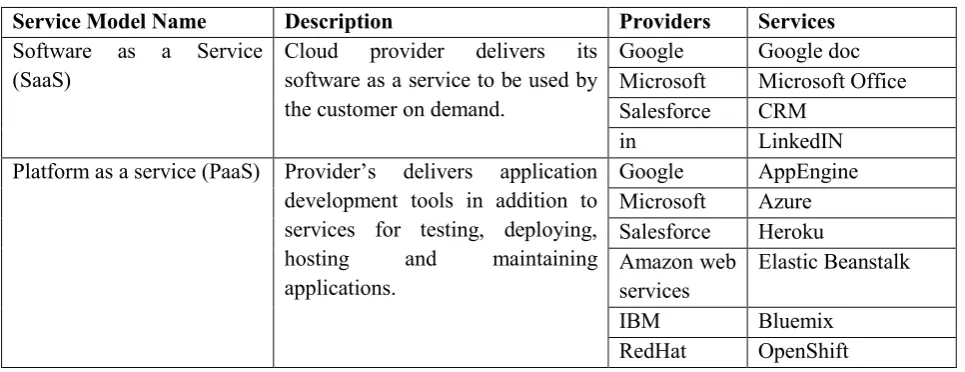
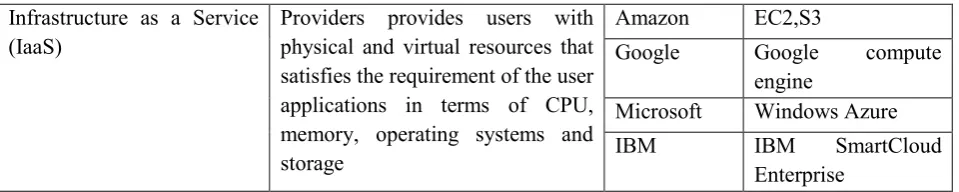
1.1Cloud Computing and pricing policies: cloud computing are the services provided over the internet, like other utility consumer needs to pay the bills as per the consumption. There are various layers of services provided by cloud like software as a service (SaaS), platform as a service (PaaS), infrastructure as a service (IaaS) etc are presented in Table-1.
The major reasons for the companies opting cloud is security, scalability, fast data recovery etc. Big cloud providers are Amazon (AWS), Google (Google cloud), Microsoft, IBM etc.
Table 1. Service model
Service Model Name Description Providers Services
Software as a Service (SaaS)
Cloud provider delivers its software as a service to be used by the customer on demand.
Google Google doc
Microsoft Microsoft Office
Salesforce CRM
in LinkedIN
Platform as a service (PaaS) Provider’s delivers application development tools in addition to services for testing, deploying,
hosting and maintaining
applications.
Google AppEngine
Microsoft Azure
Salesforce Heroku
Amazon web services
Elastic Beanstalk
IBM Bluemix
Infrastructure as a Service (IaaS)
Providers provides users with physical and virtual resources that satisfies the requirement of the user applications in terms of CPU, memory, operating systems and storage
Amazon EC2,S3
Google Google compute
engine
Microsoft Windows Azure
IBM IBM SmartCloud
Enterprise
The cloud providers have their own policies to charge for the services like Amazon has on demand pricing, reserved pricing and auction based.
With On-Demand instances, user pays for compute capacity by the hour with no long-term commitments or upfront payments. User can increases or decreases their compute capacity depending on the demands of the application and only pay the specified hourly rate for the instances they use. [1]
Reserved Instances provide you with a significant discount (up to 75%) compared to On-Demand instance pricing. In addition, when Reserved Instances are assigned to a specific Availability Zone, they provide a capacity reservation, giving you additional confidence in your ability to launch instances when you need them. [2]
Auction pricing was proposed by Amazon EC2 which whether or not a subscriber obtains the VM depends on the price it offers. It is also known as dynamic pricing. Auction based pricing is fair for both customer and service provider because the price is set as per the level of demand and supply [3]. In auction pricing there are two terms first spot price and second bid price.
For using spot instance the customer can request for instance (spot request). Request contains the bid price also. If the bid price is greater than the spot price the resource will be allocated to the customer immediately otherwise it will be allocated when price of spot become less than the bid price.
Table 2. Cloud Resources
Sr# Name of family Instance
Name
Description
1 General purpose M4,M3,T2 Memory to CPU ratio
suitable for most
general purpose
applications.
2 Compute
Optimized
C4,C3 More CPU than RAM
for compute sensitive applications.
3 Memory
Optimized
R3,R4 Larger size for memory
intensive applications.
4 GPU P2 Parallel processing for
3D graphic capability using OPENGL.
5 Storage L3,L2 For data warehousing
Above Table 2 represents some example of resources provided by AWS.
1.2 Machine Learning-Machine learning is the branch
of computer science that concerned with generating such algorithms that takes input from the historic data(training data set) and make prediction based on it. One of the examples is Amazon’s algorithms that
recommend item based on items you have purchased before
There are mainly three types of machine learning algorithm as shown in Fig-1. Supervised machine learning, unsupervised learning, reinforcement learning. Supervised learning is algorithm in which there are training data labelled data is given.
are artificial neural network (ANN), linear regression, support vector machine (SVM),deep learning based
CNN (convolutional neural network) and
RNN(Recurrent neural network)
architectures .Unsupervised is same without labelled data. K-means clustering is an example of unsupervised algorithm still most of the unsupervised algorithms are under the area of research. Reinforcement learning is the algorithm in which machines are forced to learn and take appropriate action contextually. It is mostly used in area of AI.
In recent years a London based start up which is later acquired by the Google, Deepmind achieve the major breakthrough in the area of AI by using the reinforcement learning algorithm. The company developed the algorithm which beats the highest score by human in 50 plus games. The summary of various machine algorithms is presented in Table: 3 (Machine learning algorithms).
These algorithms help the cloud provider to predict the price of the resources at the time of bidding.
Figure 1. Categories of Machine learning algorithm [4]
II.
METHODS AND MATERIAL
Table 3. Machine learning algorithms
Sr No.
Name of Algorithm
Description Mathematical
model
Applications Advantages Limitations
1. Linear Regression [5]
Supervised learning technique to predict the outcomes in quantitative way. Its work on the basis of error minimization technique to fit the linear model.
0 1
( )
h x
x
0
,
1areparameters Cost function
0, 1
( ) ( ) 2 1
( )
1 ( ( ) 2
m
i i
i J
h x y
m
Evaluate the trend in the business and help in forecasting future demand.
It is useful when there is a liner relationship between dependent and independent variable.
It is limited to linear relationship only. It is predicting numeric output only.
2. Multiple Regression [6]
It is extended version of linear regression model to predict the outcomes of more than one variables
0 1
( )
h x
x
0
,
1areparameters Cost function
0, 1
( ) ( ) 2 1
( )
1 ( ( ) 2
m
i i
i J
h x y
m
Predict the multivariable outcomes/multi classification problems.
Used in market research.
It is useful when there is a liner relationship between dependent and independent variable.
3. Decision
Tree[7] In outcome is based on decision tree the combination of conditions.
Entropy
2 2
log log
p p q q
Entropy for each branch is calculated to get the gain or decrease in entropy.
( , )
( ) ( , )
Gain T X
Entropy T Entropy T X
Used in bank for loan processing, in finance for option pricing
It finds the most important feature in data sets, easy to understand.
Complex for the large data set.
4. Naive Bayes
classifier [8] Naive classifier works on Bayes the basis of bayes theorem to predict the outcome of posterior probability from the prior probability.
( | )
( | ) ( ) / ( )
P c x
P x c P c P x
Sentiment analysis, document categorization-mail spam filtering
It is well when the input variables are categorical,
converges faster, requiring relatively little training data than logistic regression
It works under the assumption of Markov chain that means the current outcome depends on only the previous outcome. y(t) outcome depends on y(t-1)
5. Artificial Neural Network (ANN) [9]
ANN is method which has input unit hidden units and output unit’s weights to predict the outcomes. Mainly work on the basis of back propagation algorithm and gradient decent optimizer.
derivative = output * (1.0 - output) error = (weight_k * error_j) *
transfer_derivative(o utput)
weight = weight + learning_rate * error * input
Very good to solve the classification problem and pattern analysis
Easy to understand and produces good classification results.
-
6. K-means clustering [10]
It is well known unsupervised learning algorithm to make the cluster/ label from the data. It’s a generative algorithm which works iteratively.
- It is used by the most of the search engine like Google to cluster WebPages by similarities of their content.
It does not required
labelled data. Missing variate values cannot be handled by this algorithm.
7. Support vector machine (SVM) [11]
It is a supervised algorithm, it can be helpful in analysing the data for regression as well as for classification
Depends on the
selection of kernel. Recognition hand written of characters, image classification.
It represents the data in latent space. It performs well for image data.
Computationally complex as compare to ANN.
8. Hidden Markov Model (HMM) [12]
Hidden Markov model work on the basis of Markov chain assumption, state transition probability and emission transition probability.
θ=sequence of state o=sequence of observation
0 1
q q
=(start, final) A=state transition probability B=emission probability C=initial state probability compute probability model (A,B,C) Language translation, pattern recognition, language modellingIt reveals the hidden features of given sequential data set.
9. Deep learning
[13] Deep algorithms are deep learning neural networks which work on the raw data sets. DNN automatically select the best suited features to perform the task.
There are different architectures to deal with different types of problems.
Classification Problems, Pattern recognitions, Speech recognition, Natural language processing, Object detection, etc.
No need of manual feature engineering. It selects the feature
automatically from data sets and performs the task.
It is computationally very expensive and need lot of training data set as well.
III.
CONCLUSION
As there are different cloud service provider in the market and the boom of the cloud, IT companies has opted cloud. According to the behaviour of the company adoption of cloud the above machine learning algorithm can predict the future demand of cloud resources and help the provider to drive the new pricing policies. Each algorithm has its advantage and limitations; it can be found which will give the best result by implementing WEKA (Waikato Environment for Knowledge Analysis) [14] and other tools. Authors [15] compared various supervised learning algorithms.
IV.
REFERENCES
[1]. https://aws.amazon.com/pricing/ [2]. https://aws.amazon.com/ec2/pricing/
[3]. Al-Roomi, May, et al. "Cloud computing pricing models: a survey." International Journal of Grid & Distributed Computing 6.5 (2013): 93-106.
[4]. https://yourfreetemplates.com/free-machine-learning-diagram/
[5]. Montgomery, Douglas C., Elizabeth A. Peck, and G.
[6]. Geoffrey Vining. Introduction to linear regression analysis. Vol. 821. John Wiley & Sons, 2012. [7]. Woodside, Arch G. "Moving beyond multiple
regression analysis to algorithms: Calling for adoption of a paradigm shift from symmetric to asymmetric thinking in data analysis and crafting theory." (2013): 463-472.
[8]. Jin, Chen, Luo De-Lin, and Mu Fen-Xiang. "An improved ID3 decision tree algorithm." Computer Science & Education, 2009. ICCSE'09. 4th International Conference on. IEEE, 2009.
[9]. Wu, Xindong, et al. "Top 10 algorithms in data mining." Knowledge and information systems 14.1 (2008): 1-37.
[10]. Picatoste Ruilope, Álvaro. Energy demand forecasting in smart buildings. MS thesis. Universitat Politècnica de Catalunya, 2017. [11]. J. A. Hartigan and M. A. Wong Journal of the
Royal Statistical Society. Series C (Applied Statistics) Vol. 28, No. 1 (1979), pp. 100-108 [12]. Tsochantaridis, Ioannis, et al. "Support vector
machine learning for interdependent and structured output spaces." Proceedings of the twenty-first international conference on Machine learning. ACM, 2004.
[13]. Tumilaar, Kezia, Yohanes Langi, and Altien Rindengan. "Hidden Markov Model." de CARTESIAN 4.1 (2015): 86-94.
[14]. LeCun, Yann, Yoshua Bengio, and Geoffrey Hinton. "Deep learning." Nature 521.7553 (2015): 436-444.
[15]. Domingos, Pedro. "A few useful things to know about machine learning." Communications of the ACM 55.10 (2012): 78-87.
![Figure 1. Categories of Machine learning algorithm [4]](https://thumb-us.123doks.com/thumbv2/123dok_us/1217975.1625466/3.595.320.535.67.272/figure-categories-machine-learning-algorithm.webp)
