Original Research Article
Association of various socio demographic factors with knowledge
and practice regarding menstrual hygiene among school going
adolescent girls of Jaipur city
Nikita Sharma*, Rekha Shekhawat
INTRODUCTION
Adolescence (from Latin adolescere, meaning “to grow up") is a transitional phase of growth and development between childhood and adulthood. The World Health Organization (WHO) defines an adolescent as any person between ages 10 and 19 years.1
There are about 1.2 billion adolescents, worldwide. It is reported that more than half of the adolescents live in Asia. As per Census 2011, India is the home to 243 million adolescents contributing to one fifth (21.4%) of India’s population and adolescent girls constitute to 47 percent of total adolescent population.2
In the life of a female, the transition from childhood to adulthood occurs during period of adolescence which according to WHO extends from 10-19 years of age.3 It starts with the onset of menarche, a milestone in a woman’s life and denotes the beginning of her reproductive capacity of woman.4,5 Menarche is the first menstruation of a girl. It occurs at the age of 12-13 years, although it may occur as early as 10 years or as late as 16 years. The age of menarche is between 10-16 years (average age 13.5 years) in India.6 Globally about 52% of the female population is of reproductive age, meaning menstruation is part of their normal life and menstrual hygiene is therefore an essential part of basic hygienic practices.7 Adolescent girls constitute a vulnerable group,
ABSTRACT
Background: There is lack of information on the process of menstruation, the physical and psychological changes associated with puberty and proper requirements for managing menstruation. Hence this community based study was carried out with the objective to assess the level of knowledge and practice regarding menstrual hygiene and their association with sociodemographic factors among school going adolescent girls.
Methods: A descriptive, cross sectional study was conducted among 996 adolescent girls of senior secondary schools of Jaipur city.
Results: It was evident that 80.72% participants were aware about menstruation before their menarche. Majority (68.07%) used sanitary pad as absorbent material. 34.53% changed the pad at least 3 times or more in a day. 29.21% cleaned the genitalia twice or more than 2 times a day. 86.14% participants were restricted to do religious activities. Significant association was found between type of absorbent used socio economic status, mother’s education.
Conclusions: There is strong need to improvise and promote good menstrual hygiene knowledge and practices among adolescent girls. Improving mother’s knowledge on menstrual hygiene management can go a long way in improving menstrual hygiene practice.
Keywords: Adolescent, Menarche, Menstruation, Menstrual hygiene
Department ofPreventive and Social Medicine, S.M.S Medical College, Jaipur, Rajasthan, India
Received: 18 May 2019
Revised: 03 June 2019
Accepted: 04 June 2019
*Correspondence:
Dr. Nikita Sharma,
E-mail: [email protected]
Copyright: © the author(s), publisher and licensee Medip Academy. This is an open-access article distributed under the terms of the Creative Commons Attribution Non-Commercial License, which permits unrestricted non-commercial use, distribution, and reproduction in any medium, provided the original work is properly cited.
particularly in India where female child is neglected one. The manner in which a girl learns about menstruation and its associated changes may have an impact process as it is linked with several misconceptions and inadequate practices, which sometimes result into adverse health outcomes.8 Menstrual hygiene, which refers to the effective management of menstrual bleeding by women and girls, is an important aspect of reproductive health, which if not handled appropriately can cause infections of the urinary tract, pelvic inflammatory diseases, vaginal thrush, as well as bad odour, soiled garments and ultimately shame, leading to infringement on the girl’s dignity.9 The myths and taboos related to menstruation in society prevents girls from articulating their needs and the problems of poor menstrual hygiene management. Even in urban areas due to lack of time given by parents, hesitation of teachers girls have incomplete knowledge regarding menstruation. Thus, present study was conducted with the aim to explore the prevailing knowledge and practices of menstrual hygiene among school going adolescent girls (10-19 years) of Jaipur city and to determine its association with socio demographic variables.
METHODS
Study area
Senior Secondary schools of Jaipur City.
Study type
This is a community based descriptive type of observational study which was conducted on adolescent female students (10-19 years) of Jaipur city.
Study design
Cross sectional study design.
Study period
After getting approval from the institutional research review board and Ethical committee, plan of study was executed. Data collection for this study was carried out from 1st July 2017 to 10th April 2018.
Study universe
Female students of age group 10-19 years studying in class 6th-12th of randomly selected schools of Jaipur city.
Sample size
The sample size calculated was 793 at 95% confidence interval and 7% relative error to verify the expected minimum 50.8% of prevalence of adolescent girls practicing the use of sanitary pads during menstruation.10 To cover the expected 20% non response, it was enhanced to 1000.
Study tool
Pre-designed and pre tested structured questionnaire having following parts:
Section A-Socio demographic Proforma.
Section B-Questionnaire regarding knowledge and practice of menstrual hygiene.
Inclusion criteria
Inclusion criteria were female students of 10 to 19 years studying in government and private senior secondary schools having ≥500 students of Jaipur city; female students present on the day of study; female students who had attained menarche.
Exclusion criteria
Exclusion criteria were those whose Principal /school authorities did not give consent; female students who had not attained menarche; female students who were absent on the day of study.
Sampling technique
worksheet. Continuous data was summarized in form of mean and SD and analysed and countable data was expressed in form of proportions. Socio economic status (SES) was determined by modified Kuppuswamy classification 2018. Out of 1008 selected students, 996 filled the questionnaire completely.
RESULTS
In the present study 996 participants had filled the questionnaire completely; 499 from private and 497 from government school. Majority of them (43.77%) were in age group 13-15 years. Proportion in upper middle class and lower middle class found to be 42.27% and 31.73% respectively. Mothers of majority (23.59%) of the girls were educated till high school. Participants whose mothers were graduates were 13.45%. Participants living in a nuclear family were 68.07% while 31.92% were living in joint family (Table 1).
Table 1: Socio-demographic distribution of study population (n=996).
S.
no. Variables Number
Percentage (%)
1. Age group (in years)
10-12 161 16.16
13-15 436 43.77
16-19 399 40.06
2. Socio economic status
Upper class 29 2.91
Upper-middle class 421 42.27
Lower-middle class 316 31.73
Upper-lower class 220 22.09
Lower class 10 1
3. Educational qualification of mother
Illiterate 233 23.39
Primary school 97 9.74
Middle school 122 12.24
High school 235 23.59
Intermediate/diploma 170 17.06
Graduate 134 13.45
Professional degree 5 0.50
4. Type of family
Nuclear 678 68.07
Joint 318 31.92
Majority (80.72%) of the participants were aware about menarche before its onset. 68.07% of participants used sanitary pad as absorbent material. 34.53% reported that they change the pad at least 3 times or more in a day. Only 29.21% cleaned the genitalia twice or more than 2 times a day (Table 2). 86.14% participants were restricted to do religious activities, 21.3% were restricted to play during menstruation. 4.31% participants were not allowed to go school during menstruation (Figure 1).
Figure 1: Distribution of participants as per restrictions faced by them during menstruation.
Table 2: Distribution of study population as per their knowledge and practice regarding menstrual hygiene.
S.
no. Variables Number
Percentage (%)
1. Awareness about menarche before its onset
Yes 804 80.72
No 192 19.27
2. Type of absorbent used
Sanitary pad 678 68.07
Cloth 318 31.92
3. Frequency of changing pad
3 or ≥3 times 344 34.53
≤3 times 652 65.46
4. Cleaning of external genital area
Twice or more 291 29.21
Less than two times 705 70.78
With increasing age knowledge which participants had before menarche has increased. The proportion is maximum in age group of 16-19 years (83.20%) followed by age group of 13-15 years (81.65%). This difference was found to be significant. Socio economic status is also significantly associated. Proportion is higher in upper class (93.10%); in lower class it is only 40%. All (100%) the girls whose mothers were professionally qualified knew about menarche before its onset while whose mothers were illiterate this proportion was only 64.38%. Proportion was found to be more in those living in nuclear family (84.51%) (Table 3).
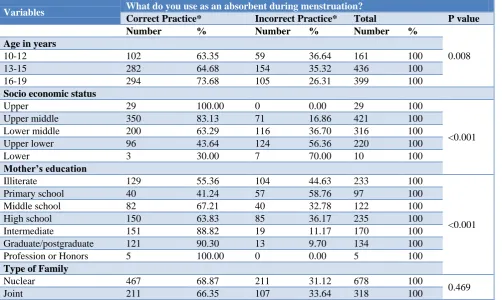
Practice of using sanitary pad was found maximum in 16-19 years of age group (73.68%). All the participants (100%) of upper class used sanitary pad while only 30% participants of lower class used sanitary pad. All (100%) the participants whose mothers were professionally qualified used sanitary pad, while only 55.36% used sanitary pads whose mothers were illiterate. Hence, significant association was found between correct practice of absorbent used with socio economic status, mother’s education (Table 4).
0 10 20 30 40 50 60 70 80 90
Pray Household
work
Restricted to go to
school
Playing 86.14
13.85
4.31
21.3
Percentag
Table 3: Association of various socio demographic factors with knowledge of menstruation before menarche.
Variables
Did you had knowledge about menstruation before menarche?
Yes (n=804) No (n=192) Total (n=996)
P value Number % Number % Number %
Age (in year)
10-12 116 72.05 45 27.95 161 100
0.007
13-15 356 81.65 80 18.35 436 100
16-19 332 83.20 67 16.79 399 100
Socio economic status
Upper 27 93.10 2 6.89 29 100
<0.001
Upper middle 345 81.94 76 18.05 421 100
Lower middle 290 91.77 26 8.22 316 100
Upper lower 138 62.72 82 37.27 220 100
Lower 4 40.00 6 60.00 10 100
Mother’s education
<0.001
Illiterate 150 64.38 83 35.62 233 100
Primary school 63 64.95 34 35.05 97 100
Middle school 92 75.41 30 24.59 122 100
High school 204 86.81 31 13.19 235 100
Intermediate 160 94.12 10 5.88 170 100
Graduate/postgraduate 130 97.01 4 2.99 134 100
Profession or Honours 5 100.0 0 0.00 5 100
Family type
Nuclear 573 84.51 105 15.48 678 100
<0.001
Joint 231 72.64 87 27.35 318 100
Table 4: Association of various sociodemographic variable as per their practice regarding type of absorbent used.
Variables What do you use as an absorbent during menstruation?
Correct Practice* Incorrect Practice* Total P value Number % Number % Number %
0.008
Age in years
10-12 102 63.35 59 36.64 161 100
13-15 282 64.68 154 35.32 436 100
16-19 294 73.68 105 26.31 399 100
Socio economic status
Upper 29 100.00 0 0.00 29 100
<0.001
Upper middle 350 83.13 71 16.86 421 100
Lower middle 200 63.29 116 36.70 316 100
Upper lower 96 43.64 124 56.36 220 100
Lower 3 30.00 7 70.00 10 100
Mother’s education
Illiterate 129 55.36 104 44.63 233 100
<0.001
Primary school 40 41.24 57 58.76 97 100
Middle school 82 67.21 40 32.78 122 100
High school 150 63.83 85 36.17 235 100
Intermediate 151 88.82 19 11.17 170 100
Graduate/postgraduate 121 90.30 13 9.70 134 100
Profession or Honors 5 100.00 0 0.00 5 100
Type of Family
Nuclear 467 68.87 211 31.12 678 100
0.469
Joint 211 66.35 107 33.64 318 100
Table 5: Association of various sociodemographic profile as per their practice regarding frequency of changing pad.
Variables
How frequently you change pad during menstruation?
Correct practice* Incorrect practice* Total
P value Number % Number % Number %
Age in years
10-12 49 30.43 112 69.57 161 100
0.28
13-15 147 33.71 289 66.28 436 100
16-19 148 37.09 251 62.90 399 100
Socio economic status
Upper 12 41.37 17 58.62 29 100
<0.001
Upper middle 110 26.12 311 73.87 421 100
Lower middle 127 40.18 189 59.81 316 100
Upper lower 94 42.72 126 57.27 220 100
Lower 1 10 9 90 10 100
Mother’s education
Illiterate 90 38.62 143 61.37 233 100
0.056
Primary school 24 24.74 73 75.25 97 100
Middle school 43 35.24 79 64.75 122 100
High school 82 34.89 153 65.10 235 100
Intermediate 48 28.23 122 71.76 170 100
Graduate/Postgraduate 54 40.29 80 59.70 134 100
Profession or Honours 3 60 2 40 5 100
Type of Family
Nuclear 234 34.51 444 65.48 678 100
0.221
Joint 110 34.59 208 65.40 318 100
Correct practice*- 3 or more than 3 times, Incorrect practice*-Less than 3 times.
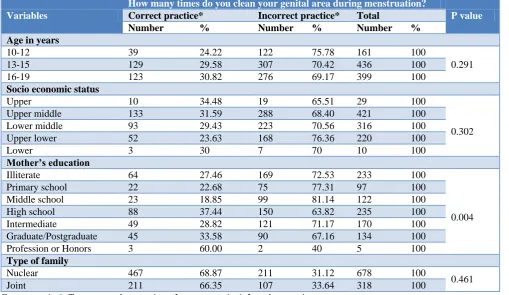
Table 6: Association of various sociodemographic variable as per their frequency of cleaning genitalia during menstruation.
Variables
How many times do you clean your genital area during menstruation?
P value
Correct practice* Incorrect practice* Total
Number % Number % Number % Age in years
10-12 39 24.22 122 75.78 161 100
0.291
13-15 129 29.58 307 70.42 436 100
16-19 123 30.82 276 69.17 399 100
Socio economic status
Upper 10 34.48 19 65.51 29 100
0.302
Upper middle 133 31.59 288 68.40 421 100
Lower middle 93 29.43 223 70.56 316 100
Upper lower 52 23.63 168 76.36 220 100
Lower 3 30 7 70 10 100
Mother’s education
Illiterate 64 27.46 169 72.53 233 100
0.004
Primary school 22 22.68 75 77.31 97 100
Middle school 23 18.85 99 81.14 122 100
High school 88 37.44 150 63.82 235 100
Intermediate 49 28.82 121 71.17 170 100
Graduate/Postgraduate 45 33.58 90 67.16 134 100
Profession or Honors 3 60.00 2 40 5 100
Type of family
Nuclear 467 68.87 211 31.12 678 100
0.461
Joint 211 66.35 107 33.64 318 100
The correct practice of changing pad (≥3 times) was maximum (37.09%) in age group 16-19 years and the proportion is decreasing with the age and found to be 30.43% in 10-12 years age group. Significant association was also found with socio economic status. It was found that 41.37% of female students who belong to upper class changed the pad ≥3 times a day during menstruation in contrast to the lower class in which this proportion was found to be 10% adopted the correct practice (Table 5).
Mother’s education was significantly associated with the correct practice (2 times or more) of cleaning genitalia. This proportion came out to be 60% in daughters of professionally qualified mothers, however it was only 27.46% in participants whose mothers were illiterate. However age, socio economic status and type of family are not significantly associated (Table 6).
DISCUSSION
Present study comprises 996 adolescent girls (10-19 years) of class 6-12th studying in senior secondary schools of Jaipur city. Mean age of the participants was 15.13±1.63 years which is similar to the study of Shanbhag et al, in which mean age was found to be 14.08±1.06 years.10 In the present study maximum number of the participants (43.77%) were in age group 13-15 years similar to the study done by Zaidi et al, which showed majority of the respondents, (57.3%), were aged between 13-15 years.11 42.27% of participants were belonging to upper middle class while in study by Zaidi et al showed most of the participants (75.6%) belonged to upper lower class, this difference may be because their study comprised of students only from government school. In this study majority (23.59%) of the participants had their mother’s educated till high school which was similar to the study done by Suhasini et al, in which 36% mothers have studied till high school followed by intermediate school (17.06%).12 Participants whose mothers were graduates were 13.45%; less than one percent were having professional degree which is almost equal to the datas of study by Suhasini et al in which graduate mothers and professional degree holder mothers had a proportion of 12.5% and 2% respectively. In the present study respondents living in nuclear family and joint family are 68.07% and 31.92% respectively similar to the study done by Ishita et al, in which respondents living in nuclear family and joint family were 69.07% and 30.3% respectively.13
In the present study 80.72% participants were having prior knowledge about menstruation before their menarche which was supported by the study done by Dixit et al, who reported that majority of the girls (86%) knew about menstruation before menarche occurred.14 In contrast study done by Ester et al, in Rundu, Namibia all (100%) the girls had knowledge on menstruation before menarche.15 The difference may be due to attributed socio –demographic and cultural difference of the participants.
In the present study a significant association was found between the knowledge of menstruation before menarche and age, socio economic status as well as mother’s education. Proportion of participants who had knowledge before menarche is higher in upper class (93.10%) whereas in lower class it is only 40%. All (100%) the girls whose mothers were professionally qualified knew about menstruation before menarche, followed by graduates, while whose mothers are illiterate this proportion was only (64.38%). In contasrt study done by Jagruti, concluded that mother’s education and knowledge regarding menstruation before menarche was not significant.16
The present study concluded that the proportion of participants using sanitary pad as absorbent was increasing with age and was maximum (73.68%) among 16-19 years age group and minimum in 10-12 years of age (63.35%). This difference was found to be significant. All the participants (100%) of upper class (2.9%) used sanitary pad while 30% participants of lower class used sanitary pad. All (100%) those female students whose mothers were professionally qualified used sanitary pad, while only 55.36% used sanitary pads whose mothers were illiterate. Almost three fourth of the participants from private school use sanitary pad while 59.15% participants from government school uses sanitary pad which was supported by the study done by Manohar et al, who concluded that 58.82% from the private school and 56 percent from the Government school were using disposable sanitary pads.17 Hence, significant association was found between correct practice of absorbent used with socio economic status, mother’s education and type of schools of the participants. Study done by Teketo et al, concluded that Girls from literate families were more likely to use sanitary napkins than their counterparts who were from illiterate family.18 Girls from families having better socio economic status were more likely to use sanitary napkins than their counterparts. These findings were supporting the present study.
concluded that association was found between frequency of change of soakage material and socio-demographic determinants and concluded that statistically significant association was observed between frequency of change of soakage material and age (p=0.012), mother's literacy status (p=0.050).20
In this study mother’s education was significantly associated with the correct practice (2 or more than 2 times) of cleaning genitalia. This proportion came out to be 60% in daughters of professionally qualified mothers, however it was only 27.46%in participants whose mothers were illiterate. However age, socio economic status, type of family are not significantly associated.
CONCLUSION
In this study it is concluded that mother’s education status and socio economic status are significant predictors of good menstrual hygienic practices. Hence, improving mother’s knowledge on menstrual hygiene management and social marketing of good quality, low cost sanitary napkins can go a long way in improving menstrual hygiene practices.
It is very important that adolescent girls should be educated about the importance of maintaining hygiene during menstruation to prevent risk of reproductive tract infections. Taboos should be removed by healthy discussion.
ACKNOWLEDGEMENTS
The authors sincerely thanks the staff of the schools involved in the study for their co-operation.
Funding: No funding sources Conflict of interest: None declared
Ethical approval: The study was approved by the Institutional Ethics Committee
REFERENCES
1. WHO Adolescent health, 2018. Available at: www.who.int/topics/adolescent_health/en. Accessed on 18 April 2018.
2. Census of India Government of India, Ministry of Home Affairs, Office of the Registrar General and Census Commissioner, India, 2011. Accessed 10 March 2018.
3. World Health Organization, Programming for adolescent health and development, WHO Tech Rep Ser No.1996:2.
4. Ray S, Dasgupta A. Determinants of Menstrual Hygiene Among Adolescent Girls: A Multivariate Analysis. National J Community Med. 2012;3(2):294-301.
5. Thakre SB, Thakre SS, Reddy M, Rathi N, Pathak K, Ughade S. Mestrual Hygiene: Knowledge and Practice among Adolescent School Girls of Saoner,
Nagpur District. J Clin Diagnos Res. 2011;5(5):1027-33
6. Jacob A. A Comprehensive Textbook of Midwifery. 2nd Ed. New Delhi; 2008: 63.
7. House. S, Mahon T, Cavill S. Menstrual Hygiene Matters: A Resource for Improving Menstrual Hygiene Around the World Wateraid. Taylor & Francis, Ltd; 2012;21(41):257-9.
8. Kamaljit K, Arora B, Singh KG, Neki NS. Social Beliefs and Practices associated with Menstrual Hygiene among Adolescent Girls of Amritsar, Punjab, India. JIMSA. 2012;25(2):69-70.
9. Verma P, Ahmad S, Srivastava RK. Knowledge and Practices about menstrual hygiene among higher secondary school girls. Indian J Community Health. 2013;25(3):265-71.
10. Shanbhag D, Shilpa R, D’Souza N, Josephine P, Singh J, Goud BR. Perceptions regarding menstruation and Practices during menstrual cycles among high school going adolescent girls in resource limited settings around Bangalore city, Karnataka, India. Int J Collab Res Intern Med Public Health. 2012;4(7):1353-62.
11. Zaidi SHN, Sivakami A, Jegadeesh Ramasamy D. Menstrual hygiene and sanitation practices among adolescent school going girls: a study from a South Indian town. Int J Community Med Public Health. 2015;2(2):189-94.
12. Kanyadi S, Metgud C. Factors Influencing Menstrual Hygiene Practice Among Late Adolescent Girls in an Urban Area of Belgaum. Ann Community Health. 2017;4(4):20-4.
13. Sarkar I, Dobe M, Dasgupta A, Basu R, Shahbabu B. Determinants of menstrual hygiene among school going adolescent girls in a rural area of West Bengal. J Family Med Prim Care. 2017;6(3):583–8. 14. Dixit S, Raghunath D, Rokade R, Nawaz SA,
Nagdeve T, Goyal I. Awareness about Menstruation and Menstrual Hygiene Practices among Adolescent Girls in Central India. Ntl J Community Med. 2016;7(6):468-73.
15. Kandjimi E, Aku-Akai L. Menstrual Hygiene and School Attendance among Adolescent School Girls in Rundu. Ann Community Med Pract. 2018;4(2):1036.
16. Prajapati J, Patel R. Menstrual hygiene among adolescent girls: A cross sectional study in urban community of Gandhinagar. JMR. 2015;1(4):122-5. 17. Sharma M, Johal KK, Malhotra V. To study the
knowledge, attitude and practice regarding menstrual hygiene and restrictions imposed upon them during menstruation in Adolescent girls studying in a government and a private school in Sahibzada Ajit Singh Nagar (Mohali City) In Punjab; A comparison Pilot Study. IOSR-JDMS. 2017;16(8):30-7.
19. Omidvar S, Begum K. Factors influencing hygienic practices during menses among girls from south India- A cross sectional study. Int J Collab Res Intern Med Public Health. 2010;2(12):411-23. 20. Goel P, Kumar R, Meena GS, Garg S. Associatioin
of sociodemographic characteristics with KAP regarding menstrual hygiene among women in an urban area in Delhi. Trop J Obstet Gynaecol. 2018;35(2):158-64.