Original Research Article
Assessment of knowledge and attitude towards emergency
contraception among postnatal mothers in Bruhat Bengaluru
Mahanagara Palike referral hospital
Ramegowda Chethana, Puttaiah Thejaswini*
INTRODUCTION
Unintended pregnancy is an important public health issue in developing countries like India.2 It is estimated that about 40% of pregnancies are unintended (i.e., pregnancy that is reported to have been either unwanted or mistimed) worldwide and up to 1,00,000 maternal deaths could be avoided each year if women who did not want children used effective contraception.1 One of the option for preventing such pregnancy is the use of emergency contraception (EC). Emergency contraception refers to
methods of contraception that can be used to prevent pregnancy within the first 5 days of sexual intercourse. It is intended for use following unprotected intercourse, rape or coerced unprotected sex. It provides an additional support to prevent pregnancy whenever there is a breach in the regular contraceptive use.3 The consequences of unintended pregnancy are multiple. It can lead to unsafe abortion, maternal morbidity and mortality which in-turn leads to various social and economic consequences. Hence it is important to initiate contraception in early postpartum period as ovulation can occur as early as 25
ABSTRACT
Background: Unintended pregnancy is an important public health issue in developing countries like India. Emergency contraception (EC) is one of the method for preventing such pregnancies. Awareness regarding EC is necessary for postnatal mothers since delay in contraceptive use during postpartum period until return of menstruation might subject them to risk of unintended pregnancy. Hence, the present study was undertaken.
Methods: The study was conducted at Bruhat Bengaluru Mahanagara Palike (BBMP) referral hospital, Bengaluru from March 2016 to May 2016. A total of 100 postnatal mothers, were included in the study. A pre-tested semi-structured proforma was administered and information about socio-demographic profile, knowledge and attitude towards use of emergency contraception was obtained.
Results: Among the study subjects, 28% were aware of emergency contraception, friends (57%) were the major source of information about EC. Overall knowledge regarding methods, time limit and dosage was low. There was a significant association between the educational level (p=0.01) and previous planned delivery (p<0.001) with awareness about EC. 51.4% had favourable attitude towards its use as an additional contraception whenever necessary.
Conclusions: There is lack of knowledge and unfavourable attitude towards EC among post natal mothers.The factors such as education and previous planned deliveries had significant association with the awareness about EC. Hence health education regarding emergency contraception is necessary.
Keywords: Emergency contraception, Unintended pregnancy, Postnatal women, Knowledge, Attitude
Department ofCommunity Medicine, Kempegowda Institute of Medical Sciences, Bengaluru, Karnataka, India
Received: 06 July 2018
Accepted: 13 August 2018
*Correspondence:
Dr. Puttaiah Thejaswini,
E-mail: [email protected]
Copyright: © the author(s), publisher and licensee Medip Academy. This is an open-access article distributed under the terms of the Creative Commons Attribution Non-Commercial License, which permits unrestricted non-commercial use, distribution, and reproduction in any medium, provided the original work is properly cited.
days of postpartum among non-breastfeeding women.4 The dynamics of contraception use among women in the extended postpartum period is of much more interest at the family planning programme level, since delay of use until the return of menstruation might subject women to the risk of unintended pregnancy.5 According to the report of National Family Health Survey (NFHS-III) of India, more than 60% pregnancies occur within three years of the previous birth, and only 28 percent have an optimal birth interval of 36-59 months.6 Hence, the higher proportion of unintended pregnancies might be due to shorter birth intervals. An increase in contraceptive use during the postnatal period (i.e. period after the birth of a child and extending for about six weeks) substantially reduces the rates of maternal and infant mortality. Moreover, women are usually accessed to the healthcare system and can be easily motivated to avoid unwanted pregnancies. Hence, postnatal period becomes more crucial for initiating contraception to space births and to prevent unintended pregnancies.
Good knowledge and favourable attitude towards emergency contraception is necessary among postnatal mothers, to avoid unintended pregnancies. Hence future pregnancies can be delayed and planned accordingly. However, there is lack of information regarding knowledge and attitude about emergency contraception in developing countries like India. In this context, the present study was taken up to assess the knowledge and attitude of postnatal mothers towards emergency contraception and to find out the association between socio-demographic variables, parity and previous planned delivery with awareness of emergency contraception.
METHODS
A hospital based cross sectional study was conducted in Bruhat Bengaluru Mahanagara Palike (B.B.M.P) referral hospital from March 2016 to May 2016. A total of 100 postnatal women who attended the OPD, IPD and emergency services, wished to participate and gave informed consent were enrolled in the study. Subjects who had underwent hysterectomy or permanent sterilization or seriously ill were excluded from the study.
An institutional ethical committee clearance was obtained prior to study. All postnatal mothers enrolled in the study were thoroughly interviewed by using pre designed, pre-tested semi-structured proforma. All questionnaires were prepared in English language and then translated to kannada for data collection and then re-translated back to english to prevent inconsistencies in the given answers.
The first part of the questionnaire covered the demographic information that included age, level of education, occupation, socioeconomic status, and parity. The second part assessed the knowledge on EC which includes methods, advantage, situation, time limit, dosage etc. Each correct answer to knowledge question was given a score of one and each incorrect answer and don’t know both were given a score of zero. The third part assessed the attitude of the respondents towards EC.
Attitude questions regarding effectiveness, willingness, recommending to others, safety, future pregnancy etc. were included. The attitude was measured using 5 point Likert scale as Strongly agree (5), agree (4), don’t know (3) Strongly disagree (2) disagree (1) and reverse scoring system was used to negatively framed questions. All individual answers to attitudinal questions was computed to obtain total scores and calculated for means. The mean scores were used to classify the participants into two groups; favourable and nonfavourable attitude. The respondents who scored ≥50% are considered as having favourable attitude and less than 50% as having unfavourable attitude.
Data was entered in MS Excel 2016 and statistical analysis and interpretations were done by using descriptive statistics like mean, percentages and χ2
test to find out association by IBM SPSS statistics-23 package.
RESULTS
Table 1: Description ofsocio-demographic profile of the study subjects (n=100).
Percentage (%)
Age group
15-19 7.0
20-24 54.0
25-29 32.0
30-34 7.0
Religion
Hindu 86.0
Muslim 14.0
Education
Primary school 13.0
Higher secondary school 52.0
PUC 20.0
Graduate 15.0
Occupation
Home maker 92.0
Private service 4.0
Business 3.0
Labourer 1.0
Socio economic status
Upper class 4.0
Upper middle 40.0
Lower middle 48.0
Upper lower 7.0
Lower 1.0
Type of family
Nuclear 81.0
Joint family 13.0
3rd Generation family 6.0
Previous planned pregnancy
Planned 12.0
Unplanned 88.0
Parity
Primipara 51.0
In the present study, a total of 100 postnatal women were enrolled. The age of the post natal mothers were ranged from 18 to 34 years with median age 23 years (Table 1). Amongst 54% of them were in the age group of 20-24 years. 86% of them were belong to Hindu religion. 52%
of them were educated up to higher secondary school. 92% were homemakers, 48% belongs to lower middle class socio economic status scale according to modified Kuppuswamy classification and about 81% belonged to nuclear type of family.
Table 2: Knowledge about EC among postnatal mothers who have heard about EC (n=28).
Sl no Questions Correct
response (%)
1. Do you know the methods of EC? 07 (25.0)
2. Do you know that EC has advantage to prevent unintended pregnancy? 24 (85.7)
3. Do you know EC is required in the situations like condom breakage, missed regular pills and
when no contraceptive is used to prevent unintended pregnancy? 20 (71.4)
4. Does EC cause abortion if consumed? 8 (28.5)
5. Do you know EC is available in the market? 13 (46.4)
6. Do you know the time limit within which you need to take EC? 5 (17.9)
7. Do you know about dosage of EC pills? 1 (3.6)
8. Do you know doctor’s advice is necessary before taking EC? 18 (64.2)
Note: Figures in parenthesis indicate percentages.
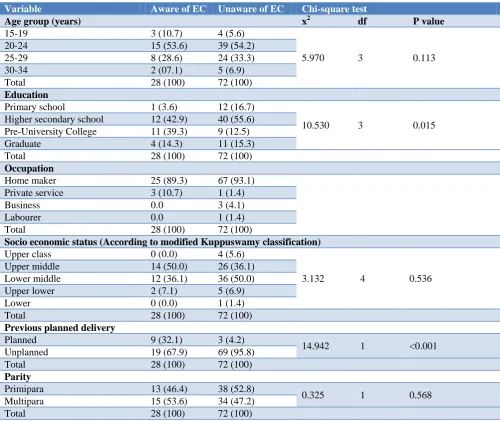
Table: 3 Association between socio-demographic variables and awareness of EC.
Variable Aware of EC Unaware of EC Chi-square test
Age group (years) x2 df P value
15-19 3 (10.7) 4 (5.6)
5.970 3 0.113
20-24 15 (53.6) 39 (54.2)
25-29 8 (28.6) 24 (33.3)
30-34 2 (07.1) 5 (6.9)
Total 28 (100) 72 (100)
Education
Primary school 1 (3.6) 12 (16.7)
10.530 3 0.015
Higher secondary school 12 (42.9) 40 (55.6)
Pre-University College 11 (39.3) 9 (12.5)
Graduate 4 (14.3) 11 (15.3)
Total 28 (100) 72 (100)
Occupation
Home maker 25 (89.3) 67 (93.1)
Private service 3 (10.7) 1 (1.4)
Business 0.0 3 (4.1)
Labourer 0.0 1 (1.4)
Total 28 (100) 72 (100)
Socio economic status (According to modified Kuppuswamy classification)
Upper class 0 (0.0) 4 (5.6)
3.132 4 0.536
Upper middle 14 (50.0) 26 (36.1)
Lower middle 12 (36.1) 36 (50.0)
Upper lower 2 (7.1) 5 (6.9)
Lower 0 (0.0) 1 (1.4)
Total 28 (100) 72 (100)
Previous planned delivery
Planned 9 (32.1) 3 (4.2)
14.942 1 <0.001
Unplanned 19 (67.9) 69 (95.8)
Total 28 (100) 72 (100)
Parity
Primipara 13 (46.4) 38 (52.8)
0.325 1 0.568
Multipara 15 (53.6) 34 (47.2)
Total 28 (100) 72 (100)
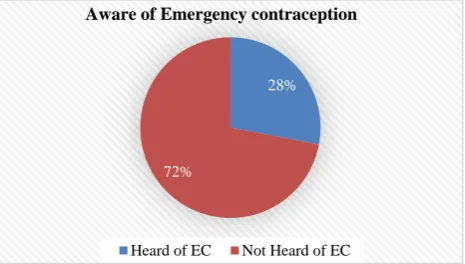
Amongst 100 mothers only 12% of them had planned pregnancy and most i.e. 88% of them had unintended pregnancies. 50% of the study subjects knew about oral contraceptive pill, 44% about tubectomy, 35% of them knew about IUCD as various methods of contraception. However only 28% of the respondents were heard of EC (Figure 1).
In Table 2, the respondents who have heard about EC (n=28), 85.7% said that they knew about the advantage as to prevent unintended pregnancy, 71.4% pointed out that EC D necessary following condom breakage, missed regular pills, rape and when no contraceptive is used, 64.2% of them told that doctor’s advice is necessary before taking EC, and only 46.4% were aware about the availability of EC in the market. More importantly 71.5% had the misconception that ECP can be used to induce abortion. However very few subjects were aware about its methods, dosage and the time limit to take EC.
Figure 1: Distribution of study subjects regarding awareness about emergency contraception.
(Table 3) There was a significant association between the educational level (p=0.015) and previous planned delivery (p<0.001) of the study subjects with awareness on EC, but there was no significant association observed between occupation, socioeconomic status and parity of the study subjects with awareness on EC (p>0.05).
Table 4: Distribution of study subjects according to source of information regarding EC.
Sl No Source of information about EC
Frequency (n=28)
1. Medical and paramedical
personnel 3(10.7)
2. Family and relatives 2(7.1)
3. Friends 16(57.2)
4. Television and radio (media) 5(17.9)
5. News paper 2(7.1)
Note: Figures in parenthesis indicate percentages
Regarding source of information about EC (Table 4), majority i.e. 57.2% of them got to know from their friends, 17.9% from the media, 10.7% from health care
personnel and 7.1% from their relatives and newspaper each.
Table 5: Attitude towards emergency contraception (n=28).
Questions Attitude questions
Average mean score percentages
Q.1
ECP acts as an additional contraception when there is a miss of regular OC Pills.
51.4
Q.2
Emergency
contraception is effective in preventing pregnancy.
45.0
Q.3 Willingness to use EC in
future 39.3
Q.4 I recommend my friends
and relatives to use EC 29.3
Q.5 Emergency contraception can prevent STI 26.4 Q.6 Emergency
contraception is unsafe to be used.
33.6
Q.7 EC might affect
pregnancy in the future 27.1
Table 5, the average percentages of attitude score, among 28 study subjects, shows 51.4% had favourable attitude towards its use as an additional contraception when there is a miss of regular OC Pills. However unfavourable attitude was seen regarding EC, on effectiveness in preventing pregnancy (45.0%), Willingness to use in future (39.3%), recommending to friends (29.3%), regarding prevention of STI (26.4%), about safety in its usage (33.6%) and its effect in future pregnancy (27.1%).
Figure 2: Attitude of the respondents in relation to EC.
28%
72%
Aware of Emergency contraception
Heard of EC Not Heard of EC
7.1 14.3 21.4 28.6 10.7 0.0 0.0 14.3 10.7 14.3 14.3 14.3 21.4 3.6 7.1 14.3 17.9 28.6 46.4 17.9 21.4 64.3 53.6 39.3 25.0 17.9 42.9 50.0 7.1 7.1 7.1 3.6 10.7 17.9 25.0 Q1 Q2 Q3 Q4 Q5 Q6 Q7 Percentage Q uestio ns
Attitude towards Emergency Contraception
Strongly disagree(%) Disagree(%)
Neutral(%) Agree(%)
DISCUSSION
Unintended and unplanned pregnancies pose a major challenge to the reproductive health of women. Each year approximately 210 million pregnancies occur worldwide and more than one-third (75 to 80 million) of these are unintended, more than half of these (46 million) unintended pregnancies undergo unsafe abortions.7 Worldwide up to 1,00,000 maternal deaths could be avoided each year if women who did not want children used effective contraception.1 Emergency contraception is one such method which helps to prevent unintended pregnancy following unprotected sexual intercourse. However, EC to be effective only when it is timely taken at proper dose. Hence, the present study was undertaken in our setup to see the knowledge and attitude towards emergency contraception. In the present study, a total of 100 postnatal mothers were enrolled with the median age 23 years. Most of them were in the age group of 20-24 years and followed by 25-29 years, 86% were belonged to Hindu religion and the rest were Muslims. Majority i.e. 52% of study subjects were educated up to higher secondary school with 48% belonging to lower middle class and 40% upper middle class socio-economic status.
Among the post-natal mothers, 88% of them had unintended pregnancies, while in a similar study by Trussell in in United States 49% of their respondents had unintended pregnancies.8 It was found that the prevalence of unintended pregnancy was 30% in the study conducted on women of rural Bangladesh by Kamal.9 Similarly, studies from Nepal and Philippines have also reported the incidence to be 41% and 53% respectively.10,11 the high prevalence of unintended pregnancy in our study could be attributed to lack of knowledge regarding emergency contraception and other contraceptive methods.
It was found that, among respondents 28% were aware of emergency contraception and 2% of them used previously. In which 85.7% said that they knew that it is used to prevent unintended pregnancy, 46.4% were aware about the availability of EC in the market, 17.9% of them correctly knew about the timing when these pills should be taken and only 3.6% of them knew the dosage. Similarly, another study conducted by Rebecca Johnson et al to assess the knowledge to use emergency contraception among low-income post-partum women reported that 36% of their study respondents knew about EC, 5.7% knew about its availability and 7% knew about correct time limit.12 A study conducted by Lakshmi Devi et al to assess the knowledge, experience and opinion on emergency contraception among urban educated women at Bangalore, India revealed 24.2% of the participants were aware about EC.13 Similarly, another study conducted to assess the women’s knowledge and opinion regarding emergency contraception by Dahiya et al showed that, only 12.2% (55 women) respondents were aware of EC methods.14 A study by Srivastav et al reported that knowledge about emergency contraceptive has 6.83% even though 71.22% females had awareness
regarding any method of contraception.15 Thus it is clear that, there is lack of knowledge among women in the
reproductive age group regarding emergency
contraception.
In the present study, it was evident that the key factors
which influenced the awareness on emergency
contraception were education and previous planned deliveries whereas age, occupation, socioeconomic status and parity were not significantly associated with awareness about EC. However, a significant association between contraception acceptance and education, occupation and socio-economic status were observed in a study conducted by Nath et al among postpartum women in North Indiaand another study conducted by Thapa et al in tertiary care centre among post-partum and post abortal women observed that the awareness about EC was more reported by multiparous women in comparison to primiparous women.17 Education plays a key role in
understanding and creating awareness towards
emergency contraception. If women had previous planned delivery, she would have come across various contraceptive methods available and might have adopted any one of her choice. This may be the reason for increased awareness regarding EC.
Among those participants who were aware of EC, 57.2% got to know about ECs from their friends, 17.9% from the media, 10.7% from health care personnel and 7.1% from their relatives and newspaper each. Whereas a study conducted by Srivastav et al on women of reproductive age, reported that TV/radio was the major source of information about contraception in their study however the family relatives were the least source.15 The reason may be due to uncomfortableness to discuss with their family members.
The most commonly cited reasons for contraceptive non-use in India and other developing countries include: quality, accessibility, and cost of family planning services; side effects (either experienced by a woman herself or by other women she knows); fear of a particular method or health reasons for not using a method; desire for more children; and opposition to family planning for religious or other reasons. Misconceptions about contraceptive use and a negative image of the family planning programme are also sometimes mentioned as reasons for discontinuation and non-use.18
reproductive age group by Singh et al regarding ECPs, 37.5% said it is effective for preventing pregnancy, 41.6% would use ECPs in future, 28% not used due to fear of side effects.19 In another study on female college students by Arora et al, 38.7% would ever use emergency contraceptive pills or recommend it to a friend/relative in case of need. 11.1% said it may result in more women suffering from STI.20 However, in contrast, a study on female nursing staff in Sikkim by Rahaman et al, reported that 60.71% were willing to use EC, 79% would encourage friends and relative to use and in another study by Relwani et al, among engineering college girls in Nagpur district of central India, more than 70% students agreed or strongly agreed that they would either themselves use or recommend emergency contraceptive pills in case of need.21,22 The variation in the results could be attributed to the differences in the occupation and educational level of the study subjects. From the present study it is evident that there is a lack of awareness about EC among postnatal mothers and even among those who have heard of EC the attitude is favourable only towards its use as an additional contraception whenever necessary. Most of them were apprehensive regarding side effects of EC which could affect pregnancy in future when they desire to become pregnant. This ultimately leads to non-usage of EC even if they are willing. Hence there is a need to provide health education in order to sensitise the postnatal mothers to improve their knowledge and attitude regarding EC’s.
CONCLUSION
From the present study it is evident that there is a lack of awareness regarding emergency contraception among postnatal mothers. Among those who have heard of emergency contraception favourable attitude was observed only towards its usage. Hence there is a need to
educate postnatal mothers about emergency
contraceptives, with emphasis on the available methods and correct timing of use. Thus unintended pregnancies can be prevented when knowledge and attitude towards usage of emergency contraception is improved.
Recommendation
Regular counselling and information should be provided regarding various methods, timing of its usage, availability and safety of emergency contraception, in order to improve knowledge and its acceptance by bringing about favourable attitude among postnatal mothers. When postpartum family planning counselling is provided as a part of maternal and child-health services, it will have better acceptance.
ACKNOWLEDGEMENTS
The authors express many thanks and sincere gratitude to the staff of department of Community Medicine, Kempegowda Institute of Medical Sciences, Bengaluru. I would also extend my wholehearted thanks to my fellow
postgraduates for their immense support, help and encouragement during the study. We also thank all the study participants for their co-operation during the study.
Funding: No funding sources Conflict of interest: None declared
Ethical approval: The study was approved by the Institutional Ethics Committee (KIMS IEC/A-20/2016)
REFERENCES
1. Marston C, Cleland JC. Do unintended pregnancies
carried to term lead to adverse outcomes for mother and child? An assessment in five developing countries. Population Studies. 2003;57:77–93.
2. Gipson JD, Koenig MA, Hindin MJ. The effects of
unintended pregnancy on infant, child and parental health: A review of the literature. Studies in Family Planning. 2008;39:18-38.
3. Takkar, Goel P, Saha PK, Dua D. Contraceptive practices and awareness of emergency contraception in educated working women. Indian J Med Sci. 2005;59(4):143-9.
4. Laurie Barclay. CDC updates guidelines for
postpartum contraceptive use. Medscape, 2011. Available at: http://www.medscape.com/viewarticle/ 746177. Accessed on 6 May 2016.
5. Vernon R. Meeting the family planning needs of
postpartum women. Stud Family Planning.
2009;40(3):235-45.
6. International Institute for Population Sciences (IIPS).The third national family health survey (NFHS-3), India, 2005-06. Int Insti Popul Sci Mumbai.2007;2:1-168.
7. Ali SA, Ali SA. Unmet need for contraception and
unintended pregnancies among women of
reproductive age group: a situation analysis. Elective Med J. 2014;2(3):259-65.
8. Trussell J. The cost of unintended pregnancy in the United States. Contraception. 2007;75:168–70. 9. Kamal M, Islam A. Prevalence and socioeconomic
correlates of unintended pregnancy among women
in rural Bangladesh. Salud Publica Mex.
2011;53(2):108-15.
10. Adhikari R, Soonthorndhada K, Prasartkul P.
Correlates of unintended pregnancy among
currently pregnant married women in Nepal. BMC Int Health Hum Rights. 2009;9:17.
11. Singh S, Cavigon JV, Hossain A, et al. Estimating the level of abortion in the Philippines and Bangladesh. Int Fam Plann Perspect. 1997;23:100– 7.
12. Jackson R, Schwarz EB, Freedman L, Darney P. Knowledge and willingness to use emergency contraception among low-income post-partum women. Contraception. 2000;61:351-7.
14. Dahiya K, Mann S, Nanda S. Women’s Knowledge and Opinions regarding Emergency Contraception. J South Asian Federation Obstetrics Gynaecol. 2012;4(3):151-4.
15. Srivastav A, Khan MS, Chauhan CR. Knowledge, Attitude and Practices about Contraceptive among Married Reproductive Females. Int J Scientific Study. 2014;1(5):2-4.
16. Nath J, FarzanaIslam. A Study on the Knowledge, Attitude and Practice about Contraception in Postpartum Women of North India. International J Sci Res. 2015;4(12):465-8.
17. Thapa S, Rani A, Mishra CP. Knowledge, attitude and belief about contraception in post-partum and post abortal women in a tertiary care centre. Int J Reprod Contracept Obstet Gynecol. 2014;3(3):533-9.
18. Mishra VK, Retherford RD, Nair PS, Feeney G. Reasons for discontinuing and not intending to use contraception in India. National Family Health Survey Subject Report No 13. Mumbai, India: International Institute for Population Sciences and
USA, Hawaii, Honolulu: East-West Center,
Population and Health Studies; 1999: 36.
19. Singh V, Thakur P, Nayak PK, Agrawal S.
Knowledge attitude and practice (KAP) of
emergency contraceptive pills among women of reproductive age group attending AIIMS OPD Raipur (C.G). Int J Adv Med. 2014;1:105-12.
20. Arora P, Bajpai RC, Srivastava R. Emergency
Contraception: A Study to Assess Knowledge, Attitude and Practices among Female College Students in Delhi. Natl J Community Med. 2013;4(2):282-5.
21. Rahaman H, Renjhen P, Kumar A. A study on
emergency contraceptive practice among nursing staff in Sikkim, India-A cross sectional study. Australian Med J. 2010;3(10):667-71.
22. Relwani N, Saoji A, Kasturwar NB, Nayse J, Junaid
M, Dhatrak P. Emergency Contraception: Exploring the knowledge, attitude and practices of engineering college girls in Nagpur district of central India. National J Community Med. 2012;3(1):14-9.