* To whom all correspondence should be ad-dressed.
Predicting Crimes Using Time Series Model and ARCGIS Software
Mohammad Hassan Rahmani
Department of Human Science, Faculty of Geography, Payame Noor University, Boein Zahra, Iran. doi: http://dx.doi.org/10.13005/bbra/1592
(Received: 18 June 2014; accepted: 20 July 2014)
Possibility for predicting crimes using time series model and ARCGIS Software are investigated in the current work. Analysis and study of mutual relationship between skeletal environment of cities and social disorders and crimes is the subject which has been entered in geographical studies in recent decades and has become very important. Geographical information system was used in this work to predict crimes. To this end, the crimes related to theft from March 2011 to February 2011 as well as two years ago and one year later crimes were recorded and investigated in ARCGIS Software so that a solution can be found in providing time patterns by technical analysis. Thus, urban area was studied as statistical population. Then, using database of these crimes and statistical and graphical tests in ARC GIS environment, the crimes were predicted. Analytical – descriptive method was used as research method and it was an applied research study. Data and information were collected using library and field methods. Results show applying theft location to a conventional point in each district may be useful for providing an analytical model and then predicting and presenting solutions for police centers. Crime analysis maps are important tools in crime analysis and they can be necessary prerequisites for crime prediction.
Key words: Cluster analysis, ARCGIS software, Analytic Hierarchy Process (AHP), Time series, modeling
The main factor for formation of undefended urban spaces is lack of compatibility between form, function and meaning. Considering the principle that every activity should be done within area with compatible skeletal and spatial characteristics with the activity, the relationship form, function and meaning can be understood. This relationship should be so that physical skeleton (form) is able to respond simultaneously to the function and meaning.
Spaces without usage in large cities are very extensive due to speculation in urban lands and the idea of land as a trusted asset. Abandoned buildings and unfinished construction projects that have been stopped for some reasons and empty buildings are spaces with no function which provide ground for incidence of urban crimes. Spaces with alternative functions are among other undefended spaces. These spaces are abandoned in some periods of day or season or year.
sanitation, immigrant settlement, density, etc. they have become crime neighborhoods (Richard, 6:2001).
There is no regular system in the police for the following cases:
Mapping crime, collision time and its location, informing resources to prevent crime, evaluating preventive effect of crime, helping in prevention and rapid response to crime
Dense locations are more vulnerable to crime than calm locations. Internal regions of the cities, where there is no optimal environmental condition and are suitable for gathering of newcomer immigrants, as well as slums and shanty-towns around cities with high densities are considered as locations with high rate of crimes. Violent crimes often occur in internal regions of the cities and urban slum areas.
Characteristics of these areas include: Low-income level, racial accumulation, dilapidated houses, working mothers, low levels of education and professional skills, high unemployment rate, high population of single men, houses under the standard, low rate of home ownership, employment of multiple housing, mixed land uses and high population densities (Walmsly, 1998).
Prediction Techniques
They are classified into two classes:
Long-term prediction models are used for police design and applications in extending and developing methods and models.
Short-term prediction models are used for tactical decisions. Strategic plans in long-terms perspective are crucial for organizing specific sector for designing location and layer of demand prediction and planning new products. In comparison, long-term prediction constitutes low part in crime prediction courses in police organization, while short-term prediction is recommended for initiating the first forward step. One-week or one-month predictions are often used for crime prediction and prevention for general offenders by police departments (Gorr and Olligschlaeger, 1997).
Proper implementation of prediction methods depends on information, which is a necessary part for accuracy and reliable prediction, though estimation of appropriate model is also very important. To this end, the more practical is the method, all techniques estimate only the procedure
and they are highly dependent on the information which is entered into the analysis.
Having inadequate information leads to producing poor prediction model and the result would be unrealistic. The method which is used in crime prediction depends on the following questions: where and how criminal acts occur? According to the responses, the model is converted to a special – local model. There are no boundaries between models in the writings. When the crime occurs, several techniques are designed for local prediction model or drawing hot spots is important for crime prediction model.
The simplest way to identify future crime model is single-and multi-variable techniques. Except for short-term prediction techniques which are single-variable techniques, prediction models are depends on the type of search and demand.
Single-variable technique is used for crime prediction, and 2. Multi-variable technique is used for showing prediction model, which uses various variables for effect of crimes to crime prediction models.
The main difference in two models is that outsourcing models predict for future only by outsourcing current crime model from evidence, while marker models are able to predict new crimes model which have not ever observed (Gorr and Olligschlaeger, 1997).
Chaineyand Rateliffe (2005) proposed a third technique for modeling the process, in which multi-variable models of offenders behavior with time prediction is addressed. Temporaldistribution of crimes is the model which no specific model for temporal prediction has been mentioned in the literature. Temporal distribution and time series graphs of crimes are tools for predicting probable time of occurrence (Gorr and Olligschlaeger, 1997). The main problem is obtaining accurate and reliable information and appropriate model. Several techniques have been designed for predicting time and location of crime occurrence in the future. Such methods as econometrics, box Jencks, temporal – spatial self-defeating, average movement of multivariate transfer models (ST.ARIMA) and artificial neural networks are used in modeling based on statistical method in predicting temporal – special crime prediction (Gorr and Olligschlaeger, 1997).
predictions are done using one or more time series in econometrics and the past values of time series are necessary for the prediction. This method extends a recursive model. Past values are well predicted in each time series as dependent variables of dependent time series, which are independent time series or predictive values in this method.
· Crohn’s model ST-ARIMA: it is a method for modeling single-variable time series. The model power depends on ARIMA. They can joint in self-defeating periods and average movement periods. Using ARIMA model is similar to box Jencks, though both AR and MA models are considered as common in ARIMA model. However, they are yet as models in box Jencks or ARIMA models.
· The other technique in temporal – spatial prediction is artificial neural networks. These models are based on the past location of crime temporal information.
Crime Prevention and Prediction
The term prevention means preventing, obstacle, blocking andprecautions to prevent adverse and bad events (Boba, 2005). Considering meaning of the term, it also meansoutnumbering, forestalling, and informing and warning.
Kizer defines crime prevention as follows: all measures that their ultimate goal is minimizing extent and severity of crime, whether through reducing opportunities and situations of crime occurrence or through influencing potentialoffenders and the whole society; thus, success of police’s preventive measures is based on prediction power (Graham, 1992).
It plays fundamental role in proactive prevention. Proactive prevention is collection of non-criminal measures and actions which aims at preventing crime before committing it by intervention in potentiality of crime and pre-criminal situation. Such prevention inherently is a predictive action, which is in two ways:
1. Situation-based prevention 2. Social prevention
Situation-based prevention essentially is based on information and prediction. Such prevention includes a collection of non-criminal measures and actions which prevents from committing the crime through eliminating or recuing opportunities for crime and showing inappropriateness of pre-criminal situation and condition. In other words, situation-based
measures and actions show crime as harmful for possible offenders by intervention in pre-criminal situations (Graham, 1992).
Situation-based prevention includes reductive measures for situations which:
1. Consider specific forms of the crime.
2. Include design management or urgent manipulation of environmentin a specific and permanent manner.
3. Attempt to increase crime risk and reduce interest of a wide scope of offenders.
Prediction Methods for Police Prevention of Crime
Predictions were done often based on continuation of the trend in the past, while today prediction methods have higher stability due to systematic and experimental reviews of data and use of logic and research science, and have higher reliability. Prediction of threats and harms now is considered as a necessity for social management and it turns to a continuous and ongoing process. Especially by changes in social, economic and cultural components, threats and harms have also changed and thus more need for prediction and monitoring changes is felt with complexity of the society.
There are various methods in police prevention, using which the police practitioners especially decision makers can estimate future crime changes in terms of type and prevention. Some of these methods include:
Trend Analysis
Trend analysis includes studying specific trend of a phenomenon in order to discover nature of incidence causes, speed of formation and its potential outcomes. In this method, an estimate of the future is possible by studying continuation of events. For example, armed thefts are investigated within one recent year and its continuation in the future in terms of type, way, region, etc. can be predicted.
Scenario Planning
occur exactly as the same way they were imagined, they would be useful. These scenarios help in recognizing issues and problems which may occur in a future operation (Shafiee, 2001).
Scenarios are alternative events which are developed for directing attention to causal processes and important points of decision making. Scenarios respond two types of question:
1.How is it possible that a step-by-step hypothetical situation occur?
2. What are alternatives for each actor in each step for preventing, distorting or facilitating this process?
Delphi Method
This method was proposed in 1960s by Rand Research Center, California. The main idea is that many experts systematically focus on a subject so that more information about the subject is provided and they are able to offer more comprehensive prediction. Delphi is an easy and suitable method for identifying trends and events which should be considered. Approaches and predictive views which can be used in these cases are limited and include expert simulation and prediction. Questions which are generally
proposed in design and planning applications in Delphi method include:
1.Predictions about future changes. 2.Benefit of future positions.
3.Tools to achieve or prevent a situation in the future.
Computer Simulation
Different situations in police missions and operations such as hostage, terrorist events, and etc. can be simulated by computer games. Commanders and operational forces can reconstruct multiple positions and have different predictions and consider several likelihoods of such events and processes. Computer simulations can specify the space resulting from possible predictions in order to better prevent and manage them.
Brainstorming (Thinking Together)
Generating new ideas is realized using thought group which is formed with the purpose of creative thinking. By introducing specific issues and in order to predict future events, it is possible to process data in collecting thinking and generate ideas. Brainstorming method is very useful for
Table 1. City area and comparison to district and province area
Qazvin area vs. Area (sq.km) Location
Qazvin Province Qazvin District
23.49% 0.65% 3713 Qazvin City 5693 Qazvin District 15805 Qazvin Province
Table 2. City population and its main changes
City Growth Population Growth Population Growth Population Population – village percent in 2006 percent in 1996 percent in 2006 in 1996
Qazvin 2.02 355338 1.59 291117 5.97 248591 139258
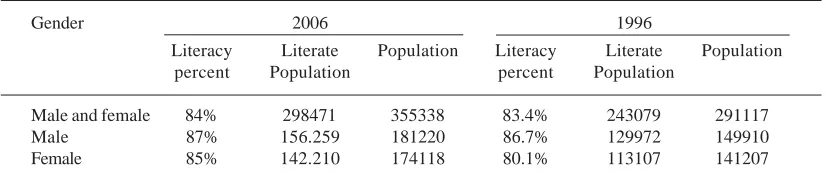
Table 3. Estimation of literacy level in Qazvin city population in 2006
Gender 2006 1996
Literacy Literate Population Literacy Literate Population percent Population percent Population
identifyingpossibilities, damages, threats and opportunities in the field of crime.
Analytic Hierarchy Process
Use of Analytic Hierarchy Process includes analytic process for predicting security and police phenomenon in order to make decision. The way of formation of complicated situations and future probability are monitored in this method and mutual reactions between factors are measured and all information are combined to determine priorities. In AHP: 1. Firstly the information on an issue are collected and provided for experts. 2. Then, possible options for occurrence in the future are collected. 3. Their analysis and hierarchy priorities of them is specified. This process considers numerical value for each variable of the problem with imposing a kind of cohesion and helps decision makers to predict decisions and measures by summing the values (figures) (LokaLunzipier, 2002).
Police Game
Police operations can be simulated. Police commanders and directors especially in operation and prevention field simulate future operations
scenes by drawing plans on the large urban maps or regional maps, and design and predict measures related to prediction or operation in different positions by reviewing possible situations. Establishment of command station and performing preventive operations in the form of police maneuvers is one of the police games. In this method, designers can use the thinking as an opponent and assume situations which may be adopted by the opponent. This method helps in determining vulnerable points and the way of utilizing them.
Crime prediction may be testing in three different areas: temporal, spatial and temporal – spatial. Prediction of temporal - special crimes is a new type and it has been popular among cerographists. Crime analysis using time series methods is used in statistical methods in investigating economic issues in neural network (Brown, 2000). Analysis of crime foci in demographic aspects (of clustering type) may be better than mere locating these cases, since it provides better analysis of the crime and its foci for identifying vulnerable areas. Thus, using a
Fig 1a.Time period of home theft during 2010-2011-2012
Fig 1b.Time period of home theft during 2010-2011-2012
Fig 2a.Time period of store thefts during 201-2011-2012
realistic analysis, appropriate police tactics can be adopted for prevention of crime as an urban problem. Then, units can be located properly and finally it is possible to have predictions using this improved model of the analysis. It is useful for managers and decision makers to identify hot spots, since most police organizations have inadequate number of staffs. Current work seeks for answering following questions:
How to find suitable location for establishment of a new police station?
What are principles of clustering model for crime analysis and prediction?
What are benefits of mathematical and local models applicable in this regard?
What are practical and scientific solutions to cope with criminality and increased risk factor for crime occurrence in foci susceptible to crime?
Data Collection Methods and Results Statistical Population
Statistical population in this research includes crimes (thefts) occurred within the central part of the city during 3 years (since March 21, 2009 to March 20, 2012).Statistical methods and statistical and graphical analysis as well as Office/ Excel software were used for data analysis in this work. GIS software was used for statistical and graphical analysis. It should be notedGIS capabilities were used in identifying spatial patterns of foci vulnerable to crime. Use of GIS in geographical investigation of crime was started sine 1970s. Using capabilities and techniques of this system, it is possible to develop databases, ordering, spatial representation of criminal information, information integration and its spatial analysis.
Table 1 shows city area and comparison to district and province area. Table 2 indicates city
Fig 3a.Time period of vehicle thefts during 201-2011-2012
Fig 3b.Time period of vehicle thefts during 201-2011-2012
population and its main changes. Table 3 shows estimation of literacy level in city population in 2006.
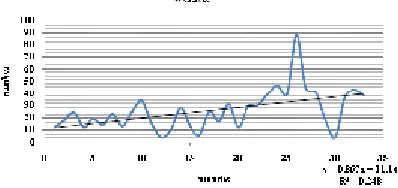
Figure 1 indicates time period of home theft during 2010-2011-2012. Despite of fluctuations observed in the figure, there is a positive slope for increasing crimes in the region, Figure 3 indicates time period of store thefts during 201-2011-2012. Positive slope in vehicle theft is much more than store and home thefts.
information. Most institutions which are successful in implementing the law in other countries are using crime mapping, crime model analysis and data-based management. Solving the problem prevents from crime and reduces crime rate. Prediction possibilities are compared in three aspects in the following. They were compared in three phases; phase 1: through time series, phase 2: through linear regression equations, phase 3: using least squares regression formula, which are provided in the following.
Using least squares regression formulae, home theft will increase by 1.4 percent in 2013, home theft will decrease by 1.2 percent and vehicle theft will increase by 2 percent. It should be noted these figures would be reduced by increasing security cases and informing, otherwise considerable increase will be observed given predictions.
As observed, there is partial difference in phase 2 and two other phases which can be explained as follows; the more information and better statistical interval is available, better time series would be present, otherwise, regression will be better in case there is information deficiency and low time interval.
CONCLUSION
Statistics obtained from urban situation indicate it is possible to identify probability of theft
occurrence in different regions by analysis of ARCGIS software data. As shown, crime occurrence time and location can be easily identified. Awareness of the statistics for crime occurrence is the basic element in predicting crime occurrence so that we can have a useful crime prediction.
REFERENCES
1. Boba, R. Crime Analysis and Crime Mapping, Sage, USA 2005.
2. Brown, D. and J. Dalton. Regional Crime Analysis Program (RECAP), presented at CrimeMapping Specialists Meeting, National Institute of Justice, Washington, DC, 1998. 3. Gorr W.L., Olligschlaeger A. ”Spatio-Temporal
Forecasting of Crime:Application of Classical and Neural Network Methods.” Working Papers of TheHeinz School, Carnegie Mellon University 1997.
4. Harries D. Keith. The Geography of Crime and Justice. McGraw-Hill.1974.PP. 119-121. 5. Lawman, J. “Conceptual issues in geography of
crime.” Toward a Geography of Control Annals,
Association of American Geographers, 1982;
76: 81-94.
6. Richard, M. Urban Poverty Reduction: Slum Prevention And UrbanUpgrading. World Bank 2001.
7. Safiri, S. City and crimes, role of councils in providing urban security, Journal of Municipalities, 2002; 1, Tehran Municipality. 8. Walmsly, D. J. Urban Living. Longman Scientific