Original Research Article
Effectiveness of adolescent health education among secondary and
senior secondary school girls in rural Bangalore
Dharini Kishor
1, Madhusudan Madaiah
2*, Santhosh Munipapanna
3,
Suresha Doddasabbenahalli Sonnappa
2INTRODUCTION
Adolescents
Often referred as the “generation of hope”. According to the World Health Organization, adolescence is defined as the period between 10 and 19 years, the second decade of life.1 It is a phase of transition from childhood to adulthood. It is during this period, that the boy/girl
acquires sexual and reproductive maturity. Today 1.2 billion adolescents stand at the crossroads between childhood and the adult world. India is home to more than 243 million adolescents, who account for a quarter of the country’s population.2
Health education
W.H.O defines health education as “Health education is any combination of learning experiences designed to help
ABSTRACT
Background: Adolescence is a phase of transition from childhood to adulthood. It is during this period that the adolescents acquire sexual and reproductive maturity. Health education given to adolescent girls helps build their knowledge, motivates them to improve and maintain their health, prevent diseases and reduce risky behaviors among them hence the study was done to assess the effectiveness of health education among rural adolescent girls.
Methods: An educational interventional study was carried out among adolescent girls in one secondary and one senior secondary school in Hoskote, rural Bangalore. Initial survey was done to assess the baseline knowledge regarding adolescent health issues using semi structured, self-administered questionnaire. Health educational sessions were conducted using audio-visual aids such as slide presentations, charts, posters and handouts. The education was followed by an interactive session with the students to clarify doubts and the impact of intervention was assessed. Results: The study comprised of 150 students (75 secondary and 75 senior secondary school girls). It was found that overall general knowledge regarding adolescent changes, menstruation and menstrual hygiene, pregnancy, contraception and sexually transmitted infections including HIV/AIDS was poor among the study participants. Following educational session statistically significant improvement was observed among the students as detected by improved correct response rates.
Conclusions: Study successfully proved that adolescent health education was effective in improving the knowledge among adolescent girls in rural area.
Keywords: Adolescent health, Adolescent girls, Health education, Menstrual hygiene, Contraception, HIV/AIDS
1
MVJ Medical College and Research Hospital, Hoskote, Bangalore, Karnataka, India
Department of Community Medicine, 2MVJ Medical College and Research Hospital, Hosakote, 3Raichur Institute of
Medical Sciences, Raichur, Karnataka, India
Received: 15 July 2019 Revised: 30 August 2019 Accepted: 04 September 2019
*Correspondence: Dr. Madhusudan Madaiah,
E-mail: [email protected]
Copyright: © the author(s), publisher and licensee Medip Academy. This is an open-access article distributed under the terms of the Creative Commons Attribution Non-Commercial License, which permits unrestricted non-commercial use, distribution, and reproduction in any medium, provided the original work is properly cited.
individuals and communities improve their health, by increasing their knowledge or influencing their attitudes.”3
Adolescent health education
In rural India, the health education given to these adolescent girls, helps build their knowledge, motivates them to improve and maintain their health, prevent diseases and reduce risky behaviors among them. The health situation of this age group is a key determinant of India’s overall health, mortality, morbidity and population growth scenario.4 Issues associated with reproductive health are never discussed openly and the silence surrounding them burdens the young girls by keeping them ignorant of their biological function. Even after the attainment of menarche, very little information is given to these young girls about the physiological processes involved and the hygienic practices to be followed.5 They need authentic knowledge that helps them understand the process of growing up in particular reference to their reproductive and sexual health needs. They have to be well equipped to cope with the situations, which they confront during this transitional
phase. They need guidance and independence
simultaneously education as well as opportunities to explore life for themselves and attain a level of maturity required to make responsible decisions.6
Effectiveness of health education
Offering adolescents and young people high-quality reproductive health services and ensuring that they have
sound knowledge regarding adolescent changes,
menstruation and hygiene, conception and contraception, and STIs, empowers them in their choices and behaviors.7 Adolescent reproductive and sexual health education will yield dividends in terms of delaying age at marriage, reducing incidence of teenage pregnancy, meeting unmet contraception need, reducing the maternal mortality,
reducing STI incidence and reducing HIV prevalence.4
The suddenness and rapid pace in which the changes take place in the body and mind of the adolescents makes them confused and vulnerable although they observe and experience these changes they are unable to completely understand them. Since they don’t have an authentic source available they rely on their peer group which itself is ill-informed or movies/videos which leaves them misunderstood. Teachers are given the task of teaching health education, but they do not have expertise in the field and have vague ideas about reproductive health themselves. This incomplete information can leave a wrong impression on them. The school syllabus and textbooks also limit its content and does not include any information regarding the physical, biological (sexual), psychological and social changes they undergo during this period. The ignorant and conservative outlook of the rural society consider it a taboo to openly discuss such issues, so rarely parents or other family members impart this essential knowledge to them.
The need for this study was felt considering the fact that many studies on reproductive health education had focused on urban population, slums in the cities etc., but not many from rural areas, hence the present study was carried out in Hoskote Taluk which is a part of rural Bangalore and the study population represented the rural adolescent girls.
Objectives
The main objective of the study is to assess the current knowledge of the study participants regarding growth and development during adolescent period, menstruation and menstrual hygiene, conception and contraception, sexually transmitting infections including HIV/AIDS; to improve their knowledge regarding the same through health education; to evaluate the effectiveness of the health education.
METHODS
Study design
Educational interventional study (pre- and post-
experimental study design).
Study duration
The present study was conducted for two months from July 2018 to August 2018.
Study participants/source of data
The study was carried out in one secondary school and one senior secondary school in Hoskote Taluk, Rural Bangalore. A total of 150 students (75 secondary school girls and 75 senior secondary school girls) were the study participants.
Selection criteria
Inclusion criteria include secondary and senior secondary school girls in selected schools. Exclusion criteria include students unavailable on the day of study, students who did not agree to participate.
Study process
Study was done in following phases
Phase 1
respondents. Questionnaire contained simple questions to assess knowledge of the girls on adolescent changes,
menstruation and menstrual hygiene, pregnancy,
contraception and sexually transmitted infections including HIV/AIDS. No information pertaining to personal identity was collected to ensure unbiased response. Materials such as slide presentations, charts, posters, handouts were developed to educate the students.
Phase 2
Questionnaire and materials developed was pilot tested for its content and age appropriateness. Based on the findings of pilot test necessary changes were made to the questionnaire and materials prepared for health education.
Phase 3
The process of data collection included the following.
Pre intervention survey
The schools were visited on a particular day, the study participants were gathered in a hall and were made to sit at a fair distance from one another to avoid copying and discussing. They were explained about the purpose of the study. A baseline survey was conducted to assess their knowledge regarding the various aspects of adolescent health using the pretested questionnaire. They were instructed on how to fill the questionnaire. Adequate time was given to fill up the questionnaire. Difficulties faced while answering the questionnaire were sorted out immediately.
Intervention
Health education was conducted the next day after evaluating the answers of the questionnaire and noting the areas which need to be stressed upon during the lecture. Audio-visual aids such as slide presentations, charts, posters, handouts were used along with the lecture. The education was followed by an interactive session with the students to clarify doubts. Students were divided into groups containing not more than 30 students per session of health education for better effectiveness. A total of 6 sessions were conducted in the secondary (3 sessions) and senior secondary school (3 sessions).
Post intervention survey
Was conducted immediately after the health education session to assess the improvement in the knowledge regarding adolescent health using the questionnaire.
Phase 4
The data was analyzed using Statistical Package for Social Sciences (SPSS) version 21.
Statistical analysis
Data was entered into Computer using Microsoft Excel sheet and analyzed using SPSS version 21. Descriptive statistics was used as basis for statistical analysis. Frequency and percentage was used for categorized variables. Mean and standard deviation was used for continuous data. Chi-square test was used to compare the pre and post-test improvement of knowledge among study participants. The statistical significance was evaluated at 5% level of significance.
RESULTS
A total of 150 study subjects participated in the study out of which 75 were secondary school girls and 75 were senior secondary school girls. Participants belonged to the age group of 13-18 years, with the mean age of 15.5 years. Around 140 girls had attained menarche with minimum and maximum age of menarche being 10 and 16 years respectively and the mean age of menarche being 13.26 years. Ten girls had not yet attained menarche.
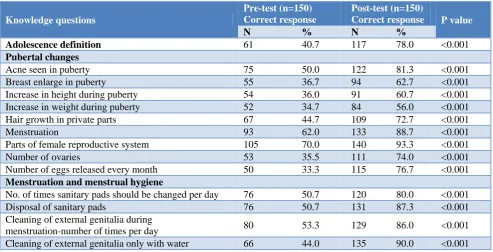
Table 1 show that the girls’ knowledge about puberty changes and menstruation improved significantly after intervention. Students had a good knowledge regarding age at first menses, reason for menstruation and ideal absorbents to be used during menstruation at pre-test. However knowledge regarding number of ovaries and number of eggs released per menstrual cycle was 35.5% and 33.3% which improved to 74% and 76.7% post educational intervention respectively and it was found to be highly statistically significant (p<0.001).
Around 107 (71.3%) subjects knew that menstruation is a physiological process but only around 70 (46.7%) subjects knew that menstrual blood comes from the uterus. Only 63 (42.0%) knew the normal menstrual cycle duration and 84 (56.0%) the normal number of days flow occurs per cycle but on intervention the knowledge increased to a significantly high value of 90.0% and 95.3% respectively.
Menstrual hygiene practices with regard to usage of sanitary pads such as the minimum number of times pads should be changed per day and proper method of disposal of sanitary pads improved from 50.7% to 80.0% and from 50.7% to 87.3% respectively which was found to be highly statistically significant.
respectively (p value <0.001) and the knowledge
regarding the good practices during pregnancy
was fairly good (Table 2).
Table 1: Knowledge related to puberty, menstruation and menstrual hygiene pre and post educational intervention.
Knowledge questions
Pre-test (n=150) Correct response
Post-test (n=150)
Correct response P value
N % N %
Adolescence definition 61 40.7 117 78.0 <0.001
Pubertal changes
Acne seen in puberty 75 50.0 122 81.3 <0.001
Breast enlarge in puberty 55 36.7 94 62.7 <0.001
Increase in height during puberty 54 36.0 91 60.7 <0.001
Increase in weight during puberty 52 34.7 84 56.0 <0.001
Hair growth in private parts 67 44.7 109 72.7 <0.001
Menstruation 93 62.0 133 88.7 <0.001
Parts of female reproductive system 105 70.0 140 93.3 <0.001
Number of ovaries 53 35.5 111 74.0 <0.001
Number of eggs released every month 50 33.3 115 76.7 <0.001
Menstruation and menstrual hygiene
No. of times sanitary pads should be changed per day 76 50.7 120 80.0 <0.001
Disposal of sanitary pads 76 50.7 131 87.3 <0.001
Cleaning of external genitalia during
menstruation-number of times per day 80 53.3 129 86.0 <0.001
Cleaning of external genitalia only with water 66 44.0 135 90.0 <0.001
Table 2: Knowledge related to pregnancy pre and post educational intervention.
Knowledge questions
Pre-test (n=150) correct response
Post-test (n=150)
correct response P value
N % N %
How pregnancy occurs 92 61.3 144 96.0 <0.001
Ideal child bearing age 105 70.0 146 97.3 <0.001
First sign of pregnancy 55 36.7 131 87.3 <0.001
Pregnancy occurs in mid phase of menstrual cycle 56 37.3 118 78.7 <0.001
Normal gestational period 120 80.0 143 95.3 <0.001
Smoking is harmful during pregnancy 132 88.0 147 98.0 <0.001
Periods do not occur during pregnancy 99 66.0 140 93.3 <0.001
Eating nutritious foods is a good health
practice during pregnancy 126 84.0 147 98.0 <0.001
Exercising during pregnancy 55 36.7 128 85.3 <0.001
Immunization during pregnancy 87 58.0 129 86.0 <0.001
Minimum medical checkups during pregnancy 78 52.0 121 80.7 <0.001
Ideal spacing between two pregnancies 45 30.0 124 82.7 <0.001
Table 3: Knowledge related to contraceptive methods and advantages of contraceptives pre and post educational intervention.
Knowledge questions
Pre-test (n=150) correct response
Post-test (n=150)
correct response P value
N % N %
Contraceptive methods
Contraceptive pills 43 28.7 118 78.7 <0.001
Condoms 57 38.0 134 89.3 <0.001
Copper T 47 31.3 125 83.3 <0.001
Injectable hormones 15 10.0 78 52.0 <0.001
Knowledge questions Pre-test (n=150) correct response
Post-test (n=150)
correct response P value
Female sterilization 32 21.3 120 80.0 <0.001
Male sterilization 21 14.0 85 56.7 <0.001
Advantages of contraceptives
Child spacing 44 29.3 128 85.3 <0.001
Population control 53 35.3 123 82.0 <0.001
Prevent unwanted pregnancy 48 32.0 121 80.7 <0.001
Barrier methods of contraceptives help prevent
spread of STDs 37 24.7 120 80.0 <0.001
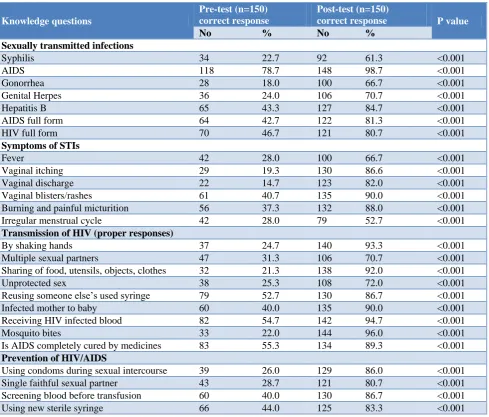
Table 4: Knowledge related to sexually transmitted infections and HIV/AIDS pre and post educational intervention.
Knowledge questions
Pre-test (n=150) correct response
Post-test (n=150)
correct response P value
No % No %
Sexually transmitted infections
Syphilis 34 22.7 92 61.3 <0.001
AIDS 118 78.7 148 98.7 <0.001
Gonorrhea 28 18.0 100 66.7 <0.001
Genital Herpes 36 24.0 106 70.7 <0.001
Hepatitis B 65 43.3 127 84.7 <0.001
AIDS full form 64 42.7 122 81.3 <0.001
HIV full form 70 46.7 121 80.7 <0.001
Symptoms of STIs
Fever 42 28.0 100 66.7 <0.001
Vaginal itching 29 19.3 130 86.6 <0.001
Vaginal discharge 22 14.7 123 82.0 <0.001
Vaginal blisters/rashes 61 40.7 135 90.0 <0.001
Burning and painful micturition 56 37.3 132 88.0 <0.001
Irregular menstrual cycle 42 28.0 79 52.7 <0.001
Transmission of HIV (proper responses)
By shaking hands 37 24.7 140 93.3 <0.001
Multiple sexual partners 47 31.3 106 70.7 <0.001
Sharing of food, utensils, objects, clothes 32 21.3 138 92.0 <0.001
Unprotected sex 38 25.3 108 72.0 <0.001
Reusing someone else’s used syringe 79 52.7 130 86.7 <0.001
Infected mother to baby 60 40.0 135 90.0 <0.001
Receiving HIV infected blood 82 54.7 142 94.7 <0.001
Mosquito bites 33 22.0 144 96.0 <0.001
Is AIDS completely cured by medicines 83 55.3 134 89.3 <0.001
Prevention of HIV/AIDS
Using condoms during sexual intercourse 39 26.0 129 86.0 <0.001
Single faithful sexual partner 43 28.7 121 80.7 <0.001
Screening blood before transfusion 60 40.0 130 86.7 <0.001
Using new sterile syringe 66 44.0 125 83.3 <0.001
Contraceptive methods were a topic regarding which the study participants had a very poor knowledge, especially towards injectable hormone, male and female sterilization procedures as contraceptives. In pre-survey as high as 67 (44.7%) had not heard of any contraceptive methods before but after intervention their knowledge regarding the contraceptive methods and their advantages improved significantly (p value <0.001) (Table 3). In Table 4, it is
food, utensils, objects and clothes and by mosquito bite pre intervention which was increased to 93%, 92% and 96% respectively post intervention. After intervention their knowledge regarding various STIs, symptoms of STIs, Transmission and prevention of HIV/AIDS improved significantly (p value <0.001). Regarding using condoms while sexual intercourse for prevention of AIDS pre-test only 26% knew which was increased to 86% post intervention which was statistically highly significant.
The students reported that their major source of information regarding reproductive and sexual issues were their mothers (71.3%) followed by their friends (66.0%). Barriers they faced to seek information was either they hesitated (56.0%) or feared (50.7%) to ask questions or some felt there was no ideal source (45.3%). Majority (73.3%) of the girls reacted worried to their first menstruation. The girls also faced restrictions during menstruation such as they were not allowed to attend religious functions (79.3%) and were not allowed to do routine work (56%). The students wanted to learn more about these topics and preferred to hear about them from doctors or health personnel (85.3%), followed by school or college lecturers (72.7%).
DISCUSSION
The present study was carried out among secondary and senior secondary school girls to evaluate the effectiveness of health education in improving their knowledge regarding growth and development during adolescent period, menstruation and menstrual hygiene, conception and contraception, sexually transmitting infections including HIV/AIDS.
In the present study the age of the study participants ranged from 13 to 18 years with the mean age being 15.5 years. The mean age of menarche of study participants was 13.26 years which was comparable with studies conducted by Ghongdemath JS et al and Mittal et al.8,9 During the initial pretest gross inadequacy was found for most of the aspects of reproductive health especially for contraceptive methods and STIs this was in consistent with various other studies conducted on reproductive health.10-13
In the present study majority of the students preferred to learn more about these topics from doctors/ health personnel (85.3%) but only 40% from mother. This is in contrast to the study findings of the studies conducted by Vanusha et al where 75% preferred their mothers as source of information.13 Differing observations may be accounted for due to regional variations in views and attitude. When asked about the barriers they faced in seeking information regarding reproductive health hesitation, fear, shame were the main reasons cited which confers with the study findings of Vanusha et al.13
Studies done in rural areas of East Delhi, Guntur and Vadodara district have reported that 80% of girls were
forbidden from worshipping and had restrictions on many day to day activities during menstruation which was similar to the findings of our study.14-16
In the present study only 36.7% of girls answered missing periods as the first sign of pregnancy during pre-test however following health education 87.3% of the girls were aware that missing period is the first sign of pregnancy which is comparable to the intervention study conducted by Vanusha et al, Rao et al, but the study conducted by Malleshappa et al showed only 74% had answered correctly following intervention.13,17,18
In the present study around 38% and 28.7% of the girls were aware of condom and contraceptive pills respectively as method of contraceptives during the initial phase. This was in concordance with the study done by Malleshappa et al where it was 28% and 34.7%
respectively.18 However statistically significant
improvement in knowledge regarding contraceptives were found following health education.
In the present study majority (78%) of the girls knew that HIV/AIDS is a STI and around 42% and 46% of the students were able to expand HIV and AIDS respectively during pre-test survey which was comparable with the study done Mittal et al in Haryana where around 50%
were able to expand HIV/AIDS.9 Majority of them were
unaware about other modes of transmission of AIDS.
As seen in our study, few studies in the recent years too have shown the effectiveness of such educational interventions which increased the knowledge of reproductive health.10-13
The studies conducted in developing countries also prove the efficacy of such intervention in improving their knowledge in various aspects of reproductive health.19-23 This study has certain limitations that need to be taken into account when considering the study and its findings. This study focused on Adolescent Health, a subject too vast to cover all relevant issues in a single questionnaire. Because of time constraints, the number of questions was limited and some adolescent health issues such as suicides, mental health, violence and substance abuses were not included.
CONCLUSION
The results of the present study successfully proved that adolescent health education was successful in improving the knowledge among adolescent girls in rural area. It helped clear the myths and misconceptions related to reproductive health by providing them authentic knowledge. It strived to empower the rural girls to take care of their own health and protect themselves from the risks of unwanted conceptions, STIs etc., in their future life.
Further research is necessary on whether adolescent health education is effective on the long run and periodic health education should be provided from school level to help them retain this information.
ACKNOWLEDGEMENTS
The Authors offer their sincere thanks to Indian Council of Medical Research (ICMR) for funding this project under Short Term Studentship (STS) 2018.
Funding: No funding sources Conflict of interest: None declared
Ethical approval: The study was approved by the Institutional Ethics Committee
REFERENCES
1. WHO Adolescence Health. Available at:
https://www.who.int/topics/adolescent_health/en/. Accessed on 5 August 2018.
2. UNICEF, 2011. Adolescence- an age of
opportunity. Available at: http://unicef.in/Press Releases/87/Adolescence-An-Age-of-Opportunity. Accessed on 20 August 2018.
3. WHO definition of health education. Available at: http://www.who.int/topics/health_education/en/. Accessed on 18 August 2018.
4. Ministry of Health and Family Welfare.
Implementation guide on RCH II Adolescent Reproductive Sexual Health strategy. National Rural
Health Mission. May 2006. Available at:
http://www.jknhm.com/ARSH%20Guidelines.pdf. Accessed on 21 August 2018.
5. UNICEF (2008). Sharing simple facts, useful
information about menstrual health and hygiene. UNICEF India. Available at: https://www.susana.
org/_resources/documents/default/2-1151mhmbook.pdf. Accessed on 18 August 2018.
6. National AIDS Control Programme. Youth and
Adolescent: Working Group Report. May 2011.
7. National Aids Control Organisation. Adolescence
education programme, life skills dvelopment- Facilitators guide. New Delhi. Available at: http://164.100.130.11:8091/webarsh/Resources%20 on%20ARSH/Adolescent%20Education%20Progra mme%20Facilitators%20Guide.pdf. Accessed on 18 August 2018.
8. Ghongdemath JS, Sidhmalswamy A, Mallapur AA,
Shindholimath VV. Impact of adolescent health education on adolescent girls in rural schools and colleges. Int J Reprod Contracept Obstet Gynecol. 2016;5:53-7.
9. Mittal K, Goel MK. Knowledge regarding
reproductive health among urban adolescent girls of Haryana. Indian J Community Med. 2010;35:529-30.
10. Tawfik MM, El-Sharkawy OG, Abdelbaqy MA,
Hanafy SA, Shehata SF, Malek A, et al. Reproductive Health Education Among Adolescent Girls in Alexandria, Egypt. Population Reference Bureau, MENA Working Paper Series. March 2013.
Available at:
https://assets.prb.org/pdf13/girls-education-egypt-mena-workingpaper.pdf. Accessed on 18 August 2018.
11. Tork HMM, Al hosis KF. Effects of Reproductive Health Education on Knowledge and Attitudes Among Female Adolescents in Saudi Arabia. J Nurs Res. 2015;23(3):236–42.
12. Parwej S, Kumar R, Walia I, Aggarwal AK.
Reproductive health education intervention trial. Indian J Pediatr. 2005;72(4):287–91.
13. Vanusha A, Parvathavarthini K. Assessment of
present awareness on reproductive health and evaluation of a tool designed for reproductive health education among school going adolescent girls. Int J Reprod Contracept Obstet Gynecol. 2018;7:2381-7.
14. Gandhi AB, Raval. The role of audio visual
programme in creating awareness about
reproductive health in adolescent girls. J Obstet Gynaecol India. 1993;43:257-61.
15. Malathy S. Menstrual and gynecological disorders in 500 school girls in Madras city. J Obstet Gynaecol India. 1993;43:940-5.
16. Grover NP. Awareness and practices of
menstruation and pubertal changes amongst unmarried female adolescents in a rural area of East Delhi. Indian J Community Med. 2007;32:156-7.
17. Rao RSP, Lena A, Nair NS, Kamath V, Kamath A.
Effectiveness of reproductive health education among rural adolescent girls: a school based intervention study in Udupi Taluk, Karnataka. Indian J Med Sci. 2008;62(11):439–43.
18. Malleshappa K, Krishna S. Knowledge and attitude
about reproductive health among rural adolescent girls in Kuppam mandal: An intervention study. Biomed Res. 2011;22(223):305–10.
19. Lawan UM, Yusuf NW, Musa AB. Menstruation
and menstrual hygiene amongst adolescent school girls in Kano, Northwestern Nigeria. Afr J Reprod Health. 2010;14(3):201-7.
20. Nwankwo TO, Aniebue UU, Aniebue PN.
Menstrual disorders in adolescent school girls in
Enugu, Nigeria. J Pediatr Adol Gynecol.
2010;23(6):358-63.
21. Werven IV. Health and hygiene school program
22. Sapkota D, Sharma D, Budhathoki SS, Khanal VK, Pokharel HP. Knowledge and practices regarding menstruation among school going adolescents of rural Nepal. J Kathmandu Med Coll. 2013;2(5):122-7.
23. Haque SE, Rahman M, Itsuko K, Mutahara M,
Sakisaka K. The effect of a school-based educational intervention on menstrual health: an
intervention study among adolescent girls in Bangladesh. BMJ Open. 2014;4:e004607.