Original Research Article
A study of prevalence of hypertension and socio-demographic
factors in urban slum, Maharashtra
Gautam B. Sawase, Sunayana G. Kumthekar*, Shweta N. Salphale, Mohan K. Doibale
INTRODUCTION
Hypertension is a chronic condition because of its role in the causation of stroke, coronary heart disease and other vascular complications. Sir George Peckering formulated a concept regarding hypertension that, blood pressure is continuously distributed as a bell-shaped curve with no real separation between normotension and hypertension.1 Hypertension is a major public health problem due to its high prevalence all around the globe. WHO named
hypertension as a Silent Killer as this disease causes immense harm to our body by appearing asymptomatic by outside.2 In India there is 24-30% of prevalence of hypertension in urban areas and 12-14% in rural areas.3 Around 7.5 million deaths or 12.8% of the total of all annual deaths worldwide occur due to high blood pressure. In 2025, adults with hypertension is estimated to be increased to 1.56 billion.4 In both developed and developing countries, the major public health problem is hypertension, in continuation with this now a days we can
ABSTRACT
Background: Hypertension is the commonest cardiovascular disorder, posting a major public health problem of the
world and especially to population in socio-economic and epidemiological transition. Around 7.5 million deaths or 12.8% of the total of all annual deaths worldwide occur due to high blood pressure. It is predicted to be increased to 1.56 billion adults with hypertension in 2025. In India there is 24-30% of prevalence of hypertension in urban areas and 12-14% in rural areas. The objectives of the study were to find out the prevalence of hypertension in study population of 18 years and above and to study some socio-demographic factors affecting hypertension.
Methods: A community based cross sectional study was carried out in urban slum area, under urban field practice area of a Govt. Medical College & hospital. Sample size of 360 participants of age more than 18 yrs residing in study area taken. Data collected by using systematic random sampling by house to house visit. A semi-structured & pretested questionnaire used to interview the patients after obtaining their consent. The data was analyzed using SPSS version 23. Appropriate statistical tests were applied.
Results: The overall prevalence of hypertension was 30.5%. Out of 360 subjects, 47 (13%) found elevated
hypertensive. Out of 110 hypertensive population nearly 53 (48%) were in older age group, nearly 60 (55%) were illiterate and 53 (48%) were unskilled workers out of 110 was found statistically significant (p<0.05).
Conclusions: Prevalence of hypertension found to be 30.5%. Some socio-demographic factors like age, sex,
education, occupation were statistically significant (p<0.05).
Keywords: Hypertension, Prevalence, Socio-demographic
Department of Community Medicine, Govt. Medical College, Aurangabad, Maharashtra, India
Received: 19 September 2018
Revised: 24 December 2018
Accepted: 26 December 2018
*Correspondence:
Dr. Sunayana G. Kumthekar, E-mail: [email protected]
Copyright: © the author(s), publisher and licensee Medip Academy. This is an open-access article distributed under
the terms of the Creative Commons Attribution Non-Commercial License, which permits unrestricted non-commercial use, distribution, and reproduction in any medium, provided the original work is properly cited.
see there is transition from communicable to non-communicable disease burden load in developing countries.5
Accurate estimates of hypertension prevalence are therefore necessary to plan effective control measures. There is a felt need for the community based studies in urban and rural areas of our country with a view to determine the geographic differences in the prevalence of hypertension and the awareness of being hypertensive, their treatment seeking behaviour as well as their compliance to the treatment in terms of regularity. The present study was undertaken to estimate the prevalence of hypertension. The awareness status and health seeking behaviour among hypertensive population.
METHODS
Study design
It is community based cross sectional study.
Study place
The study was undertaken in the urban field practice area of the Department of Community Medicine, Govt. Medical College, Aurangabad.
Study duration
1st November 2017- 31st January 2018
Study population
The study population comprised of people aged >18 years residing in the urban-field practice area of Govt. medical college, Aurangabad.
Inclusion criteria
Individual aged >18 yrs who are the permanent residents of in study area.
Exclusion criteria
Exclusion criteria were persons <18 years of age; pregnant woman; severely ill person.
Study procedure
The present study was conducted in the field practice area of Urban Health Training Centre, Govt. Medical College, Aurangabad attached to the teaching hospital and medical college. Urban Health Centre is situated in the slums about 3 km from the teaching institute. The field practice area of Urban Health Centre consists of mainly Harshnagar and Labour colony areas & has population of 11450 (2011 census).
Urban Health Centre provides curative, preventive and promotive health services to the urban slum population in the surrounding area and conducts daily out-patient services viz General OPD, Pediatrics OPD, Chronic and specialist OPDs, Antenatal health check-ups and follow up services are provided to ANC and PNC mothers. National Health Programme like immunization, RNTCP and AIDS control programmes are also implemented.
Total 360 study participants of more than 18 years of age were considered by using systematic random sampling method. Data collected from November 2017 to January 2018 by doing house to house visits. Investigator visited each house and measured blood pressure of each and every individual according to inclusion criteria and study participant considered as having hypertension according to JNC VIII criteria given in table below. Along with this known cases of hypertension also taken in consideration. Data collected with semi-structured questionnaire in their local language after taking consent of study participants.
Hypertension is defined as a state of chronically elevated arterial blood pressure, as compared to what is normally expected, as per the defined level given in JNC VIII (Table 1).
Table 1: JNC (Joint National Committee)-VIII.
BP category
Systolic level (mm Hg)
Diastolic level (mm Hg)
Normal <120 And <80
Elevated 120-129 And <80 Hypertension stage-1 130-139 Or 80-89 Hypertension stage-2 ≥140 Or ≥90
Sample size
Considering prevalence of hypertension 26.2% in previous studies.3 Sample size calculated in Open Epi software with urban slum population 11450 (2011 census) at 95% confidence interval was found to be 297. Considering 20% non response rate, sample size came 356.6 so investigator took round figure of 360.
Data analysis
Data entry and statistical analysis was done using SPSS version 24. The data collected using the above mentioned measures were analyzed using frequencies and percentages. Chi square test was used for testing the significance of association at P value of 0.05. Data analysis was done using SPSS version 23, Chi square test was applied.
Ethical approval
RESULTS
Figure 1: Distribution of study subjects according to JNC VIII criteria.
In our study, 69.4% were having normal BP. 13.1% were having elevated BP (SBP 120-129 and DBP <80 mmHg). 10.8% were having stage I HTN (SBP 130-139 mmHg or DBP 80-89 mm Hg). 6.7% of the subjects were having stage II HTN (SBP >140 mmHg or DBP >90 mm Hg) giving a prevalence of 30.5% (Figure 1).
Table 2: Relation of age with study participants.
Study variable
Hypertensive (n=110) (%)
Non-hypertensive (n=250) (%)
P value
a) 18-35 14 (12.7%) 181 (72.4%)
0.00001
b) 36-60 53(48.1%) 53 (21.2%)
c) 61-75 36 (32.7%) 14 (5.6%)
d) >75 07 (6.4%) 2 (0.8%)
Table 2 depicts higher prevalence of hypertension seen in age group 36-60 yrs. There is highly significant association between HTN and age (p<0.0001).
Figure 2: Relation of gender.
Females have shown higher prevalence of HTN (64.5%) compared to male (35.5%). There is highly significant association between HTN and sex (p<0.0001) (Figure 2).
Table 3 depicts that 26.4% of hypertensive were Hindu, 57.3% were Muslim and 16.4% were of other religion.
There is no significant association between HTN and religion (p=0.518).
Table 3: Relation of religion.
Study variable
Hypertensive (n=110) (%)
Non-hypertensive (n=250) (%)
P value
Hindu 29 (26.4) 55 (22)
0.518
Muslim 63 (57.3) 159 (63.6)
Other 18 (16.4) 36 (14.4)
Figure 3: Relation of education.
Figure 3 depicts prevalence of hypertension is 54.5% in illiterate individuals compared to literate. There is highly significant association between HTN and education. (p≤0.000001).
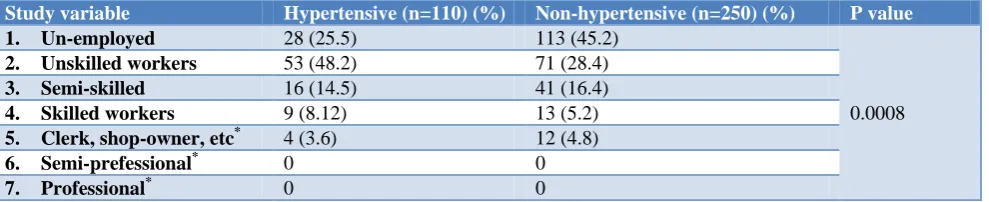
Table 4 depicts that, 48.2% of hypertensive were unskilled workers, 25.5% in unemployed, 14.5% in semi-skilled and remaining comes in semi-skilled etc. Shows significant association between HTN and occupation. (p=0.0008).
Figure 4: Percentage of hypertensive who were already diagnosed and newly detected.
Figure 4 shows that 81% of hypertensive were already diagnosed to have HTN while 19% were newly diagnosed hypertensive.
69% 13%
11% 7%
Normal
Elevated
Stage I
Stage II
male female
35.5 64.5
46.4
53.6
HTN NON-HTN
0.00% 20.00% 40.00% 60.00% 80.00% 100.00%
NON HTN HTN
Yes 81% No
19%
Table 4: Relation of occupation.
Study variable Hypertensive (n=110) (%) Non-hypertensive (n=250) (%) P value
1. Un-employed 28 (25.5) 113 (45.2)
0.0008
2. Unskilled workers 53 (48.2) 71 (28.4)
3. Semi-skilled 16 (14.5) 41 (16.4)
4. Skilled workers 9 (8.12) 13 (5.2)
5. Clerk, shop-owner, etc* 4 (3.6) 12 (4.8)
6. Semi-prefessional* 0 0
7. Professional* 0 0
(* = clubbed together for χ² purpose).
DISCUSSION
The present study was undertaken in the urban field practice area of Govt. Medical College, Aurangabad. The objective of this community based cross sectional study was to find the prevalence of hypertension and socio demographic factors associated with it among adults.
In our study, 110 were found to have hypertension giving a prevalence of 30.5%. Among them 81% of hypertensive were already diagnosed to have HTN while 19% were newly detected hypertensive according to JNC VIII criteria. The overall prevalence of hypertension in the present study (30.5%) was lower compared to study conducted in Raichur by Chethana et al.2,4,6 The prevalence washigher in comparison with the prevalence reported in study conducted by Bhardwaj et al in Nagpur as well as studies done by Mohan in Chennai and By Kaur et al in South India.7-9
Female exhibit higher prevalence of hypertension than their male counterparts (F: 53.6% and M: 46.4%). While studies done in Varanasi by Singh et al and by Singh in Rewa showed prevalence is more in males than females.4,10 Higher prevalence in females is found in study conducted by Reddy et al on Indian industrial population.11 This may contribute to exposure of more female population while doing survey, as male members were out of house for working purpose during our visit hours.
Age related increase of hypertension is a common, but not a universal phenomenon. Prevalence of HTN found more in older age group it clearly follows the fact that as age advances, prevalence also increases because with increasing age, the stiffening of arterial walls occurs which ultimately causes increase in blood pressure. A study done by Chethana et al and Gupta reported that highest prevalence (56%) is seen in 60-65years age group.2,12 A study on growing trend of high prevalence of hypertension in developing country conducted by Das et al is not showing similar result, rather they found high prevalence in younger population which may be due to restricted age group in study i.e.18-50 yrs.6
In present study low literacy rate showing high prevalence (54.5%) compared to prevalence of HTN in
literate (30.4%). Study done by Singh et al in Varanasi supports this finding.4 Such finding could be due to the reason that higher education imparts better knowledge & information about hypertension. Opposite findings were found in study done by Daniel et al in Nigeria.5
CONCLUSION
From the results it is concluded that, prevalence of hypertension found to be 30.5%. 81% of hypertensive were already diagnosed while 19% were newly detected hypertensive. As age advances, prevalence of HTN also increases. Prevalence was more in females 53.6% compared to males 46.4% which is statistically significant. Illiterate population having more prevalence due to lack of knowledge and information about hypertension.
Recommendations
Routine screening for NCDs in the community. Programs are needed to improve the surveillance systems and implementation of community based screening programs for early detection of hypertension.
ACKNOWLEDGEMENTS
The authors would like to thank all the participants for participating in the study.
Funding: No funding sources Conflict of interest: None declared
Ethical approval: The study was approved by the Institutional Ethics Committee
REFERENCES
1. Park. K. Text Book of Preventive and Social Medicine. 24th edition. Jablapur: Banarsidas Banot; 2017: 391-395.
2. Chethana KV, Anusha T, Mane A, Prasad VM, Sunkad VM. Prevalence of hypertension and its risk factors among adults in urban field practice area NMC, Raichur, Karnataka, India Int J Community Med Public Health. 2017;4(1):45-50.
Adults Residing in Field Practice Area of Urban Health Training Centre, Government Medical College Aurangabad. National J Community Med. 2017;8(1):31-6.
4. Singh S, Shankar R, Singh GP. Prevalence and Associated Risk Factors of Hypertension: A Cross-Sectional Study in Urban Varanasi, Hindawi Int J Hypertension. 2017:5491838:10.
5. Daniel OJ, Adejumo OA, Adejumo EN, Owolabi RS, Braimoh RW. Prevalence of hypertension among urban slum dwellers in lagos, Nigeria. J Urban Health. 2013;90(6):1016–25.
6. Das SK, Sanyal K, Basu A. Study of urban community survey in India: growing trend of high prevalence of hypertension in a developing country. Int J Med Sci. 2005;2(2):70-8.
7. Bhardwaj SD, Sinha U, Shewte MK, Khadse J.R, Bhatkule PR. Prevalence Awareness, Treatment and Control of Hypertension among the people above 15 years in rural area Nagpur Maharashtra – a cross sectional study. National J Community Med. 2012;3(2):213-7.
8. Mohan V, Deepa M, Farooq S, Datta M, Deepa R. Prevalence, awareness and control of hypertension in Chennai--The Chennai Urban Rural Epidemiology Study (CURES-52). J Association Physicians India. 2007;55:326-32.
9. Kaur P, Rao TV, Sankarasubbaiyan S, Narayanan AM, Ezhil R, Rao SR, et al. Prevalence and
distribution of cardiovascular risk factors in an urban industrial population in south India: a cross-sectional study. J Assoc Physicians India 2007;55:771-6.
10. Singh S, Dubey DK, Kushwah SS, Patel M. Effect of Life Style Risk Factors on Prevalence of Hypertension in a Defined Urban Population of Rewa. National J Community Med. 2012;3(4):570-5.
11. Reddy KS, Prabhakaran D, Chaturvedi V, Jeemon P, Thankappan KR, Ramakrishnan L, et al. Methods for establishing a surveillance system for cardiovascular diseases in Indian industrial populations. Bull World Health Organ. 2006;84:461-9.
12. Gupta R. Trends in hypertension epidemiology in India. J Human Hypertension. 2004;18:73-80. 13. Tanu Midha, Bhola Nath, Ranjeeta Kumari,
Yashwant Kumar Rao, Umeshwar Pandey. Prevalence of hypertension in India. World J Meta-Analysis. 2013;1(2):83-9.
Cite this article as: Sawase GB, Kumthekar SG,