Development of a BOT for Time Optimization
at a Fast-Food
Lucas Guimarães da Rocha¹, Tiago Bittencourt Nazaré², Patrícia Werneck Silva de Oliveira³
¹Student of Industrial Engineering, Faculdades Integradas de Cataguases-FIC/UNIS ²Master in Engineering systems management, Universidade Católica de Petrópolis-UCP
³Expert in Sociology, Universidade Federal de Juiz de Fora-UFJF Cataguases/MG, Brazil
Abstract
Considering the current perspective of the market, it is noticed that time is a valuable resource, where it is sought to optimize the time used in processes in an efficient way. In this environment, technology arises bringing efficient possibilities through neural networks and artificial intelligence, allowing the machine to be even more capable of performing human functions. The present work aims to develop a virtual attendant, which aims to fulfill requests in a fast food franchise and compare with the time of service of a study by another author, with the proposal to optimize the time of service, at the end of its development the service time was compared with the time measured in the work used for comparison, and customer satisfaction survey questionnaires were applied in relation to the developed project. The developed virtual assistant has artificial intelligence, provided by a neural network that enables it to distinguish intentions and entities in a message, was developed in the C # language and using the resources of the cloud computing, the virtual attendant in this context is also called as BOT and operates via chat channels such as Telegram, Slack, Skype, among others. The BOT reached a service time of 3.1 minutes, meaning a reduction of 78.5% of the time used in each request. The operation of the BOT was consistent in the services performed, responding as expected and the responses of the customer satisfaction survey questionnaires indicated a satisfactory approval.
Keywords - Artificial Intelligence, Virtual Attendant, Fast-Food.
I. INTRODUCTION
In this age, time is a valuable resource, according to [1], this situation was not always so, it began when, with the arrival of the industry, workers began to undergo great demands to meet expectations of profitability. Yet according to the author above, most citizens today suffer from the lack of time to meet their commitments and goals daily.
According to [2] due to this time race, the companies of fast-food emerged deriving from a need for fast food and at an affordable cost, this market line has been meeting these demands and increasingly seeking to improve more and more it’s service and production strategies.
Considering the need to save time and in the great demand of consumption, the technology of neural networks and artificial intelligence appear as a great an opportunity of aid in this objective. According to [3], the neural network gives the decision-making power of the human brain to machines, software and applications, making them capable of performing many of the tasks humans do, allowing employees to spend their time on more specific jobs which requires more of human capacity.
Based on the assumptions of technology, this work aims at the development of a virtual attendant equipped with artificial intelligence, which operates via text communication channels, a chat, where one can consider the name of chat bot or BOT to refer to the idea of virtual attendant, according to [4] the concept of chat bot are softwares that constitute artificial conversations that rely on techniques of grammatical and linguistic modeling, and that operate from the input of a text, according to the author, chat bots are widely implemented in applications of attendance to the client.
The virtual attendant to be developed has as general objective to simulate the fulfillment of requests in a fast food franchise and to compare the time measured in a service with the time that is presented in the work of [2], aiming also for a natural, dynamic and intuitive dialogue to the clients as well as a more efficient service operating 24 hours a day. The main objective of this work is to make the customer service process more efficient, achieving a reduction of the time in order fulfillment, considering that the BOT has the capacity to respond as quickly as possible according to the client's time and also considering that the BOT serves more than one customer at a time.
II. LITERATUREREVISION
A. Artificial Intelligence
contribution that increasingly aims to improve this intelligence. In the last century artificial intelligence has made a great advance due to the great evolution of resources and capabilities of the current systems, such as processing, storage, among others.
B. Neural Networks
According to [6] a neural network is a mechanism that aims to give artificial intelligence to a given system by modeling the entire process that the human brain performs when processing information. The basis of a neural network consists of artificial neurons or processing units that aim to represent the same tasks that a system of neurons perform in the human brain.
According to the author [7], a neural network is composed of simple elements that operate in parallel, where these elements are connected to each other, forming the neural network that together is adjusted and trained so that from an input of an information, this information is processed and compared to the output, allowing a new learning the network.
C. Cloud Computing
According to [8], cloud computing is a set of computational resources that allows a user to access and enjoy these resources from anywhere on the planet without worrying about the infrastructure and configurations that would be required to process, store and maintain these resources locally. These capabilities can be used to run applications, services, data storage, servers, and more, and the technologies that enable cloud computing are the Internet and virtualization.
According to [9], the definition of cloud computing is a model that enables demand-driven service delivery by providing network access along with shared storage, processing, applications that are made available on demand, requiring little interaction with the service provider.
D. Concept of BOT
According to [10] BOTs are like human users, possess an identity, photo, can send messages, be added to a group chat and perform specific tasks that have been programmed to run. They can be part of an application as well as some BOTs depending on their purpose need not be associated with any application.
III.METHODOLOGY
This work was developed through literature review, based on books, articles, magazines and technology documentation sites, consolidating a large information base, making possible the development of this methodology.
A. Materials
1) Cognitive Services API LUIS (Language Understanding): According to [11], LUIS is a
cognitive services API based on machine learning that was created by Microsoft. LUIS aims to implement the ability to interpret natural text within applications, BOTs and IoT devices, being able to identify intentions and entities in a text and it integrates perfectly with the Azure BOT Service, thus facilitating its construction of BOT that requires these capabilities.
2) IDE Microsoft Visual Studio Community 2017: According to [12] Visual Studio is a tool that was developed by Microsoft for application developers and whose priority is to enable them to be more productive. Visual Studio is an Integrated Development Environment (IDE) that brings a wide range of possibilities to the developer because it allows you to choose and add various tools and extensions that integrate perfectly and allow the user to enjoy new resources within the IDE, resources these, such as programming in the language of your choice, Visual Basic, C #, Python, among others, as well as mobile development and cloud computing.
3) C# and .net Framework language: According to [13] C # is a high-level programming language based on the concepts of OOP (Object Oriented Programming) and was developed for the Microsoft .NET platform. The .NET platform provides several features such as strings, graphics, multimedia, file processing, prepackaged data structures, database processing, networks client/server based on the Internet and the World Wide Web and distributed computing, which allow the creation of web-based applications that work on multiple devices.
4) Microsoft Azure: According to [14] Microsoft Azure is a cloud computing platform that offers several services that enable rapid development of solutions without the developer having to worry about what physical hardware infrastructure would be needed to accommodate their storage and data. Azure also has some artificial intelligence tools that are the APIs of cognitive services hosted on Azure that can be used for free in a limited way.
Fig. 1 - BOT Connectors
B. Methods
1) BOT creation: The BOT was developed in the Microsoft Visual Studio Community 2017 IDE, using the C # language and features of the Microsoft Bot Framework platform. Through the Bot Framework is configured the address of the application, which will allow the connection between the user and the BOT, receiving the message sent by the user through a request so that this information can be treated. The security of the BOT is provided by two keys, one private and one public, provided by the Bot Framework, preventing the possibility of unauthorized persons making changes to the BOT.
2) Neural network creation and configuration: The development of the fundamental structure that makes BOT intelligent was implemented through LUIS (Language Understanding Intelligent Services), which is responsible for the cognitive part of the BOT. The creation of this service was based on 3 main steps, being these, the classification of the intentions, the classification of the entities and the integration of the Web service API by with the algorithm of the BOT through an endpoint that is a URL through which the sending and receiving of data.
The step of classifying the intentions provides the BOT with the intelligence necessary to search in an expression for the possible intentions it contains in accordance with the pre-established intentions that LUIS has been trained to identify. The second step, of classification of entities, aims to classify key words also predetermined after the analysis of each term of the expression that was received.
After the treatment and separation of this information the LUIS returns to the algorithm of the BOT these data already treated through an endpoint associated with the service, in sequence it is used this information to forward the flow of dialog to the place that meets the respective intentions and entities identified initially.
3) Construction of BOT features: It was studied in theoretical frameworks and books on the processes of fast-food companies, observing the context of customer service, seeking to identify what would be the greatest needs and in which processes the BOT could contribute to benefit productivity through the economy of time in processes, making service more efficient. The BOT was fed with various information
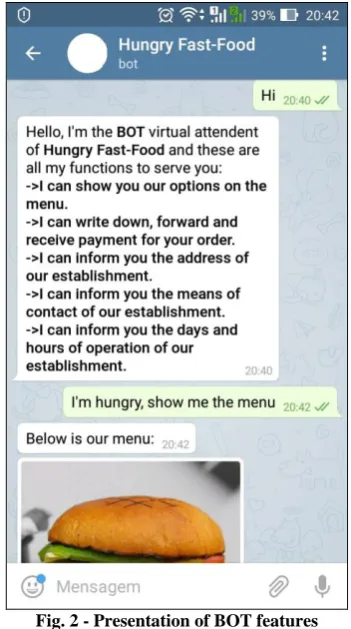
about the establishment so that it could fulfill the tasks of answering and responding customers on the issues presented in Fig. 2. In Fig. 3 and Fig. 4 are presented the intentions and entities classified to make the intelligence of the BOT capable of recognizing and attending the functionalities presented in Fig. 2.
Fig. 2 - Presentation of BOT features
Fig. 2 shows the beginning of a dialogue with the BOT, after recognition of a compliance intention the BOT presents itself to the client and informs him of all his capabilities to serve him.
Fig. 3 - LUIS Intentions
4) Treatment of Information: The information processing stage is responsible for receiving user requests through messages received on any of the channels on which the BOT was published. These messages are sent to the neural network, where all the information will be analyzed and classified, seeking to identify the intentions and entities already predetermined in the neural network. Posteriorly all these classifications and information are already returned to the main algorithm, where according to this information, the answer that best serves the user's message will be selected and sent to the Bot Framework, which in turn will be responsible for forwarding the message to the user by the respective conversation channel.
5) Hosting the BOT in the cloud: In this step the hosting of the application in the cloud was realized, this integration was realized using Azure, a powerful cloud computing platform of Microsoft. Enabling secure, fast and efficient online and accessible application operation every day, 24 hours a day. The platform is shown in Fig. 5.
Fig. 5 - Portal Azure
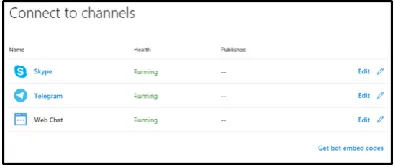
6) Integration with messenger channels: This step had the objective of making the use of BOT by customers practical and popular, BOT was published in two message channels, these being Telegram and Skype. The publication was performed through the Microsoft Bot Connector Framework service, the platform is presented in Fig. 6.
Fig. 6 - Integration with the channels
7) Comparison of the BOT with the case study: The last step is the comparison of BOT in a study presented in the paper by [2] in a fast-food company, where the author makes the timing of each of the stages of the customer order fulfilment process and applies a calculation of the time estimates to measure the expected time spent in each presented task in Table 1.
It was simulated the same processes of attendance presented in the author's work cited above and timed
the time spent in each step of the service process performed by BOT, considering that in the service performed by BOT, only the total time spent in all stages of the Table 1, since the BOT performs several of these tasks simultaneously until the fulfilment of the request is completed.
Posteriorly, a verification of the operation of the BOT was carried out in order to confirm the consistency with the intended objectives in the service and at the end a questionnaire of customer satisfaction was applied in a given sample of clients to obtain feedbacks in order to identify possible improvements of the BOT.
TABLEI
EXPECTED TIME FOR ORDER FULFILLMENT ACTIVITIES
Activities Expected Time (min)
A Customer requests the
waiter 10,2
B Waiter notes request 1,1
C Waiter checks the order
with the customer 1
D Order printing 0,5
E Receipt of the printed
order 1
F Request call 0,2
Total expected time 14
IV.RESULTSANDDISCUSSION
The BOT proved to be effective in customer service, without presenting errors in the interpretation of users' intentions during a dialogue. BOT also presented a great efficiency in order fulfillment, exercising all steps of the information collection process in the execution of an order with the customer, such as the presentation of the menu, registration of the order, confirmation of the order with the customer, call of the request, in addition to also performing the steps of note of the delivery address if necessary, customer contact and the information to make the payment, the total time of service of a request executed by the BOT was 3.1 minutes.
considering that this number of orders results in a total time spent with service of 36,400 minutes, based on the time savings made in a request by the BOT, this same number of requests would result in a total service time spent of 7,843 minutes, which at the end reaches an optimization of 28,557 minutes less used with monthly attendance.
These results imply that the BOT developed in this work showed cohesion in its performance and was able to contribute in an impactful way in the efficiency of the processes reducing the service time, thus reaching the objective proposed in this work.
V. CONCLUSIONS
This work was developed through researches in literature review, books, articles, journals and technological documentation. A virtual service prototype was developed, called BOT, which aims to reduce and optimize the time spent attending a fast food franchise, presented in the paper by [2] with the use of cloud technology and artificial intelligence to give intelligence to BOT to process all incoming information, enabling it to understand the intentions and entities in the messages of the clients, and to answer them in channels such as Facebook Messenger, Telegram, Skype and Slack with efficiency and quality. As final steps of the methodology, to measure the efficiency and quality of the service performed by the BOT, the total time of service of the BOT was measured and simulated consultations seeking to verify the coherence of the BOT intelligence in the recognition of the intentions of the user.
The total time of a service measured with the BOT was 3.1 minutes, which represents a time 4.64 times lower than the total time spent of 14 minutes in the accomplishment of the same processes in the work of [2]. In this way it is possible to note that the BOT reached its objectives, therefore analyzing the time spent in a month of service in the work of [2] and considering the time spent by the BOT, it was possible to optimize 28,557 minutes to less expenses with monthly visits, proving the efficiency achieved by BOT.
The present work contributes to the academic environment, since there are no articles describing the process of application of BOTs returning to optimize efficiency in attending fast food companies.
REFERENCES
[1] A. Taggart, “Why you never have enough time, a history,” 9 Maio 2018. [Online]. Available: https://qz.com/work/1272033/why-you-never-have-enough-time-a-history/. [Acesso em 17 07 2018].
[2] E. G. L. Barreto, R. d. L. S. dos Santos, V. L. de Menezes e R. M. da Silva, “A melhoria do processo produtivo em uma empresa de fast food através do PERT/CPM,” Revista Gestão Industrial, vol. 6, nº 4, pp. 231-245, 2010.
[3] S. Karsoliya, “Approximating Number of Hidden layer neurons in Multiple Hidden Layer BPNN Architecture,”
International Journal of Engineering Trends and Technology
(IJETT), vol. 3, nº 6, pp. 714-717, 2012.
[4] C. Chakrabarti e G. F. Luger, “Artificial conversations for customer service chatter bots: Architecture, algorithms, and evaluation metrics,” Expert Systems with Applications, nº 42, p. 6878–6897, Maio 2015.
[5] S. J. Russell e P. Norvig, Inteligência Artificial, 3ª ed., Harlow: Elsevier, 2013.
[6] S. Haykin, Redes Neurais. Princípios e práticas, 2ª ed., Ontário: Bookman, 2003.
[7] A. Sharma e D. R. Chaudhary, “Character Recognition Using Neural Network,” International Journal of Engineering Trends and Technology (IJETT), vol. 4, nº 4, pp. 662-667, Abril 2013.
[8] N. Ruparelia, Cloud Computing: The MIT Press Essential Knowledge Series, London: MIT University Press Group Ltd, 2016.
[9] P. Mell e T. Grance, The NIST Definition of Cloud Computing, vol. 15, 2010.
[10] M. Lee, L. Frank, F. Beute, Y. de Kort and W. IJsselsteijn, “Bots Mind the Social-technical Gap,” Proceedings of 15th European Conference on Computer-Supported Cooperative Work - Exploratory Papers, Reports of the European Society
for Socially Embedded Technologies (ISSN 2510-2591), 2017.
[11] Microsoft, “LUIS:Homepage,” 2017. [Online]. Available: https://www.luis.ai/home. [Acesso em 03 01 2017].
[12] B. Johnson, Professional Visual Studio 2017, 1ª ed., Indianapolis: Wrox, 2017.
[13] H. Deitel, P. Deitel, J. A. Listfield, T. Nieto, C. Yaeger e M. Zlatkina, C# Como Programar, 1ª Edição ed., São Paulo: Makron Books, 2003.
[14] M. Collier and R. Shahan, Microsoft Azure Essentials, 2ª ed., Redmond, Washington: Microsoft Press, 2016.