Enhanced the Performance of Self-Optimal
Clustering Technique Using Particle Swarm
Optimization
1Kavita Firke, 2 Dinesh Kumar Sahu
1 M.Tech Scholar, Department of CSE 2 Asso. prof., Department of CSE Sri Satya Sai College of Engineering, RKDF University, Bhopal M.P., India
ABSTRACT
Self-optimal clustering technique is great advantage over partition clustering technique. the partition clustering technique faced a problem of the generation of cluster and quality validation of generated cluster. The optimal clustering technique automatically decided the number of cluster according to their selection of center point and generation of cluster. In this paper used particle swarm optimization technique for the fitness constraints function for the selection of center point. the particle of swarm optimization gives the dual fitness constraints for the selection of cluster center and quality validation. The modified self-optimal clustering technique implemented in MATLAB software and used reputed data set from UCI. Our experimental result shows that better performance instead of SOC algorithm.
Keywords: -PSO, SOC, Clustering, EA, SVM.
INTRODUCTION
The terms data mining, patent mining, text mining and visualization are employed for the processing of the documents. This chapter will try to give some explanations of the terms and explain why “data mining” was chosen for the title of the study. Data mining is the analysis of (often large) observational data sets to find unsuspected relationships and to summarize the data in novel ways that are both understandable and useful to the data owner.Clustering is a division of data into groups of similar objects. Representing the data by fewer clusters necessarily loses certain fine details, but achieves simplification. It models data by its clusters. Data modelling puts clustering in a historical perspective rooted in mathematics, statistics, and numerical analysis [16]. From a machine learning perspective clusters correspond to hidden patterns, the search for clusters is unsupervised learning, and the resulting system represents a data concept. From a practical perspective clustering plays an outstanding role in
under-sampling is to cut down the number of the majority class samples. But it may lose information of the majority and decrease the performance of classification. The other method focuses on the algorithm based approach, which introduces certain mechanism to handled the imbalance and make it suitable for the classification on imbalanced data sets. Examples of such techniques are: cost sensitive, support vector machines algorithm (SVM), and some ensemble methods. There are many mechanisms in revising algorithms for imbalanced data mining. For example, the use of adjustment of cost function, the use of different values of weight, the change of probability density. Cost sensitive study algorithm uses the cost of each class to make classification decision.
The rest of paper discuss as in section 2 discuss the Evolutionary Algorithm. In section 3 discuss the Feature Selection. In section 4 discuss proposed Work. In section 5 discuss the experimental result and analysis.Finally discuss conclusion & future work in section 6.
2.EVOLUTIONARY ALGORITHM
EAs utilize the vocabulary obtained from hereditary qualities. They recreate the advancement over an arrangement of eras (cycles inside an iterative procedure) of a populace (set) of applicant arrangements. An applicant arrangement is inside spoken to as a series of qualities and is called chromosome or person. The position of a quality in a chromosome is called locus and all the conceivable qualities for the quality shape the arrangement of alleles of the separate quality. The interior representation (encoding) of a competitor arrangement in a developmental calculation frames the genotype that is prepared by the transformative calculation. Every chromosome relates to an applicant arrangement in the pursuit space of the issue, which speaks to its phenotype. An unraveling capacity is important to make an interpretation of the genotype into phenotype. Transformation and Crossover are two oftentimes utilized administrators alluded to as developmental methodologies [12].
Transformation comprises in an arbitrary irritation of a quality while hybrid goes for trading hereditary data among a few chromosomes, therefore keeps away from neighborhood optima. The chromosome subjected to a hereditary administrator is called parent and the came about chromosome is called posterity. A procedure called choice including some level of haphazardness chooses the people to Recombination or Crossover makes offspring's, chiefly in view of individual legitimacy [16]. The individual legitimacy is assessed utilizing a wellness capacity, which
evaluates how the hopeful arrangement befitted being encoded by the chromosome, for the issue being understood. The wellness capacity is detailed in light of the scientific capacity to be advanced. The arrangement returned by a transformative calculation is normally the most fitted chromosome in the last era.
3. FEATURE SELECTION
A vast variety of feature selection methods have been proposed according to different metrics, such as information gain, entropy, chi-square test, t-test. Yet when applied to multi-class classification task, these methods generally suffer a pitfall of a surplus of predictive features for some classes while lack of predictive features for the remaining classes. More specifically, the strongly predictive features for the few “easy” classes rank before the weakly predicatively features for the remaining “difficult” classes. As a result, the features that are necessary for discriminating “difficult” classes would be ignored by traditional feature scoring methods [4]. This problem is called the “siren pitfall”. It lessens the quantity of elements, evacuates unessential, repetitive, or loud components, and realizes tangible effects for applications: accelerating an information mining calculation, enhancing learning precision, and prompting to better model conceivability.Various studies show that some features can be removed without performance deterioration. Feature selection has been an active field of research for decades in data mining, and has been widely applied to many fields such as genomic analysis , text mining, image retrieval ,intrusion detection, to name a few. As new applications emerge in recent years, many challenges arise requiring novel theories and methods addressing high-dimensional and complex data. Feature selection for data of ultrahigh dimensionality, steam data, multi-task data, and multi-source data are among emerging research topics of pressing needs.
4. PROPOSED ALGORITHM
Self-optimal clustering well knows method for data clustering. In SOC cluster is suffered from a selection of k number of cluster for level. The selection of optimal number of cluster improves the performance of cluster weighted cluster for multi-category data clustering. Machine learning play big role in pattern recognition and network security. The recognition of pattern faced the series of training process. The training process of clustering technique generates the accuracy performance of classifier and method of pattern recognition. In phase of dataset training imbalance of data arise a problem of minority and majority of class labeling.
In this section discuss the proposed algorithm based on partition clustering and particle of swarm optimization. The particle of swarm optimization gives the optimal number of cluster and validate point of center and data.
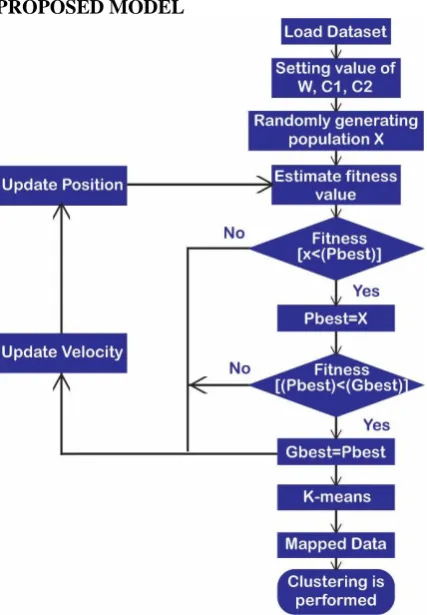
Step1. Initially the data passes through the PSO and PSO define and initialized data in terms of particle and decide random size of population N=1000.
a. Define the
velocity of particle in terms of data point difference value
b. Define the value
of fitness constraints for the selection of data for the process of k-means algorithm
𝐷𝑘 𝑁𝑖,𝑅𝑗 = 𝑊𝑖𝑗𝜖 (𝐶𝑖𝑗 )
𝑝(𝑖,𝑗 )𝑖 , 𝑅𝑖𝜖𝐿𝑘 𝐶𝑖, 𝑅𝑖 … … … … . . (4.1)
Here (𝑀𝑖, 𝑅𝑖) is the value of attribute and mapping for seed
c. Iteration process
is done and calculate the value of Gbest and Pbest
d. Passes data
through k-means
Step2. Here show steps of processing of SOC 1) Process the PSO data and initialized the number of index.
2) Randomly select the PSO vector for the process of index optimization.
3) Every particle is examined to find the best match PSO.
4) The similarity of index is decrease and the number of optimal PSO is going to k-means 5) After that the index value are adjusted and passes through the PSO space of cluster map. The function PSO mapping creates data matrix of index.
1. After processing of this of PSO data creates cluster.
2. Generate PSO mapping of each cluster according to the optimal index.
3. The cluster measures the Similarity and return the equivalent cluster of data.
4. If the relevant cluster is not found that the process going again in PSO space.
PROPOSED MODEL
Figure 1: shows that proposed model of self-optimal clustering technique.
5. EXPERIMENTAL RESULT ANALYSIS
Figure 2: Shows the result value for Ecoil input having K=1 in SOC method.
Figure 3: Shows the output image for Ecoil input having K=1 in SOC-PSO method.
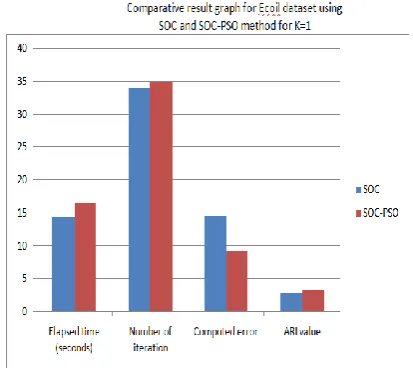
For Ecoil dataset having K=1 Val
ue OfK
Meth od
Elapsed time (second s)
Numbe r of iteratio n
Compu ted error
AR I val ue
1
SOC 14.354 549
34.000 000
14.540 000
2.8 60
SOC-PSO
16.573 459
35.000 000
9.2200 00
3.2 60
For Glass dataset having K=1 Val
ue Of K
Meth od
Elapse d time (secon ds)
Numbe r of iteratio n
Comp uted error
ARI value
1
SOC 8.3202 58
21.000 000
6.6200 00
1.640 000 SOC
-PSO
11.195 804
22.000 000
3.7700 00
2.040 000
Figure 4: Shows that result for Ecoil dataset using SOC and SOC-PSO for K=1
Figure 5: Shows that result for Ecoil dataset using SOC and SOC-PSO for K=2
quality during view of data. In future reduces the computational time and complexity factor of data distribution of particle swarm optimization.
REFERENCES
[1] Yuwen Huang “Dynamic Cost-sensitive Ensemble Classification based on Extreme Learning Machine for Mining Imbalanced Massive Data Streams”, SERSC, 2015, Pp 333-346.
[2] Benjamin X. Wang and Nathalie Japkowicz “Boosting support vector machines for imbalanced data sets”, Springer, 2009, Pp 1-20.
[3] M. Mostafizur Rahman and D. N. Davis “Addressing the Class Imbalance Problem in Medical Datasets”, International Journal of Machine Learning and Computing, 2013, Pp 224-228.
[4] R. J. Lyon, J. M. Brooke, J. D. Knowles and B. W. Stappers “A Study on Classification in Imbalanced and Partially-Labelled Data Streams”, IEEE, 2013, Pp 1-6.
[5] Ramachandra Rao Kurada, Dr. K Karteeka Pavan, and Dr. AV Dattareya Rao “A PRELIMINARY SURVEY ON OPTIMIZED MULTIOBJECTIVE METAHEURISTIC METHODS FOR DATA CLUSTERING USING EVOLUTIONARY APPROACHES”, IJCSIT, 2013, Pp 57-77.
[6] R. J. Lyon, J. M. Brooke, J. D. Knowles and B. W. Stappers “Hellinger Distance Trees for Imbalanced Streams”, International Conference on Pattern Recognition, 2014, Pp 1-6.
[7] Yasser Ganjisaffar, Thomas Debeauvais, Sara Javanmardi, Rich Caruana and Cristina Videira Lopes “Distributed Tuning of Machine Learning Algorithms using MapReduce Clusters”, ACM, 2011, Pp 1-8.
[8] Volkan Tunali, Turgay Bilgin, and Ali Camurcu “An Improved Clustering Algorithm for TextMining: Multi-Cluster Spherical K-Means”, International Arab Journal of Information Technology, 2015, Pp 12-19.
[9] Rahul Malviya, Astt Prof.sushil Tiwari and Prof.S.R.Yadav “A Survey of Modified Support Vector Machine using Particle of Swarm Optimization for Data Classification”, Journal of Advanced Computing and Communication Technologies, 2015, Pp 27-32.
[10] A. Fernandez, S. Garcia, and F. Herrera “Addressing the Classification with Imbalanced Data: Open Problems and New Challenges on Class Distribution”, Springer, 2012, Pp 1-10.
[11] Shafiq Alam, Gillian Dobbie, Yun Sing Koh, Patricia Riddle and Saeed Ur Rehman “Research on particle swarm optimization based clustering: A systematic review of literature and techniques”, Elsevier, 2014, Pp 1-13.
[12] LUO Xin “Chinese Text Classification Based on Particle Swarm Optimization”, NCEECE, 2015, Pp 53-58.
[13] Rukshan Batuwita and Vasile Palade “Efficient Resampling Methods for Training Support Vector Machines with Imbalanced Datasets”, IEEE, 2010, Pp 1-8.
[14] Spencer Angus Thomas and Yaochu Jin “Reconstructing Biological Gene Regulatory Networks: Where Optimization Meets Big Data”, Springer, 2014, Pp 1-15.
[15] Mikel Galar, Alberto Fern´andez, Edurne Barrenechea, Humberto Bustince and Francisco Herrera “A Review on Ensembles for the Class Imbalance Problem: Bagging-, Boosting-, and Hybrid-Based Approaches”, IEEE, 2012, Pp 462-484.
[16] Nishchal K. Verma, Abhishek Roy “Self-Optimal Clustering Technique Using Optimized Threshold Function” IEEE SYSTEMS JOURNAL, IEEE 2013. Pp 1-14.
[17] Li Xuan, Chen Zhigang, Yang Fan “Exploring of clustering algorithm on class imbalanced Data” The 8th International Conference on Computer Science & Education IEEE ,2013. Pp 89-94.
[18] RamachandraRaoKurada, K KarteekaPavan, AV DattareyaRao “A preliminary survey on optimized multiobjectivemetaheuristic methods for data clustering using evolutionary approaches” International Journal of Computer Science & Information Technology (IJCSIT) Vol 5, 2013. Pp 57-78.
[19] R. J. Lyon, J. M. Brooke, J. D. Knowles “A Study on Classification in Imbalanced and Partially-Labelled Data Streams” IEEE 2013.Pp 451-457.