DOI: 10.14738/abr.57.3411.
Ama, N. O., & Okurut, F. N. (2017). Challenges MSMEs Face And Benefits In The Adoption Of Open Collaborative Innovation:
A Principal Component Approach. Archives of Business Research, 5(7), 85-103.
Challenges
MSMEs Face And Benefits In The Adoption Of Open
Collaborative Innovation: A Principal Component Approach
Njoku Ola Ama Department of Statistics University of Botswana, Gaborone
Francis Nathan Okurut Department of Economics University of Botswana, Gaborone
ABSTRACT
This study investigates the use of open collaborative innovation practices by MSMEs in Botswana and uses the opinions of a stratified sample of 206 MSMEs’ owners/managers to identify the benefits and challenges that MSMEs face in engaging in open collaborative innovations to scale up their businesses. The results show that majority of the enterprises (81.1%) were not engaged in open collaborative innovations, had owners/managers with first degree qualification or below (59.7%), lacked access to financial resources, and had below 5 years of experience (69.4%) in running the enterprises. Using the Principal component analysis, the identified benefits are increased financial revenue, improved market strategy, better incentives and improved knowledge; while the challenges are lack of networks, lack of financial support, market demands and previous innovation experiences. The study recommends that there is need for agencies charged with MSME Development in Botswana (LEA, CEDA) to sensitize MSMEs to engage in open collaborative innovation to enhance growth; enterprises should be encouraged to collaborate with universities to bridge the gap in the lack of qualified research experts with PhD ; policies to enable the MSMEs access finance for the businesses and protect the intellectual property rights abuse of businesses are imperative; and policies that would protect micro and small enterprises from unnecessary market competition with larger enterprises need to be put in place.
Keywords: Open collaborative innovations, MSMEs, benefits, challenges, businesses
INTRODUCTION
URL: http://dx.doi.org/10.14738/abr.57.3411. 86
EU was 67%. Micro companies contribute to approximately 30% of that percentage, small enterprises with approximately 20% and middle companies with 17% (Carnazza, n.d; Airaksinen et al. 2015; Edinburg Group, 2012).
In India, MSMEs contribute nearly 45% to manufacturing and about 40% to the Indian export sector. Their contribution to the Indian GDP is 8% and the sector has registered growth rate of 10.8%. MSMEs provide employment to almost 60 million people, and it is the largest source of employment in India, after the agriculture sector (Price water house Coopers Private Limited, 2011). MSMEs brought about 30% of the total export value in Asia on average in 2007–2012. In the People’s Republic of China (PRC), MSMEs accounted for 41.5% of total export value in 2012, up 6.8% year-on-year, while in Thailand they made up 28.8% of total export value with 3.7% year-on-year growth. MSMEs have the potential to promote international trade and mobilize domestic demand (ADB 2014). MSMEs contributed 59.1% of nominal gross domestic product (GDP) in Indonesia in 2012. In Thailand, it contributed 37% of nominal GDP in 2012, and in Malaysia, 32.7% of real GDP in the same year (Yoshino and Taghizadeh-Hesary, 2016). In Bangladesh, enterprises of less than 100 employees account for 99% of firms and 58% of employment. Similarly, in Ecuador, 99% of all private companies have less than 50 employees and account for 55% of employment (WBCSD, 2007). According to the International Finance Corporation (IFC), there is a positive relationship between a country’s overall level of income and the number of MSMEs per 1,000 people (IFC, 2006).
In Africa there is also boom in small and medium-sized enterprises including microenterprises. More than 90% of all firms outside the agricultural sector are SMEs and microenterprises, generating a significant portion of GDP. For example, in Morocco, 93% of industrial firms are MSMEs and account for 38% of production, 33% of investment, 30% of exports and 46% of employment.These small and growing businesses create around 80% of the region’s employment, establishing a new middle class and fuelling demand for new goods and services (dos Santos, 2015). MSMEs in South Africa account for about 91% of the formal business entities, contribute to about 51% of GDP, and provide almost 60% of employment. The Government of South Africa sees the advancement of Small, Medium and Micro-sized Enterprises (MSMEs) as the catalyst to achieving economic growth, development, job creation, mitigation of poverty, and as an economic empowerment vehicle for previously disadvantaged people (Masarira and Msweli, 2013). It is estimated that MSMEs account for 70 percent of Ghana's gross domestic product (GDP) and 92 percent of its businesses, and 70 percent of the manufacturing sector in Nigeria (Frimpong, 2013). The MSMEs serve as a means for economic diversification through the development of new and unsaturated sectors of the economy. In many African countries MSMEs account for about 50% of job creation. In Tanzania for example, it is estimated that more than a third of the GDP originates from the MSME sector (Frimpong, 2013; Akugri, 2015).
Although the level of awareness of MSMEs is remarkable and MSMEs contribute to the development of African economies, yet the growth of MSMEs in Africa faces a number of challenges. They include the lack of access to appropriate capital from both the banking sector and the capital markets. There is a general perception in the financial sector that lending or provision of capital to MSMEs is risky business due to high mortality rates of MSME businesses, suspect management capabilities and skills, poorly prepared business proposals, obscure historical records of the operations of the MSMEs and the lack of reliable collateral or collateral mismatch between type of assets held by MSMEs and type of assets required by banks for collateral (Frimpong, 2013). Yoshino and Taghizadeh-Hesary (2016) outline limited access to finance, lack of a database, low research and development (R&D) expenditures, undeveloped sales channels, and a low level of financial inclusion as some of the reasons behind the slow growth of MSMEs. Chimucheka and Mandipaka (2015) identified lack of networking opportunities and lack of government support as some of the impediments to the establishment, survival and growth of MSMEs in the Nkonkobe Municipality in Eastern Cape Province of South Africa.
In Botswana, the MSME policy identifies three different categories of micro, small, and medium sized enterprises (MSMEs) (Government of Botswana, 1999) based on the size and annual turnover (see Table 1).
Table 1: Categorization of MSME in Botswana
Enterprise Size (employees) Annual turnover
Micro 1- 5 (including owner) P 60,000 ($ 7, 500)
Small 6- 24 P60,000–P1,500,000 ($7,500 - $187,500)
Medium 25-100 P1, 500,000 P8, 000,000 ($187,500
-$1,000,000)
Exchange rate US$1 = P8; Source: Government of Botswana (2009)
Definitions of MSMEs are different country by country. In some countries the criteria for the categorization is capital, in some countries it is based on the number of employees, and others use a mixed criteria and it varies in each business. In the European Union, the upper limit is 250 employees while in United States MSMEs include firms with fewer than 500 employees. Small firms are those with fewer than 50 employees while micro-enterprises have at most 10 or in some cases five workers (OECD, 2000).
Table 2: Definition of MSMEs based on firm size and percentage of enterprises Enterprise
type
United States of America European Union
Size of enterprise
Percentage (%) Size of enterprise Percentage (%)
Micro 0-9 50 Less than 10 93
Small 10-99 38 10-49 5.9
Medium 100-499 8 50-249 0.9
Large 500 or more 4 More than 249 0.2
Source: OECD/Eurostat database on SME Statistics; OECD (2000)
URL: http://dx.doi.org/10.14738/abr.57.3411. 88
lack of market, poor quality products, lack of commitment by promoters on their business and lack of qualified mentors to oversee projects, shortage of business premises especially for small enterprises, and lack technology, innovation and expertise (LEA,2007; BIDPA, 2007; Modisane, n.d; Lall and Peedoly, 2006).
The Government of Botswana has put up structures and institutions to assist the MSMEs. They include:
•
Citizen Entrepreneurial Development Agency (CEDA)-provides subsidized credit,along with monitoring, mentoring, business advisory services and training, to selected citizen entrepreneurs (CEDA, 2016);
•
The Local Enterprise Authority (LEA)- provides development and support services tothe local industry needs of MSMEs, encompassing training, mentoring, business plan finalization, market access facilitation, and facilitation of technology adaptation and adoption (LEA, 2008);
•
The Youth Development Fund (YDF) -It caters for out-of-school youth, marginalized youth, unemployed youth and underemployed youth (working youth earning less than P600 monthly) who are citizens of Botswana aged between 18-29 years (Molelu, 2010). The Youth Development Fund is 50 percent grant and 50 percent interest free loan of the total approved amount.• Young Farmers Fund (YFF)- provides funding to all young people (aged between 18
and 35 years) who are citizens of Botswana or wholly citizen owned companies, wishing to start or expand agricultural projects (Ministry of Finance and Development Planning, 2006).
• Botswana Textile and Small Business Owners Association (BOTSBOA)- develop
business linkages between small, medium and large scale entrepreneurs to further entrepreneurial development and growth; creates opportunities for members of the association to interact with Government and other organisations and to facilitate the benefit from Government programmes and incentives; facilitates bulk buying of raw materials for the members to reduce the costs through buying for the association. Membership to BOTSBOA is open to small and medium scale entrepreneurs of all sectors i.e. small business owners (Government of Botswana, 2011).
• Botswana Innovation Hub: The premises of BIH are designed based on four main
principles: orientation to high-tech customers, flexibility, ample common-use premises/shared facilities and use of environmentally-friendly technologies; offers tailor-made solutions, with high standards of security and data connections; BIH services are designed to support tenants' competitiveness by allowing them to concentrate on their core business; provides advanced telecommunications infrastructure and services, modern and fully equipped meeting and conference facilities, human resources services, reception and helpdesk, professional facilities management, security and access control, telephone, cleaning, mail, cafeteria & catering. Additional services as furniture leasing, removal services, travel services, transportation, shipping agent, courier services, short-term legal advisory services are provided. BIH will regularly develop a range of services based on companies' needs and feedback (Government of Botswana, 2011).
Despite the support given to MSMEs by the Government, institutions and the private sectors, the growth of the MSMEs in Botswana has been minimal. One of the areas of support from the institutions has been for MSMEs to establish linkages or collaborate with each other to enhance their growth through innovations. As a strategy for young firms or enterprises to scale up their businesses, open innovation collaboration with larger and established enterprises or firms has been seen to be an important and a valuable option. This is so that younger enterprises are able to access capacity building in financial and organizational management from the larger and established enterprises/firms, while the established firms seeking to improve their external innovation capabilities can take advantage of the different perspectives, approaches and risk outlooks of young firms (World Economic Forum, 2015).
Chesbrough (2006) defined open innovation as the use of “purposeful inflows and outflows of knowledge to accelerate innovation internally while also expanding the markets for the external use of innovation”. This model involves strategic, managed exchanges of information. Friedman and Angelus (n.d) defined collaborative innovation as an open innovation strategy that enables consumer packaged goods (CPG) manufacturers and retailers to partner for profit and provide shoppers and consumers with more innovative offerings. Open collaborative innovation allows for the utilization of external ideas from different interinstitutional and transdisciplinary entities, and looks towards the common goal of providing practical solutions to business challenges that arise in a globalized world (Ramirez, 2016). Between 30 and 60 per cent of MSMEs can be characterised as innovative, of which some 10 per cent are technology-based. Innovative MSMEs are more market-driven rather than research-driven, and respond very fast to new opportunities than large firms (OECD, 1998). Open innovation has a wide range of potential opportunities for significantly improving the innovative performance of MSMEs. Open innovation practices, for example, can offer alternative and more viable strategies by which growth-oriented MSMEs can access inter-firm resources at a lower cost, addressing obstacles such as technological and internal financial and human resources that hinder new product development and the ability to enter new markets. Additionally, open innovation can enable greater access to information, technologies and laboratory facilities that could have taken years and require significant R&D investment to acquire in-house (Wynarczyk, 2014).
A study by the OECD found that only 5-20% of MSMEs are actively using open innovation approach (Hossain, 2015). Studies on open innovation in MSMEs are also fragmented (Bianchi et al. 2010; Colombo et al. 2014). Some researchers argue that MSMEs can achieve greater benefits from the open innovation than larger firms because of their less bureaucracy, increased willingness to take risks, and faster ability to react to changing environments (Parida et al. 2012). Gassmann et al. (2010) have shown that open innovation is a promising means for MSMEs to overcome their challenges and increase their profitability.
URL: http://dx.doi.org/10.14738/abr.57.3411. 90 and development (R&D) outsourcing, and external participations (van de Vrande et al. 2009). How these apply to MSMEs in Botswana together with the challenges they encounter in Open Collaborative Innovations (OCI) to improve the growth of the enterprises are not very clear and constitute the crux of this paper.
This study investigates the use of open collaborative innovation practices by MSMEs in Botswana and identifies the challenges that the MSMEs face and the benefits when pursuing a more open approach towards innovation.
METHODOLOGY
The study covered three cities, namely, Gaborone, Lobatse and Francistown in Botswana and their environs, purposively selected because of concentration of MSMEs. Data were collected from stratified sample of 206 micro, small and medium enterprises (MSMEs) that were interviewed (Table 3). This sample size was determined with the use of Raosoft (2004), a sample size calculator, which shows that a statistically appropriate sample size for a population of 56,450 MSMEs (50, 000 Micro enterprises, 6,000 small enterprises and 450 medium size enterprises) (Sentsho, n.d.) at 95% confidence interval and allowing an error margin of 5% is 382. However, this statistically acceptable sample size was reduced to 206 because of the limited budget for the study.
Table 3: Number of interviewed MSME
Type of enterprise Number interviewed Percent
Micro 101 49
Small 80 39
Medium 25 12
Total 206 100
Two types of data, qualitative and quantitative data, were collected in the main study from which this paper emanated, through documentary review, focus group discussions/key informant interviews, and MSME survey. The key issues captured from the interviews included: the perceptions of the MSMEs about open collaborative innovations, their experiences with open collaborative innovation initiatives, the benefits and challenges of open collaborative innovations to the enterprises, the cost of these collaborative innovations to the enterprises, what should be done to enhance collaborative innovations and forestall any intellectual property violations in the open collaborative innovations adopted. This paper focusses only on the quantitative results from the survey using questionnaires.
Trained research assistants administered the questionnaires on the owners or managers of the sampled enterprises in their offices. They explained to the participants the purpose of the study, assured them of confidentiality of information supplied and anonymity of individuals participating in the study. The participants were further informed that participation in the study was voluntary; there would be no payment for participation and they could back out of the study any time they desired. Those who accepted to participate in the study were requested to sign a consent form before the interviews were started. The questionnaire used in this study was developed with the help of Oslo Manual (OECD, 2005). At the end of the data collection, 206 fully completed questionnaires were returned.
study covers only a small area of the country. However, information generated will be useful in developing a national study with the excellent methodology.
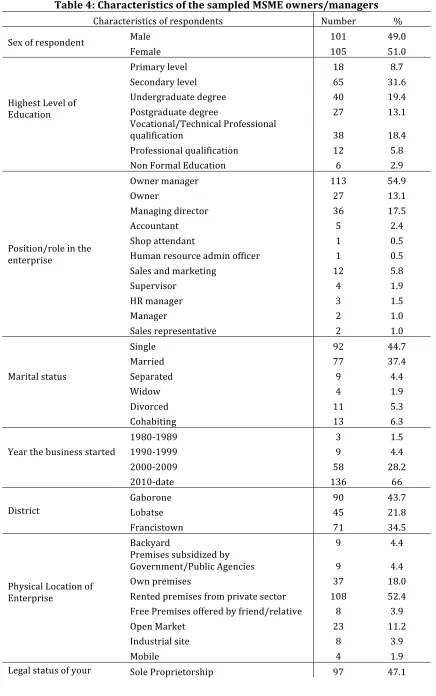
RESULTS Characteristics of sampled enterprises
URL: http://dx.doi.org/10.14738/abr.57.3411. 92
Table 4: Characteristics of the sampled MSME owners/managers Characteristics of respondents Number %
Sex of respondent Male 101 49.0
Female 105 51.0
Highest Level of Education
Primary level 18 8.7
Secondary level 65 31.6
Undergraduate degree 40 19.4
Postgraduate degree 27 13.1
Vocational/Technical Professional
qualification 38 18.4
Professional qualification 12 5.8
Non Formal Education 6 2.9
Position/role in the enterprise
Owner manager 113 54.9
Owner 27 13.1
Managing director 36 17.5
Accountant 5 2.4
Shop attendant 1 0.5
Human resource admin officer 1 0.5
Sales and marketing 12 5.8
Supervisor 4 1.9
HR manager 3 1.5
Manager 2 1.0
Sales representative 2 1.0
Marital status
Single 92 44.7
Married 77 37.4
Separated 9 4.4
Widow 4 1.9
Divorced 11 5.3
Cohabiting 13 6.3
Year the business started
1980-1989 3 1.5
1990-1999 9 4.4
2000-2009 58 28.2
2010-date 136 66
District
Gaborone 90 43.7
Lobatse 45 21.8
Francistown 71 34.5
Physical Location of Enterprise
Backyard 9 4.4
Premises subsidized by
Government/Public Agencies 9 4.4
Own premises 37 18.0
Rented premises from private sector 108 52.4 Free Premises offered by friend/relative 8 3.9
Open Market 23 11.2
Industrial site 8 3.9
Mobile 4 1.9
registered business entity Partnership 25 12.1
Cooperative 2 1.0
Limited Private Co. 26 12.6
Society/Group 5 2.4
Registered Businesses 41 19.9
Auto Mechanic 10 4.9
Best description of the sector in which you operate
Manufacturing 18 8.7
Transport and Communication 8 3.9
Construction Services 15 7.3
Wholesale / Retail Trade 85 41.3
Agriculture 72 35.0
Others 8 3.9
How business originated
Linkage to an existing business 30 14.6
Inherited family business 26 12.6
Bought an existing business 19 9.2
Managers buying the business ) 15 7.3
Completely new start-up 116 56.3
How would you classify your business growth
A business in the Seed stage 10 4.9
A business in the Start-up stage 50 24.3
A business in the Growth stage 94 45.6
A business in the Maturity stage 36 17.5
A business in the Decline stage 16 7.8
Classification of your
business Formal 168 81.6
Informal 38 18.4
Firm has been engaged in some form of open collaborations
Yes 39 18.9
No 167 81.1
Years of experience in business
0-5 143 69.4
6-10 40 19.4
11-15 12 5.8
16 and over 11 5.3
Number of employees in your company
1-5 101 49.0
6-24 80 38.9
25-99 25 12.1
Engagement in Open Collaborative Innovation
URL: http://dx.doi.org/10.14738/abr.57.3411. 94
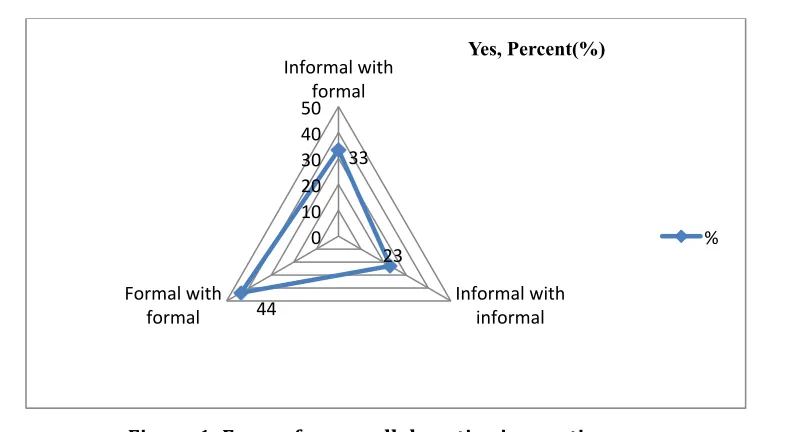
Figure 1: Form of open collaborative innovation
Benefits of the open collaborative innovation to enterprises (scale up)
The benefits of OCI to enterprises in this study were assessed by the responses of the enterprises to 23 suggested options of possible benefits in terms of scaling up their businesses on a five point Likert scale of 1 = strongly disagree, 2 = disagree, 3 = neither agree nor disagree, 4 = agree and 5 = strongly agree.
The responses were subjected to Principal Component Analysis, a data reduction process, so as to determine the variables that best describe the benefits of OCI in scaling up the enterprises based on the components that explain the highest percentage of total variation in the variables. Table 5 shows the four components that best describes the benefits, namely, increased financial revenue which explains over half (58.3%) of the total variation in all the variables and heavily loaded on financial (e.g. increased valuation)(0.841), agility to adopt more quickly to market changes (0.813), business (increased revenue)(0.801), investment (0.789), access to key contacts (0.743), increased visibility and enhanced publicity or reputation (0.678), relationship with experts in scaling up (0.61), access to markets (0.54). The second component which explains 8.8% of the total variation is improved market strategy and is heavily loaded on increased profit (0.836), improved strategy on markets (0.835), new products and services (0.742), provision of tools and training staff (0.6), increase in shareholder value (0.571), and creation of strategic plans (0.559). The third component, best described as better incentives, explains 7.7% of the total variation and is loaded heavily on recognition and reward of achievement (0.795), communication effectiveness (0.777), motivation of staff (0.756), and improved hiring process to find best professionals to take the business to next level (0.692). The fourth component is improved knowledge which explains 6% of the total variation and heavily loaded on gaining market knowledge (0.86), business development (entering new markets or gaining new customers) (0.835), start-ups may bring fresh thinking to help solve core business problems (0.657), increased number of skilled employees (0.552). The four components explain 80.8% of the total variance.
33
23
44 0 10 20 30 40 50
Informal with formal
Informal with informal Formal with
formal
Yes, Percent(%)
Table 5: Principal Components that best describes the benefits of OCI to enterprises
Benefits of open collaborative innovations
Component
Increased financial revenue (1)
Improved market strategy
(2)
Better incentives
(3)
Improved knowledge
(4)
Financial (e.g. increased valuation) 0.841
Agility to adapt more quickly to market changes 0.813
Business (increased revenue ) 0.801
Investment 0.789
Access to key contacts 0.743
Visibility and enhanced publicity or reputation 0.678
Relationship with experts in scaling up 0.61
Access to new markets 0.54
Increased profit 0.836
Improved strategy on markets 0.835
New products and services 0.742
Provision of tools and training to staff 0.600
Increase in shareholder value 0.571
Creation of strategic plans 0.559
Alliances with other firms or with universities 0.547
Recognition and reward of achievement 0.795
Communication effectiveness 0.777
Motivation of staff 0.756
Improved hiring process to find best professionals to
take the business to next level 0.692
Gaining market knowledge 0.860
Business development (entering new markets or
gaining new customers), 0.835
Start-ups may bring fresh thinking to help solve core
business problems 0.657
Increased number of skilled employees 0.552
URL: http://dx.doi.org/10.14738/abr.57.3411. 96 Table 6: Principal Component models of benefits of OCI to enterprises
Principal Component Variable names
Variables 1 2 3 4
New products and services -0.17 0.32 -0.14 0.15 X1
Increased number of skilled employees -0.16 -0.05 0.14 0.24 X2
Improved hiring process to find best professionals to take the
business to next level -0.13 -0.04 0.25 0.11 X3
Motivation of staff -0.02 -0.11 0.27 -0.02 X4
Communication effectiveness -0.05 -0.06 0.29 -0.04 X5
Recognition and reward of achievement -0.09 -0.11 0.34 -0.02 X6
Provision of tools and training to staff -0.25 0.18 0.22 0.07 X7
Creation of strategic plans -0.08 0.15 0.05 0.04 X8
Increase in shareholder value 0.08 0.15 -0.01 -0.13 X9
Relationship with experts in scaling up 0.12 -0.01 0.12 -0.17 X10
Increased profit -0.01 0.30 -0.02 -0.17 X11
Improved strategy on markets 0.03 0.30 -0.11 -0.13 X12
Alliances with other firms or with universities 0.06 0.13 -0.07 -0.01 X13 Visibility and enhanced publicity or reputation 0.12 -0.02 -0.05 0.06 X14
Access to new markets 0.08 0.13 -0.17 0.07 X15
Gaining market knowledge -0.09 -0.02 -0.04 0.34 X16
Business development (entering new markets or gaining new
customers), 0.00 -0.10 -0.09 0.32 X17
Start-ups may bring fresh thinking to help solve core business
problems 0.03 -0.08 -0.01 0.20 X18
Access to key contacts 0.16 -0.03 -0.05 0.02 X19
Investment 0.22 -0.07 -0.13 0.02 X20
Financial (e.g. increased valuation) 0.22 -0.09 -0.03 -0.04 X21
Business (increased revenue ) 0.23 -0.06 -0.02 -0.11 X22
Agility to adapt more quickly to market changes 0.21 -0.08 -0.04 -0.04 X23
Challenges faced by the MSMEs in embracing open collaborative innovations.
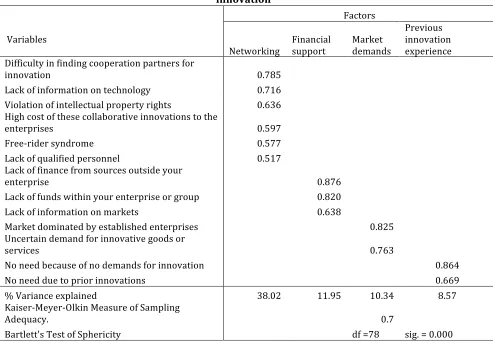
The enterprises were asked to rate how important some defined 13 variables were to them in hampering their innovation activities on a four point scale of 1 = Not used; 2 = Low and 3= Medium and 4 = High. To underscore the most important factors hindering embracing open collaborative innovation, the variables were subjected to a Principal Component analysis (PCA) and four factors, namely, networking, financial support, market demands and previous innovation experiences with the highest eigen values of 4.94, 1.55, 1.34 and 1.12, respectively, were identified as challenges to open collaborative innovations. These components account for 68.9% of the total variation in the observed variables (Table 7).
Networking (F1)
Financial Support (F2)
This component was heavily loaded on three variables: Lack of finance from other sources outside the enterprise with component loading 0.876, Lack of funds within your enterprise or group (0.820) and Lack of information on markets (0.638). This factor explained 11.95% of the total variance.
Market demands (F3)
This component is heavily loaded on two variables: Market dominated by established enterprises with component loading 0.825 and uncertain demand for innovative goods or services (0.763). The component explained 10.34% of the total variance.
Previous innovation experience (F4)
This component is loaded highly on two variables: No need because there are no demands for innovation with component loading 0.864 and No need due to prior innovations (0.669). The factor explained 8.57% of the total variance.
The Kaiser-Meyer-Olkin Measure of Sampling Adequacy with value of approximately 0.7 (good) shows that we should be confident that the sample size is adequate for PCA. The Bartlett’s measure tests the null hypothesis that the original correlation matrix is an identity matrix against the alternative that it is not an identity matrix. Thus they are some relationships between the variables that are in the analysis. The Bartlett’s test is significant (p < 0.01) showing that the variables are highly correlated lending themselves for PCA.
Table 7: Principal Components that best describe the challenges to open collaborative innovation
Variables
Factors
Networking
Financial support
Market demands
Previous innovation experience Difficulty in finding cooperation partners for
innovation 0.785
Lack of information on technology 0.716 Violation of intellectual property rights 0.636 High cost of these collaborative innovations to the
enterprises 0.597
Free-rider syndrome 0.577 Lack of qualified personnel 0.517 Lack of finance from sources outside your
enterprise 0.876
Lack of funds within your enterprise or group 0.820 Lack of information on markets 0.638
Market dominated by established enterprises 0.825 Uncertain demand for innovative goods or
services 0.763
No need because of no demands for innovation 0.864 No need due to prior innovations 0.669 % Variance explained 38.02 11.95 10.34 8.57 Kaiser-Meyer-Olkin Measure of Sampling
Adequacy. 0.7
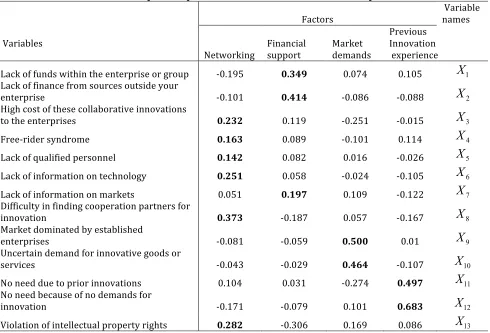
URL: http://dx.doi.org/10.14738/abr.57.3411. 98 Table 8 shows the models for the four components (factors). The factor score or beta coefficient indicates the level of relationship between a component and the various variables. Thus in the first equation (component 1), the networking factor, is positively correlated with difficulty in finding cooperation partners for innovation (X8), violation of intellectual property rights (X13), lack of information on technology (X6) and high cost of these collaborative innovations to the enterprises (X3). It has the highest regression weight of 0.373 on the variable X8 (difficulty in finding cooperation partners for innovation). The second component (Financial support) is positively correlated with lack of funds within the enterprise or group (
1
X ), lack of finance from sources outside the enterprise (X2) and lack of information on markets ( X7). The market demands component is positively correlated with Uncertain demand for innovative goods or services ( X10) and Market dominated by established enterprises (X9) while the fourth component, previous innovation experience, is highly positively correlated with no need due to prior innovations (X11) and no need because of no demands for innovation (X12)
Table 8: Principal component models for the different components
Variables
Factors Variable names
Networking
Financial support
Market demands
Previous Innovation experience
Lack of funds within the enterprise or group -0.195 0.349 0.074 0.105 X1
Lack of finance from sources outside your
enterprise -0.101 0.414 -0.086 -0.088 X2
High cost of these collaborative innovations
to the enterprises 0.232 0.119 -0.251 -0.015 X3
Free-rider syndrome 0.163 0.089 -0.101 0.114 X4
Lack of qualified personnel 0.142 0.082 0.016 -0.026 X5
Lack of information on technology 0.251 0.058 -0.024 -0.105 X6
Lack of information on markets 0.051 0.197 0.109 -0.122 X7
Difficulty in finding cooperation partners for
innovation 0.373 -0.187 0.057 -0.167 X8
Market dominated by established
enterprises -0.081 -0.059 0.500 0.01 X9
Uncertain demand for innovative goods or
services -0.043 -0.029 0.464 -0.107 X10
No need due to prior innovations 0.104 0.031 -0.274 0.497 X11
No need because of no demands for
innovation -0.171 -0.079 0.101 0.683 X12
Violation of intellectual property rights 0.282 -0.306 0.169 0.086 X13
DISCUSSION OF THE RESULTS
open collaborative innovations (81.1%). Close to half (47.1%) of the businesses were sole proprietorship and were in their growth stage (business is growing steadily and sales are increasing) (45.6%) while 56.3% of them originated as new start up. The findings of the study are in line with those of Hossain (2015) that stated that only between 5% and 20% of MSMEs are adopting open innovations in the OECD countries. van de Vrande et al. (2009) and Teirlinck and Spithoven (2013) found that the smaller the size of an SME, the less the degree of collaboration and medium-sized firms have lower involvement in R&D outsourcing than the smaller enterprises. However, the small sizes of the enterprises can be capitalized on to enhance open collaborative innovations since the enterprises can be more homogeneous and therefore unlikely to be affected by bureaucratic manipulations. The enterprises are also more likely to have strong desires to take risks which are essential ingredients in business expansion (Parida et al. 2012).
The study revealed that 60% of the enterprises’ owners/managers had a first degree qualification or below. This explains to some degree why most of the enterprises studied were not engaged in open collaborative innovations. Studies have shown that the urge to engage in research cooperation is positively associated with the number of PhD holders among the research managers and R&D experts (Teirlinck and Spithoven, 2013) and also, the craving to outsource increases with the formal qualification level of the R&D personnel and with R&D training (Op cit).
The youthful nature of the businesses, and with owners/managers who are inexperienced are likely to have affected the desire of the enterprises to get engaged in open collaborative innovation. Rahman and Ramos, (2013) advocated that MSMEs with these characteristics are bound to have relatively low level of absorptive capacity, policy and financial constraints, and perceived management challenges to be effectively engaged in open collaborative innovations and to realize its benefits (Van de Vrande et al., 2009; Saguy, 2011). Open collaborative innovation requires that managers/owners must be able to identify the critical knowledge associated with every step of their enterprises’ innovative processes and be able to institute processes for integrating knowledge into their collaborative efforts (Gassmann et al, 2010). This move requires experience and necessary skills which might be lacking in the youthful enterprises. It is important, therefore, to have leadership of enterprises with absorptive capacity to drive several organizational changes, including the institution of an effective knowledge management strategy. In their paper, Tushman and Nadler (1986) identified that visionary leadership is an important factor that affect whether an organization realizes benefits from innovation. Ashurst, Freer, Ekdahl, and Gibbons (2012) emphasized that organizations can gain competitive advantage not only by managing effectively for today, but at the same time by creating innovation for tomorrow.
URL: http://dx.doi.org/10.14738/abr.57.3411. 100
operative functions of the firm, and access to up-to-date scientific excellence. Christensen et al. (2005) highlighted that open innovation sometimes incurs high transaction costs. Wynarczyk (2013) argued that to remain competitive locally and internationally, MSMEs are highly dependent on R&D capacity, managerial structure and competencies, open innovation practices and the ability of the enterprises to attract government grants for R&D and technological development.
Notwithstanding the above challenges that MSMEs have, most of the few enterprises that were involved in OCI still realized some benefits which included: increased financial benefits, businesses having added value, experienced increased agility to adapt more quickly to market changes, realized increased revenue and investments, more access to key contacts, increased visibility and enhanced publicity or reputation in the public domain with improved relationship with experts on how businesses can be scaled up. Improvement in market strategy, better business incentives and improved knowledge of business management principles were some other benefits realized. These results are in line with Wynarczyk (2014) who showed that open innovation can enable greater access to information, technologies and laboratory facilities that could have taken years and which require significant R&D investment to acquire in-house. Although Lee et al. (2009) found that the open innovation is not an attractive option especially for enterprises at the early-stage (start-ups) because they do not have adequate capabilities regarding R&D investment, Lee et al. (2010) showed that open innovation has high potential for MSMEs, including micro enterprises.
It is, therefore, imperative that if the MSMEs are equipped with appropriate resources such as finances for the businesses, appropriate information on innovation practices and technology, higher education and appropriate IP environment, the challenges of small size and inability to conduct research and participate in development can be overcome. Enterprises owners/managers need higher education and training which encourage and appreciate creativity, critical thinking, self-discipline, self-motivation, desire for knowledge and life-long learning, openness, and cooperation to sensitize MSMEs towards open innovation practices and establishments of networks to enhance productivity of the businesses through launching products and services.
RECOMMENDATIONS
The study, therefore, recommend as follows:
Ø There is need for agencies charged with MSME Development in Botswana (LEA, CEDA)
to sensitize MSMEs to engage in open collaborative innovation to enhance growth.
Ø Owner/managers of MSMEs need to be trained in management of enterprises which include knowledge of government regulations, new technologies and innovation parameters, customer responsiveness, IP rights and practices, and information on new markets.
Ø Enterprises should be encouraged to collaborate with universities to bridge the gap in
the lack of qualified research experts with PhD to enhance their R&D needs for innovation.
Ø Policies to enable the MSMEs access finance for the businesses and protect the intellectual property rights abuse of businesses are imperative.
ACKNOWLEDGEMENT
The authors wish to thank the Open AIR network and acknowledge the support of University of
Cape Town (UCT), its partners and the Project's funders, namely, the UK Government's Department for International Development, the International Development Research Centre (IDRC), Canada, and the Social Sciences and Humanities Research Council of Canada for the financial support to carry out the study The views expressed in this work are those of the authors and do not necessarily represent those of the research funders.
References
Abouzeedan, A, Klofsten, M, & Hedner, T. (2013). Internetization Management as a Facilitator for Managing Innovation in High-Technology Smaller Firms. Global Business Review, 14(1), 121–136.
Akugri, M.S., Bagah, D.A. and. Wulifan J.K.(2015) The Contributions of Small and Medium Scale Enterprises to Economic Growth: A Cross-Sectional study of Zebilla in the Bawku West District of Northern Ghana. European Journal of Business and Management ISSN 2222-1905 (Paper) ISSN 2222-2839 (Online) Vol.7, No.9, 262-274 Airaksinen, A., Luomaranta, H., Alajääskö, P., and Roodhuijzen A. (2015) . Statistics on small and medium-sized enterprises: Dependent and independent MSMEs and large enterprises. Available at
http://ec.europa.eu/eurostat/statistics-explained/index.php/Statistics_on_small_and_medium-sized_enterprises. Accessed 17 April 2017
Ayyagari, M., Demirgüç-Kunt, A. and Maksimovic, V. (2011), Small vs. Young Firms across The World –
Contribution to Employment, Job Creation, and Growth, Policy Research Working Paper 5631 (The World Bank Development Research Group)
Ashurst, C., Freer, A., Ekdahl, J., & Gibbons, C. (2012). Exploring IT-enabled innovation: A new paradigm? International Journal of Information Management. 32(4), 326–336. Available at
http://dx.doi.org/10.1016/j.ijinfomgt.2012.05.006
Asian Development Bank (ADB) (2014). Asia SME Finance Monitor 2013. Manila: Asian Development Bank. Bianchi, M, Campodall’Orto, S, Frattini, F, & Vercesi, P. (2010). Enabling open innovation in small-and medium-sized enterprises: how to find alternative applications for your technologies. R&D Management, 40 (4), 414–431 Carnazza, G. (n.d). The Role and the Main Developments of MSMEs in the European Economy UEAPME STUDY UNIT MAISON DE L'ECONOMIE EUROPEENNE -RUE JACQUES DE LALAING 4 -B-1040 BRUXELLES. Available at http://www.ueapme.com/IMG/pdf/The_role_and_the_main_developments_of_MSMEs_in_the_European_economy _without_Annex.pdf
CEDA (2016) Citizen Entrepreneurial Development Agency (CEDA). Available at http://www.ceda.co.bw/background
Chesbrough, H. W. (2006). Open innovation: A new paradigm for understanding industrial innovation. In H. W. Chesbrough, W. Vanhaverbeke & J. West (Eds.), Open Innovation: Researching a New Paradigm (pp. 1-12). Oxford: Oxford University Press
Chimucheka, T. and Mandipaka, F. (2015). Challenges Faced By Small, Medium And Micro Enterprises in the Nkonkobe Municipality. International Business & Economics Research Journal, Volume 14(2):309-316
Christensen, JF, Olesen, MH, & Kjær, JS. (2005). The industrial dynamics of open innovation—evidence from the transformation of consumer electronics. Research Policy, 34(10), 1533–1549.
Colombo, MG, Piva, E, & Rossi-Lamastra, C. (2014). Open innovation and within-industry diversification in small and medium enterprises: The case of open source software firms. Research Policy, 43(5), 891–902
Daniels, L. (1999), "The role of small enterprises in the household and national economy in Kenya: A significant contribution or a last resort". World Development, 27(1), 55 – 65
dos Santos, J.F.S .(2015) Why MSMEs are key to growth in Africa Available at
URL: http://dx.doi.org/10.14738/abr.57.3411. 102
http://viewpoints.io/uploads/files /Best_Practices_in_Collaborative_Innovation_1.pdf. Accessed on 16 May 2016 Frimpong, C. Y. (2013). MSMEs as an Engine of Social and Economic Development in Africa. Available at
https://www.modernghana.com/news/478225/1/MSMEs-as-an-engine-of-social-and-economic-developme.html. Accessed 17 April 2017
Gassmann H, Enkel E, Chesbrough HW (2010). The future of open innovation. R&D Management 40, 213-221. Government of Botswana (2011). Support for Existing Small & Medium Enterprises.
http://www.gov.bw/en/Business/Sub-audiences/Small--Medium-Businesses/Support-for-Existing-Small--Medium/. . Accessed 15 December 2016
Hossain M. (2015). A review of literature on open innovation in small and medium-sized enterprises. Journal of Global Entrepreneurship Research (2015) 5:6 DOI 10.1186/s40497-015-0022-y
IFC. (2006). Micro, Small, and Medium Enterprises: A Collection of Published Data, in Newberry, Derek, 2006. The Role of Small- and Medium-Sized enterprises in the Futures of Emerging Economies. Earth Trends 2006. World Resources Institute under a Creative Commons License.
Jefferis, K. (n.d) The New Policy on Small, Medium and Micro Enterprises: BIDPA Briefing. Available at http://dspace.africaportal.org/jspui/bitstream/123456789/31791 /1/SPECIAL%20BRIEFING%20-%20SME%20POLICY.pdf?1 Accessed 13 December 2016
LEA(2008). About Local Enterprise Authority; Gaborone.
LEA (2007). Small, Medium and Large Enterprises Database, sector mapping and validation in Botswana: Findings and Strategies for Local Enterprise Botswana.
BIDPA (2007). The role of the informal sector in Diversification of Selebi-Phikwe. Gaborone
Lee, YG, Park, SH, & Song, YI. (2009). Which is better for a firm’s financial performance: An externally oriented or inwardly oriented innovation strategy? An empirical study on Korean MSMEs. Asian Journal of Technology Innovation, 17(1), 57–73.
Lee, S, Park, G, Yoon, B, & Park, J. (2010). Open innovation in MSMEs—An intermediated network model. Research Policy, 39(2), 290–300.
Lin J.Y. & Lin Y.(2001). Promoting growth of medium and small-sized enterprises through the development of medium and small-sized financial institutions. Economic Research Journal, No. 1: pp.10-19
Masarira, S and Msweli, P. (2013). The Role of MSMEs in National Economies: The Case of South Africa. Economic and Social Development: Book of Proceedings; Varazdin: 1484-1494. Varazdin: Varazdin Development and Entrepreneurship Agency (VADEA).
Mead C. D. (1994), "The contribution of small enterprises to employment growth in Southern and Eastern Africa". World Development, 22 ( 12), 1881-1894
Ministry of Finance and Development planning (2006). CEDA young farmers Fund guidelines
Modisane (n.d). The challenges facing the development of SMMEs in Botswana. Stanbic Bank, Botswana, Gaborone. Available at
http://www.hotwireprc.com/documents/SBB%20article_challenges%20faced%20by%20SMMEs.pdf. Accessed 28 August 2016
Molelu, K. (2010). Youth success through fund. Available at http://www.gov.bw/en /Citizens/Topics /Citizen-News /YOUTH-SUCCESS-THROUGH-THE-FUND/. Accessed 15 December 2016.
Naoyuki Yoshino and Farhad Taghizadeh-Hesary (2016). Major Challenges Facing Small and Medium-sized Enterprises in Asia and Solutions for Mitigating Them. Asian Development Bank Institute Working Paper Series, No. 564 April 2016
OECD (2000) Small and Medium-sized Enterprises: Local Strength, Global Reach. Policy Brief. Available at
file:///E:/Open%20Air%20Studies%20_Collaborative%20innovation/New%20Research_Collaborative%20innov
ation/Paper+Article%20Development/Small%20and%20Medium-sized%20enterprises_Local%20and%20Global.pdf
OECD (1998). Small businesses, job creation and growth: facts, obstacles and best practices. OECD, 53 pages. Available at https://www.oecd.org/cfe/MSMEs/2090740.pdf
Parida, V, Westerberg, M, & Frishammar, J. (2012). Inbound Open Innovation Activities in High-Tech MSMEs: The Impact on Innovation Performance. Journal of Small Business Management, 50(2), 283–309.
Pricewater house Coopers Private Limited (2011). Innovation: Changing the MSME landscape. Available at http://www.pwc.in/assets/pdfs/publications-2011/innovation-msme-2011.pdf. Accessed 17 April 2017 Rahman, H. (2010) Open innovation: Opportunities and challenges for MSMEs. In M. M. Cruz-Cunha & J. Varajão (Eds.), E-business issues, challenges and opportunities for MSMEs: Driving Competitiveness (pp. 87-100). IGI Global
Rahman H and Ramos I. (2013). Challenges in Adopting Open Innovation Strategies in MSMEs: An Exploratory Study in Portugal. Issues in Informing Science and Information Technology, Volume 10, p. 431-448
Robu, M (2013). The Dynamic and Importance of MSMEs in Economy. The USV Annals of Economics and Public Administration, Volume 13, Issue 1(17), 84-89
Saguy, I.S. 2011. Paradigm shifts in academia and the food industry required to meet innovation challenges. Trends in Food Science & Technology 22:467-475 doi: 10.1016/j.tifs.2011.04.003
Teirlinck, P, & Spithoven, A. (2013). Research collaboration and R&D outsourcing: Different R&D personnel requirements in MSMEs. Technovation, 33(4), 142–153.
Tushman, M., & Nadler, D. (1986). Organizing for innovation. California Management Review, 28(3), 74– 92. Van de Vrande, V., De Jong, J. P. J., Vanhaverbeke, W., & De Rochemont, M. (2009). Open innovation in MSMEs: Trends, motives and management challenges. Technovation, 29(6), 423-437.
WBCSD. (2007). Promoting small and medium enterprises for sustainable development. [Online] Available: http://www.wbcsd.org/Plugins/DocSearch/details.asp?DocTypeId=25&ObjectId=MjU1MTM
Wohlmuth, K., Alabi, R. A., Burger, P., Gutowski, A., Jerome, A., Knedlik, T., Meyn, M., & Urban, T. (2009). New Growth and Poverty Alleviation Strategies for Africa-Institutional and Local Perspectives. LIT Verlag Münster World Economic Forum (2015) Collaborative Innovation Transforming Business, Driving Growth. Available http://www3.weforum.org/docs /WEF_Collaborative_Innovation_report_2015.pdf. Accessed 7 December 2015 Wynarczyk, P. (2014). Exploring the benefits of open innovation in MSMEs. TECH MONITOR, April_June, 2014, pp.53-54 . Available at http://www.techmonitor.net/tm/images /3/37/14apr_jun_managing_innovation.pdf Wynarczyk, P. (2013). Open innovation in MSMEs: A dynamic approach to modern entrepreneurship in the twenty-first century. Journal of Small Business and Enterprise Development, 20(2), 258–278
Yoon B., Shin J. and Lee S. (2016). Open Innovation Projects in MSMEs as an Engine for Sustainable Growth. Sustainability, 8, 146:1-27