Performance of knapsack sprayer: effect of
technological parameters on nanoparticles
spray distribution
Majid Hazim Reshaq Alheidary
Department of Agriculture Machines and Equipments, Agriculture College, Basrah University, Basrah, Iraq
Abstract
Iraqi farmers are currently used knapsack sprayers
in their applications with a low cost to control
diseases in vegetables and trees. Laboratory and
field tests were carried out to study performance of
knapsack sprayer after its modification to determine
the optimal spray deposit on the target at different
settings to control the flowrate at the time of
application. A knapsack sprayer of 16 liters capacity
was modified using existing materials in markets
and its performance evaluated. Tests were done with
conical dual tip nozzle. White papers cards were
utilized to measure droplet characteristics. All
measurements were made at different nozzle heights
of 50, 70, and 90 cm, different operating pressure
were without pressure gauge, 15, 25, and 30 psi.
The main results showed that droplet distribution
was proportional to nozzle heights and operating
pressures. Increasing nozzle heights and operating
pressure cause an effect in droplet distribution and
spray deposit. A high spray deposit was observed at
nozzle height of 50 cm and operating pressure of 30
psi. Operating pressure has greater influence on
droplet size than nozzle height. Increasing operating
pressure from 15psi to 30psi led to decrease in
droplet size of 13.62%.
Keywords: Knapsack sprayer, nozzle height, operating pressure, droplet size diameter, deposit,
coverage
Introduction
Increasing the population numbers are requires
increasing in the crop production and quality [1].
Use of pesticides produces at agricultural
applications is an important issue in fields to
improve both of quantity and quality of agricultural
yield. As well as, to protect plants from diseases,
weeds which consider unfavorable for agricultural
plant [2].From the other hand, the use of pesticides
have side-effect on the environment and human
health [3,4].
According to ASAE (American Society of
Agriculture Engineers) droplet sizes are categories
from very fine to extremely coarse. Droplet size
diameter is one of the most important factors use to
evaluate the performance of any sprayer that
affecting on several parameters as VMD (Volume
Median Diameter), spray deposits, and spray
coverage.
VMD is defined as droplet size diameter which
indicates that half of the spray volume is in droplet
smaller than this number and half of the spray
volume is in droplets larger than this size. In
additions, there are two other values important
insides VMD. First value is Dv0.1 which indicates
that 10% of the spray volume is in droplets smaller
than this value and may be a major part of the
driftable fine sizes. Second value is Dv0.9 which
indicates that 90% of the spray volume is in droplets
smaller than this value and 10% of the spray volume
is in droplets larger than this value [5].
The distribution of spray deposits and coverage on
the target site are depends on several factors as
density of plant, droplet size diameter, droplet
velocity, droplet density, physo-chemical properties
of spray liquid, surface characteristics of the foliage,
application [6,7,8,9,10]. Some of these studies have
focused on the complex relationship that exists
between spray coverage on the target site, droplet
size diameter and the efficacy of agricultural
spraying applications.
One of techniques is used for determination of spray
characteristics in field is water sensitive cards. These
cards are widely utilized in the world by different
authors in order to measure droplet size spectrum on
the target site [11,12].
The technologies that used in agricultural
applications to apply the pesticides in farming are
advancing rapidly in the world. While, in small scale
farmers, the knapsack sprayers offers several
advantages to reduce the face difficulties in choosing
a suitable sprayers machine for different types of
crops and pesticides application [13].
Most of the Iraqi farmers are currently used
knapsack sprayers in their applications to apply
pesticides with a low cost to control any disease in
vegetables and trees up to 2.5m height.
Several studies were conducted on sprayers using
different technological parameters as nozzle height
and working pressure separately to show their effect
on spray characteristics. Select a proper nozzle
height and working pressure at agricultural
applications allows uniform coverage of the spray
pattern. When the nozzle height is closed to the
target site, the overlap might be not achieved. Also,
excessive nozzle height leads to increase in spray
drift contamination [14,15]. In addition, nozzle
height was reported by [16] to be the most
significant variable in spray deposit, coverage, and
to reduce spray drift. To achieve satisfied spray
characteristics could be considered an appropriate
nozzle height that causes major differences in
deposition on the intended target site.
Other parameter is operating pressure that can be
controlled using pressure gauge. Pressure gauge on
affecting on the variable in each of flowrate of
nozzles, spray pattern, spray width, droplet size in
spray, spray coverage and chemical performance in
field to control the disease intended. Also,
inconsistent pressure has influence on the spray drift.
One of the main problems that face using of
knapsack sprayers in agriculture applications is
cannot maintain of operating pressure at all time of
pesticides application which effect on each other
explained above.
Several types of sprayers as knapsack sprayers are
requires on specific information as maximum
amount of spray deposit on the intended site, droplet
size diameter, number of droplet density, spray
coverage area.
The main goal of this present study is to evaluate the
performance of knapsack sprayer after its
modification for the following reasons:
Use different nozzle heights of knapsack sprayer
existing after check it at different operating
pressures to Study the suitable height of nozzle vs.
target.
Study the variable in the operating pressure occurs at
the time of application.
Evaluate and compare the droplet diameter, spray
coverage, spray deposit and uniformity of droplets
with standard type of knapsack sprayer existing in
market without pressure gauge.
To get more details accurately at the time of
spraying to guaranty reach the acceptable amount of
pesticides on target and
To improve the deposition volume on the intended
target site using both of a suitable nozzle height and
working pressure.
Materials and Methods
The knapsack sprayer was used in this study as
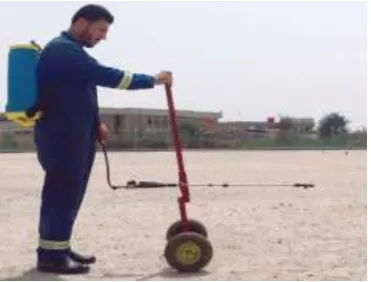
Figure 1: View of knapsack sprayer used
(a) Before modification (b) After modification
This type of sprayer was modified at Department of
Agriculture Mechines and Equipments, Agriculture
College, Basrah University. The main part that
modified in this study was added pressure gauge to
the pipe before the nozzle mounted Fig.1 (b) for
controlling the pressure at time of Agricultural
applications. Tank capacity of knapsack sprayers
was 16 liters. Knapsack sprayer is carried on the
back by two adjustable shoulder straps. An operating
level, positioned either over the shoulder. Drives a
piston or diaphragm pump. The pump is most
commonly fitted on the inside of the tank in order to
prevent damage. The piston pump is preferred for
applying insecticides and fungicides which
considered working with a maximum pressure of 30
PSI. The level of pressure in chamber size is not
stable at the time of sprayer applications; however,
these variations in pressure level are considerably
worsened if pressure chamber capacity is
inadequate.
Considerations taken in modified of knapsack sprayer
Modification of knapsack sprayer in this study was
considered in the development of crop protection as
following:
1. The materials selected are easy, found in
the markets, and
2. Materials parts are used resistance to chemical
products.
Flowrate setup
A cylinder tube was used in laboratory tests for
measuring the volume of liquid discharged into it in
ml per minute unit to fix the flowrate nozzle using a
tap water.
Nozzle setup
Dual conical tip nozzle used in this study as shown
in Table 1
Table 1: Nozzle characteristics
Flowrate (L.min-1)
Without pressure
gauge With pressure gauge (PSI)
30 25
15
0.59 0.83
0.64 0.52
Meteorological conditions
Meteorological conditions including air temperature,
Relative humidity and wind speed were recorded
during each field test at site (Fig. 2) using
anemometer model MS 6252B.
A summary of meteorological conditions during of
spray test is shown in
Table2.
Table 2: Weather conditions during the spray test
Average
temperature
ºC
Average
relative
Humidity
%
Average
wind
Speed
m.s-1
Wind
direction
16.1 52.46 2.1 North
Modalities setup
The field test was carried out with an operator at
field measuring 10m length * 10m width. The
worker walked with average speed 0.9 m/sec. The
discharged volume in liters per minute was recorded
at time of test for the nozzle that used in this study as
shown in table 1. 36 modalities were conducted in
this study by using different nozzle height (50, 70,
and 90cm), different operating pressures (without
pressure gauge, 15, 25, and 30 PSI). All modalities
carried at the same nozzle type dual conical tip and
average wind speed of 2.1 m.s-1. The test of
procedure was repeated 3 times and the mean value
determined.
Procedure the work
The experiments were performed at Department of
Agriculture Mechines and Equipments, Agriculture
College, Basrah University. The experiments were
conducted in soil virgin (without plants). Spray
deposits were collected for measuring and analysis
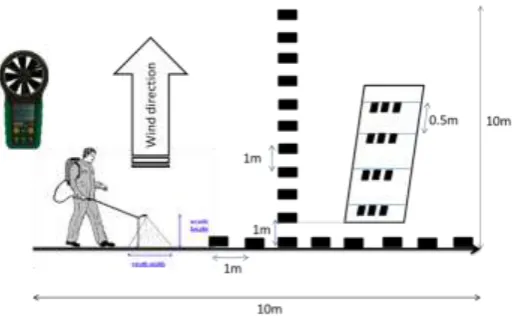
using both horizontal and vertical collectors. A spray
deposit with vertical collectors were 0.5m width*
2m length, whereas the horizontal collectors were
placed at each 1m until 10m. A total of 12 vertical
white cards were collected for each test, the collector
layout is shown in Fig. 3.
Figure 3: Schematic view of the test site and
collection spray locations.
All tests were applied in a crosswind (perpendicular
to wind direction). The average of wind speed for all
tests was 2.1 m.s-1.
Determination of spray distribution
Spray distribution with nozzle test was conducted
using white papers. A liter of water was mixed with
a tracer florescent which poured into the tank of
sprayer. The position of spray nozzle was located at
lateral position (parallel to wind direction). The total
deposition onto horizontal surface that covered with
droplets of liquid on the white cards (42 cm2) above
the ground was measured Figure 4. Testing was
conducted when the average wind speed was 2 m/s.
So, wind drift was minimal. The white cards were
scanned using DropletScan® software.
The white papers are positioned at the safe distance,
safe wind speed to avoid walking and to crush it by
the worker.
After each replication, the white cards were
remained in their origin place for 15 min after
spraying until dry it then placed in
prelabeled-sealable bags for preservation. Data envelopes were
used to organize and store the white cards until
analysis was complete.
This present work, it presents just only the samples
in horizontal collectors because of the values in
vertical locations were small at a low wind speed of
2.1 m.s-1.
Measurement distribution of the spray characteristics
Droplet size was measured on the white cards paper
after spraying. The papers were collected and
scanned by a scanner (HP Scanjet 2400) with a
resolution of 600 dpi none interpolated and analyzed
by means of the computer DropletScan® (WRK of
Arkansas, Lonoke, AR; and WRK of Oklahoma,
Stillwater, Ok; Devore Systems, Inc., Manhattan, KS)
was used to analyze the white cards. Each white card
was 5 cm width*8.5 cm length. The total area of the
pieces of white card was analyzed by the program.
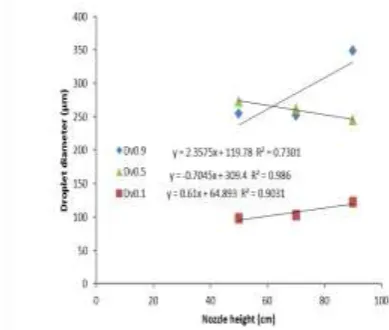
For the analysis, were evaluated the volume median
diameter, Dv0.1, Dv0.9, and droplet median
diameter, droplet size.
Dropletscan software converts each individual image
spot area to the actual droplet diameter by using the
equation
Dd= 1.06 As0.455 --- (1)
Where Dd is actual droplet diameter µm; As is spot
area cm2
Collection spray deposition measurements After spraying, the droplets deposit on the collector.
Fluorescent dye Brilliant Sulpho-Flavine (BSF) was
selected in this study with a concentration of 1g.l-1.
One of the main reasons to use BSF tracer in this
article are due to the results of [17] when compared
the performance of different fluorescent dyes and
selected this type of tracer as the best type of tracer
to reproduce the atmospheric transport of pesticides.
As well as, BSF tracer was with a low degradation
after it exposure to sunlight. All experimental
measurements are repeated three times then
calculated the average after.
Statistical analysis
All experiments were statistically analysed of data
using graph pad software® to enable the comparison
between repetition and normalize the data.
Results and discussion
Effect of nozzle height and operating pressure on volume median diameter
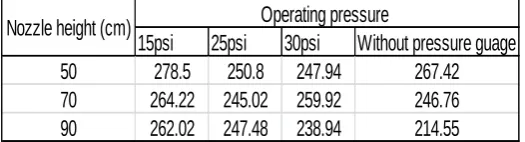
As shown in Table 3 increasing the operating
pressure and nozzle height led to significant
differences in droplet diameter. The minimum of
VMD value was observed 214.55 µm at unknown
pressure (without pressure gauge mounted on the rod
of sprayer) and nozzle height of 90cm, and the
maximum of VMD value was 278.5µm at 15 PSI
and nozzle height of 50 cm.
Table 3: Spray characteristics at different nozzle
heights and operating pressure
15psi
25psi
30psi
Without pressure guage
50
278.5
250.8
247.94
267.42
70
264.22
245.02
259.92
246.76
90
262.02
247.48
238.94
214.55
Operating pressure
Nozzle height (cm)
The percentage of droplets diameter less than 100
mm on the white card were 69 % at nozzle height
90cm and operating pressure of 30psi.
Increasing operating pressure led to reduce in the
mean of droplet sizes in all modalities conducted in
this study and increased in the percentage of spray
Effect of operating pressure and nozzle height on spray distribution (droplet size)
Increasing both of the operating pressure and nozzle
height led to significant differences in droplet size
diameter. As shown in Figures 5, 6, 7, 8, represents
the effect of working parameters as operating
pressure and nozzle height on spray distribution
(droplet size). Increasing in operating pressure and
nozzle heights results in generating spray droplets
with smaller size in diameter. Consequently, the
results showed increasing in the percentage of spray
coverage with increase in operating pressure. Also, it
could be seen that any change in operating pressure
lead to influence on the spray distribution. The
portion of small droplet size on the collectors was
small in low operating pressure and nozzle height.
The effect of operating pressure on droplet size was
greater than nozzle height. Increasing operating
pressure from 15psi to 30psi led to decrease in
droplet size of 13.62%.
Figure 5: Effect of nozzle height on spray droplets
distribution at 15PSI- horizontal location samples
Figure 6: Effect of nozzle height on spray droplets
distribution at 25PSI- horizontal location samples
Figure 7: Effect of nozzle height on spray droplets
distribution at 30PSI- horizontal location samples
Figure 8: Effect of nozzle height on spray droplets
distribution at horizontal location samples- without
pressure gauge
Effect of operating pressure on nozzle flowrate Table 4 induced the nozzle flowrate of water liquid
at different operating pressures. The discharge
volume of liquid in L.min-1 increased from 0.52 to
0.83 l/m when increased operating pressure from 15
Table 4: Results of nozzle flowrate
Table 4 revealed that the average discharge volume
is change depending on operating pressure and mean
time taken to spray in sec. Nozzle flowrate has
affected by operating pressure. There was variation
in the nozzle flowrate recorded due to working
pressure with a constant walking operator speed at
the time of field test. Higher flowrate observed at 30
psi and lower nozzle flowrate at 15 psi.
Effect of operating pressure and nozzle height on spray distribution (area coverage %)
Results showed in Tables 5 induced increasing the
operating pressure and nozzle height led to
significant differences in spray coverage. Spray
coverage was increased when increase both of
operating pressure and nozzle height. High coverage
observed at the highest operating pressure of 30 PSI
and nozzle height of 90 cm. The lowest spray
coverage in this study was showed at unknown
pressure. The results showed that when median
droplet size is decreased, spray coverage on the
white paper collectors is increased.
Table 5: effect of operating pressure and nozzle
height on area coverage %
The decreased in droplet size observed at the highest
operating pressure of 30psi and highest nozzle
height of 90 cm , but the spray coverage increased to
the highest value 17.2%.
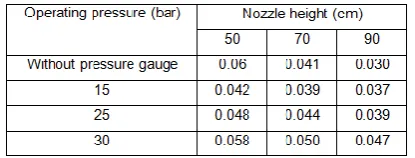
Effect of operating pressure and nozzle height on droplet deposition
Increasing the operating pressure and nozzle height
led to significant differences in droplet deposition.
As shown in Fig. 6 droplet deposit has affected by
operating pressure and nozzle height.
Table 6: effect of operating pressure and nozzle
height on spray deposit (µL/cm²)
The deposits on the white papers are between 0.03
and 0.06 µl/cm2. Results from this study showed that
the application without a constant pressure has a
greater effect on droplet size and coverage which
related directly to droplet deposit.
Smaller droplets size gives better uniformity in
droplet deposit distribution than larger droplets size.
They are also higher deposits on the white papers
when the nozzle height is the lowest and the
operating pressure is the highest. These results are
important because it would support to select of a
suitable droplet size and coverage at each parameter
used. Also, it would to support the management of
spray drift. Also, the results from this study showed
low drift deposits on the ground after 2m downwind
due to low wind speed at the time of test.
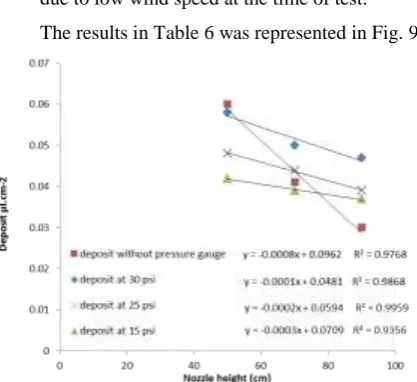
The results in Table 6 was represented in Fig. 9
Figure 9: Effect of operating on deposit at different
nozzle heights
As shown from the experimental results in Figure 8
a linear correlation between spray deposit and
operating pressure at different nozzle heights. It is
also observed when the sprayer without pressure
gauge the deposit decreased rapidly with nozzle
heights compared to with pressure gauge.
Conclusions
The paper presents the effect of technological
parameters as nozzle height and operating pressure
on spray characteristics as droplet size diameter,
spray coverage, and spray deposit. The main results
showed technological parameters have significant
impact on spray characteristics. The impact are
varies with both of nozzle height and operating
pressure. Spray deposit and coverage influenced by
changing of droplet size diameters. The main factor
has effected on droplet size was operating pressure.
Any change in the mean of droplet diameter as a
function of changes in the operating pressure will be
changed in spray deposit and coverage. It would be
recommended to alternate these parameters to
increase coverage at increase operating pressure and
decrease nozzle height as possible.
Other recommendations of the study to use pressure
gauge with knapsack sprayer for limiting the
differences in spray impact. As well as inconsistent
pressure influence on the spray deposit and coverage
by controlling the flowrate and nozzle height at the
time of application when applied at an acceptable
meteorological conditions. To achieve a constant
volume application rate at the time of application,
the pressure level must be maintained.
Acknowledgements
The author is grateful to IRSTEA-Montpellier
especially to Dr. Jean Paul Douzals and Mr. Bakache
from France for their supports this article with BSF
tracer and to 4th class students at Department of
Agriculture Machines and Equipments for their help
and participate in field work. Without their generous
contributions, I could never have been able to
conduct this article.
References
[1]FAO.http://www.fao.org/fileadmin/templates/wsfs/docs/expert _paper/How_to_Feed_the_World_in_2050.pdf.
[2]Godfrey, L.D., 2014. The contributions of pesticides to pest management in Metting the Global need for food production by 2050. Council for Agricultural Science and Technology, Issue paper 55, 28 pp.
[3]Gil,Y.; Sinfort, C., 2005. Emission of pesticides to the air during sprayer application: A bibliographic review. Atmospheric Environment 39, 5183-5193.
[4]Franzen, M., 2007. Programme to reduce the risks connected with the use of pesticides in Sweden. In: SuproFruit, 9th Workshop on spray Application Techniques in Fruit Growing, PP.1-7.
[5]ASAE S572.1. 2009. Spray nozzle classification by droplet spectra. Am. Soc.Agric. Eng.St.Joseph, MI.,4 pp.
[6]Kent, J.; Early, R., 1999. Spray drift fact sheet. Pesticide Application in vineyards. 2nd edition
[7]Salyani, M.; Farooq, M.; Sweeb, R. D., 2007. Spray deposition and mass balance in citrus orchard applications. Transactions of the ASABE, 50, 1963-1969.
[9]Zhu, H.; Salyani, M.; Fox, R. D., 2011. A portable scanning system for evaluation of spray deposit distribution. Computers and Electronics in Agriculture, 76, 38-43.
[16]Ozkan, H. E.; Womac, A., 2016. Best management practices for boom spraying. The Ohio State University, College of Food, Agricultural and Environmental Sciences.
[17]Cai, S.S.; Stark, J.D., 1997. Evaluation of five fluorescent dyes and triethyl phosphate as atmospheric tracers of agricultural sprays. Journal of Environmental Science and Health Part B-Pesticides Contaminationts and Agricultural Wastes 32, 969-983.
[10]Guler, H.; Zhu, H.; Ozkan, H.E.; Ling, P., 2012. Characterization of hydraulic nozzles for droplet size and spray coverage. Atomization and Sprays, 22(8), 627-645.
[11]Vangessel, M.J.; Johnson, Q.R., 2005. Evaluating drift control agents to reduce short distance movement and effect on herbicide performance. Weed technology, 19(1), 78-85.
[12]Salyani, M.; Zhu, H.; Sweeb, R.D.;Pai, N., 2013. Assessment of spray distribution with water-sensitive paper. Agri. Eng Int: CIGR Journal.15(2), 101-110.
[13]Singa, D.D., 2007. Evaluation of knapsack and ulta-low volume (ULV) sprayers for use by small-scale farmers in Malawi. Malawi Journal of Agricultural Science 3(1),24-31.
[14]De Jong, A.; Michielsen, H.; Stallinga, H.; Van de Zande, J.C., 2000. Effect of sprayer boom height on spray drift. 52nd International Symposium on Crop Protection PtsI and Ii proceedings, 65(2A-B), 919-930.