University of Pennsylvania
ScholarlyCommons
Publicly Accessible Penn Dissertations
Summer 8-13-2010
Narrative “Flow”: A Model of Narrative Processing
and its Impact on Information Processing,
Knowledge Acquisition and Persuasion
Jean M. Brechman
University of Pennsylvania, [email protected]
Follow this and additional works at:http://repository.upenn.edu/edissertations
Part of theHealth Communication Commons
This paper is posted at ScholarlyCommons.http://repository.upenn.edu/edissertations/204
Recommended Citation
Brechman, Jean M., "Narrative “Flow”: A Model of Narrative Processing and its Impact on Information Processing, Knowledge Acquisition and Persuasion" (2010).Publicly Accessible Penn Dissertations. 204.
Narrative “Flow”: A Model of Narrative Processing and its Impact on
Information Processing, Knowledge Acquisition and Persuasion
Abstract
The utility of narrative as a powerful communication tool is undisputed. However, within both narrative and media effects literature, there is a general lack of attention afforded to the process through which narrative influences audiences. This dissertation investigates the distinct cognitive and emotional dimensions that comprise one’s narrative flow and comprehension through the development and validation of a process model. In addition to continuous response measurement and stimulated recall interviews, validation efforts included the use of a scaling technique designed to investigate the conditional nature of narrative flow. These efforts provided evidence for the model’s successful characterization of the psychological processes involved in narrative processing.
Insofar as remembering narrative information is a necessary first step toward behavior change, the relationship between narrative flow and memory was explored. A sample of young women (n=115) viewed two excerpts from the primetime medical drama, ER, each addressing a relevant health topic – HPV and BRCA1. Segments of these excerpts, previously found to elicit/inhibit narrative flow, served as a basis for comparison. High engagement produced significantly more recall than low engagement periods. Accurate recognition of key health information was greater when information was presented during low engagement periods.
Degree Type Dissertation
Degree Name
Doctor of Philosophy (PhD)
Graduate Group Communication
First Advisor
Joseph N. Cappella, PhD
Second Advisor Robert Hornik, PhD
Third Advisor Paul Messaris, PhD
Keywords
Subject Categories
Narrative “Flow”: A model of narrative processing and its impact on information
processing, knowledge acquisition and persuasion
Jean Brechman
A DISSERTATION
in
Communication
Presented to the Faculties of the University of Pennsylvania
In Partial Fulfillment of the Requirements for the
Degree of Doctor of Philosophy
2010
Supervisor of Dissertation
Signature _____________________
Dr. Joseph Cappella, Gerald R. Miller Professor of Communication
Graduate Group Chairperson
Signature______________________
Dr. Katherine Sender, Associate Dean of Graduate Studies
Dissertation Committee
Dedication
Contrary to most, I’ve never hoped I would grow up to be unlike my mom and dad. They are selfless, and I woud like to think they’ve given some of their best qualities to
me – a love for learning, a deep respect for education – both formal and informal, an appreciation for people and places of the world. Warmth, compassion, commitment.
To my mom and dad.
I don’t say it often enough. I am a sister. And when you have brothers like I do, that is something to be proud of. I’d like to think that I have supported them, challenged them
and embraced them for who they are…because, to be honest, they are two of the most incredible men I know. To my brothers.
I’m a sensitive person, but I know how to laugh at myself. I think this comes from my friends (in-laws included), who have always laughed at me for my shortcomings. Their
digs have reminded me that , although I am not perfect, I am loved as though I were.
To my friends.
I believe in miracles. And superheros. I believe that good things happen to good people. I met my husband on the first day of 6th grade. And now during these last days
of my 21st (?!) grade, I think to myself – our love is a miracle. My husband is my superman. And together, he and I experience something amazing each and every day.
To my husband.
ABSTRACT
NARRATIVE “FLOW”: A MODEL OF NARRATIVE PROCESSING AND ITS IMPACT ON
INFORMATION PROCESSING, KNOWLEDGE ACQUISITION AND PERSUASION
Jean Brechman
Supervisor: Joseph N. Cappella, PhD
The utility of narrative as a powerful communication tool is undisputed.
However, within both narrative and media effects literature, there is a general lack of
attention afforded to the process through which narrative influences audiences. This
dissertation investigates the distinct cognitive and emotional dimensions that comprise
one’s narrative flow and comprehension through the development and validation of a
process model. In addition to continuous response measurement and stimulated recall
interviews, validation efforts included the use of a scaling technique designed to
investigate the conditional nature of narrative flow. These efforts provided evidence for
the model’s successful characterization of the psychological processes involved in
narrative processing.
Insofar as remembering narrative information is a necessary first step toward
behavior change, the relationship between narrative flow and memory was explored. A
sample of young women (n=115) viewed two excerpts from the primetime medical
drama, ER, each addressing a relevant health topic – HPV and BRCA1. Segments of
these excerpts, previously found to elicit/inhibit narrative flow, served as a basis for
periods. Accurate recognition of key health information was greater when information
Table of Contents
I. Introduction and Specific Aims 1
II. Background and Significance 3
Entertainment as education? Efforts and empirical evidence for effects 3
Narrative as a persuasive tool 5
Theoretical Framework: How entertainment media can inform, persuade & motivate
change 12
Narrative engagement as a mechanism of entertainment media effects 14
III. Phase I: Model Development 19
Flow Theory: Defined 19
Model of Narrative Flow 20
Model Development (Pilot Study I) 25
Methods
Results
IV. Phase II: Model validation using a scaling technique 45
Model Validation (Pilot Study II) 45
Methods
Results
Model Validation (Pilot Study III) 53
Methods
V. Phase III: Application of Model 61
The (inverted-U) relationship between engagement and information processing
Possible effects of message modality on information processing
Possible effects of a message’s temporal position on information processing
Possible effects of narrative flow on knowledge acquisition and persuasion
Further considerations
Final Study 69
Methods 69
Analysis 79
Discussion 111
Conclusion 129
Appendix A 130
Appendix B 131
Appendix C 133
Appendix D 134
Appendix E 135
Appendix F 138
Appendix G 149
List of Tables
Table I (Inter-rater reliability of evaluations of viewers’ variation in engagement)
Table II (Ways to describe variation in viewer engagement: Evaluations of possible labels)
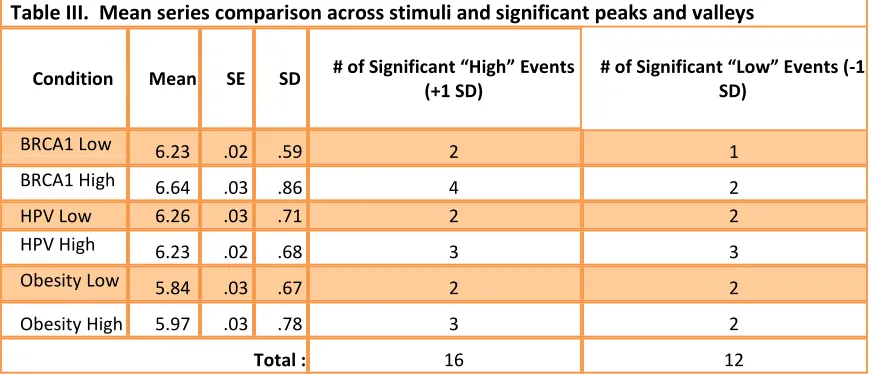
Table III (Mean series comparison across stimuli and significant peaks and valleys)
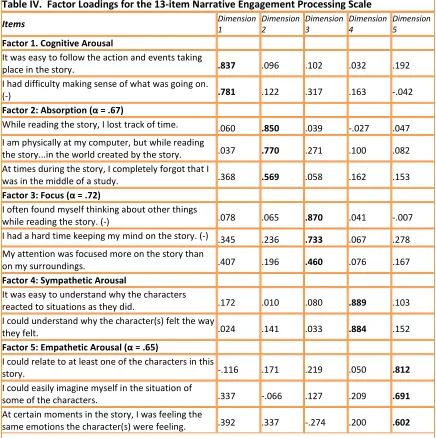
Table IV (Factor Loadings for the 13-item Narrative Engagement Processing Scale)
Table V (Simple correlations among the five dimensions of Narrative Engagement Processing Scale)
Table VI (Recognition Accuracy during High and Low Engagement Periods)
Table VII (Visual versus Audio Recognition during High and Low Engagement Periods)
Table VIII (Visual versus Audio Response Latency during High and Low Engagement Periods)
Table IX (Paired Samples T-Test: Pre-/During/Post- High Engagement Recognition)
Table X (Health versus Non-Health Response Latency within High and Low Engagement Periods)
Table XI (Regression of Attitudes toward HPV detection/prevention onto Demographics, Health familiarty and experience, and Transportation)
Table XII (Regression of Intentions to recommend screening to female friends/family onto Demographics, Health familiarty and experience, and Transportation)
Table XIII (Regression of Intentions to get breast exam onto Demographics, Health familiarty and experience, and Transportation)
Table XIV (Regression of Intentions to be tested for BRCA1 mutation onto Demographics, Health familiarty and experience, and Transportation)
Table XVI (Regression of Intentions to recommend HPV vaccine to young female friend/family onto Demographics, Health familiarty and experience, and Transportation)
Table XVII (Correlations among Narrative Engagement Measures)
I. Introduction and Specific Aims
In recognition of the media-saturated environment in which we live, it is
important to consider the role of media as socialization agents. As acknowledged by the
CDC's Office of Communication Entertainment Education Initiative, "The mass media in
general, and television in particular, provide enormous amounts of information about
health through storylines in entertainment programming. This information may be
correct or incorrect, peripheral or central to characters' lives, planned or serendipitous"
(Salmon, 2000, p.8). In addition to social networks and community ties, myriad
messages reach the public through mass media. Zillman & Vorderer (2000) observe that
entertainment has never before been so accessible to so many people, comprising such
a significant portion of their leisure time.
Until recently, the general tendency of effects research has been to assume
negative effects. A growing body of research, however, recognizes media as a potential
tool for education and health promotion (Singhal & Rogers, 1999). Taken together, both
perspectives highlight the necessity for increased attention to the role of entertainment
media in public health information acquisition.
If media content is, indeed, leaving an impression on viewers, research is needed
to understand how that content facilitates cognitive and/or behavioral change in its
audience. The research program presented here moves beyond assumptions of effect
cultivates change. Specific goals of the research include (1) developing and validating a
model of narrative flow, capturing the multi-dimensional process of engagement; and
(2) determining the extent to which narrative flow impacts processing, acquisition of
cancer knowledge and story-consistent belief change.
Increasing our awareness and understanding of the relationship between
narrative flow and information processing can inform the development of programming.
For example, it is likely that critical health information is better remembered when it is
presented within a period of low engagement. While this study assumes a public health
orientation, specifically focusing on cancer outcomes, an area of increasing concern to
public health officials and health practitioners, findings may also extend beyond the
context of entertainment television to the broader scope of message design and
II. Background and Significance
Elucidation of the mechanisms by which one’s exposure to messages is linked
with individual perception can improve our understanding of the utility of
entertainment media as a strategy for promoting public health. This dissertation
explores, more specifically, cancer outcomes and behavior.
B.1) Entertainment as education? Efforts and empirical evidence for effects
In addition to health campaigns (Hornik, 2002; Rice & Atkin, 2001), advertising
(Macklin & Carson, 1999) and news coverage (Yanovitsky, 2002; Yanovitzky & Stryker,
2001), entertainment media has been recognized as an agent for social change. Until
recently, communication scholars largely neglected the entertainment function of
entertainment media (Katz & Foulkes, 1962; Sutton-Smith, 1988). Given the trend
toward global entertainmentization1, however, the study of entertainment media and
genre has increased exponentially.
Fisch, Truglio & Cole (1999) distinguish between media content produced purely
for entertainment purposes and programming developed with the intention of providing
instruction (e.g. Sesame Street) or incorporating educational messages into
entertainment-oriented storylines (see Singhal & Rogers, 1999). In the former case,
entertainment programs are often created with no intention to educate, persuade or
1
motivate change in their audience. Lack of persuasive intent on the part of producers
does not necessarily, however, translate into nontrivial effects. For example, some of
the earliest media effects research explored the association between exposure to
violent programming and aggressive behavior among young viewers (Bandura, Ross &
Ross, 1961) More recently, scholars have extended exploration of media’s influence to
a variety of outcomes including childhood obesity (Redelmeier and Stanbrook, 2003),
sexual risk and responsibility (Escobar-Chaves et al., 2005), creation and maintenance of
ethnic stereotypes (Oliver, 2006) and smoking initiation and cessation (Wakefield et al.,
2003).
In contrast, entertainment media can be used in deliberate fashion. For
centuries, means of entertainment (e.g. story-telling, drama and dance) have offered
instruction while simultaneously providing a forum for social interaction and reflection.
More recently, the practice of intentionally positioning educational content within an
entertainment context has been recognized as a veritable strategy for advancing public
health goals and is referred to as entertainment-education. Increasingly,
carefully-crafted messages are appearing in popular music (Church & Geller, 1989; Kincaid et al.,
1998), television (Collins, Elliott, Berry, Kanouse & Hunter, 2003), comic books (Milleliri,
Krentel & Rey, 2003; Schinke, Gordon & Weston, 1990) and video games (Brown,
Lieberman, Gemeny, Fan, Wilson & Pasta, 1997; Dragone, Bush, Jones, Bearison &
Much of the research that has informed and guided our way of thinking about
entertainment education developed prior to the advent of many communication
technologies (e.g. internet, interactive gaming) and in parts of the world very different
from the media landscape here in the United States. The existing US system of
commercial broadcasting and government intervention limits projects that involve the
development of programming that places continuous emphasis on select issues. Rather,
the U.S. approach to entertainment education has predominantly focused on
integrating messages into ongoing storylines in broadcast media. As such, efforts in the
United States rely primarily on outreach to major television networks to offer expert
information and resources to be used in single episodes (Montgomery, 1989).
As has been previously discussed, people make inferences and draw conclusions
from entertainment media, even when its content is produced with the exclusive intent
to entertain an audience. Rather than differentiating between programming produced
with or without persuasive intent, this research program emphasizes the fact that much
of today’s entertainment programming is presented in narrative form.
B.2) Narrative as a persuasive tool
Recently, Kreuter, Green, Cappella and colleagues (2007) put forward four
distinct capabilities of narrative. These include its faculty in (a) facilitating information
processing; (b) overcoming audience resistance; (c) providing surrogate social
address these factors and show how each contributes to narrative’s ability as a
persuasive tool.
B.2a) Facilitating information processing
A sizeable body of literature, across content domains (e.g. public health, politics)
and different contexts (e.g. news programming versus fictional drama) has shown that
narrative has the potential to facilitate attention, comprehension, and recall of
embedded messages. This is especially true when intended recipients have limited
ability or motivation to process a more didactic message (Kreuter et al., 2007). Studies
show that recall of narrative information is twice as likely as recall of expository
information (Graesser, Hoffman & Clark, 1980; Haberlandt & Graesser, 1985).
According to Schank & Abelson (1977, 1995) and Graesser and Ottati (1995), narrative
information may be privileged by its skeletal features or schema-like patterns. Schemas,
from a theoretical perspective, offer a way of thinking about how viewers can construct
meaning from a narrative program.
Schemas can be thought of as templates for enabling individuals to store
perceptual and conceptual information about their surroundings and allowing them to
make interpretations of events through experience. The concept, "schema," has been
referred to in a variety of ways, including "cultural model" (D'Andrade and Strauss,
1992; Holland and Quinn, 1987), "mental model" (Johnson-Laird, 1983), "idealized
cognitive model" (Lakoff, 1987), "folk model" (D'Andrade, 1987), "script" (Schank and
are characteristics that distinguish these conceptualizations from one another. For
example, as Busselle & Bilandzic (2008) point out, schemas exist independent of the
narrative while mental models are “cognitive representations of events and states of
affairs constrained in the time and space of the narrative.” It is the process, then, of
relying on pre-existing schema to create mental models that guides a viewer through
the narrative experience.
B.2b) Overcoming audience resistance
“Narrative forms of communication might enjoy some special advantage over
more didactic forms for addressing particular bases of resistance,” (Kreuter et al., 2007,
223). Resistance can be broadly defined as one’s reaction against change, or motivation
to counteract a persuasive appeal(Knowles & Linn, 2004). Kreuter and his colleagues
(2007) distinguish between an individual’s resistance to a behavior and his/her
resistance to a persuasive message, both of which can be advantageously addressed
through narrative communication. Resistance to a behavior, for example, might involve
denying the effectiveness of a behavior (e.g. mammography as a preventive measure
against breast cancer) or simply choosing not to perform a particular action (e.g. breast
self-examination). Depending on the class of behaviors under consideration, resistance
of this sort frequently originates with an individual’s perceived lack of self-efficacy.
Through modeling, viewers can watch similar others succeed and gain an understanding
A second basis for resistance to behavior involves response efficacy. That is, an
individual may not believe that a particular action can actually have an effect. Although
little is known about the persuasive power of narrative versus expository information in
terms of addressing behavioral barriers, it is reasonable to assume that a compelling
narrative may convey the benefits of performing a behavior more effectively than a
recitation of statistical data (Green & Brock, 2000). The personal accounts, especially
from similar others, stands to be a powerful means of persuasion(Brosius, 1995;
Brosius, 1996, Zillman & Brosius, 2000).
When exposed to overtly persuasive communication individuals can engage in a
variety of ways that lead to resistance of message acceptance. Narrative
communication, on the other hand, can activate different processing strategies that
often preclude cognitive resistance and minimize the likelihood of counterarguing. For
example, suspension of disbelief and intense absorption produced through engagement
with the story, termed transportation, can depress one’s ability to generate
counterarguments. In fact, Slater (1997) argues, narrative transportation and
counterarguing are “fundamentally incompatible.”
More often than not, narratives involve exemplars, defined as “personal
descriptions by people who are concerned or interested in an issue” (Brosius, 1999, p.
179). The very nature of exemplification (of a health concern, political orientation etc.)
makes it difficult for people to discount narrative content. While this can be
generalize from exemplar accounts and expand the exemplar account as being a typical
representation of those affected by a problem (Hamill, Wilson & Nisbett, 1980) or
overestimating the prevalence of an issue (Zillmann, Perkins & Sundar, 1992). Celebrity
announcements or endorsements illustrate the power of narrative to generate
awareness and, in many cases, behavior change. The “Couric Effect”, for example,
refers to the 20% increase in colonoscopies performed in the months following a
televised broadcast of Katie Couric getting the screening for herself (Cram et al., 2003).
Audience response to celebrity news stories (e.g. Magic Johnson’s disclosure of his HIV+
status, Nancy and Ronald Regan’s respective breast and colon cancer prevention
campaigns) may be a result of identification. Identification, described below,
encourages attention to the message, thoughts about the message post-vewing and
interpersonal discussion (Rubin & Perse, 1987).
Insofar as narratives employ a relatively subtle form of persuasion, they lower
one’s guard to the possibility of overt persuasion. This may increase receptivity to a
message that otherwise would have been discredited, or even avoided altogether (Dal
Cin, Zanna & Fong, 2004).
B.2c) Providing surrogate social connections
One way narrative provides viewers with surrogate social connections is through
parasocial interaction (PSI). Parasocial interaction is thought to result from viewer
interaction with media figures (i.e. hosts, actors, celebrities) and involves the formation
relationships (Horton & Wohl, 1956; Giles, 2002). Research suggests that, once
established, media figures can often be looked to for counsel and comfort as viewers
appreciate their values and motives (Papa, Singhal, Law, Pant, Sood, Rogers &
Shefner-Rogers, 2000). Viewers of the E-E film, Yellow Card, for example, addressed thousands
of emails to the charactersthemselves, often filled with phrases such as “I love you” or
“I think you’re great” or requests for personal contact, “I really want to be friends,
please write me” (Buenting, 2003).
In a distinct departure from other conceptualizations of narrative engagement,
the type of involvement brought about by PSI may induce central processing of a
message (Slater & Rouner, 2002). Central, or active, processing of a message has been
shown to improve retention (Larsen, 1991) and is thought to be associated with attitude
and behavior change from audiences “having internalized the values and experiences
embodied in the story, rather than through a direct acceptance of arguments
presented,” (Slater & Rouner, 2002, p. 188; Parrott, 1995). 2
Despite the long-time concern over the influence of media figures in
adolescence, most studies that consider the impact of role models on youth (e.g. thin
models on adolescent eating habits; Harrison, 1997; Heilman, 1998) rely on
identification as the central psychological process involved. Although this research
program does not involve extensive testing of the PSI construct, it should be noted that
2
parasocial interaction as an explanatory mechanism for the persuasive effect of media is
a “seriously neglected” topic in communication literature and by developmental
psychologists (Giles, 2002).
B.2d) Addressing emotional and existential issues
Narratives and their exemplars, often foster identification and empathy. At its
most basic level, identification involves shared perspective (e.g. age, gender, social
class) between message recipients and key characters portrayed in a narrative (Feilitzen
& Linne, 1975). An alternate form of identification, wishful identification, involves the
desire to emulate the figure with which one identifies (Liebes & Katz, 1990; Zillman,
1994). Both of these media-user relationships differ, albeit subtly, from parasocial
interaction. Most individuals begin to adopt PSI characteristics by early adolescence, a
shift that is perhaps best illustrated in a set of studies that explored character
preferences among a sample of children, ages 5 to 11, at various developmental stages.
The qualitative data, collected by Giles and Long (1998), indicates that young children,
particularly boys, rely on sex-role stereotyping (i.e. gender identification) when selecting
favorite media characters. Five- and six-year old male study participants overwhelmingly
preferred male characters to female characters. On the other hand, the selection of
favorites by 10- and 11-year old participants reflects the influence of PSI, as many
described them as sharing qualities of their friends.
Identification is also distinct from parasocial interaction in that it requires
figure. Parasocial interaction can occur without shared perspective, thus explaining why
one might engage with a character whom he/she actively dislikes (Giles, 2002).
An alternative way to think about identification comes from Cohen (2001).
Cohen’s (2001) “point-of-view” interpretation defines identification as “a process that
consists of increasing loss of self-awareness and its temporary replacement with
heightened emotional and cognitive connections with a character,” (251). Cohen
emphasizes, then, identification as a phenomenological process rather than an attitude,
perception or emotion (Busselle & Bilandzic, 2008). Approaching the study of
identification from this perspective, identification as metaphor rather than simile (e.g.
“the [viewer] is the character for the duration of the story instead of recognizing
similarities between him/herself and the character,” Busselle & Bilandzic, 2008; Kuiken,
Miall & Sikora, 2004; Kuiken, Phillips et al., 2004), influences how one proposes
mediated messages are processed. For example, PSI involves a more active role in
processing of messages whereas identification draws a viewer into the story such that
he/she can no longer engage in central processing.
B.3) Theoretical Framework: How entertainment media can inform, persuade & motivate change
Several theoretical paradigms are useful in guiding the present research.
Developed independent of any consideration involving the role and function of media,
psycho-social theories focus on individual-level cognitive and behavior change. While
interactions associated with issues of media saturation, they are valuable in
understanding micro-level learning processes. Particularly relevant to the study of
fictional narrative, Bandura’s Social Cognitive Theory (1986) posits that individuals
observe the behavior of role models they admire, leading them to make inferences and
attributions about consequences of behavior, and acquire social scripts and normative
beliefs that subsequently direct decisions about behavior. Thus, media constitutes a
possible conduit for behavior modeling, as the constant stream of characters and
portrayals present viewers with an opportunity to consider the acceptability of, and
outcomes associated with, a particular behavior.
Separate corpuses of theories emphasize the roles and effects of media and
society. There are strong theoretical reasons to believe that media plays an important
role in socialization including the realism and consistency of content and limited access
to countervailing information (Huston et al., 1998). A predominant theoretical model
supporting this line of research has been cultivation theory which hypothesizes that
invariant cultural patterns in media programming cultivate long-term beliefs about the
real world (Gerbner et al., 1978). Essentially, cultivation theory assumes that media’s
influence is indirect, subtle and cumulative. Bryant and Rockwell (1994) refer to this as
“stalagmite effects – cognitive deposits built up almost imperceptibly from the
drip-drip-drip of television’s electronic limewater,” (183). Greenberg (1988), alternatively,
suggests more of a drench hypothesis whereby media portrayals with which viewers
two distinct routes of media influence, one immediate and one more gradual, both
assume identical end states. That is, media content can influence audiences.
Finally, consideration of select persuasion theories, such as Petty & Cacioppo’s
(1986) Elaboration Likelihood Model (ELM),are appropriate in that they provide
frameworks with which to conceptualize how narrative influence may come about. The
traditional ELM model proposes that, together, an individual’s motivation and ability
moderate central (i.e. attention to argument quality) versus peripheral (i.e. attention to
source cues, argument quantity) processing. While such propositions are robust within
the realm of overtly persuasive messages, researchers have voiced concern over the
extent to which ELM processing holds up under conditions when the message is not
perceived to have high issue or value relevance to the recipient (Slater, 2002). As one
might imagine, these circumstances are especially relevant to the study of fictional
programming. The care with which one weighs the pros and cons of a given message is
arguably greater when the intent to persuade is high and there is a clear implication for
one’s health, safety or quality of life, for example. On the other hand, individuals who
encounter a message without any intent of being persuaded, as is the case with most
entertainment television viewing, are less likely to engage their cognitive resources in
much the same way.
B.4) Narrative engagement as a mechanism of entertainment media effects
Within both narrative and media effects literature there is a general lack of
The importance of narrative engagement as a concept in persuasion research is
undisputed. Used somewhat inconsistently, engagement has emerged as a crucial
contingency variable in persuasion and message effects research. It is useful in that it
explains variation in how we process messages (Grunig, 1989; Petty & Cacioppo, 1986).
In a review of its usage over time, Slater (1997) notes that early
conceptualizations framed involvement as a state of arousal/increased attentional
capacity (Greenwald & Leavitt, 1984). Later approaches defined involvement
motivationally (Mitchell, 1979; Park and Mittal, 1985). More recent frameworks present
involvement-as-arousal while simultaneously recognizing the role of motivational
antecedents which affect processing strategies (Andrews, Durvasala & Akhter, 1990;
Johnson & Eagly, 1989).
Salmon (1986) concedes “[narrative engagement] has become a vague
metaconcept that subsumes a class of related concepts that have both affective and
cognitive derivations,” (p. 244). This lack of concept explication makes it difficult to
successfully characterize one’s narrative experience. Alternative ways of interpreting
viewer engagement measures can impact proposed models of narrative processing
(Busselle & Bilandzic, 2008).
One of the most widely recognized conceptualizations of engagement with
narrative is transportation, a distinct mental process involving “an integrative melding of
attention, imagery and feelings” (Green & Brock, 2000, 701). Transportation was
developers contend “the key psychological ingredients of the transportation experience
are assumed to take place regardless of modality of communication,” there are
potentially significant differences among media (Green, Brock & Kaufman, 2004, 312).
The formal properties associated with audio-visual material (i.e. its attention capturing
and maintenance abilities), for example, can increase the likelihood of narrative
immersion. Furthermore, television’s dual modality presents unique issues concerning
how viewers respond to information presented in audio and video channels, both
independently and in combination with one another (see Section E.2).
Only a few studies have looked at the role of transportation in an audio-visual
environment (Dal Cin, Zanna & Fong, 2004; Rowe Stitt & Nabi, 2005; Slater, Rouner &
Long, 2006). In their study of fictional television dramas, Slater and colleagues (2006)
adapt Green & Brock’s (2000) transportation scale and found that their measures made
up more than one dimension of television viewing. In addition to the transportation
construct, several items overlapped with concepts such as perceived realism and
identification. Such findings highlight the necessity for more detailed work investigating
how transportation cultivates media effects.
Transportation emphasizes viewers’ perceptions of their experience with
content, “rather than their judgments about the content itself, and encompasses their
sense of a loss of self-awareness and sense of engagement with the
story…transportation implies processing that is intense and uncritical,” (Bilandzic &
mental capabilities are allocated to processing the narrative rather than critically
assessing content or challenging the story’s premise. Thus, it is this reduction in
counterarguing that positions transportation as a mechanism for explaining the ability
of narrative to influence attitudes and beliefs.
Unfortunately, although transportation is instructive in its utility to broadly
capture a viewer’s experience with content, it does not allow for nuanced consideration
of how the viewer reaches such a level of engagement. In all likelihood transportation is
the result of several related, but unique, phenomena. Concepts such as identification
and empathy, as well as narrative realism, are currently presented in the literature as
necessary, though incomplete, predictors of transportation (Green & Brock, 2002). I
argue that the current conceptualization of transportation is insufficient in partitioning
out the distinct cognitive and emotional manifestations of the narrative viewing
experience. To use a “toolbox” metaphor, offered by Nisbett and colleagues (2001) in
their study of analytic versus holistic thinking: viewers of fictional programming are
equipped with a collection of tools that can aid them in reaching a state of narrative
engagement (transportation) but a particular tool may be more or less accessible in a
particular situation.
This dissertation investigates the distinct cognitive and emotional dimensions
that comprise one’s narrative engagement and comprehension through the
development and validation of a process model. During Phase I propositions of the
is conducted. Phase II seeks further validation of the model, applying alternative
methodology to investigate the conditional nature of narrative engagement. The third
and final phase considers the differential effects of narrative engagement on (a)
information processing, (b) knowledge acquisition and (c) persuasion. Essentially, this
final phase serves as a means of establishing the utility of narrative engagement in the
III. Phase I: Model Development
Drawing from Csikszentmihalyi’s Flow Theory, a model of narrative processing is
proposed; its basic assumptions are reviewed here.
C.1) Flow Theory
Originally advanced in the 1970s as a result of efforts to account for the pleasure
found in everyday activities, Csikszentmihalyi's (1988, 1997) concept of flow offers
conceptual guidance in thinking about narrative engagement. Through watching artists
and musicians at work, Csikszentmihalyi (1993) noticed that they became lost in the
creative process – focused on their tasks yet removed from the world around them. The
concept of flow, then, describes the phenomenological state that occurs when an activity
provides an optimal level of challenge for one's skill set, therein prompting an individual
with the intrinsic motivation to continually strive toward just-manageable levels of
challenge. It is characterized by focused concentration, loss of self-consciousness, a sense
that one is in control of the situation and distortion of temporal experience.
In recent years, communication scholars have expressed interest in
re-conceptualizing flow for application in media research (e.g. Finneran and Zhang, 2003;
Mandryk, Inkpen, & Calvert, 2006; Sherry, 2004). The concept’s application has been
particularly popular within video and online gaming contexts (e.g. Bryce and Rutter, 2001;
Bowman & Sherry, 2006). Weber and colleagues (2009) caution, however, that video
necessary to create and maintain flow experiences. Media that do not involve active
attention and effort on the part of the consumer would fail to meet the antecedent
condition of challenging the user/audience’s skill set. To the contrary, Sherry (2004)
argues, “Sometimes skill simply consists of specialized knowledge that is required for
entrée into the genre,” (p. 335). He discusses the evolution of media and presents
examples of film and television programs that have departed from standard conventions
of shot composition, editing, use of sound and narrative structure. As media evolve, so
do the requirements placed on consumers.
Perhaps as a result of the inherent difficulties in measuring a phenomenological
state of being, attempts to re-conceptualize and operationalize flow within a media
context are varied and inconsistent (see Weber et al., 2009, for a review). Most
recently, Weber et al. (2009) propose a model of flow and cognitive synchronization,
pointing out that their neurophysiological perspective allows for a method of dynamic
real-time measurement. The authors point to limited empirical evidence based on a
study using functional Magnetic Resonance Imaging (fMRI) and distraction during video
game play. Although this was more an exploration of attentional networks than of flow
experiences, patterns in the findings are promising.
C.2) Model of Narrative Flow
The model of narrative flow proposed here is based on basic tenets of
Csikszentimihalyi’s Flow Theory as well as key concepts within the narrative domain.
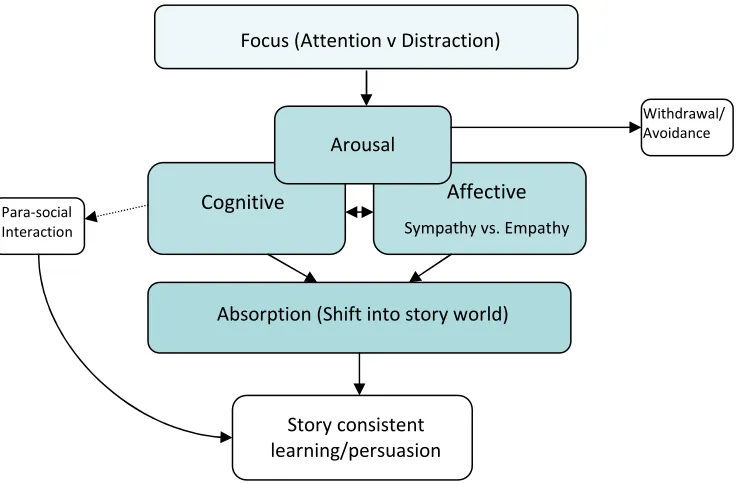
processing: Focus, Cognitive Arousal, Affective Arousal and Absorption. For conceptual
purposes, the Affective Arousal dimension can be further segmented into: Sympathetic
Arousal and Empathetic Arousal (i.e. Loss of Self-Consciousness).
Figure 1. Flow Model: Narrative engagement and story-consistent change
Arguably, narrative engagement begins when an individual’s focus is directed
toward a story’s characters, situations and events (Slater & Rouner, 2002).3
Csikszentmihalyi (1978) notes:
“What to pay attention to, how intensely and for how long, are choices that will determine the content of consciousness, and therefore the experiential information available…Thus Williams James was right in claiming, ‘My experience is what I agree to attend to. Only those items which I notice shape my mind’” (p. 339).
3
While it is certainly possible that effects are observed based merely on exposure to media (e.g. Drew & Weaver, 1990), the current research emphasizes a viewer’s engagement with media.
Absorption (Shift into story world) Arousal
Cognitive
Affective
Sympathy vs. Empathy
Focus (Attention v Distraction)
Story consistent learning/persuasion
Para-social Interaction
By definition, the phenomenology of flow reflects attentional processes. An individual’s
attention provides evidence that s/he has selectively invested in the present exchange. 4
As viewers focus on the situation and characters presented within a narrative,
pre-existing schemas are activated which allow viewers to create mental models. Defined as
“cognitive representations of events and states of affairs constrained in the time and
space of the narrative” (Busselle & Bilandzic, 2008), these models facilitate
comprehension. The construction of mental models, indeed, invites cognitive
elaboration and affective response from viewers. Therefore:
Proposition I: Focus is a necessary pre-condition to subsequent sub-processes of narrative flow, namely Cognitive and Affective Arousal.
Arousal refers to a period of heightened physiological and/or psychological
stimulation. This dimension corresponds to Csikszentmihalyi’s concept of awareness.
Awareness, according to Csikszentimihalyi (1978), involves the system “encompassing all
of the process that take place in consciousness, such as thinking, willing and feeling
about information” (p. 91).
Arousal can be comprised of both cognitive and affective factors, although it is
unclear whether one necessarily precedes the other (Busselle & Greenberg, 2000). One
proposition is that cognitive processes, relating to viewer perceptions of realism, are
4 As it is presently conceptualized, Focus can be compromised by any number of pre- or coexisting
“central” to any of the other dimensions of narrative engagement (Busselle & Bilandzic,
2008, p. 14). Therefore, the following research question is put forward:
RQ1: What is the relationship between Cognitive Arousal and Affective Arousal?
First, factors that influence cognitive arousal are considered. Narrative
processing can be significantly impacted by the extent to which material is perceived as
realistic (Perse, 1986; Potter, 1986). Both external realism, the degree to which fictional
content is consistent with the real world (e.g. clothing, physical settings, dialogue and
situations) and narrative realism, the degree to which there is consistency among logic,
motivation and events within a fictional context, contribute to one’s judgments.
Importantly, the social cognition literature distinguishes between
memory-based, or reflective, realism judgments and online judgments of realism (see Hastie &
Park, 1986). Memory-based realism judgments occur retrospectively and are informed
by memory content previously processed and stored (Hastie & Park, 1986). In contrast,
online realism judgments occur during viewing (Shapiro & Chock, 2003; Shapiro & Lang,
1991), most likely as the viewer retrieves schema and constructs the mental models
necessary to understand the narrative.
For the most part, consumers of fiction are able to “suspend their disbelief”
(Worth, 2004), thereby granting these types of narratives a higher threshold of realism
than, for example, a news story. As long as a program is “internally coherent…doesn’t
contradict itself…and leaves nothing jarringly unexplained”, (Hall, 2003), viewers have
story events or character behaviors do not otherwise make sense, audience members
are forced to think critically, incorporating new information into their mental models.
Experimental research using text-based narratives provides additional evidence
that story inconsistencies interfere with engagement (Albrect & O’Brien, 1993; Kaup &
Foss, 2005; Rapp & Gerrig, 2002). For example, the average length of time it took
individuals to read a story increased when characters’ traits and behaviors were
inconsistent with one another (e.g. vegetarian eats a cheeseburger, Albrect & O’Brien,
1993). Within an audio-visual context, individuals do not have the option of “slowing
down” the process. Rather, negative cognitions associated with violations of realism
disrupt cognitive arousal and lower transportation (Busselle & Bilandzic, 2008; Green,
2004). Prentice and Gerrig (1999) echo that doubt, prompted by “obvious cues,” can
lead a viewer to question the narrative and retreat from the ‘story world’ (p. 531).
Conversely, a healthy (i.e. uninterrupted) dose of cognitive arousal is proposed as a
necessary pre-condition for the heightened cognitive connections and coherent story
processing that characterize the final dimension of narrative engagement, Absorption.
Proposition II: Cognitive Arousal is a necessary pre-condition to Absorption.
Having considered factors that influence cognitive arousal, the discussion would
be remiss without mentioning affective features of arousal. Narratives and their
characters often foster identification and empathy (refer to Section B.2d). Viewers
often identify characteristics or traits they themselves share with characters. This
situations, behaviors and emotions. At the same time, it is also possible that a
character’s words and/or actions trigger negative reactions, engaging viewers in a form
of negative affective arousal. It is proposed that the processes occurring during the
Affective Arousal dimension serve as a springboard for more intense involvement with
the story and its characters.
Proposition III: Affective Arousal is a necessary pre-condition for the final dimension of narrative flow, Absorption.
Cohen’s (2001) “point-of-view” interpretation of identification positions it as “a
process that consists of increasing loss of self-awareness” (p. 251). This actually does a
nice job of characterizing the shift that occurs as individuals move from Affective
Arousal to the final dimension represented in the model, Absorption. In order for an
individual to be considered “in flow” s/he cannot be engaged in any conscious cognitive
or affective activity (Nakamura & Csikszentmihalyi, 2005). This includes self-reflection
and/or comparison.5 Any sort of identification processes would necessarily shift away
from inducing a sympathetic relationship (feeling for) to an empathetic one (feeling
with). In addition to loss of self-consciousness, absorption is further characterized by
temporal distortion.
C.3) Model Development (Pilot Study I)
The narrative processing model proposed here assumes that there are a variety
of unique, yet related, factors that work together to produce flow. It goes so far as to
5
suggest that the relationship among these factors is hierarchical.6 In order to explore
the nature of and relationships between the sub-processes proposed in the model a
pilot study was conducted.
Traditionally, research on narrative transportation is collected following
exposure to a stimulus program. Aside from problems associated with retrospective
measures (e.g. recall bias, mental editing), this practice provides little insight into the
ongoing process. Continuous response measurement (CRM) is a data collection
technique well-suited to exploring theoretical issues regarding cognitive processes
associated with continuous messages. CRM systems are designed to log
moment-by-moment shifts in self-reported mental states, evaluations and/or opinions during
message processing. From Merton et al.’s (1956) seminal focus group work on viewers’
thoughts during media viewing, to its utility in the political arena, measuring voter
opinions of political candidates and debates (e.g. West, Biocca & David, 1991, 1992), to
its extensive commercial applications (e.g. Hughes, 1992; Zabor, Biocca & Wren, 1991),
CRM technology has been applied in a variety of contexts. To date, however, there is no
research that utilizes continuous response measurement to investigate the
psychological processes involved in narrative communication.
6
Whereas the model proposes that its four unique dimensions are necessary to produce narrative flow, it does not propose that it is sufficient in characterizing the narrative experience. That is, the model does not address various features of the narrative, the individual or the environment that influence
Communication is a dynamic process, and narrative communication is no
different. Characters and events are introduced and develop at varying rates; in the
context of entertainment media, multiple storylines are often embedded within one
larger narrative. As scenes/stories switch, it is not unreasonable to assume that
viewers’ cognitive states change continuously, resulting in varying levels of engagement
as their attendance to, comprehension of and response to messages changes. The
processes underlying such shifts are unclear. This exploratory study considers viewers’
engagement with a story and its characters over time. It also solicits audience feedback
about their “on-line” thoughts during viewing.
RQ1: What psychological processes underly shifts (i.e. increases or decreases) in viewer engagement over the course of stimulus viewing?
Methods
Sample Characteristics
Participants from a large, northeastern city were recruited through an online
posting on Craig’s List in exchange for a small cash payment.
The final sample consisted of 29 participants (62.1% male). Nearly two-thirds of
participants (65.5%) were between the ages of 18 and 35 years and the majority(75.8%)
held a college degree. Fifty-five percent of the sample identified as Caucasian, 34.5%
identified as Black, 6.9% as other/multi-racial and 3.4% as Asian. Sixty two percent of
participants reported a combined annual household income of less than $50,000.
more than $100,000.
Stimuli and Apparatus
Three stimuli from an episode of the medical drama ER were screened;
descriptions of each are available in Appendix A. Total viewing time for each clip was
between 10-13 minutes.
This program reflects the recent popularity in medical-based drama (e.g. Grey’s
Anatomy, Private Practice). The program, ER, contains intense and emotional material,
providing subjects with a variety of content with which to engage, as well as a diverse
cast, providing audience members numerous characters with which to identify.
The video stimuli were viewed by participants in the Media Lab in the Annenberg
School for Communication at University of Pennsylvania. The display systems used for
presentation of stimulus material were large flat panel color monitors (23”). In an effort
to maintain ecological validity, the size and resolution of these monitors closely
resemble the media systems with which a typical viewer might interact.
Continuous response measurement was implemented using an online-rating
function of MediaLab software (Jarvis, 2004). During the stimulus presentation, a
9-point rating scale was displayed at the bottom of the monitor screen such that the video
clip occupied almost the full screen. Participants used the left and right arrow keys on
Design & Procedure
This was a within/between-subjects design with two experimental factors:
Transportation (high versus low) and Narrative Content (HPV, BRCA1, Obesity).
Participation involved watching three stimuli. In order to prevent fatigue effects,
subjects were randomly assigned to one of three conditions varying the order of
Narrative Content (ABC, BCA, CAB where A=BRCA1, B=HPV and C=Obesity).
Transportation was randomized within each sequence such that each participant
received at least one High and one Low stimulus.
Participants arrived at the Media Lab and were seated at an individual viewing
station. After reading an informed consent form, participants were provided with
instructions on how to provide continuous response data throughout each program.
Specifically, participants were given the following instructions both verbally and on
screen:
“I would like you to indicate how engaging the events and people in the show are by pressing the right and left arrow keys on your keyboard (visual included). By engaging, I mean that the events and people invite you to become mentally and emotionally absorbed in the story. If you think the events and people are engaging, press the key with the right arrow. The more engaging you think they are, the more often you should press the key with the right arrow. If you think the events and people are not engaging, press the key with the left arrow. The more disengaging you think they are, the more often you should press the key with the left arrow. Please keep pressing the appropriate keys to indicate your rating throughout the segment as things change.”
Participants were given an opportunity to run through a 60-second practice trial.
of engagement. Also following each segment were items assessing the personal
relevance of the narrative content and subjects’ familiarity with the program/episode
prior to that day’s viewing. Participants also completed a personal questionnaire
consisting of demographic items and several questions about media habits.
The study concluded with a stimulated recall interview. During these interviews,
study participants provided feedback about their thought process during “key”
moments – those in which there was a visible shift in engagement levels. Before
beginning the interviews, the researcher was able to review CRM data as it was
recorded. This permitted the researcher to select one of the three stimuli, the one that
produced the most variability in engagement ratings, to serve as the focus of the recall
interview.
Before re-viewing any portion of the selected stimulus, participants were
encouraged to reflect upon and discuss various aspects of the program. Then, as particular
moments from the program were shown on screen, participants were asked questions
(e.g. "Can you describe what was going through your mind at this point during program?")
designed to stimulate reflection about their views, feelings and considerations during key
moments (i.e. dips or spikes in involvement). Following the stimulated recall interview,
participants were debriefed.
Continuous Response Data: Consistent with methods used by Shapiro & Chock
(2003), online ratings were sampled once every 1/10 second. For each 1 second
segment, the average rating was computed.
Transportation: Green & Brock’s (2000) 11-item Transportation Scale was used (α=
.69 to .92). Items were modified to accommodate an audio-visual narrative since
items were originally developed for text. Items were measured on a seven-point
scale ranging from 1(strongly disagree) to 7 (strongly agree). Examples of items
include “The story was so clear to me that I knew its smell, touch, and "feel" and “I
had trouble visualizing the persons and places described in the story.”
Personal Experience and Program-Related Outcomes: Participants were asked to
indicate their personal experience with various types of cancer and cancer-related
outcomes (e.g. “A family member or someone close to me has been diagnosed with
cervical cancer”; “I work on these issues through my job or volunteer work.”)
Participants were also asked to indicate whether they had seen any of the stimuli
prior to the study and, if so, how long ago.
Media Use: Participants filled in, in hours and minutes, frequency of television
exposure on both a typical weekday (e.g. Tuesday, Wendesday) and a typical
weekend (e.g. Saturday, Sunday). Participants were also asked about the regularity
with which they watch a select list of television programs, specifically ER, House,
Participant Demographic Information: Key descriptive and sociodemographic
information on each participant was collected.
Data Analysis (Overview; results follow below)
Stimulated Recall Interview
Data analysis began with a review of transcripts from the stimulated recall
interviews. The objective of this review was to determine whether viewers’ shifts in
engagement could be attributed to the sub-processes proposed in the model of
narrative flow. During the review, viewers’ self-reported reasons for increases and
decreases in engagement were extracted. In order to avoid biased interpretation of
important conceptual and contextual differences among the reasons provided, a
two-step evaluation strategy was developed.
Six independent evaluators were asked to sort all of the reasons associated with
increases and decreases in viewer engagement into piles based on the degree of
similarity among them. Evaluators were told that most people used 3-4 piles, but they
were instructed to use as many piles as they found necessary to create natural groups
that captured the similarities and differences they perceived among the reasons. The
average number of piles was four. Inter-evaluator reliability (Cohen’s Kappa) was then
calculated using PRAM software, comparing each evaluators’ sorting decisions against
While the sorting activity is designed to provide evidence for“piles” that
represent sub-processes set forth in the proposed model, the second rating phase is
used to establish whether these sub-processes are sufficiently characterized by the
model. Upon completion of the sorting activity, evaluators were provided with a set of
possible labels that may/may not be suitable for describing the piles they created.
These labels were based on the model and described reasons for variation in viewer
engagement (i.e. “lack of realism,” “identification with character”). Ten labels offered
possible ways of describing piles created with reasons for increased engagement and
eight labels were proposed for piles using reasons for decreased engagement.
Evaluators were asked to rate how well, on a 7-point scale, each label captured the
perceived similarities among reasons within each pile. Insofar as each label was rated
for each pile created, there are natural “foils” – labels that should not receive high
ratings for particular piles because they are inappropriate representations.
Continuous Response Data
The next phase of data analysis involved consideration of the continuous
response data. Having determined the ratings from individual participants to be reliable
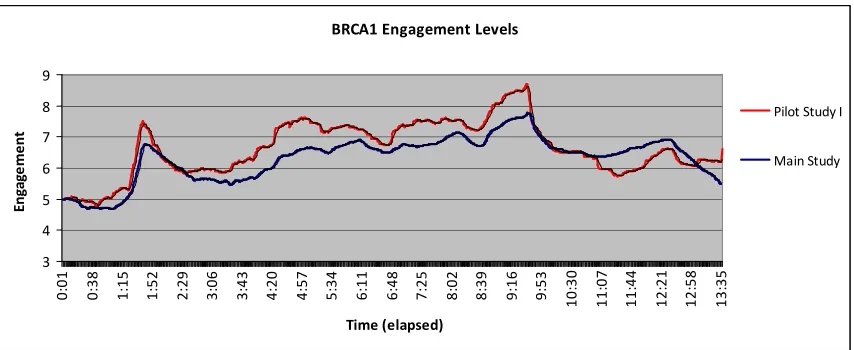
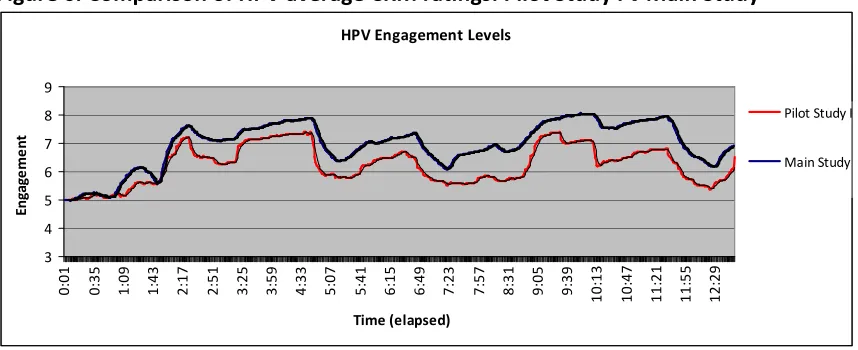
(with other participants’ ratings) the mean series was calculated across all participants
assigned to a particular ER excerpt (n=14 or 15).
t m m m
M = 1 2... with
n y m
n
i it
t
∑
=where mtrepresents the mean score of all subjects at time t, yitrepresents the score of
subject i at time t, and n represents the total number of subjects.
Following a visual inspection of the mean series, significant deviations were
identified. These events were tied back with audience tellback, therein producing a
richly detailed picture of the changes (and continuities) associated with narrative flow.
Results
Twenty-nine participants completed this study. Ten participants viewed stimuli
in ABC order (BRCA1, HPV, Obesity), ten viewed stimuli in BCA order (HPV, Obesity,
BRCA1) and the remainder (n=9) viewed stimuli in CAB order (Obesity, BRCA1, HPV)7.
Equal numbers of participants saw high and low (transportation) versions within each
stimulus program.
Evaluation of Stimulated Recall Interviews: Card Sorting and Rating Activity
A total of 56 reasons associated with increases (n=24) and decreases (n=32) in
engagement were extracted by the researcher. These reasons were sorted into piles
according to perceived similarities and differences by six independent evaluators. First,
sorting decisions related to decreases in viewer engagement were considered. As
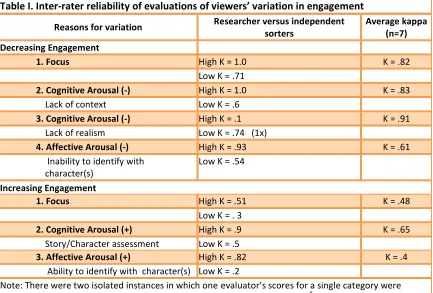
shown in Table 1 below, when comparing the researchers’ sorting decisions against each
individual sorter, kappa ranged from .71 to 1 for the Focus category, from .92 to 1 for
the Cognitive Arousal – Lack of Context category and from .74 to 1 for the Cognitive
Arousal – Lack of Realism category. Average kappa scores across all sorters were also
7
high (.82, .83 and .91, respectively). Reliability, across sorters (average kappa = .61) and
between the researcher and each sorter independently (kappa ranged from .54 to .93),
was less than desirable for the Affective Arousal – Inability to identify category.
Table I. Inter-rater reliability of evaluations of viewers’ variation in engagement
Reasons for variation Researcher versus independent sorters
Average kappa (n=7) Decreasing Engagement
1. Focus High K = 1.0 K = .82
Low K = .71
2. Cognitive Arousal (-) High K = 1.0 K = .83
Lack of context Low K = .6
3. Cognitive Arousal (-) High K = .1 K = .91
Lack of realism Low K = .74 (1x)
4. Affective Arousal (-) High K = .93 K = .61 Inability to identify with
character(s)
Low K = .54
Increasing Engagement
1. Focus High K = .51 K = .48
Low K = . 3
2. Cognitive Arousal (+) High K = .9 K = .65
Story/Character assessment Low K = .5
3. Affective Arousal (+) High K = .82 K = .4 Ability to identify with character(s) Low K = .2
Note: There were two isolated instances in which oneevaluator’s scores for a single category were dropped because they varied significantly from the other evaluators’ scores.8
Next, sorting decisions related to increases in viewer engagement were
considered. When comparing the researchers’ sorting decisions against each individual
sorter, kappa ranged from .28 to .51 for the Focus category, from .5 to .9 for the
Cognitive Arousal – Assessment category and .2 to .82 for the Affective Arousal – Ability
8For the Affective Arousal (-) Inability to identify category, the dropped evaluator’s sorting decisions were
to identify category. Average kappa scores across all sorters were consistently
inconsistent as well (.48, .65 and .4, respectively).
In an effort to account for inconsistencies in sorting decisions, evaluators’
open-ended feedback about their decision-making, as well as their ratings of possible category
(pile) labels, were consulted. It appears that evaluators’ decisions may simply represent
a more refined version of the researcher’s sorting scheme. To this end, evaluator
categories were combined where appropriate.9
Once these “like” categories were combined, kappa scores improved
substantially. The Affective Arousal – Inability to identify average kappa score increased
from .47 to .72 and, comparing the researcher’s decisions against others’, kappa ranged
from .83 to 1. Similarly, the average kappa score increased from .4 to .8 for the
Affective Arousal – Ability to identify category. Kappas ranged from .7 to .91, comparing
the researcher against other sorters.
9
Three of the labels provided to evaluators as possible reasons for decreasing engagement included: “Inability to identify with character(s) and/or storyline(s)”; “Character and/or storyline was boring”; “Personal dislike of actor/actress”. Arguably, these might be considered finer distinctions of the umbrella category, Affective Arousal – Inability to identify. Evaluators 2 and 3 created two piles whose highest rated labels (7s on a 7-point scale) were for labels “Character and/or storyline was boring” and “Personal dislike of actor/actress.” The evaluators’ self-created labels for these piles were “Boring,” “Disdain for a character,” “Not interested/invested in the characters (don’t care),” and “Annoying/boring characters.” Similarly, three of the proposed labels for piles representing increasing engagement had to do with viewer-character relations: “Make sense of the characters and their situations”; “Identification with character(s) and their situations”; “Emotional response due to perceived similarity and/or sympathy for character(s)” and may represent the broader category, Affective Arousal – Ability to identify. Evaluators 3-6 had between two and four piles combined based on the fact that their highest rated labels (6.5 to 7 on a 7-point scale) corresponded with one of the above. Evaluators’ self-created labels for their piles were “Sympathy for the mother,” “Similar personal situations/character identification,”
The only remaining categories with less than desirable reliability are the Focus
and Cognitive Arousal ones relating to increased levels of engagement. Here, it appears
that the majority of sorters failed to make a distinction between increased levels of
attention and increasing efforts to make sense of the characters and/or storylines.
Indeed, if the researcher were to concede the division of reasons representing increased
Focus (n=3) and combine them with those in the Cognitive Arousal category, the
average kappa score would be .71.
Suitability ratings provided following the sorting activity were then further
reviewed to determine how well various labels captured evaluators’ perceived
similarities and differences among piles.10
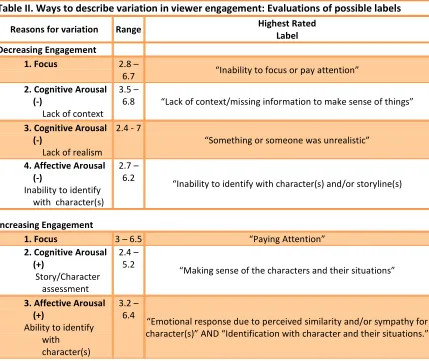
The ratings from each of the six independent evaluators were averaged for each
category (i.e. pile). Table 2 depicts the labels that were identified as the “best”
descriptors for each pile. These labels align closely with the individual components of
the proposed model of narrative flow, suggesting that it successfully captures the
various psychological processes involved with one’s narrative experience. There were
no instances where viewer tell-back regarding variation in engagement did not
correspond with one of the model’s four unique dimensions. However, evidenced in the
10
multiplicity of ways evaluators considered affective responses to the narrative, the
model’s dimensions represent complex sub-processes of an even more complex
experience, affected by individual characteristics, environmental factors and features of
the narrative itself.
Continuous Response: Trends in Viewer Engagement
To reiterate, participants’ engagement ratings, ranging from 1(completely
disengaged) to 9 (completely engaged), were sampled once every 1/10 of a second. In
Table II. Ways to describe variation in viewer engagement: Evaluations of possible labels
Reasons for variation Range Highest Rated Label Decreasing Engagement
1. Focus 2.8 –
6.7 “Inability to focus or pay attention”
2. Cognitive Arousal (-)
Lack of context
3.5 –
6.8 “Lack of context/missing information to make sense of things”
3. Cognitive Arousal (-)
Lack of realism
2.4 - 7
“Something or someone was unrealistic”
4. Affective Arousal (-)
Inability to identify with character(s)
2.7 – 6.2
“Inability to identify with character(s) and/or storyline(s)
Increasing Engagement
1. Focus 3 – 6.5 “Paying Attention”
2. Cognitive Arousal (+)
Story/Character assessment
2.4 – 5.2
“Making sense of the characters and their situations”
3. Affective Arousal (+)
Ability to identify with character(s)
3.2 – 6.4