DEVELOPMENT OF E-PUBLIC DISTRIBUTION
SYSTEM (E-PDS) USING SMART CARD
Mr. Nishant P. Khot
1, Dr. Mahadev S. Patil
21
M.Tech-Electronics,
2Head of Program,
Department of Electronics and Telecommunication Engineering, RIT, Sakharale (India)
ABSTRACT
Smart card based automatic ration shop is novel approach in public distribution system (PDS) useful for more
efficient, accurate, and automated technique of ration distribution. Public distribution system also called
rationing distribution system is one of the widely controversial issues that involve malpractices. The present
ration distribution system has drawbacks like inaccurate quantity of goods, low processing speed, large waiting
time, material theft in ration shop. The proposed system replaces the manual work in ration shop. The main
objective of the designed system is the automation of ration shop to provide transparency. The proposed
automatic ration shop for public distribution system is based on Smart Card technology that replaces
conventional ration cards. The RFID tags are provided instead of conventional ration cards.
Keywords: Arm-7 Controller, Rfid, Gsm, Public Distribution System, Weighing Machine.
I. INTRODUCTION
India’s Public Distribution System (PDS) is the largest retail system in the world. Public distribution system [7]
provides a ration card issued under an order or authority of the State Government for the purchase of essential
consumer materials like rice, wheat, kerosene and oil. State Government [6] issues distinctive ration cards like
yellow ration card, saffron ration card, and white ration card depending on family annual income. The consumer
material is supplied to ration card holders in the first week of every month by ration shopkeeper. Public
Distribution System is one of the widely controversial issues that involve malpractice. The manual intervention
in weighing of the materials leads to inaccurate measurements and/or it may happen, the ration shop owner
illegally uses consumer materials without prior knowledge of ration card holders.
The proposed system aids to control malpractices which are present in ration shop by replacing manual work
with automatic system based on RFID and GSM. Every consumer i.e. family head provided RFID card which
acts as ration card. The RFID card has unique identification number. The consumer scans the card on RFID
reader which is interfaced with controller kept at ration shop. Once consumer is validated by password, the
system asks the consumer to select appropriate material and quantity of material through keypad. Based on
material chosen by consumer, appropriate circuitry will be activated and consumer gets material. GSM
interfaced with controller sends information in the form of SMS to related people. The proposed automatic
ration shop system would bring transparency in public distribution system and become helpful to prevent
Dhanoj Mohan, Rathikarani, Gopakumar[1] has developed system on automation of ration shop using PLC. They have designed hardware for two commodities sugar and kerosene. These two commodities are stored in tanks.
User has to enter the required quantity and product using a keypad. For the measuring, it uses load cell for sugar
and level sensor for kerosene. The problems in this system are no security provided to consumer, smart card,
information exchange between authorities and data storage.
Mohit Agrawal, Bhupendra Singh and Manish Sharma[2] have developed system on smart ration card using
RFID and GSM technique. Here paper work of ration shop is replaced by RFID card. Through RFID consumer
access their account. GSM is used to send confirmation message to consumer. Limitation of this system is
security not provided and for quantity measurement weighing machine is not used. Data storage is also not
considered.
S.Valarmathy, R.Ramani[3] have developed system on automatic ration material distributions based on GSM and
RFID technology. Consumer must show RFID tag to access the account. After accessing, controller checks the
consumer details. Then consumer needs to enter the required materials by using keypad. Controller will send the
message through GSM after receiving the materials. This system has limitation like no password protection, no
visual display and no data storage available.
Rajesh C., Pingleand P. B. Boroley[4] have developed system on automatic rationing for public distribution
system (PDS) using RFID and GSM module to prevent irregularities. They use smart card reader (RFID Based),
GSM module, microcontroller (AT89C51) and PC via RS232 to develop such a system. It has limitations like
more total material display, password protection and no data storage on web portal.
S.Kalpanadevi, S.Sukhumar, K.Gopinathan, P.Naveenkumar[5] have developed system on automatic rationing
system using embedded system technology. In this system they provided finger print detection for security. PIC
microcontroller and PLC modules are used. To provide eco-friendly machine, they use solar. After transaction,
confirmation message is delivered to each consumer. It has limitations like more costly and no data storage is
available.
Public Distribution System[10] provided three types of ration card as yellow, saffron and white cards based on
family income. This is issued under authority of the state Government for purchase of commodities like Wheat,
Rice, Kerosene and Oil. The ration shop owner keeps record of all consumer materials. It has limitation like
material theft, processing speed is low, unable to get materials at any time.
II. SYSTEM DIAGRAM
Fig. 1 shows the system block diagram based on RFID technology [2]. System consists of controller-LPC2148,
RFID, GSM [1], weighing machine, solenoid valve circuitry, LCD, keypad and internet connection. The
proposed system demonstrates distribution of two solid materials (wheat and rice) and two liquid materials
(kerosene and edible oil). RFID reader, weighing machine, and keypad acts as inputs to system and LCD, seven
segment displays are used for displaying ration stock and related activities.
The microcontroller outputs are used to drive motor and flow sensor, solenoid valve. GSM is used to sends
message to costumer after completion of transaction. All transactions are stored in PC and uploaded on web
Fig.1 Block Diagram of System
III. ALGORITHM
Every user is provided with a RFID card which is registered by the Government authority.
1) At the time of ration distribution, first password of user is verified
2) System will check type of the card & then display quantity of material
3) Based on type of material chosen, the motor or flow meter valve is activated
4) The weight balancing machine or flow meter will check proper quantity
5) After collecting proper quantity material motor or flow meter is disabled
6) Exchange the information in the form of SMS between controller assembly and user
7) Display of current stock in the ration shop
8) Store the data on computer
9) Upload data to web portal
IV. DESCRIPTION
4.1 Controller LPC-2148
It is the heart of automatic ration shop. The LPC2148 has following features,
One or two 10-bit ADCs provide a total of 6/14 analog inputs, with conversion times as low as 2.44 micro sec
per channel
Two 32-bit timers
Multiple serial interfaces including two UARTs
Power saving modes include Idle and Power-down
4.2 LCD and Keypad interfacing
System uses 16x2 LCD modules which is easily programmable and economical. Interfacing of 16x2 LCD
modules with LPC2148 which operates on +3.3V is not same as interfacing with microcontrollers like AVR
which operates on +5V. LCD module is interfaced successfully with LPC2148 using CD4050 IC. System uses
4x3 matrix keypad. Both the terminals of the switches of 4x3 matrix keypad are connected to the port pin i.e.
four rows and three columns. Each row and column section pulled by high or low to scan particular key press.
4.3 RFID and GSM Modem
Each RFID Card consist different tag. This RFID cards are provided to each consumer. Different password is
provided to each smart card. On RFID reader magnetic fields are generated. When this card is come in contact
with RFID reader then signal is generated and this signal is given to controller.
GSM modem is used to send the message to each consumer after completion of each transaction.
4.4 Liquid quantity measuring subsystem
Fig. 3 Flow sensor & Solenoid valve
Flow sensor and solenoid valve are used to measure the quantity of edible oil and kerosene. At the output of
flow sensor we get pulses using those pulses we are controller flow of liquid. Solenoid valve is used to ON and
OFF the flow of oil or kerosene. Both are operated on 12V DC supply.
V. Grain quantity measuring subsystem
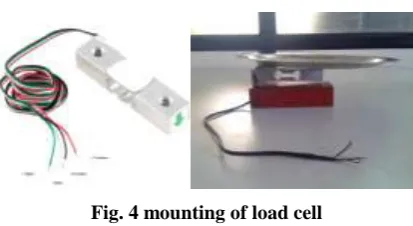
Fig. 4 mounting of load cell
Load cell is used to measure the weight of grains. Fig. 4 shows arrangement of load cell. It consist two ends,
one end is for mounting and another is for calculating. Output of load cell is in micro volts. It is amplified and
converted into digital form and displayed on seven segment display.
V. RESULTS
When card is placed in front of RFID module then generated signal is given to controller. Controller will
identify the costumer as shown in fig 5 and it will display the name of costumer. After completion of each
transaction SMS is delivered to each consumer using GSM [4].
Fig. 5 Interfacing of RFID and GSM
5.2 Interfacing of motor and load cell
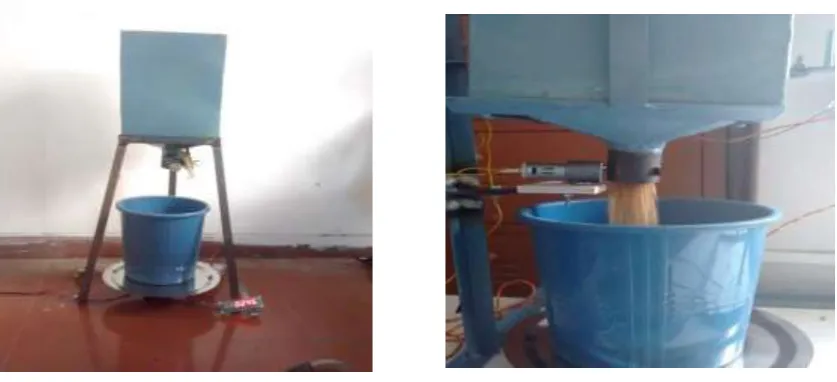
Fig. 6 Grain drawn from system
Interfacing of DC motor and LPC248 usign L293D IC, IC L293D provides proper matching between motor and
LPC2148. Features of high torque 12V DC geared motor 10 RPM are
a) High torque DC motor with Metal Gear box and off cantered shaft.
b) 6mm diameter shaft with M3 thread hole.
c) Shaft length 15mm.
Table.1 Load Cell Calibration Table
One circular plastic is attached to shaft of motor across the cylindrical pipe. If costumer enters 1kg then motor
will turn vertically that is turns in 90˚. When the weight on weighing machine will reach to 900gm then motor
will turn to 45˚ clockwise then the speed of grain will slow down and when reached to 1000gm then motor goes
horizontal across the cylinder.
Flow sensor and solenoid valve is used to measure the accurate amount of liquid materials (edible oil and
kerosene). Flow sensor is used to measure the flow of liquid. It consist three pins namely supply, ground and
output. Output pulses are used to measure flow of liquid. Water flow sensor consists of a plastic valve body, a
water rotor, and a hall-effect sensor. When water flows through the rotor, rotor rolls. Its speed changes with
different rate of flow. The hall-effect sensor outputs the corresponding pulse Signal. Flow rate range is about 1
to 10 lit. per minute. Solenoid valve is used only to turn ON and OFF the flow of liquid.
After completion of each transaction SMS is delivered to each costumer as shown in fig. 5 and also record of
each costumer is stored in computer using visual basic software. Data stored in computer are uploaded on
internet to web portal of Public Distribution System. District level officers can access and can check the data of
any costumer.
Weight
(in Kg)
Load
cell
output
Voltage
Amplifier
Output
No
Load
0.59
mV
0.17 V
1 Kg
2.8 mV
0.70 V
2 Kg
5 mV
1.31 V
3 Kg
7.3 mV
1.80 V
4 Kg
9.59
mV
2.22 V
5 Kg
11.8
mV
Fig. 7 Delivered message on consumer mobile
VI. CONCLUSIONS
The conventional system has drawbacks like malpractices, low processing speed, long waiting time at ration
shop to get material and material theft in ration shop without any acknowledgement to Government and
consumer. To overcome above problems, automatic ration shop played important role. The automatic ration
shop involved RFID as well as GSM technology to distribute rice, wheat, kerosene, editable oil. Ration card is
replaced by RFID and information is sent to consumer using GSM module.
The proposed system creates the transparency in public distribution system as the work becomes automatic.
With the help of this system, it is possible to make public distribution system efficient and free from
malpractices. The proposed system has advantages like it is helpful to prevent malpractices at ration shop,
maintain data properly, reduces paper work, time saves time and cost effective.
ACKNOWLEDGEMENTS
The authors thank to the workshop staff of mechanical department, Rajarambapu Institute of Technology,
Rajaramnagar for helping in carrying out fabrication work.
REFERANCES
[1] S.Kalpanadevi, S.Sukhumar, “Automatic Rationing System Using Embedded System Technology”,
International Journal of Innovative Research in Electrical, Electronics, Instrumentation and Control
Engineering, 2013, Vol. 1, Issue 8, pp. 339-342.
[2] Dhanoj Mohan, Rathikarani, opakumar,“Automation of Ration Shop Using PLC”, International Journal of
Modern Engineering Research,2013, Vol. 3, Issue. 5, pp. 2971-2977.
[3] S.Valarmathy, R.Ramani, “Automatic Ration Material Distributions Based on GSM and RFID Technology”,
International Journal Intelligent Systems and Applications, 2013, Vol. 11,pp. 47-54. Rajesh C. Pingleand P.
B. Boroley,“Automatic
[4] Rationing forPublic DistributionSystem (PDS) using RFID and GSM Module to Prevent Irregularities”,
HCTL Open International Journal of Technology Innovations and Research, 2013, Vol. 2, pp. 102-111.
[5] Yogesh Kumar Sharma, K. B. Shiva Kumar, “Multi-Modality Biometric Assisted Smart CardBased Ration
[6] http://en.wikipedia.org/wiki/Ration_card_(India)
[7] http://www.indiaenvironmentportal.org.in/files/file/Functioningof the pds.pdf
[8] Vinayak t. shelar and Mahadev S. Patil “Automatic Rationing System using LPC2148” National Conference