C o p p i n g , Ad ri a n ( 2 0 1 6 ) Ex pl o ri n g c o n n e c ti o n s b e t w e e n c r e a tiv e t h i n ki n g a n d h i g h e r a t t ai ni n g w r i ti n g . E d u c a ti o n 3-1 3 : I n t e r n a ti o n al Jo u r n a l of P ri m a ry, El e m e n t a r y a n d E a r ly Yea r s E d u c a ti o n , 4 6 ( 3). p p . 3 0 7-3 1 6 .
Do w n l o a d e d fr o m : h t t p ://i n si g h t . c u m b r i a . a c . u k /i d/ e p ri n t/ 2 5 1 5 /
U s a g e o f a n y i t e m s f r o m t h e U n i v e r s i t y o f C u m b r i a’ s i n s t i t u t i o n a l r e p o s i t o r y ‘I n s i g h t ’ m u s t c o n f o r m t o t h e f o l l o w i n g f a i r u s a g e g u i d e l i n e s .
Any it e m a n d it s a s s o ci a t e d m e t a d a t a h el d i n t h e U niv e r si ty of C u m b r i a ’s in s ti t u ti o n al r e p o si t o r y I n si g h t ( u nl e s s s t a t e d o t h e r wi s e o n t h e m e t a d a t a r e c o r d ) m a y b e c o pi e d , di s pl ay e d o r p e rf o r m e d , a n d s t o r e d i n li n e wi t h t h e JIS C f ai r d e a li n g g ui d eli n e s ( av ail a bl e h e r e) fo r e d u c a t i o n al a n d n o t-fo r-p r ofi t a c tiviti e s
p r o v i d e d t h a t
• t h e a u t h o r s , ti tl e a n d full bi blio g r a p h i c d e t ail s of t h e it e m a r e ci t e d cl e a rly w h e n a n y p a r t
of t h e w o r k is r ef e r r e d t o v e r b a lly o r i n t h e w ri t t e n fo r m
• a h y p e rli n k/ U RL t o t h e o ri gi n al I n si g h t r e c o r d of t h a t it e m is i n cl u d e d i n a n y ci t a ti o n s of t h e w o r k
• t h e c o n t e n t is n o t c h a n g e d i n a n y w a y
• all fil e s r e q ui r e d fo r u s a g e of t h e it e m a r e k e p t t o g e t h e r wi t h t h e m a i n it e m fil e.
Yo u m a y n o t
• s ell a n y p a r t of a n it e m
• r e f e r t o a n y p a r t of a n it e m wi t h o u t ci t a ti o n
• a m e n d a n y it e m o r c o n t e x t u ali s e it i n a w a y t h a t will i m p u g n t h e c r e a t o r ’s r e p u t a t i o n
• r e m ov e o r a l t e r t h e c o py ri g h t s t a t e m e n t o n a n it e m .
T h e full p oli cy c a n b e fo u n d h e r e.
Exploring connections between creative thinking and higher attaining writing
Adrian Copping
Abstract
This paper explores writing pedagogy in the primary classroom and connections
between children thinking creatively and their achievement in writing. Initially
‘continuing professional development’ for teachers, I designed and facilitated a two day
writing workshop with a class of children around the theme of a Victorian murder
mystery. This was observed by primary teachers and then deconstructed. Set within the
context of a National Curriculum for English which focuses more explicitly on the skills
of transcription as indicators of quality writing, this paper explores initial findings from
a pilot project considering the contribution creative thinking makes to the writing
process.
Keywords: creative thinking; possibility thinking; teacher-in-role; writing process; achievement.
Background and Introduction
What does it actually mean to teach a child to write? The reality is that there is a vast
range of complex knowledge, skills and understanding to acquire. However, the usual
image that forms in the mind is one of spelling, handwriting and grammatical
correctness. The National Curriculum for England (2013) arguably reinforces the image
with its larger focus on these transcriptional elements of the writing process. It also
terminology that children should know. All of this gives the impression that these are
the most important elements to teaching writing. Chamberlain in Cox (2011) introduces
three models of writing. The first of these is the one the National Curriculum purports: a
skills-based approach. This approach argues that ‘developing automaticity in
handwriting and later spelling will free up the cognitive resources needed to generate
ideas needed for composition’ (2011 P.42/3). This builds on the work of Medwell and
Wray (2007) and Stainthorp (2002). The next approach Chamberlain introduces is the
genre approach to writing. This approach is concerned with writing in different genres:
explanation, instruction, traditional tale, non-chronological report, adventure/mystery
for example. It takes these as a starting point, looks to forge cross-curricular links and
focuses on content, text structure and the language features of each genre. Chamberlain
(2011) finally introduces the process approach to writing, drawing on the work of
Graves (1983), the main proponent of this approach. The main focus here is starting
with the child and their interests and the teacher works with them to create and craft
writing together. These three approaches are widely accepted as central to writing
pedagogy and all have positive and negative elements.
My research uses ostensibly a process-based /genre approach as a starting point.
However, whilst writing within the genre it is important to be able to measure against
attainment targets for summative assessment and accountability, it is the process of
composing that actually forms the measure of learning. This research does not neglect
transcriptional skills, skills which Brien (2012) calls the secretarial aspects of writing,
however the approach this research uses focuses on these towards the end of the writing
What does research tell us about children’s writing?
Clark’s (2013) findings for the National Literacy Trust found that for the year 2012 only
44.1% of children surveyed enjoyed writing very much or quite a lot (2013 p.4). Clark
also found that girls ‘thought more positively about writing than boys’ (2013 p.11). Not
surprisingly, Clark (2013) also reports that there was a direct correlation between
children who enjoy writing and those who attain well. Interestingly though, there are
mixed views on what being a good writer is. Clark and Douglas (2011) reported that
whilst the majority of children they surveyed agreed that being a good writer involved
enjoying writing, using their imagination and using good punctuation (2011, p.18), there
was disparity between the emphasis that girls and boys placed upon the question. Boys
tended to emphasise the technical aspects such as good spelling being hallmarks of a
good writer, whereas girls would emphasise using imagination and being able to discuss
writing. Clark and Douglas (2011) also discovered that children found writing more
difficult than reading (p.18). This finding also links to attainment evidence: Beard and
Burrell (2010) cite DCSF (2009) who report that standardised testing results in 2009
demonstrated that 86% of pupils achieved the national benchmark in reading, but only
67% did so in writing (2010. P.77). Children also state that being given more ownership
of what to write about would be more fun, but they also stated that ‘they have trouble
deciding what to write’. (2011. P.18)
What does research tell us about effective teaching of writing?
Gillespie and Graham (2010) state that children should be given more strategies to plan,
unless they consider this as part of planning. They do suggest that children should be
given steps to success, particularly in relation to genre and that teachers should model
the process for children. Andrews et al (2009), places a high emphasis on the process
model of writing, advocated by Graves (1983). This was later developed by Bereiter and
Scardamalia (1987) who focus more on children developing of metacognitive strategies
to support their writing development. The aim is that children can be supported to think
through the process of writing rather than just what the outcome should be. This
approach encompasses peer collaboration, drawing on a social constructivist approach
to learning.
Fisher, Myhill and Twist's (2009) evaluation of ‘Every Child a Writer’ also
focuses on some key elements of the effective teaching of writing. The report states that
the best writing came from ‘lessons where teachers focused on meaning and
communicative effect’ (2009, P.5). Alongside this, the report stated that where
grammatical features were taught, they were used but not necessarily with
understanding. This is a point emphasised by Horton and Bingle (2014) who state that
‘to write effectively for a given purpose and audience, children need to have a
conceptual understanding of grammar in preference to simply naming terms and
features’ (2014, p.13). In other words, grammar should be taught in context to be
effective. The report also emphasised the role that feedback plays in teaching writing,
saying that feedback did not focus on children’s communication of meaning and effect
but upon the more secretarial features, emphasising the usage of grammatical devices
rather than understanding them as tools for communicating authorial intent.
Guilford (1967) draws our attention to different types of thinking. He brought to light
the distinction between two different types of thinking: convergent being about looking
for the one right answer and divergent looking for a myriad of possible answers. Craft
(2000), suggests that creative thinking is involved in both divergent and convergent
thinking. She amends this (2007) by stating that ‘Possibility thinking, then, essentially
involves a transition in understanding: in other words, the shift from ‘What is this?’ to
exploration – i.e. ‘What can I/we do with this?’ Fostering possibility thinking involves
enabling children to find and refine problems as well as to solve them.’ (2007p.2). In
their research into creative thinking in Science, Türkmen and Sertkahya (2014) suggest
that creative thinking is desirable as it is more akin to the society, technology and
innovations that exist outside of ‘traditional’ education. Creative thinking can therefore
support children’s understanding of how these spheres operate. However, they do stress
that in order to facilitate this type of thinking the environment and ethos must be
appropriate. De Bono (1995) refers to creative thinking being provocative. In this sense,
creative thinking provides a new way of looking at something, provoking the
suspension of disbelief. He states that creative thinking promotes a willingness to look
for further alternatives, organise and reorganise concepts and pause just before applying
the lateral option. However, Jeffery and Craft (2004) point out that it is the impact on
children’s learning that should be at the fore here. Creative thinking is not just about
motivating and engaging children, although this no doubt aids learning. Wood and
Ashfield (2008) suggest that creative thinking extends vocabulary, supports the
application of learning, gives children more ownership of learning and as an aside, puts
Research Design
This preliminary study was undertaken in two Lancashire primary schools. School A is
a one form entry urban school in between two contrasting socio-economic areas. It
draws from both affluent and deprived areas as part of its catchment and therefore each
class (approx.28 children) has a strong mix of children from a range of socio-economic
backgrounds.
School B is a three form entry city centre school in the middle of one of Lancashire’s
most deprived areas. Two residential estates consisting mainly of families of low
socio-economic background form a large percentage of the school’s catchment and this has a
significant impact on attainment. Results as measured by Standard Attainment Tests are
low but progress is high considering the low base upon entry.
The study comprised of two, two-day writing workshops in year 5 mixed ability classes
in both schools. (approx. 58 children took part). Class teachers from the two schools
involved were recently qualified teachers (RQTs) and former students who had worked
with me during their initial teacher education. The writing workshops were planned to
integrate into the topic of Victorian Britain which both classes were studying during the
research period. Therefore, the work undertaken by the participants would serve as part
of their ongoing school work as opposed to any extra work that may require additional
consent. Through the school, all participants and their carers had been informed about
the project and knew that whilst their children were in school on the two specified
workshop days, I would be teaching them and they had all received an outline of the
work being undertaken. This is a very small study and forms a preliminary case study,
the findings of which will inform the design of a new theoretical framework for
earlier in this section. Therefore, any emerging findings are interpreted within this
context and the intent is not to make any wider claims.
The research approach was ethnographic in that I spent time within the
environment of both schools and got to know the children. It was also exploratory and
evolving. As ‘Death at Denscombe’ was facilitated and the children and teachers’
responded it became apparent that other avenues other than those I had planned for were
arising. For example, the issue of the disruptive effect that changing the classroom
environment had on children’s ability to focus. This had not been a factor I had
considered originally and as the workshops evolved it came more to the fore. This led to
some more emerging questions from the children “Why did you change the classroom
around so much?” and added a further dimension to the research.
The writing workshop was designed as a murder mystery where the children
were given a context. Victorian Prime Minister, William Gladstone was found dead in
an upstairs toilet in fictional stately home, Denscombe Park. This simulation, as Cremin
(2009) puts it, the lived experience of drama becomes a natural writing frame that is
charged with the emotions and experiences of the imagined world’ (2009, P.98). In role
as ‘Stokes’, the butler to the house, I facilitated the children’s journey through motives,
clues, evidence and document investigation leading to the creation of an evidence file
complete with hypothesis to present to the ‘court’ at the end of the workshop. The
workshop was underpinned by a social constructivist philosophy and also utilised De
Bono’s (2000) six hats thinking technique. The writing element, creating the evidence
pack involved writing in role, writing for a purpose and included scaffolding resources
Follow-up questionnaires with each participant were completed at the end of the
workshop and semi-structured interviews were undertaken with both class teachers and
English subject leaders. Participant responses were followed up with prompts for further
detail, (What? Where? How? Why?). The semi-structured interview approach was
chosen so these follow-ups could be tailored to each context but supplementary
questions were centred around Patton’s (1990) checklist of questions useful at various
stages during the interview process. Completing the triangulation was my own
observations and reflective diary during the process of the writing workshops. The
unstructured nature of the observations and the lack of pre-determined categories did
make the research more natural (Punch and Oancea 2014). As a result, the categories
below emerged and unfolded from the observations, semi-structured interviews and
were not necessarily predicted.
Data analysis started with questionnaires where I used what is referred to by Punch and
Oancea as ‘open coding’ (2014, p.232) to break open the data. This generated some
conceptual categories that were then used as an analytic tool to explore the interviews.
In order to check that these categories were appropriate and arising purely from the
data, transcripts were read and discussed by another researcher and some student
teachers disconnected form the research context. This was to guard against my own bias
impacting upon analysis. This process proved important to the integrity of the data as
categories emerged that were not expected. The idea of this was to generate some
grounded abstract concepts to use as building blocks for later stages of the research.
These blocks were identified through this process as;
• The process of thinking and getting to the product must have value;
• A tangible purpose leads to increased motivation and higher attainment;
• High expectations lead to higher attainment.
These are discussed in the ‘findings and discussion’ section of this paper. The
aim was to ensure that only categories arising out of the data were used rather than
bringing any prior codes or theoretical constructs to the data.
Analysing the content inductively (Cohen and Manion 1994), meant that the
children’s and teachers’ responses were analysed and explored separately through each
of the four categories. The data from the children’s questionnaires and interviews with
the teachers were compared and contrasted looking for emerging themes across both
interview
Transcripts were read twice: descriptive codes were applied during the first
reading and reapplied after the second. This process proved to be fundamental to data
integrity as new insights emerged upon second reading. These new insights led to
adding to the above categories. For example, the links between motivation and
attainment came through the data and added to the third category as did the idea of
maintaining a thinking environment. These were not apparent after first reading and
were added to by the other researcher and student teachers.
Findings and discussion
Through analysis of data from my own reflective diary and both questionnaires and
interviews, these concepts and ideas emerged;
• The process of thinking and getting to the product must have value;
• A tangible purpose leads to increased motivation and higher attainment;
• High expectations lead to higher attainment.
An environment for thinking needs to be created and maintained.
My observations of the groups working together using De Bono’s thinking hats to
develop different perspectives on their hypotheses were very interesting. Firstly, during
both workshops the groups of children behaved in similar ways. There was a lot of what
Mercer (2000) terms disputational talk. Children in both workshops seemed unable to
collaborate with their peers and saw others’ ideas as a threat to their own. They were
keen to have the ‘right’ answer and wanted to know if their hat was the one to give the
‘right’ answer. There was a significant misconception as to the purpose of the thinking
hats tool, that all of them were needed to bring different perspectives, the process of
discussion was the outcome not necessarily the product. These observations were
corroborated by some questionnaire data: In response to the question ‘What helped you
do excellent writing?’ no responses mentioned the thinking hats tool and there as little
data collected to suggest that this activity had any impact upon their writing.
However, during the observations a number of questions arose and these were explored
in interviews with staff. Both class teachers commented that their children, especially
the boys were highly competitive, wanted to get the right answer and usually as quickly
as possible. In fact, this attitude was reported to permeate through every subject and
learning activity. When I probed further, one of the boys stated,
“Yeah, it doesn’t matter if it’s any good, well it does, but it’s all about getting it done as
This suggests that the thinking hats activity was seen as something to race through and
get the answer ‘right’ , the content or process was not really that important. The culture
of both classes was one (not necessarily set by the teachers, but neither was it changed
by them) where speed was the definition of success rather than the quality of thinking
and learning. In order for the activity to be valued, the children needed not just to know
the purpose, which they did but to see the purpose as valuable. This was again
corroborated by my observations and one of the teacher’s responses;
“I’ll be honest, I was a bit disappointed that they didn’t engage with the thinking hats
activity. You gave them the purpose and they already knew about the characters, but I
don’t think they could see how it would fit into the overall picture, even though they had
that purpose. I just don’t think they, you know, got it” (School A: Teacher A)
This issue could also have arisen because the children had never met either the thinking
hats activity or approach and the idea that structuring their thoughts is important. It
seems clear through this stage of research that before using a thinking technique as a
tool for writing, children do need to be educated in the use of thinking skills and
thinking techniques, not just to see their value and how they fit into the writing process
but also the use of the actual technique itself. During my observations I recorded some
of the comments from the children trying to master the six hats thinking activity;
“I don’t get it, what does it mean?” (School A, child B)
“What are we supposed to do? What is this for?” (School A, child A)
“Well, we know who did it, so why do we have to do this?” (School B, child A)
“What does this ‘judgement’ mean? Why is it a black hat?” (School B, child B)
“I know what I think about this thing, but I don’t know what I am supposed to
say” (School B, child C)
Child C from school B clearly has some ideas about the mysterious death and his
hypothesis, but for him the thinking hats cards are a barrier, another hoop to jump
through. As a result, he appears to not be able to see that what he has to say could well
contribute to the group’s viewpoint. Perhaps he sees his thinking hat as a constraint for
his ideas rather than something to enable more divergent thought? Child A, from the
same class who has what she deems the ‘right’ answer herself and therefore to add
anything else is pointless. For her, the outcome is achieved.
For these pupils, thinking together as a means of developing learning and ideas as well
as a scaffold for the writing process is not high on their agenda. The conditions for
thinking are not in place and education in the value, purpose and processes is clearly
needed in order to have an impact on the end product and for a fuller learning
experience to be achieved.
The process of thinking and getting to the product must have value
Data from the previous section provides many connections to this point. For both of
these classes, completing the activity as quickly as possible was their purpose. There
was no data collected as to why that might be, however, a systematic analysis of the
questionnaires from the children and interviews with teachers did make it clear that their
“It is hard to fit everything in and it often feels like I am rushing through stuff. I have to
get work finished for book scrutiny and parents’ evenings, Ofsted, so it feels like if they
are not producing anything written then there is a problem” (School B, teacher A)
“I have to get the children writing the objectives down, then they have to have
something there to evidence whether they have met the objectives or not, it often feels
like a production line. Actually, I don’t think they do what they capable of because it’s
all such a rush”(School A, teacher B)
Both teachers felt under pressure for their children to produce something tangible.
Teacher B from school A actually used a factory metaphor to describe what happens in
her classroom and there is an implication that she feels powerless to change it. She
seemed to feel very frustrated as she felt that her class could do so much better but they
are constrained by what ‘has’ to be done. Interestingly this was supported by some of
the children’s comments I recorded in my reflective journal as they were working
together;
“It’s good to have two whole days on this, we can actually get stuck in to it” (School A,
child H)
“I like having a longer time to spend on something. I do feel a bit rushed usually. Miss
always wants us to get things done quickly.” (School A, child S)
Perhaps then, the culture of speed and product is a constraint for some children.
Thinking takes time. Ritter and Dijksterhuis (2014) refer to the importance of incubation
time as part of creative thinking. They pick up on what is traditionally an important
stage in creative thinking: letting the issue rest, giving it time. They suggest that often a
the pressure of the end product that can be assessed and provide proof that a child has
exceeded expectations or obtained mastery. Neither teacher felt permitted to focus on
the process and this, as demonstrated above impacted on some of the children’s
perspectives on learning.
A tangible purpose leads to increased motivation and higher attainment
A real-life context, linked to a topic work previously studied within a genre the children
had some knowledge of certainly engaged the children. They also found that being able
to interact with me, in role as a character from the story, provided a good way in for
them too. In response to the question ‘What did you enjoy about Death at
Denscombe?’ (the name of the murder mystery). These were indicative responses;
“We did something different” (School A, child D)
“Hot-seating and preparing for the courtroom” (School A, child B)
“We got to role-play and you were very believable as the butler” (School B, child A)
“It was fun, we got to be investigators and it got me into finding out what
happened” (School B, child D)
The responses relate to the ‘different’ nature of what was being done. They had a
two-day workshop. They were being taught by someone other than their teacher, in role as a
character from the simulation for the whole time, in fact only stepping into role as a
judge at the end. There was also the investigative nature of the workshop – there was a
problem to solve. Interestingly, I was asked repeatedly throughout the workshop by
children in each school: ‘Who did it?’ and ‘Were we right?’ So, there is a danger that the
fact that I, who created the simulation did not have an outcome in mind was very
frustrating for the children. Whilst frustrating, it did help them focus on the process a
little more. The class teachers from both schools, including a literacy subject leader,
supported this point through their interviews, including the idea that this process
approach led to the children’s higher attainment. The extract below is from a
semi-structured interview with a teacher (A) and a literacy subject leader (B). The interview
took place in school B.
Teacher A: Well, I popped in for the session before break yesterday and I was
surprised to see some many of the children engaged. Adrian used
approaches that I didn’t anticipate would work with this class.
Teacher B: I must admit, when you told me I was surprised at what he attempted,
considering what has been tried before.
Teacher A: Maybe, he got lucky, maybe because he was different, not me, in role, it
was a one off, or the actual content and idea really engaged them. They
also were focused on real writing, not just for me to mark.
Teacher B: (laughs) Could we get him to come and do some staff CPD on the
approach then?
My reflective diary entry for the second day at school B corroborates this;
This second day went a lot better than expected. A lot of the children were able to
engage with the different types of writing asked of them and enjoyed the real, historical
examples, especially the coded letters. They were able to draw on the creative thinking
and structures they used. Having looked at some of their previous writing I was really
impressed. (Reflective diary extracts lines 54-58 School B)
The children at school B were certainly motivated, excited and asking a lot of questions
about the mysterious death at the centre of the simulation. Instinctively they used
possibility thinking, exploring different possibilities as to how the Prime Minister came
to be in an upstairs toilet at Denscombe Park and how he died. In role as Lord
Denscombe’s butler, Stokes, I invited the children to stand at the start and recite a
Victorian pledge, vowing to Her Majesty Queen Victoria, that the matter would be duly
investigators and the perpetrators brought to justice. The data demonstrates that this
authenticity captured the children’s imagination.
High expectations lead to higher attainment
When working with both classes, I was told not to expect too much as many of the
children were still working at emerging expectations for their year group. However, it
soon became clear that for both classes this attainment level related, in many cases, to
their transcriptional skills. I did use a lot of scaffolding to support the children through
the writing process. One of these was some ‘I can…’ statements derived from success
criteria linked to exceeding expectations for this year group. The outcome was largely
about the thinking and discussion and the lines of argument presented towards a
hypothesis for the Prime Minister’s death. However, in order to help focus, I wanted the
class to write a case file that contained a variety of authentic evidence: prosecution and
defence speeches, coded letters, an epitaph, a biography and an extract from the House
audience: a judge and jury provided a real purpose for the work. Other scaffolding
included word banks, real examples of the types of writing to use as a model for
language and also writing frames to support structure. The challenge was, as recorded in
my reflective diary, explaining the purpose of these texts as many of the children hadn’t
met them before. Despite this challenge, there is no data or observation evidence
suggesting that any of the children were bored, wanted to opt out or found it too
demanding.
In response to the question ‘What helped you do some excellent writing?’ these are
indicative responses;
“Having something mysterious to write about” (School A, child A)
“The word banks helped me not to be so confused” (School A, child C)
“The writing frames with question prompts helped me structure the work” (School B,
child A)
“Having a role to play, because I could mess around with what I wanted to
say” (School B, child D)
“We had to persuade a jury, so we had to have good language” (School B, child C)
These responses demonstrate that high expectations can challenge the children to higher
attainment. However, there does have to be effective scaffolding and then exploration as
to whether the children can apply their skills. But I would also argue that this support
should be for transcriptional skills, as certainly in these contexts, this was a barrier.
Child D from school B also comments about writing in role and how that can help with
and his writing partner produced a very high quality prosecution speech which he
delivered superbly, each accusation punctuated by thumping the table emphatically.
Implications and next steps
This pilot study establishes some very interesting avenues for exploration. These are
essentially to do with valuing the process of learning as well as the product, in fact
rethinking the nature of product. This leads to further questions about the nature of the
curriculum, how it is organised and the tension between gathering evidence of
children’s attainment in their books or evidencing the process and valuing the thinking
that led to the end product.
In an attempt to discover connections between creative thinking and children
writing at a higher level, there is work to do to establish the climate for success. The
data highlights the importance of this context and the challenges of a product-driven
performativity system. The data collected here seems to suggest that this is frustrating
for teachers as they feel rushed and under pressure to the point where their children are
not able to be supported to fulfil their potential. It highlights the frustration some
children felt at not being able to get stuck into something. Yet this is counterbalanced by
others who were quite happy to rush through and get the activity completed as quickly
as possible without regard to quality.
This piece of work is preliminary as has been stated earlier and has become a
pilot for a series of case studies (a larger scale piece of work) which will form a
PhD. This larger scale piece is planned to take place over academic year 2016/17 and
school to those in this paper, but one that draws from an area of socio-economic
deprivation and whose attainment when compared nationally is low but whose progress
and achievement is considerable. Three different year groups have been identified by
the school as being a helpful research field, (years 2,4 and 6). The workshops will be
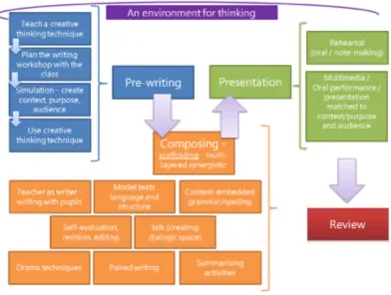
planned and developed by myself and each class using a ‘think 4 writing’ framework
(figure 1 below)
!
Figure 1: 'Think 4 Writing'. A draft theoretical model for connecting thinking and writing.
as a theoretical underpinning. This has been developed through further reading and as a
result of findings and reflection on the study presented in this paper. Data will be
collected through semi-structured interviews with staff, focus groups with children and
creative thinking as they engage in planning and each workshop will contain
opportunities for the children to engage in creative thinking. The aim being to explore
how creative thinking impacts upon children’s achievement, and attainment in writing.
Each research episode (workshop + interviews, focus groups and reflections) will be
written up as a case study. Then drawing on my own adaptation of Yin’s (2003) multiple
case study framework, I will develop some cross case analysis, pulling out
commonalities across year groups, differences in response and evaluate the ‘think 4
writing’ framework. Understandings gained from the pilot project/preliminary study
which features in this paper have led to the development of this much larger scale piece
and it will be written up over the next two years.
References
Andrews, R. Torgerson, C. Low, G. and McGuinn, N. 2009. Teaching argument writing
to 7-14 year olds: an international review of evidence of successful practice. Cambridge
Journal of Education. 39 (3). Pp: 291-310.
Beard, R. and Burrell. A. 2010. Investigating narrative writing by 9-11 year olds.
Journal of Research in Reading. 33 (1). Pp: 77-93.
Bereiter, C. and Scardamalia, M. 1987. The Psychology of Written Composition.
Hillsdale. NJ: Lawrence Erlbaum Associates.
Chamberlain, L. 2011. Writing. In Cox, R. (ed). Primary English Teaching. An
Introduction to Language and Literacy. London. Sage.
Clark, C. 2013. Young People’s Writing in 2012: Findings from the National Literacy
Trust’s Annual Literacy Survey. National Literacy Trust.
Clark, C. and Douglas, J. 2011. Young People’s Reading and Writing: an in-depth study
focusing on enjoyment, behaviour, attitudes and attainment. National Literacy Trust.
Cohen, L. and Manion, L. (1994). Research Methods in Education. 4th ed’n. London.
Routledge.
Cox, R. (ed) 2011. Primary English Teaching. London. Sage.
Craft, A. 2000. Creativity across the Primary Curriculum. London. Routledge.
Craft, A. 2007. Creativity and Possibility in the Early Years. [online]. Available at:
http://www.tactyc.org.uk/pdfs/Reflection-craft.pdf. (accessed 5th Jan 2016)
Cremin, T. 2009. Teaching English Creatively. London. Routledge.
DCSF. 2009. Review of Key Stage 2 Testing, Assessment and Accountability Progress
De Bono, E. 1995. Serious Creativity. In The Journal for Quality and Participation. 18
(5). Pp: 12-18. Available at: http://teaching.ust.hk/~mark329/Papers/serious
%20creativity.pdf. (accessed 28th Jan 2016)
De Bono, E. 2000. Six Thinking Hats. London. Penguin.
DFE. 2013. National Curriculum for England. London. Crown Copyright.
Fisher, R. Myhill, D and Twist, L. 2011. Evaluation of Every Child a Writer Report 2:
Teaching and Writing in ECaW classes. University of Exeter and National Foundation
for Educational Research. DfE RR108b.
Gillespie, A. and Graham, S. 2010. Evidence-based practices for teaching writing. John
Hopkins School of Education: New Horizon for Learning. [online]. Available at http://
education.jhu.edu/newhorizons/Better/articles/Winter2011.html. (accessed 1st Feb 2016)
Graves, D. 1983. Writing: Teachers and Children at Work. London. Heinemann.
Guilford, J.P. 1967. The Nature of Human Intelligence. New York. McGraw-Hill.
Horton, S. and Bingle, B. 2014. Lessons in Teaching Grammar in Primary Schools.
Jeffery, B. and Craft, A. 2004. Teaching creatively and teaching for creativity:
Distinctions and relationships. Educational Studies. 30 (1). Pp: 77-87.
Medwell, J. and Wray, D. 2007. Handwriting: what do we know and what do we need to
know? Literacy. 41 (1). Pp: 10-15.
Mercer, N. 2000. Words and Minds: How we use language to think together. London.
Routledge.
Patton, M. 1990. Qualitative Evaluation and Research Methods. 2nd edition. Newbury
Park. CA. Sage.
Punch, K. and Oancea, A. 2014. An Introduction to Research Methods in Education. 2nd
edition. London. Sage.
Ritter, S. and Dijksterhuis, A. 2014. Creativity – the unconscious foundations of the
incubation period. Frontiers in Human Neuroscience. Vol 8: Article 215. Available at:
http://www.ncbi.nlm.nih.gov/pmc/articles/PMC3990058/pdf/fnhum-08-00215.pdf.
(accessed 10th Feb 2016)
Stainthorp, R. 2012. Writing is hard. Psychology of Education Review. 26 Pp: 3-11.
Turkmen. H. and Sertkahya, M. .2014. Creative thinking skills analyses of vocational
(4). Pp: 74-86. Available at: http://eds.a.ebscohost.com/eds/pdfviewer/pdfviewer?
vid=4&sid=8a300b06-77cb-44db-8e98-e185b6ddfee9%40sessionmgr4001&hid=410
(accessed 31st Dec 2015)
Wood, R. and Ashfield, J. 2008. The use of the interactive whiteboard for creative
teaching and learning in literacy and mathematics: a case study. British Journal of
Education Technology. 39 (1). Pp: 84-96.
Yin, R. (2003). Case Study Research: Design and Methods. 3rd ed’n. Thousand Oaks.