Site Seeing:
Interpreting Site in Landscape Architecture
Alex. J. Albans
This thesis has been submitted in fulfilment of the requirements of
Birmingham City University
for the degree of Doctor of Philosophy
Birmingham School of Architecture
Faculty of the Arts, Design and Media
Birmingham City University
ii
ACKNOWLEDGEMENTS
I would like to thank the following people for their support and guidance in the preparation of this thesis:
Firstly, to my supervisor Prof. Kathryn Moore who has guided and supported me throughout this research project. Prof. Moore’s enthusiasm for the subject continues to be inspirational, as does her dedication, knowledge and kindness. Thanks also to Prof. Richard Coles whose input in the early stages of the thesis was very much valued. Special thanks must also be extended to Dr. Lawrence Green whose timely involvement in this project renewed my confidence and gave me the impetus to keep going. You have all helped me to see things differently, to think more deeply, and to push the limits of what I thought I was capable of.
Next, I must also thank each of my interviewees for taking part in this research: for taking time out of their busy schedules to talk to me, and for the enthusiasm with which they each greeted the subject of my research.
Heartfelt thanks go to my wife, Allison, for your love, unwavering confidence and on-going support. Thanks too, to Isla for brightening my life when times were tough. To my parents and my brother: thank you – I could not have done this without you.
To Helen Albans, Barbara Payman, Claire Clarke and Anthony Searle – you have all helped me along my journey in different ways, and I value you all greatly.
iii
ABSTRACT
In landscape architecture, sites are commonly portrayed as being the inspiration behind practitioners’ ideas; lending a sense of legitimacy to projects seeking to connect people and place, and strengthening local identity by ‘coming from the site’. In landscape design theory, a site’s history, genius loci (spirit of place) and its physical and cultural contexts are considered to be highly significant shapers of material form in contemporary landscape architecture. Furthermore, professional practice renders the site survey as an exercise in data-gathering and/or as searching for the site’s ‘je ne sais quoi’. Students are encouraged to conduct these
investigations neutrally and objectively before any analysis or interpretation.
Such conceptions appear to rob novice designers of the confidence in their own decisions because they presume the site must ‘tell’ them what to do. Primarily benefiting students and early-career practitioners, the thesis challenges established ways of understanding and working with sites, as revealed through the embedded knowledge and expertise of experienced designers. It is an investigation into the circumstances and motivations that shape how landscape architects interpret sites and make design decisions, applicable to education and career-development.
iv
CONTENTS
Acknowledgements ii
Abstract iii
Contents iv
List of figures vii
List of appendices viii
PART ONE 1
1. Does Site Matter? 2
2. Professional Perspective 10
2.1 Historical perspective 10
2.2 Landscape architecture in context 12
2.3 Educating landscape architects 15
2.3.1 Landscape architecture’s key components 16 2.3.2 Chartership and professional development 29
3. Theorising Site 32
3.1 Terminology 34
3.2 A history of site in landscape architecture 38 3.3 Academic Dimension: Conceptions of site in landscape architecture 45
3.3.1 A way of seeing 46
3.3.2 Geographical, physical site 47
3.3.3 Emptied site 51
3.3.4 Full site 52
3.4 Professional Dimension: Site survey and practice 67
4. Operationalising the Study 77
4.1 Research Journey 77
4.2 Research Questions 90
4.3 Research Methods 93
v
4.3.2 Pilot Study 96
4.3.3 Literature review 100
4.3.4 In-depth interviews 101
4.3.5 Interview analysis 110
PART TWO 115
5. Delving Deep into Site 116
5.1 Pilot Study: a report 116
5.2 Re-forming a Site’s History 121
5.2.1 Understanding a site 122
5.2.2 Connecting people and place 127
5.2.3 Informed and critical decision-making 134
5.2.4 Stakeholders 139
6. A landscape architecture way of seeing 146
6.1 Personal context 149
6.2 Professional context 156
6.3 Site context 163
6.4 Project context 172
6.5 Socio-political context 175
7. Whose site is it anyway? 178
7.1 Stakeholders’ views 179
7.1.1 Diversity in the range of stakeholders 179 7.1.2 How stakeholders influence the interpretation of site 183
7.1.3 Expanding stakeholders’ horizons 187
7.1.4 Negotiating working relationships 188
7.2 Landscape architects’ views 191
7.2.1 Landscape architects’ relationship to other stakeholders 191 7.2.2 What landscape architects bring to a project 193 7.2.3 How stakeholders influence landscape architects’ practice 194 7.2.4 Negotiating working relationships 196
vi
7.3.1 What stakeholders want 198
7.3.2 What landscape architects want 200
7.3.3 Listen and learn 202
PART THREE 207
8. Site-seeing: Contextualising the Findings 208
8.1 What is a site? 211
8.1.1 Materiality of a site 211
8.1.2 Ideas about a site 214
8.1.3 Ideas informing materiality 218
8.2 Interpreting sites 220
8.2.1 Forming and understanding of a site 220
8.2.2 Site survey 222
8.2.3 A landscape architecture way of seeing 225
8.2.4 Stakeholders’ ways of seeing 228
8.3 Communicating site 231
PART FOUR 235
9. Interpreting Site: Conclusions, Recommendations and Limitations 236
9.1 Research Questions 237
9.2 Contribution to Knowledge 246
9.3 Forward Agenda 251
9.4 Limitations 254
References 255
vii
LIST OF FIGURES
Chapter 1
1.1 Thesis structure 6
Chapter 2
2.1 Map of International Federation of Landscape Architects delegates 12 Chapter 4
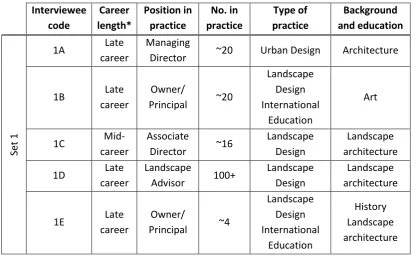
4.1 Example of Primary Generators 99
4.2 Set 1 interviewee details 103
4.3 Set 2 interviewee details 105
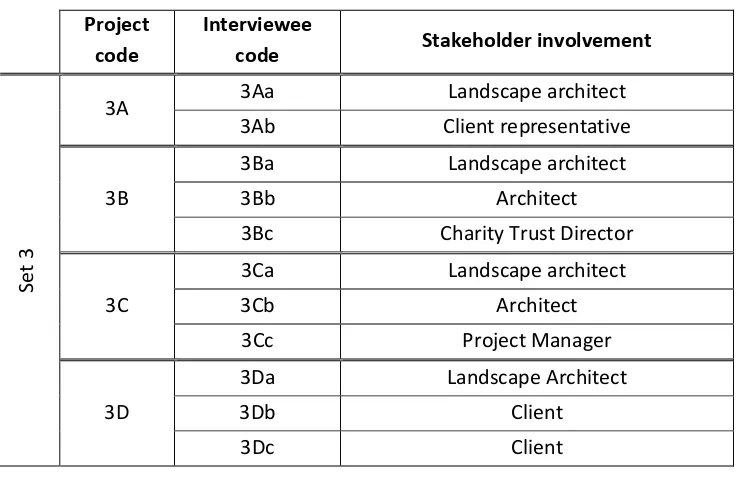
4.4 Set 3 interviewee details 107
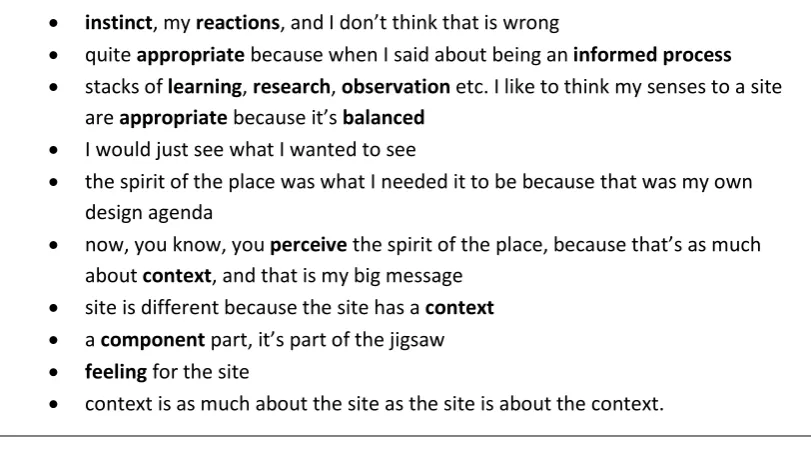
4.5 Portion of transcript from interview 2D 112 4.6 Interview data pertinent to 2D’s site survey approach 112
4.7 Subjects for study matrices 113
Chapter 9
9.1 Pocket guide to site survey 253
Appendix 1
A1.1 Number and percentage of project by category 273
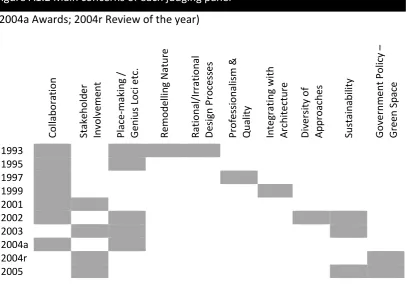
A1.2 Main concerns of each judging panel 274
viii
LIST OF APPENDICES
Appendix 1: Pilot Study results 271
Appendix 2: Letter to potential interview candidate 297
Appendix 3: BCU/BIAD ethical statement 299
1
PART ONE
Part Chapter
1
1 Does Site Matter? 2 Professional Practice 3 Theorising Site
4 Operationalising the study: Journey, Questions and Method
2 5
Results
Delving Deep into Site
6 A Landscape Architecture Way of Seeing
7 Whose Site is it Anyway?
3 8 Site Seeing: Contextualising the Findings
4 9 Interpreting Site:
2
1
Does Site Matter?
“For the disciplines and professions concerned with design of the physical environment,
site matters
.”(Burns and Kahn 2005: viii)
Site matters in landscape architecture because it constitutes the principal
environment of the discipline. It is variously thought of as the forum in which we operate, the profession’s muse, the material with which we sculpt, or the canvas onto which we paint. The intrinsic value of site to landscape architecture is such that our abilities in “site-reading and editing” were acknowledged by Meyer as “establishing landscape architecture as a discipline separate from architecture, engineering, and horticulture” (2005: 94). In practice, the site benefits from all manner of close inspections: from survey to analysis, through design to
construction, the site is at the forefront of the landscape architect’s mind. This does not however, mean that it is well-explored or understood.
3 hinders the need to address the fundamental question ‘what is site?’ at a time when the profession’s profile as one concerned with bold, forward-thinking ideas, artistic practice and the creation of thoughtfully-designed places is being actively encouraged.
Landscape architecture tends to be split into theory and practice: with the former examining individual subjects (the genius loci for example) without exploring how they affect actual design decisions; and the latter focusing on general practice as if all landscape architects were a homogeneous group. The strength of the discipline lies in its diversity and subtle complexity because this demonstrates a thriving and dynamic profession which is seeking out opportunities, and is responsive to shifts in societal, cultural, artistic and political landscapes.
Recognising the environmental, economic, political and cultural value of the landscape, the Landscape Institute – governing body of the profession in the UK – have put much effort into promoting the discipline’s role as the keystone in the industries connected with the landscape (see LI 2011b, 2012c). Partly due to the ratification of the European Landscape Convention, landscape is on the socio-political agenda. Influential thinkers such as Sir Terry Farrell acknowledge that:
“the design and stewardship of landscape is valued as much as, if not more than, buildings. In towns and cities throughout the country, it is the streets and pavements that are most highly valued … These priorities are often completely the reverse for the development community and built
environment professionals … it is aspects like the heights of buildings and their style and appearance that have become the big issue. I can count on one hand the number of [Design Review] panels where landscape and the ground plane became the passionate focus for debate”.
(Farrell 2014a: 14)
It is therefore crucial that we have the best tools with which to help shape discourse, policy and practice. This means that we have to be clear about the link between site and landscape and not simply rely on inherited norms and
4 Landscape is defined by the Council of Europe (2000) as “an area, as perceived by people, whose character is the result of the action and interaction of natural and/or human factors”. The significant detail in this definition is that landscape is a human construct, and as such, landscape does not exist apart from human consciousness expressed through culture. Landscape is different from ‘the land’ and encompasses the richness of accrued relationships between nature and humanity. If an expansive term such as landscape exists within the professional arsenal, why does site need to be similarly stretched? Why can’t site remain as a Cartesian locale, the physical location within which landscape architects practice, and allow landscape to carry the torch for the inspiration and creativity of landscape architecture?
The key to this issue lies within the practice of the discipline. Although the
profession is called landscape architecture, and, at its best, practitioners do indeed engage with landscape in its fullest meaning, there is a sense in which the
landscape needs to be captured and brought onto the drawing board or computer screen. It is at this point that landscape becomes site so that the work of a
landscape architect can be related to a specific area and a specific brief. In a sense,
landscape architecture becomes site architecture. Acknowledging that landscape
and site are closely linked, this thesis argues that, just like landscape, site is a social or cultural construct, and expanding the work of Moore (2010), is not a neutrally objective entity which we can supposedly observe from a detached point of view. In seeking to address the relationships between theory and practice, the research will draw on three contextual sources: academic literature; professional guidance and policy literature; and the experiences of practising professionals.
5 addresses the impact of working relationships on how site is interpreted and design decisions are made. Uncovering what Burns and Kahn label “tacit knowledge about site in design” (2005: xiv), it is anticipated that this study will reveal and make connections between this knowledge and the implications it has for how we understand and work with sites.
Cosgrove suggests that “landscape is a way of seeing the world” (1998: 13) whereby different groups have “framed themselves and their relationships with both the land and with other human groups” (ibid: xiv), uniting groups of people around a common understanding and shared outlook. When examining how landscape architects seek to understand a particular site, is it possible that they are
demonstrating – to misquote Cosgrove – a “landscape architecture way of seeing the world” which is particular to the profession? The site survey is the primary way that landscape architects ‘get to know’ a site, and this thesis locates the traditional site survey as a “way of seeing” that is a vitally important aspect in the process of understanding a site. In this study, a ‘landscape architecture way of seeing’ is an interpretative perspective based on the expertise manifest through a specific discipline.
A number of key terms used in this thesis are explained below:
Construct/Construction In an industry concerned with the building and construction of landscape schemes, it is important to differentiate building-construction from social,
6 Way of seeing After Cosgrove (1998), this term describes how a
group of people (landscape architects in this thesis) comprehend, articulate and approach a subject. Site-seeing Following on from the above, this term is used as a
way of conveying an approach to site from the perspective of an individual or group (of landscape architects).
Thesis structure
This thesis is divided into four parts as set out below (figure 1.1). Part one, of which this introduction is the first chapter, sets the context of the study and includes the literature review and methodology. Part two sets out the results of the research in sequential and iterative stages, and part three draws the research together for discussion. Completing the research is part four which outlines its conclusions together with recommendations for theory, practice and education.
Figure 1.1 Thesis structure
Part Chapter
1
1 Does Site Matter? 2 Professional Practice 3 Theorising Site
4 Operationalising the study: Journey, Questions and Method
2 5
Results
Delving Deep into Site
6 A Landscape Architecture Way of Seeing
7 Whose Site is it Anyway?
3 8 Site Seeing: Contextualising the Findings 4 9 Interpreting Site:
7 Part 1
Following this introduction (chapter 1), chapter 2 sets this study within landscape architecture’s professional context. Drawing on the literature which governs the professional practice and education of the discipline, this chapter outlines the key concerns which shape landscape architecture and influence how we understand and work with site. It gives an overview of the profession, locating this study primarily within landscape design and demonstrating that site is customarily ‘known’ through the lens of certain standardised assessment tools.
Chapter 3 is an examination of the wider inter-disciplinary literature pertinent to the study. The chapter starts with an exploration of three inter-connected terms which frame the study of site and shows how their similarities and differences add to the complexity and ambiguity of site as a subject of enquiry. Drawing on
discourses from architecture, urban design and geography, as well as the academic enquiry associated with landscape architectural theory, this chapter examines a number of different theoretical approaches to site and shows how their constituent parts impact landscape architectural practice. The remainder of this review focuses on ways that landscape architects interact with site as part of their professional practice, establishing how the site survey is based on particular ways of seeing site.
8 enquiry. The chapter details the methods used to select interview candidates, conduct the interviews and analyse the subsequent data.
Part 2
Part two is divided into three chapters covering each stage of this research’s data-gathering phase. Chapter 5 begins with a brief report on the pilot study which set the scene for this research project and revealed that professionals’ understandings of site required further investigation. The results of this pilot study are detailed in Appendix 1. The remainder of chapter 5 sets out the results from interviews with five high-profile designers who have worked with historical landscape
interpretation. Demonstrating that site-history cannot be viewed in isolation from other aspects of site which also influence design decisions, these findings lead directly to the instigation of the second set outlined in chapter 6. In this next chapter, fourteen interviewees are asked about how they ‘get to know’ a site by focusing on a number of key factors as revealed in the literature review. To conclude this study, chapter 7 explores the influence and impact of different stakeholders on how landscape architects interpret site and make design decisions within four landscape projects. Together with the literature reviewed in chapters 2 and 3, all of the data gathered in part two of the study is read, analysed and
investigated iteratively and forms the basis for the discussion set out in part three.
Part 3
In chapter 8, the findings from parts 1 and 2 are drawn together with particular emphasis on demonstrating how the situations in theory and practice inform one another. Beginning with an exploration of the conceptual basis of what we mean by site in landscape architecture, this research shows how practitioners’ ways of seeing site are at odds with the simplistic portrayals of site in much of the technical literature. The chapter turns to look at how site is a construct rather than a
9 to, a site. Finally, the discussion examines how communication within working relationships is seen as a key component in the conception and interpretation of a site within landscape architecture.
Part 4
Chapter 9 brings the findings of this research project together, drawing conclusions which relate to the research questions which are briefly set out below. These conclusions show how the understanding and interpretation of site in practice differs from that outlined in the technical literature, as well as demonstrating how some of the more fecund conceptions of site found in the academic discourse relate to professional practice. Finally, recommendations are made with specific reference to enabling students to more fully explore sites within the context of design studio projects.
Research Questions
The research journey (chapter 4.1) outlines how the evolving course of this study has developed, resulting in these questions set out below. That same chapter also sets out the questions more fully (4.2), with an explanation of the rationale and aims which underpin them. In this chapter, they are simply introduced as:
10
2
Professional Perspective
This chapter explores the contexts which shape landscape architecture and how these in turn influence how we understand and work with sites. The history and development of landscape architecture shows how approaches to the discipline have changed over time and how current site-thinking sits atop accrued layers of thought and practice. Following a brief historical overview, this chapter focuses on two contemporary documents which set the context for the profession in the UK and how these guide how we understand ‘site’. The remainder of this chapter examines what the Landscape Institute (the UK profession’s governing body; responsible for the Royal Chartership and for accrediting university courses and professional development of landscape architects in the UK) decrees as being essential for all landscape architects to be taught. This gives a base-line for the industry – showing what is important to the profession – and in doing, shapes our understandings of, and approaches to, sites.
2.1 Historical perspective
“Landscape architects create places where people can live, work and relax and they create places where plants and animals can thrive.”
(www.iwanttobealandscapearchitect.com)
11 variously shaped for agriculture, religion or ceremony, trade, habitation or to
demonstrate power and/or wealth. The creation of private gardens or paradises as pleasure grounds for the wealthy upper echelons of society broadly differed from other land-shaping because skilled designers were employed to alter the land on behalf of their clients rather than the populace shaping the land for their own, often prosaic or functional, requirements. These specialist land-shapers were the forerunners of landscape architects, and their single-minded endeavours the origins of landscape architecture (Jellicoe and Jellicoe 1998, Thompson 2014). From this perspective, the term ‘site’ is synonymous with ‘location’ and can be understood as a locus for humanity’s numerous and varied endeavours, whether they be based on culture, power, wealth, ownership, ritual, religion or conflict.
According to Jellicoe and Jellicoe (1998) and Thompson (2014) it is generally agreed that landscape architecture had its roots as a recognisable discipline in Europe as it flowed from the fashionable large-scale land-shaping projects amongst the
European elite during the seventeenth and eighteenth centuries, typified by the works of André Le Nôtre (1613-1700) in France or Lancelot ‘Capability’ Brown (1716-1783) in England. Later, these emerging principles of landscape design began to be employed for the public good, such as Joseph Paxton’s (1803-1865) design for Birkenhead Park. These more egalitarian roots spread to the United States in the nineteenth century where they were famously taken up by Fredrick Law Olmstead (1822-1903) and Calvert Vaux (1824-1895) who, according to Thompson (2014: 1), were the first to describe themselves as landscape architects in their 1858 design for New York’s Central Park. Each of these early pioneers saw the notion of site differently. For example, at Versailles, Le Nôtre sought to overcome the site’s considerable physical challenges as a way of demonstrating his client’s (Louis XIV) – absolute monarchical power and authority. In contrast, Paxton saw the site in more democratic terms, as an opportunity to ameliorate man’s degradation of nature and to provide open public access (Jellicoe & Jellicoe 1998).
12 landscape architecture as a distinct discipline began in the United States with the establishment of the American Association of Landscape Architects in 1899, and the Institute of Landscape Architects (now the Landscape Institute) in the United
Kingdom in 1929 (Thompson 2014). With increasing pace, over the last century the number of nations across the world with similarly established professional bodies has risen to stand at 70 according to statistics from the International Federation of Landscape Architects (figure 2.1).
Figure 2.1 National Delegates of the International Federation of Landscape Architects.
(http://iflaonline.org/organisation/executive-council/)
2.2 Landscape architecture in context
As landscape architecture has become increasingly professionalised and
internationalised, so certain central tenets have emerged which impact how site is understood and interpreted at a local level. Each of the national bodies (fig. 2.1) represents the coalition of landscape architects around a common core, but it is important to note that the particular context and expression of the discipline varies from nation to nation. Thompson notes that “in some countries, landscape
13 others it’s the bedfellow of architecture, planning and urban design. Elsewhere, it may be found in a school of forestry or environmental sciences” (2014: 12). Within this diversity there is a common core of minimum requirements for the
achievement of professional recognition. Such requirements, although interpreted differently according to nation, institution and area of expertise, nevertheless give a basis to those areas deemed vital to the discipline and therefore to how site might be understood (see EFLA & ECLAS 2012, Landscape Institute 2012b, QAA 2007 for details).
The diverse and inter-disciplinary nature of landscape architecture means that it contributes to – and is impacted by – a whole spectrum of concerns. Within the UK this inter-activity is seen most clearly in two relatively recent initiatives: The
European Landscape Convention (Council of Europe 2000), and The Farrell Review (Farrell 2014).
The European Landscape Convention
“’Landscape’ should not be the exclusive preserve of specialist scientific and technical bodies. When members of the public are able to take
responsibility for what happen in the landscape and influence their
surroundings, they can reinforce local/regional identity and distinctiveness, leading to greater individual, social and cultural fulfilment.”
(http://www.landscapeinstitute.org/policy/EuropeanLandscapeConvention.php) [viewed 30/9/2014]
The ratification and interpretation of the European Landscape Convention (ELC) in the UK – as demonstrated by the Landscape Institute’s response, above – clearly reflects what is important to the profession within its societal, cultural and economic contexts. According to the Landscape Institute, in the UK, the ELC “provides a people-centred and forward-looking way to reconcile environmental management with the socio-economic challenges of the 21st century and to help
14 understand and provide evidence of how an identity has built up over time so that this identity can be used to connect people and place. In this sense, the site is seen as a smaller component-part or a segment of a larger landscape to which current attention is directed for the purposes of understanding and unlocking a unique local identity as perceived by human-kind.
The Farrell Report
This report, an “industry-wide review of architecture and the built environment” (Berman 2014) was commissioned in 2013 by Ed Vaizey, the Minister for Culture, Communications and the Creative Industries, to examine how these industries might best respond to the increasing pace of change and scope of development within the built environment over the next twenty years and beyond (Farrell
2014a). The report cements the role of landscape architecture within the context of a “holistic way of viewing the built environment” (Farrell 2014b: 3) under the acronym PLACE (Planning, Landscape, Architecture, Conservation and Engineering). The Landscape Institute’s response to the Farrell Report suggested that achieving high standards of design within the built environment “requires a thorough
understanding of a site’s social, economic and environmental characteristics i.e. its landscape context” (Landscape Institute 2013d: 7). Expanding the Farrell Report, which identifies the importance of the built environment’s cultural heritage to a society and its identity, the Landscape Institute asserts that it is also “landscape, spaces, places, views, vistas, landmarks, routes, boundaries, geological and manmade features [which] give places their character and helps to define their local distinctiveness” (Landscape Institute 2013d: 11).
In responding to this report, the Landscape Institute clarifies how landscape
architects contribute to the PLACE context by understanding and approaching sites thus:
15 features to the ‘sense of place’. Good designers will take the best from the past and make good use of existing resources and assets on a site, to create development that is sustainable.”
(Landscape Institute 2013d: 12-13)
Both of these documents show how individual sites are seen as part of a larger, culturally-valued landscape context which contributes to people’s sense of identity.
2.3 Educating professional landscape architects
The Farrell report identifies the importance of cross-disciplinary education, recommending a common first-year curriculum for all built-environment students (Farrell 2014b). At the time of writing, the education of landscape architects is geared towards the requirement to work towards Chartership set out by the Landscape Institute (Landscape Institute 2012 a & b and 2013b), and as such, this part of the chapter examines the core aspects of the discipline as defined by the Landscape Institute and used as the basis for all LI accredited higher education courses in the UK. It is important to acknowledge the existence of an alternative set of requirements whose impact on the UK profession’s education is as yet untested, but which may be taken on-board by the Landscape Institute depending on
whether commonality with European institutions becomes necessary or desirable in the future. The Minimum Requirements for European Landscape Architectural
Studies to Qualify for Professional Recognition drawn up by EFLA (European
Federation for Landscape Architecture) and ECLAS (European Council for Landscape Architecture Schools) suggests that landscape architecture students “have
knowledge, understanding and abilities in 5 areas:
1. Landscape Architectural Practice 2. Theory and Precedent
3. Technology and Sustainability
16 5. Professional Ethics and Values”
(EFLA & ECLAS 2012)
Although these areas of ‘knowledge, understanding and abilities’ are structured differently to the Landscape Institute’s curriculum and Chartership syllabi, there is much commonality and agreement of content, approach and ethos across all examples. This chapter will therefore focus solely on the Landscape Institute’s documentation because it remains as the official pathway through landscape architectural education and Chartership in the UK.
The LI is very clear in all of its documentation that there is “diversity of landscape as a profession and as a discipline” and encourages each accredited university
programme to “have its own clear identity and emphasis” (Landscape Institute 2012a: 9). This thesis is written from within the context of Birmingham City
University’s accredited landscape architecture programme and so the focus of this chapter on the Landscape Institute’s core requirements – rather than “its academic interpretation” (LI 2012d: 9) – gives a clearer picture of what landscape architecture students are taught across the UK. What we teach our students is a reflection of the concerns of the discipline as it interacts with, and addresses, the wider
socio-political context of today’s world, and thus also contributes to our ideas about site.
2.3.1 Landscape architecture’s key components (according to the
Landscape Institute)
“Attempts to define the discipline usually fail... Most of them are prolix and wordy, trying to capture all of the assorted activities in which landscape architects are engaged.”
(Thompson 2014: 23)
17 include “all aspects of the science, planning, design, implementation and
management of landscape and their environment in urban and rural areas” (Landscape Institute 2012b: un-numbered). The Landscape Institute outlines the scope of the discipline in its document Landscape Architecture: elements and areas
of practice; An Educational Framework (Landscape Institute 2012b). This publication
sets out to “inform the LI’s educational processes by describing what is involved in the day to day chartered practice of landscape architecture and the main broad areas of practice in the profession” (un-numbered) and can thus be taken as a guide to the core aspects of the discipline, namely: landscape design; landscape
management; landscape planning; landscape science and urban design.
Within the industry there are practices and individuals who specialise in one of these areas and others whose portfolios cover multiple aspects. This research is primarily concerned with landscape (and urban) design but it is important to understand the other areas of practice as they influence the overall structure and foundation of the discipline, and in turn how this shapes practitioners’
understanding of and approach to site.
Landscape Design
“The world is moving into a phase when landscape design may well be recognised as the most comprehensive of the arts.”
(Jellicoe and Jellicoe 1998: 7)
Geoffrey and Susan Jellicoe make a significant observation about the discipline by highlighting a subtle distinction between landscape design and landscape
architecture. Landscape design is sometimes used as a way of distinguishing this
aspect of the practice from its other components (planning, management and science), and sometimes because it is a more readily understood term in everyday parlance. In the UK, landscape architecture is generally introduced as “an
aesthetically based profession” (Holden and Liversedge 2014: 8) and so landscape
design has a more immediate connection with the individual sites that make up our
18 The Landscape Institute defines this area of practice thus:
“Landscape design is the holistic process of shaping the natural and built environment to create desirable places for people to live, work and play and environments for plants and animals to thrive.”
(Landscape Institute 2012b: un-numbered)
Formative concepts of site through landscape design
The design of the landscape as a reflection of the trends, concerns, policies, beliefs and economies of a culture, shifts over time and from place to place. A striking example of these shifts in approach and attitude can be seen in the near contemporaneous dichotomy between the English poet Alexander Pope (1688-1744) and the French landscape André Le Nôtre (1613-1700). In England, Pope wrote of the desire to emulate nature; for the landscape architect’s work to blend into the scenery thus, “He gains all points who pleasingly confounds, surprises, varies, and conceals the bounds” (Jellicoe and Jellicoe 1998: 233). In stark contrast, across the Channel at Versailles, Le Nôtre sought to dominate nature, to
demonstrate man’s control over the natural world through the imposition of a tightly controlled formality over nature’s wild informality, described by Jellicoe and Jellicoe (1998: 188) as “the most splendid expression of absolute monarchy in history”. This dichotomy in approach – between blending in with a site versus
standing out from a site – has been part of the landscape design discourse ever
since, with practitioners and academics variously arguing for gradations between one or other position.
Pope’s approach still appears to be the predominant position in landscape design:
“the traditional way of working with landscape spaces is to ‘consult the genius of the place’ as Alexander Pope put it – that is to soak up the natural atmosphere of the locale and somehow to work with it, designing in tandem with what might be considered the presiding spirit of the place, atmosphere or space-flavour”
19 Along with Pope’s genius loci, the other enduring approach to landscape design is Ian McHarg’s (1920-2001) influential ecological method. This approach is based on the surveying and mapping of all the different components of a site; geological, historical, cultural, biological etc. and the layering of this mapped data to build up a picture of the site to provide an empirical basis for design decisions. McHarg called his method “the sine qua non for all landscape architecture” (McHarg 1967: 41). Later developments of this approach were known under the acronym SAD (Survey Analysis Design).
Pope and McHarg’s focus on basing design decisions on what is found within the existing site would, at first glance, appear to have extinguished the type of blank-canvas transformation typified by Le Nôtre at Versailles. However, on closer inspection, today’s landscape designers recognise that each shares a common concern – that of identity (see Butina-Watson & Bentley 2007, Dixon-Hunt 2014, Thompson 2000 et al.). The former approach seeks to maintain an existing identity through the appropriation of a site’s existing character, whilst the latter seeks to create a new identity in contrast to the found conditions. Whilst it is rare to find examples at the extreme ends of either side of this dichotomy, most contemporary landscape design projects pursue a balance between respecting the existing site’s context and creating a new (or improved) identity.
In the UK, the Landscape Institute broadly acknowledges this by proposing that landscape designers “reflect the identity and quality of place while meeting the current and future needs of stakeholders in a sustainable and aesthetically coherent way” (Landscape Institute 2012b: un-numbered). This desire to find a balance between the existing and the new is evident in many of the UK’s landscape practices, who promote their design approach as, for example:
“Our ethos is to achieve our client’s aspirations by using the inherent qualities of each site to maximise opportunities for positive and imaginative solutions.”
20 “We seek to reveal the essence of the place, interpret and manifest this in the physical design of the environment.”
(http://iteriad.com/cumbria-landscape-architects-leading-the-creative-thinking-process) [viewed 23/6/14]
Even those practitioners who Richardson identifies as “revel[ling] in the heretical notion that their designs might erase or overlay all traces of what has gone before” (2008: 35), such as Martha Schwartz or Tony Heywood (ibid), are actively and carefully assessing the existing site in order to look for and create identity. Martha Schwartz describes her own ideas about how a site’s conditions influence design decisions:
“to decipher what the image should be for an individual project, a
community or even a city – one that is unique to that particular place, that is strong enough to create an identity, and most importantly, will be embraced by the public.”
(http://www.marthaschwartz.com/about/philosophy.php) [viewed 23/6/14].
Some projects exist in a context which already has a strong, positive and sustainable identity and so an approach of ‘fitting in’ is deemed appropriate; whereas other projects may exist in a context where the identity is deemed to be somehow lacking. For example in places that have “become more homogenised” Schwartz suggests that “there is an increasing need to create a new or enhanced identity that differentiates neighbourhoods or cities” (ibid). The built-form of a project is the interpretation of a designer’s response to the context of a site and the needs of the client and end-users.
Those engaged in landscape design might also undertake other activities relating to a site in a specific context, such as:
Feasibility studies, site appraisals and written reports and recommendations.
21 Developing design solutions and proposals with illustrations and models as
appropriate.
Participating in the tendering process, contract administration, site inspections, specifying materials.
Managing contracts and projects.
Contributing to public inquiries and acting as an expert witness.
(Landscape Institute 2012b: un-numbered)
Landscape Planning
“Landscape planning is concerned with the development of policies,
strategies and practical interventions in landscape at the large-scale and is a form of spatial environmental planning where there is a major emphasis on sustainability. It is an integrating activity that deals with the many
interacting factors – physical, natural and social/cultural – that together shape landscapes over time.”
(Quality Assurance Agency for Higher Education (QAA) 2007:2-3)
In essence, landscape planning is the strategic arm of landscape architecture, assessing and resolving “environmental, economic and social opportunities and constraints relevant to areas of landscape interest and take these into account in addressing a landscape’s potential and capacity to accommodate change”
(Landscape Institute 2012b: un-numbered). To some degree, all design projects undertaken by a landscape architect will adopt this approach, which influences how landscape architects understand and work with sites in other aspects of their work. This is most clearly seen when surveying a site to assess its potential for future development and intervention.
22 Transcendental movements which sought to preserve nature from the
ever-encroaching effects of urbanisation. The initial consequences of this movement in landscape planning was “the notion of the designated and protected landscape and, specifically, of the national park” (Thompson 2014: 100). The need to control development meant it was necessary to properly understand the landscape to assess its suitability for different types of activity. Ian McHarg – introduced above – led the way in developing a systematic, data-led procedure for landscape
assessment and planning.
“Known as ‘landscape suitability analysis’ or sometimes just as ‘sieve mapping’, the technique he developed involved layering information on acetate sheets. So, for example, in considering the optimal route for a new highway, McHarg would combine layers showing the engineering properties of the substrates with layers showing productive soils, significant wildlife habitats, important cultural sites, and so on. When these were combined, it was the areas which were clearest of symbols that were the better areas in which to construct the road.”
(Thompson 2014: 102)
This approach and its associated tools, along with their later developments, are now pervasive within landscape architecture as a way of gathering information, analysing sites and adding weight to decision-making processes. McHarg’s
technique was an early forerunner of GIS (Geographical Information Systems) which rely on the collection and manipulation of data overlaid or combined with
computerised map or satellite data. It is rare that the all-encompassing positivistic approach of McHarg’s method is used as the only, or even primary decision-making tool in landscape architecture, but its importance and lasting influence on how we ‘get to know’ a site, is hard to ignore.
23 (Environmental Impact Assessment) and LVIA (Landscape and Visual Impact
Assessment).
Environmental Impact Assessment (EIA)
“... a process by which the identification, prediction and evaluation of the key environmental effects of a development are undertaken and by which the information gathered is used to reduce likely negative effects during the design of the project and then to inform the decision-making process.” (Landscape Institute & Institute of Environmental Management and Assessment
2002: 3)
Environmental Impact Assessments form part of the statutory UK and EU planning processes but are only normally required in certain specific cases where
development is likely to pose a significant impact on the environment. Such
developments might range in scale from transport infrastructure, waste-processing or power-generation, some large-scale leisure or tourism facilities, some of the heavy industries such as metal working or chemical processing and even large premises dealing with food production or manufacture
(http://www.legislation.gov.uk/uksi/2011/1824/contents/made and
http://planningguidance.planningportal.gov.uk/blog/guidance/environmental-impact-assessment/) [viewed 9/7/2014].
The aim of these assessments is “to protect the environment by ensuring that a local planning authority when deciding whether to grant planning permission for a project, which is likely to have significant effects on the environment, does so in the full knowledge of the likely significant effects and takes this into account in the decision making process.”
24 This is a clearly-defined example of how landscape architects take responsibility for providing solutions (whether through design, planning, management – or more likely a combination thereof) which meet the often conflicting needs of numerous and diverse stakeholders including clients, the public and the natural world.
Landscape Character Assessment (LCA)
"The tool that is used to help us to understand, and articulate, the character of the landscape. It helps us identify the features that give a locality its 'sense of place' and pinpoints what makes it different from neighbouring areas."
(http://www.naturalengland.org.uk/ourwork/landscape/englands/character/assess ment/) [viewed 24/6/2014]
25 The kinds of assessment set out above necessitate that the landscape is surveyed, comprehended and described in particular ways in order to meet the necessary statutory remits they are designed to fulfil. Along with other ways of seeing the landscape (and individual sites), such techniques give a structure to the ways that landscape architects ‘get to know’ a site. The various sets of criteria associated with these assessment tools mean that practitioners are directed (and required) to focus their attention onto a limited number of each landscape or site’s attributes; and consequently overlook a place’s many other aspects or qualities. This has the effect that sites (and whole landscapes) are only seen, valued and understood through a relatively narrow set of norms which reflect very particular socio-political contexts.
Landscape Management
“Landscape management is the care of land to ensure that landscapes can fulfil needs and aspirations in an effective and sustainable manner for present and future communities of users.”
(Landscape Institute 2012b: un-numbered)
Landscape management has very many overlaps with landscape planning and design, particularly where “management of the landscape is an essential means of achieving design aims and objectives” (QAA 2007: 3). In practice, projects that contain an element of design and construction will almost always contain elements of planning and management, and it would be difficult to separate the different parts of a project and assign them to one or other of these labels. Broadly speaking, landscape management is concerned with the three main phases of project
(planning for a project, implementation and post-completion). These phases are frequently fluid and are not always easy to separate in practice, but are useful to explore on paper as a way of showing how different elements of landscape
26 costing, and guidance on the adherence of relevant policies, will lay the foundation for decision-making in collaboration with the relevant stakeholders (Landscape Institute 2012b: un-numbered).
Once the appropriate decisions have been made, landscape management moves into its second phase: to plan for and manage the process of change. This may involve giving advice on restoration schemes or other management-based solutions such as ecological conservation or long-term community involvement. Landscape management at this stage of a project may take the form of written reports or advice produced by a landscape architect for other stakeholders to follow, or may involve the landscape architect themselves taking an active part in the on-going management of the project, depending on the type and scale of the scheme (Landscape Institute 2012b: un-numbered).
The final phase of a landscape project is to plan for the management of the scheme post-completion. This is especially important in landscape architecture because a landscape will continue to develop and mature and will need careful and continual management in order to assure its continuing success. As part of the development of a project, landscape architects will try to ensure that provision is made for the continuing maintenance of the project once it is handed over to the client. Details of a scheme’s future requirements will form part of the documentation prepared at earlier stages of a project. Occasionally, the landscape architect is able to retain a long-term input into the management of a project as part of their contract.
Landscape Science
“Landscape science is the application of environmental and ecological expertise in the assessment, analysis and resolution of practical landscape issues, and in the enhancement of the landscape.”
(Landscape Institute 2012b: un-numbered)
27 “Landscape science is a vital element in environmental impact assessment, landscape character assessment, master planning, management and creative elements of habitat creation, mixing science with design.”
(QAA 2007: 3)
The key concerns of landscape science are also shared by professionals such as ecologists, conservationists, geologists and foresters who specialise in specific aspects of the landscape. Whilst some of the work categorised as landscape science may not be conducted by a chartered landscape architect, some landscape
architects may, in addition to their design or planning work, have the training (and in some cases licences) needed to conduct the more specialist types of surveys, assessments and studies (such as bird, bat or amphibian habitat surveys) as part of a larger scheme. In other cases this type of work is out-sourced to a consultant. Where there is overlap with these other professions, landscape architects’ knowledge, experience and practice are widened, just as their understanding-of and approach-to site is also shaped by exposure to other disciplines’ way of thinking and working.
The Landscape Institute guides debate and policy on areas of concern which affect the landscape, such as climate change, sustainable urban water systems, green infrastructure and public health. Landscape science plays an important role in each of these areas, and landscape architects use their design, planning, management and scientific expertise to find solutions to these contemporary issues.
Urban Design
“Urban design is the process of shaping the physical setting for life in cities, towns and villages. It involves both the art of ‘placemaking’ and the science of creating urban form which is fit for purpose.”
(Landscape Institute 2012b: un-numbered)
28 (2009: 176). Waterman goes on to assert that “urban design is a discipline rather than a profession (2009:176), which is echoed by Thompson who recognises that “to practise as an urban designer one generally needs to be qualified in one of the related professions – perhaps landscape architecture” (2014: 110). These ‘related professions’ might also be either architecture or urban planning (ibid) and thus the perspective brought to urban design will reflect the practitioners’ distinct
background as well as any subsequent specialist training in urban design. Reflecting on his own teaching experience, Thompson suggests that “the differences between landscape architecture and urban design are largely a matter of perspective... the urban designers’ inclination was to fill [an existing open space] with buildings, amongst which would be a smattering of small parks and urban squares. The
landscape architecture students tended towards the opposite direction, scattering a few buildings amid large tracts of open space” (2014: 111). Whereas landscape architecture tends towards a more holistic outlook which also encompasses the natural world, urban design tends towards a human-centric approach;
“...urban design is for and about people... the significance of ‘place’”
(Carmona and Tiesdell 2007: 1)
Despite these apparent differences in perspective, there is a fundamental principle that underpins both urban design and landscape design; that of place-making (Farrell 2014).
Whilst it is unclear whether place-making (with its focus on creating places for people) first influenced landscape architecture which in turn influenced urban design, or vice versa; it is clear that place, place-making, place-identity, sense of place, spirit of place (genius loci) and local identity are extremely important to both disciplines. It is from this standpoint that practitioners working within these
professions understand and work with site.
29 site’s physicality in order to ensure its designs can be built; urban design might seek to understand the character of a place; and landscape science might investigate the ecology of an area. All of this combined knowledge and expertise impacts practice because it influences how sites are understood, and as a consequence, the
decisions we make about their future.
2.3.2 Chartership and Professional Development
The Landscape Institute has a programme of gaining formal recognition in the profession through Royal Chartership, and of keeping abreast of an ever-changing industry through Continual Professional Development.
“Chartered status confirms that an individual has the skills, knowledge, understanding and integrity to practice as a landscape professional in the UK.”
(Landscape Institute 2013: 9)
Building upon an accredited university education, the Pathway to Chartership focuses on the knowledge and skills which are needed to operate as a professional. The Landscape Institute defines four core elements required for chartership:
Professional judgement, ethics and values: understanding what it means to be a professional; the ethical obligations and implications as they relate to the LI’s Charter and Code of Conduct; the wider contexts in which landscape decisions are made; recognising and working with best practice and other professionals’ expertise.
Organisation and management: Understanding the legal requirements and obligations which impact the profession; understand and observe Health and Safety guidelines; work within the LI’s guidelines on appointment and remuneration.
Assessment and analysis: Adhere to the legislative requirements,
30 to identify client requirements and establish a professional working
relationship; identify stakeholder requirements and expectations; use appropriate methods to assess the significance, context and character of a site; document and record findings and proposals.
Implementation: Use and create appropriate plans and budgets; use the appropriate tendering processes and contractual arrangements; monitor and control projects from instigation to completion and handover.
(Landscape Institute 2013b)
The syllabus is followed by all newly-qualified landscape architects on their way to Chartership in accordance with the Landscape Institute’s Royal Charter. From this foundation, each landscape architect is then encouraged to develop their own expertise, knowledge and skill throughout the experiences of their working life. Continual Professional Development is a requirement of the Landscape Institute’s Code of Conduct, ensuring that practitioners maintain their professional
competence. It is down to each individual to tailor their learning based on a combination of industry-wide developments and those which are pertinent to a practitioner’s own interests and areas of work.
Implications for the research
From the themes outlined above, the following points form the context within which this research is located:
1. Primarily concerned with landscape design and (to a lesser degree) urban design, this research must acknowledge and address the key importance that place, place-making etc. have on these subjects.
2. That landscape architects use a number of standardised (but flexible) tools to assess the significance, context and character of a site.
3. That formal, accredited landscape architectural education is only the first part of a practitioner’s professional education which continues through the
31 Development. A practising landscape architect is therefore able (and
encouraged) to build upon a base-line of core elements in order to gather the skills, knowledge and experience needed throughout their career. This
continual learning necessarily reflects the unique shape of their own interests, skills, education and practice.
Each of these points influences how site is understood: from a discipline-wide perspective; through the interpretive-tools of professional and legislative assessment; through the lenses of the multi-faceted areas of practice and associated disciplines; and also, always, through the skillset and education of an individual practitioner.
Practitioners are educated and trained within the context of an industry that has certain values, practices and orthodoxies which inform how individuals respond to sites within particular cultural, societal and political environments. Every landscape architect will therefore respond to any given project from a unique set of
32
3
Theorising Site
This review explores the factors which underpin why ideas about site are frequently portrayed in prosaic, technical terms, the effect this can have on landscape
architectural practice and the alternative ways of understanding sites which place their interpretation as part of a complex, creative process. As a key concept in landscape architecture, the point at which design becomes material, site appears to have drawn the short straw in terms of its academic attention when compared to the very closely associated concepts of place and landscape. Although both of these are equally important in landscape architecture, they do not share the same
precision as site which focuses the designer’s response to a specific piece of ground; nor do place or landscape share site’s burden of the crucial site-survey upon which key decisions are made and creative insights unlocked. It is imperative therefore, to understand how site came to be viewed as little more than a
descriptor, despite the fact that it shares as much of the complexity, nuance and creative potential as either place or landscape claim, and because it lies at the very centre of the discipline.
“To think about landscape is to think about site. This seemingly transparent proposition is anything but – for the potential of site in landscape design is often overlooked … One reason for this oversight is the convention of equating sites with building lots – available parcels bound by legal
demarcation driven by property ownership – as opposed to understanding them as large complex landscapes”
(Czerniak 2006: 107)
33 literature associated with place and landscape is extensive; that associated with site is seen as lacking (Burns and Kahn 2005). With particular reference to landscape architecture, this review therefore sets out to examine site as more than “an area of ground” (Christensen 2005) in the same way that place has been explored as more than “a point in space” (Collins English Dictionary) or landscape is understood to be more than “the landforms of an area” (Christensen 2005).
Recognising the centrality of site in landscape architecture, over time there have been a number of attempts to theorise the concept, as outlined in section 3.2. This historical context provides the basis for the remainder of the review and
demonstrates how conceptions of site are dynamic. Section 3.3 examines three key conceptions as they are evident across the literature: a geographic, physical
understanding of site; site as empty, cleared of meaning; and site as full, containing identity and inspiration. The most prevalent conception of site in the literature, this last section focuses on the impact of place, identity, the genius loci, site history and how site is used as a source of inspiration in practice.
34
3.1 Terminology
Conceptions of site, place and landscape are ambiguous. Examining the similarities and differences between these terms is important because all are key subjects in landscape architecture and all have clear overlaps with each other as descriptors of the ground upon which we work. However, the complexity inherent in each of these terms is such that differences do exist, even though authors disagree on the precise nature of these distinctions. Significantly, in landscape architecture, matters of place (such as the spirit of place) and matters of landscape (such as landscape character) impact each individual site that we may work with, adding further complexity and ambiguity to the relatedness of these terms. This section presents examples of how each is posited within the literature and sets the scene for more detailed examples in the rest of the chapter.
Site
When thinking about site in landscape architecture, the term is most commonly connected to specifically physical conditions (Burns and Kahn 2005, Butterworth and Vardy 2008, Christensen 2005, Waterman 2009 et al.) because “every work of design focuses on spatially finite places” (Burns and Kahn 2005: x). Typical
definitions of site will generally be framed around its physicality, for example:
1. A defined area of ground (with boundaries) where a building, project, park, etc. is located or proposed to be located.
2. Any land area of reference.
Dictionary of Landscape Architecture and Construction (Christensen 2005: 336)
35 Beauregard 2005, Burns and Kahn 2005, Swaffield 2002 et al.). Burns and Kahn offer an alternative explanation of site which stands in contrast to it being simply an “area of ground” (Christensen 2005: 336):
“A site exists out there in the world but acquires design meaning only through its apprehension, intellectually and experientially … We claim the site as a relational construct that acquires meaning and value through situational interaction and exchange.”
(Burns and Kahn 2005: xv)
Framing their discourse in light of this definition, the authors explain that the exchange between site and designer can be termed “site thinking” (2005: xiv – xxiii). “Thinking” is important because they do not conceive of site outside of this interactive relationship. A purely physical definition falls short for those disciplines “concerned with the design of the physical environment” (2005: viii) precisely because it leaves out the designer, suggesting “that designers have no role to play in determining sites and, conversely, that the determination of a site does not bear on matters of design consideration” (2005: x).
Acknowledging the importance of a relational and interactive understanding of site, Burns and Kahn highlight the “culturally rich construct [of] closely associated terms [that] address different aspects of physical location”; such as “place, property, ground, location, setting, context, situation, landscape” (2005: xiii). Burns and Kahn call for further examination of this territory in order to overcome the “terra
incognita” (2005: xix) which they identify as surrounding this area of study. In assessing the literature most closely associated with site as it relates to design in landscape architecture, the two terms which overlap and impact the discourse most significantly are place and landscape. In common with site, these associated
36 Place
Interestingly, given that the Landscape Institute describes the discipline as “creat[ing] places where people can live, work and relax”
(www.iwanttobealandscapearchitect.com), the Dictionary of Landscape Architecture and Construction does not have a definition for place. Among the forty-seven definitions in the Collins English Dictionary however, the most significant to this study are as follows:
1. A particular point or part of space or of a surface, esp. that occupied by a person or thing.
2. A geographical point, such as a town, city, etc. 8. Any building or area set aside for a specific purpose.
Collins English Dictionary (1987: 1171)
The similarities between site and place can be seen in the physical and geographical nature of each, especially in reference to location. In common with some
conceptions of site, place also has further layers of meaning, although its discourse is wider-ranging and more established. The subject of considerable academic attention, place is understood to be more than “a geographical point”, as Creswell asserts:
“When we look at the world of places we see different things. We see attachments and connections between people and place. We see worlds of meaning and experience.”
(Cresswell 2006: 11)
Landscape
Considering that working with landscape is the fundamental basis of the discipline, it is wholly surprising that the Dictionary of Landscape Architecture and Construction contains only prosaic, descriptive definitions for the term:
37 2. The landforms of an area.
Dictionary of Landscape Architecture and Construction (Christensen 2005)
In part, this may be a recognition that the term has its roots in German (landschaft), Dutch (landskip) and French (paysage) terms which signify an “area” or “stretch of land” (Girot 2002, Oakes and Price 2008). However, it is also recognised that
landscape has meaning beyond that of its dictionary definition or linguistic roots.
Cosgrove (1998: 13) argues that landscape is “an imprecise and ambiguous concept”, echoed by Swaffield (2005) who labels it “complex and … confusing”. These complex and more richly-layered understandings of landscape have parallels with the concept of place, where it is taken to mean “the history of human customs with respect to a given piece of land” (Girot: 2002: 86). This aspect of landscape has been given official recognition in the European Landscape Convention.
“Landscape means an area, as perceived by people, whose character is the result of the action and interaction of natural and/or human factors”.
(Council of Europe 2000)
In landscape architecture, the discourse surrounding place has had the most impact because it has been high on the cultural and political agenda. Placelessness, a sense
of place and place-making have readily found their way into practitioners’
vocabulary, giving them a way of persuading their clients that their designs are appropriate and sensitive to a particular place.
The literature confirms a degree of overlap between the terms site, place and
landscape, with different authors bestowing on each subtly different meanings
depending on their particular standpoint. It is important to be aware of these differences, and as long as this is taken into consideration, it is sometimes possible to apply what an author says about place or landscape in design discourse to a discussion of site. Having acknowledged this ambiguity in terminology, the literature review continues to examine further facets of site (and by association,
place and landscape) as a way of demonstrating assumptions, influences and
38
3.2 A History of site in landscape architecture
Drawing on the works of Meyer (2005) and Thwaites and Simkiss (2007), this
section examines how attitudes to the subject of site in landscape architecture have shifted over time, and how this has resulted in its predominance as a technical term describing an area of land.
Beginnings
As landscape architecture has transformed over time and across the globe, so too has its understanding of and relationship to site. According to Meyer (2005), site theory – which is intimately linked to the way we design landscapes – has “ebbed and flowed” in parallel to shifts in the relationship between humanity and the natural world, varying in significance and meaning as society has changed over time. Writing from an American perspective, Meyer (2005: 93-129) charts the chronology of site theory from the beginnings of landscape practice in nineteenth century North America, asserting that landscape architects differentiated
themselves from architects, engineers and horticulturalists with the skill for
“visiting a site and interpreting its essential character… a connoisseur who discerns” (2005: 95). Echoes of this approach can be seen decades later in the work of land artists whose work, according to Irwin, should be framed by “an intimate, hands-on reading of the site” (Irwin 1985: 573. c.f. Cooper and Taylor (2002)).
Within the discipline’s early years there was a tangible emphasis on revelation, suggesting that each site:
i) had something to reveal and
ii) that it took the skills of a landscape architect to bring about its fullest potential.
39 art the native but hidden graces of the landscape”. Furthermore, Meyer (2005), and Thwaites and Simkiss (2007) note that as the nineteenth century progressed, the notion of revelation gained currency so that each site came to be valued for its specificity and uniqueness.
Physical Sciences
According to Meyer, the next significant stage in site-thinking was the development of a public appreciation of natural history, with geology and later, ecology, being of particular fascination (2005: 98). Meyer argues that in nineteenth century America, an intense public interest in physical sciences impacted the role of landscape
architecture by positioning it as a discipline concerned with the artistic revelation of site specificities. The scales at which geology influences the landscape can vary from the tectonic plates which undergird continents, down to uniquely localised geomorphology. Moreover, Meyer notes that this diversity in scale affects landscape architecture in a number of ways: by revealing or highlighting the workings and structures of a specific site as a signifier of the wider landscape. The same author also points out that in particular, it was advances in, and appreciation of, the graphical representation of geological form which drove this new phase in site appreciation.
Landscapes had long been graphically represented through cartography and
40 Meyer suggests that because a site could be captured on paper or photographic plate, identifiably different to its surroundings, with boundaries and specificity, each place could be examined in new and detailed ways. By selecting, editing and presenting a limited set of data, Meyer argues that the influence of an ecological lens on landscape introduced a process of translating scientific fact into design vocabulary in landscape architecture (Meyer 2005: 100). The incorporation of su