On a Cloud-Controlled Architecture for Device-to-Device
Content Distribution
Jiri Danihelka
ETH Zurich Zurich, Switzerland
Domenico Giustiniano
IMDEA Networks Institute Madrid, Spain
Bernhard Plattner
ETH Zurich Zurich, Switzerland
ABSTRACT
It has been shown that the distribution of popular content can ben-efit from solutions that dynamically distribute copies of the content from the backend to a subset of subscribed users, and let these users spread the content with opportunistic communication. In this work, we study with an experimental analysis how cloud computing could help to disseminate the popular content for the above scenario. We design an architecture for cloud-based controller of content deliv-eries, and we investigate strategies for delivering the content with the cloud logic. We implement our system using Microsoft Azure cloud service and building a video application running on commod-ity smartphone. We experimentally compare different strategies and show that solutions controlled by the cloud are more efficient in terms of traffic offload than approaches without cloud logic, and that practical challenges are solved by our approach that were not considered in former analytical works.
Categories and Subject Descriptors
C.2.1 [Computer-Communication Networks]: Network Archi-tecture and Design—Wireless Communication
Keywords
Mobile Data offloading; Opportunistic Networks; Cloud Comput-ing; Design; Implementation; Evaluation
1.
INTRODUCTION
A recent forecast study made by Cisco Inc. [1] shows that the mobile phone workload of cellular networks will be doubling or tripling every year. This dramatic traffic growth is driven by mobile video streaming, which will account for72%of total mobile data traffic by 2019. Although the problem can be postponed by build-ing the next generation of cellular networks, it is expected that the principal challenges will remain the same [2]. Due to this expo-nential growth of mobile data traffic and bandwidth-hungry appli-cations, there is a demand for new approaches to access content. It has been shown that the devices can cooperate to download video content from the Internet and share it using their opportunistic wire-less connection (e.g. Bluetooth), in the attempt to address the
cel-Permission to make digital or hard copies of all or part of this work for personal or classroom use is granted without fee provided that copies are not made or distributed for profit or commercial advantage and that copies bear this notice and the full cita-tion on the first page. Copyrights for components of this work owned by others than ACM must be honored. Abstracting with credit is permitted. To copy otherwise, or re-publish, to post on servers or to redistribute to lists, requires prior specific permission and/or a fee. Request permissions from [email protected].
CHANTS’15,September 11, 2015, Paris, France.
©2015 ACM. ISBN 978-1-4503-3543-0/15/09 ...$15.00. DOI: http://dx.doi.org/10.1145/2799371.2799377.
lular bandwidth crunch problem [3]. Analytical work has further shown that dynamic decisions can be taken by the controller logic residing in the backend, such that the mobility of users and limited control overhead are jointly taken into account to decide to which users to send the content, and then let these users spread the content with opportunistic communication [4,5]. This concept intentionally introduces delays in the content delivery with the goal of reduc-ing cellular data traffic [6], and it is of interest forthose applica-tions where a local group of users carrying their own mobile device is interested in the same content, like watching a popular Internet video [3], reading news feeds [7], and receive a flow of road traffic updates [4] and social data [8]. In this work, we focus on the design and implementation of solutions that address the problem of video content delivery in practice - by far the most challenging in terms of network resources among the set of use cases above. However, our ideas and concepts can be applied or reformulated for other use cases as well. By exploiting the similarity of interests among mul-tiple mobile users, mulmul-tiple contents can be also delivered using an extension of our architecture.
In the context of this work, it remains still unknown how to de-sign and deploy a system architecture to deliver the popular video content. The specific question we address is howcloud computing could tackle the overloading of the cellular networks and how it could help the network operators to alleviate the load of the net-work. Second, users may be at one position or may move, and theavailable bandwidth of device-to-device (D2D) communication
(and thus the offload opportunities) can greatly change over time. We then make the following contributions:
● We design a cloud service that coordinates D2D dissemina-tion steps, based on low-signaling feedbacks from the oppor-tunistic network.
● We investigate several strategies to reduce the cellular net-work load while taking into account realistic limitations of the opportunistic bandwidth.
● We implement our architecture using Windows Azure cloud service and a dedicated application running in smartphones, and we test our implementation in representative experiments. We measure the performance of our methods with up to16 smart-phones, and further emulate environments where congestion of op-portunistic D2D deliveries may occur. In our emulation environ-ment conducted in a controlled setup, we achieve up to71%of saved bandwidth with all the phones in D2D range. Our practical exper-iment with fewer phones in D2D range shows that users can save 39%on average and53%in peak values.
2.
SYSTEM ARCHITECTURE
Subscription database
Dissemination service
Mobiledevices Bluetooth
content spreading
Bluetooth
Subscription service Recording
service
Chunk storage Cloud
Internet
Mobile
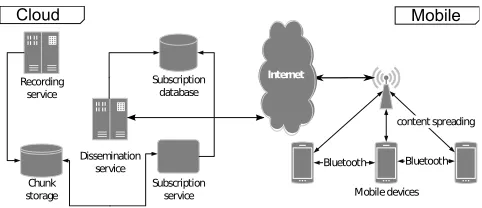
Figure 1: Schema of the cloud-based distribution system
2.1
Scenario
The system consists of a cloud component and a mobile com-ponent. A schema of the whole system is shown in Figure 1. The cloud part of the distribution system contains a media recording ser-vice, listening to online video streams on the Internet. Because mo-bile devices do not handle all video formats, the media recording service also converts the video content to a specific compression format and splits its length into fixed intervals. We refer to these short content files aschunks. The media recording service stores them afterwards in a cloud virtual drive called Chunk storage. A new mobile device can register to desired channels using the Sub-scription service, see Figure 1, and the channels per user are stored in the Subscription database.
We suppose that there areN users that are all subscribed to a common channel and want to fetch a content. In order to dissemi-nate each chunkkof the entire content, each data chunk is initially delivered tomkdevices, that spread it throughout the opportunistic network to devices without the chunk for a time periodT. When the timeThas passed, there arem′
kdevices without the data chunk yet. These devices request the chunk to the cloud. This allows for
guaranteed delaysof the content delivery and to use an application like video-streaming without interruptions in the service [4–6].
2.2
Dissemination service
The central component of the cloud is the Dissemination service. For each chunk, its main goal is to select themkdevices that will be used for initial content spread. The initial spreading time of chunk k tomk devices is denotedspread period, as shown in Figure 2. According to the specific strategy, the dissemination service might also provide additional information.
Once this injection from the cloud is concluded, the devices en-ter in thedissemination period, which is the timeTdesignated for D2D dissemination of the chunk to other devices. In this work, we use Bluetooth for D2D communication. Each mobile device tries to connect to another device within its Bluetooth proximity. In case of successful establishment of a connection, the two devices com-pare their lists of chunks that have been previously downloaded. In order to increase the transfer rate, the dissemination periods of dif-ferent chunks in a video sequence can overlap, so it is possible to share more than just the last chunk. The overlap of different chunks is shown in Figure 2. A random order for the delivery is defined for chunks present in only one of the two devices. The devices disconnect when there are no other chunks to be shared, or when their connection has been interrupted due to a communication fail-ure. Each chunk that has not be fully downloaded due to commu-nication failure is lost. Therefore, the size of the chunk should be sufficiently small to guarantee an efficient delivery, e.g. in presence of users with short contact durationδ. After that, both devices start searching for another device to connect to.
All deliveries from the cloud take place either before (mk deliv-eries) or after (m′
kdeliveries) the dissemination period. This has the
Spread Period Dissemination Period Panic Period Playback Legend
Tc
T
chunkk
chunkk+2
chunkk+3 chunkk+1
Figure 2: Timeline for content distribution. Each line repre-sents the distribution of one data chunk. Data is sent from the cloud during the spread period and the panic period, and from opportunistic D2D communication during the dissemina-tion periodT. The chunks’ dissemination period can overlap.
advantage of avoiding to monitor how information spreads during the dissemination period. We use the termdissemination deadline
to denote a point in time when the opportunistic dissemination ends for a particular chunkk. We refer to the time interval after the dissemination deadline aspanic period(see Figure 2), because the devices use their costly connection to download the chunk before its playback should start. The duration of the panic period has to be chosen to guarantee the delivery in the worst-case scenario of slow cellular connection to any of them′
kdevices.
Overall, the total number of data transmissions through cellular network isMk=mk+m′
k.We want to design a system architecture and strategies for deliveries that leverages the cloud to control the opportunistic dissemination. The goal is to reduce the traffic from the cellular network Mk as much as possible, while meeting the requirement that all the devices have received the content by the content’s deadlineTc, defined as the sum of the spread period, the dissemination periodTand the panic period (see Figure 2).
3.
INITIAL SPREADING STRATEGIES
In this work, we investigate two general types of strategies that aim to reduce the traffic load of cellular network:
● Initial spreading strategies: for each chunk, it decides how many (mk) and which devices should be selected for deliver-ies during the spread period (Section 3).
● Dissemination strategies: it determines when and which de-vices should establish D2D communication during the dis-semination period, and which data they should share (Sec-tion 4).
We start investigating three strategies to injectmk copies of the chuckkduring the spread period, which can be divided in strategies with and without cloud logic. In the strategy without cloud logic, we simply randomly selectmkdevices among the total set ofN de-vices. In the strategies with cloud logic, we randomly select themk devicesper each connected componentof the opportunistic network to avoid the problem that all the devices of one connected compo-nent may all need to download the chunk from the cloud during the panic period. The topology of the network is estimated by the cloud based on the feedbacks received by each node of the opportunistic network. The report of each user provides the list of other mobile devices that are visible in opportunistic range. Note that the set of devices chosen by the cloud for chunkk+1is independent of the set chosen for the previous chunkk.
Next, we describe how to select how many copies mk of the chunkkhave to be sent during the spread period.
3.1
Multi-armed bandit strategy
de-pending on the time of the day [9]. Therefore, the initial spreading strategy should selectmkaccording to the history of the content dis-tribution system. The first strategy we study in this work builds on the multi-armed bandit problem [10]. The multi-armed bandit prob-lem has found applications in diverse fields, such as control, eco-nomics, statistics, or learning theory. In the original multi-armed bandit problem a gambler faces a row of slot machines and has to decide which of theNmachines to play in each of a number of games. Each machine provides a random reward from a distribution specific to that machine. The gambler’s objective is to maximize the sum of the rewards earned through a sequence of lever pulls. More formally, letrk,1. . . ,rk,Nbe the rewards for each of theNlevers at roundk, andˆrkthe reward for the selected lever at roundk. Let also µ1, . . . ,µN be the mean values associated with reward distributions of theNlevers andµ∗=max
k{µk}the maximal reward mean. The regretρafterRrounds is defined asρ=Rµ∗− ∑R
k=1rˆk, that is, the difference between the reward sum associated with an optimal strat-egy and the sum of the collected rewards. A stratstrat-egy is defined “a zero-regret strategy”, when the average regret per roundρ/Rtends to zero with probability 1 when the number of played rounds tends to infinity.
We can identify an analogy between the multi-armed bandit prob-lem and our content distribution probprob-lem. The number of games in the multi-armed bandit problem corresponds to the number of data chunks in the content, as they both represent the number of rounds in the problem. The number of leversNcorresponds to the number of subscribed mobile devicesN. The gambler’s reward for chunk (round)kcan be defined as the offloading ratio
ˆ
rk= N−Mk
N saved by selecting the levermk.
We implement a content dissemination algorithm that is based on the Epsilon-greedy method to solve our multi-armed bandit prob-lem [10]. In this approach, the strategy will pickmkthat gives its maximal rewardrkˆ (according to the current gambler’s findings) for 1−єof the time (0<є<1), and another lever is randomly selected for a proportionє, which represents the likelihood of performing exploration moves. The algorithm then attempts to maximize the short-term reward based on current findings and to discover op-timal parameters for long-term rewards in future (exploration vs. exploitation trade-off). This method is shown to provide a good approximation of the optimal decision [11].
For the algorithmic implementation, the empirical expectation of the reward function formk is stored in a dedicated array as well as the certainty (confidence) on each value. The confidence for a value decreases in each round by an aging factorγ. Values close to the actualmk have the chance to be selected in proportion to their uncertainty. Therefore, the more uncertain we are about the correctness of a reward function, the more probable we will select the corresponding levermkfor the next round in exploration phase.
3.2
Initial / deadline balance
This second strategy considers that a large number of downloads after the dissemination deadline indicate insufficient initial spread of chunks by the cloud, and vice versa. Recording in the dissemi-nation service the number of chunks that were distributed in the last panic period, the objective of this strategy is to drive the system to the case wherethe number of data chunks injected from the cloud during the spread periodis approximately equal tothe number of chunks injected during the panic period, that ismk = m′
k. The-oretical justifications on the initial/deadline balance strategy can be derived simplifying the assumptions presented in [5] for sake of simplicity of the system implementation, modeling the pair-wise
contact event as an independent and memoryless Poisson process of rateλand describing the chunk dissemination during the dissemi-nation periodT as a pure finite-state birth process{S(t),t ≥0}1. For the selection ofmk with initial/deadline balance strategy, we implement an adaptive algorithm according to a control theoretic approach based on Proportional Integrator (PI) controller. In order to deliver one chunk, the controller monitors the system behavior (and in particular the output signalm′
k−mk) given the valuemk that is currently used. Based on this behavior, it decides whether to increase or decreasemkfor the next chunk in order to drive the sys-tem to the reference value zero2. The parametersKpandKi of the PI controller are chosen as a trade-off between a stable and reactive system, using Ziegler-Nichols rules [12] and imposing the stability constraint on the closed-loop gain.
3.3
Fixed ratio spread
Finally, a simple distribution strategy for initial spread is to de-livery the chunk to a fixed ratiom/N of theN subscribers. This strategy can also be implemented in scenarios that do not use dis-tribution logic in a cloud component (and thus client-only). In this case, at the beginning of the initial spread period per chunk, a mo-bile device downloads the chunk with given probability.
4.
DISSEMINATION STRATEGIES
We study three strategies to disseminate the content chucks dur-ing the dissemination period.
4.1
Client-only dissemination
After the initial spread period, each mobile device tries to con-nect to a random device within its Bluetooth proximity and down-load the missing chunks if available in the node in proximity. The client-only dissemination strategy uses the cloud only for down-loading the chunks, both in the spread and the panic periods.
4.2
Cloud-based dissemination
Former work did not consider that congestion can happen also in the D2D communication [3, 5, 6]. In this strategy, each mobile device reports to the cloud service every chunk downloaded from D2D dissemination. When a mobile device completes its scanning of nearby Bluetooth devices, it downloads a list of the available chunks per device from the Dissemination service in the cloud. This knowledge ensures that the mobile device avoids connecting to other mobile devices that have no chunks available for sharing.
4.3
Adaptive cloud-based dissemination
As a limitation of Bluetooth technology, a device cannot accept a Bluetooth connection while it is (a) trying to connect to another device, or (b) scanning for nearby devices. We then consider that, when either (a) or (b) is concluded, the device waits for a random-length interval t for other incoming connections before actively scanning, where t ∈ [t1,t2] and(t2−t1) is the listening period. In addition, this strategy reduces the frequency of communication attempts in cases there are too many connection failures, and that increases the random period when the devices are listening for in-coming connections. In the event of an unsuccessful Bluetooth connection attempt the strategy will increase the listening period (t2−t1)by the multiplication-factor parameterα. In the event of
1
This is a pure-birth Markov chain withN states, where stateSi corresponds to the case whereidevices have the chunk.
2Note that the selection ofm
kfor chunkkis based on the last avail-able feedback. Since we consider that the dissemination periods of chunks may overlap, this will be in general equal tom′
Table 1: Setting used in the experimental evaluation Parameters common to all strategies
Video compression MPEG
Video resolution 426×240pixels
Content’s deadline Tc=100sec Initial spread phase length 15sec
Dissemination period length T=55sec Panic period length 30sec
Playback time for each chunk 2−10sec
Average chunk size ≈500kB
Parameters specific to individual strategies
Default listening period t1=5sec; t2=15sec
Fixed spread ratio 25%
Adaptive factorα 1.15
Adaptive factorβ 0.95
Kp(Initial/deadline balance strategy) 0.2
Ki(Initial/deadline balance strategy) 0.1176
Aging factorγ(multi-bandit strategy) 0.9
a connection success, the strategy will decrease the listening period by the multiplication-factor parameterβ.
5.
SYSTEM IMPLEMENTATION
In this section, we introduce the implementation details of our cloud-controlled system for D2D content distribution.
5.1
Cloud services
All our cloud services are hosted in the Windows Azure envi-ronment. Applications for Microsoft Azure are written in C# using .NET libraries. The Recording service and the Dissemination ser-vice run as worker role instances. Chunk storage is implemented like cloud blob storage. We use Azure Mobile Services technology for the Subscription service, which allows us to use seamless inte-gration of cloud services into mobile client code with support from development tools. The subscription database is based on Azure SQL Database (the cloud version of the Microsoft SQL Server). A new device can register to desired video channels and the worker role of the Dissemination service is then notified about the new de-vice and its content requests. It will then consider the new dede-vice in its future deliveries.
5.2
Mobile devices
We implement a video streaming application that runs on HTC8S Windows Phone 8 mobile devices. We choose Windows for better integration with Windows Azure cloud service. For the purposes of this paper, we use Bluetooth 3.1 for D2D communication. The video in the application is transparent to the actual wireless inter-face used to receive the chunks. Note that Wi-Fi Direct has limited support at the time of writing with Windows Phone 8. The ap-plication handles initial D2D discovery and it can send signaling messages to the cloud, if requested by the strategy.
SignalingFor the strategies with cloud logic, signaling mech-anism is controlled by the mobile device. When a new chunk is available, the device queries the Azure Mobile Service. The reply will state whether the chunk should be downloaded immediately or not from the cloud during the spread period. In the latter case, the device will attempt to get the content during the dissemination pe-riod. In case the device has not received the chunk yet by the end of the dissemination period, it will make a new query to the Azure Mobile Service to request the chunk. Therefore, at least one query and up to two queries per chunk are performed.
Overall, the size of the signaling (up to400Bytes) is such that it is largely negligible for reasonable chunk sizes, such as the ones of video content. The request from the device to the cloud (D2C) starts with a Strategy field, which indicates the strategy used. The last bit of the Strategy field is a flag, indicating whether the device is in spread period or panic period. Next, there is the chunk ID that the device is querying for download (Request Chunk). If requested by the Dissemination strategy, it will further send the list of chunks downloaded by the devices and available for D2D communication (that is, currently in dissemination period, Dissemination Chunks) as well as the devices in D2D range (Nearby Devices).
The first field of the response from the Azure mobile service is the Strategy field. As in the request, the last bit of the Strategy field is a flag. For a response, the flag indicates whether the de-vice should download or not the chunk from the cloud. In case of positive reply, the uniform resource identifier (URI) is given to the chunk to identify the path in Chunk Storage (Chunk URI). If re-quested by the strategy and if the device did not indicate that it is in panic period, a list of nearby devices and their chunks can also be provided (Nearby Devices - Chunks per Device).
D2D communicationThe D2D communication is initiated by one device (device A) after an active scanning. In the event that a connection is successfully established, device A connects to an-other device (device B) which is in Bluetooth listening mode. The communication is composed by a handshake to exchange the set of chunks that are available and missing. The missing chunks in one device and available in the other device are exchanged according to a random order.
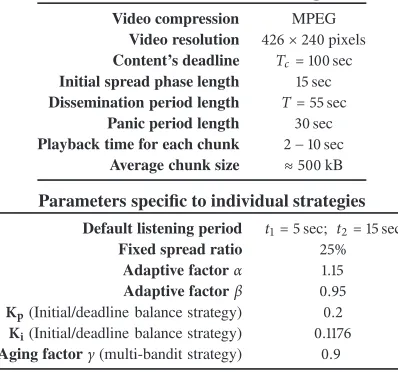
System settingThe main parameters are summarized in Table 1. In our implementation, we use a deadline ofTc =100sec. For the purpose of performance measurements, we use prerecorded video streams. This approach circumvents any problems with the stream-ing source and the reproducibility of the tests. We use prearranged chunk files in Chunk storage of up to500kB, with recording inter-val between2and10sec (The time per chunk is greatly depend-ing on the content of the chunk. Chunks with lively action de-plete very quickly 500kB of size). Therefore, multiple chunks may be exchanged during the dissemination opportunity interval ofT=55sec. The total video size is approximately50MB and the total number of chunks per video is99. The video is continuosly repeated once it is over. The total number of roundsRis equal to the total number of chunks of the entire experiment.
6.
EXPERIMENTAL EVALUATION
We perform two different types of evaluation, first using a con-trolled setup, and then measuring the performance with real users.
6.1
Automated testing system
In order to compare and evaluate the strategies described in Sec-tion 3 and 4, we implement an automated module that tests the performance of the Dissemination service. The module repeatedly sends a short video stream (10 minutes) to mobile devices. Af-ter each test, the module changes the dissemination strategy that is used, or its parameters. The module can also place a mobile phone temporarily outside the dissemination process for one test by sending a command to turn off its Bluetooth connection. This step enables measurements to be made for groups between2and16 phones. We run the experiments overnight to minimize the interfer-ence from other2.4GHz radio sources.
2 4 6 8 10 12 14 16 25
50 75
Number of devices
Saved Bandwidth [%]
Fixed ratio + Cloud−based Fixed ratio + Client−only Fixed ratio + Adaptive cloud−based Initial/deadline balance + Cloud−based Initial/deadline balance + Adaptive−cloud based Multi−armed bandit + Cloud−based Multi−armed bandit + Adaptive cloud−based
Figure 3: Comparison of saved bandwidth for different strate-gies. Each value is the average over three tests (each test is10
minutes long).
2 3 4 5 6 7 8 9 10 11 12 13 14 15 16
25 30 35 40 45 50 55 60
Number of devices
Congestion signal [%]
Client−only Cloud−based Adaptive cloud−based
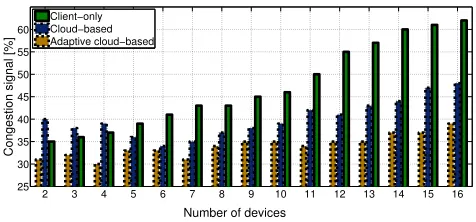
Figure 4: Congestion signals of D2D communication for the three different dissemination strategies.
the amount of data in byte downloaded over D2D communication over the total video size in byte downloaded for the video.
We first analyze the result of initial spreading strategy. As base-line strategy for the comparison, we usecloud-based dissemination
as dissemination strategy. Results of initial spread strategy in Fig-ure 3 show that multi-armed bandit strategy and the initial/deadline balance strategy achieve similar performance in terms of saved band-width. However, while the first one achieves slightly better perfor-mance for small number of devices in range, the opposite holds for higher number of devices. The reason why the initial/deadline balance strategy is slightly worst than expected is likely due to the fact that this strategy implicitly assume that transmission of a sin-gle chunk is instantaneous in both the cloud-to-device and the D2D communication [5]. In contrast, multi-armed bandit strategy does not rely on this assumption.
We further notice that a fixed ratio strategy achieves poor per-formance, and the performance decreases for more than12devices. This is because the bandwidth available for D2D communication becomes the bottleneck and thus more injections in absolute in the spread periods have only the effect to increase the failed attempts of D2D communication.
We then study the dissemination strategy, again referring to Fig-ure 3. As baseline for the comparison, we usefixed ratio spread
as initial spreading strategy and study which dissemination strat-egy helps to reduce the congestion of the D2D communication. We observe that cloud-based strategies outperforms the client-only one. Not shown in the figure, results with client-only get even worst with higher fixed spread ratio. For instance, using a fixed spread ratio of 50% rather than25%, we report31.43% of saved bandwidth with 16devices rather than36.66%. The best performing dissemination strategy is the adaptive cloud-based strategy, that can dynamically adjust the communication load of opportunistic network.
Finally, we compare the initial-deadline balance and multi-armed bandit, using the adaptive cloud-based as dissemination strategy.
0 20 40 60 80 100
0 0.2 0.4 0.6 0.8 1
Saved Bandwidth [%]
ECDF
ECDF using the Average Saved Bandwidth over Time
Experiment I Experiment II
0 20 40 60 80 100
0 0.2 0.4 0.6 0.8 1
Data from the Cloud [%]
ECDF
ECDF using the Average Data from Cloud per Device Experiment I
Experiment II
Figure 5: Comparison of Experiment I and Experiment II. On the left: ECDF of average saved bandwidth during the entire experiment. Each sample is the average saved bandwidth over a short time interval of≈15minutes. On the right: ECDF using the average data downloaded from the cloud per each device.
The plot in Figure 3 shows that the combination of multi-armed bandit and adaptive cloud-based strategies generally outperforms any other strategies, with up to71% of saved bandwidth.
We analyze in more details the performance loss for high num-ber of devices. We define the congestion signal as the numnum-ber (in percentage) of unsuccessful opportunistic connections between mo-bile devices over the total number of attempts. Figure 4 shows that a Client-only strategy is greatly affected by a very high rate of con-gestion signals for increasing number of devices. The consequence is that the devices are not able to download the chunk using D2D communication, despite there are devices in range with a copy of it. In contrast, the adaptive cloud strategy shows a quite stable level of congestion signal, which explains why it outperforms other strate-gies in terms of saved bandwidth.
6.2
Evaluation with real users
To evaluate our system in practical scenarios, we organize two experiments in different days with volunteers that carry a mobile device with our application. The volunteers work in the same floor and different offices, and they carry the mobile device all the time. In Experiment I, we have16volunteers. In Experiment II, we have 12volunteers. For Experiment I, we usefixed ratioas initial strategy andclient-onlyas dissemination strategy. For Experiment II, we use themulti-armed banditas initial spreading strategy and theadaptive cloud-based disseminationas dissemination strategy.
Both experiments are performed during working time when most of the volunteers are inside the building or in its proximity. The devices stream a video with a bit rate close to400kb/s (a usual bandwidth for a low-resolution YouTube video). The experiment attempts to emulate situations when multiple users want to access the same video content and may have the opportunity to be in D2D communication range with some of other volunteers. The users stay in the office or move according to their usual pattern.
9:00 10:00 11:00 12:00 13:00 14:00 15:00 16:00 17:00 25
30 35 40 45 50 55
Saved Bandwidth [%]
1.5 2 2.5 3 3.5 4 4.5
Time [h:m]
Devices in D2D range
Saved bandwidth Devices in D2D range
Figure 6: Bandwidth savings for Experiment II, and average number of nearby devices after Bluetooth scanning.
We then study the amount of data (in bytes) that each device downloads from the cloud over the total amount of data downloaded from both the cloud and D2D communication and compute how fair is the injection of chunks from the cloud using different strategies. For each device, we compute the average over the entire experi-ment, and plot the ECDF of data downloaded from the cloud on the right of Figure 5. We measure a Jain’s fairness index of0.989for Experiment I and0.967for Experiment II. This results show there is a fair access to the costly wireless network interface. Concluding, a cloud-based approach is preferable in terms of saved bandwidth and it comes at negligible cost in terms of fairness.
In Figure 6, we finally depict the saved bandwidth, and the av-erage number of nearby devices for Experiment II as a function of the time. The resulting saved bandwidth is39%on average and53% in two peak values at 10:45 and 13:45. The figure shows that the amount of saved bandwidth tends to increase and decrease accord-ing to the number of nearby devices in range, with a high Pearson correlation coefficient between the two variables of0.79. As a re-sult of this high correlation, we also observe that the strategy can adapt to variable conditions of the D2D network topology.
7.
RELATED WORK
The principles of cooperative techniques to disseminate content have been presented in [13], motivating that cooperation will be-come one of the key technologies enabling better cellular networks. The authors of [14, 15] studied a cooperative technique for oppor-tunistic podcast and feed distribution. However, they assumed that there is absence of cellular infrastructure, while we assume that this infrastructure exists, but the bandwidth does not suffice to dissemi-nate popular content to all the subscribed users. [16] described a co-operative video streaming architecture with mobile devices sharing a single access point and D2D connectivity. [17] allowed a single video content to be received by multiple mobile devices using mul-ticast from a common base station. Mulmul-ticast increases the cost of complexity of the cellular base station deployment and it requires that traffic is sent at lower rate [3]. Differently from these works, we design strategies to disseminate the content under dynamic condi-tions and variable D2D network topology and congestion, and test these strategies with experiments and cloud services.
MicroCast [3] introduced a system for cooperative video stream-ing usstream-ing cellular connection and Wi-Fi peer-to-peer connection. Their algorithm assigns the next segment of a video to be loaded to a phone which has the smallest set of segments to down-load from the cellular network. In our system, we consider prac-tical problems such as congestion of D2D communication, algo-rithms that can choose the exact number of devices such that the saved bandwidth is a high as possible, etc. [6] made a case study for cellular traffic offloading using opportunistic connections. They proposed heuristics to select the target set of users, in order to min-imize the cellular data traffic. [4, 5] studies through heuristics and analytical study, respectively, the problem of injecting copies of the
content to the users. However, none of those works looked at strate-gies for the distribution of D2D content during the dissemination period and the evaluation is solely done by means of simulations.
8.
CONCLUSION
We have implemented and experimentally evaluated a novel ar-chitecture to disseminate popular video content to subscribed users. We have experimentally shown that cloud logic can help to alleviate the saturation of cellular network traffic and that an initial spread-ing strategy based on multi-armed bandit problem provides high offloading opportunities. We envision that the inherent scalability properties of the cloud can allow to deploy multiple instances of the media recording service for a large number of requested me-dia streams and dynamically adapt the allocated network resources according to the number of subscribed users and the dynamics of D2D communication.
Acknowledgments
This work has been partially funded by Microsoft Innovation Clus-ter for Embedded Software (ICES) HyCloud project, and partially by the European Commission in the framework of the H2020-ICT-2014-2 project Flex5Gware (Grant agreement no. 671563). We thank Vincenzo Sciancalepore for his constructive feedbacks.
9.
REFERENCES
[1] “Cisco visual networking index: Global mobile data traffic forecast update, 2014–2019,” White Paper, Cisco, 2015.
[2] S. Y. Hui and K. H. Yeung, “Challenges in the migration to 4g mobile systems,”
Communications Magazine, IEEE, vol. 41, no. 12, pp. 54–59, 2003. [3] L. Keller, A. Le, B. Cici, H. Seferoglu, C. Fragouli, and A. Markopoulou,
“Microcast: cooperative video streaming on smartphones,” inProceedings of the 10th international conference on Mobile systems, applications, and services. ACM, 2012, pp. 57–70.
[4] J. Whitbeck, M. Amorim, Y. Lopez, J. Leguay, and V. Conan, “Relieving the wireless infrastructure: When opportunistic networks meet guaranteed delays,” inProceedings of IEEE WoWMoM, 2011.
[5] V. Sciancalepore, D. Giustiniano, A. Banchs, and A. Picu, “Offloading cellular traffic through opportunistic communications: Analysis and optimization,”
Accepted for publication at IEEE Journal on Selected Areas in Communications, 2015.
[6] B. Han, P. Hui, V. Kumar, M. V. Marathe, G. Pei, and A. Srinivasan, “Cellular traffic offloading through opportunistic communications: a case study,” in
Proceedings of the 5th ACM workshop on Challenged networks. ACM, 2010, pp. 31–38.
[7] S. Ioannidis, A. Chaintreau, and L. Massoulie, “Optimal and scalable distribution of content updates over a mobile social network,” inProceedings of IEEE INFOCOM, 2009.
[8] B. Han, P. Hui, V. A. Kumar, M. V. Marathe, G. Pei, and A. Srinivasan, “Cellular traffic offloading through opportunistic communications: A Case Study,” inProceedings of ACM CHANTS, 2010.
[9] A. Chaintreau, P. Hui, J. Crowcroft, C. Diot, R. Gass, and J. Scott, “Impact of human mobility on opportunistic forwarding algorithms,”Mobile Computing, IEEE Transactions on, vol. 6, no. 6, pp. 606–620, June 2007.
[10] R. Sutton and A. Barto,Reinforcement learning: An introduction. Cambridge Univ Press, 1998, vol. 1, no. 1.
[11] S. Bubeck and N. Cesa-Bianchi, “Regret analysis of stochastic and nonstochastic multi-armed bandit problems,”CoRR, vol. abs/1204.5721, 2012. [Online]. Available: http://arxiv.org/abs/1204.5721
[12] G. F. Franklin, J. D. Powell, and M. L. Workman,Digital Control of Dynamic Systems, 2nd ed. Addison-Wesley, 1990.
[13] F. H. Fitzek and M. D. Katz,Cooperation in wireless networks: Principles and applications. Springer, 2006.
[14] V. Lenders, G. Karlsson, and M. May, “Wireless ad hoc podcasting,” inSensor, Mesh and Ad Hoc Communications and Networks, 2007. SECON’07. 4th Annual IEEE Communications Society Conference on. IEEE, 2007, pp. 273–283.
[15] G. Karlsson, V. Lenders, and M. May, “Delay-tolerant broadcasting,”
Broadcasting, IEEE Transactions on, vol. 53, no. 1, pp. 369–381, 2007. [16] M. Ramadan, L. El Zein, and Z. Dawy, “Implementation and evaluation of
cooperative video streaming for mobile devices,” inPersonal, Indoor and Mobile Radio Communications, 2008. PIMRC 2008. IEEE 19th International Symposium on. IEEE, 2008, pp. 1–5.