https://doi.org/10.5194/amt-11-2151-2018 © Author(s) 2018. This work is distributed under the Creative Commons Attribution 3.0 License.
Computational efficiency for the surface renewal method
Jason Kelley and Chad Higgins
Dept. of Biological and Ecological Engineering, Oregon State University, 116 Gilmore Hall, Corvallis, OR 97333, USA Correspondence:Jason Kelley ([email protected])
Received: 20 April 2017 – Discussion started: 1 June 2017
Revised: 5 March 2018 – Accepted: 15 March 2018 – Published: 16 April 2018
Abstract. Measuring surface fluxes using the surface re-newal (SR) method requires programmatic algorithms for tabulation, algebraic calculation, and data quality control. A number of different methods have been published describ-ing automated calibration of SR parameters. Because the SR method utilizes high-frequency (10 Hz+)measurements, some steps in the flux calculation are computationally expen-sive, especially when automating SR to perform many itera-tions of these calculaitera-tions. Several new algorithms were writ-ten that perform the required calculations more efficiently and rapidly, and that tested for sensitivity to length of flux averaging period, ability to measure over a large range of lag timescales, and overall computational efficiency. These al-gorithms utilize signal processing techniques and algebraic simplifications that demonstrate simple modifications that dramatically improve computational efficiency. The results here complement efforts by other authors to standardize a ro-bust and accurate computational SR method. Increased speed of computation time grants flexibility to implementing the SR method, opening new avenues for SR to be used in re-search, for applied monitoring, and in novel field deploy-ments.
1 Introduction
Originally described by Van Atta (1977), the SR model mea-sures vertical flux that occurs during rapid events which man-ifest as coherent structures in a turbulent flow. The physi-cal mechanisms are statistiphysi-cally distinct from those described in the eddy covariance (EC) method, which has been estab-lished as a robust and accurate method to measure flux (Bal-docchi, 2014). The surface renewal (SR) method offers sev-eral advantages and complements the use of EC to measure flux. While EC requires fast (10 Hz+)measurement of both
the vertical wind speed and air temperature to measure the sensible heat flux, the SR method does not explicitly require vertical wind speed, allowing flux to be determined solely from rapid measurements of temperature or other scalar con-centrations. Because fewer, lower-cost sensors are required, the SR method theoretically can be used for general applied monitoring (Paw U et al., 2005; Spano et al., 2000). Another advantage of SR is the ability to measure flux very near the surface or near the top of the plant canopy (Katul et al., 1996; Paw U et al., 1992). By taking measurements very close to the surface, the measurement fetch is reduced and the effec-tive “flux footprint” is smaller (Castellví, 2012), yielding a more localized flux estimate.
im-plementations and other novel field methods could provide new insights into the complexities of sub-basin-scale hydrol-ogy, be used to validate downscaled models, and measure the heterogeneity of flux at sub-field scales.
The implementation of SR requires a prescribed averag-ing time period (on the order of minutes) and ramp time du-ration (on the order of seconds), for which a representative and statistically robust flux magnitude can be determined. To implement SR on a moving vehicle (for instance, to map spatially variable flux), finding a minimum averaging time is desirable to increase the spatial resolution of the result-ing map. The averagresult-ing time and lag time used in the SR method relate the sensitivity of the scalar measurement to the timescales at which most significant flux occurs (Shap-land et al., 2014). To find the minimum measurement period, field studies were conducted in 2014 and 2015 over various types of surface conditions. This required a rapid computa-tional method that worked over a range of different time av-eraging periods, and which could implement the various cal-ibration procedures used in the SR method. Initial attempts to calculate flux followed methods as described by Paw U et al. (2005) and Snyder et al. (2008). However, implementing these methods as documented was hampered by slow compu-tation time, which constrained the many iterations required to determine the minimum flux averaging period.
Open-source software and online forums are abound with methods that utilize advances in computing power, memory availability, and the accessibility of multithreaded process-ing. These methods reduce computational overhead, and can augment the SR technique to allow implementation with low-cost computers and data loggers, or where remote telemetry is required. Three example methods are shown here which streamline specific operational steps in the SR method. The first is a method adapted from signal processing to “despike” noisy data, a quality control technique commonly used in processing raw meteorological data. Second is a method to compute structure functions over multiple time lags rapidly using convolution in two dimensions. Third, an algebraic ar-ray calculation is used to find the cubic polynomials roots used to determine the SR ramp amplitude. By using more ef-ficient algorithms, rapid iterative trials can be conducted to adjust calibration parameters, test hypotheses on the time av-eraging of flux calculations, and potentially measure SR flux in real time.
Advantages such as low-cost, relatively simple instrumen-tation, and easier field implementation are all cited as mo-tivating factors to use the SR method (Paw U et al., 2005), yet work remains to standardize a robust method (French et al., 2012; Suvoˇcarev et al., 2014). Because sensor cost is reduced, SR systems can be implemented to measure flux more extensively than EC, and in situations where EC is impractical. Extensive, site-specific SR estimates can aug-ment the utility of sparsely located, permanent weather sta-tions in mapping the heterogeneity of surface flux. Examples of situations which could benefit from low-cost flux
mea-surements include direct crop ET monitoring, experiments at remote field sites, and developing regions. While SR may expand flux measurement applications, the method still re-quires standardized calibration and quality control measures to establish that SR is robust and accurate, and a critical step in developing the method is to reduce computation costs.
2 Methods
The example algorithms shown here improve or economize existing calculation methods, including despiking of time se-ries data (Højstrup, 1993; Starkenburg et al., 2016), calcu-lation of structure functions (Antonia and Van Atta, 1978), and Fourier analysis of signals, i.e., spectral analysis (Press, 2007; Stull, 1988). In each case, dramatically faster execu-tion times were accomplished using simple programming im-provements. Most efficiency gains were a result of code vec-torization, which is the conversion of iterative looping algo-rithms into array calculations. All methods described here were implemented in the MATLAB language (The Math-works Inc., 2016), with the Statistics, Curve Fitting, and Signal Analysis toolboxes. MATLAB’s Profiler (profile.m) was used to track the memory demand and time to imple-ment calculations. Trials were conducted on multiple desk-top systems; for uniformity, analysis shown here only used test runs that were conducted on a Windows 10 operating system running on an Intel Core™i7-3720QM processor op-erating at 2.60 GHz with 16 GB of RAM. Processor clock speed was verified using MATLAB’s Profiler tool at run time, and processing times reported are described as run time (ac-tual observed execution time) or as total run time, which is the sum of CPU time for all calculation threads. Example methods are indicated byfunction namein italics. Abbrevi-ated, commented scripts for the example functions are pro-vided in the Supplement. Example data were collected dur-ing various field experiments from 2014–2017, usdur-ing an in-tegrated sonic anemometer and infrared gas analyzer (IR-GASON) and fine wire thermocouples (FWTs), and were recorded at 10, 20, and 100 Hz using a CR1000 data log-ger (Campbell Scientific). The data used in verifying the methods are provided through supplementary materials on-line (https://doi.org/10.7267/N9X34VDS).
Figure 1. The total computation time is the sum of CPU time spent on all calculation threads. Triangles mark the mean run time for multiple runs, which varied from 30 runs (15 min–4 h data) to 10 runs (8, 12, 24 h). The 48 h calculation is represented by one run only. Error bars represent 1 standard deviation of all runs.
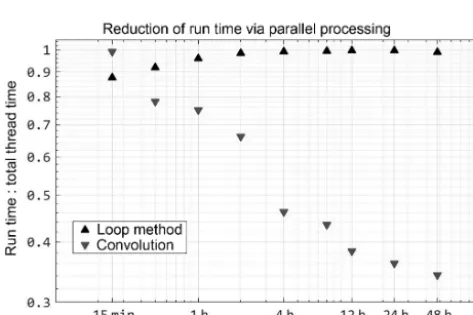
Figure 2.Fast calculation of larger data sets is due to implicit paral-lel processing via the FFT, which is readily performed by multiple simultaneous threads. The efficiency of parallel processing is shown by a lower ratio of run time to total thread time.
of these methods are particular to the MATLAB language, the general mathematical concepts are universal. Although these methods were prototyped in MATLAB, the examples shown are generally useful as solutions to challenges com-monly encountered in micrometeorology.
2.1 Despiking of noisy data using convolution
Despiking is the removal of erroneous or extreme data points from a time series of sampled values. It is a common pro-cedure when measuring environmental parameters, espe-cially in challenging conditions or complex environments
(Göckede et al., 2004; Starkenburg et al., 2016). The origin of spikes in a time series may be electronic or physical (sensor malfunction or actual physical non-errors); regardless of the origin, spikes can be recorded as abnormally large or small values, or may be marked by an error flag defined in the firmware. Spikes become problematic if they are not read-ily differentiated during automatic data imports (Rebmann et al., 2012). Spikes interfere with statistical calculations, and require some deliberate and objective method to identify, re-move, and interpolate where they exist. For instance, a data logger program may record an error as “9999” or a charac-ter string, while MATLAB denotes missing values in a nu-merical array as NaN (“not a number”). Because normally distributed data may contain noise in a wide range of values, robustness of the despiking algorithm is complicated by the requirement to differentiate between “hard spikes” charac-teristic of automatic flags (such as 9999) and “soft spikes”, which are realistically valued but erroneous measurement. An objective limit for soft spikes is usually defined as ap-propriate for the signal-to-noise ratio of any particular data, usually in terms of variance during a defined windowing pe-riod. Clearly distinguishing errors can be achieved by a static objective criteria, by a dynamic statistic, or in a separate pre-processing operation. Previous authors have described a va-riety of methods including use of autocorrelation (Højstrup, 1993) and statistics within a moving window (Vickers and Mahrt, 1997). A comprehensive review of despiking meth-ods is presented by Starkenburg et al. (2016), with emphasis on the accuracy and statistical robustness of different com-putation methods.
pro-gram average run time was 27 s. Using convolution, the sec-ond program average run time was 0.2 s, decreasing run time by approximately 99 %. While this drastic improvement may potentially overemphasize slow compile times of for loops in MATLAB (compared to other languages), it nonetheless demonstrates the value of the FFT in calculations with time domain signals. Faster processing time facilitates more com-prehensive, calibrated, and accurate analysis, and can reduce data loss compared to coarser filtering techniques.
To test computation time uniformly, identical 10 Hz data were sub-sampled to record lengths of 0.25 to 48 h, and mul-tiple runs were despiked with each sample set. Raw data were checked for hard error flags which required converting text to number values. Data were not otherwise manipulated prior to despiking. MATLAB Profiler was used to track the run time for all threads, using the undocumented flag “built-in” to track pre-compiled MATLAB functions as well as user functions,1. The total run time for all threads was tabulated and averaged across sets of each data length (Fig. 1). By us-ing convolution, despikus-ing was 2 orders of magnitude faster for all lengths of data. To illustrate the effect of MATLAB’s built-in parallel processes, Fig. 2 shows the ratio of actual run time to total run time, indicating that the convolution method relies on computations conducted in parallel for processing increasingly longer data records. This benefit is directly ac-crued from the efficiency of the FFT.
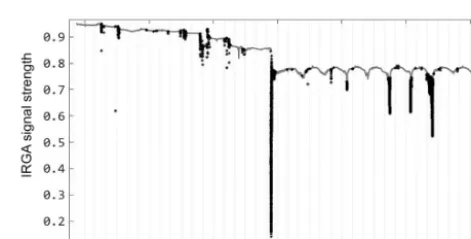
With increased computation speed, automatic and accu-rate despiking can be accomplished, with reduced time cost to determine any necessary calibrate for the procedure. The various methods employed to despike data are variously lim-ited by computational inefficiency (Starkenburg et al., 2016). “Phase space thresholding”, originally described by Goring and Nikora (2002), is one such method that Starkenburg noted as being hampered by computational costs, and by a re-quirement for iterative applications to calibrate despiking pa-rameters. By decreasing the execution time, a similar method was developed that allows rapid and accurate despiking of data, for the detection of both hard and soft spikes. A phase space method allows objective criteria to be calibrated for specific sensor data, and a visual diagnostic phase space dia-gram that allows for rapid calibration of the despiking criteria (Fig. 3). Projecting the signal into a phase space diagram re-veals modes related to sensor error, response time, and other factors leading to spikes. Using convolution to determine moving window statistics (such as a moving mean, standard deviation), objective identification of behaviors characteris-tic to a parcharacteris-ticular sensor response. In Fig. 3, infrared gas ana-lyzer data (in this case, signal strength) collected at 20 Hz for 17 days are projected with 1 min moving window statistics. Based on this projection, a cut-off in phase space for spike identification can be assigned, and the subsequent percent-age of removed data calculated. In this case, the sensor was
1http://undocumentedmatlab.com/blog/
undocumented-profiler-options-part-4 last access: January 2017
Figure 3.Phase space diagram showing moving window statistics of IRGA signal (17 days of 20 Hz data).
Figure 4.Time series showing data removed as spikes (bolded) from phase space criteria in Fig. 3.
repeatedly affected by dust from farm operations (Fig. 4), yet only 1.5 % of the data were required to be removed as spikes due to the precision of the despiking algorithm. This proce-dure took less than 5 s of computation.
2.2 Structure function calculation
The general form for a structure function is
Sn(r)= 1 N−r
i=N−r X
1
[T (i+r)−T (i)]n, (1)
in which a vector of lengthN−1 is composed of differences between sequential (temperature) samplesT (i), separated by lag r. The structure functionSn(r) of order n for a given sample lagr is obtained by raising the difference vector to thenpower, summing the vector and normalizing byN−1. In a turbulent flow field, the sampled fluctuations of scalar time series1T (i)are a combination of random fluctuations and coherent structures (Van Atta and Park, 1972). The ran-dom (incoherent) part of the signal is a product of isotropic turbulent processes, and over an adequately large sample this sample should have no particular directional sense or orienta-tion (by the isotropic definiorienta-tion). On the other hand, coherent structures generate characteristic anisotropic signatures, with periods of gradually change punctuated by sharp transitions. These sharp transitions occur during “sweeps and ejections” of parcels enriched or depleted in scalar concentration (heat or water trace gas), evidence of transport from an Eulerian perspective. Structure functions can be used to decompose the time series fluctuations into isotropic and anisotropic components and identify the characteristic ramp amplitude and duration of coherent structures (Van Atta, 1977). Ad-vances in sensor response time and processor speed have re-vealed an increasingly detailed picture of the coherent ramp structures. In deriving a method to find ramp geometry, Van Atta (1977) calculated structure functions for eight different lags. Two decades later, increased processor power and mem-ory size allowed Snyder et al. (1996) to calculate structure functions on 8 Hz data for lags from 0.25 to 1.0 s, but they were unable to resolve fluxes accurately at some measure-ment heights and surface roughness conditions. Later it was realized that determining the contributions from “imperfect ramp geometry” would require more thorough examination of ramp durations (Chen et al., 1997a; Paw U et al., 2005).
For this analysis, data were used from several field ex-periments. The data records used ranged in length from 8 h to over 2 months, with sampling frequencies of 10, 20, and 100 Hz (fastest frequency for short duration trials only). Initially, computation of structure functions with the first method (series of nested for loops) for 3 min periods with lags up to 10 s required an average 39 s computation time. In contrast, using the convolution method, this same cal-culation was accomplished in 7.6 s, an∼80 % reduction in execution time. The function strfnc.m(provided in Supple-ment, Sect. S1) also simultaneously time stamps the averag-ing period, finds the sign ofS3(r)(used to find flux direc-tion), and indexes the maximized value ofS3(r)/r, prepar-ing the data for subsequent steps in determinprepar-ing flux. Usprepar-ing 100 Hz FWT data increased processing time using the convo-lution method to 38.4 s. The loop method would be unable to process 100 Hz data in real-time applications, and would
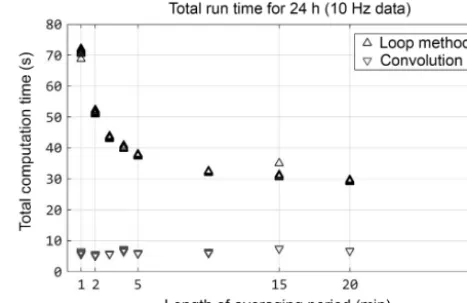
re-Figure 5.Ten iterations of the structure function calculations using a range of averaging periods.
quire long calculation time when using large continuous data records.
For a total ofN sample lags, two-dimensional convolu-tion is performed using a filter matrix which is composed of N column vectors of length N+1:[1−1000],[10−100], [1000.−1]. Each column represents a sample lag increasing distance. When the filter matrix is convolved with time se-ries data, the column vectors of the resulting matrix are vec-tors of the element-wise differences(T (i+r)−T (i))as in Eq. (1); these vectors correspond to each sample lag in the filter. Trials of 10 Hz data using MATLAB’s Profiler showed that calculation efficiency is not accrued directly from con-volution, but by changing the order of implementation. In the looping method, exponentiation (n=2,3,5) is conducted on the difference vectors for each lag separately. The accelerated exponentiation instrfnc.mis possible by using matrix multi-plication on the convolved matrix, and is faster due to com-pact memory allocation of the FFT. The resulting efficiency (calculation time for a given data size) does not depend on total data size, but is strongly dependent on the length of the averaging period used to partition the data (Fig. 5). In other words, the choice of averaging period length is the most sig-nificant factor in computation time of the maximized struc-ture functions used to determine ramp geometry. Computa-tion time increases rapidly for periods shorter than 5 min. The length of averaging time is a critical consideration in developing a rapid SR measurement method.
In most SR studies to determine flux, a lag time is assigned to the structure function calculation, with only a few authors allowing for a procedure to maximize the ratioS3(r)/r (Sha-pland et al., 2014). Yet lag time has been identified as a crit-ical parameter in the linear calibration of ramp geometry to calculate flux (French et al., 2012).
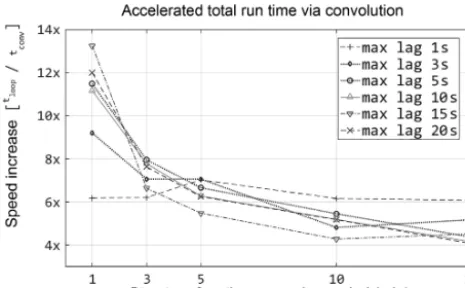
Figure 6.The performance gains using convolution are more signif-icant for short averaging periods, regardless of maximum lag used in calculating structure functions.
broad range of stability conditions, a short maximum lag (3– 5 s) is usually adequate under unstable conditions. Following the model of parcel residence time, this is likely a result of buoyancy and higher flux magnitude leading to shorter ramp duration. Under stable conditions, though, longer lags are re-quired to detect the true maximum of the ratio S3(r)/r, in-dicating that the timescale contributing to flux increases. To evaluate sensitivity to the maximum calculated lag, the struc-ture functions were calculated iteratively, varying the averag-ing period and maximum tested lag time (Fig. 6). Regardless of the length of the assigned range of lags, the convolution method was between 4 and 14×faster than the loop method, with short averaging periods again the largest factor in the difference between the two methods. Using the 2-D convolu-tion, automated selection of a lag in a continuous time series is feasible.
2.3 Cardano’s method for depressed cubic polynomials For the idealized SR method, the structure functions are re-tained (for each averaging period) for the lag which maxi-mizes the ratioS3(r)/r– this lag is associated with the the-oretical maximum contributing scale of flux. The resulting values are used as coefficients in a cubic polynomial, the root of which is the ramp amplitude (A) used to calculate flux:
A3 +
10S2(r)−S
5(r)
S3(r)
A + 10S3(r)=0. (2) The magnitude of the real root (of 3 possible roots) is the characteristic ramp amplitude of the scalar trace (Spano et al., 1997). The MATLAB root-finding algorithm computes eigenvalues of a companion matrix to approximate the solu-tion to anth-order polynomial, regarding the input function as a vector with n+1 elements (roots.mdocumentation2).
2http://www.mathworks.com/help/matlab/ref/roots.html, last
access: 9 August 2016
Consequently, this function cannot be executed directly on an array. On the other hand, an algebraic solution method can be applied to vectors. An appropriate method for this type of cubic polynomial was found by Gerolamo Cardano in the 1545Ars Magna. Cardano’s solution for “depressed” cubics (with no squared term) is found by substituting A with (m1/3+n1/3)into the abbreviated equationA3+pA+q=0. Expanding terms and using the quadratic equation yields an exact solution:
A= −q
2+
r q
2
2 +p
3
3 !13
+ −q
2−
r q
2
2 +p
3
3 !13
, (3)
wherep andq are coefficients in the depressed cubic and derived from the structure functions (Edwards and Beaver, 2015). The function cardanos.mwas adapted from a func-tion by Bruno Luong,3, in a reduced form for the real-valued cases used to implement the SR method. The function output was verified against the MATLAB functionroots.mfor poly-nomials with both positive and negative real valued inputs (imaginary inputs are applicable to ramp parameters). Solu-tion for the real roots in this manner expedites determinaSolu-tion of flux magnitude and direction. The algebraic root-finding method simplifies and speeds iterative application of the SR method by operating directly on arrays.
Solving for the roots of this function yields a single, pre-dominant ramp amplitude from a given temperature trace (with units of◦C or K). In addition to ramp amplitude, the timescale or ramp duration must also be determined. Van Atta (1977) suggested that ramp timeτ should be related lin-early to amplitudeAand proposed
τ = −A
3r
S3(r). (4)
In practice, determination of ramp timeτ fromAusing this equation requires an empirical calibration; this calibration has been shown to be related to surface conditions and instru-mentation (Chen et al., 1997b; Shapland et al., 2014). Ongo-ing work usOngo-ing replicate measurements at multiple heights (Castellvi, 2004) and frequency response calibration (Shap-land et al., 2014; Suvoˇcarev et al., 2014) has begun to resolve the causes of variability in this parameter. In this study, it was found that the ratio in Eq. (4) remains essentially constant for a given surface roughness condition, allowing determination ofτ algebraically. Automated computation of Eq. (2) using the exact solution facilitates rapid evaluation of the ramp ge-ometry, and determining flux magnitude from ramp geometry is a relatively simple matter of linear scaling when calibrat-ing to a control measure such as eddy covariance.
3https://de.mathworks.com/matlabcentral/fileexchange/
3 Conclusions
As with other methods for measuring flux from the surface, analytic solutions do not always translate easily into straight-forward numerical computation, especially when working with large data records or when calculating in real time. In applied research, custom algorithms are often developed by individual researchers, requiring special training in program-ming, significant time investment, and the motivation to use sophisticated techniques that fully utilize available memory and processing power. Efforts to standardize the eddy co-variance method (Aubinet et al., 2012; Baldocchi, 2014) and data quality control (Allen et al., 2011; Foken et al., 2012) have not yet been similarly applied to the SR method, al-though substantial work has been made to validate and unify SR methods (Castellví, 2012; Chen et al., 1997b; French et al., 2012; Suvoˇcarev et al., 2014). By appropriating methods common in signal processing, and by sharing open-source tools on online forums, more sophisticated approaches can be implemented. In particular, reducing the computational overhead of calculating flux enables broad implementation and robust verification of the SR method. Rapid algorithms allow for automated assignment of lag time, rather than fixed assignment, and allow flux determinations while varying the length of flux averaging periods. These procedures allow for comprehensive analysis of both the physical timescales of surfaces flux, and the sensor response and uncertainty associ-ated with the SR derived flux. Calibration of despiking crite-ria can be implemented quickly at low computational cost. In summary, efficient methods for computing SR flux allow im-plementation in novel deployments such as low-cost, contin-uous monitoring and on moving platforms. Future work re-mains to transfer efficient methods from the MATLAB devel-opment platform to opsource implementations, and to en-able hardware to perform these techniques directly for real-time applications. Reducing the cost and power requirement of the required data loggers, computers, and telemetry will facilitate the extensive deployment of SR sensors to aid in describing the heterogeneity of flux across the landscape.
Data availability. All data used in this analysis and scripts im-plementing the algorithms described above are available online at https://doi.org/10.7267/N9X34VDS (Kelley, 2017).
Abbreviated scripts for the three example methods may be found in the Supplement. Requests for phase space despiking methods can be directed to the corresponding author.
Supplement. The supplement related to this article is available online at: https://doi.org/10.5194/amt-11-2151-2018-supplement.
Competing interests. The authors declare that they have no conflict of interest.
Acknowledgements. The authors would like to acknowledge the contributions of Bruno Luong, whose function for Cardano’s solution to depressed cubic polynomials we adapted for this analysis.
Edited by: Andrew Sayer
Reviewed by: three anonymous referees
References
Allen, R., Pereira, L. S., Howell, T. A., and Jensen, M. E.: Evap-otranspiration information reporting: I. Factors governing mea-surement accuracy, Agr. Water Manage., 98, 899–920, 2011. Altman, Y.: Accelerating Matlab Performance, CRC Press, 2015. Antonia, R. A. and Van Atta, C. W.: Structure functions of
tem-perature fluctuations in turbulent shear flows, J. Fluid Mech., 84, 561–580, 1978.
Aubinet, M., Vesala, T., and Papale, D.: Eddy covariance: a practi-cal guide to measurement and data analysis, Springer Science & Business Media, 2012.
Baldocchi, D.: Measuring fluxes of trace gases and energy between ecosystems and the atmosphere–the state and future of the eddy covariance method, Glob. Change Biol., 20, 3600–3609, 2014. Castellvi, F.: Combining surface renewal analysis and similarity
theory: a new approach for estimating sensible heat flux, Water Resour. Res., 40, https://doi.org/10.1029/2003WR002677, 2004. Castellví, F.: Fetch requirements using surface renewal analy-sis for estimating scalar surface fluxes from measurements in the inertial sublayer, Agr. Forest Meteorol., 152, 233–239, https://doi.org/10.1016/j.agrformet.2011.10.004, 2012.
Castellví, F., Perez, P. J., and Ibañez, M.: A method based on high-frequency temperature measurements to estimate the sensible heat flux avoiding the height dependence, Water Resour. Res., 38, 20-1–20-9, 2002.
Chen, W., Novak, M., Black, T. A., and Lee, X.: Co-herent eddies and temperature structure functions for three contrasting surfaces. Part I: Ramp model with fi-nite microfront time, Bound.-Lay. Meteorol., 84, 99–124, https://doi.org/10.1023/A:1000338817250, 1997a.
Chen, W., Novak, M., Black, T. A., and Lee, X.: Coher-ent eddies and temperature structure functions for three contrasting surfaces. Part II: Renewal model for sen-sible heat flux, Bound.-Lay. Meteorol., 84, 125–147, https://doi.org/10.1023/A:1000342918158, 1997b.
Edwards, A. C. and Beaver, J. M.: Investigating Cardano’s Irreducible Case, Proceedings of the National Confer-ence on Undergraduate Research (NCUR) 2015, Eastern Washington University, April 16–18 2015, available at: http://www.ncurproceedings.org/ojs/index.php/NCUR2015/ article/view/1478 (last access: 9 April 2018), 2015.
Foken, T., Leuning, R., Oncley, S. R., Mauder, M., and Aubinet, M.: Corrections and data quality control, Eddy Covariance, 85–131, Springer, 2012.
an advective irrigated agricultural site, Adv. Water Resour., 50, 91–105, https://doi.org/10.1016/j.advwatres.2012.07.007, 2012. Gao, W. and Li, B. L.: Wavelet analysis of coherent structures at the
atmosphere-forest interface, J. Appl. Meteorol., 32, 1717–1725, 1993.
Gao, W., Shaw, R. H., and Paw U, K. T.: Observation of organized structure in turbulent flow within and above a forest canopy, Bound.-Lay. Meteorol., 47, 349–377, 1989.
Göckede, M., Rebmann, C., and Foken, T.: A combination of qual-ity assessment tools for eddy covariance measurements with footprint modelling for the characterisation of complex sites, Agr. Forest Meteorol., 127, 175–188, 2004.
Goring, D. G. and Nikora, V. I.: Despiking Acoustic Doppler Velocimeter Data, J. Hydraul. Eng., 128, 117–126, https://doi.org/10.1061/(ASCE)0733-9429(2002)128:1(117), 2002.
Højstrup, J.: A statistical data screening procedure, Meas. Sci. Tech-nol., 4, 153–157, https://doi.org/10.1088/0957-0233/4/2/003, 1993.
Katul, G., Hsieh, C.-I., Oren, R., Ellsworth, D., and Phillips, N.: Latent and sensible heat flux predictions from a uniform pine forest using surface renewal and flux variance methods, Bound.-Lay. Meteorol., 80, 249–282, 1996.
Katul, G., Porporato, A., Cava, D., and Siqueira, M.: An analysis of intermittency, scaling, and surface renewal in atmospheric sur-face layer turbulence, Physica D, 215, 117–126, 2006.
Kelley, J.: Demonstration data for computational effi-ciency in surface renewal analysis, OSU Libraries, https://doi.org/10.7267/N9X34VDS, 2017.
Paw U, K. T., Brunet, Y., Collineau, S., Shaw, R. H., Maitani, T., Qiu, J., and Hipps, L.: On coherent structures in turbulence above and within agricultural plant canopies, Agr. Forest Meteorol., 61, 55–68, https://doi.org/10.1016/0168-1923(92)90025-Y, 1992. Paw U, K. T., Qiu, J., Su, H.-B., Watanabe, T., and Brunet, Y.:
Sur-face renewal analysis: a new method to obtain scalar fluxes, Agr. Forest Meteorol., 74, 119–137, https://doi.org/10.1016/0168-1923(94)02182-J, 1995.
Paw U, K. T., Snyder, R. L., Spano, D., and Su, H.-B.: Surface Renewal Estimates of Scalar Exchange, in Mi-crometeorology in Agricultural Systems, American Soci-ety of Agronomy, Crop Science SociSoci-ety of America, and Soil Science Society of America, Madison, WI, 455–483, https://doi.org/10.2134/agronmonogr47.c20, 2005.
Press, W. H. (Ed.): Numerical recipes: the art of scientific comput-ing, 3rd Edn., Cambridge University Press, Cambridge, UK, New York, 2007.
Rebmann, C., Kolle, O., Heinesch, B., Queck, R., Ibrom, A., and Aubinet, M.: Data acquisition and flux calculations, Eddy Co-variance, 59–83, Springer, 2012.
Shapland, T. M., McElrone, A. J., Snyder, R. L., and Paw U, K. T.: Structure Function Analysis of Two-Scale Scalar Ramps. Part I: Theory and Modelling, Bound.-Lay. Meteorol., 145, 5–25, https://doi.org/10.1007/s10546-012-9742-5, 2012a.
Shapland, T. M., McElrone, A. J., Snyder, R. L., and Paw U, K. T.: Structure Function Analysis of Two-Scale Scalar Ramps. Part II: Ramp Characteristics and Surface Re-newal Flux Estimation, Bound.-Lay. Meteorol., 145, 27–44, https://doi.org/10.1007/s10546-012-9740-7, 2012b.
Shapland, T. M., Snyder, R. L., Paw U, K. T., and McEl-rone, A. J.: Thermocouple frequency response compen-sation leads to convergence of the surface renewal al-pha calibration, Agr. Forest Meteorol., 189–190, 36–47, https://doi.org/10.1016/j.agrformet.2014.01.008, 2014.
Shaw, R. H. and Gao, W.: Detection of temperature ramps and flow structures at a deciduous forest site, Agr. Forest Meteorol., 47, 123–138, 1989.
Snyder, R. L., Spano, D., and Pawu, K. T.: Surface renewal analysis for sensible and latent heat flux density, Bound.-Lay. Meteorol., 77, 249–266, 1996.
Snyder, R. L., Spano, D., Duce, P., Paw U, K. T., and Rivera, M.: Surface renewal estimation of pasture evapotranspiration, J. Irrig. Drain. E., 134, 716–721, 2008.
Spano, D., Snyder, R. L., Duce, P., and Paw U, K. T.: Surface re-newal analysis for sensible heat flux density using structure func-tions, Agr. Forest Meteorol., 86, 259–271, 1997.
Spano, D., Snyder, R. L., and Duce, P.: Estimating sensible and la-tent heat flux densities from grapevine canopies using surface renewal, Agr. Forest Meteorol., 104, 171–183, 2000.
Starkenburg, D., Metzger, S., Fochesatto, G. J., Alfieri, J. G., Gens, R., Prakash, A., and Cristóbal, J.: Assessment of Despiking Methods for Turbulence Data in Micrometeorology, J. Atmos. Ocean. Tech., 33, 2001–2013, https://doi.org/10.1175/JTECH-D-15-0154.1, 2016.
Stull, R. B.: An introduction to boundary layer meteorology, Springer, 1988.
Suvoˇcarev, K., Shapland, T. M., Snyder, R. L., and Martínez-Cob, A.: Surface renewal performance to independently estimate sen-sible and latent heat fluxes in heterogeneous crop surfaces, J. Hy-drol., 509, 83–93, https://doi.org/10.1016/j.jhydrol.2013.11.025, 2014.
The Mathworks Inc.: Matlab R2016b, The MathWorks Inc., Natick, MA, 2016.
Van Atta, C. W.: Effect of coherent structures on structure functions of temperature in the atmospheric boundary layer, Arch. Mech., 29, 161–171, 1977.
Van Atta, C. W. and Park, J.: Statistical self-similarity and inertial subrange turbulence, in: Statistical Models and Turbulence, 402– 426, Springer, 1972.