The Thirty-Third AAAI Conference on Artificial Intelligence (AAAI-19)
Tracking Logical Difference in
Large-Scale Ontologies: A Forgetting-Based Approach
Yizheng Zhao
The University of Manchester, UK
Ghadah Alghamdi
The University of Manchester, UKRenate A. Schmidt
The University of Manchester, UKHao Feng
North China University of Science & Technology, ChinaGiorgos Stoilos
Babylon Health, UKDamir Juric
Babylon Health, UKMohammad Khodadadi
Babylon Health, UKAbstract
This paper explores how the logical difference between two ontologies can be tracked using a forgetting-based or uniform interpolation (UI)-based approach. The idea is that rather than computing all entailments of one ontology not entailed by the other ontology, which would be computationally infeasi-ble, only the strongest entailments not entailed in the other ontology are computed. To overcome drawbacks of exist-ing forgettexist-ing/uniform interpolation tools we introduce a new forgetting method designed for the task of computing the logical difference between different versions of large-scale ontologies. The method is sound and terminating, and can compute uniform interpolants forALC-ontologies as large as SNOMED CT and NCIt. Our evaluation shows that the method can achieve considerably better success rates (>90%) and provides a feasible approach to computing the logical dif-ference in large-scale ontologies, as a case study on different versions of SNOMED CT and NCIt ontologies shows.
Introduction
Ontologies are widely deployed and used to give structured representations of domain knowledge suitable for AI rea-soning and have become increasingly popular across nu-merous industry sectors, including medical, digital biology and energy sectors. In this paper we are concerned with the problem of tracking the changes between different versions of an ontology, which can be done based on the notion of
logical difference. The logical difference between two on-tologies are the axioms in one that are not entailed by the other, reflecting the information gained and information lost between the ontologies (Konev, Walther, and Wolter 2008; Konev et al. 2012).
From the perspective of ontology engineers, tracking the differences of large-scale ontologies is a critical task for the purpose of maintaining them: to track what has changed in a new version of an ontology, to ensure that the extension is safe in the sense of being a conservative extension (Lutz, Walther, and Wolter 2007), and to identify gained and lost information (Klein et al. 2002). This provides a means of discovering issues in the ontologies and enhance quality control, which is important for ontology curators. Being able
Copyright c2019, Association for the Advancement of Artificial Intelligence (www.aaai.org). All rights reserved.
to compute logical difference between ontologies is also im-portant when merging/aligning/integrating different ontolo-gies (Jim´enez-Ruiz et al. 2011; Solimando, Jim´enez-Ruiz, and Guerrini 2017; Stoilos et al. 2018).
At present most existing ontology difference tools and ontology alignment/merging tools are only able to compute thestructural differences(Noy and Musen 2002; Gonc¸alves, Parsia, and Sattler 2012) or to approximate the logical difference (Konev et al. 2012; Jim´enez-Ruiz et al. 2011; Kremen, Smid, and Kouba 2011; Solimando, Jim´enez-Ruiz, and Guerrini 2017). A particular challenge is the size of ontologies used in real-world applications. Our target are SNOMED CT and NCIt ontologies. Being the most com-prehensive, multi-lingual medical ontology in the world, the core SNOMED CT ontology contains over 335K concepts definitions (Spackman 2000). The NCIt ontologies define terminologies in the biomedical domain and include more than 60K concept definitions (Hartel et al. 2005).
Some Basics of Description Logic
ALC
In this paper the focus is on the description logicALC. Con-ceptsinALChave one of the following forms:> | ⊥ |A| ¬C|CuD|CtD| ∃r.C| ∀r.C,
whereA ∈NCdenoteconcept names,r ∈NRdenoterole
names, andCandDdenote arbitrary concepts. We assume anALC-ontology contains only a TBox, i.e., a set of axioms of the formC v D (concept inclusions), where CandD are concepts. The semantics ofALCis defined as usual.
Let us fix some commonly used notation. By sigC(X) andsigR(X)we denote respectively the sets of the concept names and role names occurring inX, whereXranges over concepts, clauses, axioms, sets of clauses and sets of axioms (ontologies). We letsig(X) =sigC(X)∪sigR(X). A clause is called anS-clauseif it containsS, whereS ∈NC∪NR.
Logical Difference via Forgetting
The notion of logical difference used in this paper was in-troduced by (Konev, Walther, and Wolter 2008) as a means of capturing the difference in the meaning of terms that is independent of the representation of ontologies.
Definition 1(Logical Difference forALC). LetO1andO2
be two ALC-ontologies. LetΣ = sig(O1)∩sig(O2) be
the common signature ofO1andO2. Thelogical difference
between O1 and O2 is the set Diff(O1,O2) of all ALC
-axioms α such that (i) sig(α) ⊆ Σ, (ii) O2 |= α, but
(iii) O1 6|= α. An axiomαsatisfying these conditions is a
witnessof a change inO2with respect toO1. Ifα∈ O2we
call it anexplicit witness, else it is animplicit witness.
We notice thatDiff(O1,O2)computesinformation gain
fromO1toO2, orinformation lossfromO2toO1.
To compute all witnesses inDiff(O1,O2)it is necessary to
derive all entailments of the second ontology (satisfying the signature restriction) which are not entailed by the first on-tology. In general, this set is however infinite. Existing log-ical difference tools compute therefore only approximations of the difference set. Many methods compute only witnesses that are simple inclusions of the form A v B (Jim´enez-Ruiz et al. 2011; Gonc¸alves, Parsia, and Sattler 2012; Kremen, Smid, and Kouba 2011) or also inclusions of a formA v ∃r.B(Stoilos et al. 2018), where AandB de-note concept names and ris a role name inΣ. Tools like ECCO (Gonc¸alves, Parsia, and Sattler 2012) can only find explicit witnesses, i.e., witnessesαsuch thatα ∈ O2 and
O16|=α, but not implicit ones.
A finite representation ofDiff(O1,O2)can be computed
using a uniform interpolation-based approach.
Definition 2(Uniform Interpolation forALC). LetObe anALC-ontology andΣ⊆sig(O)be a set of concept and role names. An ontologyV is anALC-uniform interpolant
ofOforΣiff the following conditions hold: (i)sig(V)⊆Σ and (ii) for anyALC-axiomαwithsig(α)⊆Σ,V |=αiff O |=α.Σis called theinterpolation signature.
Uniform interpolants are strongest entailments. By defi-nition,V is a strongest entailment ofO, ifO |=V and for any ontologyV0 such thatO |= V0 andsig(V0) ⊆Σthen
V |= V0. In general it can be shown that: V is a uniform
interpolant of an ontologyO forΣiffV is a strongest en-tailment of OinΣ. Uniform interpolants are unique up to logical equivalence.
Logical difference can therefore be related to uniform in-terpolation as follows: Diff(O1,O2) = ∅ iff O1 |= V2,
whereV2is a uniform interpolant ofO2forΣ =sig(O1)∩
sig(O2), the common signature ofO1andO2. IfO16|=V2,
this means thatDiff(O1,O2)is non-empty. Then every
ax-iomα∈ V2withO16|=αis a witness ofDiff(O1,O2).
The idea of our method is to compute a uniform inter-polantV2ofO2for the common symbols inΣand take the
witnesses from this (Ludwig and Konev 2014).
Definition 3(UI Difference forALC). LetO1andO2be
twoALC-ontologies. Let Σ = sig(O1)∩sig(O2)be the
common signature of O1 and O2. The UI difference
be-tween O1 andO2 is the set UI-Diff(O1,O2)of all ALC
-axiom α such that (i) sig(α) ⊆ Σ, (ii) α ∈ V2 and
(iii)O16|=α, whereV2is a uniform interpolant ofO2forΣ.
αis referred to aUI-witnessof a change inO2with respect
toO1.
Since any α ∈ V2 is an entailment of O2, every
UI-witness is a UI-witness and UI-Diff(O1,O2) ⊆ Diff(O1,O2).
Since all the witnesses can in principle be computed from the deductive closure of aΣ-uniform interpolantV2ofO2,
we can think ofUI-Diff(O1,O2)as a representation of the
setDiff(O1,O2). ForALC,UI-Diff(O1,O2)is in fact a
fi-niterepresentation of the witnesses, which is crucial (possi-bly involving auxiliary symbols).
From these considerations it follows that the set of UI-witnesses can be computed by this two step algorithm:
Step (1): compute the uniform interpolant V2 of O2 for
Σ =sig(O1)∩sig(O2), and then
Step (2): collect the axiomsα∈ V2not entailed byO1.
The first step can be performed using an uniform interpo-lation tool, the second step can be done using an external DL reasoner. As a third step it may be useful to partition the (UI-)witnesses into explicit and implicit (UI-)witnesses.
Interpolating an ontologyOfor a signatureΣamounts to capturing the information inOthat involves only the names inΣ. This is realized byforgettingfromOthe names that do not belong toΣ(Koopmann 2015; Ludwig and Konev 2014). Uniform interpolation is therefore also referred to as
(deductive) forgettingof the names inF=sig(O)\Σ. This means the uniform interpolant does not contain names inF. In the case of logical difference, the signature to be forgotten is the setF =sig(O2)\sig(O1).
The following very simple example illustrates the main notions in our approach. Consider the ontologies
O1={AvB, CvE}, and
O2={AvB, CvE, BvC, F vC, AvF}
with common symbolsΣ ={A, B, C, E}. The logical dif-ference is the set
To compute the UI difference we forgetF ={F}fromO2
to get the uniform interpolantV2={AvB, C vE, Bv
C, AvC}. Eliminating the axioms inferred byO1we get
UI-Diff(O1,O2) ={B vC, AvC}.
We can view these as the strongest witnesses gained fromO1
toO2.B vCis an explicit witness because it is an axiom
inO2, whileAvCis an implicit (inferred) witness. Since
the problem is Boolean, the logical difference has a finite representation, and other methods using a generate-and-test approach can compute the difference set. Our method guar-antees a finite UI-based logical difference is found for all ALC-ontologies, thus presenting a general method to track the difference ofALC-ontologies.
Drawbacks of Existing Forgetting Tools
Practical tools for forgetting include FAME 1.0 (Zhao and Schmidt 2018a), LETHE(Koopmann 2015) and the tool de-veloped by (Ludwig and Konev 2014). For several reasons these tools, in their present form, have not been found suited for the logical difference task.FAME1.0 is a Java-based implementation of a forgetting method developed in the work of (Zhao and Schmidt 2015; 2016). The method computessemantic solutionsof forget-ting for the description logicALCOIH. While the tool has proved to be very fast and thus might have been a good op-tion to realize Step (1) of the logical difference algorithm — using FAME1.0, forgetting solutions could be computed within seconds in more than 70% of the test cases (Zhao and Schmidt 2018a) — experimental results have shown that there are at least two reasons why FAME 1.0 is not best suited for the task. One reason is that extra expressivity may be required to capture semantic solutions of forgetting; of-ten the witnesses are expressed using operators not in the language of the given ontologies, and were found to be syn-tactically complex and intuitively unreadable.
In particular, our evaluation of FAME1.0 on different ver-sions of the SNOMED CT and NCIt ontologies showed that the computed forgetting solutions contained a large number of deeply nested axioms of the formCv ∀r−.∃s.D,
involv-ing the inverse role operator, which is not part ofALC. A more critical reason is that semantic solutions of forget-ting do not always exist forALC-ontologies, even for only acyclic cases or with extended expressivity (Konev et al. 2013). This is different from uniform interpolation, where using fixpoints or auxiliary concept definers, uniform in-terpolants can always be found for ALC (Koopmann and Schmidt 2013), whereas semantic solutions do not always exist forALC, even with extra expressivity in the target lan-guage. This means that FAME1.0 is incomplete, and there are forgetting problems where FAME 1.0 is unable to find a solution. For these cases, the ‘witnesses’ identified by an external DL reasoner from the forgetting solution are not those as desired, as they may contain newly introduced de-finer names that do not belong to the common signature of the given two ontologies.
LETHE and the tool developed by (Ludwig and Konev 2014) use resolution-based methods to compute uniform in-terpolants forALCTBoxes, and in the case of LETHE, also
several extensions ofALCTBoxes (Koopmann and Schmidt 2013; 2014; Koopmann 2015). Since ALC does not have the uniform interpolation property (Lutz and Wolter 2011), LETHEincorporates fixpoints in the target language to en-sure that the uniform interpolants can always be finitely rep-resented, and the tool developed by (Ludwig and Konev 2014) solves the problem by adapting a depth-bounded ver-sion of its core algorithm. While these make the tools (uni-form interpolation) complete for ALC-ontologies, it has been found that neither of them can be used for the log-ical difference problem. A current drawback of LETHE is lack of speed and inability to handle very large ontologies. A preliminary comparison of LETHEand a previous version of FAME1.0 showed that LETHEwas considerably slower than FAME 1.0 (Alassaf and Schmidt 2017). A casual test showed that LETHEcould not handle ontologies as large as SNOMED CT and NCIt, getting stuck in the forgetting loop. We conjecture that this is because LETHEintroduces definer names1in a systematic and exhaustive manner, which often leads to an exponential explosion of axioms in the forgetting process; see (Koopmann 2015) for a comprehensive analysis of this plus examples.
Problems with the tool of (Ludwig and Konev 2014), be-sides not being as fast as FAME 1.0 either, include that the tool can only eliminate concept names, but not role names, and only depth-bounded uniform interpolants are computed although this did not seem to have been a restriction in the authors’ evaluation.
Our Method for Computing Uniform
Interpolants for
ALC
-Ontologies
In this section, we introduce a new method designed to com-pute uniform interpolants for very largeALC-ontologies. It contains two main ingredients: a calculus for concept name elimination and a calculus for role name elimination. Both operate on axioms in clausal normal form.2
Calculus for Concept Name Elimination
The calculus for eliminating a concept nameA∈ sigC(N) from a setN of clauses includes three types of rules: a pair of purify rules, a pair of Ackermann rules, and a combina-tion rule. Thepurify rulesstate that, ifN is positive (nega-tive) w.r.t.A, thenAis eliminated by replacing every occur-rence ofAinN by>(⊥). This is referred to aspurification. Let thepivotbe the name inFunder current consideration for forgetting. TheAckermann rulesare:
N(A−), α1tA, ..., αntA (premises)
N(A−)A
¬α1t...t¬αn (conclusion)
(1)
N(A),¬Atα1, ...,¬Atαn (premises)
N(A)Aα
1u...uαn (conclusion)
(2)
1
Definer namesare fresh concept names introduced to facilitate the normalization of an ontology (Koopmann and Schmidt 2013).
2
whereA∈NC is the pivot, theαi (1 ≤ i ≤ n) are con-cepts that do not containA,N(A+)(N(A−)) denotes the
clause setN being positive (negative) w.r.t.A, andNA α de-notes the clause set obtained fromN by substitutingαfor every occurrence ofAinN. The Ackermann rules replace the axioms above the line, namely thepremises, by those un-der the line, namely theconclusion. The rules are applicable (toN to eliminateA) iffN has the form as above, which, however, is not always the case.
The purify rules and the Ackermann rules preserve se-mantic equivalence up to the remaining names; details and a proof of this can be found in (Zhao 2018). This means the conclusions of these rules are uniform interpolants ofOfor sig(O)\{A}.
LETHEand the tool of (Ludwig and Konev 2014) do not use the Ackermann rules for concept name elimination, but it has been found in many cases that, in order to eliminate a concept name, LETHEneeds to introduce many auxiliary definer names, whereas our method can apply directly the Ackermann rules.
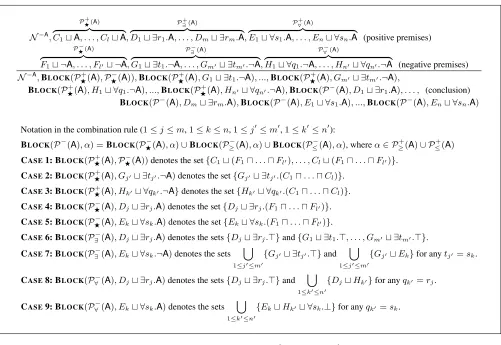
IfAis notpurifiable(i.e., cannot be eliminated by purifi-cation) or cannot be eliminated using the Ackermann rules, it is attempted to be eliminated using thecombination rule, shown in Figure 1. The combination rule is applicable (toN to eliminateA) iffN is inA-reduced form.
Definition 4(A-Reduced Form). LetA∈NCbe the pivot.
A clause is in A-reduced formif it is of the form CtA, Ct ¬A,Ct ∃r.A,Ct ∃r.¬A,Ct ∀r.AorCt ∀r.¬A, wherer∈NRis any role name andCis a clause that does
not containA. A setN of clauses is in A-reduced formif everyA-clause inN is inA-reduced form.
TheA-reduced formgeneralizes all basic forms in which a concept nameA∈NCcould occur;Acould occur (either positively or negatively) at the top level of a clause, or under a∃-restriction or a∀-restriction. Given a setN of clauses, not everyA-clause inN is inA-reduced form; anA-clause not inA-reduced form has the formCt ∃r.DorCt ∀r.D, wherer∈NRis a role name, (i)Cis a clause that contains A, or (ii)D6=Ais a concept that containsA. AnA-clause (not inA-reduced form) can be transformed intoA-reduced form using definer names: LetND⊂NCbe a set of definer names disjoint fromsigC(N). Definer names are introduced as substitutes, incrementally replacing ‘C’ and ‘D’ in every A-clause not inA-reduced form until (i) and (ii) do not hold. A new clause¬DdtC(¬DdtD) is added toN for each replacedC(D), whereDd∈NDis a fresh definer.
LetN be a set of clauses inA-reduced form. We use the notationPF+(A)andPF−(A)to denote the sets of the clauses of the formC tAandCt ¬A, respectively. We use the notationP+
∃(A)andP −
∃(A)to denote the sets of the clauses
of the formCt ∃r.AandCt ∃r.¬A, respectively. We use the notation P+
∀(A) andP −
∀(A)to denote the sets of the
clauses of the formCt ∀r.AandCt ∀r.¬A, respectively. ByN−A(−r)we denote the set of clauses that do not contain
A(r). ByP+(A)we denote the union ofP+
F(A),P
+ ∃(A)
andP∀+(A)(positive premises), and byP−(A)the union of
PF−(A),P∃−(A)andP∀−(A)(negative premises).
As with the Ackermann rules, the combination rule is a replacement rule that replaces the premises by its conclu-sion. The idea is to combine all positive premises P+(A)
with every negative premiseα∈ P−(A)(or to combine all
negative premisesP−(A)with every positive premiseα∈
P+(A)). The result of each combination is a set of clauses
that does not containA, denoted byBLOCK(P+(A), α)(or BLOCK(P−(A), α)). The conclusion of the rule, which is also the solution of forgetting{A}fromN, is the union of the results obtained from each combination.
Lemma 1. The combination rule in Figure 1 preserves all logical consequences up to the names insig(N)\{A}.
Proof. The idea of the combination in Cases 1, 2, 3, 4 and 5 is basically that of Rules (1) and (2). The result in Case 6 follows directly from the premises. We prove Case 7 (Case 8 can be proved similarly). Assume a domain elementdhas a t-successor not satisfyingAand a domain elementd0has all itss-successors satisfyingA, ift = s, thendandd0 must be different elements. We prove Case 9. Assume a domain element dhas all its s-successors satisfying Aand has all itsq-successors not satisfyingA, ifs=q, then it has all its s-successors satisfying⊥.
Theorem 1. The calculus for concept elimination is sound.
This follows from soundness of the purify and the Acker-mann rules, Lemma 1 and Lemma 2 stated below.
Calculus for Role Name Elimination
The calculus used by our method for eliminating a role name r∈sigR(N)from a clause setN includes onecombination rule, shown in Figure 2. The combination rule is applicable (toN to eliminater) iffN is inr-reduced form.
Definition 5(r-Reduced Form). Letr ∈NRbe the pivot.
A clause is inr-reduced formif it is of the formCt ∃r.Dor Ct ∀r.D, whereC(D) is a clause (concept) that does not containr. A setN of clauses is inr-reduced formif every r-clause inN is inr-reduced form.
Ther-reduced formgeneralizes all basic forms in which a role namer ∈ NRcould occur;rcould occur under a∃ -restriction or a∀-restriction. Anr-clause is not inr-reduced form if ‘C’ or ‘D’ containsr. It can be transformed intor -reduced form using definer names as well: definer names are used as substitutes, incrementally replacing ‘C’ and ‘D’ in everyr-clause not in r-reduced form neither of them con-tainsr. A new clause¬DdtC(¬DdtD) is added toN for each replacedC(D), whereDd∈NDis a fresh definer.
Lemma 2. Using the definer name introduction, any setN of ALC-clauses can be transformed into A- orr-reduced form. The transformation is polynomial and preserves all logical consequences up tosig(N)\{A}orsig(N)\{r}.
Proof. Definer name introduction is basically the standard structural transformation, which is polynomial.
N−A
,
P+
F(A)
z }| {
C1tA, . . . , CltA,
P+ ∃(A)
z }| {
D1t ∃r1.A, . . . , Dmt ∃rm.A,
P+ ∀(A)
z }| {
E1t ∀s1.A, . . . , Ent ∀sn.A (positive premises) P−
F(A)
z }| {
F1t ¬A, . . . , Fl0t ¬A,
P∃−(A)
z }| {
G1t ∃t1.¬A, . . . , Gm0t ∃tm0.¬A,
P∀−(A)
z }| {
H1t ∀q1.¬A, . . . , Hn0t ∀qn0.¬A (negative premises)
N−A
,BLOCK(P+ F(A),P
−
F(A)),BLOCK(P +
F(A), G1t ∃t1.¬A), ...,BLOCK(P +
F(A), Gm0t ∃tm0.¬A),
BLOCK(P+
F(A), H1t ∀q1.¬A), ...,BLOCK(PF+(A), Hn0t ∀qn0.¬A),BLOCK(P−(A), D1t ∃r1.A), . . . , (conclusion)
BLOCK(P−
(A), Dmt ∃rm.A),BLOCK(P−(A), E1t ∀s1.A), ...,BLOCK(P−(A), Ent ∀sn.A)
Notation in the combination rule (1≤j≤m,1≤k≤n,1≤j0≤m0,1≤k0≤n0):
BLOCK(P−(A), α) =BLOCK(PF−(A), α)∪BLOCK(P≥−(A), α)∪BLOCK(P −
≤(A), α), whereα∈ P
+
≥(A)∪ P
+
≤(A)
CASE1: BLOCK(PF+(A),PF−(A))denotes the set{C1t(F1u. . .uFl0), . . . , Clt(F1u. . .uFl0)}.
CASE2: BLOCK(P+
F(A), Gj0t ∃tj0.¬A)denotes the set{Gj0t ∃tj0.(C1u. . .uCl)}.
CASE3: BLOCK(P+
F(A), Hk0t ∀qk0.¬A}denotes the set{Hk0t ∀qk0.(C1u. . .uCl)}.
CASE4: BLOCK(PF−(A), Djt ∃rj.A)denotes the set{Djt ∃rj.(F1u. . .uFl0)}.
CASE5: BLOCK(PF−(A), Ekt ∀sk.A)denotes the set{Ekt ∀sk.(F1u. . .uFl0)}.
CASE6: BLOCK(P∃−(A), Djt ∃rj.A)denotes the sets{Djt ∃rj.>}and{G1t ∃t1.>, . . . , Gm0t ∃tm0.>}.
CASE7: BLOCK(P∃−(A), Ekt ∀sk.¬A)denotes the sets
[
1≤j0≤m0
{Gj0t ∃tj0.>}and
[
1≤j0≤m0
{Gj0tEk}for anytj0=sk.
CASE8: BLOCK(P∀−(A), Djt ∃rj.A)denotes the sets{Djt ∃rj.>}and
[
1≤k0≤n0
{DjtHk0}for anyqk0=rj.
CASE9: BLOCK(P∀−(A), Ekt ∀sk.A)denotes the sets
[
1≤k0≤n0
{EktHk0t ∀sk.⊥}for anyqk0 =sk.
Figure 1: The combination rule for eliminatingA∈sigC(N)from a setN of clauses inA-reduced form
Lemma 3. The combination rule in Figure 2 preserves all logical consequences up to the names insig(N)\{r}.
Proof. Same proof as for Cases 7 and 8 in Lemma 1.
Theorem 2. The calculus for role elimination is sound.
Proof. This follows from Lemmas 2 and 3.
The Forgetting Process
Theinputto the forgetting method are a setFRof role names to be forgotten, a setFCof concept names to be forgotten, and a setclsofALC-clauses from which the names inFR and FC are to be eliminated. If a concept (role) name is successfully eliminated fromcls, immediately it is removed fromFC(FR); otherwise it remains inFC(FR).
Theforgetting processin the method consists of the con-cept forgetting process and the role forgetting process. Our method defaults to performing role forgetting first, because then the definer names introduced during the role forgetting process can be eliminated as part of subsequent concept for-getting; otherwise the method may need to perform concept forgetting again (to eliminate the definer names possibly in-troduced in the previous role forgetting). Therole forgetting processis an iteration of several elimination rounds in each
of which a role name inFRis eliminated using the calculus for role name elimination, as described above.
N−r
,
P+(r)
z }| {
C1t ∃r.D1, . . . , Cmt ∃r.Dm, P−(r)
z }| {
E1t ∀r.F1, . . . , Ent ∀r.Fn
N−r
,BLOCK(P−
(r), C1t ∃r.D1), . . . ,
BLOCK(P−(r), Cmt ∃r.Dm)
BLOCK(P−(r), Cit ∃r.Di)denotes the union of the following sets (1≤i≤m):
1st-tier: [
1≤j≤n
{CitEj}, for anyFjs.t.DiuFjv ⊥.
2nd-tier: [
1≤j1≤j2≤m
{CitEj1tEj2}, for anyFj1,Fj2s.t.DiuFj1uFj2v ⊥.
. . .
nth-tier:{CitE1t · · · tEn}, ifDiuF1u · · · uFnv ⊥.
Figure 2: The combination rule for eliminatingr∈sigR(N)from a setN of clauses inr-reduced form
become empty, i.e., all concept names inFChave been elim-inated fromcls.
Definer names, if introduced, are eliminated in exactly the same way as concept names inFCexcept that definer elimi-nation is not always successful; it may fail when the original ontology contains cyclic dependencies over the forgetting signature; see (Zhao 2018) for an example. Cyclic cases can however be solved using fixpoints, but since fixpoints are not compatible with the OWL API and are at present not supported by mainstream tools, we do not include them in the target language for practicality of our method. Without fixpoints, definer names would be infinitely introduced. Our method guarantees termination of cyclic cases by examining whether the axioms in the intermediary resulting set have identical syntactic patterns as those in the given one. If so, the method terminates immediately. The following theorem states termination and soundness of the method (as a conse-quence of Theorems 1 and 2).
Theorem 3. Given anyALC-ontologyOand any forgetting signatureF ⊆sig(O), our method always terminates and returns a finite setO0of axioms. IfO0does not contain any
introduced definer names, then our method issuccessfuland O0is anALC-uniform interpolantofOforsig(O)\F.
Crucial to the method are a set of equivalence-preserving simplification rules. These rules are applied throughout the forgetting process, ensuring that the clauses are always sim-pler representations, and no redundant clauses would be present in the forgetting solutions.
Evaluation of the Method
In order to investigate the practicality of our method, we implemented a prototype in Java using the OWL API Ver-sion 3.5.63and evaluated it on a snapshot of the NCBO
Bio-Portal repository4 taken in March 2017 (Matentzoglu and Parsia 2017), containing 396 OWL API compatible ontolo-gies. The corpus was previously used for the evaluation of FAME1.0 in the work of (Zhao and Schmidt 2018a) where statistical information about these ontologies can be found.
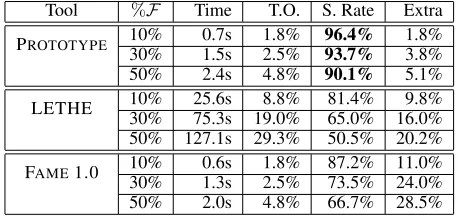
The prototype was evaluated for three settings: forget-ting 10% (199), 30% (597) and 50% (995) of concept and role names in the signature of each ontology. We compared
3
https://github.com/owlcs/owlapi 4
https://bioportal.bioontology.org/
the obtained results with those computed by LETHE and FAME 1.0. The names to be forgotten were randomly se-lected. The experiments were run on a desktop computer with an Intel Core i7-4790 processor, four cores running at up to 3.60 GHz, and 8 GB of DDR3-1600 MHz RAM. The experiments were run 10 times on each ontology and we av-eraged the results in order to verify the accuracy of our find-ings. A timeout of 1000 seconds was imposed on each run.
Tool %F Time T.O. S. Rate Extra
10% 0.7s 1.8% 96.4% 1.8% PROTOTYPE
30% 1.5s 2.5% 93.7% 3.8% 50% 2.4s 4.8% 90.1% 5.1%
10% 25.6s 8.8% 81.4% 9.8%
LETHE
30% 75.3s 19.0% 65.0% 16.0%
50% 127.1s 29.3% 50.5% 20.2%
10% 0.6s 1.8% 87.2% 11.0%
FAME1.0
30% 1.3s 2.5% 73.5% 24.0%
50% 2.0s 4.8% 66.7% 28.5%
Table 1: Results computed by our prototype, LETHE and FAME1.0. (T.O.: Timeout, S. Rate: Success Rate)
The results obtained from the experiments are shown in Table 1. What is striking about the numbers in the table is that our prototype had considerably better success rates (>90%) over LETHE and FAME 1.0, whose success rates stayed between 50.5%–81.4% and 66.7%–87.2%, respec-tively.5 As for speed, it can be seen that our prototype was comparable to FAME 1.0. LETHEwas however struggling with speed; it was on average 50 times slower than other tools. LETHE’s success rates were significantly affected by its speed; a large portion of its failures was due to the time-out. The column headed ‘Extra’ shows the percentages of cases where forgetting solutions contained undesired names or extra expressivity, i.e., FAME 1.0 introduced nominals to express semantic solutions, LETHEused fixpoint opera-tors and our prototype used definer names to capture cyclic dependencies. What was unexpected is that forgetting so-lutions containing undesired names occurred rarely for our
5
prototype, yet it occurred fairly frequently for LETHE, but these tools are supposed to show similar behaviour in this respect. This remains to be further investigated.
Logical Difference Case Study
In this section, we study how our prototype performs in prac-tice for the forgetting task in the logical difference problem. Specifically, we used the prototype to compute the uniform interpolantV2ofO2for the common signature of two given
ontologiesO1andO2that are being compared, and we used
the DL reasoner Hermit (Glimm et al. 2014) to check if an axiomα ∈ V is a witness ofUI-Diff(O1,O2). To simplify
the entire process, we implemented a tailor-made tool that integrated both our prototype for forgetting and HermiT for entailment checking. Theinputof the tool are two ontolo-gies to be compared which must be specified as OWL/XML
files, or as URLs pointing to OWL/XMLfiles, and a file path specifying the location where the output returned by the tool is going to be saved. Theoutputare a setWof UI-witnesses, a setEWof explicit UI-witnesses, and a setIWof implicit UI-witnesses, whereW=EW ∪ IW. The witness sets are saved as standard ontologies (OWL/XMLfiles) that can be used for in depth analysis or further processing.
We evaluated our difference tool on four versions of the
SNOMED CTontology and eight versions of the NCIt
ontol-ogy. Hardware configurations remained unchanged. The tool, along with the prototype for forgetting and the test data sets, can be downloaded via http://www.cs.man.ac. uk/∼schmidt/publications/aaai19/.
Tracking Logical Difference between Different
Versions of SNOMED CT Ontology
The four versions of the SNOMED CT ontology used in the evaluation were the following:
• SNOMED CT January 2017 International edition • SNOMED CT July 2017 International edition • SNOMED CT Australia edition
• SNOMED CT Canada edition
The SNOMED CTJuly 2017 International edition is an up-date of the January 2017 edition. The Australia and Canada editions are local extensions of the SNOMED CTJuly 2017 International edition.
Case UI-Diff(O1,O2) #FC #FR #cls 1 UI-Diff(January, July) 10696 17 648080 2 UI-Diff(July, January) 614 0 630483 3 UI-Diff(July, Australia) 102880 15 1435778 4 UI-Diff(Australia, July) 6 0 648080 5 UI-Diff(July, Canada) 1700 0 650341 6 UI-Diff(Canada, July) 0 0 648080
Table 2: Logical difference and forgetting tasks for SNOMED CT
We consider the cases of computing the logical difference between six pairs of different versions of SNOMED CT; see Table 2. The first step is to compute a uniform interpolant from which the set of UI-witnesses is obtained. This requires
to eliminate#FCnumber of concept names and#FR num-ber of role names from#clsnumber of clauses.
Case 1 2 3 4 5 6
Succ Yes Yes Yes Yes Yes N/A
FD 68.8 7.6 3994 5.0 7.8 N/A
#V 636K 630K 928K 648K 648K 648K
#ND 5991 1182 65 0 0 N/A
#PRF 8594 928 63158 3 1482 N/A
#ACK 3326 580 35329 3 215 N/A
#CR 1219 154 37 0 0 N/A
#AE 3548 134 4421 0 3 N/A
Table 3: Statistics of forgetting process and forgetting solu-tions
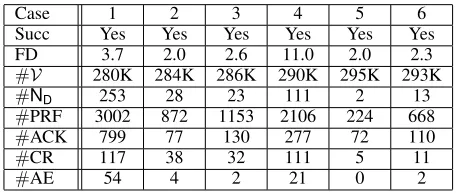
The results obtained from the forgetting are shown in Ta-ble 3, where Succ indicates whether or not the forgetting was successful (i.e., eliminated all names inF, and the in-troduced definer names), FD denotes the forgetting duration (in seconds),#Vdenotes the number of axioms in the com-puted uniform interpolant,#NDdenotes the number of de-finer names introduced during the forgetting process,#PRF denotes the number of cases where a concept or definer name was eliminated by purification, #ACK denotes the number of cases where a concept or definer name was elimi-nated using the Ackermann rules,#CR denotes the number of cases where a concept or definer name was eliminated using the combination rule in Figure 1. An interesting case is that a concept or definer name had been eliminated when the prototype proceeded to its elimination round (it had been eliminated in the round of eliminating other names);#AE denotes the number of such cases. Observe that only in a small number of cases definer names were introduced; in more than 98.8% of the elimination rounds, a concept or definer name could be eliminated by purification or using the Ackermann rules, and without introducing any definer names. This explains why our prototype, introducing definer names in a conservative manner, is much faster than LETHE, which introduces definer names in a systematic and exhaus-tive manner.
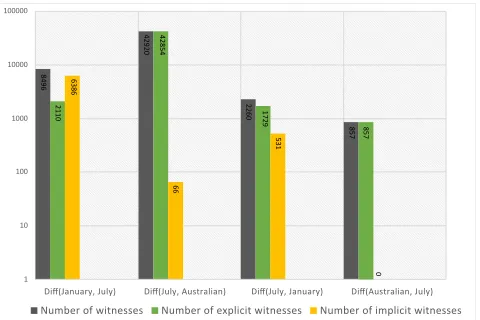
8496
42920
2260
857
2110
42854
1729
6386
66
531
1 10 100 1000 10000 100000
Diff(January, July) Diff(July, Australian) Diff(July, January) Diff(Australian, July) Number of witnesses Number of explicit witnesses Number of implicit witnesses
857
0
The next step is to find from each computed uniform inter-polant all witnesses ofUI-Diff(O1,O2)using HermiT. Since
the main focus of this paper is forgetting, we do not describe the entailment checking process. The logical difference be-tween the four versions of the SNOMED CT ontology com-puted by the tool is shown in Figure 3.UI-Diff(July, Can-nadian) andUI-Diff(Canada, July) disappear from the figure because there were no witnesses found in them, though the Canada edition had introduced 1700 new terms over the In-ternational July 2017 edition. Since the introduction of new terms does not interfere with the meanings of existing terms, the Canada edition can be seen as a safe extensionof the base edition. The Australia edition in contrast has had many term definitions of the base edition changed in the exten-sion; there were 42920 witnesses found inUI-Diff(July, Aus-tralia). In this case, the involvement of a domain expert may be useful to validate the changes.
Tracking Logical Difference between Different
Versions of NCIt Ontology
In order to make our findings and claims more convincing, we conducted another evaluation, where we used our logical difference tool to compute the logical difference between six pairs of different versions of the NCIt ontology. We used the most recent eight versions, consecutively released in 2018, as our test data. It was noticed from the SNOMED CT case that computing information gain was more challenging than computing information loss, as there were more names to be forgotten. Hence, in this test, we only considered the ‘for-ward direction’, computing the logical difference between an NCIt version and its most recent new release. The logi-cal difference tasks performed in this test, together with the corresponding forgetting tasks, are shown in Figure 4. We omitted the case ofDiff(18.05d, 18.06d) because these two versions were identical.
Case UI-Diff(O1,O2) #FC #FR #cls 1 UI-Diff(18.01e, 18.02d) 3719 0 283326 2 UI-Diff(18.02d, 18.03d) 963 0 284806 3 UI-Diff(18.03d, 18.04e) 1294 0 286861 4 UI-Diff(18.04e, 18.05d) 2404 0 291462 5 UI-Diff(18.06d, 18.07e) 299 0 292091 6 UI-Diff(18.07e, 18.08e) 778 0 293426
Table 4: Logical difference and forgetting tasks for NCIt
Case 1 2 3 4 5 6
Succ Yes Yes Yes Yes Yes Yes
FD 3.7 2.0 2.6 11.0 2.0 2.3
#V 280K 284K 286K 290K 295K 293K
#ND 253 28 23 111 2 13
#PRF 3002 872 1153 2106 224 668
#ACK 799 77 130 277 72 110
#CR 117 38 32 111 5 11
#AE 54 4 2 21 0 2
Table 5: Statistics of forgetting process and forgetting solu-tions
The results obtained from the forgetting are shown in Ta-ble 5. The most encouraging result is that our prototype was successful in all cases and uniform interpolants were com-puted within a few seconds. In more than 97% of the cases, a concept or definer name could be eliminated by purification or using the Ackermann rules, and without introducing de-finer names. This shows once again our method is practical.
441
145
70
521
183
330
177
122
55
289
166
273
264
23
15
232
17
57
1 10 100 1000
Diff(18.01e, 18.02d) Diff(18.02d, 18.03d) Diff(18.03d, 18.04e) Diff(18.04d, 18.05e) Diff(18.06d, 18.07e) Diff(18.07e, 18.08e) Number of witnesses Number of explicit witnesses Number of implicit witnesses
Figure 4: Logical difference between versions of NCIt
The logical difference between versions of the NCIt on-tology computed by our tool is shown in Figure 4. It can be observed that the numbers of witnesses in the NCIt cases were notably smaller than those of the witnesses in the SNOMED CT cases (i.e., NCIt is evolving more gradually). This is probably because SNOMED CT is updated on a half-yearly basis, whereas NCIt is updated on a monthly basis (more frequent changes implies fewer changes), and also because SNOMED CT contains country specific extensions where significant adjustments can be expected.
Conclusion and Future Work
In this paper we have introduced a logical difference analysis tool able to track the changes in very large ontologies. As the forgetting step in the algorithm was a bottleneck with exist-ing tools, we have developed a highly optimized deductive forgetting method and tool. For the first time it is possible to compute the logical difference between two ontologies of the size of SNOMED CT and NCIt in feasible time. This provides ontology engineers with a practical tool to analyze and maintain changes in their ontologies.
As the external reasoners have performance issues for en-tailment checking, a new approach to computing logical dif-ference that obviates the need for a reasoner will be investi-gated in future work.
DL reasoners allowing disjunctive concept assertions. In these cases, a feasible solution would be to approximate the uniform interpolants and witness sets.
Acknowledgments
We would like to thank the reviewers for useful comments and good suggestions. This research was funded by EPSRC IAA Project 204 and Babylon Health.
References
Alassaf, R., and Schmidt, R. A. 2017. A Preliminary Compari-son of the Forgetting Solutions Computed using SCAN, LETHE and FAME. InProc. SOQE’17, volume 2013 ofCEUR Workshop Proceedings, 21–26. CEUR-WS.org.
Glimm, B.; Horrocks, I.; Motik, B.; Stoilos, G.; and Wang, Z. 2014. HermiT: An OWL 2 Reasoner. J. Autom. Reasoning53(3):245– 269.
Gonc¸alves, R. S.; Parsia, B.; and Sattler, U. 2012. Ecco: A Hybrid Diff Tool for OWL 2 ontologies. InOWLED, volume 849 ofCEUR Workshop Proceedings. CEUR-WS.org.
Hartel, F. W.; de Coronado, S.; Dionne, R.; Fragoso, G.; and Gol-beck, J. 2005. Modeling a description logic vocabulary for cancer research.Journal of Biomedical Informatics38(2):114–129. Jim´enez-Ruiz, E.; Grau, B. C.; Horrocks, I.; and Llavori, R. B. 2011. Supporting concurrent ontology development: Framework, algorithms and tool.Data Knowl. Eng.70(1):146–164.
Klein, M. C. A.; Fensel, D.; Kiryakov, A.; and Ognyanov, D. 2002. Ontology Versioning and Change Detection on the Web. InProc. EKAW’02, volume 2473 ofLecture Notes in Computer Science, 197–212. Springer.
Konev, B.; Ludwig, M.; Walther, D.; and Wolter, F. 2012. The Logical Difference for the Lightweight Description LogicEL. J. Artif. Intell. Res.44:633–708.
Konev, B.; Lutz, C.; Walther, D.; and Wolter, F. 2013. Model-theoretic inseparability and modularity of description logic ontolo-gies.Artif. Intell.203:66–103.
Konev, B.; Walther, D.; and Wolter, F. 2008. The Logical Dif-ference Problem for Description Logic Terminologies. InIJCAR, volume 5195 of Lecture Notes in Computer Science, 259–274. Springer.
Konev, B.; Walther, D.; and Wolter, F. 2009a. Forgetting and uniform interpolation in extensions of the description logicEL. In Proc. DL’09, volume 477 of CEUR Workshop Proceedings. CEUR-WS.org.
Konev, B.; Walther, D.; and Wolter, F. 2009b. Forgetting and Uni-form Interpolation in Large-Scale Description Logic Terminolo-gies. InProc. IJCAI’09, 830–835. IJCAI/AAAI Press.
Koopmann, P., and Schmidt, R. A. 2013. Uniform Interpolation ofALC-Ontologies Using Fixpoints. InProc. FroCos’13, volume 8152 ofLecture Notes in Computer Science, 87–102. Springer. Koopmann, P., and Schmidt, R. A. 2014. Count and Forget: Uniform Interpolation ofSHQ-Ontologies. InProc. IJCAR’14, volume 8562 of Lecture Notes in Computer Science, 434–448. Springer.
Koopmann, P., and Schmidt, R. A. 2015. Uniform Interpola-tion and Forgetting forALC-Ontologies with ABoxes. InProc. AAAI’15, 175–181. AAAI Press.
Koopmann, P. 2015. Practical Uniform Interpolation for Expres-sive Description Logics. Ph.D. Dissertation, University of Manch-ester, UK.
Kremen, P.; Smid, M.; and Kouba, Z. 2011. OWLDiff: A Practical Tool for Comparison and Merge of OWL Ontologies. InProc. DEXA’11, 229–233. IEEE Computer Society.
Lin, F., and Reiter, R. 1994. Forget It! InProc. AAAI Fall Sympo-sium on Relevance, 154–159. AAAI Press.
Ludwig, M., and Konev, B. 2014. Practical Uniform Interpola-tion and Forgetting forALCTBoxes with Applications to Logical Difference. InProc. KR’14. AAAI Press.
Lutz, C., and Wolter, F. 2011. Foundations for Uniform Interpo-lation and Forgetting in Expressive Description Logics. InProc. IJCAI’11, 989–995. IJCAI/AAAI Press.
Lutz, C.; Walther, D.; and Wolter, F. 2007. Conservative Extensions in Expressive Description Logics. In Proc. IJCAI’07, 453–458. AAAI/IJCAI Press.
Matentzoglu, N., and Parsia, B. 2017. BioPortal Snapshot 30.03.2017.
Noy, N. F., and Musen, M. A. 2002. PROMPTDIFF: A Fixed-Point Algorithm for Comparing Ontology Versions. In Proc. AAAI/IAAI’02, 744–750. AAAI/MIT Press.
Solimando, A.; Jim´enez-Ruiz, E.; and Guerrini, G. 2017. Minimiz-ing conservativity violations in ontology alignments: algorithms and evaluation.Knowl. Inf. Syst.51(3):775–819.
Spackman, K. A. 2000. SNOMED RT and SNOMED CT. promise of an international clinical ontology.M.D. Computing 17. Stoilos, G.; Geleta, D.; Wartak, S.; Hall, S.; Khodadadi, M.; Zhao, Y.; Alghamdi, G.; and Schmidt, R. A. 2018. Methods and Met-rics for Knowledge Base Engineering and Integration. InProc. WOP’18, volume 2195 ofCEUR Workshop Proceedings, 72–86. CEUR-WS.org.
Wang, K.; Wang, Z.; Topor, R. W.; Pan, J. Z.; and Antoniou, G. 2014. Eliminating Concepts and Roles from Ontologies in Expres-sive Descriptive Logics. Computational Intelligence30(2):205– 232.
Zhao, Y., and Schmidt, R. A. 2015. Concept Forgetting in ALCOI-Ontologies Using An Ackermann Approach. InProc. ISWC’15, volume 9366 ofLNCS, 587–602. Springer.
Zhao, Y., and Schmidt, R. A. 2016. Forgetting Concept and Role Symbols inALCOIHµ+(O,u)-Ontologies. InProc. IJCAI’16, 1345–1352. IJCAI/AAAI Press.
Zhao, Y., and Schmidt, R. A. 2017. Role forgetting for ALCOQH(O)-ontologies using an ackermann-based approach. In
Proc. IJCAI’17, 1354–1361. IJCAI/AAAI Press.
Zhao, Y., and Schmidt, R. A. 2018a. FAME: An Automated Tool for Semantic Forgetting in Expressive Description Logics. InProc. IJCAR’18, volume 10900 ofLecture Notes in Computer Science, 19–27. Springer.
Zhao, Y., and Schmidt, R. A. 2018b. On concept forgetting in description logics with qualified number restrictions. InProc. IJ-CAI’18, 1984–1990. IJCAI/AAAI Press.