LOCATION-BASED SERVICES USING
SIP
Abdullah Azfar
Lecturer, Department of Computer Science and Information Technology, Islamic University of Technology (IUT), Board Bazar, Gazipur-1704, Bangladesh
Md. Sakhawat Hossen
Lecturer, Department of Computer Science, American International University Bangladesh (AIUB), Kemal Ataturk Avenue, Dhaka-1213, Bangladesh
María José Peroza Marval
MSc Student, School of Information and Communication Technology, Royal Institute of Technology (KTH), Stockholm, Sweden
Razib Hayat Khan
PhD Researcher, Department of Telematics, Norwegian University of Science and Technology (NTNU), Trondheim, Norway
[email protected] Abstract :
Due to the popularity of Location-Based Services and IP telephony, we decided to review a number of different proposals to implement Location-Based Services over a SIP-based mobile network. The result is an interesting overview about the potential functionalities of Location-Based Services and the capabilities of SIP for implementing these services.
Keywords: Location-Based Service (LBS), Session Initiation Protocol (SIP), Triangulation, Trilateration, Multilateration.
1. Introduction
In an increasingly competitive telecommunication world, mobile network operators continuously seek new and innovative ways to create differentiation, to be preferred by customers and to increase profits. One way to accomplish this is through the delivery of highly personalized services [1], For example, taking real advantages of the “mobile” concept to deliver relevant services and information to the user.
We have experienced several trends in social media in conjunction with information technology, websites, e-mail, chat, videoconference, social networks, real-time information, and other services are examples of the need of people to be, without caring where they are.
In contrast, Location-Based Services (LBSs) defined as “services that integrate a mobile device’s location or position with other information so as to provide added value to a user” [2] deliver different information and services depending upon where the user is. Hence, LBSs are extremely related to positioning.
This is a transcendental moment for LBS and IP telephony and we should not miss this evolution. Each day IP technology is taking the place of other technologies and LBS one day will become “as common as the cell phone itself” [3].
This paper is organized in 6 sections. In Section 2 we describe the different location technologies. Section 3 is overview of Location-Based Services (LBS). Section 4 presents the current mobile network architecture using Location-Based Services. In Section 5, LBS using the Session Initiation Protocol (SIP) is introduced. Finally, section 6 offers some conclusions.
2. Wireless Location Technologies
In wireless communication systems there exist several mechanisms that enable us to calculate or estimate the position of a user. Many of these technologies are well known and widely used. In this paper we will take a closer look at four of these wireless Location Technologies: Global Positioning System (GPS), triangulation, trilateration, and multilateration.
2.1. Global Positioning System (GPS)
GPS is a global navigation satellite-based system that provides reliable positioning and timing services freely available to all. GPS is used for determining the position of receivers using signal broadcast by satellites [6]. In this system, each receiver obtains satellite positions by listening to broadcasts from the satellite and measures the time for a signal to propagate from the transmitter (each satellite) to the receiver. The position is calculated using trilateration [6].
Despite its global use and high accuracy, GPS has some drawbacks such as high power consumption of the GPS receiver and poor indoor coverage [7]. Assisted GPS (A-GPS) was created to overcome these problems, enhancing the positioning performance of a GPS receiver by providing an initial estimate of the position of the device, the
approximate time, and possibly information about what satellite may be visible to the mobile device [6]. 2.2. Triangulation: AOA
Triangulation is used for many purposes and it estimates the position of a mobile by measuring the angles of arrival (AOA) between the mobile and reference point’s knowledge of the location of the reference points [6]. Figure 1 illustrates this process.
2.3. Trilateration
Trilateration determines the relative position of objects using the known location of two or more references points, e.g. base stations, or the distance between the mobile and each reference point. Trilateration can be used with signal strength analysis, or with time of arrival (TOA), where the distance is obtained by estimating TOA of received signals [6].
2.4. Multilateration
Also known as hyperbolic lateration, multilateration usually is a positioning process that estimates the time difference of arrival (TDOA) of a signal.
3. Location-Based Services
Location-Based Services (LBSs) are information and entertainment services accessible from mobile devices through a mobile network, utilizing the location of the mobile terminal [8]. They can be classified by categories (commercial, internal, emergency, and lawful intercept services) and by types (push or pull services) [6].
3.1. Push LBS
Push services mean that the client receives the information without having requested it. In other words, the information is proactively sent to the client. Examples of push services are an advertising welcome message when entering a new town or hurricanes warnings. Some of this information may be sent to the user with prior consent [2].
Push services efficiently use the bandwidth of the mobile network, since communication only occurs if there is (new) information available [9]. However, this kind of services has not come to flourish yet, so although the consumer “has given prior consent for the use of location data”, the service could be intrusive and tend to interrupt the consumer [10].
3.2. Pull LBS
Pull services imply that a user actively requests (pulls) information from the network [2]. For instance, when the user asks for the nearest cash machine.
In pull-based location services, the client performs periodic checks for information, even if no new content is available, which consumes network resources (air interface bandwidth, buffers, IP-addresses) and terminal resources (transmit power) [9]. In this type of LBS privacy concerns are less salient.
4. Current LBS Architecture in Mobile Network
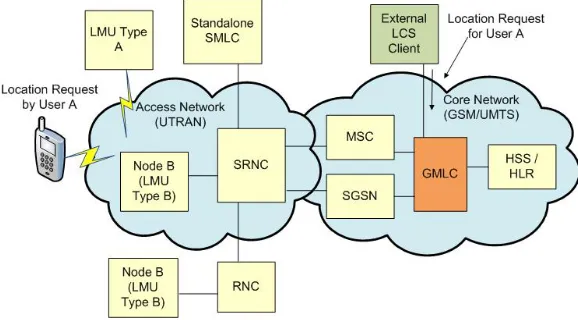
The standard architecture of a positioning network is illustrated in Fig. 2. It includes new network elements to be added to the mobile network (for GSM). These elements are [7]:
Gateway Mobile Location Center (GMLC): it receives the positioning request, authenticates the client, and checks for authorization. It is also responsible for “transmitting the required service quality (accuracy, response time, etc) to the network and for converting the positioning results into the desired format” [12].
Serving Mobile Location Center (SMLC): it handles the coordination of resources needed in the positioning procedure and calculates the actual position of the user (graphical coordinates plus any degree of uncertainty). SMLC can either be integrated with a base station or be an independent network element [13].
Location Measurement Unit (LMU): works under the control of the SMLC, its role is to take radio measurements to support a LBS [14].
For providing LBS in mobile networks, the GMLC is the first node that the LCS client accesses to request the current geographic position information of a mobile terminal (Fig. 2). Depending on the type of the network, the access network can be either GERAN or UTRAN. The GMLC, after being reached by a request, requests routing information from the Home Location Register (HLR). After the LBS client is registered and authorized, the GMLC transmits a request for position to either SGS (Serving GPRS Support Node) or MSC (Mobile Switching Centre). The corresponding network entities responsible for estimating the final location are the TOA (TDOA positioning method), handset or hybrid positioning method (e.g. A-GPS). The estimate forwarded back to the requesting LCS client. A confirmation of the target mobile terminal’s privacy profile settings are always performed in the mobile terminal’s home network prior to delivering a location estimate to the requesting LBS client [11].
The LBS network is simple and useful for many location services, but does not support advance services such as map based routing, geo-coding services, or finder services (e.g. find a nearby restaurant). In order to provide these services, the GMLC needs new functionalities to be added [11].
5. LBS Using Session Initiation Protocol (SIP)
Although, information about LBS is widely available on the internet, there are not many papers describing LBS together with SIP. In the following subsections, we will try to give to the reader a basic understanding of LBS using SIP.
5.1. SIP (Session Initiator Protocol)
SIP is used to establish, modify and terminate all types of sessions [15]. It is a text based HTTP-like protocol, with two types of messages: a SIP client generates a SIP request and a SIP server responds to that request by generating a response [16].
There are two types of entities in SIP: SIP User Agents (UA, in the terminal) and SIP network servers. The latter are employed to route a call and to maintain the call state. A user registers by sending a registration massage to Register Server when he/she wants to be reachable. This register message is time limited, and contains the current address of the client. This address will be stored by the Register Server. Any client can unregister by sending a register message with a time limit of zero [9].
Through some extensions, SIP can also be used for presence and instant messaging applications. These extensions introduce three methods: SUBSCRIBE and NOTIFY for presence and MESSAGE for instant messaging [17] [18].
Pospischil, Stadler, and Miladinovic [9] indicate that these extensions can be used for push services. For instance, if a user wants to subscribe for a push channel, the SUBSCRIBE method can be used; or if the operator wants to be informed about an event, this can be pushed to all interested users by using the NOTIFY method.
Sip has a number of advantages: it will be available in all future mobile terminals and on the internet, it is an open internet standard, it is highly scalable architecture, it is easy to implement, etc.
5.2. SIP and location detection
There are different ways to describe location and there are different technologies to determine an entity's location. Fig. 3 shows (on the left) that location information can be sent directly to the SIP User Agent, this associates the user’s identity with his/her location. In [19], this scheme is called agent centric location detection and these authors suggests that in a SIP based Internet telephony system, result of the agent-centric location detection can be sent to a location server in SIP PUBLISH requests [20].
Location detection can also be server-centric when SIP User Agent cannot directly learn the locations. The right hand side of Fig. 3 shows that when, a user places his/her profile in a small device such as a swipe card, then the reader of this device can send the profile to a location server. If the location server knows the reader’s location, then it will associate the profile with this location. In [19] the authors propose that the SIP User Agents may subscribe to their own location events by following the SIP event notification architecture.
It is important to indicate that a server-centric approach is cheaper than agent-centric schema. However, the latter offers better control to the client over his/her location privacy [19].
5.3. LBS
To better analyse LBS in a SIP context, [19] proposes five categories. Each of these categories is briefly described below.
5.3.1 Sending location information to remote parties for location tracking
Location usually refers to a physical address or geospatial coordinates. In SIP based Internet telephony system location tracking is based on the SIP event notification method [17]. A watcher sends a SIP SUBSCRIBE request to a presentity. If presentity accepts the subscription, then by using a SIP NOTIFY the presentity sends the location information to the watcher [19].
5.3.2.
Making communication decisions
Certain communication behavior is expected of a user in a specific location. For instance in some jurisdictions, video or text conversation is not allowed when driving, therefore when making an outgoing call the SIP User Agent might check its own location to determine if it should make the call or might suggest the user call later [19]. For incoming calls similar functionality can be provided.
5.3.3.
Triggering actions
SIP User Agents may invoke specific actions when detecting location changes [19]. When a user drives to his office, his User Agent might get a location notification and automatically turn on the air conditioner in his office. In this example, the action is triggered by the user’s own location changes, based upon the user subscribing to his own location information (hence no authorization needed). If the actions are triggered by remote parties’ location (when users subscribe to another user’s location information) then authorization will be needed.
5.3.4.
Resource discovery
Location information can be used to find nearby resources. A SIP User Agent might have limited multimedia I/O capabilities. He/she might put location information in a Service Location Protocol (SLP) query to find available multimedia I/O resources in the context [19]. Then the UA can control the resources.
5.3.5.
Treat a location as a communication entity
By assigning a URI to a location we can treat the location as a communication entity, and the URI will represent all the people in that location. In this way, users can communicate with other users in the same location by sending instant messages to the location URI which could be broadcasted to all people in that location.
6. Conclusions
LBS is used more and more often in people’s daily life. Issues such as locating the nearest restaurant, the nearest petrol station, the nearest cash machine, can be answered with the help of LBS. LBS in conjunction with IP telephony is a clear part of the future of the mobile communications and social networks. However, LBS need to be enhanced by using other sensors.
References
[1] Location-based Services, http://www.mobilein.com/location_based_services.htm, Last visited: February 2010.
[3] Ben Parr, “Mashable The Social Media Guide, Location-Based Services: Are you using them?”, http://mashable.com/2009/07/12/location-based-services/, Last visited: February 2010.
[4] Sarah Perez, “2009: The Year of LBS (Location-Based Services)”, http://www.readwriteweb.com/archives/2009_the_ year_of_lbs_location-based_services.php, Last visited: February 2010.
[5] TechTarget, http://searchunifiedcommunications.techtarget.com/sDefinition/0,,sid186_gci212388,00.html, Last visited: February 2010. [6] Shu Wang, Jungwon Min, Byung K. Yi, LG Electronics Mobile Research, USA, ”Location Based Services for Mobiles: Technologies and
Standards, 2008” http://to.swang.googlepages.com/ICC2008LBSforMobilessimplifiedR2.pdf, Last visited: February 2010.
[7] H.T. Chu, W.S. Chen, Y.H. Huang, J.Y. Chen, “An easy way for location-based services”, Proceedings of the IASTED European Conference: internet and multimedia systems and applications, Chamonix, France, 2007, pp: 23 - 27
[8] Stefan Steiniger, Moritz Neun and Alistair Edwardes, “Foundations of Location Based Services”,
http://www.geo.unizh.ch/publications/cartouche/lbs_lecturenotes_steinigeretal2006.pdf, Last visited: February 2010.
[9] G. Pospischil, J. Stadler, and I. Miladinovic, “A location-based push architecture using SIP”, 4th International Symposium on Wireless Personal Multimedia Communications (WPMC 2001), Aalborg, Denmark, September, 2001.
[10] R. Unni, R. Harmon,“Perceived Effectiveness of Push vs. Pull Mobile Location-Based Advertising”, Journal of Interactive Advertising, Vol 7 No 2, Spring 2007, ISSN:1525-2019.
[11] M. Zündt, G. Deo, M. Naumann, M. Ludwig, “Realizing Peer-to-Peer Location-Based Services in Mobile Networks”, Proceedings of the 2nd Workshop on Positioning, Navigation and Communication (WPNC’05) & 1st Ultra-Wideband expert Talk (UET’05), 2005, pp: 175-182.
[12] M.A. Dru, S. Saada, ”Location-based mobile services: The essentials”. http://sysdoc.doors.ch/ALCATEL/14drugb.pdf , Last visited: February 2010.
[13] Ajay R. Mishra, “Fundamentals of cellular network planning and optimisation: 2G, 2.5G, 3G”, John Wiley & Sons Ltd., Southern Gate, Chichester, West Sussex, England, 2004.
[14] Dialogic Corporation, “Adding Location-Based Services to Existing Architectures: Building Feature-Rich Mobile Telephony Applications
Using Dialogic Signaling Components”,http://www.dialogic.com/products/signalingip_ss7components/docs/9862_Add_Locationbased_Servs_an.pdf, Last visited:
February 2010.
[15] F.D. Sorbo, G. Lombardi, D. Pompili, “SIP based services and Virtual Home UMTS environment in the IST research project FUTURE”, Global Telecommunications Conference, 2002. GLOBECOM '02. IEEE, Volume 2, November 2002, pp: i- xliv, ISBN: 0-7803-7632-3. [16] Henry Sinnreich, Alan B. Johnston, “Internet Communications Using SIP”, Wiley Publishing, Inc. Second Edition, Indianapolis, USA,
2006.
[17] A.B. Roach, “Session Initiation Protocol (SIP)-Specific Event Notification”, IETF RFC 3261, IETF Network Working Group, June 2002. [18] J. Rosenberg, D. Willis, R. Sparks, B. Campbell, H. Schulzrinne, J. Lennox, C. Huitema, B. Aboba, D. Gurle, “SIP Extensions for Instant
Messaging draft-ietf-simple-im-01”, Internet Engineering Task Force, Internet-Draft, July 2001.
[19] Xiaotao Wu and Henning Schulzrinne, “Location-based Services in Internet Telephony”, IEEE Consumer Communications & Networking Conference 2005 (CCNC'05), January 1, 2005.