ISSN(Online): 2320-9801 ISSN (Print): 2320-9798
I
nternational
J
ournal of
I
nnovative
R
esearch in
C
omputer
and
C
ommunication
E
ngineering
(An ISO 3297: 2007 Certified Organization)
Website:www.ijircce.com
Vol. 5, Issue 1, January 2017
A Survey on Multimedia Data Mining Using
Deep Learning
Prof.A. G. Dombe, Aditya Welhal, Shambhu Singh, Santosh Hundekar, Pravin Singh
Dept. of Information Technology, JSPM’s Rajarshi Shahu College of Engineering, Pune, India
ABSTRACT: Today very large amounts of Multimedia data is present on the Internet or web, Multimedia data mining is one of best for research. Multimedia mining is a form of data mining. In Data mining various type of algorithms are used to segment the data to identify patterns and to make its predictions. Despite the successes in many areas, data mining remains a challenging task. In the past, multimedia mining was one of the fields where the results were often not agreeable. Multimedia Data Mining extracts the data from multimedia files like audio, video and still images to perform similarity searches, identify associations. As the mining techniques have matured, new techniques has been developed. A lot of progress has been made in areas such as visual data mining and usual language processing using deep learning techniques. Deep learning is a branch of machine learning and has been used among other on Smartphone’s for face recognition and voice commands. Deep learners are a type of artificial neural networks with numerous data dealing out layers that learn representations by increasing the level of abstraction from one layer to the next. These methods have enhanced the state in multimedia mining, in speech recognition, visual object recognition, natural language processing and other areas such as genome mining and predict the effectiveness of drug molecules. This paper describes some of the deep learning techniques that have been used in recent research for multimedia data mining.
KEYWORDS: Data mining; multimedia data mining; deep learning; artificial neural networks; natural language processing; visual data mining
I. INTRODUCTION
Due to the huge amounts of Multimedia data on the Internet, Multimedia mining has become a very lively area of research. Multimedia mining is a form of data mining. Data mining uses algorithms to segment data to classify useful patterns and to predict. Despite the success in many areas, data mining remains a challenging task. In the past, multimedia mining was one of the fields where the results were regularly not agreeable. Multimedia Data Mining extracts significant data from multimedia files such as audio, video and still images to perform similarity searches, identify associations, entity resolution and for classification. Face recognition is very famous technology concept in recent days. It can be used various applications. In this project we extract face from image or video. Then extracted face will be processed to recognize it. For recognition we will use Eigen face concept. Eigen faces is the name given to a set of eigenvectors when they are used in the computer idea difficulty of human face recognition. First, the original images of the training set are transformed into a set of Eigen faces. Afterwards, the weights are calculated for each image of the training set.
Upon observing an unknown image, the weights are calculated for that particular image and stored in the vector. Vector of unknown image is compared with stored vectors of Eigen face and distance calculated. If feature distance is below threshold then we can consider face is matched. Output will be recognized face name.
A. MOTIVATION:
ISSN(Online): 2320-9801 ISSN (Print): 2320-9798
I
nternational
J
ournal of
I
nnovative
R
esearch in
C
omputer
and
C
ommunication
E
ngineering
(An ISO 3297: 2007 Certified Organization)
Website:www.ijircce.com
Vol. 5, Issue 1, January 2017
data mining and natural language processing using deep learning techniques. Deep learning is a branch of machine learning and has been used amongst other on Smartdevices for face recognition and voice commands. In this proposed system Eigen face concept is used for face detection. A set of Eigen faces can be generated by performing a statistical process called principal component analysis (PCA) on a large set of images depicting different human faces.
B. OBJECTIVE:
A. Deep learners are a kind of artificial neural networks with several data processing layers that learn representations by increasing the level of abstraction from one layer to the next.
B. Eigen face provides an easy and cheap way to realize face recognition in that: 1. Its training process is completely automatic and easy to code.
2. Eigen face adequately reduces statistical complexity in face image representation.
3. Once Eigen faces of a database are calculated, face recognition can be achieved in real time. 4. Eigen face can handle large databases.
C. Proposed system includes training and testing sets for image recognition, in training set Eigen faces of person will be kept. While testing face will be recognized from video or image.
II. LITERATURE SURVEY
Xinyu Chen, Youngwoon Cho, and Suk young Jang have proposed “Crime Prediction Using Twitter Sentiment and Weather” This paper Our aim is to predict the time and location in which a specific type of crime will occur. Our approach is based on attitude analysis by applying lexicon-based methods and understanding of categorized weather data, combined with kernel density estimation based on historical crime incidents and calculation via linear modeling. By testing our model’s ability to predict future crime on each area of the city, we observed that the model exceed the benchmark model, which predicts crime incidents using kernel density estimation.
Hong-Mei Chen, Rick Kazman, Senior Member, IEEE, and Serge Haziyev have projected “Agile Big Data Analytics for Web-based Systems: An design-centric Approach”
This paper This article describes how AABA was developed, evolved and validated at the same time in 10 empirical WBS case studies through 3 CPR (Collaborative Practice Research) cycles. In addition, this article presents an 11th case study exemplifying the processes, methods and techniques/tools in AABA for cost-effectively attaining business goals and architecture agility in a large scale WBS. All 11 case studies showed that structural -centric design, development, and operation is key to refining technical complexity and achieving liveliness necessary for successful WBS big data analytics development. Our contribution is narrative and important. The use of reference architectures, a design concepts index and architectural spikes in AABA are advancements to architecture design methods. In addition, our structural centric approach to DevOps was critical for achieving strategic control over continuous big data value delivery for WBS.
GuilhermeGuerreiro, Paulo Figueiras, Ricardo Silva, Ruben Costa, Ricardo JardimGoncalves have proposed “An Architecture for Big Data Processing on Intelligent Transportation Systems” This paper planned architecture depends on the acceptance of “big data” technologies, to process and store large volumes of data from heterogeneous sources, provided by different highway operators. The proposed architecture is proficient way of handling real-time and historical data using big data technologies such as Spark on Hadoop and MongoDB. The DATEX-II data model is adopted, to classify to harmonize course data provided by the highway operators. The work presented here, is still part of ongoing work currently addressed under the EU H2020 OPTIMUM project. Preliminary results attained so far do not address the final conclusions of the project, but enabled us to demonstrate considerable gains in performance, when compared to other traditional ETL approaches, and also form the base for pointing out and discuss future work orders and opportunities in the area of the development of big data processing and mining methods under the ITS domain.
ISSN(Online): 2320-9801 ISSN (Print): 2320-9798
I
nternational
J
ournal of
I
nnovative
R
esearch in
C
omputer
and
C
ommunication
E
ngineering
(An ISO 3297: 2007 Certified Organization)
Website:www.ijircce.com
Vol. 5, Issue 1, January 2017
propose an efficient algorithm to obtain the metadata of sub-dataset sharing. Secondly, we design an elastic storage organization called ElasticMap based on the HashMap and BloomFilter techniques to store the meta-data. Thirdly, we utilize distribution-aware algorithms for sub-dataset applications to attain balanced and efficient parallel execution. Our proposed method can benefit different sub-dataset analyses with various computational necessities. Experiments are conducted on PRObEs Marmot 128-node cluster testbed and the results show the performance benefits of DataNet.
Kyunghyun Cho, Aaron Courville, and YoshuaBengio have proposed “Describing Multimedia Content Using Attention-Based Encoder-Decoder Networks”this paper We describe systems
that learn to focus to different places in the input, for each element of the output, for a diversity of tasks: machine translation, image caption generation, video clip description, and speech recognition. All these systems are founded on a shared set of building blocks: gated recurrent neural networks and convolutional neural networks, along with trained
attention mechanisms. We report on experimental results with these systems, presenting remarkably good performance
and the advantage of the attention mechanism.
OriolVinyals ,have proposed “Show and Tell: A Neural Image Caption Generator” Paper Our model is often quite exact, which we verify both qualitatively and quantitatively. For example, while the present state-of-the-art BLEU-1 score (the higher the better) on the Pascal dataset is 25, our approach capitulate 59, to be compared to human performance around 69. We also show BLEU-1 score improvements onFlickr30k, from 56 to 66, and on SBU, from 19 to 28. Lastly, on the newly launched COCO dataset, we achieve a BLEU-4 of 27.7, which is the current state-of-the-art.
Min-Yuh Day and Chia-Chou Lee have proposed “ Deep Learning for Financial Sentiment Analysis on Finance News Providers” This paper Investors have always been interested in stock price forecasting. Since the growth of electronic media, hundreds pieces of financial news are released on different media every day. Numerous studies have attempted to examine whether the stock price forecasting all the way through text mining knowledge and machine learning could direct to unusual returns. However, few of them involved the discussion on whether using different media could affect forecasting results. Financial response analysis is an significant research area of financial technology (FinTech). This research focuses on investigating the influence of using different financial resources to asset and how to improve the exactness of forecasting through deep learning. The experimental result shows various financial resources have significantly different effects to investors and their investments, while the exactness of news categorization could be enhanced through deep learning.
Thomas CanhaoXu, Ville Lepp¨anen have proposed “Analysing up-and-coming Memory Technologies for Big Data and Signal Processing Applications” This paper we investigate and compare different emerging memory technologies as on-chip cache for big data and signal processing applications. Static Random Access Memory (SRAM) has been extensively used as level 1 and last level caches for multicore processors. Server chips integrate Dynamic Random Access Memory (DRAM) as an additional cache for better serverlevel applications that process more data. Both SRAM and DRAM have advantages and disadvantages. Therefore new types of RAMs are projected and prototyped. For big data and signal processing applications these days, enormous amount of data are processed, usually with time limitations. We analyse novel
RAMs, including Phasediffer RAM (PRAM), Magnetoresistive RAM (MRAM), Ferroelectric RAM (FRAM) and Resistive RAM (RRAM). The conventional and new memories are analysed in terms of size, area, access latency and power consumption. We present standard results using a full system simulator. Workloads are selected from several big data, server, signal processing and video processing applications. Experiments illustrate that, in consideration of these applications, it is vital to replace SRAM and DRAM caches with MRAM and RRAM.
ISSN(Online): 2320-9801 ISSN (Print): 2320-9798
I
nternational
J
ournal of
I
nnovative
R
esearch in
C
omputer
and
C
ommunication
E
ngineering
(An ISO 3297: 2007 Certified Organization)
Website:www.ijircce.com
Vol. 5, Issue 1, January 2017
Jun Wang, Senior Member, IEEE, Xuhong Zhang, Jiangling Yin, Huafeng Wu, and Dezhi Han have proposed “Speed Up Big Data Analytics by Unveiling the Storage Distribution of Sub-datasets” This paper an resourceful algorithm to obtain the metadata of sub-dataset distributions. Secondly, we design an elastic storage structure called ElasticMap based on the HashMap and BloomFilter method to store the meta-data. Thirdly, we employ distribution-aware algorithms for sub-dataset applications to achieve balanced and efficient parallel execution. Our proposed development can benefit different sub-dataset analyses with a variety of computational requirements. Experiments are conducted on PRObEs Marmot 128-node cluster testbed and the results show the performance benefits of DataNet.
IV. EXISTING ARCHITECTURE APPROACH
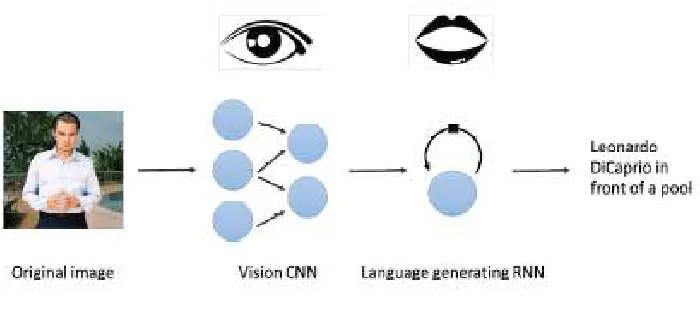
ConvNets and RNNs have been combined for multimedia data mining in recent research. Model combination nearly always improves the performance of machine learning methods Combining ConvNets and recurrent neural networks for automatic image caption generation has shown stunning results . It exploits the strength of ConvNets for multimedia mining and ANNs for NLP. First the ConvNet analyses images using object or face recognition , then the vectorial representation of the images is passed to an RNN for NLP, e. g. for image caption generation. Fig. 1 shows the combination of a ConvNet with an RNN for automatic caption generation.The combination of ConvNets and RNNs has greatly expanded the applications of DL for multimedia mining. It can be used for automated image descriptions, personidentification, and it is to be expected that similar architectures will not only be used for still image analysis but also for movies, e. g. for movie classification.
V. EXISTING ARCHITECTURE APPROACH
Fig. 1. Vision ConvNet combined with an RNN for caption generation
Disadvantages:
1. The combination of ConvNets and RNN, this methods mostly used supervised approaches where large corpuses of labelled training data are needed.
ISSN(Online): 2320-9801 ISSN (Print): 2320-9798
I
nternational
J
ournal of
I
nnovative
R
esearch in
C
omputer
and
C
ommunication
E
ngineering
(An ISO 3297: 2007 Certified Organization)
Website:www.ijircce.com
Vol. 5, Issue 1, January 2017
VI. PROPOSED ARCHITECTURE APPROACH
In the proposed approach the unsupervised DL methods are used. unsupervised DL methods used to cluster the input data in classes on the basis of their statistical properties only. The labelling can be carried out even if the labels are only accessible for a small number of objects representative of the desired classes.
Advantages:
1. Large corpuses of labelled training data are not needed.
2. Only clustering are doing the result.
VII. CONCLUSION
From this it is conclude that system is useful for face recognition using Eigen Face method. System successfully implements Deep learning using training and testing method. Thus system is useful in multimedia data mining. Deep learners were particularly successful in problems that in the past proved to be very difficult in Artificial Intelligence research such as object recognition and descriptive language generation. New trends in data mining such as data mining for social good have been emerging. Areas such as smart healthcare, social sensing, smart cities and open Government data mining will even widen the application field of DL for multimedia mining. They have the potential to make human lives more healthy and efficient and thus attract a lot of attention from academia, Governments, and the industry.
REFERENCES
[1] C. Xinyu, C. Youngwoon, and J. Suk young, "Crime prediction usingTwitter sentiment and weather.", Systems and Information EngineeringDesign Symposium (SIEDS), pp. 63-68, 2015.
[2] H. V. Jagadish, J. Gehrke, A. Labrinidis, Y. Papakonstantinou, J. M.Patel, R. Ramakrishnan, and C. Shahabi, “Big data and its technicalchallenges,” Commun. ACM, vol. 57, no. 7, pp. 86-94, 2014.
[3] J. O. Chan, “An Architecture for Big Data Analytics,” Communicationsof the IIMA, vol. 13, no. 2, pp. 1-13, 2013.
[4] A. Twinkle, and S. Paul, “Adressing Big Data with Hadoop,”International Journal of Computer Science and Mobile Computing, vol.3, no. 2, pp. 459–462, 2014.
[5] K. Xu, J. Ba, R. Kiros, K. Cho, A. Courville, R. Salakhutdinov, R.Zemel, and Y. Bengio, “Show, Attend and Tell: Neural Image CaptionGeneration with Visual Attention”, Proceedings of the 32ndInternational Conference on Machine Learning from Data: ArtificialIntelligence and Statistics, vol. 37, 2015.
[6] O. Vinyals, A. Toshev, S. Bengio, and D. Erhan, “Show and Tell: ANeural Image Caption Generator”, Google, 2015.
[7] R. Salakhutdinov, “Deep learning,” in Proceedings of the 20th ACMSIGKDD international conference on Knowledge discovery and datamining, New York, New York, USA, 2014, pp. 1973-1973.
[8] P. Wlodarczak, M. Ally, and J. Soar, "Data Process and AnalysisTechnologies of Big Data," Networking for Big Data, Chapman &Hall/CRC Big Data Series, pp. 103-119: Chapman and Hall/CRC, 2015.
[9] S. Zhou, Q. Chen, and X. Wang, “Active deep learning method for semisupervised sentiment classification,” Neurocomputing, vol. 120, pp.536-546, 11/23/, 2013.