FPGA Implementation of OFDM
Transceiver using FFT Algorithm
Shaminder Kaur1, Rajesh Mehra2
1
ME Student, ECE Department, NITTTR, Chandigarh, India-160019
2
Associate Professor, ECE Department, NITTTR, Chandigarh, India-160019 [email protected]
Abstract
-
Orthogonal Frequency Division Multiplexing (OFDM) is the most promising modulation technique. It has been adopted by most wireless and wired communication standards. The idea is to utilize a number of carriers, spread regularly over a frequency band, in such a way so that the available bandwidth is utilized to maximal efficiency. In this paper the design and implementation of OFDM on a Field Programmable Gate Array (FPGA) device has been presented. This attractive architecture uses Radix-2 serialized 512-point FFT (Fast Fourier Transform) algorithm that enhances its speed. The system design is optimized in terms of both area and speed. The implementation was made on FPGA since it allows flexibility in design and also it can achieve higher computing speed than digital signal processors. ASIC-like performance with lower development time and risks can also be achieved. The results show that the design has been simulated up to 227.355 MHz and it achieves higher speed and lower area.Keywords: FFT, FPGAs, OFDM, pipelining, Radix-2, VHDL.
1. INTRODUCTION
The principles of OFDM have been in existence for several decades. However, in recent years these techniques came into practice in modern communications system. In 4G wireless communication systems, bandwidth is a precious commodity, and service providers are continuously met with the challenge of accommodating more users with in a limited allocated bandwidth. Orthogonal frequency division multiplexing (OFDM) is such a technique which provides an efficient means to handle high speed data streams on a multipath fading environment that causes ISI. The required bit rates are achieved due to OFDM multicarrier transmissions. OFDM systems perform better than single carrier systems particularly in frequency selective channels. It is a multiplexing/multiple access scheme that has many favorable features required for the fourth generation systems [1, 2]. FFT (Fast Fourier Transform)/ (Inverse Fast Fourier Transform) IFFT are the main blocks in OFDM system. They are important in achieving high speed signal processing. FFT helps to transform the signal from time domain to frequency domain where filtering and correlation can be performed with fewer operations [3, 4].
It is important to note that the FFT/IFFT algorithms should be chosen to consider the execution speed, hardware complexity, flexibility and precision [5]. Nevertheless, for real time systems the execution speed is the main concern [6] - [8]. The observation made on various architectures reveals that most of the existing work has been based on design and implementation of the transmitter and limited work has been done on the complete design of OFDM transceiver. The OFDM hardware implementation has been done either on ASICs, Virtex based FPGA [9] - [11].ASIC based designs suffer from more time to market factor, high cost and provide less flexibility. Moreover, DSP based designs can only support limited data rates due to lack of parallelism and also they have less number of MAC(multiply and accumulate) units. On the other hand, the modern programmable circuits like an FPGA provides parallel processing system, putting the FPGA computing speed at a significant advantage over DSPs [12] - [14].
2. OFDM Basics
OFDM is a wideband wireless digital communication technique that is based on block modulation. It is known as block modulation because the OFDM frame is split into blocks and each block has Ts duration. These blocks contain one or more symbols. Each symbol or group of symbols will be assigned a separate carrier. The OFDM arranges the subcarriers in such a way that they do not overlap and maintain the orthogonality between them. These subcarriers are modulated independently. All the split information is then transmitted in parallel through multiple carriers [17]. In OFDM the carriers can be placed as near as possible maintaining the orthogonality, thereby making better utilization of the spectrum. The width of the pulse puts the limit on the sub-carrier spacing. The subcarrier spacing will be inversely proportional to the symbol duration, where symbol duration is denoted by Ts. Longer is the symbol duration, better is the performance [18].
Orthogonal frequency division multiplexing (OFDM) is also very effective technique to mitigate inter-symbol interference (ISI) in handling time dispersion of multipath fading channels. This is the fundamental problem for communication systems. OFDM also prevents ICI (inter carriers interference) by making all the subcarriers orthogonal to each other [19]. OFDM is a special case of multicarrier transmission in which a single information bearing stream is transmitted over many lower rate sub channels. It has various applications in optical communication also. It has been recently proposed for use in radio-over-fiber based links, in free space optical communication, in long haul optical communication systems, in multimode fiber links etc. For understanding the OFDM operation, it is essential to understand the concept of orthogonality. Orthogonality is
defined for both real and complex valued functions. As shown in eq. 1 the two functions are
said to be orthogonal with respect to each other over the interval a<t<b if they satisfy the condition:
dt = 0, n m (1)
Orthogonality is also defined as the two coexisting signals are independent of each other in specified time interval and do not interact with each other as shown in fig 2.3. Here the six sub carriers are placed orthogonally such that the peak of one subcarrier occurs when other subcarriers are at zero. This is achieved practically with help of Inverse Fast Fourier Transform (IFFT) technique. Orthogonality is a property that allows multiple information signals to be transmitted perfectly over a common channel, thereby making better spectrum utilization. The signal is detected without interference. Ultimately ISI is conquered. Loss of orthogonality results in blurring between the information signals and degradations in communications. Two periodic signals are orthogonal when the integral of their product, over one period, is equal to zero and they have integral number of cycles in the fundamental period. Orthogonality of subcarriers is crucial for OFDM system. If orthogonality is destroyed, the receiver will have a serious bit error rate due to (ICI). A cyclic extension of the signal in time domain called cyclic prefix (CP) is inserted between each OFDM symbol to eliminate ISI almost completely for it is larger than maximum of time delay, which keeps orthogonality between each subcarriers as well [20, 21].
3. Proposed OFDM Transceivers its Simulation
Fig.1. OFDM Model using FFT Algorithm
Since the effective SNR is reduced by transmitting pilots, the spacing of the pilots is a trade -off between good channel estimation and high effective SNR. Pilot means reference signal used by both transmitters and receivers. In order to perform frequency domain data into time domain data, IFFT block is used. Inverse Fast Fourier Transform (IFFT) correlates the frequency domain input data with its orthogonal basis functions, which are sinusoids at certain frequencies. This correlation is equivalent to mapping the input data onto the sinusoidal basis functions. It provides complete spectrum setting. The FFT and IFFT are the most important blocks in the OFDM system and their performances have a big effect on the whole system. IFFT increase the speed of processing and decrease the computational complexity. IFFT scales the signal power down by IFFT size N, so it degrades bit error rate (BER). Hence in order to improve BER power scaling block is used. It improves the BER (bit error rate). The ISI is a common problem found in high data rate communication. It occurs when the transmission interferes with itself and the receiver cannot decode the transmission correctly. This is because as the data rate increases, the time duration between the consecutive pulses decreases. For avoiding ISI, the pulse time duration should be greater than the maximum delay of the channel. The ISI is one of the major drawbacks of multipath single-carrier transmission. To avoid this, guard interval is provided along with the data period so that the ISI effect observed in the guard intervalcan be removed afterwards and the data can be retrieved.
OFDM Symbol Period
Fig.2 Elimination of ICI/ISI with addition of Cyclic prefix
It is depicted in the figure 2 that by greatly increasing the symbol period the fading per subcarrier becomes flat, so that it can be equalised with a single coefficient per subcarrier. The addition of cyclic prefix eliminates Intersymbol Interference (ISI) due to multipath. As shown in the fig.3 FFT transforms time domain signal into frequency domain. The receiver basically does the reverse operation to the transmitter. The FFT of each OFDM symbol is performed to find the original transmitted spectrum. The phase angle of each transmission carrier is then evaluated and converted back to the data word by demodulating the received phase (demapping). The data words are then split back to the same pattern as the original bits to have the serial data again by parallel-to-serial conversion.
QAM
Mod
Insert
Pilots
I
F
F
T
Add
CP
Remove
CP
FFT
Error rate
calculation
BER
T
P
Cyclic Prefix OFDM Symbol
FFT Subcarriers
Frequency (S1, S2: symbols)
S2
S1
Guard Intervals
Time
Fig.3 Description of FFT Block
The next block is used to calculate the bit error rate which is the number of bit errors divided by the total number of transferred bits during a studied time interval. BER is a unit less performance measure, often expressed as a percentage
.
The waveform obtained have been investigated and found in conformity with the theoretical observations. Waveform obtained has been presented in Fig.4.Fig.4. Simulated waveform
The above waveform is Modelsim simulated waveform. VHDL code has been developed and simulated using
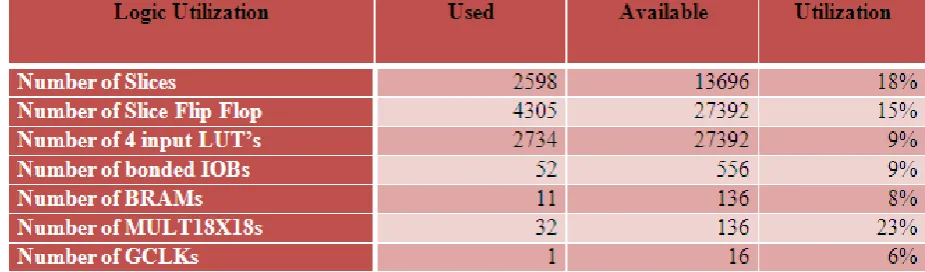
TABLE 1
Hardware Utilization Report with Virtex2 as Target Device
TABLE 2 Comparison Table
Logic Utilization
Proposed Design
(Virtex2 Pro)
OFDM Design[1]
(Virtex2 Pro
2VP30fg676)
Frequency (Speed Factor)
227.355MHz
100MHz
No. of Slices/CLB Slices(Area Factor)
2598
3418
No. of MUL (Area Factor)
32
58
No. of Bounded IOB’s
52
34
4. Hardware Implementation
5. Conclusion
An area and speed efficient technique using FPGA has been proposed to OFDM so that it can be efficiently used in wireless communication application. The concept of Radix-2 serialized FFT (DIT) algorithm has been introduced to enhance the speed and area efficiency. The comparison with other model reveals the speed and area of our model. The developed OFDM has been hardware implemented on Virtex-2Pro based xc2vp30-5ff896 target device using Xilinx ISE (10.1) tool. The required minimum input arrival time before clock is 7.183ns and the maximum output required time after clock is 5.366ns .The results show that the developed OFDM can operate at maximum frequency of 227.355 MHZ by consuming very less number of resources to provide cost effective and high performance solution for wireless communication applications.
6. References
[1] Dr Sherif Kishk, Eng Ahmed Mansourf, Prof. Mohy Eldin, “Implementation of an OFDM System using FPGA”, IEEE 26th National Radio Science Conference (NRSC), pp. 1-9, March 2009.
[2] Juan I. Montojo, Laurence B.Milstein, “Effects of Imperfection on the Performance of OFDM Systems”, IEEE Transactions on Communications, Vol. 57, No. 7, pp. 2060-2070, July 2009.
[3] Ahmed Saeed, M. Elbably, G.Abdelfadeel, “Efficient FPGA implementation of FFT/IFFT Processor” International Journal of circuits, systems and signal processing, Vol.3, Issue 3, pp. 103-110, 2009.
[4] P. Jackson, C. Chan, C. Rader, J. Scalera, and M. Vai. “A systolic FFT architecture for real time FPGA systems” High Performance Embedded Computing Conference (HPEC04), Sept. 2004.
[5] L. Yang, K. Zhang, H. Liu, J. Huang, and S. Huang, "An Efficient Locally Pipelined FFT Processor," IEEE transactions on circuits and systems—II: Express Briefs, Vol. 53, No. 7, pp. 585-589, July 2006.
[6] E. E Ngu, K. Ramar and R. Montano, V. Cooray “Fault characterization and classification using wavelet and Fast Fourier Transform,” WSEAS Transaction on Signal Processing, Volume 4, Issue 7, pp. 398- 408, July 2008.
[7] A. Cortés, I. Vélez, I. Zalbide, A. Irizar, and J. F. Sevillano, “An FFT Core for DVB-T/DVB-H Receivers,” VLSI Design, Vol. 2008, Article ID 610420, 9-pages , 2008.
[8] Jesús García1, Juan A. Michell, Gustavo Ruiz, and Angel M. Burón, "FPGA realization of a Split Radix FFT processor," Proc. of SPIE.Microtechnologies for the New Millennium, Vol. 6590, pp. 1 -11, 2007.
[9] Ioan Jivet, Alin Brindusescu, and Ivan Bogdanov “Image Contrast Enhancement using Morphological Decomposition by Reconstruction,” WSEAS transactions on circuits and systems, Volume 7, Issue 8, pp. 822-831, August 2008.
[10] M. Santhi, M.S. Kumar, G. Lakshminarayanan, T.N. Prabakar, “Design and Implementation of Pipelined MBOFDM UWB Transmitter Backend Modules on FPGA”, Proceedings of IEEE International Conference on Computing, Communication and Networking, (ICCCn), pp.1-6, Dec. 2008.
[11] X. Jinsong, L. Xiaochun, W. Haitao, B. Yujing, Z. Decai, Z. Xiaolong, W. Chaogang, “Implementation of MB-OFDM Transmitter Baseband Based on FPGA”, 4th IEEE International Conference on Circuits and Systems for Communications(ICCSC) , pp. 50-54, May 2008.
[12] J. Garcia, R. Cumplido, “On the design of an FPGA-Based OFDM modulator for IEEE 802.11a”, 2nd IEEE International Conference on Electrical and Electronics Engineering, pp. 114 – 117, Sept. 2005.
[13] Zhijian Sun, Xuemei Liu, and Zhongxing Ji, "The Design of Radix-4 FFT by FPGA," International Symposium on Intelligent Information Technology Application Workshops, pp.765-768, 2008.
[14] J. Mar, Y. Lin, T. Lung, and T. Wei, "Realization of OFDM Modulator and Demodulator for DSRC Vehicular Communication System Using FPGA Chip," International Symposium on Intelligent Signal Processing and Communications (ISPACS'06), pp. 477-480, 2006. [15] N.Balaji, K.Subba Rao, and M.Srinivasa Rao. " FPGA Implementation of Ternary Pulse Compression Sequences with Superior Merit
Factors," NAUN international Journal of Circuits, systems and signal processing. Vol .2, Issue 3, pp. 47-54,2009.
[16] J. Garcia, R. Cumplido, “On the design of an FPGA-Based OFDM modulator for IEEE 802.11a”, 2nd IEEE International Conference on Electrical and Electronics Engineering, pp. 114 – 117, Sept. 2005.
[17] Zoha Pajouhi, Sied Mehdi Fakhraie, Sied Hamidreza Jamali, “Hardware Implementation of a 802.11n MIMO-OFDM Transceiver”, IEEE International Symposium on Telecommunications, pp. 414-419, 2008.
[18] Upena Dalal, “Wireless Communication”, Oxford University Press, pp.365-366, First published in 2009.
[19] Wei-Ren Peng, “Analysis of Laser Phase Noise Effect in Direct Detection Optical OFDM Trasnmission”, Journal of Lightwave Technology, Vol. 28, No. 17, pp. 2526-2536, September 2010.
[20] Guanghui Liu, Junling Zhang, “ITD-DFE based Channel Estimation and Equalization in TDS-OFDM receivers”, IEEE Transactions on Consumer Electronics, Vol. 53, No.2, pp. 304-309, May 2007.