MODELING AND SIMULATION OF
SIGNAL PROCESSING FOR A CLOSED
LOOP FIBER OPTIC GYRO’S USING
FPGA
Radha Madhuri.Rajulapati*
Department of Electronics and Communication Engineering, K.L. University, Vijayawada, Andhra pradesh, India
Dr. Jagannath Nayak, Scientist(F), Department of Inertial Systems Group,
Research Center Imarat,RCI, Hyderabad,INDIA. [email protected]
Naseema.Sk
Department of Electronics and Communication Engineering, K.L. University, Vijayawada, Andhra pradesh, India
Abstract :
Gyroscopes are used for numerous defence and commercial applications. These include stabilization, guidance, and navigation of torpedoes; ballistic missiles and artillery shells; inertial navigation and inertial surveying; autopilot, stabilization and navigation of underwater vehicle, etc. Recently, automotive and consumer goods industries have shown significant attention towards purely commercial applications which include automobile accident-history recorder and stabilization of hand-held video camera. Fiber optic gyroscopes have several advantages over the mechanical and ring laser gyroscopes. The interferometer fiber optical gyroscopes (IFOG) is proven sensor in this field.
Many methods exist for the design of proportional-integral-derivative (PID) controllers. This paper describes a constrained optimization aimed at reducing the excess gain-bandwidth of an initial controller thereby improving its performance. This problem can be overcome by implementing the design using FPGA. Keywords: FOG; closed loop fiber optic gyro, PID controllers; FPGA.
1. Introduction
Fiber-optic gyroscopes (FOGs) have been studied and developed for more than two decades. Among different types of fiber optic gyroscopes, Interferometric fiber-optic gyroscopes (IFOGs) have been proven to be a better alternative to traditional spinning mass gyroscopes because of high reliability, wide dynamic range, low power consumption, light weight, and low cost. The major primary advantage of the IFOG technology for inertial systems are the high reliability and lower cost, as well as the potential for smaller size with increased integration of the components. Currently IFOG devices are commercially produced for application in aircraft and missile navigation systems.
are mounted on a small base with the fiber sensing coil wound around the circumference to complete the package volume. In this paper (PID) digital controller is designed.
2. Basic principle of FOG
Sagnac first demonstrated the optical gyroscope principle in 1913. Optical gyroscopes implemented so far use Sagnac effect, which states that an optical path difference induced by counter propagating beams in a rotating reference frame is proportional to the absolute rotation.
The basic configuration of the Sagnac interferometer and its operation principle is shown in Figure:
When system is at rest the light propagating in clockwise (CW) and counter clockwise (CCW) directions traverse identical paths and so there is no phase difference between them. When the system rotates at an angular rotation rate , the resultant rotation induced sagnac phase shift ∆øR is
given by 2.
Figure 1. Sagnac Interferometer [a] Bulk Optics [b] Fiber Optics and [C] Simplified interferometer.
……… (1)
where ;
R is radius of the sensor coil, L is length of the optical fiber, λ is light wavelength, and C is the speed of light in vaccum.
As with any two interferometer where two waves overlap in space, the response obtained is co-sinusoidal. Thus, the optical intensity can be written as
………(2) The main limitations of this basic configuration
poor sensitivity for small rotation rates. The direction of rotation cannot be determined.
The output is a nonlinear function of the rotation rate.
The problems of poor sensitivity and ambiguity in the determination of direction are usually overcome by the application of the phase modulation. In open loop approach, variations in the returning optical power and changes in the amplitude of the phase modulation will cause errors in output.
Technology Comparisons
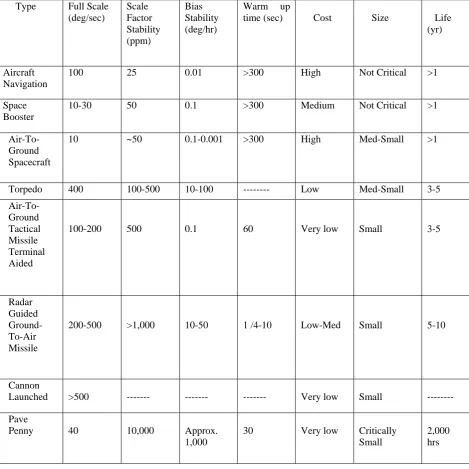
All optical gyroscopes operate by sensing and measuring the Sagnac frequency shifts induced by rotation. The means by which this is accomplished are vastly different and determine the performance, cost, design constraints, and appropriate areas of application for each type. Table 1 illustrates typical gyroscope applications and associated performance requirements.
Type Full Scale (deg/sec) Scale Factor Stability (ppm) Bias Stability (deg/hr) Warm up
time (sec) Cost Size Life (yr)
Aircraft Navigation
100 25 0.01 >300 High Not Critical >1
Space Booster
10-30 50 0.1 >300 Medium Not Critical >1
Air-To-Ground Spacecraft
10 ~50 0.1-0.001 >300 High Med-Small >1
Torpedo 400 100-500 10-100 --- Low Med-Small 3-5
Air-To-Ground Tactical Missile Terminal Aided
100-200 500 0.1 60 Very low Small 3-5
Radar Guided Ground-To-Air Missile
200-500 >1,000 10-50 1 /4-10 Low-Med Small 5-10
Cannon
Launched >500 --- --- --- Very low Small --- Pave
Penny 40 10,000 Approx.
1,000
30 Very low Critically Small
2,000 hrs
Table 1.Gyroscope applications and associated performance requirements
Performance Comparisons
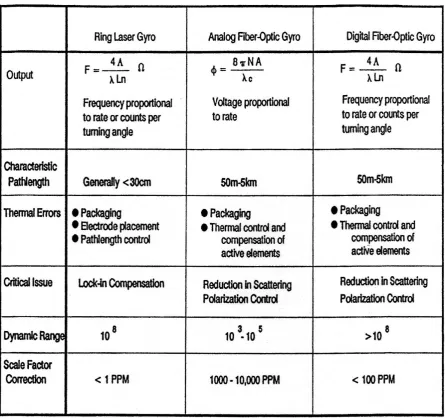
Ring laser gyros and mechanical devices continue to dominate the high performance markets, bias stability of 0.01 degrees per hour or better, which currently remain out of reach for fiber optic gyros. This, however, leaves a very wide range of non-inertial grade application suitable for fiber optic devices. Various performance characteristics of optical gyroscopes are shown in Table 2.
Table 2. Performance characteristics of optic gyroscopes
3. Configuration of closed-loop FOG
The configuration of closed-loop FOG is shown in Figure 2. The rotation rate information
∆
øR is extracted
from the detector signal and properly iterated feedback signal is given to an optical feedback element which is placed in the fiber sensing loop. The function of this optical feedback unit is provide a feedback phase shift øfbetween the CW and CCW optical waves in the fiber sensing loop proportional to the electrical signal. The feedback loop will adjust the feedback phase shift is always nearly equal and opposite in sign to the Sagnac phase for all constant input rotation rates.
Equation (3) implies that the total phase shift around the fiber sensing loop is nearly equal zero. Such fiber gyros are also reffered to as phase nulling gyros. The output of the closed-loop fiber gyro is now the electrical signal applied to the feedback element.
Figure 2. Schematic of a closed-loop fiber gyro
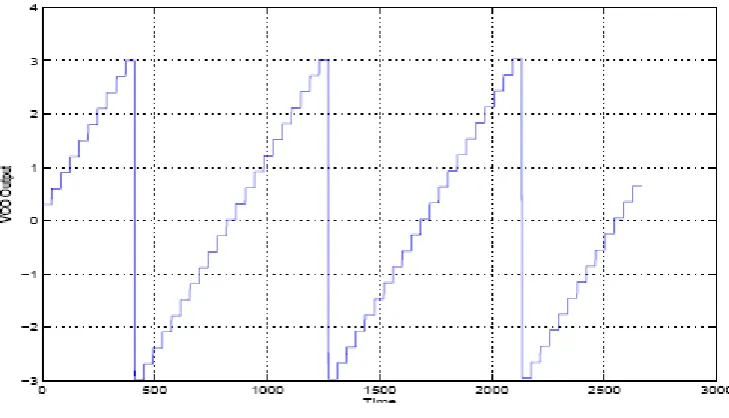
The feedback signal is given in the form of digital ramp (Figure 3) to the optical phase modulator, and slope of the digital ramp is proportional to rotation rate . The duration of each digital step is normally equal to coil transit time, τ . This modulation technique is called as digital serrodyne modulation.
Figure 3. A digital serrodyne signal for 6= 0
………..(4) where ;
V (t) is the instantaneous voltage applied to the feedback modulator and Kfp is the modulator constant.
2. Hardware implementation
Signal processing board is segmented into four major parts.
Signal conditioning amplifier, which will amplify the input PINFET signal to ADC input range. DSP processor, which will read samples from ADC, implementation of closed loop algorithm and write
Sample’s to DACs.
Optical phase modulator driver, which will give biasing and feedback electrical signal to phase modulator.
Digital output driver, which will give digital rotation rate value in RS422 levels. 2.2. Design Description
2.2.1. DSP Processor
Closed loop FOG dynamic range is about 70dB, to process these 20-bit values 32-bit processor is required. In this closed loop process ADC reading, demodulation, filtering, serrodyne modulation, writing DAC, 2π reset loop, temperature compensation is more complex. All these operations should be completed with in a cycle of modulation frequency. Because of these complexities and high precision signal processing a high performance 32-bit/40-bit floating-point processor is selected.
2.2.2. Analog-to-Digital Converter
For a dynamic range of 70 dB, 20- bit ADC is required. The bandwidth of analog signal is quite large which yields an important white noise. Signal processing theory shows that it is sufficient to sampling the analog signal with an LSB just smaller than the “σ” value of the noise, to get through digital integration the same noise reduction as with analog filtering, without any electronic source of long term drift and dead zone. To achieve the performance 16 bit ADC is selected.
2.2.3. Digital-to-Analog converter
Serrodyne modulation signal is generated by DAC, 14-bit DAC is selected. This serial, current output DAC is having 40ns settling time.
2.2.4. Op-Amp
Closed loop signal processing requires very an exceptionally high performance, high speed, low noise amplifier. The same op-amp is used as an IOC driver circuits for better results.
Figure 5. Closed loop FOG block diagram 2.2.5. Voltage Reference
4. Advantages of Gyroscopes:
Laser gyroscopes have number of advantages over conventional gyroscopes such as: There are no moving parts.
Simple design-generally less than 20 component parts. Very rugged.
Wide dynamic range.
Output is inherently digital and TTL compatible. Long and reliable lifetime(>30000 hours).
Low total cost of ownership-“fit and forget”, no maintenance.
5. Pid control theory :
Figure 6: PID Controller
The P stands for proportional control, I for integral control and D for derivative control. This is also what is called a three term controller.
Figure 7: A block diagram of a PID controller
Pseudocode
Here is a simple software loop that implements the PID algorithm in its 'ideal, parallel' form:
previous_error = setpoint - process_feedback integral = 0
wait(dt)
error = setpoint - process_feedback integral = integral + (error*dt)
derivative = (error - previous_error)/dt
output = (Kp*error) + (Ki*integral) + (Kd*derivative) previous_error = error
goto start
The basic function of a controller is to execute an algorithm (electronic controller) based on the control engineer's input (tuning constants), the operators desired operating value (set point) and the current plant process value. In most cases, the requirement is for the controller to act so that the process value is as close to the set point as possible. In a basic process control loop, the control engineer utilizes the PID algorithms to achieve this.
The PID control algorithm is used for the control of almost all loops in the process industries, and is also the basis for many advanced control algorithms and strategies. In order for control loops to work properly, the PID loop must be properly tuned. Standard methods for tuning loops and criteria for judging the loop tuning have been used for many years, but should be reevaluated for use on modern digital control systems. While the basic algorithm has been unchanged for many years and is used in all distributed control systems, the actual digital implementation of the algorithm has changed and differs from one system to another.
Theory:
The PID control scheme is named after its three correcting terms, whose sum constitutes the manipulated variable (MV). The proportional, integral, and derivative terms are summed to calculate the output of the PID controller. Defining u(t) as the controller output, the final form of the PID algorithm is:
………(5)
where
Kp: Proportional gain, a tuning parameter
Ki: Integral gain, a tuning parameter
Kd: Derivative gain, a tuning parameter
e: Error = SP − PV
t: Time or instantaneous time (the present) Proportional term:
The proportional term makes a change to the output that is proportional to the current error value. The proportional response can be adjusted by multiplying the error by a constant Kp, called the proportional gain.
The proportional term is given by:
plot of PV vs time, for three values of Kp (Ki and Kd held constant)
A high proportional gain results in a large change in the output for a given change in the error. If the proportional gain is too high, the system can become unstable. In contrast, a small gain results in a small output response to a large input error, and a less responsive or less sensitive controller. If the proportional gain is too low, the control action may be too small when responding to system disturbances. Tuning theory and industrial practice indicate that the proportional term should contribute the bulk of the output change.
Droop:
A pure proportional controller will not always settle at its target value, but may retain a steady-state error. Specifically, drift in the absence of control, such as cooling of a furnace towards room temperature, biases a pure proportional controller. If the drift is downwards, as in cooling, then the bias will be below the set point, hence the term "droop".
Droop is proportional to the process gain and inversely proportional to proportional gain. Specifically the steady-state error is given by:
e = G / Kp………(7)
Droop is an inherent defect of purely proportional control. Droop may be mitigated by adding a compensating bias term (setting the setpoint above the true desired value), or corrected by adding an integral term.
Integral term:
The contribution from the integral term is proportional to both the magnitude of the error and the duration of the error. The integral in a PID controller is the sum of the instantaneous error over time and gives the accumulated offset that should have been corrected previously. The accumulated error is then multiplied by the integral gain (Ki) and added to the controller output.
The integral term is given by:
………(8)
The integral term accelerates the movement of the process towards set point and eliminates the residual steady-state error that occurs with a pure proportional controller. However, since the integral term responds to accumulated errors from the past, it can cause the present value to overshoot the set point value.
Derivative term:
Plot of PV vs time, for three values of Kd (Kp and Ki held constant)
The derivative of the process error is calculated by determining the slope of the error over time and multiplying this rate of change by the derivative gain Kd. The magnitude of the contribution of the derivative term to the
overall control action is termed the derivative gain, Kd.
The derivative term is given by:
………(9)
4.1 The Characteristics of P, I, and D Controllers:
Response Rise Time Over Shoot Settling Time SS Error
KP Decreases Increases Small Change Decreases
KI Decreases Increases Increases Eliminate
KD Small Change Decreases Decreases Small Change
Table 3: Characteristics of PID.
4.2 How a pid controller works:
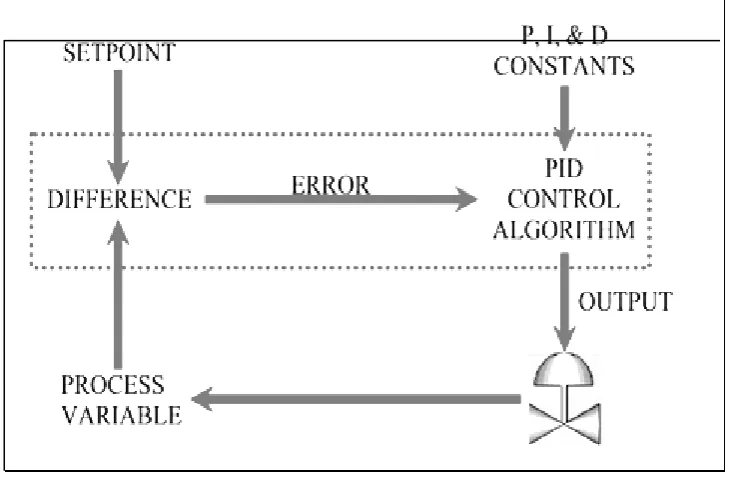
The PID controllers job is to maintain the output at a level so that there is no difference (error) between the process variable(PV) and the setpoint (SP).
Figure 8: Operation of a PID controller
In the diagram shown above the valve could be controlling the gas going to a heater, the chilling of a cooler, the pressure in a pipe, the flow through a pipe, the level in a tank, or any other process control system.
• PID control consists of a proportional plus derivative (PD) compensator cascaded with a proportional plus integral (PI) compensator.
• The purpose of the PD compensator is to improve the transient response while maintaining the stability.
• The purpose of the PI compensator is to improve the steady state accuracy of the system without degrading the stability.
6. Software development:
The DSP firmware mainly consists of following
1. Interfacing with ADC, DAC, and external world. 2. Closed loop algorithm (Gyro controller) implementation. 5.1. ADC data processing:
The input processor will have temporary storage of the input samples which can be used by the internal Gyro controller.
5.2. DAC Output Processing:
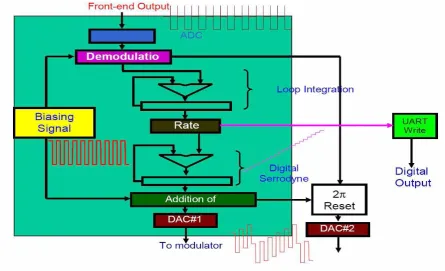
The processed data output from Gyro controller will be fed to output FIFO for temporary storage. These samples will be fed to DAC after addition of the reference bias signal (100 KHz square wave).
5.3. UART interface:
An UART interface will communicate with external host (PC). The digitized rotation rate values are sent over this communication link.
5.4. Gyro controller:
The Gyro controller block diagram is as shown below in figure 6. The demodulator, average r (LPF), Serrodyne generator and bias adder are the modules to be implemented in Gyro controller. The Gyro bias is 100 KHz square wave generated inside the DSP. This bias is added to the serrodyne signal and is fed to the DAC #1.
5.4.1. Demodulator:
The variable amplitude error output received, as input to DSP is first fed to demodulator. The demodulated output is then filtered using Low pass filter i.e. average.
5.4.2. Low pass Filter:
The low pass filter averages the demodulated error output.
5.4.3. Ramp Generator:
The filter output is used to generate the variable period Ramp signal. The filter output is sampled at 100 KHz and then used as step size of ramp.
5.4.4. Adder:
The adder adds the serrodyne signal and the biasing reference at 100 KHz square wave.
7. Modifications to the PID algorithm
The basic PID algorithm presents some challenges in control applications that have been addressed by minor modifications to the PID form.
1. Integral windup
2. Overshooting from known disturbances
3. Replacing the integral function by a model based part 4. Derivative of the Process Variable
5. Set-point ramping 6. Set-point weighting
8. Limitations of PID control
Linearity
Noise in derivative
9. Conclusion
An All-digital closed-loop (ADCL) signal processor that could be used in the all fiber FOG was developed using PID controller. This technique possesses several potential advantages over the others, such as immunity to optical intensity, no requirement of expensive IO modulator, flexibility, and possibility of the highest resolution. From the series of experiments, we could conclude that the ADCL processor resolved 0.57- radians phase difference, but with a fairly big electronics-generated offset by open wires and optics generated drift with temperature change. However, we believe that the ADCL processor, properly packaged and equipped with an appropriate stabilization circuitry for the phase modulator, would be one of the competitive signal processors for an all-fiber FOG. The Digital Controller used in this system is a PID controller with the help of the PID Algorithm as it is also having some problems so those can be overcome by implementing the FOG in FPGA. It is used for reducing the analog components.PID controller results are to be calculated for Closed loop fiber optic gyroscope CLFOG by using LABVIEW.
10.References
[1] N. Barbour and G. Schmidt, \Inertial sensor technology trends," IEEE Sensors journal, 2001. [2] The Fiber Optic Gyroscope. Artech House, Boston, 1993.
A. Pavlath, \Closed-loop _ber optic gyros," SPIE Proceedings, 1996. [3] F. cahill and E. Udd, \Phase-nulling _ber-optic laser gyro," Optics Letter, 1979.
[4] Stedman, G. E., Ring-Laser Tests of Fundamental Physics and Geophysics, In Reports on Progress in Physics, 60 (6), 1997, pp. 615--688.
[5] Nuttall, J. D., Optical Gyroscopes, Electronics and Power, November/December 1987.
[6] Pavlath, G. A., Fiber-Optic Gyroscopes, IEEE Lasers and Electro-Optics Society (LEOS) Annual Meeting, LEOS '94 Conference Proceedings, Volume 2, 31 Oct-3 Nov. 1994, pp. 237-238.
[7] Schreiber, K. U., Velikoseltsev, A., Rothacher, M., Klugel, T., Stedman, G. E., and Wiltshire, D. L., Direct Measurement of Diurnal Polar Motion by Ring Laser Gyroscopes, In Journal of Geophysical Research, 109 (B6): 2004.
[8] Schreiber, K. U., Klugel, T., and Stedman, G. E., Earth Tide and Tilt Detection by a Ring Laser Gyroscope, In J. Geophys. Res, 108, 2003, p. 2132.
[9] Kung, A., Budin, J., Thévenaz, L., and Robert, P. A., Rayleigh Fiber Optics Gyroscope, In: IEEE Photonics Technology Letters, vol. 9, num. 7, 1997, p. 973-5.
[10] Tajmar, M., Plesescu, F., and Seifert, B., Anomalous Fiber Optic Gyroscope Signals Observed above Spinning Rings at Low Temperature, (Submitted on 13 Jun 2008 (v1), last revised 25 Jun 2008 (this version, v2))
[11] Aronowitz, F., Headed in the Right Direction, Photonics Spectra, September 1988, pp. 135-140.
[12] Udd, E., Comparison of Ring Laser and Fiber Optic Gyro Technology, McDonnell Douglas Astronautics Company, 1985. [13] Kersey, A.D., Fiber Optic Gyroscope Technology, Optics News, November 1989, pp.12-19.
![Figure 1. Sagnac Interferometer [a] Bulk Optics [b] Fiber Optics and [C] Simplified interferometer](https://thumb-us.123doks.com/thumbv2/123dok_us/9643516.1492301/2.595.151.444.275.478/figure-sagnac-interferometer-optics-fiber-optics-simplified-interferometer.webp)