United Kingdom Vol. IV, Issue 10, October 2016
Licensed under Creative Common Page 199
http://ijecm.co.uk/
ISSN 2348 0386
IDENTIFYING ATTRIBUTES INFLUENCING FRESH
FRUITS AND VEGETABLES (FFV) PURCHASE
A COMPARATIVE STUDY BETWEEN NIGHT MARKET AND HYPERMARKET IN KLANG VALLEY, MALAYSIA
Amin Mahir Abdullah
Department of Agribusiness and Bio - resource Economics, Faculty of Agriculture, Universiti Putra Malaysia, Malaysia
Abdullahi Auwal Gindi
Department of Agribusiness and Bio - resource Economics, Faculty of Agriculture, Universiti Putra Malaysia, Malaysia
Mohd Mansor Ismail
Department of Agribusiness and Bio - resource Economics, Faculty of Agriculture, Universiti Putra Malaysia, Malaysia
Nolila Mohd Nawi
Department of Agribusiness and Bio - resource Economics, Faculty of Agriculture, Universiti Putra Malaysia, Malaysia
Abstract
Fresh Fruits and vegetables (FFV) retailers of various formats are dynamically influencing
customers to patronize at their stores. On the other hand, fresh fruits and vegetables consumers
are always evaluating which of these retail formats to choose for FFV purchases. This study
employs Stimulus – Organism – Response (S-O-R) model to compare consumer format choice
between night market and hypermarket retail formats and to evaluate the impact of
demographic factor (income level) of consumers on their choice of retail formats for FFV
Licensed under Creative Common Page 200
response was also evaluated. A consumer’s survey was conducted with 700 respondents from
Klang Valley Area, Malaysia. A Structural Equation Modeling (SEM) was used in analyzing the
data. Based on the empirical results of night markets and hypermarkets’ retail formats, the
models significantly fit the two retail formats and income level is not a moderator on the
relationships between stimulus, organism and response for the hypermarket retail formats’
choice models.
Keywords: Fresh Fruits, Retail formats, Stimulus, Response, Hypermarket, Moderator
INTRODUCTION
The night market which was classified as traditional retail outlet is a popular retail outlet for the consumers when purchasing fresh foods especially fruits and vegetables and is among the oldest form of food distribution channels (Chamhuri & Batt, 2013). The other category of retail format is the modern ones which include hypermarket and its emergence in Malaysia began as early as 1990s (Wong, 2007).
The night market is termed as ―PasarMalam‖ in local dialect, had become entrenched in
Licensed under Creative Common Page 201 Income, technology and lifestyles of consumers are changing, even from whom they buy are changing. The location or the place where they buy is changing; the shops are opened closed according to the convenience of the buyers. The purchasing function has gained great importance and the desires, expectations and preferences of consumers have been changing rapidly in the competitive markets due to factors such as products quality, freshness and convenience of where and when to purchase the product. In Malaysia, as in many emerging economies, there have been drastic changes in the retail industry. Although there have been many local (traditional) retail formats of night markets, modern retail formats of hypermarkets trend are increasing, thus this had intensified the competitive activities and development of new competitive strategies for the retail formats. Freshness is a factor attracting Malaysian consumers to purchase FFV from both modern and traditional retail outlets. The more the consumers have impression about freshness of the produce offered by a market, the more they have willingness to patronize the market for FFV purchase. There is conflict opinion among Malaysian consumers on the issue of which retail format offers fresh product. On the other hand, quality perception is a significant factor for retail outlets choice, and it is linked to the health attribute of food quality (Suddeephong, 2010). Presence of many varieties of products in both traditional and modern retail formats with diverse quality and prices make competition to be more intensive among the retailers.
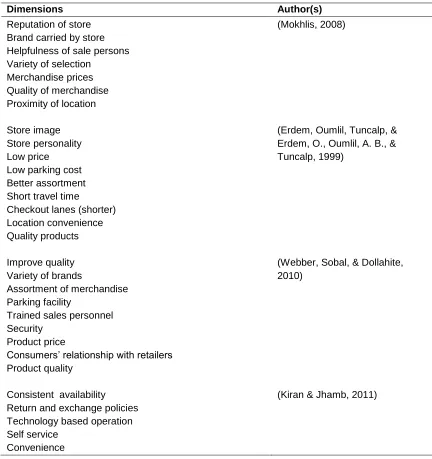
Licensed under Creative Common Page 202 choice of retail format when purchasing FFV. The study further investigates whether there is mediation effect of attitude on relationship between stimulus and response. Whether income level of the FFV consumers moderates the relationship between stimulus, organism and response of night market and hypermarket was explored. To differentiate between night market and hypermarket, factors such as services offered, space of the formats, product mix, location of the formats, time and period of operations are among the attributes used by the previous studies (Chen et al., 2012;Kattara et al., 2008;Thornton et al., 2012&Walsh et al., 2011). The review of the attributes that were generally identified by researchers as salient dimensions used by shoppers when formulating store choices were reviewed in Table 1 below.
Table 1: Dimensions Used by Shoppers for Store choice Preferences
Dimensions Author(s)
Reputation of store (Mokhlis, 2008)
Brand carried by store Helpfulness of sale persons Variety of selection
Merchandise prices Quality of merchandise Proximity of location
Store image (Erdem, Oumlil, Tuncalp, &
Store personality Erdem, O., Oumlil, A. B., &
Low price Tuncalp, 1999)
Low parking cost Better assortment Short travel time
Checkout lanes (shorter) Location convenience Quality products
Improve quality (Webber, Sobal, & Dollahite,
Variety of brands 2010)
Assortment of merchandise Parking facility
Trained sales personnel Security
Product price
Consumers‘ relationship with retailers Product quality
Consistent availability (Kiran & Jhamb, 2011) Return and exchange policies
Technology based operation Self service
Licensed under Creative Common Page 203
Color of the fruits (Albornoz, Ortega, Segovia,
Damage of the fruits Bracho, & Cubillan, 2009) Shape of the Fruits
Ripeness
There are considerable numbers of literature differentiating traditional retail formats from the modern outlets especially for fresh food purchases. Some of the literature include: Chamhuri and Batt (2013); Hino, (2010); Minten and Reardon, (2008); Schipmann and Qaim, (2011),among others. At consumer level, different factors were reported that have impacted their decisions to purchase food at either traditional or modern retail outlets (Hwa & Chin, 2012). The competition between these two different retail formats is getting tougher especially for fresh fruits and vegetables. Despite these phenomena, studies to compare the difference between night market and hypermarket choice models for FFV consumers are limited (Gindi et al., 2015).
LITERATURE REVIEW
The Stimulus-Organism-Response model is the evolution of the early consumer behavior model (CB). The early researchers on CB model tried to explain the model only as input – output relationships, whereby economics or financial factors served as inputs while purchasing behavior as output (Jacoby, 2002). But realization of numerous assumptions of the early CB model; among the foremost assumption was the assumption that consumers were expected to operate ―rationally‖ which was generally defined by reference to external criterion. Adopting this assumption means that the significance of consumers‘ mental state and processes as well as
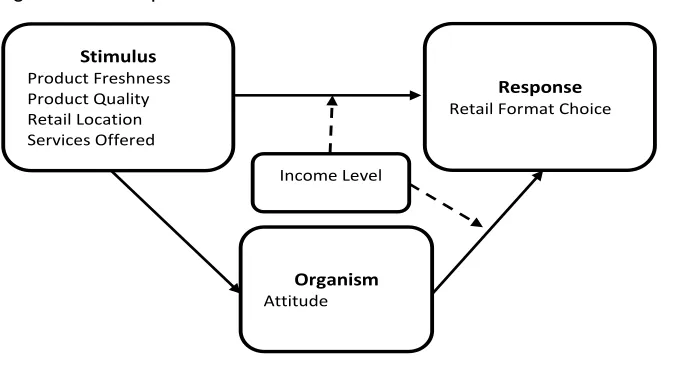
individual differences must be considered. Essentially, consumers are conceptualized as reacting to these external factors (Stimulus) to make judgment or decision (Organism) and this will lead to taking action (Response).
Generally speaking, S-O-R model consists of Stimulus as the independent variable, Organism as mediator and Response as the dependent variable (Spies et al., 1997; Turley & Milliman, 2000; Yoo et al., 2015; Vieira, 2013 and Goi et al, 2014). Most of the past researchers agreed on these three basic variables (Goiet al, 2014), but the problem was the dimensions of each variable and interrelationship between the variables. Jacoby (2002) argued that sometimes it could be very difficult for a researcher to determine whether certain constructs belong to either Stimulus realm, the Response realm, or the realm of Organism. Examples of such models can be referred in Baker et al., (2004),Hoyer, (1984)and Goi et al,( 2014). Based on this limitation of the S-O-R model, Jacoby(2002) made a conclusion that there was lack of clarity in designating whether a particular phenomenon should be represented as a Stimulus, Organism or Response factor, certain phenomenon may be both Stimulus and Response.
Licensed under Creative Common Page 204
Stimulus
Product Freshness Product Quality Retail Location Services Offered
Response
Retail Format Choice
Organism
Attitude Income Level
Despite majority of the past studies adopted the earlier dimensions of the S-O-R model i.e. environmental characteristic as stimulus, negative or positive emotion as mediator and emotional response as response (Yoo et al., 2015), other researchers have modified and made extensions to the earlier dimensions like Kaltcheva and Weitz, (2006),Fiore and Kim, (2007), and Kim & Moon, (2009). Based on these arguments, for this study, the S-O-R model was used to compare night market and hypermarket retail formats choice when deciding to purchase FFV. The Stimulus dimension comprises product freshness, product quality, location of the retail formats and service offered by the retailers. The Organism dimension is attitude of consumers toward retail format choice while the Response dimension is the retail format choice.
Literature suggested the use of Mehrabian and Russell affect model (Goiet al., 2014; Baker et al., 2004&Veira, 2013) in understanding the effect of environment on consumers‘
behavior. Most researchers in retailing had adopted this model and introduce S-O-R which requires stimulus; a set of mediating variables; and behavioral responses (Goiet al., 2014). The importance of using S-O-R model is its ability to explain factors that contribute to retailer‘s
success, which could be achieved by improving the factors considered by consumers while choosing a retail format for the FFV purchases. The S-O-R model will assist service providers in understanding behavior of Malaysian FFV consumers toward FFV purchases.
Economic status of consumers had led to a distinct social classification which was manifested in their shopping behavior. Studies by Goldman and Hino, (2005) and Farhangmehr et al., (2000) recognized the importance of economic variables as a key aspect of shopping at modern retail formats. Hino, (2010) found that wealthier consumers were the first to adapt to modern retail formats. In contrast, lower income consumers tend to continue shopping in traditional outlets due to their close proximity to home (Goldman et al., 2002). The lower class customers were more likely to purchase household items in street market while upper class patronized department stores and supermarkets (Zinkhan et al., 1999).
Licensed under Creative Common Page 205
Hypothesis Development
Perceived Product Freshness
Perceived freshness of a product is a powerful characteristic of the product attributes which prompted people to make preferences to any retail format they perceived in obtaining fresh products. Therefore, the higher the perceived freshness of fruits and vegetables from a retail format the more shoppers prefer to shop at that retail format. According to Ali et al., (2010) on buying behavior of consumers in an emerging economy, stated that about 80% of the respondents considered product attributes of freshness as very important for choosing the retail formats for FFV purchase. With this finding in mind, we propose the following hypothesis:
H1.Perceived product freshness positively affects attitude of consumers toward (a) night market (b) hypermarket for FFV purchases.
Perceived Product Quality
Perceived quality is used to measure consumers‘ judgment about the superiority of the
products. Attributes such as texture, taste and physical appearance of the products are used by the consumers in making judgment on quality of the product. There is a positive relationship between quality and demand of the products. Harker et al. (2003); reported that 1% increase in perceived quality of fruits and vegetables by the consumers might generate as much as 60% increase in demand for the product. This consequently leads to the choice of retail formats perceived to have such product. Based on this argument, we proposed the following hypothesis: H2.Perceived product quality positively affects attitude of consumers toward (a) night market (b) hypermarket for FFV purchases.
Retailers’ Service Delivery
Sweeney, (2010) argued that the salesperson behavior (service delivery) was crucial in determining customer willingness to buy. With appropriate salesperson behavior, the customer will develop a positive perception of the salesperson‘s knowledge. Foss et al., (2008) also observed that staff behavior has a positive influence on consumer satisfaction and this can influence the consumer for revisiting and repurchasing to the retail format. With these findings in mind, we propose the following hypothesis:
H3.Retailers‘ services positively affects attitude of consumers toward (a) night market (b) hypermarket for FFV purchases.
Licensed under Creative Common Page 206
Attitude of the Consumers
Research by Jackson et al., (2011) investigates the extent to which attitudes toward mall attributes and shopping value derived from a mall visit differ across gender and generational cohorts. Analysis of results show that there are no differences in hedonic and utilitarian shopping values by generational cohort, but generational differences in attitude toward mall hygiene factors, location convenience and entertainment features did exist. With these findings in mind, we propose the following hypotheses (H5 to H8):
H5.Attitude mediates the effect of perceived freshness on (a) night market choice (b) hypermarket choice for FFV purchases.
H6.Attitude mediates the effect of perceived quality on (a) night market choice (b) hypermarket choice for FFV purchases.
H7.Attitude mediates the effect of retailer‘s services on (a) night market choice (b) hypermarket choice for FFV purchases.
H8.Attitude mediates the effect of location on (a) night market choice (b) hypermarket choice for FFV purchases.
Income Level
Income is a variable strongly associated with some psychological variables. Previous studies report that the travel time sensitivity and store choice behavior of high- income shoppers differs from that of low-income shoppers (Alwitt & Donley, 1997; Bhat, 1998; Gonzalez-Benito & Spring, 2000). Low-income households FFV consumers have accessing these modern retailers have not been designed for them but for suburban middle class shoppers. On the other hand, How low-income shoppers decide where to purchase FFV depend on a variety of factors. Food cost, consumers‘ income and resources, are associated with places of preferences(Thornhill, 2006 & Yadav et al, 2013). People often reported that they ‗‗did not care‘‘ what kind of store they shopped in ‗‗as long as‘‘ it was ‗‗economical‘‘ or ‗‗nearby‘‘ or ‗‗can give me pretty much everything I need in one store.‘‘ These low-income customers did not expect concessions to be made for them, as they recognized that stores were businesses not charities. Based on these arguments, we propose the following hypothesis:
H9. Income moderates the effect of Stimulus, Organism on (a) night market (b) hypermarket choice for FFV purchases.
METHODOLOGY
Licensed under Creative Common Page 207 from all walks of life in terms ethnicity, income level, reflecting different purchasing power, and education. Data were collected within the period of three months from 5th June to 17th September, 2014. The good mix of population will provide a good mixture of sample. Retail outlets both modern and traditional types are operating side by side competing for customers but sometimes complementing each other in terms of product offering. For example, out of 296 hypermarket outlets in Malaysia, 159 (53 percent) hypermarket outlets are located in the KlangValley area (Hassan & Rahman, 2012). This study however will focus on FFV consumers who purchased at hypermarket and ‗pasarmalam‘ (night market).
The frequency of retail formats visits and the number of times respondents used retail formats for fresh fruits and vegetables purchases is depicted in Table 2. As shown in the table, hypermarket has the highest number of daily visits for fresh fruits and vegetable purchases with 10.70 percent. There is no report on daily visits to night market, this is because, the market operate only twice or once in a week.
Table 2: Frequency of Retail Formats Visit for Fresh Fruits and Vegetables Purchase (N= 700)
Retail Daily Twice in a Week Ones in a week Ones in a Fortnight
Format Freq. % Freq. % Freq. % Freq. %
Night market - - 122 17.40 230 32.90 90 12.90
Hyper market 75 10.70 70 10.00 89 12.70 91 13.00
In determining the sample size, cluster sampling technique was employed, involving clustering of the entire population in to six clusters. The clusters include Kuala Lumpur, Putra Jaya, Petaling District, Klang, Gombak and Hulu Langat. In each cluster, one city area was randomly selected. The second stage of obtaining the sample size is the use of systematic random sampling and the main advantage of using systematic random sampling is that it could be used without having a list of basic sampling units as in a situation where the dwellings were well organized in rows, blocks or along a river or main road (Ishak et al., 2012). The house units in the areas included the detached houses, semi-detached houses, terraced or link houses, bungalows, and apartments or condominiums and a total of 700 respondents were interviewed.
Licensed under Creative Common Page 208 considered while choosing retail format are ―I don‘t have interest in purchasing imported product‖, ―I don‘t consider branded fruits and vegetables as my priority in making decision to buy the product‖, and ―branding is not indication of food quality‖ These variables‘ scores are reversed. The 21 items used as store service delivery and location measures were adapted from Kim et al., (2014) and Kiran and Jhamb (2011). Attributes related to store services delivered by the consumers include: Looking how hygienic the vendors/retailers are is not my concern when purchasing fresh fruits; Looking how hygienic the premises are is important in making decision to purchase fresh fruits; I prefer to shop at retailers who have knowledge to answer customers‘ questions; I prefer to choose a store where there is room for bargaining with store personnel and I prefer to choose the store whose personnel response quickly to my request. Statements related to store location or the distance between respondents‘ residents/place of work to the retail formats are ―I don‘t care about how long it will take me to finish the purchasing of fresh fruits in selecting store to go‖, ―availability of public transportation near the store make me in choosing store for fresh fruits purchase‖ and ―I always concern about time taken to reach the store for fresh fruits purchase‖.
A total of 14 statements was adapted from Tam et al. (2006) to measure the psychographic factor of attitude in choosing retail formats for fresh fruits and vegetables purchases. The statements include: I always spend a lot of time talking to my friends about fresh fruits and vegetables shopping; I always takes opinion of my family before taking decision; I feels confident on my ability to shop for product; I do shopping to keep up with the trend; I always like to try new outlets while shopping; I feels relax while shopping; I have ability to choose the right product for myself and I do shopping to see what new products are available‖.
The statements related to night market include: ―one stop shopping of variety of products‖; Getting exact amount you want; Getting quality level you want; Problem of overcrowding; Night market is disorganized; Product are expensive and advantage of bargaining at late hours. The statements related to hypermarket construct are Products are cheaper at Hypermarket; Opportunity of using credit card; Enjoying time with friends; Enjoying entertainment; Enjoying time with family; Availability of parking space; Visually attractive shopping environment.
Licensed under Creative Common Page 209 analyzed using SPSS version 21 Software and Amos graphic software for Structural Equation Modeling (SEM).
Structural equation model have been used due to its advantages over multiple regression model. SEM have the ability to provides simultaneously overall tests of model fit and individual parameter estimate tests, regression coefficients and variance may be compared simultaneously, even across multiple between- subjects groups. SEM has the ability of interdependencies between several outcome and their causal factors.
EMPIRICAL RESULTS AND DISCUSSION
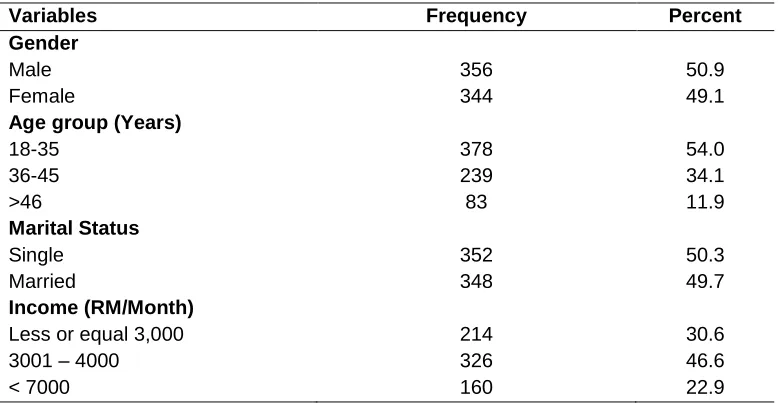
Demographic characteristics of the FFV consumers were depicted in Table 3, from the table out 51 percent of the respondents were male and 49 percent were female. The majority (54 percent) of them is within the age group of 18 to 35years, followed by 34 percent within the group of 36 to 45years and only 12 percent are above 46years. In terms of income level, that majority (47 percent) of the respondents earned between RM3001 and RM4000 per month while the remaining 30 percent and 23 percent of the sample population earned less than RM3000 and less than RM7000 per month respectively.
Table 3: Demographic Characteristics of the Respondents
Variables Frequency Percent
Gender
Male 356 50.9
Female 344 49.1
Age group (Years)
18-35 378 54.0
36-45 239 34.1
>46 83 11.9
Marital Status
Single 352 50.3
Married 348 49.7
Income (RM/Month)
Less or equal 3,000 214 30.6
3001 – 4000 326 46.6
< 7000 160 22.9
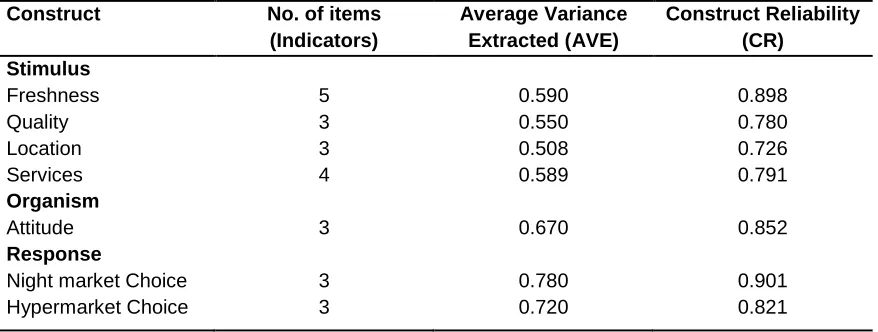
Licensed under Creative Common Page 210 Table 4: Average Variance Extracted and Construct Reliability of the FFV Study Instruments
Construct No. of items
(Indicators)
Average Variance Extracted (AVE)
Construct Reliability (CR)
Stimulus
Freshness 5 0.590 0.898
Quality 3 0.550 0.780
Location 3 0.508 0.726
Services 4 0.589 0.791
Organism
Attitude 3 0.670 0.852
Response
Night market Choice 3 0.780 0.901
Hypermarket Choice 3 0.720 0.821
Results of SEM Analysis
Structural Equation Model (SEM) was performed to evaluate sample models of night and hypermarket retail format choice for FFV purchase. Maximum likelihood method was used with AMOS to achieve model minimization. The model fit indices of the two retail formats indicate good model fit for the sample data and are presented in Table 5 below. Base on model fit indices‘ values against criteria, the proposed model was accepted.
Table 5: Model Fit Indices
Indices Criteria Night Market Choice Model Hypermarket Choice Model
χ2 679.019 794.810
χ2/df < 5.0 3.537 3.732
GFI > 0.9 0.922 0.911
CFI >0.9 0.944 0.932
TLI >0.9 0.933 0.920
RMSEA <0.08 0.060 0.062
Table 6 presents the SEM results of parameter estimates of night market and hypermarket format choice. Freshness of the fruits and vegetables has positive and significant effect on night market format choice (β= 0.101, p = 0.026), hypothesis 1a was supported. Quality of the fruits and vegetables has positive and significant effect on night market format choice (β= 0.09, p =
Licensed under Creative Common Page 211 that, behavioral intentions of consumers were influenced by perceived quality. Service delivery has positive and significant effect on night market format choice (β= 0.108, p = 0.004) and
hypothesis 3a is supported. Location of the night market has negative and significant effect on night market format choice (β= -0.159, p = 0.028), hypothesis 4a is supported. This means the longer the distance of the consumers‘ residence to the night market, the less they choose the format for fresh fruits and vegetables purchases. Attitude of the consumers toward hypermarket have significant and positive effect on hypermarket choice with regression weights of β= 0.332, and significant at 0.0001 level. All attributes are not significant and hence hypotheses are not supported.
Table 6: Regression Weights of S-O-R Models of Night and Hypermarket Retail Formats
Constructs Path Constructs
Standardized Regression Weight
Estimate (β)
S.E. C.R. P
Night market Choice <--- Freshness .101 .036 2.231 .026 Night market Choice <--- Quality .090 .071 2.143 .032 Night market Choice <--- Location -.159 .089 -1.636 .028 Night market Choice <--- Services .108 .073 1.721 .004 Night market Choice <--- Attitude .118 .059 2.025 .043 Hypermarket Choice <--- Freshness .013 .045 .290 .772
Hypermarket Choice <--- Quality .003 .088 .072 .942
Hypermarket Choice <--- Location .028 .083 .452 .651
Hypermarket Choice <--- Service Delivery .065 .075 1.181 .238 Hypermarket Choice <--- Attitude .332 .071 6.085 ***
***P< 0.001
Testing of Mediation Effect
For testing mediation effect, full model and indirect model was compared, and the former model is better than indirect model. The three measures of χ² and significant of χ², Parsimony Normed Fit Index (PNFI) and Akaike Information Correction (AIC) were used in ascertaining decision for the better model. For the χ², significant of χ² and AIC, the smaller the value the better the model fit (Kline, 2005). Table 7 presents full and indirect models.
Table 7:Full and Indirect Models Comparisons of Fresh Fruits Night Market Models
Model PNFI AIC CMIN(χ²)
Night Market Model Full Mediation Model .738 871.800 779.800 Indirect Model ―Attitude‖ .735 1218.959 1138.959
Hypermarket Model Full Mediation .741 771.169 679.169
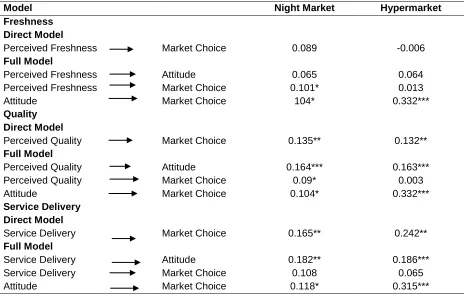
Licensed under Creative Common Page 212 To assess the effect of mediator (attitude), regression weights of direct and full models were compared as presented in Table 8. For perceived freshness attribute, the regression weights from the perceived freshness construct to mediator (attitude) are insignificant for night market and hypermarket retail format choice models. Likewise, none of the direct models regression weights from freshness to market choice is significant for both retail formats. Therefore, attitude does not mediate the effect of relationships between freshness and retail format choice of night market and hypermarket, thus hypotheses 5a and 5b are not supported. To assess the effect of attitude as mediator in the relationships between perceived quality and night market and hypermarket retail format choice, results in Table 8 show that attitude partially mediates the effect of the relationships between quality and night market choice, but fully mediates the effect of the relationships between quality and hypermarket choice, hence hypotheses 6a and 6b are supported. Attitude fully mediates the effect of the relationships between service delivery and nightmarket format and also between service delivery and hypermarket format and therefore hypotheses 7a and 7b are supported. However, attitude does not mediate the relationships between location and night market and hypermarket choice.
Table 8 Standardize path and Regression weights of Direct and Full Models of Fresh Fruits and Vegetables Market Choice Models Stimulus where Perceived Attitude Serves as Mediator
Model Night Market Hypermarket
Freshness Direct Model
Perceived Freshness Market Choice 0.089 -0.006
Full Model
Perceived Freshness Attitude 0.065 0.064
Perceived Freshness Market Choice 0.101* 0.013
Attitude Market Choice 104* 0.332***
Quality Direct Model
Perceived Quality Market Choice 0.135** 0.132**
Full Model
Perceived Quality Attitude 0.164*** 0.163***
Perceived Quality Market Choice 0.09* 0.003
Attitude Market Choice 0.104* 0.332***
Service Delivery Direct Model
Service Delivery Market Choice 0.165** 0.242**
Full Model
Service Delivery Attitude 0.182** 0.186***
Service Delivery Market Choice 0.108 0.065
Licensed under Creative Common Page 213 Location
Direct Model
Location Market Choice -0.087 0.112
Full Model
Location Attitude -0.110* 0.033
Location Market Choice -0.121 0.028
Attitude Market Choice 0.118* 0.315***
Is the regression path between constructs * significant p<0.05, ** significant p<0.01, *** Significant p<0.001
Test of Moderating Variables
A moderating variable is the variable that alters the strength of the causal relationship between independent and dependent variables. In this study, the predictors stimuli influence the response as dependent variable. We want to know whether the effect of these relationships will be altered by the income level categories of the respondents. If income level can alter the strength of the relationship, then we can say that income moderates the relationship between independent variables (stimuli) and dependent variable (response).
Test of moderation was done through Multi Group Analysis (MGA), which is splitting the data into groups based on moderator. For this research, data was split into low income level group and high income level group of fresh fruits and vegetables consumers.
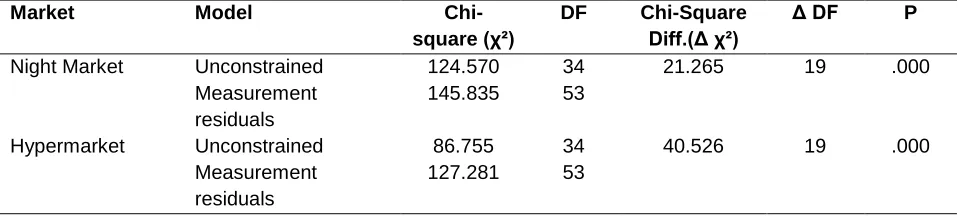
The first stage of MGA was comparing unconstrained model with measurement residuals model. In order to test for model comparison, the significant of chi- square (χ²) and change in chi-square difference (Δχ²) have to be considered. The assumption is that; If the (χ²) of measurement residual is greater than χ² of unconstrained model at p < α for both models, then the unconstrained model is better since it has smaller χ² value and conclusion could be made of the presence of moderation effect in the relationship. The results of MGA are presented in table 9.
Table 9: Multiple Group Analysis (Income Level as a moderator of Stimulus and Response of Fresh Fruits and Vegetables Night and Hypermarkets‘ Retail Formats
Market Model
Chi-square (χ²)
DF Chi-Square Diff.(Δ χ²)
Δ DF P
Night Market Unconstrained 124.570 34 21.265 19 .000
Measurement residuals
145.835 53
Hypermarket Unconstrained 86.755 34 40.526 19 .000
Measurement residuals
127.281 53
Licensed under Creative Common Page 214 The second stage of moderation effect testing on the individual paths was conducted. Hair et al., (2009)criterion was employed in determining the moderation effect of the relationship between stimulus, organism variables and response. The criterion states that the path is moderated by a moderator if beta (β) for group 1 is significant while beta (β) for group 2 is non-significant; or betas (β) for both groups are significant but one is positive and the other one is negative. The researcher examined the structural invariance of night and hypermarket retail format choice models across income levels for testing the presences of moderation
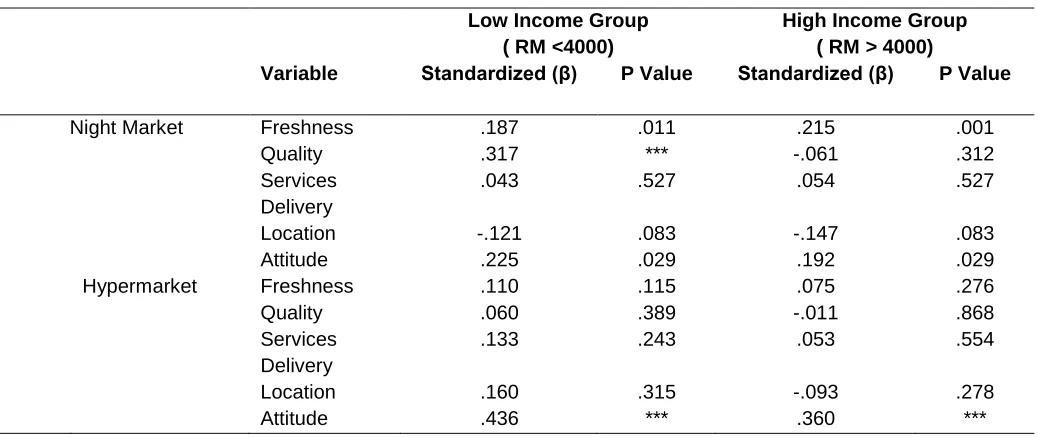
Table 10: Result of Moderation Test of Income Level on Relationship between Stimulus Predictors and Response (Night Market & Hypermarket Formats Choice)
Low Income Group ( RM <4000)
High Income Group ( RM > 4000)
Variable Standardized (β) P Value Standardized (β) P Value
Night Market Freshness .187 .011 .215 .001
Quality .317 *** -.061 .312
Services Delivery
.043 .527 .054 .527
Location -.121 .083 -.147 .083
Attitude .225 .029 .192 .029
Hypermarket Freshness .110 .115 .075 .276
Quality .060 .389 -.011 .868
Services Delivery
.133 .243 .053 .554
Location .160 .315 -.093 .278
Attitude .436 *** .360 ***
***P< 0.001
The moderation effects of income on relationships between stimulus and response are presented in Table 10. From the result, income level of the fresh fruits and vegetables consumers moderated the relationship between perceived quality of the FFV and night market choice with the following regression weights: low income level (β= 0.317, P= 0.0001) and high income level(β= -0.61, P= 0.312].Thus, income is not a moderator of the relationship between
the remaining stimuli and responses in both night market and hypermarket choice models.
DISCUSSION AND CONCLUSION
Licensed under Creative Common Page 215 retailers. The results of this research tally with the study by Zinkhan, et al., (1999) at Sao Paulo street market, Brazil, that there was deep –seated impressions about perceived freshness of produce offered by the traditional market to consumers. Goldman et al., (1999) carried out a study in Hong Kong traditional market indicated that all the FFV consumers considered food products purchased at the traditional markets as ―fresher and cheaper‘‘ than those purchased in modern market.
Empirical results of this study show that freshness, quality, location and service delivery are not significant at hypermarket retail format choice for fresh fruits and vegetables purchases. This result is not surprising because there are other factors considered by the consumers in patronizing hypermarket retail formats for their purchases. Previous studies indicate that the most important attribute mentioned was quality, followed by price (Farhangmehr et al., 2000). In contrast, Albornoz et al., (2009) discovered that hypermarket was a preferred type of retail formats due to its low prices and convenient. The survey conducted by Food Marketing International on European consumers indicates that store cleanliness and assortment are the most important attributes considered by the consumers while choosing hypermarket for FFV purchases. The work of Geuens, et al, (2009) in Chamhuri and Batt, (2013) described convenience of shopping from modern retail outlets in terms of the facilities provided such as car parking, trolley and baskets, proximity to other shops, extended trading hours and good presentation of the products.
Attitude of fresh fruits and vegetables consumers toward night market format choice fully relied on services delivered by the retailers and perceived quality of the fresh fruits at night market retail format. This is in line with the work of Suddeephong, (2010) reported that, services offered by the retailers at night markets of constantly trimming, spraying, cleaning and sorting out fruits and vegetables had positive effect on attitude of the consumers toward choosing traditional retail formats for FFV purchases. Likewise, attitude toward hypermarket format choice fully relied on convenience and service delivery at hypermarket format. Convenient at hypermarket retail formats include one –stop shopping, availability and enough parking space, food and leisure areas (Farhangmehr et al., 2000). Lower income group consumers were more propound on quality at night market than high income level. This shows that low income level group of FFV consumers concerned more on quality of the products than high income level. The result of this study is strongly supported by Worsley and Scott, (2000) who showed that poorer people were more concerned about food quality.
Licensed under Creative Common Page 216 hypermarket retailers targeting FFV consumers should place more emphasis on store attributes dimensions of convenience in their marketing strategy and communication. Improvement in service delivery from the night market retailers can also serve as marketing strategy and competitive advantage for capturing the mind of FFV consumers.
RECOMMENDATION FOR FUTURE RESEARCH
This study used Stimulus-Organism-Response model to compare preferred attributes between night market and hypermarket retail format choice for FFV purchases. This study represents a rare study of the S-O-R model focusing and comparing local and modern retail formats. There are ample opportunities remained for further research. First, the model can be tested with other local and modern retail formats. Secondly, the model can involve different product lines instead of using one specific product line (fresh fruits and vegetables).
REFERENCES
Albornoz, A., Ortega, L., Segovia, E., Bracho, Y., & Cubillan, G. (2009). Purchase attributes of fresh fruits at domestic level. Bioagro, 21(1), 57–62.
Ali, J., Kapoor, S., & Moorthy, J. (2010). Buying behaviour of consumers for food products in an emerging economy. British Food Journal, 112(2), 109–124. http://doi.org/10.1108/00070701011018806
Alwitt, L. F., & Donley, T. D. (1997). Retail Stores in Poor Urban Neighborhoods. Journal of Consumer Affairs, 31(1), 139–164. http://doi.org/10.1111/j.1745-6606.1997.tb00830.x
Arshad, F. M., & Darham, S. (2012). Parallel Mixed Mode Surveys on Consumer Attitude towards Fresh Produce. Business and Management Research, 1(3), 51–60. http://doi.org/10.5430/bmr.v1n3p51
Baker, S. Thompson, K. Engelken, J. (2004). Mapping the values driving organic food choice: Germany vs. the UK and UK vs. Germany. European Journal of Marketing, 38(8), 995 – 1012.
Bhat, C. R. (1998). Analysis of travel mode and departure time choice for urban shopping trips. Transportation Research Part B: Methodological, 32(6), 361–371. http://doi.org/10.1016/S0191-2615(98)00004-6
Chamhuri, N., & Batt, P. J. (2013). Segmentation of Malaysian shoppers by store choice behaviour in their purchase of fresh meat and fresh produce. Journal of Retailing and Consumer Services, 20(6), 516– 528. http://doi.org/10.1016/j.jretconser.2013.06.008
Chen, Jia-yin Qi. Yong, pin Z., & Wen, J. (2012). Are customer satisfaction and customer loyalty drivers of customer lifetime value in mobile data services : a comparative cross-country study. Infor. Technol Manag, 13, 281–296. http://doi.org/10.1007/s10799-012-0132-y
Erdem, O., Oumlil, a. Ben, Tuncalp, S., & Erdem, O., Oumlil, A. B., & Tuncalp, S. (1999). Consumer Values and the Importance of Store Attributes. International Journal of Retail & Distribution Management, 27(4), 137–144. http://doi.org/10.1108/09590559910268435
Farhangmehr, M., Marques, S., & Silva, J. (2000). Consumer and retailer perceptions of hypermarkets and traditional retail stores in Portugal. Journal of Retailing and Consumer Services, 7(4), 197–206. http://doi.org/10.1016/S0969-6989(00)00019-9
Licensed under Creative Common Page 217 Foss, B., Stone, M., & Ekinci, Y. (2008). What makes for CRM system success — Or failure? Journal of Database Marketing & Customer Strategy Management, 15(2), 68–78. http://doi.org/10.1057/dbm.2008.5
Geuens, M., Weijters, B., & De Wulf, K. (2009). A new measure of brand personality. International Journal of Research in Marketing, 26(2), 97–107.
Gindi, A. A., Abdullah, A. M., Ismail, M. M., & Nawi, N. M. (2015). Segmentation of Fresh Vegetable Shoppers by Product and Store Attributes Consedered for Fresh Vegetable Purchase in Klang Valley, Malaysia. IOSR Journal of Agriculture and Veterinary Science Ver. II, 8(2), 2319–2372. http://doi.org/10.9790/2380-08226067
Goi, M. T., Kalidas, V., & Zeeshan, M. (2014). Comparison of Stimulus-Organism-Response Framework between International and Local Retailer. Procedia - Social and Behavioral Sciences, 130, 461–468. http://doi.org/10.1016/j.sbspro.2014.04.054
Goldman, A., & Hino, H. (2005). Supermarkets vs. traditional retail stores: diagnosing the barriers to supermarkets‘ market share growth in an ethnic minority community. Journal of Retailing and Consumer Services, 12(4), 273–284. http://doi.org/10.1016/j.jretconser.2004.10.002
Goldman, A., Krider, R., & Ramaswami, S. (1999). The Persistent Competitive Advantage of Traditional Food Retailers in Asia: Wet Markets‘ Continued Dominance in Hong Kong. Journal of Macromarketing, 19(2), 126–139. http://doi.org/10.1177/0276146799192004
Goldman, A., Ramaswami, S., & Krider, R. E. (2002). Barriers to the advancement of modern food retail formats: theory and measurement. Journal of Retailing (Vol. 78). http://doi.org/10.1016/S0022-4359(02)00098-2
Gonzalez-Benito, J., & Spring, M. (2000). JIT purchasing in the Spanish auto components industry. Implementation patterns and perceived benefits. International Journal of Operations & Production Management, 20(9/10), 1038–1061. http://doi.org/10.1108/01443570010339145
Hair, J., Black, W., Babin, B., & Andreson, R. (2009). Multivariate Data Analysis. Faculty Publications. Retrieved from http://digitalcommons.kennesaw.edu/facpubs/2925
Harker, F. R., Gunson, F. A., & Jaeger, S. R. (2003). The case for fruit quality: an interprsaetive review of consumer attitudes, and preferences for apples. Postharvest Biology and Technology, 28(3), 333–347. http://doi.org/10.1016/S0925-5214(02)00215-6
Hassan, H., & Rahman, M. S. (2012). Transformation of hypermarket retailing industry in Malaysia. In ICIMTR 2012 - 2012 International Conference on Innovation, Management and Technology Research (pp. 513–516). http://doi.org/10.1109/ICIMTR.2012.6236449
Hino, H. (2010). Antecedents of supermarket formats‘ adoption and usage: A study in the context of non-western customers. Journal of Retailing and Consumer Services, 17(1), 61–72. http://doi.org/10.1016/j.jretconser.2009.09.005
Hoyer, W. D. (1984). An Examination of Consumer Decision Making for a Common Repeat Purchase Product. Journal of Consumer Research. http://doi.org/10.1086/209017
Hwa, Y. s., & Chin, C. H. (2012). Using Conjoint Analysis to Study Consumers Choice of Supermarkets. Jurnal Pengurusan, 34(2012), 91–100.
Ishak, N. K., Aziz, K. A., & Ahmad, A. (2012). Dynamism of a night market. Journal of Case Research in Business and Economics, 4(1), 1–16.
Jackson, V., Stoel, L., & Brantley, A. (2011). Mall attributes and shopping value: Differences by gender and generational cohort. Journal of Retailing and Consumer Services, 18(1), 1–9. http://doi.org/10.1016/j.jretconser.2010.08.002
Jacoby, J. (2002). Stimulus-Organism-Response Reconsidered : An Evolutionary Step in Modeling ( Consumer ) Behavior, 12(1), 51–57.
Licensed under Creative Common Page 218 Kattara, H. S., Weheba, D., & El-Said, O. A. (2008). The impact of employee behaviour on customers‘ service quality perceptions and overall satisfaction. Tourism & Hospitality Research, 8(4), 309–323. http://doi.org/10.1057/thr.2008.35
Kim, W. G., & Moon, Y. J. (2009). Customers‘ cognitive, emotional, and actionable response to the servicescape: A test of the moderating effect of the restaurant type. International Journal of Hospitality Management, 28(1), 144–156. http://doi.org/10.1016/j.ijhm.2008.06.010
Kim, Y.-K., Lee, M.-Y., & Park, S.-H. (2014). Shopping value orientation: Conceptualization and measurement. Journal of Business Research, 67(1), 2884–2890. http://doi.org/10.1016/j.jbusres.2012.06.006
Kiran, R., & Jhamb, D. (2011). A Strategic Framework for Consumer Preferences towards Emerging Retail Formats. Journal of Emerging Knowledge on Emerging Markets, 3(1), 1–18. http://doi.org/10.7885/1946-651X.1058
Kline, R. B. (2005). Principles and Practice of Structural Equation Modeling (2nd Editio). New York: The Guilford Press.
McLaughlin, E. W. (2004). The dynamics of fresh fruit and vegetable pricing in the supermarket channel. Preventive Medicine, 39 Suppl 2, S81–7. http://doi.org/10.1016/j.ypmed.2003.12.026
Minten, B., & Reardon, T. (2008). Food prices, quality, and quality‘s pricing in supermarkets versus traditional markets in developing countries. Review of Agricultural Economics, 30(3), 480–490. http://doi.org/10.1111/j.1467-9353.2008.00422.x
Mokhlis, S. (2008). Consumer Religiosity and the Importance of Store Attributes. The Journal of Human Resource and Adult Learning, 4(3), 122–133.
Ness, M. R., Ness, M., Brennan, M., Oughton, E., Ritson, C., & Ruto, E. (2010). Modelling consumer behavioural intentions towards food with implications for marketing quality low-input and organic food. Food Quality and Preference, 21(1), 100–111. http://doi.org/10.1016/j.foodqual.2009.08.012
Schipmann, C., & Qaim, M. (2011). Modern Food Retailers and Traditional Markets in Developing Countries: Comparing Quality, Prices, and Competition Strategies in Thailand. Applied Economic Perspectives and Policy, 33(3), 345–362. http://doi.org/10.1093/aepp/ppr018
Spies, K. Hesse, F. Loesch, K. (1997). Store atmosphere, mood and purchasing behavior. International Journal of Research in Marketing, 14, 1– 17.
Suddeephong, R. (2010). Consumers‘ preferences for fresh fruits and vegetables in metropolitan areas of Bangkok and Chiang Mai. PhD Dissertation, Kasetsart University, Bangkok.
Sweeney, J. C. (2010). Is marketing academia losing its way? Linking with practitioners. Australasian Marketing Journal, 18(3), 168–170. http://doi.org/10.1016/j.ausmj.2010.06.009
Tam, J. L. M., Tai, S. H. C., Tam, J. L. M., & Tai, S. H. C. (2006). Research note The psychographic segmentation of the. Journal of Product & Brand Management,11(4), 4–10.
Thornhill, S. (2006). Knowledge, innovation and firm performance in high- and low-technology regimes. Journal of Business Venturing, 21(5), 687–703. http://doi.org/10.1016/j.jbusvent.2005.06.001
Thornton, L. E., Pearce, J. R., Macdonald, L., Lamb, K. E., & Ellaway, A. (2012). Does the choice of neighbourhood supermarket access measure influence associations with individual-level fruit and vegetable consumption? A case study from Glasgow. International Journal of Health Geographics. http://doi.org/10.1186/1476-072X-11-29
Turley, L. W., Milliman, R. E. (2000). Atmospheric effects on shopping behavior: a review of experimental evidence. Journal of Business Research, 49, 193–211.
Licensed under Creative Common Page 219 Walsh, G., Shiu, E., Hassan, L. M., Michaelidou, N., & Beatty, S. E. (2011). Emotions, store-environmental cues, store-choice criteria, and marketing outcomes. Journal of Business Research, 64(7), 737–744. http://doi.org/10.1016/j.jbusres.2010.07.008
Webber, C. B., Sobal, J., & Dollahite, J. S. (2010). Shopping for fruits and vegetables. Food and retail qualities of importance to low-income households at the grocery store. Appetite, 54(2), 297–303. http://doi.org/10.1016/j.appet.2009.11.015
Wong, L. C. (2007). Development of Malaysia‘s agricultural sector: Agriculture as an engine of growth. In In ISEAS Conference on the Malaysian Economy: Development and Challenges. Singapore (p. 230). Worsley, a, & Scott, V. (2000). Consumers‘ concerns about food and health in Australia and New Zealand. Asia Pacific Journal of Clinical Nutrition, 9(1), 24–32. http://doi.org/10.1046/j.1440-6047.2000.00130.x
Yadav, L., van Rensburg, T. M., & Kelley, H. (2013). A Comparison Between the Conventional Stated Preference Technique and an Inferred Valuation Approach. Journal of Agricultural Economics, 64(2), 405–422. http://doi.org/10.1111/j.1477-9552.2012.00375.x
Yoo, S.-C., Peña, J. F., & Drumwright, M. E. (2015). Virtual shopping and unconscious persuasion: The priming effects of avatar age and consumers‘ age discrimination on purchasing and prosocial behaviors. Computers in Human Behavior, 48, 62–71. http://doi.org/10.1016/j.chb.2015.01.042