Sedimentological Resolution Of Hydrocarbon Play
Elements Of OGE-#1 Well, Greater Ughelli
Depo-Belt, Niger Delta Basin.
Ighodaro Ehika J, Lucas F.A, Imasuen O.I, Omodolor Hope EAbstract: One hundred and thirty six (136) side wall core samples gotten from the well were subjected to lithological description with the aim of determining the various lithofacies and hydrocarbon play elements in the well. Physical characteristics such as colour, texture, hardness, fissility, shapes/roundness of rock were noted. Four major lithofacie were typified by the lithologic model, they include; sandstone, shale, sandy shale and shaly sand respectively. The sedimentary succession penetrated reveals Eighty eight (88) lithozones from bottom to top. Mineralogical assemblages present are iron and mica. The lithologic model of the sedimentary succession penetrated reveals nineteen (19) potential petroleum reservoir rocks, Twenty three (23) potential source rocks and fifteen (15) caprocks. Lithozone - The probable reservoir rocks occupy Lithozones: 2, 3, 7, 9, 10, ,13, 15, 16, 17, 18, 21, 27, 29, 32, 33, 35, 36, 37, 39, 42, 43, 45, 46, 47, 48, 50, 51, 52, 54, 55 56, 58, 62, 72, 86.; and potential source rocks occupy Lithozones: 1, 4, 5, 8, 11, 12, 14, 20, 22, 23, 24, 25, 26, 31, 34, 40, L 49, 53, 57, 59, 60, 63, 65, 67, 71, 73, 76, 77, 78, 79, 80, 83, 85, 87, 88. The environment of deposition penetrated was parallic environment with the intercalation of sand and shale.
Index Terms: depositional environment, hydrocarbon, lithofacies, play element, sedimentology, source rocks.
————————————————————
1 Introduction and background of study
The Niger Delta complex of Southern Nigeria has been the focus of intense exploration since the first discovery of oil in the mid fifties. The delta complex contains a sedimentary thickness of over 12,000m which consists of three diachronous lithostratigraphic units. Exploration activities had been concentrated in the past in the Eocene-Pliocene sequence, but as the delta becomes better understood, exploration efforts are gradually being shifted to both the offshore (Pliocene-Pleistocene sections) and the flanks of the delta where cretaceous prospects are expected. Since the early seventies, stratigraphic analysis of the Pliocene-Eocene series of the Niger Delta has focused mainly on the regional scale depositional history (Murat, 1992).The development of the delta has been dependent on the balance between the rate of sedimentation and the rate of subsidence (Doust and Omatsola, 1990).
Hydrocarbon exploration and exploitation requires that the spatial and depth distribution and interplay of factors favorable to commercial hydrocarbon accumulation are thoroughly appreciated. These factors include the distribution of source rock, reservoir rock, and migration pathways, sealing mechanisms, and timing which is regarded as hydrocarbon play. The distribution of these elements of the petroleum system is a result of the tectonic history and fill processes occuring in a basin. Studies on the Tertiary Niger Delta have revealed three lithostratigraphic units (Short and Stauable 1967) which from top to bottom are;
Benin Formation:
Consist of coarse grained sand with gravelly admixtures and is also called continental sandstone. Age is Miocene to recent.
Agbada Formation:
A paralic sequence of interbedded sandstones and shales. Age is Eocene to recent
Akata Formation:
Dominantly of overpressured shales. Age is paleocene to recent.
_____________________
Ighodaro, Ehika J Lecturer Department of Geology and Petroleum Studies, College of Natural and Applied Science, Western Delta University, Oghara Delta State, Nigeria. Email: [email protected] Dr Lucas F.A Lecturer Geology Department,
University of Benin, P.M.B. 1154 Benin City, Edo State, Nigeria. Email: [email protected]
Dr Imasuen O.I Lecturer Geology Department, University of Benin, P.M.B. 1154 Benin City, Edo State, Nigeria.
Omodolor Hope E who is currently pursuing master’s degree in Petroleum Geology at Geology Department, University of Benin, P.M.B. 1154 Benin City, Edo State, Nigeria.
174 Fig. 1: Map showing Depo Belt of Niger Delta (Nwozor et al, 2013)
2 Methodology
Two broad methods were employed in this study.
1. Lithostratigraphy:Lithologic descriptions and grain size interpretations.
2. Sedimentology:study of Physical characteristics such as colour, texture, hardness, fissility, rock type ,shapes/roundness, mineral composition, and post depositional diagenetic effect.
A Binocular microscope was used to describe the 136 (One hundred and thirty six) samples (ditch – cutting samples) in terms of lithology, textural characteristics, accessory minerals and fossil content. Subsequently, a grain size log was generated on the basis of the dominant grain sizes in each lithologic unit and dilute HCl was used to test for calcareous material Materials used for the analysis include 1. HCL
2. Binocular microscope 3. Sample scale
4. Conical flask 5. Filter paper 6. sample plate
178
4 INTERPRETATION AND DISCUSSION OF
RESULT
4.1 SEDIMENTOLOGICAL ANALYSIS
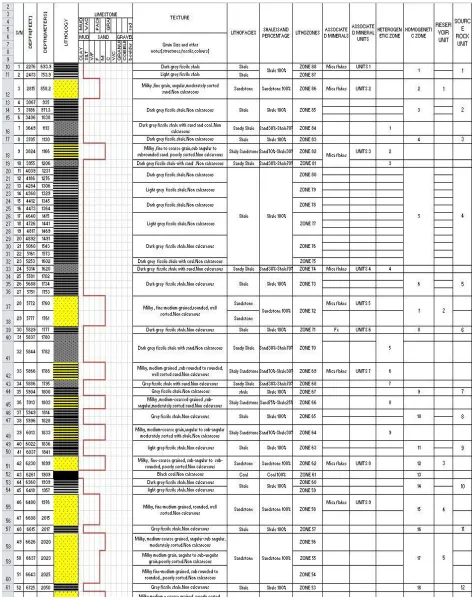
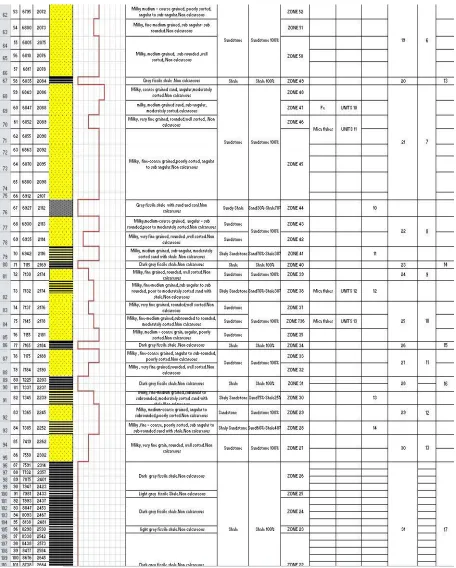
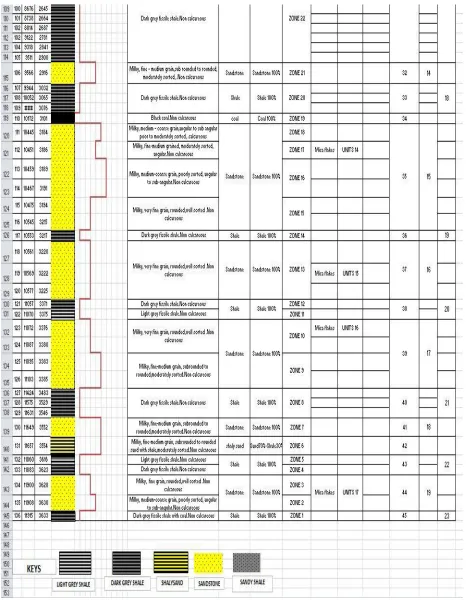
A total of One hundred and thirty six (136) side wall samples collected from the well were lithologically described using a reflected light microscope in order to obtain Physical characteristics such as colour, texture, hardness, fissility, rock type etc were noted., shapes/roundness, mineral composition, and post depositional diagenetic effect. Chemical tests to determine the presence of calcareous materials was also carried out using 10% dilute Hcl These properties are vital for the analysis of lithofacies. Consequently a Geological model embracing Lithofacies, mineral associated, Heterogenetic and Homogenetic zones were generated for the Well’s sedimentary succession. One lithostratigraphic unit Agbada Formations was penetrated by the drill, with lithofacies units ranging from Sand, Shale, Shaly sand and Sandy Shale respectively.
4.2 LITHOLOGICAL DESCRIPTION
The lithologies penetrated by the drill as observed under the microscope are sandstone and shale intervals, with sand having Milky colour and shale comprising of light and dark grey colour. Minerals found were basically iron and mica. The lithostratigraphic succession penetrated has a total number of 88 lithozones. The lithostratigraphic model was analyzed from bottom to the top.
4.3 LITHOFACIES UNITS
The concept of lithofacies as applied to sediments is a means of classifying and grouping sedimentary deposits in such a way that objective differences, usually with genetic significance are highlighted. A total of 88 lithofacies zones which include: Sandstone ,Shale, Sandy Shale and Shaly Sand facies were defined and established on the basis of the lithological types and mineralogical contents. The zones are discussed from bottom to top on the basis of probable reservoir and source rock characteristics as follows:
Lithofacies Zone 1 (3630.4-3632.6m)
This zone is characterized by a Dark grey fissile shale with coal and its non calcareous. Its thickness is 2.2m
Lithofacies Zone 2 (3628m-3630.4m)
This zone is characterized by Milky coloured, medium to coarse grain, poorly sorted sand, angular to sub-angular. Non calcareous . Its thickness is 2.4m,minerals present is mica.
Lithofacies Zone 3 (3628- 3622.8m)
This zone is characterized by Milky coloured, fine grain, rounded,well sorted sand .Non calcareous. Its thickness is 5.2m,minerals present is mica.
Lithofacies Zone 4 (3628m-3622.8m)
This zone is characterized by a Dark grey fissile shale. its non-calcareous With a thickness of 5.2m
Lithofacies Zone 5 (3622.8m-3615.8m)
This zone is characterized by a Light grey fissile shale. its non-calcareous With a thickness of 7m.
Lithofacies Zone 6 (3615.8m- 3553.9m)
This zone is characterized by Milky, fine-medium grain, subrounded to rounded sand with shale, moderately sorted. Non calcareous.( shaly sand). With a thickness of 61.9m
Lithofacies Zone 7 (3553.9m- 3551.5m)
This zone is characterized by Milky, fine-medium grain, subrounded to rounded sand,moderately sorted sand With a thickness of With a thickness of 2.4m. Non calcareous
Lithofacies Zone 8 (3546m- 3482.9m)
This zone is characterized by Dark grey fissile shale With a thickness of 63.1m.Non calcareous
Lithofacies Zone 9 (3385m- 3382.6m)
This zone is characterized by Milky, fine-medium grain, subrounded to rounded,moderately sorted sand With a thickness of 2.4m.Non calcareous
Lithofacies Zone 10 (3380.1m- 3375.6m)
This zone is characterized by Milky, very fine grain, rounded,well sorted sand with a thickness of 4.5m . mineral present is mica, Non calcareous
Lithofacies Zone 11 (3375m- 3371m)
This zone is characterized by Light grey fissile shale with a thickness of 4m. minerals present is mica. Non calcareous
Lithofacies Zone 12 (3371m- 3224.6m)
This zone is characterized by dark grey fissile shale with a thickness of 146.4m. minerals present is mica. Non calcareous
Lithofacies Zone 13 (3224.6m- 3217.3m)
This zone is characterized by Milky, very fine grain, rounded,well sorted sand with a thickness of 7.3m ,minerals present is mica. Non calcareous
Lithofacies Zone 14 (3219.8m- 3217.3m)
This zone is characterized by Dark grey fissile shale with a thickness of 2.5m.Non calcareous
Lithofacies Zone 15 (3214.9m- 3191.1m)
This zone is characterized by Milky, very fine grain, rounded,well sorted sand with a thickness of 23.8m.Non calcareous
Lithofacies Zone 16 (3191.1m- 3186.2m)
This zone is characterized by Milky, medium-coarse grain, poorly sorted, angular to sub-angular sand with a thickness of 4.9m .Non calcareous
Lithofacies Zone 17 (3186.2m- 3184.4m)
This zone is characterized by Milky, fine-medium grained, moderately sorted, angular sand with a thickness of 1.8m. Minerals present is mica. Non calcareous
Lithofacies Zone 18 (3184.4m- 3101.2m)
Lithofacies Zone 19 (3101.2m- 3075.9m)
This zone is characterized by coal with a thickness of 25.3m. Non calcareous
Lithofacies Zone 20 (3101.2m- 3031.7m)
This zone is characterized by Dark grey fissile shale with a thickness of 69.5m.Non calcareous
Lithofacies Zone 21 (3031.7m- 2916.4m)
This zone is characterized by Milky, fine – medium grain,sub rounded to rounded, moderately sorted sand with a thickness of 115.3m .Non calcareous
Lithofacies Zone 22 (2916.4m- 2529.8m)
This zone is characterized by Dark grey fissile shale with a thickness of 386.6m. Non calcareous
Lithofacies Zone 23 (2529.8m- 2481m)
This zone is characterized by light grey fissile shale with a thickness of 48.8m. Non calcareous
Lithofacies Zone 24 (2529.8m- 2433.2m)
This zone is characterized by Dark grey fissile shale with a thickness of 96.6m. Non calcareous
Lithofacies Zone 25 (2433.2m- 2422.8m)
This zone is characterized by light grey fissile shale with a thickness of 10.4m. Non calcareous
Lithofacies Zone 26 (2422.8m- 2314.3m)
This zone is characterized by Dark grey fissile shale with a thickness of 108.5m. Non calcareous.
Lithofacies Zone 27 (2314.3m- 2251.5m)
This zone is characterized by Milky, very fine grain, rounded, well sorted sand with a thickness of 62.8m .Non calcareous
Lithofacies Zone 28 (2251.5m- 2245.4m)
This zone is characterized by Milky ,fine – coarse, poorly sorted, sub angular to sub-rounded sand with shale and has a thickness of 6.1m .Non calcareous
Lithofacies Zone 29 (2245.4m- 2239.3m)
This zone is characterized by Milky, medium-coarse grained, sub angular to subrounded ,poorly sorted sand with a thickness of 6.1m.Non calcareous.
Lithofacies Zone 30 (2239.3m- 2236.8m)
This zone is characterized by Milky, fine-medium grained, subangular to subrounded, moderately sorted sand with shale and has a thickness of 2.5m. Non calcareous.
Lithofacies Zone 31 (2236.8m- 2190.2m)
This zone is characterized by Dark grey fissile shale with a thickness of 46.6m Non calcareous.
Lithofacies Zone 32 (2190.2m- 2187.5m)
This zone is characterized by Milky , very fine grained,rounded, well sorted sand with a thickness of 2.7m .Non calcareous.
Lithofacies Zone 33 ( 2187.5m- 2184.4m)
This zone is characterized by Milky , fine-coarse grained, angular to sub-rounded, poorly sorted sand with a thickness of 3.1m.Non calcareous.
Lithofacies Zone 34 ( 2184.4 m-2181.4m)
This zone is characterized by Dark grey fissile shale with a thickness of 3m. Non calcareous.
Lithofacies Zone 35 (2181.4m- 2178.3m)
This zone is characterized by Milky, medium – coarse grain, angular, poorly sorted sand with a thickness of 3.1m .Non calcareous
Lithofacies Zone 36 (2181.4m- 2178.3m)
This zone is characterized by Milky, fine-medium grained, subrounded to rounded, moderately sorted sand with a thickness of 3m. mineral present is mica .Non calcareous
Lithofacies Zone 37 (2175.9m- 2174.3m)
This zone is characterized by Milky, very fine grained, rounded,well sorted sand with a thickness of 1.6m .Non calcareous
Lithofacies Zone 38 (2174.3m-2171.5m)
This zone is characterized by Milky, fine-medium grained, sub rounded-rounded, moderately sorted sand with shales.it has a thickness of 2.8m . mineral present is mica .Non calcareous
Lithofacies Zone 39 (2174.3m-2173.7m)
This zone is characterized by Milky, fine grained, rounded, well sorted sand with a thickness of 0.6m.Non calcareous
Lithofacies Zone 40 (2173.7m- 2169.2m)
This zone is characterized by Dark grey fissile shale with a thickness of 4.5m. Non calcareous
Lithofacies Zone 41 (2169.2m- 2116.4m)
This zone is characterized by Milky, medium grained, sub-angular, moderately sorted sand with shale .it has a thickness of 52.8m .Non calcareous
Lithofacies Zone 42 (2116.4m- 2114.3m)
This zone is characterized by Milky, very fine grained, rounded ,well sorted sand with a thickness of 2.1m.Non calcareous
Lithofacies Zone 43 ( 2114.3m- 2112.8m)
This zone is characterized by Milky, medium-coarse grained, angular – sub rounded, poor to moderately sorted sand with a thickness of 1.5m. Non calcareous
Lithofacies Zone 44 ( 2112.8m- 2111.8m)
This zone is characterized by Grey fissile shale with sand and coal . it has a thickness of 1m.Non calcareous
Lithofacies Zone 45 (2111.8m-2089m)
180 Lithofacies Zone 46 (2089m-2087.5m)
This zone is characterized by Milky, very fine grained, rounded,well sorted sand with a thickness of 1.5m, .mineral present is mica.Non calcareous
Lithofacies Zone 47 (2087.5m-2086.2m)
This zone is characterized by milky, medium grained sand, sub-angular, moderately sorted sand with a thickness of 1.3m . mineral present is iron.calcareous
Lithofacies Zone 48 (2086.2m-2083.8m)
This zone is characterized by milky Milky, coarse grained sand, angular,moderately sorted sand with a thickness of 2.4m.Non calcareous
Lithofacies Zone 49 (2083.8m- 2078.3m)
This zone is characterized by Grey fissile shale with a thickness of 5.5m .Non calcareous
Lithofacies Zone 50 (2078.3m-2074.6m)
This zone is characterized by Milky, medium grained, sub rounded ,well sorted sand with a thickness of 3.7m.Non calcareous
Lithofacies Zone 51 (2074.6m-2073.1m)
This zone is characterized by Milky, fine-medium grained, sub angular- sub rounded moderately sorted sand with a thickness of 1.5m .Non calcareous
Lithofacies Zone 52 (2073.1m-2050.3m)
This zone is characterized by Milky medium – coarse grained, poorly sorted, angular to sub-angular sand with a thickness of 22.8m.Non calcareous
Lithofacies Zone 53 (2050.3m-2025.3m)
This zone is characterized by Grey fissile shale with a thickness of 25m.Non calcareous
Lithofacies Zone 54 (2025.3m-2023.4m)
This zone is characterized by Milky fine-medium grained, sub rounded to rounded sand., moderately to well sorted with a thickness of 1.9m.Non calcareous
Lithofacies Zone 55 (2023.4m-2020.1m)
This zone is characterized by Milky medium grain, angular to sub-angular grain. Poor to moderately sorted 3.3m.Non calcareous
Lithofacies Zone 56 (2020.1m-2016.7m)
This zone is characterized by Milky, medium-coarse grained, angular-sub angular, moderately sorted sand with a thickness of 3.4m.Non calcareous
Lithofacies Zone 57 (2016.7m -2014.6m)
This zone is characterized by Grey fissile shale with a thickness of 2.1m.Non calcareous
Lithofacies Zone 58 (2014.6m-1956.7m)
This zone is characterized by Milky, fine-medium grained, rounded, well sorted sand with a thickness of 57.9m .minerals present is mica.Non calcareous
Lithofacies Zone 59 (1956.7m-1939m)
This zone is characterized by light grey fissile shale with a thickness of 17.7m .Non calcareous
Lithofacies Zone 60 (1939m-1908.8m)
This zone is characterized by Dark grey fissile shale with a thickness of 30.2m .Non calcareous
Lithofacies Zone 61 (1908.8m-1899.3m)
This zone is characterized by Black coal with a thickness of 9.5m.Non calcareous
Lithofacies Zone 62 (1899.3m-1840.5m)
This zone is characterized by Milky, fine-coarse grained, sub-angular to sub-rounded, poorly sorted with a thickness of 58.8m. mineral present is mica Non calcareous
Lithofacies Zone 63 (1840.5m-1833.2m)
This zone is characterized by light grey fissile shale with a thickness of 7.3m .Non calcareous
Lithofacies Zone 64 (1833.2m-1828m)
This zone is characterized by Milky, medium-coarse grain,angular to sub-angular ,moderately sorted sand with shale.has a thickness of 5.2m Non calcareous
Lithofacies Zone 65 (1828m-1802.7m)
This zone is characterized by grey fissile shale with a thickness of 25.3m .Non calcareous
Lithofacies Zone 66 (1802.7m-1800m)
This zone is characterized by Milky ,medium-coarsed grained ,sub-angular,moderately sorted sand with a thickness of 2.7m.Non calcareous
Lithofacies Zone 67 (1800m-1794.5m)
This zone is characterized by grey fissile shale with a thickness of 5.5m .Non calcareous
Lithofacies Zone 68 (1794.5m-1788.4m)
This zone is characterized by grey fissile shale with sand and has a thickness of 6.1m .Non calcareous
Lithofacies Zone 69 (1788.4m-1781.7m)
This zone is characterized by Milky, medium grained ,sub rounded to rounded, well sorted sand with a thickness of 6.7m. mineral present is mica, Non calcareous
Lithofacies Zone 70 (1781.7m-1779.5m)
This zone is characterized by Dark grey fissile shale with sand and has a thickness of 2.2 m .Non calcareous
Lithofacies Zone 71 (1779.5m-1777.1m)
This zone is characterized by Dark grey fissile shale with a thickness of 2.4 m . mineral present is iron .Non calcareous
Lithofacies Zone 72 (1777.1m-1753.3m)
Lithofacies Zone 73 (1753.3m-1620.1m)
This zone is characterized by Dark grey fissile shale with a thickness of 133.2 m .Non calcareous
Lithofacies Zone 74 (1620.1m-1601.5m)
This zone is characterized by Dark grey fissile shale with sand and has a thickness of 18.6 m mineral present is mica.Non calcareous
Lithofacies Zone 75 (1601.5m-1573.4m)
This zone is characterized by Dark grey fissile shale with coal and has a thickness of 28.1 m .Non calcareous
Lithofacies Zone 76 (1573.4m-1468.5m)
This zone is characterized by Dark grey fissile shale with a thickness of 104.9 m .Non calcareous
Lithofacies Zone 77 (1468.5m-1363.7m)
This zone is characterized by light grey fissile shale and has a thickness of 104.8 m .Non calcareous
Lithofacies Zone 78 (1363.7m-1329.2m)
This zone is characterized by Drak grey fissile shale and has a thickness of 34.5 m .Non calcareous
Lithofacies Zone 79 (1329.2m-1278.2m)
This zone is characterized by Light grey fissile shale and has a thickness of 51 m .Non calcareous
Lithofacies Zone 80 (1278.2m-1205.7m)
This zone is characterized by Dark grey fissile shale and has a thickness of 72.5 m .Non calcareous
Lithofacies Zone 81 (1205.7m-1165.8m)
This zone is characterized by Dark grey fissile shale with sand and has a thickness of 39.9 m mineral present is mica .Non calcareous
Lithofacies Zone 82 (1165.8m-1129.5m)
This zone is characterized by Milky ,fine to coarse grain,sub angular to subrounded sand . poorly sorted, has a thickness of 36.3m. mineral present is mica Non calcareous
Lithofacies Zone 83 (1129.5m-1112.5m)
This zone is characterized by Dark grey fissile shale with a thickness of 17 m .Non calcareous
Lithofacies Zone 84 (1129.5m-1038m)
This zone is characterized by Dark grey fissile shale with sand and coal, has a thickness of 91.5 m .Non calcareous
Lithofacies Zone 85 (1038m-858.2m)
This zone is characterized by Dark grey fissile shale with a thickness of 179.8 m .Non calcareous
Lithofacies Zone 86 (858.2m-753.9m)
This zone is characterized by Milky ,fine grain, angular,moderately sorted sand with a thickness of 104.3m.mineral present is mica.Non calcareous
Lithofacies Zone 87 (753.9m-693.9m)
This zone is characterized by light grey fissile shale with a thickness of 60m .Non calcareous
Lithofacies Zone 88 (693.9m)
This zone is characterized by Dark grey fissile shale . mineral present is mica Non calcareous
4.4 Hydrocarbon Play Element in the WELL
In petroleum geology, the sands are potential reservoir while Shale is regarded as Source rocks or Seal & Cap. It is known that the condition for hydrocarbon depends on factors such as the presence of the Seal & Cap, Reservoir and Source Rocks. All these determine the Play Elements in Petroleum Geology. For easy comprehension, the lithozones would be used to depict the various Play elements.
4.4.1 Reservoir Rocks
Reservoir rocks are rocks that have sufficient porosity and permeability to store and transmit hydrocarbon. From the lithostratigraphic model established 19 major reservoir rock units were established and were categorized into 35 lithozones .
The lithozones are as follow:
Lithozones2, Lithozones 3, Lithozones 7, Lithozones 9, Lithozones 10, Lithozones,13, Lithozones 15, Lithozones16, Lithozones 17, Lithozones 18, Lithozones 21, Lithozones 27, Lithozones 29, Lithozones 32, Lithozones33, Lithozones 35, Lithozones 36, Lithozones 37, Lithozones 39, Lithozones 42, Lithozones 43, Lithozones 45, Lithozones 46, Lithozones 47, Lithozones 48, Lithozones 50, Lithozones 51, Lithozones 52, Lithozones 54, Lithozones 55 Lithozones 56, Lithozones 58, Lithozones 62, Lithozones 72, Lithozones 86.
4.4.2 Potential Source Rock
A source rock is a rock that contains organic matter and has generated or is capable of generating hydrocarbon. The nature/ Type of organic matter contained in the source rock, time length and temperature are some factors that control petroleum generation from source rock. From the lithostratigraphic model established, 23 major source rock units were present which are categorized into 35 lithozones.
The lithozones are as follows:
Lithozones 1, Lithozones 4, Lithozones 5, Lithozones 8, Lithozones 11, Lithozones 12, Lithozones 14, Lithozones 20, Lithozones 22, Lithozones 23, Lithozones 24, Lithozones 25, Lithozones 26, Lithozones 31, Lithozones 34, Lithozones 40, Lithozones 49, Lithozones 53, Lithozones 57, Lithozones 59, Lithozones 60, Lithozones 63, Lithozones 65, Lithozones 67, Lithozones 71, Lithozones 73, Lithozones 76, Lithozones 77, Lithozones 78, Lithozones 79, Lithozones 80, Lithozones 83, Lithozones 85, Lithozones 87, Lithozones 88
4.4.3 Cap and Seal Rock
182 Reservoir Rock UNIT 1 (858.2ft)
The probable cap rock for reservoir unit 1 is source rock unit 1 which is categorizes as lithozone 87 and 88 and it is composed of 100% shale.
Reservoir Rock UNIT 2 (1759.7-1761.2ft)
The probable cap rock for reservoir unit 2 is source rock unit 5 which is categorizes as lithozone 73 and it is composed of 100% shale.
Reservoir Rock UNIT 3 (1899.3ft)
The probable cap rock for reservoir unit 3 is source rock unit 9 which is categorizes as lithozone 62, and it is composed of 100% shale.
Reservoir Rock UNIT 4 (1975.6-2014.6ft)
The probable cap rock for reservoir unit 4 is source rock unit 10 which is categorizes as lithozone 59 and 60, and it is composed of 100% shale.
Reservoir Rock UNIT 5 (2020.1-2025.3ft)
The probable cap rock for reservoir unit 5 is source rock unit 11 which is categorizes as lithozone 57, and it is composed of 100% shale.
Reservoir Rock UNIT 6 (2017.6-2078.3ft)
The probable cap rock for reservoir unit 6 is source rock unit 12 which is categorizes as lithozone 53, and it is composed of 100% shale.
Reservoir Rock UNIT 7 (2086.2-2107.3ft)
The probable cap rock for reservoir unit 7 is source rock unit 13 which is categorizes as lithozone 49, and it is composed of 100% shale.
Reservoir Rock UNIT 9 (2173.7ft)
The probable cap rock for reservoir unit 9 is source rock unit 14 which is categorizes as lithozone 40, and it is composed of 100% shale.
Reservoir Rock UNIT 11 (2187.5-2190.2ft)
The probable cap rock for reservoir unit 11 is source rock unit 15 which is categorizes as lithozone 34, and it is composed of 100% shale.
Reservoir Rock UNIT 12 (2245.4ft)
The probable cap rock for reservoir unit 12 is source rock unit 16 which is categorizes as lithozone 31, and it is composed of 100% shale.
Reservoir Rock UNIT 14 (2916.4ft)
The probable cap rock for reservoir unit 14 is source rock unit 17 which is categorizes as lithozone 22, and it is composed of 100% shale.
Reservoir Rock UNIT 16 (3219.8-3224.6ft)
The probable cap rock for reservoir unit 16 is source rock unit 19 which is categorizes as lithozone 14, and it is composed of 100% shale.
Reservoir Rock UNIT 17 (3375.6-3385ft)
The probable cap rock for reservoir unit 17 is source rock unit 20 which is categorizes as lithozone 11 and 12, and it is composed of 100% shale.
Reservoir Rock UNIT 18 (3551.5ft)
The probable cap rock for reservoir unit 18 is source rock unit 21 which is categorizes as lithozone 8, and it is composed of 100% shale.
Reservoir Rock UNIT 19 (3628-3630.4ft)
The probable cap rock for reservoir unit 19 is source rock unit 22 which is categorizes as lithozone 4 and 5, and it is composed of 100% shale.
4.5 ENVIRONMENT OF DEPOSITION
Base on the various lithofacies gotten from the well, parallic environment was suggested, which is the intercalation of sand and shale.
5 Conclusion
References
[1] Avbovbo, A.A. (1978). Tertiary lithostratigraphy of Niger delta. American Association of Niger Delta. AAPG Bulletin, Vol 62, pp 295 - 306.
[2] Boggs, S. Jr., 2006, Principles of Sedimentology
and Stratigraphy: Pearson education Inc. Upper Saddle Rivers, USA, ed P. 581.
[3] Burke, K. C, Whiteman, A. J., 1973. Uplift, rifting and the break-up of Africa.In:Tarling, D. N. and Runcorn, S. K. (Eds.),Implication of continental drift to the earth sciences. New York Academic Press, pp. 734-755.
[4] Burke, K. C., 1972. Longshore drift, submarine canyons, and submarine fans in the development of the Niger Delta.American Association of Petroleum Geologists Bulletin, vol. 56, pp. 1975-1983.
[5] Burke, K. C., Dessauvagie, T. F. J. and Whiteman, A. J., 1972.Geological History of the Benue Valley and Adjacent Areas.In: Dessauvagie, T. F. J. and Whiteman, A. J. (Eds.), African Geology. University of Ibadan Press, Nigeria, pp. 187-206.
[6] Doust,H. and Omatsola, E., 1990.NigerDelta.In: Edwards, J. D.and Santogrossi,P.A.(Eds.), Divergent/passiveMarginBasins.
AmericanAssociationof PetroleumGeologists Bulletin, vol. 48, pp. 201-238.
[7] Ejedawe, J. E., Coker, S. J. L., Lambert-Aikhionbare, D. O., Alofe, K. B. and Adoh, F. O., 1984. Evolution of Oil-generative Window and Oil and Gas Occurrence in Tertiary Niger Delta Basin.American Association of Petroleum Geologists Bulletin, vol. 68(11), pp. 1744-1751.
[8] Evamy, D. D., Haremboure, J., Kamerling, P., Knapp, W. A., Molloy, F. A. and Rowlands, P. H., 1978.Hydrocarbon Habitat of Tertiary Niger Delta.AAPG Bulletin, vol. 62, pp. 1-39.
[9] Klett, T. R., Ahlbrandt, T. S., Schmoker, J. and Dolton, G., 1997. Ranking of the World’s oil and gas provinces by known petroleum volumes.U.S.Geological Survey Open-file Report-97-.463, CD-ROM.
[10]Murat, R. C., 1972. Stratigraphy and Paleogeography of the Cretaceous and Lower Tertiary in Southern Nigeria. In: Dessauvagie, T. F. J. and Whiteman, A. J. (Eds.), African Geology. University of Ibadan Press, Nigeria, pp. 251-266.
[11]Nwozor K. R., Omudu M. I., Ozumba B. M., Egbuachor C. J., Onwuemesi A. G., Anike O. L. (2013). Quantitative evidence of secondary mechanisms of overpressure generation: Insights from parts of Onshore Niger Delta, Nigeria, petr.
Techn. Dev. Jour., 3(1), 64-83.Petroleum Geologist Bulletin, v. 62, pp. 295‐ 306.
[12]Reijers, T. J. A., Petters, S. W. and Nwajide, C. S., 1997. The Niger Delta Basin, In: Selley RC, editor, African Basins-Sedimentary Basin of the World 3, Amsterdam. Elsevier Science, pp. 151-172.
[13]Reyment, R. A., 1965. Aspect of the Geology of Nigeria.University of Ibadan Press, Nigeria. 145p.
[14]Short, K. C. and Stauble, A. J., 1967.Outline of Geology of Niger Delta.American Association of Petroleum Geologists Bulletin, vol. 51(5), pp. 761-779.
[15]Stacher, P., 1995. Present understanding of the Niger Delta hydrocarbon habitat, In: Oti, M. N. and Postma, G.(Eds.), Geology of Deltas: Rotterdam, A.A. Balkema, pp. 257-267.
[16]Stoneley, R., 1966. The Niger Delta in the light of the theory of continental drift. Geological Magazine, vol. 103(3), pp. 386-397.
[17]Weber, K. J. and Daukoru, E. M., 1975.Petroleum Geological Aspects of Niger Delta.Tokyo. Ninth World Petroleum Congress Proceedings, vol. 5(2), pp. 209-221.