ORIGINAL ARTICLE
IJPHY
ABSTRACT
Background: Adhesive Capsulitis most commonly referred to as ”Frozen Shoulder” is an insidious Painful Condition with progressive and gradual restriction of all planes of movement in the glenohumeral joint. Evidence shows Mulli-gan's mobilization with movement (MWM) mobilization technique is more effective than muscle energy techniques (MET) and conventional therapy in improving shoulder function. Therefore the present study intends to determine the efficacy of muscle energy techniques along with Mulligan’s mobilization with movement, in adhesive capsulitis of the shoulder joint.
Methods: The present randomized controlled trial was conducted among 30 subjects including both sex groups aged between 40-60 years diagnosed with adhesive capsulitis of the shoulder. They were randomly assigned into two groups with 15 subjects each. Group A received Mulligan’s mobilization alone, and Group B received Mulligan’s mobilization along with MET. Both the groups received the treatment protocol six times a week for three weeks. Pre and post evalua-tion of pain was done by using the short-form McGill pain quesevalua-tionnaire, range of moevalua-tion by the Universal Goniometer and the functional disability by using Shoulder Pain and Disability Index (SPADI).
Result: There was a significant improvement (P<0.05) in pre and post-intervention levels in both groups. Between groups analysis, the results are: a range of motion improved 30%, and the values are flexion with a p-value of 0.010, for abduction, internal and external rotations with a p-value of 0.000 except for extension with a p-value of 0.109. On com-parison of SPADI using Mann Whitney U test, it showed 50% improvement with a significant difference with a p-value of 0.001 and McGill improved for more than 70% with a p-value of 0.000.
Conclusion: Mulligan’s mobilization along with Muscle Energy Technique is found to be more effective in improving quality of life among subjects with adhesive capsulitis of shoulder than Mulligan’s mobilization alone.
Keywords: Adhesive Capsulitis, MET (Muscle energy technique), Mulligan’s mobilization, Range of motion, Pain.
Received 30th August 2018, accepted 10th February 2019, published 09th April 2019
www.ijphy.org
10.15621/ijphy/2019/v6i2/181915
CORRESPONDING AUTHOR
Int J Physiother. Vol 6(2), 52-57, April (2019) ISSN: 2348 - 8336
EFFICACY OF MUSCLE ENERGY TECHNIQUES AS
AN ADJUNCT WITH MULLIGAN’S MOBILIZATION
IN ADHESIVE CAPSULITIS OF SHOULDER
¹Nithya Jaiswal *2J. Saketa
³Hannah Rajsekhar
*2J. Saketa
Assistant Professor,
Apollo College of Physiotherapy, Jubilee Hills, Hyderabad.
email Id: [email protected] ¹MPT student,
Apollo College of Physiotherapy, Jubilee Hills, Hyderabad.
³Professor and Principal,
Apollo College of Physiotherapy, Jubilee Hills, Hyderabad.
INTRODUCTION
The shoulder is a complex joint that permits a full range of movements which are crucial for many activities of daily living. The intricate structural design is responsible for the multi-plane wide arcs of movements. Adhesive capsulitis also known as frozen shoulder is a painful condition associated with synovitis and capsular restriction causing a reduced range of active and passive motion [1-4].Loyd and Loyd (1983)suggested that a secondary frozen shoulder develops when painful spasm limits activity and creates dependency on the arm [5].The estimated prevalence of adhesive capsulitis is 11-30% in diabetic patients, which is considerably higher than non-diabetic patients [6].
Adhesive capsulitis, an idiopathic disease tends to be a self-limiting with spontaneous complete or near complete recovery over a varied period. Cyriax recommended the idea of capsular examination and this pattern could be a result of joint reaction with a muscle spasm that prompts capsular constriction [7]. This clinical entity progresses through overlapping stages of freezing, frozen and thawing stages.
Evidence suggests that manual therapy with mobilizations including high-velocity, low amplitude manipulation, end-range mobilization, mid-range mobilization, and mobilization with movement has a more significant effect on improving range of motion in Adhesive capsulitis [8]. Evidence shows that Mulligan’s MWM technique is more effective than muscle energy techniques and conventional therapy [9].Whereas, another Cochrane review for shoulder pain found no benefit of any particular physiotherapy technique over other [10,11].
Mulligan’s technique performed actively or passively aims at correcting positional fault by producing synchronized hypoalgesic effects during and following its application, as well as altering sympathetic nervous system function [12]. Authors like Leon Chaitow (2006) [13] and other studies have shown that the MET is a soft tissue manipulation method that incorporates precisely directed and controlled, patient initiated, isometric and isotonic contraction. The effect of MET is to improve function by stimulation of Golgi tendon organ that results in direct inhibition of agonist’s muscles and reflexive inhibition at the antagonistic muscles allowing the joint to be moved further into the restricted ROM [14-15].
Therefore the present study intends to determine the efficacy of muscle energy techniques along with Mulligan’s mobilization with movement, in adhesive capsulitis of the shoulder joint.
MATERIALS AND METHODS
An Interventional study was conducted at Out Patient Department of Apollo College of physiotherapy. The current study includes 30 subjects who have adhesive capsulitis of the shoulder. They are selected based on inclusion and exclusion criteria and are divided into two groups- Group A and Group B by convenient sampling. Thirty subjects including 17 male and 13 female were
selected and allotted to two groups. The purpose of the study was explained to each one of them. The duration of intervention was three weeks, i.e., 6 sessions per week so a total of 18 sessions. Ethical clearances were obtained from the ethical committee of the institute, and written consent forms from all the participants were collected.
Group A: Brief demonstration of Mulligan’s movement with mobilization is given to the patients and is then taken for the treatment for day 1.
Group B: Brief demonstrations of Mulligan’s movement with mobilization and muscle energy techniques are given to the patients and then are taken for the treatment for day one.
Mulligan’s movement with mobilization:
Technique:The subject is placed in the supine position, and the therapist is standing lateral to the affected joint to perform the shoulder distraction, flexion, extension, abduction, internal and external rotation. The scapula is stabilized to prevent accessory movements. The mobilizing belt is placed close to the joint and the movement is per-formed. Therapist shifts the weight to distract the joint and the subject is asked to perform the affected movement to a pain-free range and applies passive overpressure to achieve a new range [12].
Muscle energy technique
Technique: The subject is in a side-lying position for appli-cation of the method for shoulder flexion, abduction and the supine position for shoulder internal and external ro-tation. The therapist stands by the side of the subject. The therapist performs the movement. When the first physi-ological barrier is reached, the subject is asked to oppose the movement utilizing no more than 20% of available strength, building up force slowly. This effort is firmly re-sisted, and after 7-10 seconds the subject is instructed to cease the effort simultaneously with the therapist gradual-ly. After complete relaxation, the shoulder is moved to the next restriction bar [13].
All the subjects of both groups are treated with ultrasound for pain relief.
The subjects wore loose-fitting clothes or minimal clothing for easy mobilization of the shoulder.
Outcome measures: Before the treatment, pre-test evaluation and post-intervention post-test evaluation was conducted for both the groups. The intensity of pain by short form Mc Gill pain questionnaire [16-17], range of motion of shoulder by universal goniometer [18] and functional disability with Shoulder Pain And Disability Index [19].
STATISTICAL ANALYSIS AND RESULTS:
Table 1: Demographic data for age and sex
Parameter Group A(MWM) Group B(MWM+MET) Age 46 ± 10 44± 9 Sex (M/F) 7/8 6/9
The study included a total of 30 patients with 15 in each group. Mean age of patients in experimental group was 46.6 and in control were 49.4. In Group A (Mulligan’s MWM alone) there were 7 females and 8 males while in Group B (Mulligan’s MWM along with MET) there were 6 females and 9 males.
Table 2: Within the Group Analysis of Group A- Mulligan’s MWM
Paired statistics
Range of
movement Mean N Std. Deviation Sig. (2-tailed) Flexion Pre 94.6667 15 15.52264 .010
Post 124.3333 15 40.39389
Extension Pre 42.6667 15 9.03696 .010 Post 53.3333 15 4.87950
Abduction Pre 80.6667 15 4.57738
.010 Post 129.0000 15 14.41724
IR Pre 42.0000 15 9.78337
.000 Post 64.3333 15 5.62731
ER Pre 28.6667 15 8.54958
.000 Post 54.9333 15 7.79621
McGill Pre 27.9333 15 4.25049
.000 Post 20.4667 15 1.45733
Spadi Pre 62.0667 15 2.34419
.000 Post 32.0667 15 4.19977
In Mulligan’s group (Group A), there is a significant difference between the comparison of pre and post values of flexion, extension, and abduction which was derived by a paired t-test. The p-value is 0.010 which is less than 0.05.In internal and external rotation there is a significant difference between the comparison of pre and post values which was derived by a paired t-test. The p-value is 0.000 which is less than 0.05.
Comparison of pre and post values of McGill and SPADI shows a significant difference between which was derived by the Wilcoxon test. The p-value is 0.000 which is less than 0.05.
Graph 1: Group A: Mulligan’s MWM graphical represen-tation within the group analysis
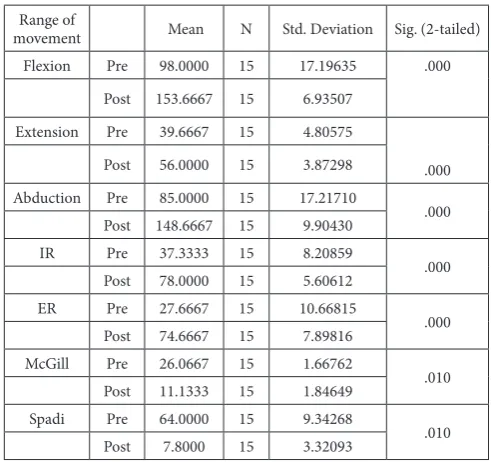
Table 3: Within the Group Analysis of Group B- Mulli-gan’s MWM along with Muscle Energy technique
Range of
movement Mean N Std. Deviation Sig. (2-tailed) Flexion Pre 98.0000 15 17.19635 .000
Post 153.6667 15 6.93507 Extension Pre 39.6667 15 4.80575
.000 Post 56.0000 15 3.87298
Abduction Pre 85.0000 15 17.21710
.000 Post 148.6667 15 9.90430
IR Pre 37.3333 15 8.20859
.000 Post 78.0000 15 5.60612
ER Pre 27.6667 15 10.66815
.000 Post 74.6667 15 7.89816
McGill Pre 26.0667 15 1.66762
.010 Post 11.1333 15 1.84649
Spadi Pre 64.0000 15 9.34268
.010 Post 7.8000 15 3.32093
In Mulligan’s and MET’s group (Group B), there is a significant difference between the comparison of pre and post values of all the rangeswhich were derived by a paired t-test. The p-value is 0.000 which is less than 0.05.
Comparison of pre and post values of McGill and SPADI shows a significant difference between which was derived by the Wilcoxon test. The p-value is 0.001 which is less than 0.05.
Graph 2: Within the group analysis: Group B Mulligan’s MWM along with Muscle energy technique
Table 4: Between the group analysis
Parameter Group Mean Std. Dev P value
Flexion Mulligan 124.3333 40.39389 .010 Mulligan+MET 153.6667 6.93607
Extension Mulligan 53.3333 4.87960 .109 Mulligan+MET 56.0000 3.87298
Abduction Mulligan 129.0000 14.41725 .000 Mulligan+MET 148.6667 9.90430
IR Mulligan 64.3333 5.62731 .000 Mulligan+MET 78.0000 5.60612
ER Mulligan 54.9333 7.79621 .000 Mulligan+MET 74.6667 7.89816
McGill Mulligan 20.4667 1.45733 .000 Mulligan+MET 11.1333 1.84649
Between the group analysis, there was a significant improvement in flexion, abduction, internal and external rotations (p<0.05). The only extension showed (p>0.05) On Comparison of McGill and SPADI score using shows Wilcoxon test a significant difference was observed with a p-value of 0.000 which is less than 0.05
Graph 3: Between the group analysis
Between the group’s analysis for these two groups also showed significant differences for flexion with a p-value of 0.010, for abduction, internal and external rotations with a p-value of 0.000 except for extension with a p-value of 0.109. On comparison of SPADI using Mann Whitney U test, it showed a significant difference with a p-value of 0.001 and McGill with a p-value of 0.000.
This shows that there is a much more significant improve-ment in the range of motion, reduction in pain and im-provement in functional disability in Group receiving Mul-ligan’s MWM along with MET as compared to the group receiving Mulligan’s MWM alone.
DISCUSSION
The present study was undertaken to evaluate the efficacy of muscle energy technique as an adjunct with Mulligan’s movement with mobilization in the treatment of adhesive capsulitis of shoulder and to compare the effectiveness of the techniques in terms of improving joint mobility, reducing pain and improving the functional activity. The intervention(group A- MWM &Group B: MWM and MET) along with ultrasound therapy was given for three weeks for both the groups and the results were significant in group B when compared with group A on follow up. The effect of both the interventions on pain, range of motion and shoulder function was positive, i.e. they both were effective.
There is an improvement in range of motion in Group A (Mulligan Group) due to the corrective glide which is given to achieve optimal alignment of articular surfaces and its maintenance by appropriate recruitment of muscles with patient’s active efforts. This goes by Mulligan’s concept of positional fault. Many previous reports explained the background of MWM to have a neurophysiological mechanism of production of initial hypoalgesia based on stimulation of peripheral mechanoreceptors and inhibition of nociceptors, altering the sympathetic nervous system. This treatment technique produces a total, immediate pain relief during the technique application. It corrects
the positional faults, and there is a quick change in bony position during the application of MWM. Albert Zakyet al. (2012) in his study “End-range mobilization (ERM) versus mobilization with movement (MWM) in the treatment of adhesive capsulitis” found that MWM was very effective in improving external rotation and abduction by mulligan therapy [20]. Also, Shruti Patelet al.(2015) conducted a study on the effect of mulligan mobilization of movement technique on internal rotation range of motion of the glenohumeral joint in a patient with adhesive capsulitis and found that internal rotation was improved significantly [21].
The alteration of the shoulder biomechanics can be due to scapular tightness in adhesive capsulitis. This capsular tightness pulls the head of the humerus towards the glenoid fossa altering humeral head excursion in glenoid fossa [22]. This alteration leads to alteration in mechanism in the scapulohumeral and acromioclavicular joint. This further leads to positional faults also. One of the staples of physical therapy and kinesiology foundations includes the convex-concave rules of joint motion [16]. It states that when a convex surface moves on a concave surface, the convex surface rolls in one direction and glides in the opposite direction. If a concave surface moves on a convex surface, the concave surface rolls and glides in the same direction, this can be crucial for understanding of joint mobility and forms the integral or fundamental part of the application of mobilizations. So if the glide is given according to the roll, slide, and glide, there will be a significant improvement in range of motion which is proved in our study.
When the responses were compared between the groups, the results showed a significant difference at follow up which means Muscle energy technique as an adjunct with Mulligan’s movement with mobilization is better than Mulligan’s alone. Abundant literature is available for MET as an effective technique in reducing pain and improving function [23,26,27]. Muscle energy technique is classified as a direct technique in which the restrictive barrier is actively engaged to contract a muscle in a precisely controlled fashion against a direct counterforce24. It can
be used to stretch over tight muscles and fascia and also to mobilize a restricted joint. Engaging restrictive barriers and then using an isometric contraction causes inhibition of agonist’s muscle through Golgi tendon organ [13]. By action on Golgi tendon organ and muscle spindle, MET is expected to reduce the tone of hypertonic muscles and re-established normal muscle resting length along with correction of postural and movement asymmetries stretching muscles and thus reducing the pain. Many researchers explained this concept of METEdrishSaifee Contractor et al. (2016) conducted a study on the effect of muscle energy technique on a range of motion in patients with adhesive capsulitis and found to be an effective technique [28,31,32].
and MET the effect is on restoring the muscle length [33]. Active movement is more emphasized in our treatment protocol which helps in restoring the range of motion with consideration towards pain. Therefore, the present study has found that Muscle energy technique as an adjunct to Mulligan’s movement with mobilization is better in the reduction of pain, improvement in range of motion and functional disability than Mulligan’s alone.
CONCLUSION
The present study concluded that both Mulligan’s movement with mobilization (MWM) alone and Mulligan’s movement with mobilization (MWM) along with muscle energy technique (MET) have shown to have an effect on reduction in pain, improvement in shoulder mobility and functional ability.
However, Mulligan’s movement with mobilization (MWM) along with muscle energy technique (MET) is found to be more effective in improving quality of life among subjects with adhesive capsulitis than Mulligan’s movement with mobilization (MWM) alone. The limitations of the study were smaller sample size; gender variations were not considered, and also muscle strength evaluations were not done.
REFERENCES
[1]
Bruckner, F.E.; Nye, C.J. A prospective study of
adhesive capsulitis of the shoulder (“frozen
shoul-der”) in a high risk population. Q. J. Med.1981; 50:
191-204
[2]
Kessel, L.; Bayley, I.; Young, A. The upper limb:
The frozen shoulder. Br. J. Hosp. Med. 1981 25:
334
[3]
Neviaser, J.S. Adhesive capsulitis and the stiff
and painful shoulder.Orthop. Clin. North Am.,
1980;11: 327-333.
[4]
Reeves B. The natural history of the frozen
shoul-der syndrome. Scand J Rheumatol. 1975; 4:193–
196.
[5]
Loyd, J.A.; Loyd, H.M. Adhesive capsulitis of the
shoulder: Arthrographic diagnosis and treatment.
South Med. J. 1983; 76: 879-883.
[6]
Saumen Gupta, Kavita Raja, Manikandan N.
Im-pact of adhesive capsulitis on qulaity of life in
elderly subjects with diabetes: A cross sectional
study. Int. J DiabCtries. 2008;28(4):125-9.
[7]
Cyriax J. Textbook of Orthopedic Medicine, Vol.
1: Diagnosis of Soft Tissue Lesions. 7th Ed. New
York, NY: Macmillan Publishing Co; 1978.
[8]
Srikanth, Babu V.; Srinivas, M.; Ravindra Kumar
B.; and Jalaja Prakash. The effects of Anterior
ver-sus Posterior Glide joint Mobilization in
Improv-ing Functional Activity of the shoulder in Patients
with adhesive capsulitis; Int. Res. J. Biological Sci.
2013; 2(1): 152.
[9]
Rizk TE, Pinals RS. Frozen shoulder. Semin
Ar-thritis Rheum. 1982; 11:440–452.
[10]
Paungmali A, O’Leary S, Souvlis T, Vicenzino B.
Hypoalgesic and sympathoexcitatory effects of
mobilization with movement for lateral
epicon-dylalgia. PhysTher. 2003; 83: 374–383
[11]
Nicholson CC: The effects of passive joint
mo-bilization on pain and hypomobility associated
with adhesive capsulitis of the shoulder. / Orthop
Sports PhysTher. 1985; 6:238246.
[12]
The Mulligan Concept of Manual Therapy:
Text-book of Techniques.Brain Mulligan. 1
sted; 2015.
[13]
Leon Chaitow. Muscle Energy
Techniques.Chur-chill Livingstone Elsevier. 3
rded; 2006.
[14]
Yang JL, Chang CW, Chen SY, Wang SF, Lin JJ.
Mobilization techniques in subjects with frozen
shoulder syndrome: randomized
multiple-treat-ment trial. PhysTher. 2007; 87: 1307–1315. 7.
[15]
Vecchio PC, Kavanagh RT, Hazleman BL, King
RH. Community survey of shoulder disorders in
the elderly to assess the natural history and effects
of treatment. Ann Rheum Dis. 1995; 54:152–154
[16]
Melzack.R.The McGill Pain Questionnaire,
American Society of Anesthesiologists, 2005;
103:199-202 (evidence level=5).
[17]
Gillian A. Hawker, SamraMian,
TetyanaKendzer-ska, Melissa French. Measures of adult pain.
Arthritis Care & Res. 63, No. S11. 2011; Pp
S240-S252.
[18]
Cynthia C.Norkin, D. Joyce White. Measurement
of joint function- A guide to goniometry. 5
thed;
2015.
[19]
Einar Kristian Tveita, Ole Marius Ekeberg, Niels
Gunnar Juel and Erik Bautz-Holter.
Respon-siveness of shoulder pain and disability index in
patients with adhesive capsulitis. BMC
Muscu-loskeletal Disorders. 2008, 9:161
10.1186/1471-2474-9-161.
[20]
AlbertZaky. End-range mobilization (ERM)
ver-sus mobilization with movement (MWM) in
treatment of adhesive capsulitis. Bulletin of
fac-ulty of physical therapy. 2012;17(2).
[21]
Shruti Patel, SanketNagrale, RachanaDabadghav,
NilimaBedekar, Ashok Shyam. The effect of
mul-ligan mobilization of movement technique on
in-ternal rotation range of motion of glenohumeral
joint in patient with adhesive capsuilites. Ind J
Physiother. 2015;3(2)
[22]
Johnson AJ1, Godges JJ, Zimmerman
[23]
EdrishSaifee Contractor, Dhara Santosh
Agni-hotri, RonakMukeshbhai Patel. Effect of muscle
energy technique on range of motion in patients
with adhesive capsulitis. Int J Health Sci Res.
2016; 6(9):252-256
[24]
Goodridge, J.P.: “Muscle energy technique:
defi-nition, explanation, methods of procedure,”
JAOA, Dec 1981; 81(4): 249- 253.
[25]
Ward, Robert C. et al.; Foundations for
Osteo-pathic Medicine. Philadelphia: Lippincott
Wil-liams and Wilkins. 2
nded; 2011.
[26]
EdrishSaifee Contractor, Dhara Santosh
Agni-hotri, RonakMukeshbhai Patel. Effect of muscle
energy technique on range of motion in patients
with adhesive capsulitis. Int J Health Sci Res.
2016; 6(9):252-256.
[27]
Lokesh M, Raja R, Prashantha S, Rajeev A.
com-parision of effectiveness of the combination of
muscle energy techniques and conventional
physiotherapy over conventional physiotherapy
alone in periarthritis of shoulder: A randomized
study. Journal of Evolution of Medical and Dental
Sciences 2015;(4):545-554.
[28]
Mohan Kumar.G, LogabalanT,
SenthilNa-than.C.V, Rajalakshmi. V, Ramachandran.S,
Sud-hakar.S. A comparative study on the effectiveness
of muscle energy techniques and mobilizations
coupled with ultrasound in patients with
peri-arthritis of shoulder joint. Int J Physiother. 2016;
3(5) :619-624.
[29]
Ankit Shrivastava, Ashok K Shyam, ShailaSabnis,
Parag Sancheti. Randomised controlled study of
Mulligan’s vs. Maitland’s mobilization technique
in adhesive capsulitis of shoulder joint. Ind J
PhysiotherOccTher. 2011;5(4).
[30]
Vermeulen HM, Rozing PM, Obermann WR,
et al. Comparison of high-grade and low-grade
mobilization techniques in the management of
adhesive capsulitis of the shoulder: randomized
controlled trial. PhysTher. 2006; 86:355–368.
[31]
Ranjana, Sahay Pallavi, Banerjee Dhruba,
Bhu-shanVidya, EquebalAmeed. Long term efficacy of
Maitland mobilization versus Mulligan
mobiliza-tion in idiopathic adhesive capsulitis of shoulder:
A randomized controlled trial. Ind J
Physioth-erOccther- an Int J. 2016; 4(4): 91-97.
[32]
Arvind Kumar. A comparative study on the
effi-cacy of Maitland’s mobilization and muscle
ener-gy technique on frozen shoulder. Ind J of
Physio-ther andOccTher. 2015;(4).
[33]
Shah Atika Suri, MisraAnand. Comparative
study on the effectiveness of Maitland
mobiliza-tion technique versus muscle energy technique
in treatment of shoulder adhesive capsulitis. Ind J
PhysiotherOccTher. 2013; 7(4):1-6.