COMMUNICATIVECOMPETENCEOFCHILDRENWITHMENTALDISABILITY Eva Zezulková
University of Ostrava, Faculty of Education, Department of Special Pedagogy, Czech Republic
Abstract
The subject of the lecture is to define basic terminology and to introduce the results of the research oriented on determination the level of differentiation of partial abilities of pupils in chosen spheres of communicative competence. This was done in comparison with expected outcomes for pre-school education. On the basis of the analysis of the results the article contains specific suggestions and measures in special-pedagogical support for pupils with mild mental disability in primary education.
Keywords: pupil with mild mental disability, key competences, communicative competence, partial abilities, special-pedagogical support, supportive measures, curriculum documents for primary education
1. INTRODUCTION
School integration of pupils with health disability can also be seen as an important means of positive influence of attitudes of majority society towards people with health disabilities. Existing experience points to the fact that school integration of pupils with health disability is a difficult process mainly because it requires significant change in the current organisation and style of education in our schools. From these requirements arise higher demands for professional competences of teachers. The development of universal, effective and open communication is thus a principal goal of primary education. The process of education is in our educational system based on adequately developed language and communication abilities and skills in spoken and written form, on the achieved level of communicative competence corresponding to the content of education in given fields. The school integration of pupils with mental handicap appears to be one of the most difficult ones, since deviation in communication is always a symptom of mental disability, where direct proportionality is valid – the higher the degree of mental disability, the more severe speech disorders. Only on the basis of realization of the nature, rules and mechanisms of psychomotor development of pupils with mental handicap we can select and apply appropriate educational and special educational means in order to develop language and language competence of pupils in order to develop the communicative competence.
2. THE ANALYSIS OF COMMUNICATIVE COMPETENCE OF PUPILS WITH MENTAL DISABILITY IN PRIMARY EDUCATION
The Aims and Methods of the Research
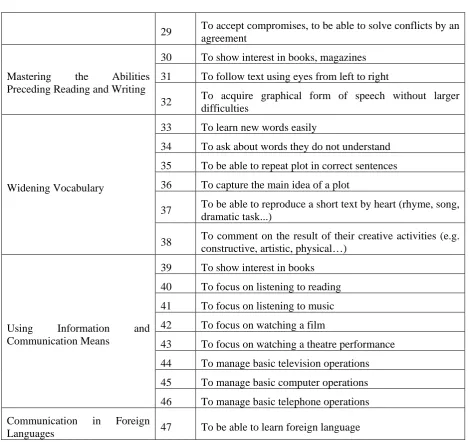
In the conception of the planned research we started with the presumption that reaching the aims of primary education is conditioned by the abilities to perceive and listen to the content of educational offer, to understand the communicated and subsequently to reproduce one’s own pieces of knowledge in written or spoken language. The aim of the research was to analyse pupils with mild mental disability in primary education from the perspective of the acquired level in selected areas of communicative competence in comparison with the expected outcomes in selected areas of preschool education. (Table 1) On the basis of obtained results it aims to characterise specific performances of pupils in the area of acquisition of communicative competence and deduce possible risks related to fulfilling educational goals (expected outcomes) in primary education.
Areas of Communicative Competence
Item
No. Selected Partial Capabilities
Controlling Speech, Formulating Thoughts Adequately
1 To name most of the things surrounding them 2 To ask many questions
3 To formulate sentences in a suitable and grammatically correct way
4 To use complex sentences in speech 5 To use simple sets of complex sentences 6 To use all kinds of words
7 To follow a story
8 To tell a story, to describe a real situation 9 To create simple rhymes
10 To follow natural intonation, loudness and pace of the speech
11 To pronounce most phones correctly 12 To articulate clearly
Sharing Feelings and Moods
13 To be emotionally stable
14 To express current emotional expressions naturally
15 To use words expressing aesthetical sense, to express positive aesthetical experiences
Communicating Through Gestures and Words
16 To react to modulating tones of speech (colour, strength and pitch of the voice, stress, intonation)
17 To be able to express mood via facial expressions (smile, crying, anger, sorrow)
18 To understand word wit and humour 19 To use semantic words
20 To understand heard communication
21 To differentiate some graphical symbols, e.g. pictographs 22 To be able to imitate various ways of behaviour
Communication with Children and Adults
23 To use speech to regulate events around them
24 To communicate adequately to the given situation (to know what is appropriate)
25
To apply the habits of social behaviour (to greet, to say please, to thank, to listen to information, to follow instructions…)
26 To improve regulatory function of speech 27 To comment on their experiences, activities 28 To speak autonomously on a given topic
29 To accept compromises, to be able to solve conflicts by an agreement
Mastering the Abilities Preceding Reading and Writing
30 To show interest in books, magazines 31 To follow text using eyes from left to right
32 To acquire graphical form of speech without larger difficulties
Widening Vocabulary
33 To learn new words easily
34 To ask about words they do not understand 35 To be able to repeat plot in correct sentences 36 To capture the main idea of a plot
37 To be able to reproduce a short text by heart (rhyme, song, dramatic task...)
38 To comment on the result of their creative activities (e.g. constructive, artistic, physical…)
Using Information and Communication Means
39 To show interest in books 40 To focus on listening to reading 41 To focus on listening to music 42 To focus on watching a film
43 To focus on watching a theatre performance 44 To manage basic television operations 45 To manage basic computer operations 46 To manage basic telephone operations Communication in Foreign
Languages 47 To be able to learn foreign language
Table 1: The Overview of the Areas of Communicative Competences and Assessed Partial Capabilities
3. THE REALISATION OF THE RESEARCH
The research was of quantitative character with the use of the method of asking questions, which was realised by the application of research means of observation record sheets. By using the record sheets of observation we investigated the indicators of the reached level of selected partial capabilities of communicative competence in pupils with mild mental disability based on long-term observation. Through a simple sheet filled in by a pupil we assessed the level of selected language and communicative capabilities of the individual pupil. Teachers quantified the level of their judgement by determining it on a numerical scale using given instructions (see the example):
Never Rather No Rather Yes Always
Speaks Autonomously
0 1 2 3
Instructions:
• If you think that the pupil always speaks autonomously, circle 3. • If you think that the pupil never speaks autonomously, circle 0. • Based on how often they speak autonomously, circle either 1 or 2. • If you were wrong, cross out the answer and circle the correct one.
The primary task of collecting empirical data in relationship to the respondents and fulfilling the research was to address as many respondents as possible so that the validity of the answers to the questions in the observation record sheets.
The research project was carried out at primary schools educating pupils with mild mental disability. We addressed teachers taking part in the education of pupils with mild mental disability in primary education from the whole Czech Republic. The actual collecting of empirical data for quantitative research depends on the participation of the teachers involved in the research related to their willingness to carry out orientational assessment of selected partial capabilities of pupils.
The basic set of the research was formed by pupils with mild mental disability in primary education. The selected set of the research was formed by pupils with mild mental disability fulfilling the following criteria:
• they are pupils of primary education (with no respect to the form of special education ); • their mother tongue is Czech language;
• the teachers are in contact with them for at least one school year;
• in pupils it is possible to orientationally assess, based on long-term observation, the acquired level in selected partial capabilities of communicative competence.
Altogether 249 schools in the Czech Republic were addressed. The research was supported by 119 schools, among which schools from all Czech regions participated. Finally, 414 respondents took part in the research by fillling in 1114 questionnaires.
During the research altogether 1114 pupils were assessed in partial capabilities of communicative competence. Out of these 0,7 % (8) were 6-year-old, 5,3 % (59) 7-year-old, 9,7 % (108) 8-year-old, 17,6 % (196) 9-year-old, 17,2 % (191) 10-year-old, 24,7 % (275) 11-year-old, 24,8 % (277) 12-year-old pupils. (Graph 1)
The way of analysis of the collected data
The evaluation of empirical research was done by statistic method via procedures of basic descriptive statistics. The aim was to graphically and numerically summarize the results and to describe the situation in the research area. The higher levels of analysis were used in specific cases of verifying stated research hypotheses. For verifying the hypotheses we used chi-square goodness of fit test. The determind p-value of test criterion was compared with the level of importance 0,05.
8
59
108
196 191
275 277
0 100 200 300
6 7 8 9 10 11 12
Number of Pupils
A
g
e
C
h
ro
n
o
lo
g
ic
ally
Assessed Pupils - Age Criterion
Average level of selected partial capabilities in all pupils was determined by arithmetic mean (quotient of the sum of all points in the scale by the number of pupils).
Acquired level of pupils in defined areas of communicative competence was determined via score calculated for each pupil by adding the points on the scale in n chosen partial capabilities (in relation to the observed area). By calculating the frequencies in all pupils the following levels were determined:
0 to n points low level
n + 1 to 2n points medium level 2n + 1 to 3n points high level
4. THE EVALUATION OF THE RESEARCH
The results of the research show the level of partial capabilities of communicative competence in pupils with mild mental disability. They confirm uneven differentiation of partial brain functions and also their limited level.
By the analysis of the results of the research we found out that:
A) In primary education pupils with mild mental disability do not reach high level in comparison to the expected outcomes of preschool education in any of the observed areas; B) In primary education pupils with mild mental disability reach medium level in comparison
to the expected outcomes of preschool education in selected areas: • Controlling speech, appropriate formulation of thoughts
• Communicating feelings and moods
• Communication through gestures and words (expected low level was not confirmed) • Communication with children and adults (expected low level was not confirmed)
• Managing abilities preceding reading and writing (expected low level was not confirmed) • Widening vocabulary
• Using information and communication means (expected low level was not confirmed);
C) In primary education pupils with mild mental disability reach low level in comparison to the expected outcomes of preschool education in the area:
• Preconditions for communication in foreign languages.
Possible Risks Related to Fulfilling Educational Goals in Primary Education
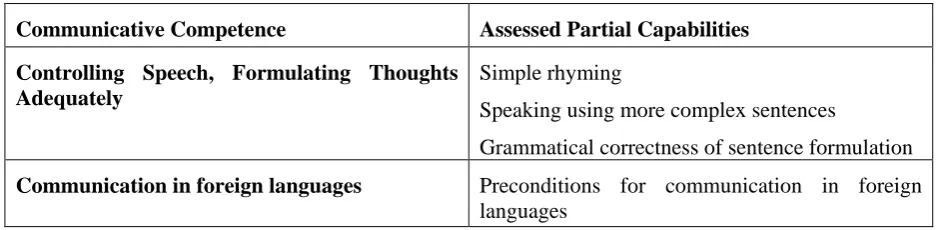
We assume that from the perspective of reaching educational goals of primary education the most risky capabilities are those that pupils do not have or rather do not have differentiated1 during primary education. (Table 2)
1
These partial capabilities reach level not or they significantly tend to level rather not
Communicative Competence Assessed Partial Capabilities Controlling Speech, Formulating Thoughts
Adequately
Simple rhyming
Speaking using more complex sentences
Grammatical correctness of sentence formulation Communication in foreign languages Preconditions for communication in foreign
languages
Table 2: Capabilities that Pupils Do Not Have or Rather Do Not Have Differentiated
In the remaining selected areas of communicative competence (to share feelings and moods, to communicate through gestures and words, to communicate with children and adults, to manage the abilities preceding reading and writing, to widen vocabulary, to use information and communication means) the research did not confirm high risks in any of the assessed partial capabilities.
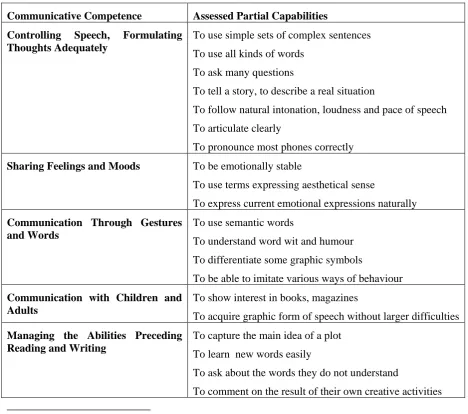
On the basis of the analysis of the results we further assume that from the perspective of reaching educational goals of primary education, medium risky are such capabilities that pupils in primary education more often have differentiated2. (Table 3)
Communicative Competence Assessed Partial Capabilities Controlling Speech, Formulating
Thoughts Adequately
To use simple sets of complex sentences To use all kinds of words
To ask many questions
To tell a story, to describe a real situation
To follow natural intonation, loudness and pace of speech To articulate clearly
To pronounce most phones correctly Sharing Feelings and Moods To be emotionally stable
To use terms expressing aesthetical sense
To express current emotional expressions naturally Communication Through Gestures
and Words
To use semantic words
To understand word wit and humour To differentiate some graphic symbols
To be able to imitate various ways of behaviour Communication with Children and
Adults
To show interest in books, magazines
To acquire graphic form of speech without larger difficulties Managing the Abilities Preceding
Reading and Writing
To capture the main idea of a plot To learn new words easily
To ask about the words they do not understand
To comment on the result of their own creative activities
2
These partial capabilities do not reach but significantly tend to the level rather yes
To reproduce a short text by heart
Widening Vocabulary To show interest in books, magazines
To acquire graphic form of speech without larger difficulties Using Information and
Communication Means
To show interest in books To focus on listening to reading
Table 3: Capabilities that the pupils have rather differentiated
We assume that from the perspective of fulfilling educational goals of primary education the least risky capabilities are those that pupils during primary education have differentiated3. (Table 4)
Communicative Competence Assessed Partial Capabilities Controlling Speech, Formulating Thoughts
Adequately
Simple rhyming
Speaking using more complex sentences
Grammatical correctness of sentence formulation Communication in foreign languages Preconditions for communication in foreign
languages
Table 4: Capabilities that the pupils have differentiated
5. SPECIAL PEDAGOGICAL RECOMMENDATION FOR THEORY AND PRACTISE The realised research confirms the presumptions that in the course of primary education pupils with mild mental disability do not have anchored partial capabilities in selected areas of communicative competence in comparison with the expected outcomes of preschool education. We assume that this finding predicts the decrease in school success and it threatens fulfilling of already modified educational goals (reaching expected outcomes) not only in primary education.
For the pupils with mild mental disability during the 1st period (1st to 3rd year) it is necessary to create a system of Supportive measures for the development of communicative competence in order to: • reduce negative impact of partial capabilities, which are not or are rather not differentiated (high
risks)
• reduce or eliminate negative impact of partial capabilities, which are rather differentiated (medium risks)
• anchor and automatize those partial capabilities that are differentiated (low risks)
Suggestion of Supportive Measures for the Development of Communicative Competence: Update general characteristics of the area of education Language and Language competence: • In the goals of the area of education:
o to stress pragmatic goal of education towards communication and practical preparation of pupils for everyday communication with people in various communication situations through language and other language means.
3
These partial capabilities reach the levels rather yes or they significantly tend to the level “yes”
• In the content of the subject matter:
o to stress the development of auditory differentiation of speech, listening with understanding and reading with understanding.
• To widen the area of education Language and Language Communication by a new (or supplementing) field of study Dramatic Education in order to support the development of communicative competence.
In the education of communication as well as during the therapy of symptomatic speech disorders in children with mental disability it is necessary to carefully take care of the requirements for language communication (expressive component) being in accordance with the level of language competence (receptive component). If the requirements for the language communication (in spoken or written form) are inadequate, the process of acquisition of communicative competence may be deformed. The primary task of the support of the development of communicative competence in pupils with mild mental disability is the stimulation of the development of internal language capabilities (language competence) and the support of formulation of thoughts. Secondly, we develop the formal aspect of speech, i.e. the articulation of phones or their graphical form.
REFERENCES
BENDOVÁ, P., ZIKL P. DÍTĚ S MENTÁLNÍM POSTIŽENÍM VE ŠKOLE. VYD. 1. PRAHA: GRADA, 2011, 140 S. ISBN 978-80-247-3854-3.
GAVORA, P. UČITEL A ŽÁCI V KOMUNIKACI. BRNO: PAIDO, 2005. ISBN 80-7315-104-9. HARČARÍKOVÁ, T. A KOL. PEDAGOGIKA DETÍ S PORUCHAMI UČENIA, SPRÁVANIA A AUTIZMOM RANÉHO A PREDŠKOLSKÉHO VEKU. BRATISLAVA: PDF UK, 2013. ISBN 978-80-89238-89-7.
HENDL, J. PŘEHLED STATISTICKÝCH METOD ZPRACOVÁNÍ DAT. ANALÝZA A METAANALÝZA DAT. PRAHA: PORTÁL, 2006. ISBN 80-7367-1234-9.
CHRÁSKA, M. METODY PEDAGOGICKÉHO VÝZKUMU. ZÁKLADY KVANTITATIVNÍHO VÝZKUMU. PRAHA, GRADA, 2007. ISBN 978-80-247-1369-4.
JANOUŠEK, J. VERBÁLNÍ KOMUNIKACE A LIDSKÁ PSYCHIKA. PRAHA: GRADA, 2007. ISBN 978-80-247-1594-0
KALEJA, M. DETERMINANTY HODNOTOVÝCH KONSTRUKTŮ VE VZDĚLÁVÁNÍ ROMSKÝCH ŽÁKŮ ZÁKLADNÍCH ŠKOL. OSTRAVA: PDF OU, 2013. ISBN 978-80-7464-233-3.
KALEJA, M. ROMOVÉ A ŠKOLA VERSUS RODIČE A ŽÁCI. OSTRAVA: PDF, 2011. ISBN 978-80-7368-943-8.
LEBEER, J. (ED.) A KOL. PROGRAMY PRO ROZVOJ MYŠLENÍ DĚTÍ S ODCHYLKAMI VÝVOJE. PRAHA: PORTÁL, 2006. ISBN 80-7367-103-4.
LECHTA, V. SYMPTOMATICKÉ PORUCHY ŘEČI U DĚTÍ. [ZE SLOVENSKÉHO ORIGINÁLU PŘELOŽILA J. KŘÍŽOVÁ]. PRAHA: PORTÁL, 2008. ISBN 978-80-7367-433-5.
PALENČÁROVÁ, J., ŠEBESTA, K. AKTIVNÍ NASLOUCHÁNÍ PŘI VYUČOVÁNÍ: ROZVÍJENÍ KOMUNIKAČNÍCH DOVEDNOSTÍ NA 1. STUPNI ZŠ. VYD. 1. PRAHA: PORTÁL, 2006, 102 S. ISBN 80- 7367-101-8.
PŘINOSILOVÁ, D. DIAGNOSTIKA VE SPECIÁLNÍ PEDAGOGICE. TEXTY K DISTANČNÍMU VZDĚLÁVÁNÍ. BRNO: PAIDO, 2007. ISBN 978-80-7315-157-7.
ŘÍČAN, P., KREJČÍŘOVÁ, D. A KOL. DĚTSKÁ KLINICKÁ PSYCHOLOGIE. PRAHA: GRADA 1997. ISBN 80-7169- 512-2.