Multi-Agent Systems’ Asset for Smart Grid
Applications
Gregor Rohbogner1, Ulf J.J. Hahnel1, Pascal Benoit1,and Simon Fey1,2
1
Fraunhofer Institute for Solar Energy Systems ISE, Division Electrical Energy Systems, Heidenhofstraße 2
79110 Freiburg, Germany
{Gregor.Rohbogner, Ulf.Hahnel, Pascal.Benoit}@ise.fraunhofer.de
2 Offenburg University of Applied Sciences, Badstraße 24
77652 Offenburg, Germany [email protected]
Abstract. Multi-agent systems are a subject of continuously increasing interest in applied technical sciences. Smart grids are one evolving field of application. Numerous smart grid projects with various interpretations of multi-agent systems as new control concept arose in the last decade. Although several theoretical definitions of the term ‘agent’ exist, there is a lack of practical understanding that might be improved by clearly distinguishing the agent technologies from other state-of-the-art control technologies. In this paper we clarify the differences between controllers, optimizers, learning systems, and agents. Further, we review most recent smart grid projects, and contrast their interpretations with our understanding of agents and multi-agent systems. We point out that multi-agent systems applied in the smart grid can add value when they are understood as fully distributed networks of control entities embedded in dynamic grid environments; able to operate in a cooperative manner and to automatically (re-)configure themselves.
Keywords: computer science, information systems, multi-agent systems, smart grid, power systems, agent-based control systems
1.
Introduction
fluctuating power generation, higher dynamics in grid frequency and grid voltage) which arise from the expansion of renewable energies (e.g. photovoltaic systems, wind turbines, and combined heat and power systems) and new electrical loads (e.g. heat pumps and electrical vehicles) [8], [38]. Numerous smart grid projects labeled with the term ‘agent’ sprouted up in the last few years, exhibiting various interpretation of when and how to apply the term ‘agent’ [19], [24]. It seems that engineers use the term ‘agent’ without a common understanding of what it actually embodies.
In the present paper, we aim at providing a clear definition of multi-agent systems in the realm of smart grid distributed control applications1. We do so by first identifying the characteristics that a control system should posses to be appropriately labeled as an agent system by emphasizing the differences between agents, optimizers, closed-loop controls, and learning systems. Second, we systematically analyze the interpretations and implementations of multi-agent systems in recent smart grid projects. We then contrast our understanding of agents and agent systems with the existing multi-agent based smart grid projects and discuss which systems can be really understood as such. Finally, we describe the extent to which agent technologies may be of further value in improving smart grid applications, and give directions for future research and practice in the realm of agent-based systems.
2.
Smart Grid – Definition and Applications
In accordance with the goals defined by the European Union, central Europe is striving for an energy supply powered by renewable energies [7]. With a rising share of distributed fluctuating renewable energy resources, it will become more and more challenging to ensure a secure and reliable energy supply in the future. This is due to:
Firstly, weather dependent fluctuation of the power supply of renewable energies (e.g. wind turbines or photovoltaic systems) makes the indispensable balancing of power generation and consumption more challenging.
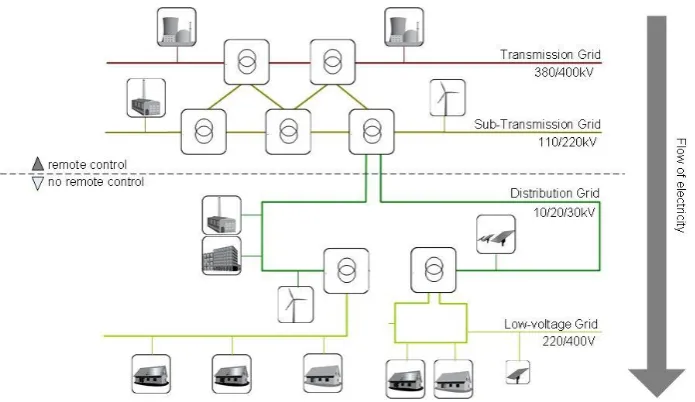
Secondly, the generated renewable electricity is fed mainly into distribution and low-voltage grids. In the past, energy was only consumed in these grids while it was produced by large fossil power plants connected to the transmission and sub-transmission grids (see Fig. 1). Thus, the recent primary grid infrastructure (e.g. local transformers, circuit breakers, lines) is designed and parameterized for these unidirectional flows. In combination with the rising electricity generation in distribution grids, problems (e.g. over-voltage and over-currents) are to be assumed.
1
Thirdly, the rising amount of distributed energy generation affects the grid frequency today already. Since the frequency is a grid-wide value, it is also necessary to ensure that the controllers of distributed energy resources are parameterized properly to ensure a stable grid. European standardization committees are currently addressing the 50.2 Hz problem, which occurs with a common switching threshold of 50.2 Hz in current inverters. This parameterization involves the danger of a major disturbance in the main grid when suddenly several gigawatt of generation disconnect in case of an underload (frequency above 50.2 Hz) and cause thereby an overload [17].
Fourthly, new applications and business models such as consumption of self-produced energy, electric vehicles, or the bundling of distributed generation to virtual power plants, will change the current static time-invariant behavior of grids to a more dynamic one.
Fig. 1. Structure of today’s (centralized) electricity supply system
injection of renewable and fluctuating energy (e.g. by wind turbines and photovoltaic systems). The complexity of smart grids’ applications arises from their interdisciplinary character, requiring the joint work of various research disciplines: electrical engineering, control theory, information technology, jurisprudence, economics and psychology. In this paper we focus mainly on control issues while briefly describing necessary interdisciplinary background.
Numerous different smart grid control systems have been developed to find cost-efficient solutions and to approach the above-mentioned problems. One of the most popular concepts to encourage users or systems to consume power when it is produced by the fluctuating energy resources is known as Demand Side Management (DMS). Mainly based on dynamic pricing, DMS encounters users or devices to redistribute electric demand over a certain period of time [36]. Another example for a smart grid control concept is the pooling of distributed generation and loads that are collectively controlled by a central control entity. These systems are known as virtual power plants [31], [41]. Furthermore, various projects can be found which take the control of so-called ‘micro-grids’ into consideration. Here, micro-grids are understood as small, local distribution grids containing electric generation and loads, which can be totally separated from, or (re-)connected to, the main distribution grid [30]. Among these examples numerous other smart grid control concepts have been developed. [12] gives a broad overview about recent smart grid projects in Europe.
3.
State-of-the-Art versus Agent Technology
In this section we discuss and define an agent from an engineer's perspective. Agents are first defined in an independent application way and then discussed in the context of smart grid applications in section 5. While [9], [14], and [44] discuss the difference between agent technology and various IT domains (e.g. artificial intelligence, web-services and expert systems and grid computing) we analyzed the differences between well established engineering control technologies and agent technology. This section begins with computer science’s definition of agents. Based on that, we differentiate in detail between an optimizer, a closed-loop controller, learning systems, and an agent.
“Reactivity Intelligent agents are able to perceive their environment, and respond in a timely fashion to changes that occur in it in order to satisfy their design objectives.
Proactiveness Intelligent agents are able to exhibit goal-directed behavior by taking the initiative in order to satisfy their design objectives.
Social ability Intelligent agents are capable of interacting with other agents (and possibly humans) in order to satisfy their design objectives.”
It seems that these attributes are to some extent also manifested in engineers’ state-of-the-art control technologies. To a certain degree this assumption is valid. For the sake of clarity, we work out how an agent can be distinguished from other control technologies, and why that makes sense.
In the rest of the paper we use the term ‘agent’ instead of ‘intelligent agent’. We do so because we believe that labeling a software artifact as ‘agent’ only offers added value if agents at least constitute a certain degree of intelligence, thus exhibiting the above listed attributes. Hence, the adjective ‘intelligent’ is dispensable.
3.1. Why Is an Agent More Than Just an Optimizer?
The classic mathematical definition describes optimization as the task of finding a
f
F
for which)
(
)
(
f
c
x
c
for allx
F
(1)while
F
c
:
ℝThereby
f
is the global optimum from the domain of feasible alternativescould be said that optimizers are to some extent goal-oriented and therefore proactively. Even if they try to find the best solution out of many, they are not acting proactive in terms of taking the initiative. Normally, optimizers do not automatically adapt their objective function when the system’s behavior changes. Thus, the program will fail to reach its goal (i.e. finding a valid optimum). But proactive self-configuration, as we shall see in section 5, is essential for smart grid control systems.
Furthermore, optimizers are neither programmed to converse with a human, nor with other computer programs, hence they exhibit no social behavior.
3.2. Why Is an Agent More Than Just a Digital Closed-Loop Control?
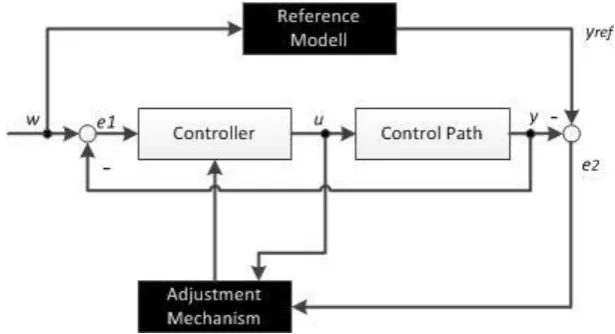
Regarding the core definition of closed-loop controllers, it seems they are fairly similar to an agent. Indeed, closed-loop controllers exhibit a reactive behavior through their feedback loop. Figure 2. depicts the basic structure of a closed-loop control. The control variable
y
is measured and compared with the defined set point valuew
. Errore
is fed to the controller, which then calculates actuating variableu
as reaction to the control path’s changes. Although conventional closed-loop controllers react to small changes in their control path (environment), they are not able to handle changes beyond the assumed system behavior of the path or an unpredicted situation. This is because closed-loop controller parameters (e.g. the integral part of a PID-controller) are tailored for the specific control path. When designing conventional controllers, it is assumed that control path behavior is time-invariant, completely known, and mathematically describable. However, conventional closed-loop controller robustness fails when the control path exhibits a time-variant dynamic.Fig. 2. Basic structure of a conventional closed-loop control
calculates the difference
e
2 between the reference model’s behavior and thecontrol path. Based on
e
2andu
, the adjustment mechanism calculates new control parameters [40].Fig. 3. Basic structure of a Model Reference Adaptive Control (MRAC)
Thus, adaptive controllers recognize environmental changes and react proactively in the sense that they adapt their initial parameters. Nevertheless, the controller is a “functional system” rather than a goal-oriented system aware of alternative ways to reach its goal. This can be illustrated with a simple logistic system:
Imagine a transport unit responsible for transporting a product from one work station to another, which has two alternative tracks available. Equipped with an adaptive control, the transport unit might be able to deliver the product in time, even when there are small obstacles on the track. But the adaptive control is not capable of choosing an alternative path through the production hall, should the track be blocked by other transport units. That is because the adaptive control is not aware of itself, what it actually performs, or the environment in which it operates. It processes the task of ensuring a stable steady state purely. In regard to the example, the controller does not know that it is operating in a production hall which features different corridors to arrive at a destination workstation. For similar reasons, the Model Predictive Control (MPC) can not be understood as proactive. MPCs predict the control path’s behavior by using a reference model, but they are not capable of adapting their model to time-variant environments, nor do they have knowledge of themselves and the surrounding environment.
they can not interact with other devices in the sense of cooperation or negotiation. This is of prime importance when several distributed controllers influence the same control path, such as in an electricity distribution grid.
3.3. Why Is an Agent More Than Solely a Learning System?
Learning systems are computer programs that use machine learning techniques. Learning as such, is described as a task which “[…] denotes changes in the system that are adaptive in the sense that they enable the system to do the same task or tasks […] more efficiently and more effectively the next time” [37]. Learning systems exhibit neither reactiveness nor proactiviness. This is because, in contrast to controllers or agents, they are not designed to control a system. First and foremost they are software artifacts which facilitate other computer programs or control systems adjustment in response to environmental changes, or the discovery of new patterns in measured data. To do so, they maintain an interaction with their environment, but only in the sense of; a) measuring data (passive unsupervised learning) or; b) experience with the environment while measuring the resulting effects (active unsupervised learning). Furthermore, learning systems have no real social ability. If social ability is exhibited, they are part of distributed problem solving systems which are commonly implemented as multi-agent system.
3.4. Functionalities of Agents
We pointed out that none of the analyzed technologies incorporate all attributes of an agent as described by Jennings and Wooldridge [16]: Reactiveness, proactiveness, and social ability. However, the functionalities of the above described technologies are joined together within an agent. Thus, an agent should not be conceived as synonym for the above mentioned state-of-the-art control technologies. Instead, the term ‘agent’ expresses a specific software artifact that joins together functionalities of optimizers, controllers, and learning systems.
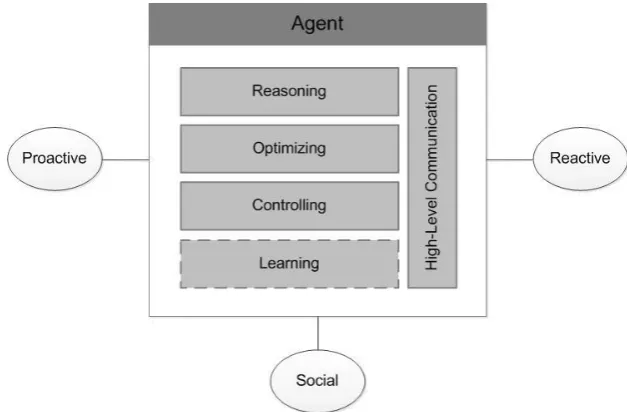
reaching their individual goals. Figure 4 depicts the five functionalities that a holistic agent should exhibit and which impart the attributes of autonomous agents as defined by Wooldridge and Jennings: reactiveness, proactiveness, and social ability. Since the extent of the functionality “Learning” can vary from one application to the other and is in some application even undesirable we marked “Learning” in Figure 4 with a dashed frame as an optional functionality for agents. The five functionalities are described in detail in turn.
Fig. 4. Functionalities of an agent: reasoning, optimizing, controlling, and high-level communication as well as learning as optional functionality (marked with a dashed frame) imparting the mentioned attributes reactiveness, proactiveness and social ability.
Reasoning
to be solved. After finding a set of possible alternatives, which can also stem from cooperation with other agents, the agents need to make the decision of which task or action they want to perform to reach their goals.
Optimization
Usually, agents make this decision by some sort of performance measurement. [44] describes the idea of associating “utilities with states of the environments”. Utility is a numeric value which shows how “good” an agent’s envisaged task/alternative is. Thus, the agent tries to find one alternative out of the set of explored alternatives that promises the highest utility. This does not imply that agents always act on basis of a single utility function to reach their goals. Sometimes they act on zero or multiple coexisting utility functions. This is illustrated in the above example: through reasoning you figured out that you have three alternative transportation options that will get you to your meeting: by car, by tricycle, or by foot. Thus, you can reach your goal either by choosing the cheapest (by foot) or the most comfortable alternative (the car). But if you have no preference it is irrelevant which vessel (task/alternative) you choose unless you reach your goal “arriving at the meeting place”. This is similar to agents. Agents can either realize the optimal task or choose a task randomly. Expressing this example in a mathematical form, the parallels between optimizers and “decision making”, as it is usually entitled by agent scientists becomes apparent (cf. section 3.1):
)
(
)
(
v
1u
v
2u
for allv
V
(2)while
V
u
:
ℝand
2 , 1
v
= vehicle one/two,V
= Pool of alternative vehicles,u
= Cost of transportLearning
not a mandatory functionality for an agent but it constitutes – when implemented – an essential distinguishing feature of an agent compared with controllers or optimizers.
Controlling
After determining which tasks should be realized, agents give commands (set points) to their technical system for which they are responsible (considering the car as technical system in our example, a command could be “start the motor and drive at a certain velocity”). Furthermore, agents need to check if the command is performed correctly and, if not, to take corrective actions. This is what loop controls do, roughly. As mentioned before, closed-loops try to arrange a given set point by reacting based on the control variable’s feedback.
High-level Communication
The most distinctive attribute of agents compared to other technical control systems is really an agent’s social ability. Social ability does not only include the interaction with humans as done with expert systems [44], it also encompasses the freedom to interact with any valuable communication partner, be it a human, superior entity (e.g. server, market), or other agents. This freedom to automatically and flexibly establish communication at run-time makes a high-level communication interface and language necessary. Such a language is specified by the Foundation for Intelligent Physical Agents (FIPA). Within the FIPA-Specification a high-level communication language is formalized and specified. FIPA-Agents Communication Language (ACL) comprises generic messages classes, so called performatives. These performatives express the type or class of a message without specifying the content and the content language (e.g. the performative “request” is used by agents asking other agents to submit any information) [10]. Thus, agents can establish communication with any kind of content at run-time and are not limited to communication interfaces defined at design time (e.g. web-services) [14], [33]. As described in section 5, this functionality will likely bring valuable advantages and it is indispensable when agents are part of a multi-agent based control systems.
4.
“Multi-Agent Systems” in Recent Smart Grid Projects
to describe the diverse systems (and their differing interpretations of agent systems) instead of using the term ‘agent’. Subsequently, in section 5, we discuss under which circumstances CEs and control systems can be understood as multi-agent control systems.
The majority of previous multi-agent labeled systems consist of distributed CEs, which are responsible for trading energy on local electricity markets (LEM) by sending bids. In distributed CEs scenarios, CEs calculate energy sales or energy purchase prices based on their individual cost functions. The cost functions for CEs are composed of the specific power device’s (e.g. combined heat and power plant, photovoltaic system, or simply a dwelling with different loads) cost function for which the CE is responsible. After calculating the cost-minimal operation of the power equipment, the CEs send bids to their dedicated LEMs. The LEMs subsequently match the CEs’ energy offers and demands and send the auctions outcome. CEs can either act as sellers or buyers at the local energy market [4], [5], [18], [21], [23], [34], [42].
The general structure of these systems is depicted in Figure 5. In addition to the descripted basic market-oriented structure (continuous lines) a further upper trading level is visualized in the figure (dashed lines). In this level, LEMs can trade energy at an upper electricity market (EM). However, they only do so if they were not able to locally match all supplies and demands of the CEs. Such a cascading system can be found in [18] and [43]. With few exceptions, such as [22], these market-oriented systems usually are non-predictive systems. Thus, they only calculate energy for the next time intervals that range between 500 milliseconds [42], [43] and several minutes [22], and do not calculate a cost optimal schedule (e.g. for the next 24 hours). In most all market-oriented systems labeled as MAS, control entities are only connected to their dedicated local energy market. Hence, these MAS are not programmed to search or adapt their strategies to other local or global markets. Furthermore, current market-oriented multi-agent systems are mainly programmed for one dedicated market type. For example, the above-mentioned systems can handle only bids within an auction based, active power market. However, an agent should be capable of handling all types of markets (e.g. active, reactive, and spinning reserve markets) and all offered products (e.g. spot deals or forward transactions).
Grid-oriented systems constitute the second important application field of multi-agent based distributed control systems in the smart grid. These control systems are primarily responsible for ensuring a grid operation in a normal state, which implies an operation within the standardized voltage, power, and frequency limitations of the grid. For example, [21] extends the market-oriented approach of [43] with a local frequency measurement and adjustment. [32] developed a voltage control system implementing a central CE that optimizes reactive power injection of distributed energy systems (DES). Therefore, the CEs are responsible for the DESs only receiving a set point from the central CE.
parameters in case of grid topology changes were developed. Grid topology2 changes can arise either by an activation of circuit breakers and (e.g. to increment or decrement the voltage level), or from connection, or disconnection, from the main grid:
a) of either single Distributed Energy Resources (DER) at any instant or
b) of entire grid sections, due to an occurring fault like a short circuit. [30]
Local Electricity Market
Control Entity Control Entity Control Entity Electricity Market
Local Electricity Market
Local Electricity Market
Local offers to buy/ for sale
Offers to buy/ for sale on a possible next hierarchic
Fig. 5. Common structure of systems labeled as MAS applying an auction based active power spot market.
While the activation of circuit breakers, and the connection and disconnection of DERs, require “solely” the reconfiguration of distributed control entities, the control of separated grid sections is particularly challenging. These so called micro-grids require several non-trivial tasks like fault detection and localization, coordination of the islanded grid section’s voltage, and frequency control as well as synchronization when reconnecting to the main grid [30]. [26] and [29] developed distributed control systems, responsible for reliable operation in the normal grid state as well as for automatic and secure transition from the normal grid state, to the island state
2
and back. Switches and distributed energy systems (e.g. photovoltaic system, electricity storages, loads, etc.) equipped with interconnected CEs are capable of communicating in a many-to-many manner, and thus may coordinate the grid in every state without passing information via a dedicated central control entity.
5.
Agents’ Assets and Suitable Application Fields
Comparing the distinction of agents developed in this paper (Section 3) and recent smart grid projects labeled as multi-agent systems (Section 4), we claim that most projects implemented control systems exhibiting some, but not all, agent functionalities in a stricter sense. Although these multi-agent control systems have proved to be very effective, some smart grid applications do not necessitate multi-agent systems as a control system. In the following, we discuss where the usage of (the notion of) multi-agent systems and the application of holistic agents might be valuable assets in the smart grid. We structured this section according to the main smart grid domains: oriented and economic-oriented approaches. While grid-oriented approaches control DERs in a way that reliable grid operation is ensured (e.g. distributed voltage control via reactive power injection), the economic-oriented approaches control DERs grid independently (e.g. virtual power plants).
5.1. Economic-oriented Control Systems
As mentioned above and posed by Jennings and Bussmann, multi-agent systems should demonstrate CEs which have the capability “to initiate (and respond to) interactions that were not foreseen at design time” [15]. Although, the investigated market-oriented systems (in section 4, paragraph 2) constitute decentralized and negotiating CEs, the systems cannot be deemed agent systems in a stricter sense (cf. section 3). This is because:
First, the negotiation of CEs in market-oriented MAS is mainly limited to only one negotiation partner, the local electricity market. Second, the investigated market-oriented MASs demonstrate CEs which are dedicated to only one market type (e.g. real time markets or active energy spot markets) and they are not capable of automatically initiating contracts (for example) on other market types (e.g. forward-markets and reactive energy (spot) markets) or to conclude a direct, bilateral, over-the-counter contract. Both seem to contradict the agent definition and somehow also the legal requirement of being able to freely choose any energy supplier3. In contrast, a multi-agent system, in a stricter sense, should allow agents to negotiate energy with any other agent, and thereby enter into any contracts with any
partner, either of a local energy market or a gird neighbor who offers or sells energy bidirectionally over the counter.
Further, CEs in economic-oriented systems labeled as multi-agent system should have the freedom to cooperate and to dynamically form subgroups (“holons”) with other CEs. Applied in the smart grid, this would enable dynamic and automatic composition (and decomposition) of energy communities. These communities would, for example, try to match electricity production and consumption within their community first, before entering negotiations with external agents or other electricity communities. In addition, it is conceivable that agents would form groups with the purpose of acting as a virtual power plant that appears as a whole, such as when trading energy at the operating reserve market [6], [39].
20kV Grid
CHP PV HP PV
Agent Agent Agent Agent
(b) Energy Community (Self-Consumption)
20kV Grid
CHP PV HP PV
Agent Agent Agent Agent
(c) Energy Community (Market-Oriented)
Low-Voltage Grid Low-Voltage Grid
Active Energy Spot Market Agent
Operating Reserve Market Agent 20kV Grid
CHP PV HP PV
Agent Agent Agent Agent
(a) Market-Oriented „MAS“
Low-Voltage Grid
Active Energy Spot Market Agent
5.2. Grid-oriented Multi-Agent Systems
The development of distributed renewable systems obliges network operators to extend their (sub-)transmission control systems to the distribution and low-voltage grids. To preserve operational personal from workload increase, which even today necessitates automation [15], multi-agent systems could be a suitable solution. Industrial manufacturing and industrial process automation already demonstrate that agent-based systems bring sizable advantages when applied as a control system for uncertain, difficult to predict and varying environments. Biological wastewater treatment plants or production systems with repetitive plugging of equipment are the most noteworthy example which Metzger et al. surveyed [25]. These conditions seem – in a weakened form – also present in future electricity distribution grids. The following paragraphs discuss where agent technology in grid-oriented control is of value. Since voltage and frequency control demonstrate the most important and most discussed grid values in smart grid research, we have subdivided this section accordingly. Further, we discuss micro-grid control systems within a separate paragraph, since it is responsible for all values which are important for stable and reliable grid operation.
Voltage Control in Distribution Grids
controllers’ parameters seems inappropriate. Thus, agents which realize automatic configuration may be valuable assets in this scenario. Especially in regions with a high percentage of overhead lines (as in the United States) automatic troubleshooting of electricity grid is of paramount interest.
Grid Frequency Control
The gradual substitution of conventional power plants with distributed renewable energy systems compulsorily increase the influence of distributed systems on the frequency. To ensure a stable and reliable grid in the future frequency control need to be coordinated among those millions of distributed systems, since large frequency changes can lead to an unstable power system.
In today’s central European electricity grid (ENTSO–E4
grid), the transmission grid operators are responsible for the frequency control. The frequency control is divided in three control levels which differ in their time of activation: a) primary control (frequency-response reserve), b) secondary control (spinning reserve), and c) tertiary control (replacement reserve). In case of a frequency deviation, the control levels are activated step-wise, beginning with the primary control, via the secondary control and ending at tertiary control (if the deviation still exists). The primary control reacts within a few seconds (max. 30 seconds) to frequency deviation by automatically adapting the power of some generation units in the electricity grid according to a given static. After one minute, the secondary control replaces the primary control and tries to restore the frequency to the nominal value (in Europe 50 Hz). If it is not possible to restore the frequency with the secondary control after five minutes, tertiary control is manual (e.g. via phone) requested by transmission operators. All forms of operating reserve (frequency-response reserve, spinning reserve and replacement reserve) are traded on the operating reserve market. Currently only larger power plants are allowed to participate on the operating reserve markets.
Assuming that the current operating reserve mechanism remains unchanged, while in the future small distributed generation units are also allowed to trade replacement reserve, agents might be of value when enabling automated participation of distributed energy systems at the operating reserve market. As a control entity for a distributed energy system (e.g. a combined heat and power plant) the agent would autonomously negotiate at the operating reserve market in order to operate its distributed energy system cost-optimally. [21] describes such a multi-agent system which controls the frequency via a market-oriented multi-agent system. A Balancing-Agent, which is responsible for the frequency, offers active energy for consumption when the frequency is about to drop and buys energy - which is left unused - when the frequency rises. Here, the Balancing-Agent appears as a central coordinating unit to which the other agents are
4
dedicated. As mentioned above, it is questionable if a control entity which is slowly connected to the operating reserve market server shall be deemed an agent in strictest sense. The automatic negotiation can also be implemented using web-services. But as described by [14] web-services are not agents. Hence, labeling negotiating control entities as agents would only make sense when they demonstrate proactiviness and social behavior as described in section 3. Consistently, proactiviness and social behavior are only feasible if alternative courses of action exist. It is the control entity which is capable of deciding, for example, to either offer at the operating reserve market or to any other energy market (cf. section 5.1), which would constitute a freedom, on the basis of which a control entity may develop its proactiviness. Furthermore, social behavior only evolves if other control entities and, with that, possibilities of cooperation (e.g. as virtual power plant) exist.
Besides the question of how distributed energy resources can participate passively at the frequency control via a replacement reserve market, it still remains unclear how they can participate actively5, without causing grid destabilization. As mentioned above, recent photovoltaic inverters were configured to disconnect from the grid if the frequency reached the limit of 50.2 Hz. If a large amount of systems would react accordingly, this would cause serious grid problems [17]. Thus, the parameterization of the distributed energy system via cooperating agents – as applied for voltage control – would be conceivable. But other than the voltage, the frequency constitutes a grid-wide value. This would imply the coordination of millions of energy systems, which seems unrealistic mainly due the associated high communication traffic. Assuming that, in the future, only some power units are responsible for the supply of frequency-response and spinning reserve power, a multi-agent system might be an appropriate solution for an automatic, autonomous, and self-parameterizing control system of the power plants control, as described in [1].
Micro-Grid Control
Micro-grids seem to be the most appropriate smart grid domain for the applications of multi-agent based control systems regarding the recent numerous micro-grid projects [19]. [3] defines micro-grids as small, local distribution systems containing generation and loads that can be separated totally from the distribution grid. Micro-grids constitute, indeed, perfect environments for the application of MAS, for the following reasons: First, other than the main grid, the micro-grid demonstrates a small separate system comprising of a limited number of control entities. That makes the coordination and the assigned communication efforts manageable. Other than in the smart grid parameterization, for example, of the frequency
5
controllers becomes feasible. Second, micro-grids in disconnected mode are fully responsible for the stable and reliable operation of the grid. That encompasses, besides the voltage control, the frequency control and protection issues as well. The indispensable energy balance needs to be ensured, while, caused by disconnection, only a reduced number of devices that can provide reserves exist. Likewise, the micro-grid control system needs to react to regular changes in the grid topology (e.g. disconnection of distributed energy resources or loads). Hence, as described in [30], MAS would be a valuable asset, because other than in a centralized micro-grid control system, no manual adaption of the central control algorithms/models is necessary. Within a MAS automatic adaption of the distributed control parameters takes place if topology changes occur. Numerous multi-agent based micro-grid control systems can be found in literature. [19] and [30] give a broad overview about recent multi-agent based micro-grid controls.
In this section we illustrated that the terms ‘agent’ and ‘multi-agent’ systems applied in the smart grid are of value when automatic, cooperative, and coordinated reconfiguration of distributed devices (e.g. distributed energy systems or grid equipment) is required during runtime. We discussed the application of multi-agent systems for frequency control, voltage, micro-grid control (grid-oriented), and economic-oriented control systems, since they constitute the major smart grid control domains. Further applications, such as the optimal coordination of an electric vehicle fleet or substation monitoring and diagnostic systems, can be considered as further possible applicable fields for multi-agent systems. However, it is recommended to carefully consider if either multi-agent systems or current state-of-the-art control technology should be applied, as the case pops up on a case by case basis. Furthermore, the term ‘agent’ should only be used if the control systems evince the above mentioned abilities: proactivity, reactivity and social behavior, and not only as a synonym for state-of-the-art control technologies.
6.
Conclusion
as agents when they encompass all of the above mentioned functionalities. The assets are: i) automatic reconfiguration in case of time-invariant environment changes (e.g. grid topology changes); ii) automatic initiation of and participation in (economic) interest groups (virtual power plants); and iii) automatic adaption to changing control strategies (e.g. in case of grid islanding). Coordination of thousands of distributed, fluctuating, electricity generators and a robust operation of our electricity grids constitutes an enormous future control challenge. This dynamic, distributed, and widespread environment seems to be perfectly suited for the application of agent-based control systems.
References
1. Bevrani, H. (ed.): Agent-based robust frequency regulation. In: Robust Power System Frequency Control, pp. 1–17. Power Electronics and Power Systems, Springer US (2009)
2. Bratman, M.E.: What is intention? pp. 15–32. The MIT Press, Cambridge, MA (1990)
3. Chicco, G., Mancarella, P.: Distributed multi-generation: a comprehensive view. Renewable and Sustainable Energy Reviews 13, 535–551 (2009)
4. Chung, I.Y., Yoo, C.H., Oh, S.J.: Distributed intelligent microgrid control using multi-agent systems. Engineering 5 (2013)
5. Dimeas, A., Hatziargyriou, N.: Operation of a multiagent system for microgrid control. IEEE Transactions on Power Systems 20(3), 1447–1455 (2005)
6. Dimeas, A., Hatziargyriou, N.: Agent based control of virtual power plants. In: Intelligent Systems Applications to Power Systems, 2007. ISAP 2007. International Conference on. pp. 1–6 (2007)
7. European Parliament: EU Directive 2009/28/EG. Official Journal of the European Union (2009)
8. European Technology Platform Smart Grids: Smartgrids strategic deployment document for europe's electricity networks of the future (2010)
9. Foster, I.T., Jennings, N.R., Kesselman, C.: Brain meets brawn: Why grid and agents need each other. In: Autonomous Agents & Multiagent Systems/International Conference on Autonomous Agents. pp. 8–15 (2004) 10. Foundation for Intelligent Physical Agents: FIPA ACL Message Structure
Specification., http://www.fipa.org/repository/aclspecs.html, available at http://www.fipa.org/repository/aclspecs.html. Accessed on 23th February 2013 11. Franklin, S., Graesser, A.: Is it an agent, or just a program?: A taxonomy for
autonomous agents. In: Müller, J.P., Wooldridge, M., Jennings, N.R. (eds.) Intelligent Agents III Agent Theories, Architectures, and Languages, Lecture Notes in Computer Science, vol. 1193, pp. 21–35. Springer Berlin Heidelberg (1997)
12. Giordano, V., Gangale, F., Fulli, G.: Smart grid projects in europe: lessons learned and current developments (2011)
14. Huhns, M.N.: Agents as web services. IEEE Internet Computing 6, 93–95 (2002) 15. Jennings, N., Bussmann, S.: Agent-based control systems. IEEE control systems
23(3), 61–74 (2003)
16. Jennings, N., Wooldridge, M.: Agent Technology: Foundations, Applications, and Markets. Springer-Verlag, Berlin (1998)
17. Kaestle, G., Vrana, T.K.: Das 50,2 hz-problem im kontext verbesserter netzanschlussbedingungen. In: Internationaler ETG-Kongress 2011 (ETG-FB 130) (2011)
18. Kamphuis, R., Roossien, B., Bliek, F., et al.: Architectural design and first results evaluation of the powermatching city field test. In: 4th International Conference on Integration of Renewable and Distributed Energy Resources. EPRI (2010) 19. Kulasekera, A.L., Gopura, R.A.R.C., Hemapala, K.T.M.U., et al.: A review on
multi-agent systems in microgrid applications. In: Innovative Smart Grid Technologies - India (ISGT India). pp. 173–177 (2011)
20. Landau, I.D., Lozano, R., M'Saad, M., et al.: Adaptive Control Algorithms, Analysis and Applications. Springer Verlag London Limited (2011)
21. Linnenberg, T., Wior, I., Schreiber, S., et al.: A market-based multi-agent-system for decentralized power and grid control. In: Emerging Technologies & Factory Automation (ETFA), 2011 IEEE 16th Conference on (2011)
22. Logenthiran, T., Srinivasa, D., Khambadkone, A.M.: Multi-agent system for energy resource scheduling of integrated microgrids in a distributed system. Electric Power Systems Research 81(1), 138–148 (January 2011)
23. Logenthiran, T., Srinivasan, D., Khambadkone, A., et al.: Multiagent system for real-time operation of a microgrid in real-time digital simulator. Smart Grid, IEEE Transactions on 3(2), 925 –933 (2012)
24. McArthur, S.D.J., Davidson, E.M., Catterson, V., et al.: Multi-Agent Systems for Power Engineering Applications – Part I: Concepts, Approaches, and Technical Challenges (2007)
25. Metzger, M., Polakow, G.: A survey on applications of agent technology in industrial process control. Industrial Informatics, IEEE Transactions on 7(4), 570 –581 (2011)
26. Nguyen, C., Flueck, A.: Agent based restoration with distributed energy storage support in smart grids. IEEE Transactions on Smart Grid 3(2), 1029 –1038 (2012)
27. Papadimitriou, C.H., Steiglitz, K.: Combinatorial Optimization Algorithms and Complexity. Dover Publications Inc. (2000)
28. Parunak, H.V.D., Sauter, J., Fleischer, M.: The rappid project: Symbiosis between industrial requirements and mas research. Autonomous Agents and Multi-Agent Systems 2, 11–140 (1999)
29. Pipattanasomporn, M., Feroze, H., Rahman, S.: Multi-agent systems in a distributed smart grid: Design and implementation. In: Power Systems Conference and Exposition, 2009. PSCE '09. IEEE/PES. pp. 1–8 (2009)
30. Planas, E., de Muro, A.G., Andreu, J., et al.: General aspects, hierarchical controls and droop methods in microgrids: A review. Renewable and Sustainable Energy Reviews 17(0), 147 – 159 (2013)
31. Pudjianto, D., Ramsay, C., Strbac, G.: Virtual power plant and system integration of distributed energy resources. Renewable Power Generation, IET 1(1), 10–16 (2007)
33. Rohbogner, G., Fey, S., Hahnel, U.J., et al.: What the term agent stands for in the smart grid. definition of agents and mulitagent systems from an engineer's perspective. In: Computer Science and Information Systems (FedCSIS), 2012 Federated Conference (2012)
34. Roossien, B.: Field-test upscaling of multi-agent coordination in the electricity grid. In: Electricity Distribution - 20th International Conference and Exhibition on. pp. 1–4 (2009)
35. Russell, S., Norvig, P.: Artificial Intelligence: A modern Approach. Pearson Education Inc. (2010)
36. Samadi, P., Mohsenian-Rad, H., Schober, R., et al.: Advanced demand side management for the future smart grid using mechanism design. Smart Grid, IEEE Transactions on 3(3), 1170–1180 (2012)
37. Simon, H.: Machine Learning: An Artificial Intelligence Approach, chap. Why should machines learn? Morgen Kaufmann (1983)
38. SMB Smart Grid Strategic Group (SG3): IEC smart grid standardization roadmap (2010)
39. Tröschel, M., Appelrath, H.J.: Towards reactive scheduling for large-scale virtual power plants. In: Braubach, L., Hoekand, W., Petta, P., et al. (eds.) Multiagent System Technologies, Lecture Notes in Computer Science, vol. 5774, pp. 141– 152. Springer Berlin Heidelberg (2009)
40. Unbehauen, H.: Regelungstechnik III Identification, Adaption, Optimierung. Springer Vieweg (2011)
41. Vasirani, M., Kota, R., Cavalcante, R.L., et al.: Virtual power plants of wind power generators and electric vehicles. Tech. rep. (2012)
42. Wedde, H., Lehnhoff, S., Handschin, E., et al.: Real-time multi-agent support for decentralized management of electric power. In: Real-Time Systems, 2006. 18th Euromicro Conference on (2006)
43. Wedde, H., Lehnhoff, S., Moritz, K., et al.: Distributed learning strategies for collaborative agents in adaptive decentralized power systems. In: Engineering of Computer Based Systems, 2008. ECBS 2008. 15th Annual IEEE International Conference and Workshop on the. pp. 26 –35 (2008 2008)
44. Wooldridge, M.: An Introduction to MultiAgent Systems. John Wiley & Sons Ltd (2009)
45. Wooldridge, M., Jennings, N.R.: Agent theories, architectures, and languages: A survey. Lecture Notes in Computer Science 890, 1–39 (1995)
Ulf J.J. Hahnel studied psychology at the University of Mainz, Germany and the University of Auckland, New Zealand. Currently, he works in the department of Cognition, Emotion, and Communication at the Institute of Psychology of the Albert-Ludwigs University Freiburg and in the department of Intelligent Energy Systems at the Fraunhofer Institute for Solar Energy Systems (ISE). His research focuses on sustainable consumer behavior, human factors psychology and consumer acceptance of innovative technologies. He published his works in international journals such as Transportation Research Part A and Ergonomics.
Pascal Benoit graduated in electrical and information engineering at Karlsruhe Institute of Technology (KIT) where he specialized in renewable energies and information technologies. During his studies he stayed abroad for several student research projects at Institute of Energy Engineering of the Politécnical University of Valencia, Spain. Since 2010 he is working at Fraunhofer Institute for Solar Energy Systems (ISE) in the department of Smart Grids. There he is active in the field of smart integration of electric vehicles and communication technologies for distributed energy systems. Since 2011 he is working on a PhD thesis focusing on new approaches for control and communication systems of large-scale concentrator photovoltaic (CPV) power plants.
Simon Fey finished his Master Degree in Electrical Engineering / Information Technology at the Offenburg University of Applied Science in 2010. He wrote his diploma thesis at the Fraunhofer Institute for Solar Energy Systems (ISE) on acquisition and storage of measurement data from power plants. Simon Fey is member of the graduate school Small Scale Renewable Energy Systems (KleE) and is currently writing his PhD thesis under the supervision of Prof. Dr. Andreas H. Christ. His thesis is on IT-based communication structures and system architectures for renewable energy systems.